What Are Automation Tools? Types, Uses and Risks for Amazon
What are automation tools? Learn the four categories, how they work, and where they help or hurt Amazon ad and ecommerce performance in 2026.

Automation tools are software that carry out repeatable tasks with limited human input. In an Amazon account, they might adjust bids, route approvals, or prepare reports. Their value depends on setting the right boundaries: routine actions can run automatically, while choices with significant financial impact may need a human approval gate.
A useful way to judge automation is to look beyond speed and ad metrics. This guide examines which tasks software can handle safely, where a person should review the decision, and whether the result improves contribution margin and organic visibility. A lower ACOS alone does not prove that automation is helping the business.
What Automation Tools Are in Plain Terms
A PPC manager at 9 a.m. finds 400 keywords to review, and most don't need strategic thought. Automation tools are software that carries out repeatable tasks with little human input, such as adjusting bids, pulling reports, or routing approvals.
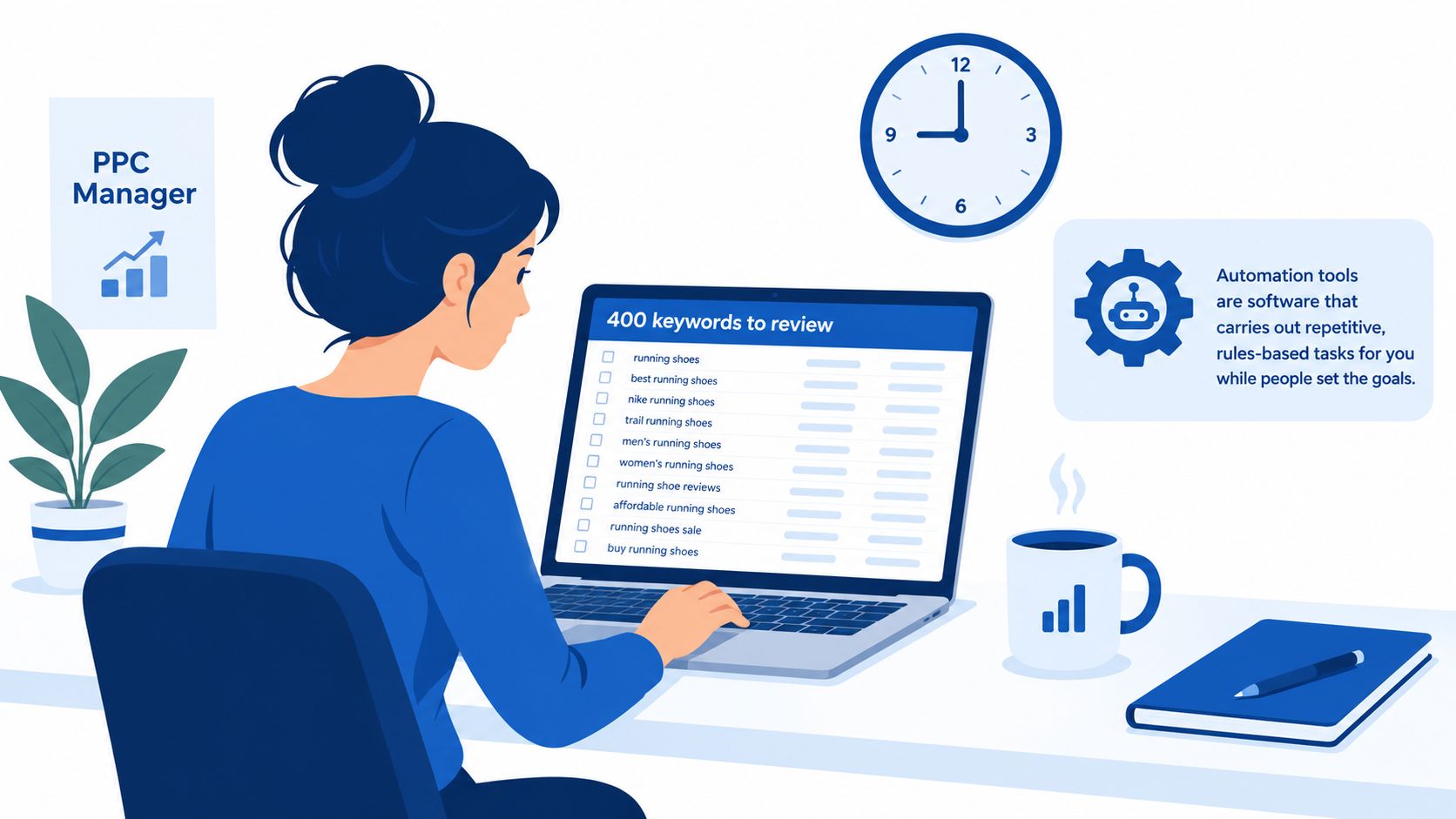
Think of a thermostat. You choose the target temperature; the thermostat checks the room and adjusts the heating. It handles repeated decisions, but it doesn't decide what temperature is right for your home. In an Amazon account, the equivalent might be setting a bid target and letting software make routine adjustments within limits.
The scope goes well beyond physical robots. Modern tools can handle data entry, workflow routing, monitoring, reporting, and decisions based on rules. For example, software can consolidate search-term reports, flag an unusual spend pattern, or apply a budget rule while a marketer decides the campaign's purpose and acceptable economics.
McKinsey's 2017 analysis mapped automation technologies against more than 2,000 work activities across approximately 800 occupations. It estimated that 49% of activities people are paid to perform globally could potentially be automated by adapting technologies demonstrated at the time. Yet fewer than 5% of occupations could be automated completely, while roughly 60% of occupations included at least 30% automatable activities, according to the McKinsey Global Institute analysis.
The business distinction is simple: automation usually takes over tasks, not whole jobs. An if-then rule follows a condition you define. A machine-learning tool estimates outcomes from data, so its behavior may be less predictable and needs closer monitoring. That difference should shape how much approval and oversight you require.
The Four Categories of Automation Tools
| Category | What It Automates | Amazon Example | Human Still Decides | Risk if Rules Are Wrong |
|---|---|---|---|---|
| Workflow | Routing tasks, approvals, and data syncs | Syncing inventory and cost data into a PPC dashboard daily | Which approvals are required and who owns them | Low to medium: stale data reaches decisions |
| Bidding | Bid changes per keyword or impression | Target ROAS bidding on Sponsored Products | Target ROAS, margin floor, and keyword scope | High: spend can scale quickly on weak traffic |
| Reporting | Dashboards, merged reports, and anomaly alerts | Alert when a campaign spends 30% above its daily average | Which anomalies matter and what action follows | Low: errors show up as wrong conclusions |
| Creative | Copy variants, image resizing, and test setup | Generating five headline variants for A/B tests | Positioning, claims, and brand voice | Medium: off-brand or non-compliant copy goes live |
The table separates tools by the work they perform and the decisions that still belong to your team. A single platform may cover several categories, so check what each feature controls before buying.
Bidding and budget tools carry the highest spend risk. Put hard caps around them, and make sure the rules account for profitability rather than treating more impressions or spend as success. Reporting tools are generally a safer starting point because they surface information without automatically changing campaign settings.
There's also a choice between Amazon-native automation and third-party software. Amazon Ads offers built-in budget rules and target ROAS bidding. Third-party tools may add cross-channel reporting, extra bid logic, or data connectors, but they also add cost and another integration that can fail. Ask which layer a tool controls, what data it relies on, and whether it can change bids, budgets, or both.
How an Automation Tool Works Step by Step
A reliable automation loop starts with a human-defined target, much like a thermostat that adjusts toward a temperature a person selected. In advertising, you might set a campaign goal and define the conditions that allow software to act.
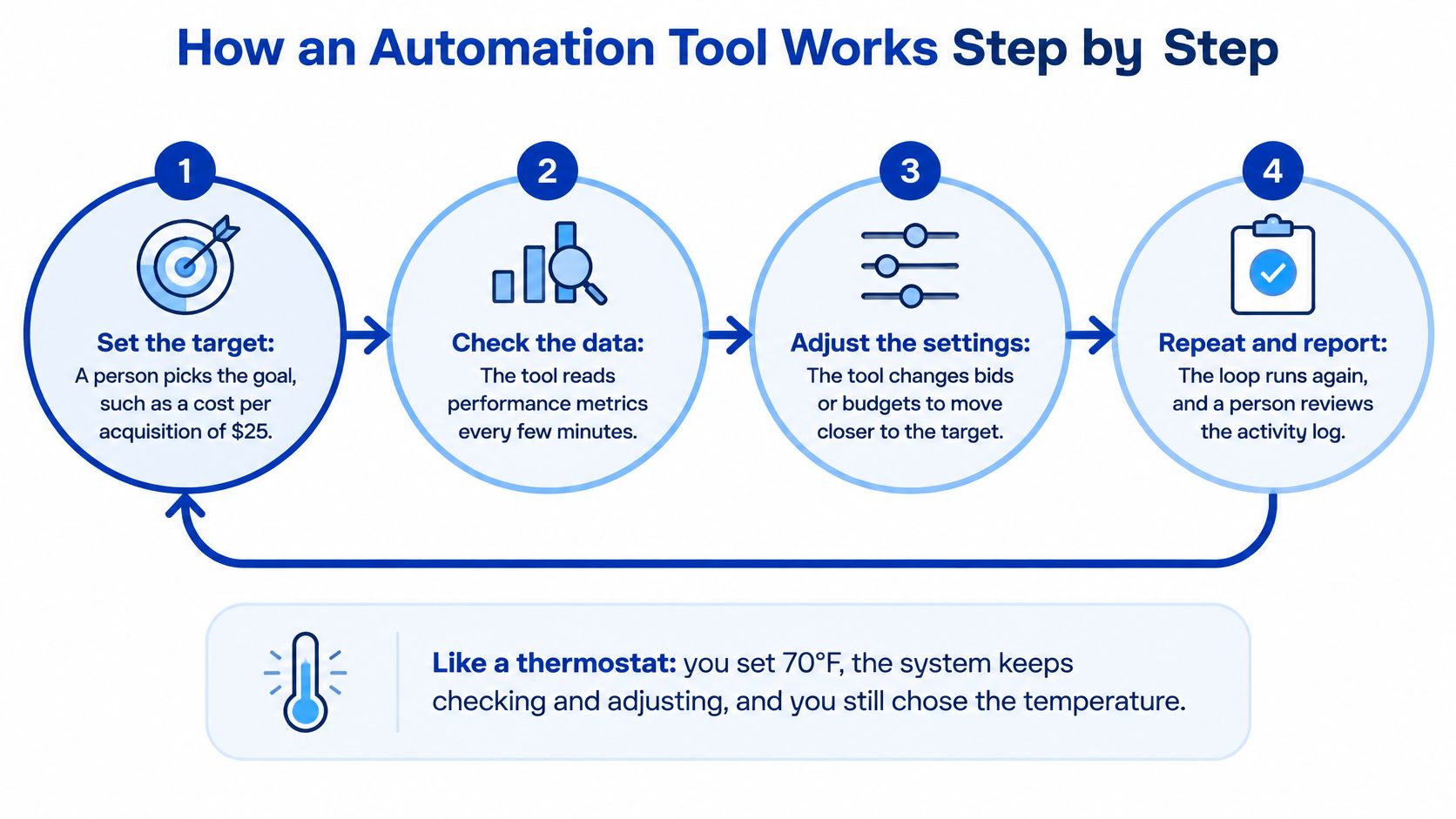
Capture a signal
The tool pulls information from a data feed or API. For a Sponsored Products workflow, that could mean collecting impressions, clicks, orders, spend, and stock status for each target. If stock data is delayed, the tool may make a decision based on a picture of the business that's already out of date.
Evaluate the signal
The software compares incoming data with a rule or a model. A rule might flag a keyword once it reaches a specified click threshold without an order. A machine-learning model may instead estimate how likely an impression is to produce a sale. These approaches don't behave identically, so know whether the action comes from a fixed condition or an estimate.
Act on the result
The tool can lower a bid, pause a target, move a budget, send an alert, or update a report. For instance, a rule might reduce a bid when a target's ACOS exceeds the account's approved margin threshold. The action should stay within limits the operator has set.
Log and monitor
Every change should appear in an audit log. Escalation thresholds and rollback rules let a person step in when results move outside the expected range.
This loop cuts reaction time and reduces inconsistent decisions between team members. But the same rule can run across many targets, so faulty inputs can turn a sensible instruction into a costly mistake. If conversion tracking stops recording orders, a rule designed to pause non-converting targets might pause winners instead.
A sound setup keeps signal collection, decision rules, execution, and monitoring distinct. That makes it easier to find the failing layer when results go wrong. For teams handling large, repetitive campaign edits, Amazon PPC bulk operations can help organize those tasks, but bulk execution still needs clear rules and review.
Where Automation Pays Off and Where It Backfires
Automation can react faster than a weekly review, apply the same rule across many targets, and give analysts more room for strategy. That's useful when campaign volume makes manual checks slow or inconsistent.
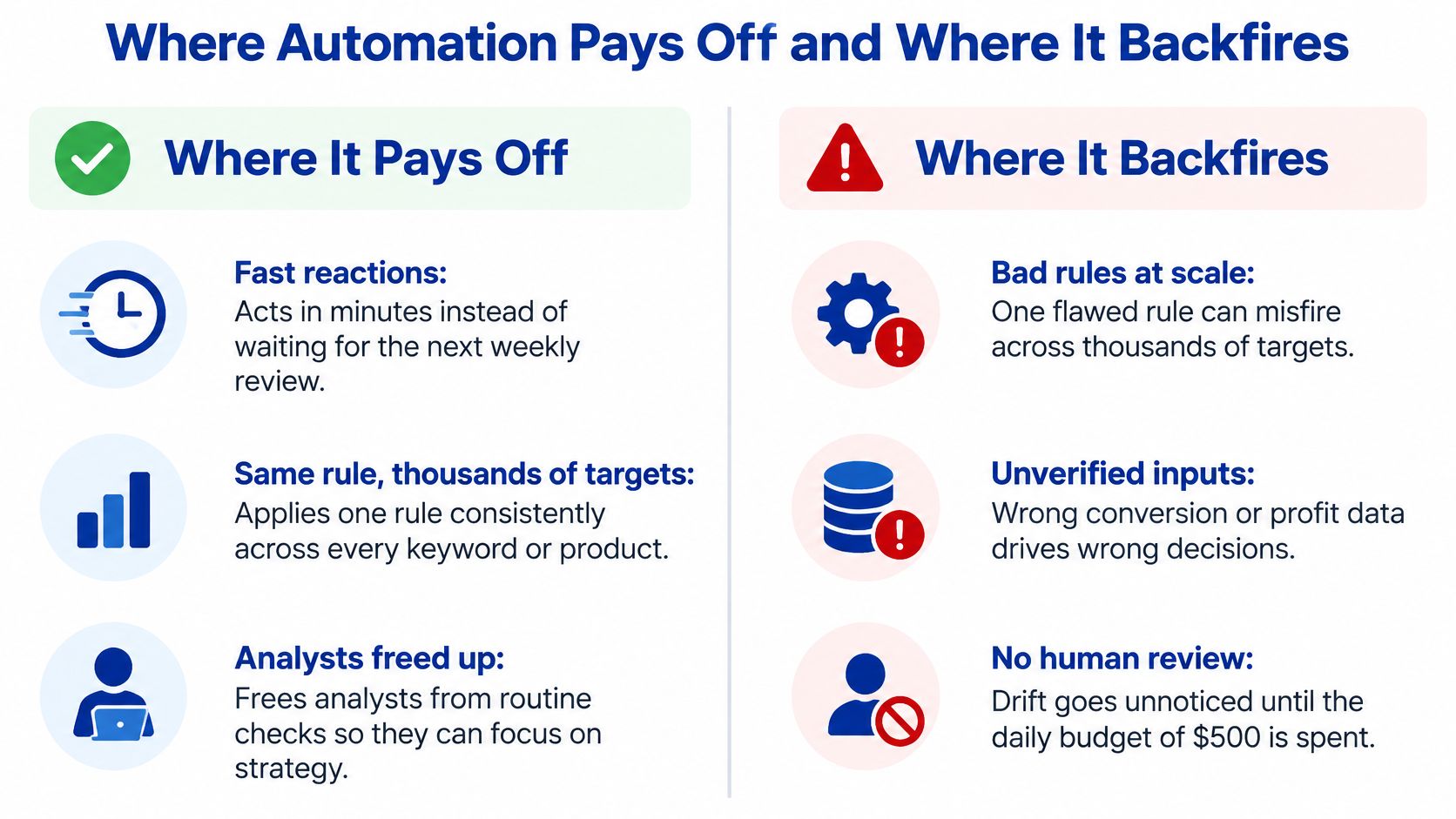
The quiet costs often come from what the software optimizes. A campaign can improve ACOS while contribution margin or organic rank worsens. Duplicated targeting across auto and manual campaigns can leak spend into overlapping traffic. A stock-aware rule can also react to a temporary inventory constraint by lowering bids or pausing a campaign just as inventory returns.
Those aren't just software problems. Data quality, integration complexity, unclear ownership, weak measurement, and missing skills can all undermine the result. When bad rules rely on bad data, automation can scale mistakes faster than a manual process. Validate the inputs and assign a human owner before allowing a tool to change bids or budgets.
Practical rule: Compare a controlled baseline with the automated treatment. Track processing time, error rate, exception rate, decision latency, and contribution margin, not just the number of actions completed or time the tool claims to save.
The scale of the account matters, too. A catalog with only a few campaigns and keywords may gain little if setup, testing, and monitoring take more effort than manual reviews. In that case, start with scheduled reporting or alerts rather than building a complex bid system.
When you're reviewing automated bidding, check the rules against the account's goals and the traffic they affect. Smart bidding campaigns still need human-set targets and guardrails; a tool's ability to act quickly doesn't make its objective commercially sound.
Amazon Advertising Cases That Show What Automation Delivers
A budget rule can release more spend during a planned sales event, while a bidding system can change bids for individual impressions. These controls make Amazon advertising easier to manage at scale, but they still need a business goal and a human decision layer. Use Amazon's guide to budget rules to distinguish schedule-based rules, which change budgets on set dates or events such as Prime Day and Halloween, from performance-based rules, which respond to metrics such as ROAS, click-through rate, or conversion rate.
For example, a schedule-based rule can raise a budget for a planned demand spike. A performance-based rule can allow more spend after a campaign meets a conversion threshold. Before either rule changes budgets, set a limit tied to contribution margin or an acceptable ROAS. More spend is not a win if the added sales do not contribute profit.
Sponsored Products target ROAS bidding evaluates impressions and adjusts bids in an effort to meet the campaign's goal. The exact behavior depends on the campaign settings, so check Amazon's target ROAS bidding details before setting expectations. Keep a human review gate for changes that could materially raise spend, and track search-term mix, conversion rate, and organic visibility alongside paid-attributed revenue.
The Ariat example is an Amazon DSP case, not evidence that automation caused the reported results. Amazon Ads presents the comparison against a control group, but the results are vendor-reported. The case study does not provide enough detail here to judge its methodology or sample size, so treat the figures as directional rather than proof of a repeatable outcome.
| Case | Metric | Reported Result |
|---|---|---|
| Ariat (Amazon DSP) | Click-through rate | +620% vs control |
| Ariat (Amazon DSP) | Effective cost per click | -72% vs control |
| Ariat (Amazon DSP) | Detail-page views | +134% vs control |
| Ariat (Amazon DSP) | ROAS | +60% vs control |
| Ariat (Amazon DSP) | New-to-brand ROAS | +107% vs control |
Those figures, from Amazon Ads' Ariat case study, show why one metric can miss changes elsewhere in the funnel. A lower effective cost per click may be useful, but it does not establish that the campaign improved contribution margin or organic visibility.
The Shirofune and Superfood Lab case study reports a before-and-after comparison over three months: ROAS increased by 1.67%, acquisitions by 64%, and clicks by 20%. These are vendor-reported results, not evidence that automated bidding alone caused the changes. The comparison suggests that reach and acquisitions can rise more than headline return, but its figures should not be treated as a forecast for another account. See Shirofune and Superfood Lab case study.
Judge results across the funnel. Review traffic efficiency, detail-page engagement, new-to-brand outcomes, contribution margin, and organic visibility. Paid clicks can bring qualified shoppers to a retail-ready listing, but they do not guarantee stronger organic rank. Treat case studies as examples to question, then decide which actions can run automatically and which should wait for human approval.
Choose Which Tasks to Automate First
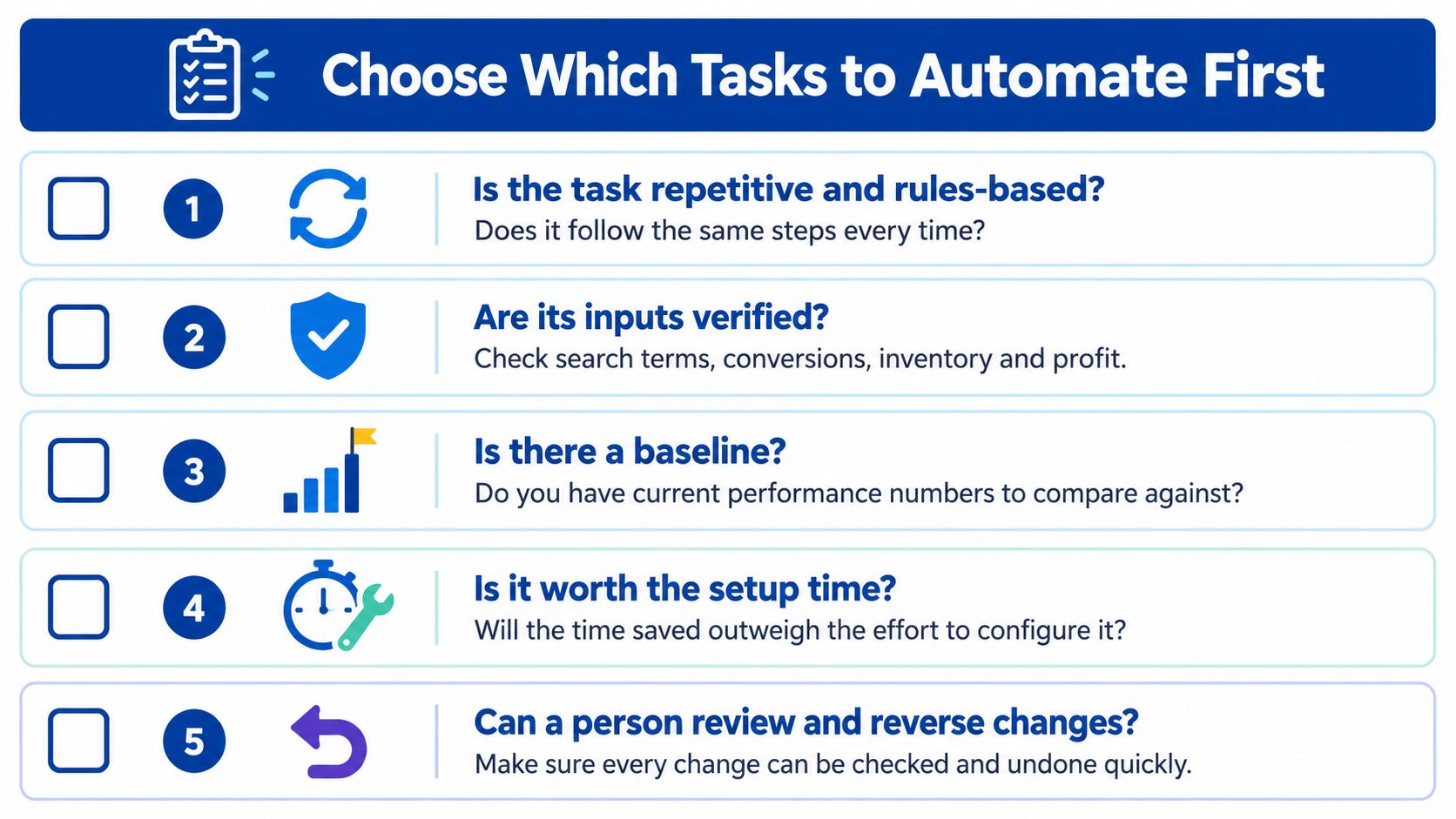
Before enabling a rule, use this checklist. If you can't answer each question clearly, keep the task manual until the gap is addressed.
- Is the task repetitive and rules-based? If the decision changes every time it arises, it may need judgment rather than a fixed rule.
- Are the inputs verified? Check search terms, conversions, inventory, catalog status, and profit data.
- Is there a baseline? You need current performance to tell whether automation helped.
- Is one person accountable? Name the human owner who reviews outcomes and responds to exceptions.
- Could a wrong action cost money within hours? If so, set a cap, an approval gate, and a quick way to reverse the change.
Set approval gates by risk
Deterministic rules can often run unattended for reporting, alerts, and capped bid adjustments, provided the inputs and action limits are sound. Keep human approval for decisions involving pricing, compliance, customer claims, brand safety, or major budget shifts. Those choices can affect more than campaign efficiency, and a software rule can't own the consequences.
Governance needs attention as teams adopt AI-assisted tools. The ISACA survey on AI skills and policy reports that 28% of organizations have a formal, thorough AI policy, 32% provide no AI training, and 22% train all employees. Treat training and ownership as part of implementation, not cleanup after an automation misfires.
A practical pilot can start with reporting and alerts, move to capped bid rules for one campaign group, and then test budget rules tied to contribution margin. At each stage, compare results with a baseline and review incrementality, contribution margin, and organic visibility, not ACOS alone. For help evaluating Amazon PPC software and choosing tools that fit your workflow, see this guide to Amazon PPC software.
If your team lacks the bandwidth to build the data layer and guardrails, work with an Amazon partner to set up a measured pilot before expanding automation across the account.
Headline Marketing Agency manages Amazon PPC and DSP, including automated bid management, with a focus on profitability, organic ranking, and long-term brand equity. Visit Headline Marketing Agency to discuss a campaign pilot with clear data checks, approval gates, and performance measures.
Get Your Free Amazon PPC Audit
Discover untapped growth opportunities and see how our data-driven approach can improve your ROAS.
Get Free Audit →Ready to Transform Your Amazon PPC Performance?
Get a comprehensive audit of your Amazon PPC campaigns and discover untapped growth opportunities.