Smart Bidding Campaigns: Amazon DSP PPC Strategy
Master smart bidding campaigns for Amazon DSP and PPC. Learn automation vs manual bidding, key metrics, and strategies for organic growth and profitability.

More than 80% of Google advertisers use automated bidding, but smart bidding campaigns aren't a shortcut to profitable growth. They work when conversion data is reliable, attribution is configured correctly, and the product detail page can convert the traffic the algorithm buys.
That challenges the most popular advice in paid media: turn on automation, accept the platform's recommendation, and wait for performance to improve. Smart bidding is more useful than that, but also more demanding. It's a force multiplier. If your retail fundamentals are strong, it can help you capture valuable demand and support organic momentum. If your listing, inventory, or measurement is weak, it can accelerate inefficient spending.
For Amazon brands, the question isn't whether to automate. The question is where automation should have authority, which signals it should optimize toward, and how closely it should remain tied to profitability and marketplace growth.
Automation as a Baseline Capability in Modern Advertising
Automation is no longer a specialist experiment or a simple CPC shortcut. Google reports that more than 80% of advertisers use automated bidding in Google Ads. Its Smart Bidding guidance explains how conversion data and contextual signals support optimization toward conversions or conversion value, and recommends evaluating performance over longer windows with at least 30 conversions, or 50 conversions for Target ROAS (Google's Smart Bidding guidance).
That adoption does not make every automated campaign effective. It establishes a competitive baseline. Manual controls still help account managers review search terms, set budgets, and structure campaigns, but they cannot assess every auction with the speed and consistency of a machine-learning system.
Automation amplifies the account you already have
Two brands can launch comparable Sponsored Products campaigns and receive very different results. One has a strong main image, benefit-led copy, accurate variation structure, stable inventory, and conversion tracking that reflects actual sales. The other has weak creative, inconsistent stock, and a product page that earns clicks without closing the sale.
Automation will magnify that gap. The first brand gives the system useful feedback about valuable shoppers and placements. The second creates noisy evidence: the algorithm buys traffic, sees weak conversion, and becomes less certain about where investment belongs.
That distinction matters beyond paid efficiency. Smart bidding can act as a force multiplier for organic ranking when the listing converts, attribution windows capture the buying cycle, and sales data reflects genuine demand. Poor listing quality or incomplete attribution gives the system authority without dependable direction.
Practical rule: Don't ask automation to solve a conversion problem that your product page, offer, or measurement setup created.
Strategy still determines the outcome
Automation changes the account manager's job. Instead of setting every bid manually, the manager defines the objective, validates inputs, sets boundaries, checks attribution windows, and investigates unexpected behavior. The goal is controlled delegation, not passive acceptance of the platform's recommendation.
Resources about native automation for performance marketers can help teams assess where to delegate control and where human review remains necessary. The useful comparison is strategic operator plus machine versus an unmanaged algorithm.
Smart bidding campaigns belong in a modern growth plan, but they should gain authority only after the account demonstrates clean data, consistent conversion behavior, listing quality, and retail readiness. Use automation to accelerate a sound system. Do not use it to conceal a weak one.
How Smart Systems Process Auction Signals
A fixed keyword bid treats an auction as if every shopper has the same value. Smart bidding treats each auction as a separate decision.
Google says its systems can evaluate more than 70 million signal permutations per auction when setting a bid (Google's Smart Bidding guide). The practical advantage isn't raw processing power. It's the ability to combine context, intent, and historical performance before deciding how aggressively to participate.
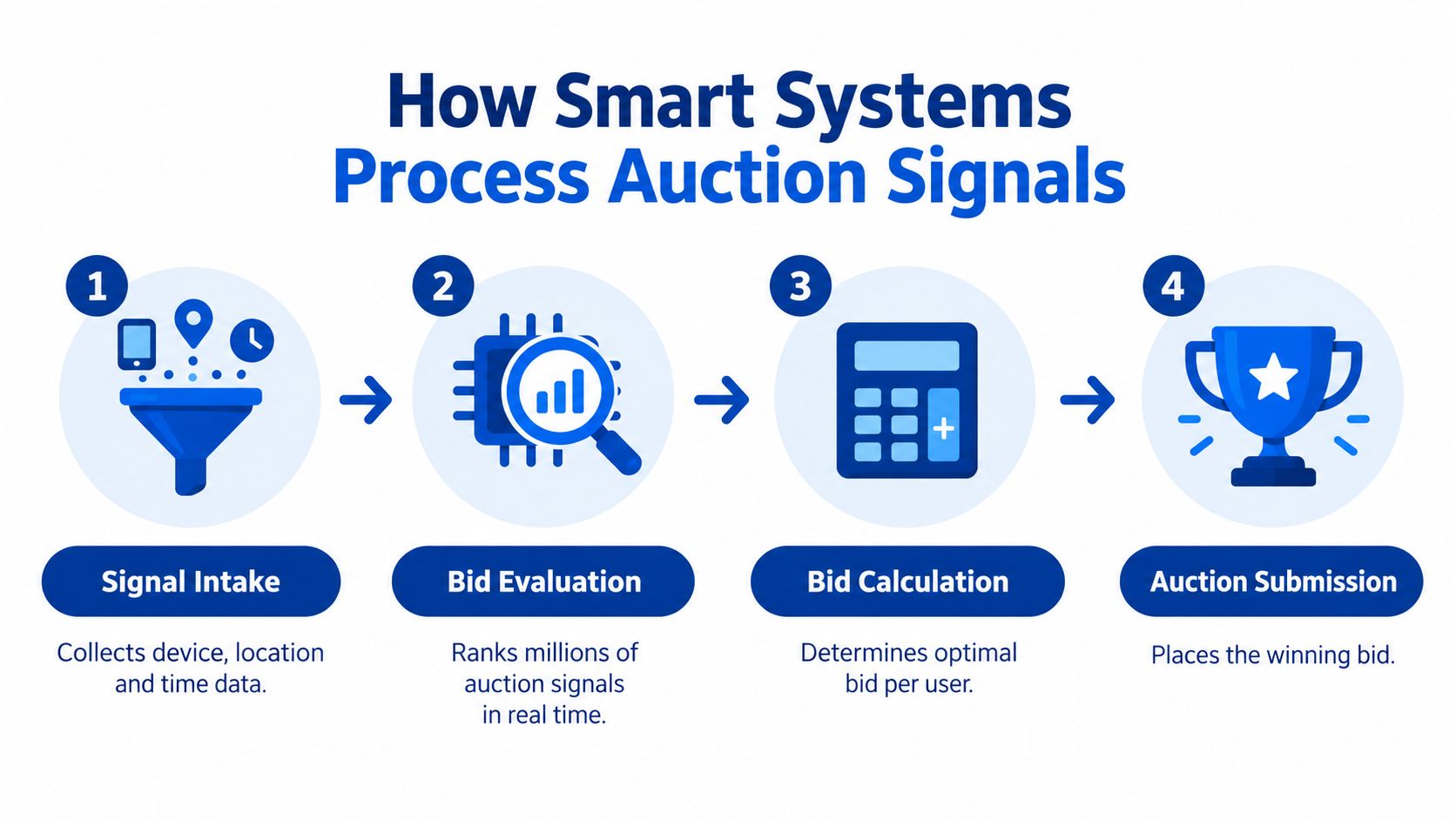
Four stages of an auction-level decision
1. Signal intake. The system gathers available context, such as device, location, timing, audience information, and indicators of user intent. For an Amazon campaign, the equivalent decision environment also includes placement, inventory conditions, product relevance, and the campaign's selected bidding mode.
2. Bid evaluation. The model compares the current auction with patterns from previous outcomes. It isn't asking only whether a keyword has converted. It's estimating whether this shopper, in this context, is likely to produce the outcome the campaign values.
3. Bid calculation. The system translates that prediction into a bid aligned with the selected objective. A conversion-focused campaign may prioritize the probability of an order. A value-focused campaign should distinguish between a low-value conversion and a higher-value sale.
4. Auction submission. The calculated bid enters the auction, subject to campaign settings, budget constraints, placement rules, and platform eligibility. The system then receives the result and uses future conversion feedback to refine later decisions.
This is why smart bidding campaigns shouldn't be judged by CPC alone. A lower click price can look efficient while producing low-value traffic. A higher bid can be sensible when the shopper has stronger purchase intent and the product page is ready to convert.
For a deeper look at how machine learning changes campaign management, see Amazon machine learning and advertising. The key operational point is simple: automation can process context that manual bidding misses, but it can only learn from the quality and completeness of the outcomes you send back.
A short visual explanation can help teams align on the mechanics before changing campaign settings.
Treat the system as a decision engine, not an oracle. If it receives incomplete conversion values, delayed attribution, or inconsistent campaign structures, it will optimize with an incomplete view of commercial value.
Measuring the True Benefits of Automation
The strongest case for automation is not convenience. It's the ability to optimize toward an outcome that manual bid changes can't evaluate consistently at auction level.
Google reports that advertisers moving from Target CPA to Target ROAS can see 14% more conversion value at a similar return on ad spend, on average (Google Ads bidding tools). That result supports a broader shift from manual bidding toward systems that use past bid performance and contextual signals to prioritize likely converters or higher-value transactions.
The commercial implication is meaningful for brands with varied product economics. If every order has roughly the same value, conversion volume may be a reasonable optimization target. If margins, prices, or product roles differ, conversion value gives the system a better objective.
The official promise has a clear limitation
Automation doesn't improve efficiency in every account. Independent research on automated bidding found no overall improvement in average keyword efficiency, while manual bidding performed better for keywords associated with transactions, revenue, and clicks (independent keyword-efficiency research).
The same research found that automated bidding tended to favor keywords associated with lower CPC, lower bounce rate, and ecommerce conversion rate. That pattern matters because cheap traffic isn't automatically valuable traffic. A system can shift spend toward apparently efficient visits while underweighting terms that cost more but contribute more revenue or commercial intent.
The metric you optimize becomes the behavior you get.
That means a target ROAS campaign can still make poor decisions if conversion values are incomplete, product margins aren't reflected, or the attribution window is too short for the business model. A promotion, repeat purchase, or assisted conversion may not appear inside the same reporting window as the initial click.
Build a measurement hierarchy
Review performance in layers rather than asking one metric to explain everything:
- Auction efficiency: CPC, click-through rate, placement performance, and spend distribution.
- Retail conversion: detail-page conversion rate, orders, revenue, and product-level profitability.
- Business impact: new-to-brand behavior, branded demand, repeat value, and organic visibility.
Use brand lift measurement as a complement to direct-response reporting when the campaign is intended to build demand, not just harvest existing demand. The account should be allowed to pursue the business outcome, but only after the team defines what that outcome means and how long it takes to appear.
Smart bidding is valuable when it optimizes toward the right value signal. It is dangerous when it merely finds the cheapest way to satisfy an incomplete one.
Comparing Bidding Modes on Amazon DSP and PPC
Amazon gives Sponsored Products advertisers three core bidding strategies: Dynamic bids, up and down, Dynamic bids, down only, and Fixed bids (Amazon Sponsored Products bidding strategies). These settings aren't cosmetic. They determine how much freedom Amazon has to change your base bid when it estimates that an impression is more or less likely to convert.
| Bidding mode | What Amazon can do | Best strategic use |
|---|---|---|
| Dynamic bids, up and down | Raise or lower bids in real time based on predicted conversion likelihood. Amazon can raise bids by up to 100% in applicable situations. | High-intent campaigns with reliable conversion signals and controlled budgets |
| Dynamic bids, down only | Lower bids when conversion likelihood is weaker, without increasing the original bid. | Efficiency-focused campaigns where downside protection matters |
| Fixed bids | Keep the exact bid, plus manual adjustments, unchanged. | Controlled tests, deliberate coverage, or situations where predictability matters most |
Rule-based bidding adds another layer. Amazon lets advertisers set a performance goal such as ROAS, then adjusts base bids for each impression to pursue that target. The system can increase bids by up to 5x the adjusted bid amount when applicable (Amazon rule-based bidding).
That level of aggression needs governance. Use rule-based bidding as a control system, not a set-and-forget setting. A target can guide the system, but it can't fix an unprofitable product, weak creative, or inaccurate value data.
For campaigns that combine retargeting, prospecting, and full-funnel objectives, Amazon DSP advertising requires the same discipline. Don't judge every inventory type through a Sponsored Products lens. Amazon uses pay-per-click billing for Sponsored Products, Sponsored Brands, and Display, while vCPM applies to certain recognized on-Amazon and off-Amazon traffic (Amazon billing and auction models). CPC and vCPM affect pacing and budget behavior differently, so the bid strategy must match the inventory.
Strategic Alignment for Organic Growth
PPC should do more than generate attributed orders. It should help a brand earn demand, improve discoverability, and build a stronger commercial position on Amazon.
That doesn't mean every paid order creates an automatic organic ranking gain. It means advertising can place a product in front of relevant shoppers, generate qualified engagement, and help the brand compete for demand that would otherwise go to established alternatives. The result depends on relevance, conversion quality, sales velocity, retail readiness, and the product's ability to satisfy the shopper.
Use bids to support the marketplace plan
A brand launching a new product may accept a different level of paid investment than a mature product defending its most valuable search terms. A seasonal promotion may justify temporary bid flexibility, while a low-stock period should trigger restraint even if the platform predicts strong conversion likelihood.
Amazon provides schedule bid rules for Sponsored Products that can raise bids at selected times or days, including around recommended promotional events (Amazon schedule bid rules). Use those rules as overlays on a deliberate campaign structure. Don't inflate base bids across the full day when demand is concentrated in a known window.

Connect paid activity to organic priorities
Build a keyword and product hierarchy that separates:
- Defensive demand, including branded terms and high-converting product targets.
- Growth demand, including relevant non-brand searches where the product can win.
- Discovery demand, where the goal is to learn which audiences and queries show commercial potential.
Then evaluate whether paid traffic is improving the conditions for broader growth. Look at organic placement, branded search behavior, retail conversion, contribution margin, and inventory health alongside ROAS. A campaign that produces efficient attributed revenue but fails to improve the brand's ability to compete may be harvesting demand without building durable equity.
PPC is a lever for organic growth, not a substitute for it. The strongest smart bidding campaigns connect auction decisions to a clear brand objective, a realistic promotional calendar, and a product portfolio that can absorb increased demand profitably.
Listing Quality as a Prerequisite for Success
Bid optimization can't rescue an offer that shoppers don't trust. If the main image is unclear, the title misses the buying language, the benefits are buried, or the detail page doesn't answer objections, automation may deliver more people to a weak conversion path.
Recent commentary on Amazon automation ties bidding outcomes to listing quality, seasonality, user intent, and stock status, while emphasizing that bid management works best when paired with listing optimization (Amazon bidding and listing optimization guidance). That aligns with the account-level reality: the algorithm doesn't operate in isolation from retail conditions.
Fix the conversion path before increasing control
Review the product detail page before expanding Dynamic bids, up and down, or rule-based automation. Check whether the page communicates the product's primary use case quickly, supports the promised benefit with credible content, and makes variation selection straightforward. Review customer questions, ratings, reviews, price positioning, delivery expectations, and promotional mechanics as part of the same diagnosis.
Inventory deserves equal attention. A campaign can appear efficient until the product goes out of stock, loses the Buy Box, or becomes unavailable in a high-value placement. If the system receives inconsistent availability signals, historical performance becomes less useful as a guide to future bids.
Don't turn on aggressive automation to compensate for weak retail readiness. Fix the offer first, then let the system scale what works.
Creative quality also affects the feedback loop. A relevant Sponsored Brands message can attract a different shopper from a product-focused Sponsored Products ad. DSP creative may support consideration rather than an immediate purchase. Put each format against the right role, and don't force every campaign to prove value through the same short attribution window.
Smart bidding campaigns can accelerate a strong catalog's reach. They can also accelerate waste in a weak catalog. The decision to automate should follow a retail-readiness review, not replace one.
Monitoring Signals and Final Recommendations
Automation needs an operating rhythm. Daily checks should focus on abnormal spend, delivery, stock status, placement behavior, and conversion tracking. Weekly reviews should examine whether the campaign is learning toward the intended commercial outcome rather than merely spending within budget.
Use this sequence:
- Validate measurement. Confirm that orders, revenue, conversion values, and attribution windows reflect the business objective.
- Review spend quality. Check search terms, product targets, placements, CPC, and the products receiving budget.
- Inspect retail conditions. Confirm inventory, price, Buy Box status, content quality, and promotional availability.
- Compare value over time. Separate short-window volatility from sustained changes in profitability, organic visibility, and branded demand.
- Adjust one control at a time. Changing bids, budgets, targeting, creative, and listing content together makes the result difficult to interpret.
Don't use a platform recommendation as a substitute for account judgment. Choose Dynamic bids, up and down when the campaign has strong signals and can tolerate more auction flexibility. Choose Dynamic bids, down only when protecting efficiency matters more than aggressive expansion. Use Fixed bids for deliberate control, and use rule-based bidding only when the ROAS target, value data, and margin logic are sound.
The recommendation is decisive: automate the auction, not the strategy. Give smart bidding campaigns clean data, a conversion-ready offer, clear guardrails, and enough time for the selected attribution window to reveal the result.
Headline Marketing Agency helps consumer brands manage Amazon PPC and DSP with automated bid optimization, retail-readiness analysis, and reporting tied to profitability, organic ranking, and long-term brand equity. Visit Headline Marketing Agency to review your bidding structure and build a growth plan that connects paid performance with sustainable marketplace scale.
Get Your Free Amazon PPC Audit
Discover untapped growth opportunities and see how our data-driven approach can improve your ROAS.
Get Free Audit →Ready to Transform Your Amazon PPC Performance?
Get a comprehensive audit of your Amazon PPC campaigns and discover untapped growth opportunities.