10 Ad Creative Testing Tools for Amazon Growth
Compare 10 ad creative testing tools for Amazon, from native experiments to panel research and attention analytics, with practical use cases and trade-offs.

The best creative test isn't automatically the most refined one. A shopper panel measures stated preference. An Amazon-native experiment measures behavior and sales. An attention study examines what people notice before they act. Cross-channel analytics looks for patterns across platforms and formats. Those are different decisions, so treating them as interchangeable creates false confidence.
That distinction matters because PPC creative testing can influence more than click-through rate. Better images, claims, video openings, and audience-message combinations can improve conversion efficiency, protect profitability, strengthen organic ranking signals, and support sustainable Amazon scale. The right tool helps you answer a specific commercial question, not just produce a winner badge.
A/B testing became a core digital marketing discipline after Google ran its first test around 2000 and reportedly conducted more than 7,000 tests in 2011. That history helped establish systematic experimentation as an alternative to choosing creative by intuition, as outlined in this history of A/B testing and message match.
The selection below evaluates each platform by the decision it improves in an Amazon workflow, from pre-screening and listing validation to attention diagnosis, asset governance, and performance connection. The useful questions are simple: Is the evidence behavioral or directional? Is the result fast enough? Can the team implement the learning? Does it improve profitable growth rather than vanity metrics?
1. Amazon Manage Your Experiments
Amazon Manage Your Experiments is the strongest choice when the decision concerns a live detail page. Available to Brand Registered sellers, it supports controlled tests for titles, images, bullets, descriptions, A+ Content, Brand Story, and related listing elements. The evidence comes from real Amazon shoppers, which makes it more commercially relevant than a preference poll when the objective is to improve conversion on an ASIN.
The platform supports randomized comparisons, significance detection, eligibility checks, and content validation. It also provides workflows for Storefront and A+ Content experiments, with guidance around duration and warnings when treatments are too similar to produce a useful comparison. Amazon recommends changing one variable at a time, while keeping other conditions consistent, so teams can connect a result to a specific creative hypothesis through its display advertising testing guidance.
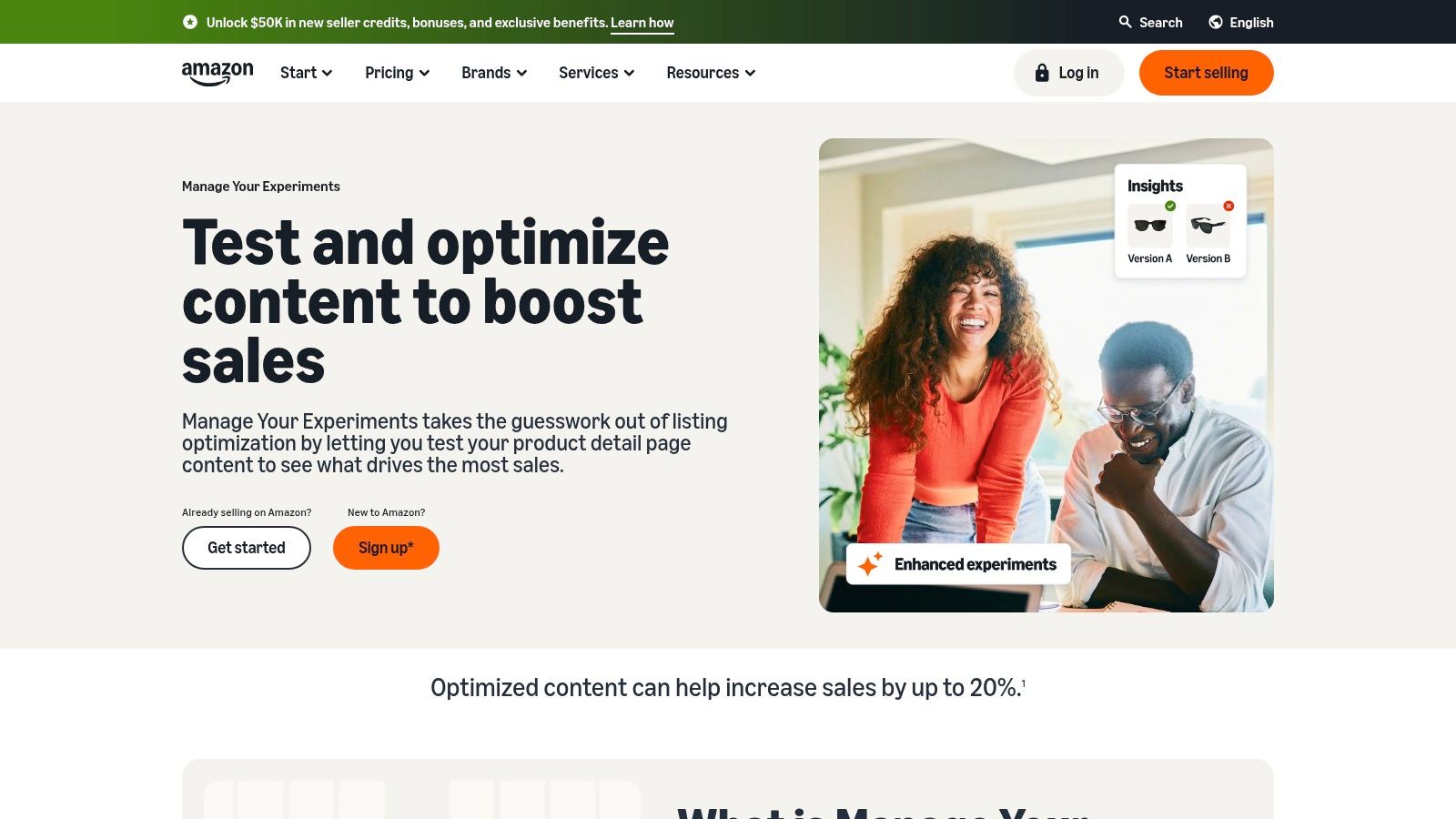
Practical rule: Use MYE to validate the listing promise after a panel or internal review has identified the strongest alternatives.
MYE's limitation is scope. It doesn't natively test price or off-Amazon ads, and low-traffic ASINs may need lengthy test windows before producing a dependable result. Amazon also recommends judging creative against outcomes beyond CTR, including conversion rate, detail page view rate, units per order, new-to-brand share, branded search activity, and repeat behavior over 30 to 60 days, according to its creative learning framework.
For teams building a disciplined process, this Amazon split testing guide is a useful companion. The practical conclusion is clear: MYE should be the final validation layer for listing changes, not the only place a brand develops ideas.
2. PickFu
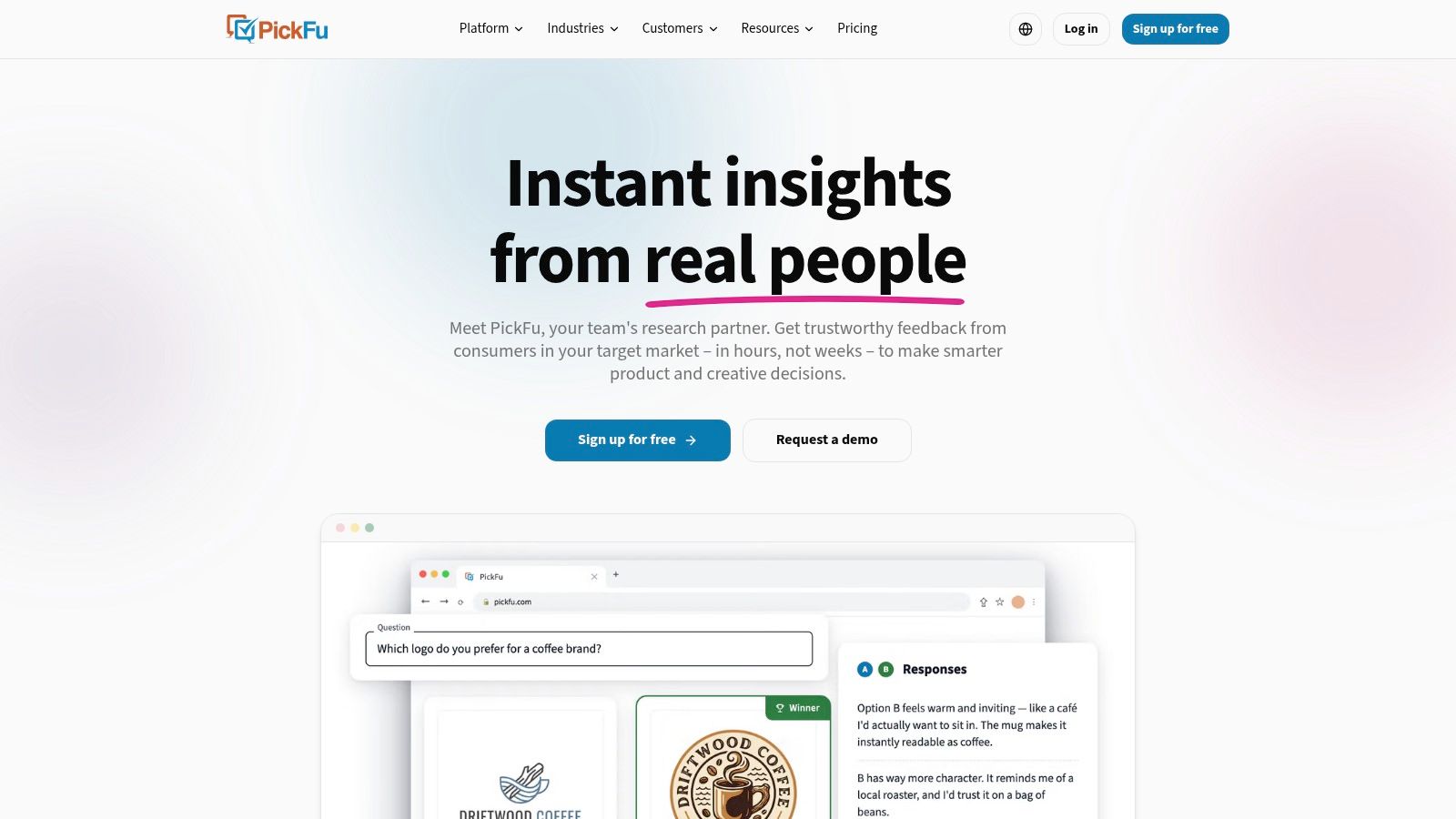
PickFu improves an earlier decision than MYE does: which concepts deserve live-market testing at all. Its panel-based studies can compare images, titles, packaging, pricing cues, and video concepts with targeted US audiences, including segments relevant to Amazon shoppers. Teams can use ranked questions, head-to-head comparisons, and open-ended feedback to understand both preference and the language behind it.
The platform's main advantage is speed and flexibility. A brand can ask whether a product image communicates the benefit clearly, whether a title sounds credible, or which packaging direction feels most appropriate before committing media budget or changing a high-value listing. The qualitative explanations are often more useful than a simple preference percentage because they give the creative team something to revise.
The evidence remains directional. Respondents aren't necessarily shopping in an Amazon auction, seeing competing Sponsored Brands, or deciding whether to buy after reading reviews and viewing a detail page. Narrow targeting and larger samples also increase the cost, so the tool works best as a filter rather than a substitute for in-market validation.
Sample discipline matters. One industry analysis estimates that detecting a 20% performance difference requires about 392 conversions per variant, while detecting a 10% difference requires about 1,568 conversions per variant, as explained in this creative testing sample-size analysis. That makes PickFu especially useful when a brand can't generate enough live conversions quickly to distinguish small effects.
Use this A/B testing methodology guide to define the hypothesis before commissioning a poll. PickFu is a strong pre-screening layer, but its result should tell you what to test next, not what will definitely win in-market.
3. Audience by Helium 10
Audience by Helium 10, powered by PickFu, suits Amazon teams that want preference testing inside an existing research and listing workflow. It brings panel-based tests for images, titles, and messaging into Helium 10, so a seller doesn't need to introduce a separate platform or teach a new interface to every operator.
The decision it improves is operational: can the team make pre-testing routine rather than occasional? Audience supports trait filters and targeted feedback, while the Helium 10 environment makes it easier to move from listing research to a creative question. That single-login experience can lower adoption friction for teams already using Helium 10 for keyword, product, or listing work.
The underlying panel quality follows PickFu, but the embedded version shouldn't be treated as identical to every native PickFu option. Feature parity may be narrower, and pricing details can be less transparent when the service is accessed through Helium 10. Those limitations matter for agencies or large brands that need highly customized research programs.
Audience isn't an Amazon-native causal experiment. It captures what a selected panel says or prefers, not whether a treatment changes detail-page conversion under live traffic. A useful workflow is to use it for early elimination, send the strongest concept to MYE or an Amazon campaign experiment, and record whether the panel rationale matched actual shopper behavior.
For small and mid-sized Amazon teams, convenience can be the deciding factor. A tool that fits the existing workflow may generate more learning than a richer platform that nobody uses consistently, provided the team keeps its hypotheses narrow and doesn't present panel preference as proof of incremental revenue.
4. ProductPinion
ProductPinion is designed around a decision that generic survey tools often miss: which creative is most likely to win attention in an Amazon shopping context? Its Amazon search-result simulations let respondents compare products in a format that resembles search behavior. Teams can test image and title variations, pricing cues, competitor comparisons, and other elements before putting media behind them.
The platform also offers rapid A/B and multivariate polling, video responses, custom audiences, and asset import by ASIN. Those capabilities help agencies and larger catalogs establish a repeatable pre-qualification cadence instead of commissioning an isolated study whenever a major launch approaches.
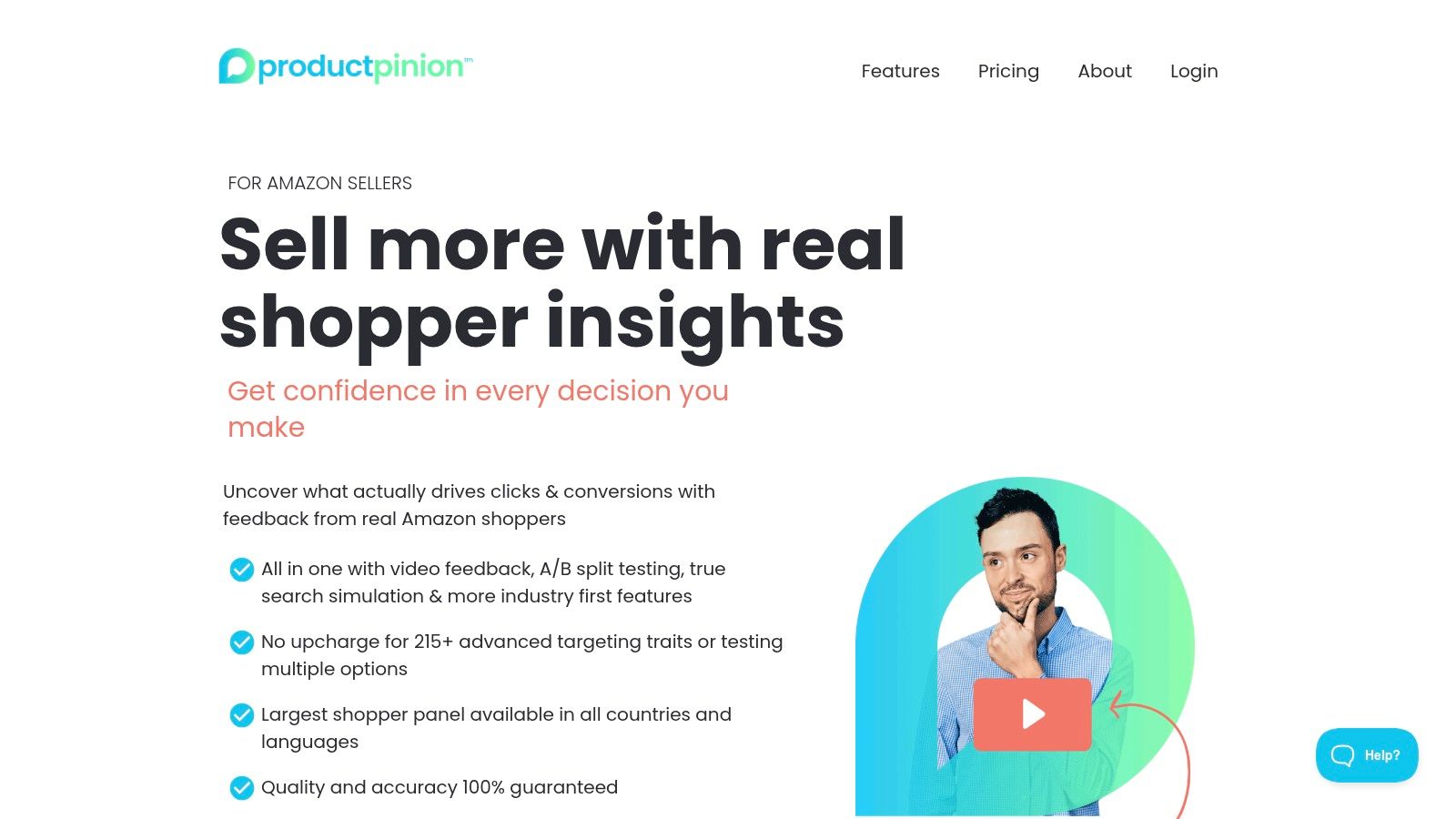
Its visual outputs are valuable because they can translate into concrete hypotheses. If shoppers select one image in a search simulation, the team can form a CTR hypothesis. If respondents choose a product but then explain that the benefit is unclear, the team has a possible CVR or detail-page messaging problem to validate separately.
The limitation is causality. Simulated shopping is closer to Amazon than a general panel, but it still doesn't reproduce auction dynamics, placement, retail readiness, review context, or the full conversion path. Multivariate tests can also create noise when teams don't have enough responses or when several changes obscure the reason for a result.
Higher tiers are needed for larger response volumes or video features. ProductPinion therefore fits brands that need Amazon-specific directional evidence at a regular cadence, especially before a listing refresh or Sponsored Brands creative launch. It shouldn't replace MYE when the business question is whether a live PDP treatment improves sales.
5. VidMob
VidMob addresses the problem that arises after a brand has accumulated too many assets to evaluate manually. It connects creative performance data with AI analysis, identifying attributes associated with outcomes across Amazon DSP, retail media, Meta, YouTube, and TikTok. Its value is not merely finding a winning ad. It helps teams ask which visual, message, format, or production choice should be repeated or removed.
The platform combines attribute-level analysis with creative operations. Insights can inform briefs, new iterations, and production through a creator network, creating a route from performance evidence to the next asset. That matters for brands running video and display at scale, where a weekly winner without a documented reason quickly becomes an isolated anecdote.
A creative library becomes a growth asset only when the team can explain what to make next.
VidMob is enterprise-oriented. Onboarding, integrations, taxonomy design, and internal adoption require more effort than a panel poll or a native listing test. Pricing is custom and typically subscription-based, so the business case depends on asset volume, channel complexity, and the cost of slow learning.
The platform is particularly relevant when Amazon PPC and DSP can't be evaluated in isolation. A product video may generate a useful signal in Sponsored Brands, then need a different opening or pacing strategy in DSP. This guide to video ads for ecommerce reflects the practical challenge: creative analysis has to connect to an explicit commercial outcome, not just a content score.
VidMob is a fit for advanced teams that need cross-channel learning and production governance. It is excessive for a brand testing a handful of static listing images.
6. CreativeX
CreativeX improves a different decision: should this asset be allowed into the media system in the first place? It checks creative against platform requirements and brand rules, then gives teams centralized visibility across live and historical assets. That makes it a governance layer rather than a consumer-panel diagnostic tool.
For multi-brand or multi-market organizations, the benefit is consistency. Teams can review whether an asset meets established quality and readiness standards before spending on it, while dashboards connect creative quality with media efficiency and outcomes. The platform helps reduce the operational waste that occurs when a campaign launches with a non-compliant, poorly formatted, or off-brand execution.
CreativeX doesn't answer every shopper question. It won't replace an Amazon-native experiment for a title or A+ Content change, and it doesn't provide the same type of consumer explanation as PickFu. Its contribution is upstream control, ensuring that the variants entering a test are usable, consistent, and aligned with brand standards.
Implementation is the main cost. Governance requires agreed rules, ownership, asset tagging, and change management across markets. Without those processes, a quality score becomes another dashboard rather than a decision mechanism.
For Amazon advertisers, CreativeX is most useful when creative volume has outgrown informal review. It can protect the baseline before PPC and DSP testing begin, but teams still need behavioral experiments and performance analytics to determine which compliant asset drives profitable conversion and supports stronger organic visibility.
7. Realeyes
Realeyes is built for the attention question: will viewers notice and process the important part of this video? Its PreView testing and attention scoring use AI-based attention and emotion signals to guide edits before or during campaigns. The platform is oriented toward video and digital advertising, making it more relevant to Amazon DSP and OTT activity than to static PDP elements.
The distinction between attention and action is important. A strong attention signal can identify a weak opening, an unclear product demonstration, or a moment where the brand disappears. It doesn't automatically prove that the viewer will click, convert, buy again, or improve an ASIN's organic ranking. Teams should use the result to revise creative, then validate the revised asset against in-market outcomes.
Realeyes has a methodological and industry-validation orientation, with SDK and API options and connections to measurement ecosystems. That makes it suitable for enterprise teams that need attention signals embedded in a wider measurement program rather than a one-off creative opinion.
The limitation is format coverage. Brands seeking to test a main image, title, bullet sequence, or A+ module will need another tool. The engagement is also enterprise-led, and pricing isn't publicly listed, so the implementation effort goes beyond uploading two assets and waiting for a poll.
Realeyes earns its place when video production and media costs are significant enough that identifying attention problems before launch can prevent waste. It should sit before an Amazon DSP performance test, not be presented as the final answer to whether a video is commercially effective.
8. Lumen Research
Lumen Research helps teams understand what people notice in a crowded retail media environment. Its Predictive Attention Engine is trained on eye-tracking data, while its in-context testing examines creative across digital and other formats. The resulting attention diagnostics can inform both the asset and the placement decision.
That combination is useful for Amazon advertisers because a creative can contain the right product benefit yet bury it among pack shots, badges, text, and competing visual elements. Lumen's attention-led approach can show whether the eye reaches the product, the brand, or the proof point before the team invests in a broader media rollout.
Unlike a shopper preference poll, attention measurement doesn't ask respondents to choose a favorite and stop there. Unlike an Amazon experiment, it doesn't observe a purchase decision. The tool therefore improves diagnosis and planning, especially when a brand needs to decide whether the problem is the creative itself or the environment in which the creative appears.
Lumen is research-oriented and often requires specialist support. Pricing and do-it-yourself access are less transparent than survey platforms, and the organization needs a clear plan for converting attention findings into edits and media decisions.
Use Lumen when clutter, video sequencing, or cross-format visibility is the primary risk. For a simple listing-image comparison, its depth may not justify the process. For a large DSP program, attention evidence can help teams avoid confusing low visibility with low consumer demand.
9. Zappi
Zappi is suited to teams that need repeatable pre-testing across a large creative pipeline. Its connected insights platform supports on-demand studies, AI-assisted analysis, benchmarking, and iterative learning from concept through finished ad. The decision it improves is which creative should move forward, and what should change before launch.
The Ask Anything capability supports focused questions without requiring a new research design for every issue. Benchmarking also gives teams a way to compare current work with prior studies and competitive context. That historical layer is important because a result becomes more useful when the organization can recognize recurring patterns rather than treating every ad as a one-off experiment.
Zappi's strength is process consistency. A brand can create a common pre-test framework across formats and markets, then use the outputs to refine concepts before buying media. It doesn't offer the same Amazon search or PDP context as ProductPinion, so teams need to be careful when translating general consumer response into an Amazon-specific forecast.
The platform makes most sense under a subscription model, where recurring usage creates more value than occasional research. Teams also need people who can interpret benchmarks and prevent AI-generated summaries from replacing commercial judgment.
Zappi belongs in a global testing program that wants speed without abandoning structured research. It can reduce weak concepts before launch, but the winning Zappi result still needs in-market validation against conversion, profitability, and downstream Amazon effects.
10. Ipsos Creative|Spark and Creative|Spark AI
Ipsos Creative|Spark is the most research-led option in this comparison. It evaluates branded attention, emotional response, brand encoding, and sales-validated measures across short- and long-term effects. Creative|Spark AI accelerates the diagnostic process, while human interpretation remains available when the business question requires deeper judgment.
The platform improves a high-stakes decision: does this creative build a brand while also supporting commercial performance? That is broader than choosing the image with the strongest immediate click response. For Amazon brands investing in video, retail media, or full-funnel campaigns, it can help identify whether the asset makes the product memorable and communicates a meaningful reason to buy.
Ipsos brings a methodology and validation orientation that suits decisions with substantial production or media consequences. It can provide guidance on edits, not only a score, and supports different formats and funnel stages. That depth comes with greater cost and longer timelines than DIY panel tools.
Creative|Spark isn't built specifically around Amazon search results, PDP modules, or Seller Central workflows. Teams must translate its findings into Amazon hypotheses, such as whether a product demonstration should become a Sponsored Brands video opening or whether stronger brand encoding may support branded search and repeat behavior.
This is a strategic research tool, not a quick listing test. Use it when the creative represents a major brand or cross-channel investment and the organization needs evidence that extends beyond immediate response.
Top 10 Ad Creative Testing Tools Comparison
| Tool | Primary capability | Target audience | Key strengths | Limitations | Pricing |
|---|---|---|---|---|---|
| Amazon Manage Your Experiments (MYE) | Native A/B & multivariate listing tests (titles, images, A+, Storefront) | Brand Registered sellers; Amazon listing teams | In-market shopper behavior & sales outcomes; native Seller Central; statistical significance guidance | Brand Registry only; can't test price or off-Amazon ads; slow for low-traffic ASINs | Free (native to Seller Central) |
| PickFu | Rapid panel preference testing for images, titles, packaging, videos | PMs, marketers, agencies needing quick pre-tests | Very fast turnaround; targeted US panel; flexible question types and qualitative feedback | Survey/panel-based (not in-market); cost rises with narrow targeting/large samples | Paid per poll (pay-as-you-go) |
| Audience by Helium 10 (PickFu inside H10) | Integrated PickFu-style polls inside Helium 10 workflow | Helium 10 users and Amazon sellers centralizing tools | Single login with H10 tools; familiar UI; same panel quality as PickFu | Fewer native PickFu features; pricing/limits less transparent via H10 | Via Helium 10 (varies by plan/add‑on) |
| ProductPinion | Amazon search-result emulation + rapid polls and video feedback | Amazon teams/agencies wanting Amazon-context pre-tests | Search-result simulation; CTR/CVR-focused visual outputs; ASIN imports | Panel-based (not in-market); higher tiers required for video/scale | Paid tiers; higher cost for video/volume |
| VidMob | AI-driven creative analytics + production workflow across channels | Enterprise brands/agencies optimizing video/display at scale | Attribute-level KPI insights; ties insights to briefs & production; multi-platform support | Enterprise onboarding and learning curve; custom pricing | Enterprise pricing (custom) |
| CreativeX | Creative quality governance, compliance and effectiveness benchmarking | Brands/agencies needing cross-market creative governance | Automated compliance checks; centralized asset library; quality scores reduce wasted spend | Focused on governance over consumer diagnostics; requires process change | Enterprise/subscription (custom) |
| Realeyes | Attention & emotion AI for video ad testing and prediction | Brands running video-heavy DSP/OTT and retail media campaigns | Attention and emotion metrics; industry-validated predictive signals; reduces media waste | Primarily video-focused; enterprise engagement and pricing | Enterprise pricing (custom) |
| Lumen Research | Predictive attention engine using eye-tracking data; in-context testing | Research teams, agencies, brands needing attention science | Eye-tracking–backed attention models; in-context diagnostics across formats | Research-oriented; specialist support often required; pricing opaque | Enterprise research pricing (custom) |
| Zappi | Automated ad pre-testing, iterative learning and benchmarking platform | Enterprise creative teams needing repeatable testing workflows | Fast templated studies; rich benchmarks; supports concept→ad workflows | Subscription needed for best value; less Amazon-specific context | Subscription (tiered; custom) |
| Ipsos Creative|Spark (and Creative|Spark AI) | Sales-validated creative & copy testing with AI-accelerated diagnostics | Brands seeking rigorous research and sales-linked creative guidance | Research costs and timelines higher than DIY tools; less Amazon-specific setup | Custom research pricing |
Build a Testing Stack, Not a Tool Wishlist
The right stack follows the decision. Start with Amazon Manage Your Experiments when you need to validate a live listing change with real shopper behavior and sales outcomes. Use PickFu, Audience by Helium 10, or ProductPinion when the team needs to screen concepts quickly, clarify the language behind a preference, or decide which variants deserve scarce traffic and budget.
That sequencing prevents a common mistake. A panel can tell you that shoppers prefer one image or message, but it can't establish that the treatment will improve conversion under Amazon auction conditions. Conversely, an in-market test can show a winner without explaining why it won. The strongest workflow uses pre-market evidence to narrow the field, native experiments to validate behavior, and analytics or attention research to make the next iteration smarter.
Sample size should govern ambition. An analysis of six-variant testing found that 300 total conversions could detect only differences above roughly 56%, a threshold much larger than the effect many creative changes produce, according to this statistical power review of ad testing tools. Don't launch a crowded test just because a platform makes it easy to upload more variants. Start with a focused hypothesis and enough volume to support the decision.
A useful experiment record should include:
- Hypothesis: State the shopper problem and the single creative change.
- Primary metric: Choose conversion or another business outcome before launch, not after seeing the result.
- Audience: Define the ASIN, customer segment, placement, and funnel stage.
- Test window: Specify when the result will be read and what conditions must remain stable.
- Decision threshold: Decide what evidence is strong enough to keep, revise, or reject the treatment.
- PPC implication: Record how the result changes bids, budget allocation, targeting, or DSP sequencing.
- Organic implication: Explain how improved conversion, branded demand, or customer response could support sustainable marketplace growth.
Amazon's retail media creative optimization category reflects why this stack is becoming a serious operating capability. The market was valued at USD 2.63 billion in 2024 and is projected to reach USD 11.12 billion by 2033, with a projected 17.4% CAGR from 2025 to 2033. The category explicitly includes A/B testing, analytics and reporting, and campaign management, as reported in this retail media creative optimization market forecast. Growth in tooling doesn't remove the need for judgment. It raises the cost of choosing the wrong evidence.
VidMob, CreativeX, Realeyes, Lumen, Zappi, and Ipsos become more defensible when creative volume, geographic coverage, or cross-channel complexity justifies enterprise implementation. Their value lies in explaining attributes, attention, quality, benchmarks, and brand effects that native Amazon tests may not isolate. They won't replace Amazon measurement, but they can stop teams from repeatedly testing symptoms without learning the underlying cause.
Headline's performance-first position is straightforward. PPC should not be managed as a traffic purchase detached from the listing, the customer journey, or organic growth. A creative winner is not just the asset with the strongest click signal. It's the asset that improves profitable conversion, supports efficient media, strengthens the product's marketplace position, and gives the team a repeatable insight for the next campaign cycle.
That standard also applies to content and asset review. Teams evaluating tools such as reviewing Predis AI content quality should ask whether the output can be connected to a controlled hypothesis and a commercial metric. Faster production only creates value when the organization can govern the assets, test them credibly, and scale what works without losing brand consistency.
Headline Marketing Agency combines Amazon PPC and DSP management with creative testing, performance analysis, dynamic creative optimization, brand consistency review, and mobile optimization. If your team needs to connect ad concepts with profitable conversion, listing quality, and organic-growth implications, visit Headline Marketing Agency to discuss a testing and advertising program built around your Amazon workflow.
Get Your Free Amazon PPC Audit
Discover untapped growth opportunities and see how our data-driven approach can improve your ROAS.
Get Free Audit →Ready to Transform Your Amazon PPC Performance?
Get a comprehensive audit of your Amazon PPC campaigns and discover untapped growth opportunities.