Product Research Amazon: A Data-Driven Framework for 2026
Product Research Amazon done right: check demand, model profit after fees and ads, set PPC break-even, and make a clear go/no-go call.


The most popular Amazon product research advice starts with demand: find a growing keyword, check competitor sales, then source something similar. That's a good way to find products people buy. It's not enough to find products your brand can sell profitably.
Start with what the product can afford to pay for a customer. Then test whether demand, competition, reviews, and fulfillment support that number. Headline's approach treats PPC as a controlled investment in profitable sales and organic visibility, not a rescue plan for weak product economics.
Market Thresholds to Set Before You Search
Screen a niche before your team spends hours on supplier quotes or listing design. For mid-priced consumer goods, I'd use the following bands as working defaults, not Amazon standards or measured category benchmarks. Widen or narrow them based on fulfillment costs, product differentiation, and the advertising investment your business can support.
Starting market thresholds for a niche screen
| Metric | Pass | Caution | Walk away |
|---|---|---|---|
| Contribution margin after fees, before ads | 35% or more | 25% to below 35% | Under 25% |
| Top three products' click share | Under 40% | 40% to 60% | Over 60% |
| Search volume change, last 90 days | Flat or rising | Down 5% to 15% | Down over 15% |
| Competitor out-of-stock rate | Over 10% | 3% to 10% | Under 3% |
| Average review count, top ten results | Under 500 | 500 to 2,000 | Over 2,000 |
| Average selling price | $25 or more | $15 to below $25 | Under $15 |
A small decline that falls between the trend bands needs investigation rather than an automatic score. These are decision prompts, not a scoring algorithm that replaces commercial judgment.
Amazon's Product Research Playbook identifies keyword search demand and keyword growth alongside brand counts, product counts, prices, reviews, and stock availability as opportunity-screening signals, as summarized in the ECDB Amazon marketplace report. Use those signals together. Search interest without a viable entry price isn't an opportunity.
Why these bands matter
Contribution margin determines bidding room. A product with little contribution before advertising leaves the operator choosing between restricted visibility and unprofitable acquisition.
Click concentration and review counts indicate different obstacles. Concentrated clicks suggest shoppers strongly prefer existing offers, while large review libraries make an unfamiliar product harder to trust. Neither proves that entry is impossible, but both increase the burden on differentiation.
Stockouts deserve more caution than a green cell suggests. Competitor availability problems can create an opening, but they can also reveal difficult replenishment, unreliable suppliers, or seasonal forecasting errors. Confirm that your operations team can solve the problem competitors haven't.
Selling price is only a rough filter. A higher-priced product can still fail because of packaging dimensions, returns, or expensive materials. A lower-priced product can work when fulfillment and acquisition costs remain unusually lean.
Separate market opportunity from launch feasibility
For nonresident sellers, account setup and business-address arrangements belong on the launch checklist, not in the demand model. The Cloud Residents guide for Amazon sellers is a useful resource for reviewing address considerations before committing to a US launch.
Screening rule: One walk-away flag means investigate before deciding. Two or more mean move to the next niche unless you can document a specific advantage that changes the economics.
A brand advantage needs evidence: an exclusive specification, a material sourcing improvement, or an existing audience. A larger advertising budget alone doesn't make a weak niche attractive.
Unit Economics That Set Your Break-Even CPC
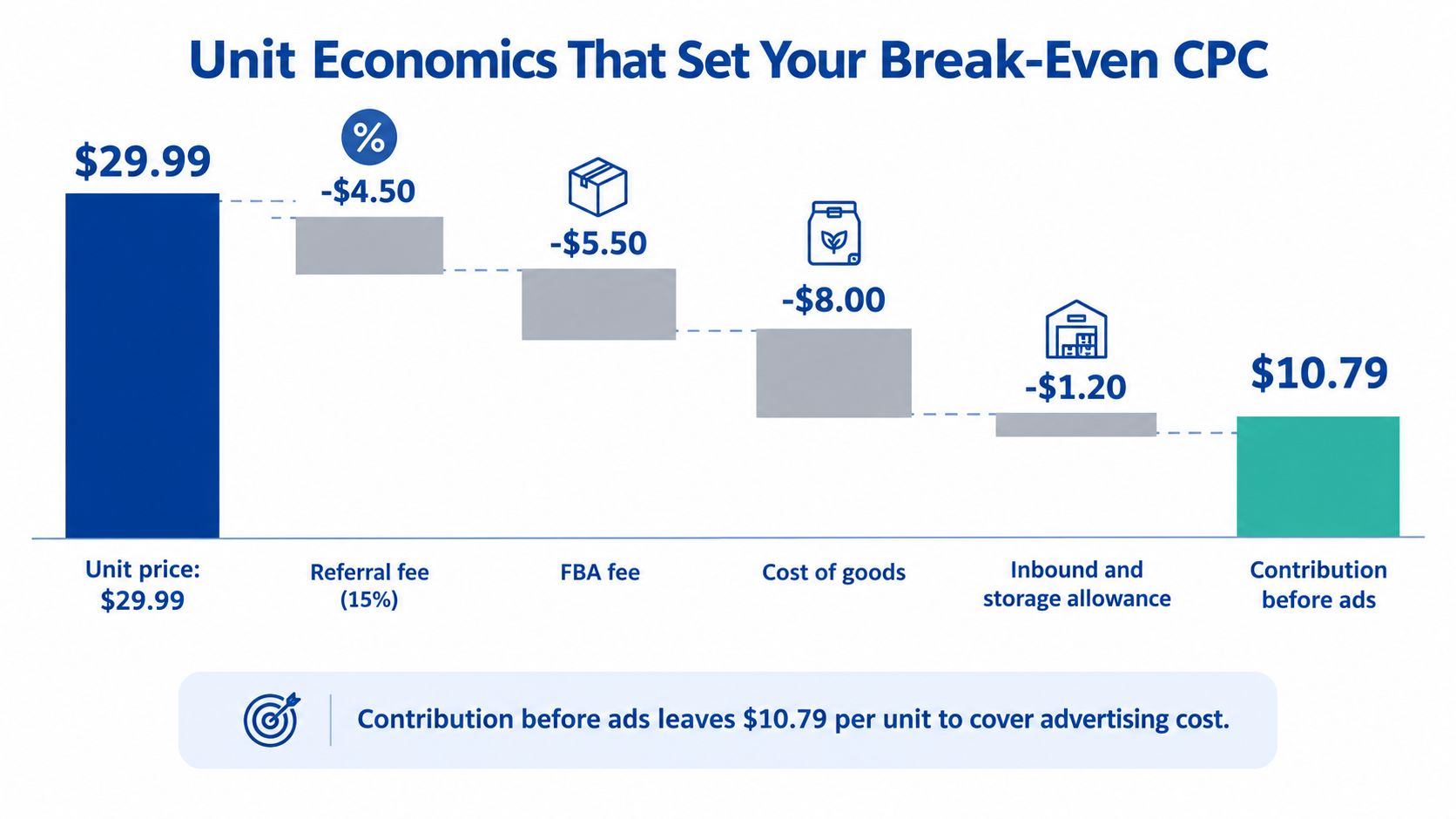
Take a hypothetical product selling for $29.99. Assume a referral fee of 15%, rounded to $4.50, an FBA fulfillment fee of $5.50, cost of goods of $8.00, and an inbound freight and storage allowance of $1.20. That leaves $10.79 before advertising, approximately 36% of selling price.
Those are example inputs, not a current Amazon fee quote. Confirm category, packaged dimensions, weight, and applicable charges before approving a purchase order.
The waterfall shows how much of the selling price remains available for advertising.
Convert contribution into a bidding limit
Break-even ACOS equals contribution before advertising divided by selling price. At that point, advertising consumes all the contribution available from the attributed sale. It doesn't leave money for corporate overhead or profit.
For this example, choose a 25% target ACOS rather than bidding up to break-even. That permits approximately $7.50 of advertising per sale.
Worked break-even example for a $29.99 product
| Line item | Per unit | What it means |
|---|---|---|
| Selling price | $29.99 | Example list price |
| Referral fee (15%) | $4.50 | Illustrative rate; check your category |
| FBA fulfillment fee | $5.50 | Example; confirm against the current schedule |
| Cost of goods | $8.00 | Landed cost at your warehouse |
| Inbound freight and storage allowance | $1.20 | Estimated allowance per unit sold |
| Contribution before ads | $10.79 | Selling price minus the modeled costs |
| Break-even ACOS | Approximately 36% | Ads consume all contribution |
| Target ACOS (25%) | $7.50 ad spend per sale | Leaves approximately 11 percentage points of buffer |
| Break-even CPC at 12% conversion | Approximately $1.30 | Contribution multiplied by conversion rate |
| Target CPC at 12% conversion | Approximately $0.90 | Ad allowance multiplied by conversion rate |
The relationship is straightforward:
Allowable CPC = allowable advertising spend per sale × purchase conversion rate.
If expected CPC is $1.10, the same hypothetical $7.50 allowance requires at least 14.7% conversion to hold the target. If your offer can't reasonably achieve that, negotiate a better cost structure or reject the niche. Don't substitute optimism for the missing conversion.
The Amazon seller profit calculator guide can help structure the calculation, but the quality of your fee and cost inputs determines whether the answer is useful.
Stress-test costs separately
A March 2025 seller survey announced on Business Wire surveyed 325 Amazon sellers and found that more than 50% became less profitable in 2024; 67% raised prices because of FBA fee increases, yet nearly 60% of those sellers still reported lower profits.
A higher selling price isn't a guaranteed repair. Competitors may hold their prices, and shoppers may stop converting at the rate your bidding model needs.
Build separate scenarios for:
- Fee increases: Change fulfillment and other applicable charges without assuming you can pass them through.
- Returns: Include expected refund losses, handling costs, and unsellable inventory.
- Discounts: Model the realized selling price and promotional costs, not the headline price.
- Competitor moves: Test whether the offer remains viable if you must defend its price position.
- Currency exposure: Adjust imported product costs where purchasing and selling currencies differ.
For a simple hypothetical sensitivity, an additional $1.00 fulfillment charge reduces contribution from $10.79 to $9.79. At unchanged conversion, your affordable bid falls too.
Finally, work backward to a maximum acceptable landed cost. Subtract Amazon costs, advertising allowance, inbound and storage allowances, return reserves, and required contribution after advertising from expected revenue. Keep freight definitions consistent so you don't count the same expense twice.
The supplier quote must fit that ceiling. The ceiling shouldn't move just because the team likes the product.
How to Size Demand and Trend Direction
Demand analysis should produce an inventory decision, not just an attractive chart. Record the customer need, the demand window, the competing offers, and the price customers encounter.
The first pass should connect the search phrase to a market segment.
Build a demand verdict
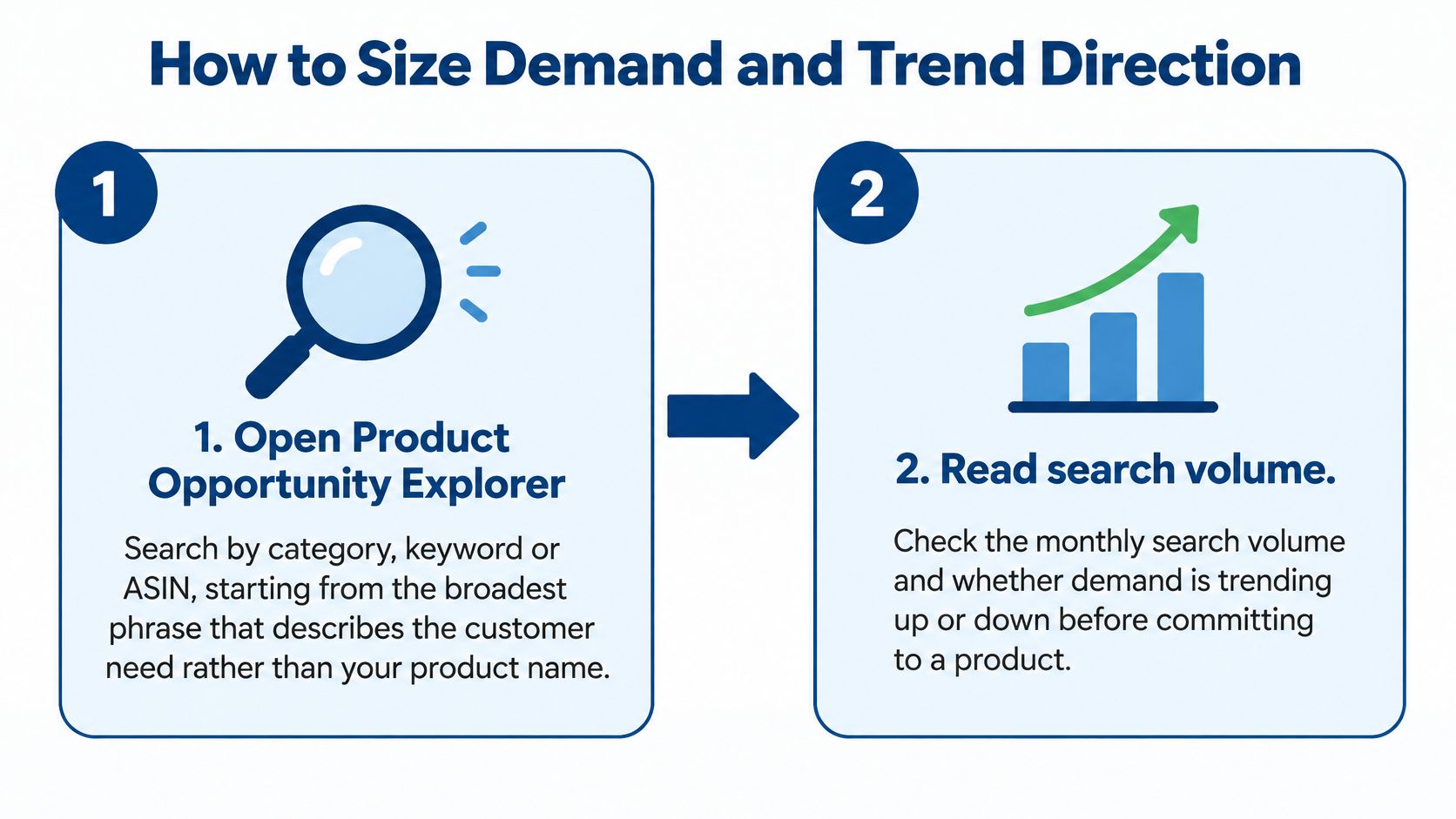
Start with the customer need. Open Product Opportunity Explorer and search by category, keyword, or ASIN. Use the broad phrase a shopper would recognize before narrowing to your preferred specification. Starting with your proposed product name can hide substitute products that compete for the same purchase.
Read the longer baseline before recent growth. Amazon's Product Opportunity Explorer guide describes search filters and comparisons across 360-day and 90-day windows, with market-segment definitions updated monthly and other metrics updated weekly. Treat recent acceleration as a hypothesis until the longer view supports it. A promotional burst shouldn't determine a replenishment commitment.
Inspect where shoppers click. Record the leading products and whether they belong to the same brand. Separate genuine brand preference from a temporary availability advantage. A segment with several credible alternatives calls for a different launch strategy than one organized around a dominant brand.
Compare search demand with conversion. Amazon's Product Opportunity Explorer overview identifies search volume, click share, search conversion, customer feedback, returns, and unmet-demand opportunities among its research capabilities. Strong search activity with weak purchasing deserves investigation, but it doesn't automatically mean shoppers want your product. They may be browsing, finding prices unacceptable, or searching for something the segment doesn't represent accurately.
Record the commercial price band. Review trending terms, items sold, and average price in the niche view. Then inspect the actual offers behind the average. Bundles, sizes, and premium materials can make an average price misleading for the specification you intend to launch.
Write a demand verdict. Classify the opportunity as durable, seasonal, or spiking, then state what evidence would change that judgment. Match the initial inventory commitment and test budget to the uncertainty rather than to the supplier's preferred order size.
Turn the verdict into an operating decision
For a hypothetical portable blender, travel-related searches might rise while home-use searches stay steady. Don't assume both audiences deserve the same inventory forecast or keyword budget. Check whether the growing use case matches the product's capacity, charging method, and cleaning requirements.
Save the niche definition with your analysis and recheck it before ordering. If Amazon changes which products belong in the segment, an apparent change in demand may partly reflect a different comparison set.
Bids based on temporary demand can become unaffordable when shoppers stop arriving with the same purchase intent.
Use this operating cadence rather than projecting a recent upswing indefinitely.
| Demand window | Question to answer | Decision it should inform |
|---|---|---|
| Annual baseline | Is demand durable or tied to a seasonal cycle? | Inventory commitment and replenishment timing |
| Recent-quarter view | Is demand accelerating or deteriorating? | Launch timing and test exposure |
| Weekly monitoring | Has the launch hypothesis changed? | Bid restraint, pacing, and forecast updates |
| Monthly segment review | Are you still evaluating the same market? | Whether comparisons remain valid |
Review and Return Signals That Change the Call
A hypothetical product with strong search demand and a 4.5-star average can still be a poor investment if customers misunderstand its size, compatibility, or durability. The average tells you little about whether your offer can avoid the same problems.
In ProductPinion's 2025 survey of 1,001 US Amazon shoppers, 38.6% returned products occasionally or often, and 58.2% believed some reviews might not be genuine; when price, reviews, and features were similar, delivery speed was the strongest purchase influence at 31.4%, ahead of brand reputation at 28.8% and images or video at 21.2%. These are shopper responses, not a return-rate forecast for your category.
Separate the complaint from the remedy
Read the low-rated reviews across the leading listings and classify each complaint. The practical exercise is a three-way dissatisfaction sort, with review credibility assessed separately.
| Signal | What to investigate | Likely response |
|---|---|---|
| Low-rating dissatisfaction | Material failure, poor durability, inconsistent performance | Change specifications, supplier, or quality control |
| Wrong-expectation dissatisfaction | Incorrect size assumptions, incompatibility, misleading appearance | Improve dimensions, compatibility guidance, images, and bullets |
| Delivery-driven dissatisfaction | Damage, lateness, missing components | Improve packaging, pack-out checks, or fulfillment |
| Suspicious review patterns | Generic praise or unusual posting clusters | Reduce reliance on those reviews in your assessment |
For a working audit, inspect one- to three-star reviews across the top ten listings. Tag repeated language such as size, battery, and not as pictured, then connect each theme to a change your team can make.
Don't count mentions without reading context. A battery complaint may mean short runtime, difficult charging, or a unit that never worked. Those require different interventions and carry different costs.
Don't confuse distrust with proof
Look for clusters of generic five-star reviews posted close together, but don't label them fraudulent on timing alone. Promotions and launch activity can also create clusters. Exclude questionable entries from your qualitative assessment or run a sensitivity check without them, rather than pretending you can authenticate every review.
Also read positive feedback. If shoppers repeatedly praise a competitor's secure fit, that feature may be an entry requirement rather than a differentiator.
- Assign an owner: Product teams own specification failures; content teams own expectation gaps; operations teams own packaging and delivery fixes.
- Price the remedy: A reinforced insert or improved component belongs in the margin model before launch.
- Verify the promise: Test samples against the specific complaints your advertising will claim to solve.
More paid traffic can mean more disappointed customers when the product promise remains unclear.
Keep the niche in play when the main complaint is a fixable communication or packaging issue. Walk away when the recurring defect has no credible sourcing solution. Advertising shouldn't amplify a problem your team already understands but hasn't fixed.
Validating Keywords With Search Query and AMC Data
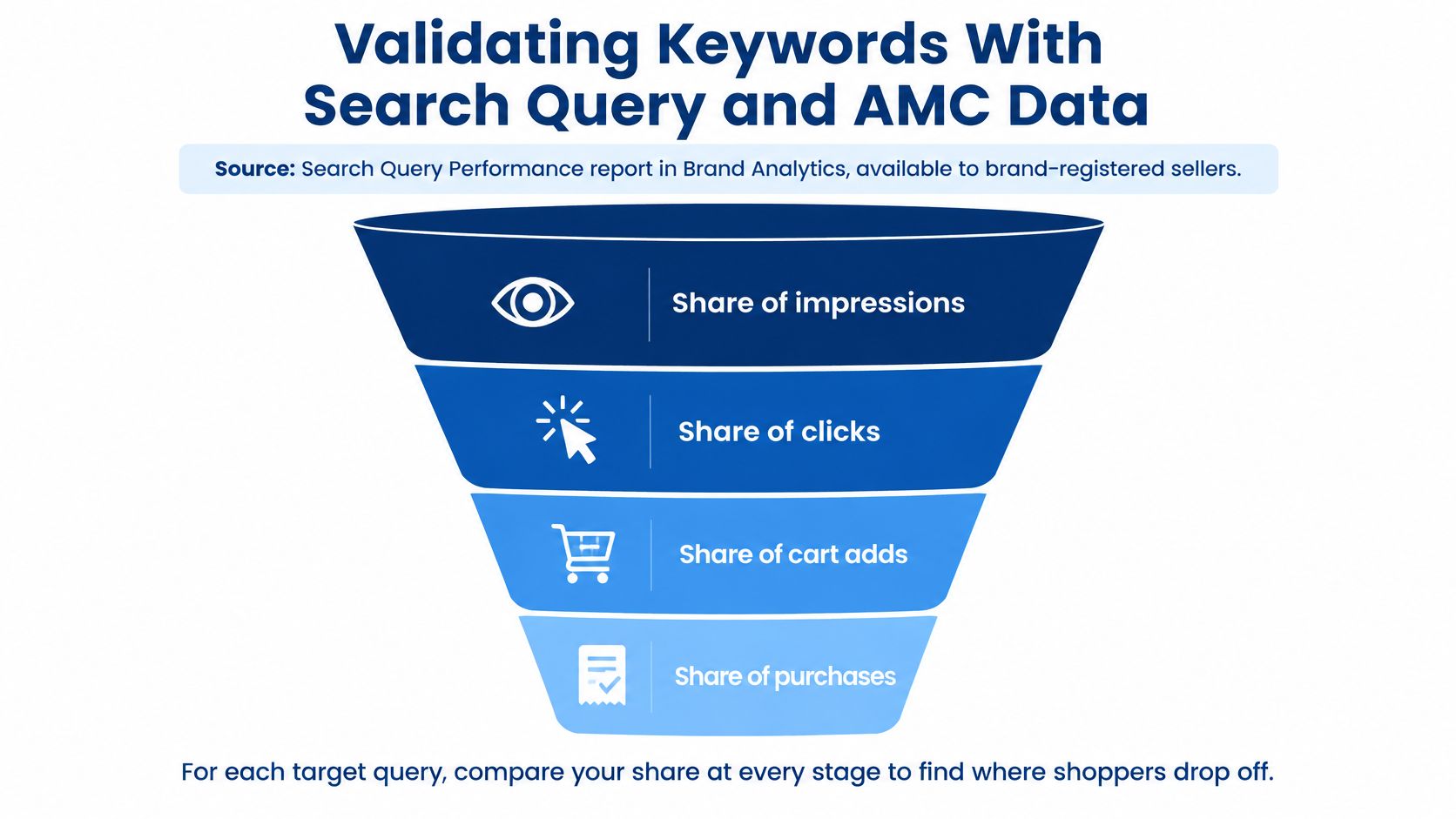
Start with Search Query Performance in Brand Analytics, available to eligible brand-registered sellers. For each target query, compare your share of impressions, clicks, cart adds, and purchases. The useful question isn't whether a keyword generates traffic, but where your offer loses shoppers.
Amazon's Search Analytics Dashboard documentation describes anonymized shopping insights and downloadable Search Query and Catalog Performance data, including ASIN-level detail. Use that detail to separate an exposure problem from an offer problem.
The funnel makes those comparisons easier to organize.
Match the intervention to the gap
Low impression share with healthy downstream performance can justify expanding relevant keyword coverage. But if shoppers already see the product and choose competing offers, buying more exposure can repeat the same loss at greater expense.
When click share trails impression share, inspect the search-result presentation: main image, title, price, delivery promise, and relevance to the query. When purchase share trails click share, investigate the detail page and product proposition.
Funnel gaps and the fix to try first
| Funnel gap | Metric to check | Fix first |
|---|---|---|
| Low visibility | Impression share versus click share on target queries | Add keyword coverage and Sponsored Products targeting |
| Weak click-through against leaders | Click share versus the top three clicked products | Test the main image and title before raising bids |
| Weak conversion after the click | Search conversion versus the segment benchmark | Fix price, images, reviews, or A+ content before adding spend |
| Halo or cross-sell gap | Purchases of other catalog ASINs after ad exposure in AMC | Adjust campaign mix and product grouping |
Use equivalent reporting periods and relevant product groupings. Shares describe positions within a query funnel; they aren't interchangeable with click-through or conversion rates.
The Search Query Performance guide provides a practical basis for building query-level reviews. Keep a decision log that records the observed gap, the proposed fix, and the metric that should respond.
Use AMC for catalog-level questions
Amazon Marketing Cloud supports custom SQL-style analysis of available advertising exposure and shopping-event datasets. It requires setup, suitable access, and analytical skill, so introduce it when the test has generated enough eligible activity to answer a defined question.
For example, a hypothetical flagship-ASIN campaign may precede purchases of another catalog product. AMC can help examine those cross-product paths and compare campaign audiences or exposure patterns.
That finding belongs in the campaign-mix decision, not in an artificially relaxed target ACOS for the flagship. Keep direct product economics and broader catalog contribution visible separately.
An observed purchase after exposure also isn't proof that the ad caused an incremental sale. Use appropriate comparisons or experiments before claiming incrementality.
The organic-growth application is practical: move converting customer language into relevant listing content, strengthen the offer for those searches, and monitor unpaid visibility alongside advertising. Lower ACOS alone doesn't establish that the brand is becoming less dependent on paid traffic.
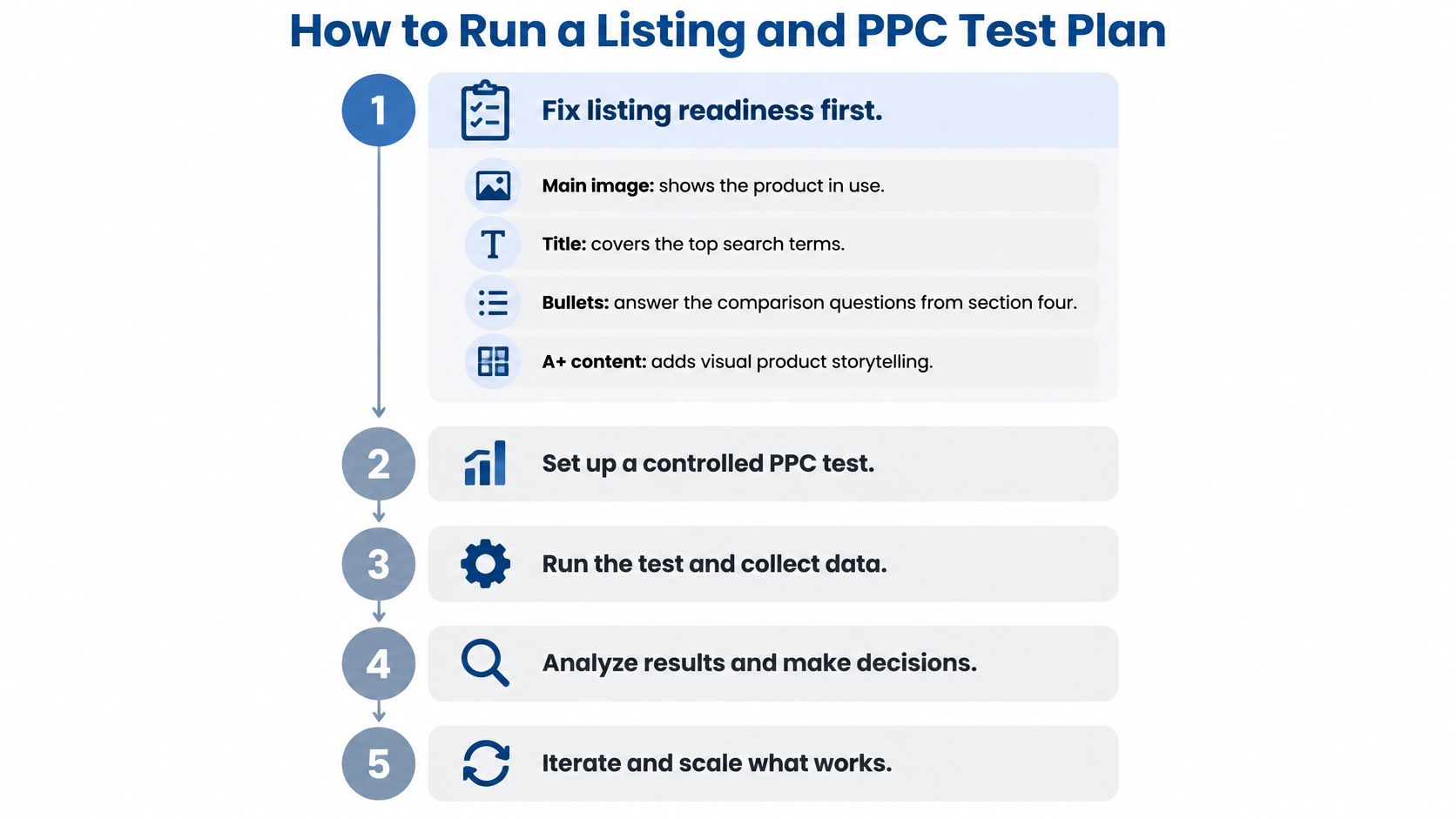
How to Run a Listing and PPC Test Plan
Treat the first PPC test as a bounded purchase of information. You're checking whether the offer can convert at an affordable acquisition cost, not proving that the team can spend its launch budget.
According to Global Brands Magazine's Amazon growth analysis, Amazon's advertising business reached $68.6 billion in 2025, up 22% year over year and 5.4 times its 2019 size. That establishes the scale of paid competition, not a universal increase in CPC for every category.
Use a readiness check before buying that visibility.
Run a controlled seed test
Fix listing readiness first. Make the product immediately understandable in the main image while following category image requirements. If a product-in-use scene isn't permitted there, place it in secondary images. Cover relevant search terms naturally in the title, answer comparison questions in bullets, and use A+ content to clarify fit, features, and limitations.
Separate intent from discovery. Build three campaign groups: exact match on priority terms, broad discovery, and product targeting against the three most-clicked competitors. Separate budgets so exploratory traffic can't consume the money intended to validate high-intent searches.
Bid from economics. Start at or below the calculated target CPC, not the suggested top-of-search bid. Check placement adjustments so the effective bid remains consistent with your intended exposure.
Use a bounded observation period. As a hypothetical operating default, run a 14-day seed test with a $500 ceiling and avoid routine bid changes before 150 relevant clicks. Pause earlier for broken listings, irrelevant targeting, stock problems, or a breached loss limit. These are governance defaults, not statistical significance guarantees.
Read the funnel before intervening. Diagnose exposure, click selection, and purchase behavior separately. Make a targeted change with a written hypothesis rather than changing price, imagery, targeting, and bids simultaneously.
Release the next budget only after review. Reconcile advertising results with actual fees, discounts, and emerging returns. A campaign dashboard can look acceptable while the underlying product contribution falls short.
For a disciplined approach to isolating changes, use the Amazon A/B testing guide to structure the experiment. Keep the approval decision separate from the person's enthusiasm for the creative.
Use the accompanying video as a discussion aid when aligning the team on test execution.
Gate spending rather than chasing momentum
The following is a hypothetical budget policy for the worked product, not a prescribed Amazon testing standard. Set the benchmark from a comparable segment or relevant existing offer before spending begins.
Test phases with spend and decision gates
| Phase | Budget and duration | Scale if | Stop or rework if |
|---|---|---|---|
| Seed test | $500 total over 14 days | Conversion at or above benchmark and ACOS under break-even | Conversion under 60% of benchmark after 150 clicks |
| Scale test | $1,500 total over 30 days | ACOS holding under the 25% target for two straight weeks | ACOS above break-even after 300 clicks |
| Steady state | Weekly budget set from contribution per unit | Organic rank rising while ad share falls | Organic rank flat and ACOS drifting up, so review the listing |
A calendar deadline doesn't make an inconclusive test conclusive. If the campaign can't attract enough relevant traffic within the approved ceiling, investigate demand access and bidding feasibility before extending it.
For a new product, testing requires a limited quantity of sellable stock. Treat that as a separate validation commitment, not approval for the full commercial order.
Confirm the Go or No-Go Call Before You Order Stock
Approve the commercial order only when economics, demand, customer experience, and execution all support it. A strong result in one area shouldn't excuse a failure in another.
The margin must support the intended acquisition cost with a reserve. Demand must justify the inventory commitment. Customer complaints must have credible remedies, and the identified funnel weakness must be something your team can fix.
Make the approval auditable
Use a short purchase-order checklist with named owners and supporting documents:
- Economics signed off: Break-even CPC uses actual fee estimates, supplier quotations, and consistent landed-cost definitions.
- Downside scenarios passed: Fee changes, returns, discounts, and competitive pricing don't erase the required contribution.
- Competitive access established: Click concentration and recent demand movement remain within the team's approved screening bands.
- Customer risk resolved: Samples, packaging checks, and listing content address the recurring failure modes.
- Retail readiness approved: The live offer matches the product specification and fulfillment promise.
- Validation authorized: The seed budget, loss limit, reporting access, and decision owner are confirmed.
For a physical-product perspective, Lounge Wagon's account of launching a multifunctional outdoor product is useful context for discussing how a product concept becomes a market-ready offer. Keep that development discussion connected to operational feasibility, not separate from the commercial decision.
Reject the niche when the repair isn't credible
Say no when the product can't support acquisition at the intended bid, when the longer demand pattern is deteriorating, or when entrenched offers capture shoppers your product can't persuade. Don't approve inventory on the assumption that organic ranking will eventually repair an unprofitable sale.
A smaller niche with stable economics can be the better allocation of capital. Your objective isn't to enter the largest market. It's to build an offer that generates enough contribution to fund replenishment, product improvement, and sustainable customer acquisition.
If the numbers pass but your team lacks Search Query Performance access, AMC capability, or a clean experiment design, make measurement readiness the next task. Headline's team can help build the test architecture and interpret the funnel before you authorize the full stock order.
Headline Marketing Agency offers Amazon PPC and DSP management, Search Query Performance and AMC analysis, and listing experiments tied to profitability and organic growth. Visit Headline Marketing Agency to discuss a product-validation plan with clear bidding limits, test budgets, and go-or-no-go gates before committing more inventory.
Get Your Free Amazon PPC Audit
Discover untapped growth opportunities and see how our data-driven approach can improve your ROAS.
Get Free Audit →Ready to Transform Your Amazon PPC Performance?
Get a comprehensive audit of your Amazon PPC campaigns and discover untapped growth opportunities.