PPC Services Packages That Scale Profitably
Compare PPC services packages by tier, pricing and ROI. Learn what to expect, what to avoid and how to choose a package that drives profit.

You're probably looking at three PPC proposals right now that all sound roughly the same.
They all promise campaign setup, keyword research, bid optimization, and reporting. They all say they'll lower ACoS. They all look clean in a slide deck. Then six months later, one agency has helped a brand build durable query share and better margin, another has kept spend moving with no real business lift, and the cheapest option has become the most expensive.
That gap usually has nothing to do with whether someone knows how to push bids up and down.
It has everything to do with what the package is built to do. A weak package is a task list. A strong package is a growth system. On Amazon, that system affects not just paid efficiency, but organic visibility, listing conversion, audience quality, and how fast your team can spot where profit is leaking.
Mid-market brands get burned when they shop for PPC management like they're buying bookkeeping. Same category. Same deliverables. Lowest fee wins. That's the wrong lens. PPC services packages should be judged by whether they help you scale profitably, defend rank on commercially important terms, and reduce wasted spend over time.
That matters more on Amazon because paid and organic performance are tied together. Search Query Performance doesn't isolate only ad clicks. Amazon's own help documentation says the query set includes performance from organic and Sponsored Products originating from search results in the same report, which gives operators a practical way to judge whether paid activity is improving combined query performance, not just ad efficiency (Amazon Seller Central help).
If your package can't connect paid investment to total query share, conversion quality, and downstream organic lift, you're not buying strategy. You're buying account maintenance.
Introduction Why Your PPC Package Choice Matters More Than You Think
A common scenario plays out the same way. A brand doing solid revenue on Amazon decides it's time to professionalize ads. The team has internal operators stretched thin, category CPCs are getting less forgiving, and leadership wants cleaner reporting. So they ask for proposals.
One agency sells a low retainer with basic management. Another offers a more expensive plan with creative support and deeper analytics. A third talks about full-funnel measurement, but the scope feels vague. On paper, they all “manage Amazon PPC.”
They do not deliver the same outcome.
What you're actually choosing
When you pick a package, you're choosing how your brand will make decisions every week. You're choosing whether someone will actively harvest exact-match winners, cut waste with disciplined negative targeting, pressure-test creative, tighten listing relevance, and connect ad spend to actual purchase behavior.
Or whether they'll mostly send reports.
Practical rule: If a package is defined by tasks completed rather than business outcomes improved, expect maintenance, not growth.
The biggest mistake I see is letting ACoS become the only buying criterion. A low-ACoS package can still be bad for the business if it starves high-value search terms, slows sales velocity on strategic ASINs, or ignores the listing and creative work needed to convert expensive traffic. Amazon PPC should support margin. It should also help your products earn better placement over time.
Why package structure predicts performance
Package structure drives behavior. If the scope only covers bid management, then the agency has no incentive to fix the listing issues hurting conversion. If AMC analysis is excluded, no one is looking at purchase paths across Sponsored Products, Sponsored Brands, Display, and Video. If Search Query Performance isn't part of the workflow, teams stay trapped in ad-console metrics and miss what's happening at the search-term level.
That's why the package choice matters early. Not because of vanity deliverables, but because it tells you whether the agency is equipped to improve profitability, organic rank, and sustainable scale.
What PPC Services Packages Actually Include
Most brands think a PPC package is a management plan. That's incomplete. A real package is a bundled operating model for how campaigns are researched, launched, optimized, measured, and improved over time.
Setup is only the starting point. Management is the product.
The easiest way to think about it
Think of Amazon PPC like owning a retail store. Building the shelves, signage, and checkout counter matters. That's setup. But stores don't win because the shelves exist. They win because someone is constantly managing inventory, pricing, placement, promotions, and shopper flow.
Amazon PPC works the same way. Campaign structure matters. Ongoing decisions matter more.
What belongs in the package
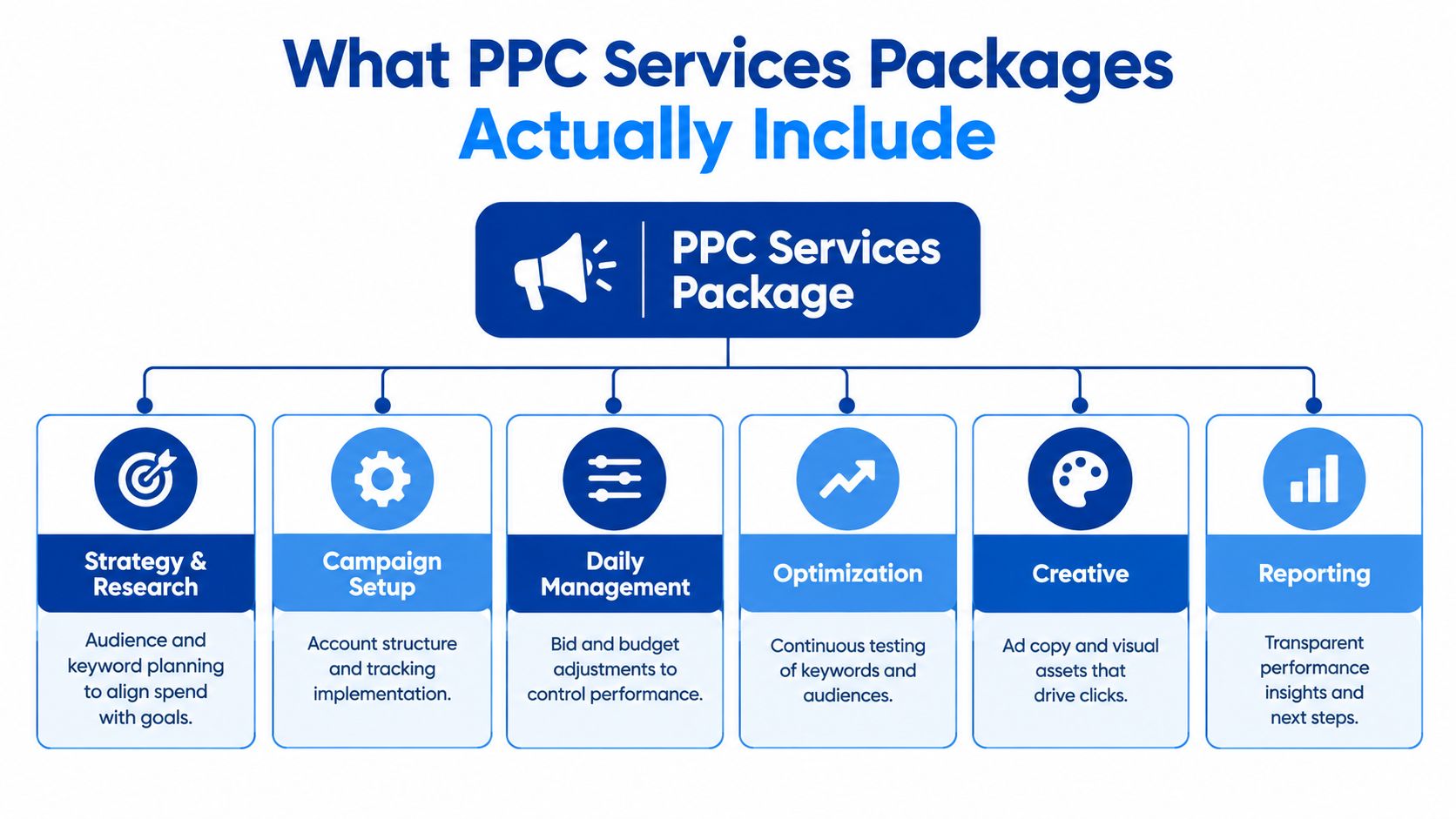
At minimum, most PPC services packages bundle several moving parts:
- Strategy and research that decides where budget should go, which search terms matter, and which ASINs deserve aggressive support.
- Campaign setup that creates the account structure, match type separation, budgeting logic, and tracking foundation.
- Daily or frequent management covering bids, budgets, search term filtering, and campaign hygiene.
- Optimization work that improves targeting quality over time instead of freezing the account after launch.
- Creative and content support for Sponsored Brands assets, testing hooks, and improving conversion inputs.
- Reporting and decision support so leadership can understand what changed, why it changed, and what happens next.
If you want a useful outside reference on how the market describes package structures, this 2026 PPC pricing guide is a decent comparison point because it shows how agencies bundle management around ongoing service, not one-time setup.
Why the tiers exist
Agencies usually label offers as Starter, Growth, or Enterprise. The labels aren't important. The reason for them is.
Amazon packages are typically tiered by three things:
Spend level
More spend creates more data, more budget pressure, and more consequence for bad decisions.Category competitiveness
A low-friction niche and a brutal category with expensive top terms should not get the same service scope.Operational complexity
A single-market Sponsored Products account is simpler than a multi-ASIN program using Sponsored Brands, Display, video, and measurement layers.
A package should tell you who is doing the thinking, not just who is touching the account.
If an agency can't explain where strategy ends and execution begins, the package is underbuilt. If they can't tell you whether listing optimization, creative testing, and advanced analytics are included or separate, the package is underdefined. Both are bad signs.
How PPC Services Packages Are Priced and Tiered
You approve a PPC package because the fee looks reasonable. Three months later, ad spend is up, ACOS looks stable, and profit is worse. That usually happens when the package was priced around activity, not around contribution to margin, new-to-brand demand, and organic lift.
Pricing models matter because they shape behavior. A team paid only to manage spend will usually optimize to keep campaigns within target ranges. A team priced and scoped to drive better query acquisition, stronger conversion rates, and cleaner measurement will make harder decisions that improve total account economics.
By 2026, PPC management pricing had largely standardized around percentage-of-spend and retainer models, with common arrangements ranging from 10% to 20% of monthly ad spend, higher percentages on smaller accounts, monthly fee floors, and custom pricing for larger programs (Pitchsite PPC pricing packages guide).
What those pricing models actually signal
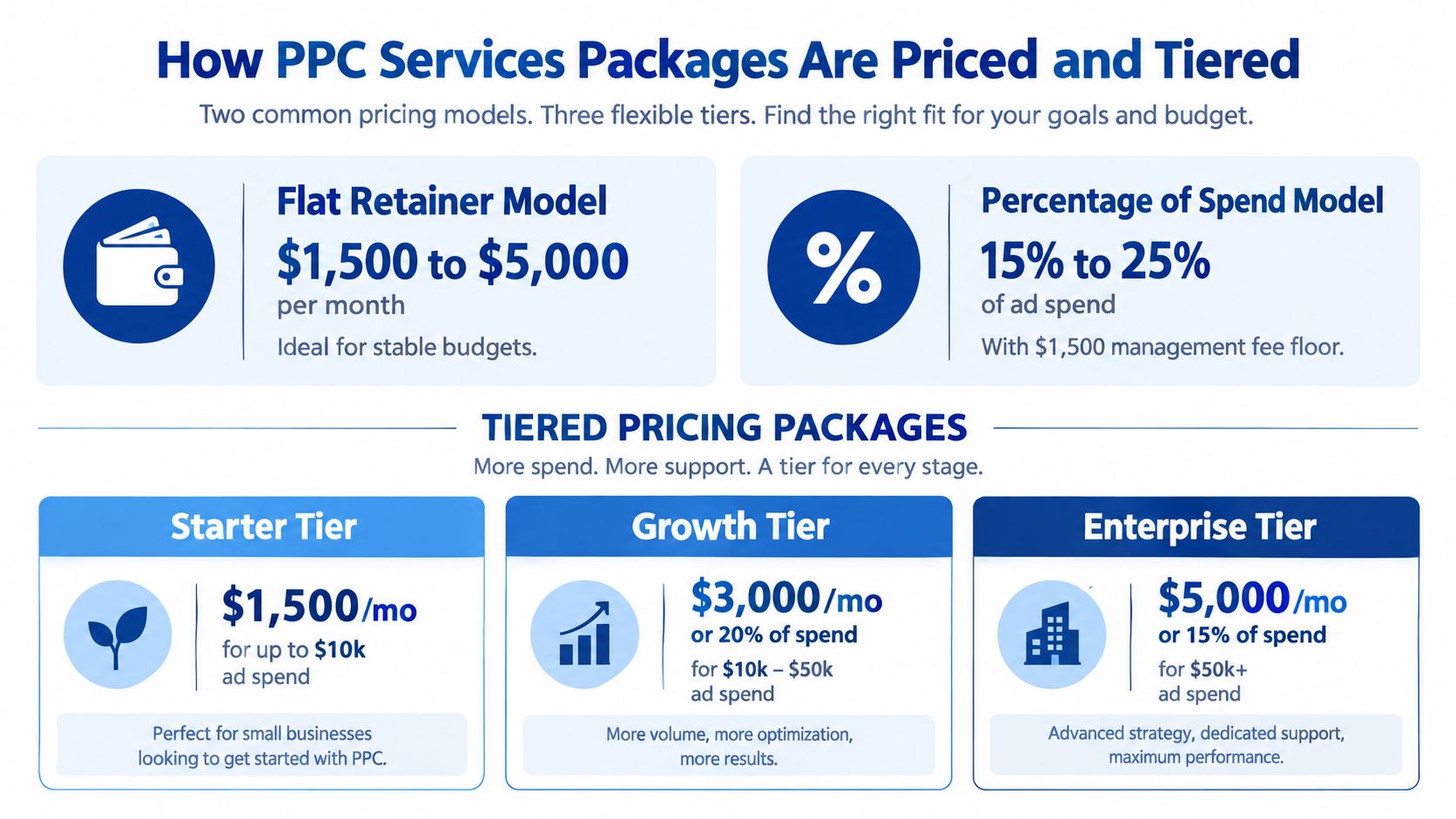
A flat retainer works best when the account scope is narrow and the brand does not need constant expansion work. A percentage-of-spend model makes more sense when campaign volume, SKU count, creative testing, and reporting demands increase with budget.
The issue is scope discipline.
If an agency charges on spend percentage, ask what happens after the account reaches efficient scale. You need to know whether the extra fee buys more analysis, more testing, and better measurement, or just more dashboard updates. If the package does not include search query mining, SQP review, retail-readiness feedback, and a clear method for connecting ad spend to organic movement, the pricing model is secondary. You are paying for account maintenance.
Amazon package tiers exist because account economics change fast by category and by maturity. Analysts at SellerPlex found wide CPC variation across managed Amazon accounts, with expensive categories paying sharply more for traffic than the median account (SellerPlex Amazon PPC benchmarks). That is why serious agencies tier around complexity, not just around hours.
A lower-cost package can be the right choice for a focused catalog with clean listing fundamentals and limited growth pressure. A higher tier earns its keep when the brand needs AMC analysis, full-funnel reporting, sponsored brand video testing, and tight coordination between paid search, conversion rate, and rank capture. That is the dividing line I care about. Can the package help you buy the right traffic, convert it efficiently, and defend the organic gains that follow?
For teams trying to align media control with broader governance, this FindClout brand controls overview gives a useful operating model.
You should also compare proposal pricing against Amazon-specific fee realities instead of generic paid search retainers. This breakdown of cost of PPC management is useful for separating fee structure from actual scope.
Later in the buying process, this short video is worth a watch because it gives a practical framing for pricing and service expectations.
What to Expect Inside Each Package Tier
Tier names vary, but the underlying pattern doesn't. Lower tiers usually cover setup and basic optimization. Middle tiers add deeper query work and conversion support. Enterprise tiers expand into cross-funnel media and analytics.
The problem is that many agencies blur those boundaries in the sales process.
What's usually inside each level
A Starter package usually fits brands that need core Sponsored Products management with basic structure and maintenance. Expect campaign setup, keyword research, bid adjustments, search term reviews, and reporting. Don't assume creative testing, listing optimization, or deep category analysis are included unless they say so plainly.
A Growth package should go further. I expect disciplined exact-match harvesting, negative targeting, campaign segmentation by intent, Sponsored Brands support, and active work on conversion inputs. Independent benchmark data puts Sponsored Products around 0.35% to 0.70% CTR, 10% to 18% CVR, and 15% to 25% ACoS, with competitive CPCs often in the $0.70 to $1.40 range and harder categories seeing $2.00+ for top keywords. That's exactly why growth-stage packages should include systematic negative targeting, exact-match harvesting, and listing optimization instead of only bid edits (WisePPC Sponsored Products benchmarks).
The transparency gap that matters
An Enterprise package should be explicit about advanced media and analytics. Many package pages still leave open whether creative testing, listing optimization, AMC analysis, or DSP are included or billed separately. That matters because Amazon's own managed-service option for display, video, and DSP typically requires a $50,000 minimum spend in the US, while Sponsored Products, Sponsored Brands, and display ads are CPC-based, and display or video costs can vary by format and placement (Amazon Advertising FAQ).
If a package says “full funnel” but never defines the analytics layer, assume the scope is thinner than the pitch.
| Deliverable | Starter Package | Growth Package | Enterprise Package |
|---|---|---|---|
| Campaign setup | Standard | Standard | Standard |
| Sponsored Products management | Standard | Standard | Standard |
| Sponsored Brands support | Add-on or limited | Standard | Standard |
| Search term harvesting | Basic | Standard with structured expansion | Standard with broader cross-campaign integration |
| Negative targeting | Basic cleanup | Systematic and ongoing | Systematic across larger portfolio |
| Listing optimization input | Often excluded | Usually included or tightly aligned | Standard with broader testing support |
| Creative testing | Often excluded | Partial or periodic | Standard across formats |
| AMC analysis | Rarely included | Often add-on | Standard or expected |
| DSP and video | Not included | Usually add-on | Often included if media mix supports it |
| Cross-channel measurement | Minimal | Developing | Full-funnel expectation |
One practical benchmark for evaluating deliverable depth is to compare any proposal against a detailed service framework like PPC advertising management services. Not because every brand needs the fullest scope, but because you need to see what's omitted before you sign.
If a proposal can't tell you what happens outside bid management, it can't tell you how it will improve margin.
How PPC Packages Drive Profit and Organic Growth on Amazon
Most agency conversations break down. They keep talking about ads as if ads exist in isolation. On Amazon, they don't.
A good package should improve paid efficiency. A strong package should also help your products earn better total search presence.
Search Query Performance is the missing filter
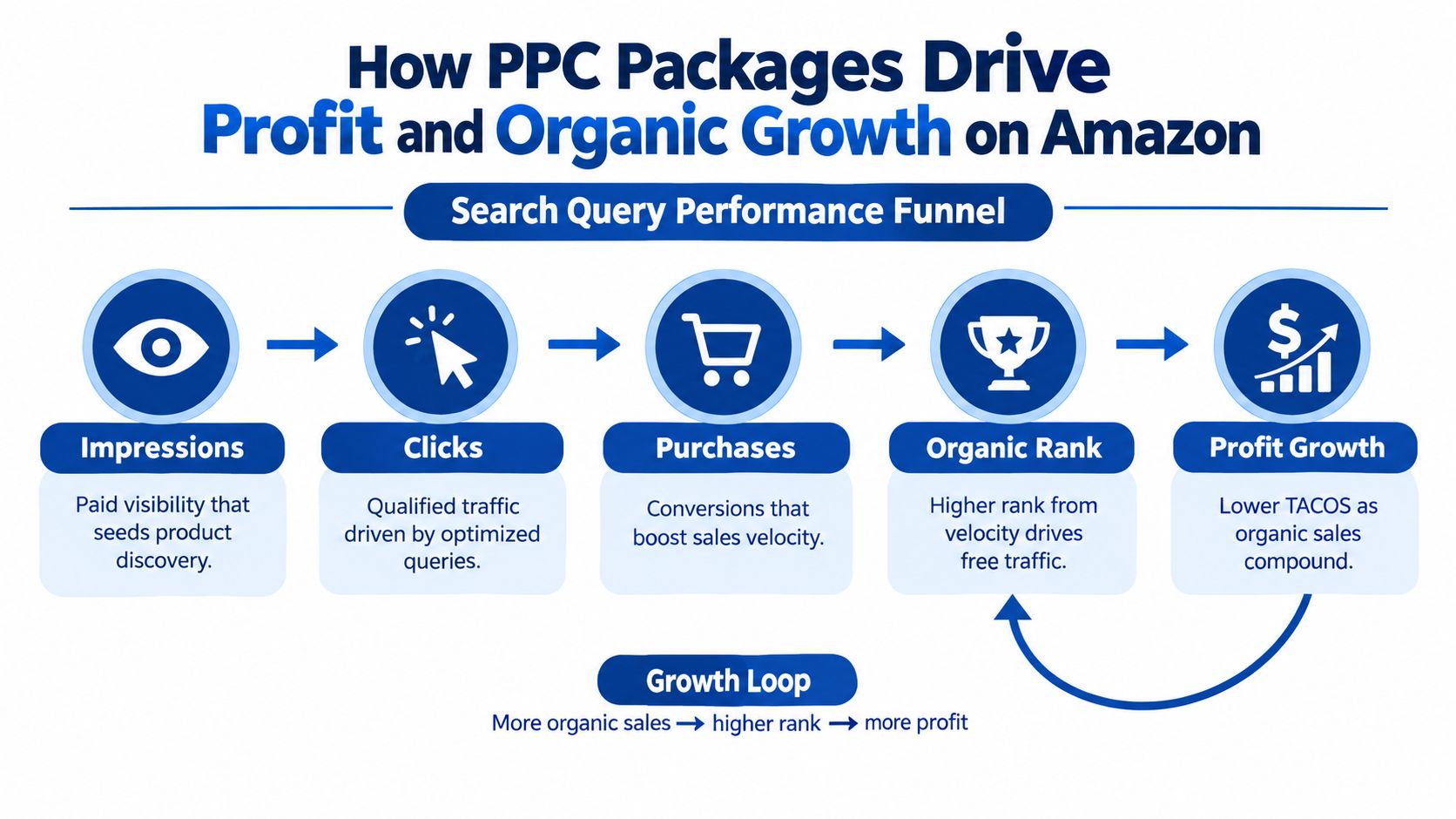
Amazon's Search Query Performance report breaks each search term into impressions, clicks, cart adds, and purchases, and shows both marketplace totals and your brand's or ASIN's share at each stage. For brand-registered sellers, that changes how PPC should be managed because you can see where visibility is weak, where traffic is unqualified, and where conversion is lagging on commercially relevant terms (Trellis guide to Search Query Performance).
That's a far better planning tool than staring at ACoS in a vacuum.
A package built around SQP can separate terms that attract clicks from terms that generate cart adds and purchases. That matters because Amazon Sponsored Products performance is highly sensitive to query-level relevance, and SQP gives operators visibility into impressions, clicks, add-to-cart activity, and purchases by search term. That makes budget shifts much more intelligent than relying on bid reports alone (Headline article on optimizing Amazon ads).
Paid media should support organic position
One academic study on Amazon-sponsored search found that sponsored results often sit outside the top organic results, and reported that almost half of sponsored results never appear within the first three pages of collected organic results (AIES24 sponsored search paper).
That's the important nuance. Paid rank and organic rank are related, but they are not interchangeable.
So the right package doesn't just chase efficient clicks. It uses PPC to close visibility gaps where your product isn't earning enough organic exposure yet, then watches whether sustained conversion and sales velocity improve your broader query position over time.
AMC is where full-funnel packages separate themselves
Search alone won't answer every growth question. Brands that need audience strategy, repeat purchase support, and channel overlap insight need Amazon Marketing Cloud in the package.
Amazon has expanded AMC capabilities with a 25-month ad traffic lookback window and generative-AI-assisted query creation, while a separate Amazon advertising reporting summary notes AMC is available at no cost to eligible advertisers and that AI tools can reduce query development time from hours to minutes (Sequence Commerce on Amazon advertising reports).
That matters because measurement is no longer an enterprise-only luxury. It's becoming table stakes for brands that want to understand purchase paths across Sponsored Products, Sponsored Brands, Display, and Video.
A real-world example of the mechanic is Envision Horizons' use of AMC to build an audience around organic 90-day buyers for bareMinerals, showing how brands can use organic customer behavior to guide remarketing and full-funnel media choices (Envision Horizons AMC case example).
Judge Amazon PPC by whether it improves total query share and profitable demand, not whether it produces a tidy dashboard.
How to Evaluate and Compare PPC Services Packages for ROI
Most brands still compare packages like they're buying labor. Number of campaigns. Number of keywords. Monthly calls. That shopping method is lazy, and it produces bad partner choices.
You don't need more checklists. You need better filters.
Start with infrastructure, not promises
If an agency can't show you how it uses Search Query Performance, query-level mining, and deeper measurement, don't overthink it. Move on.
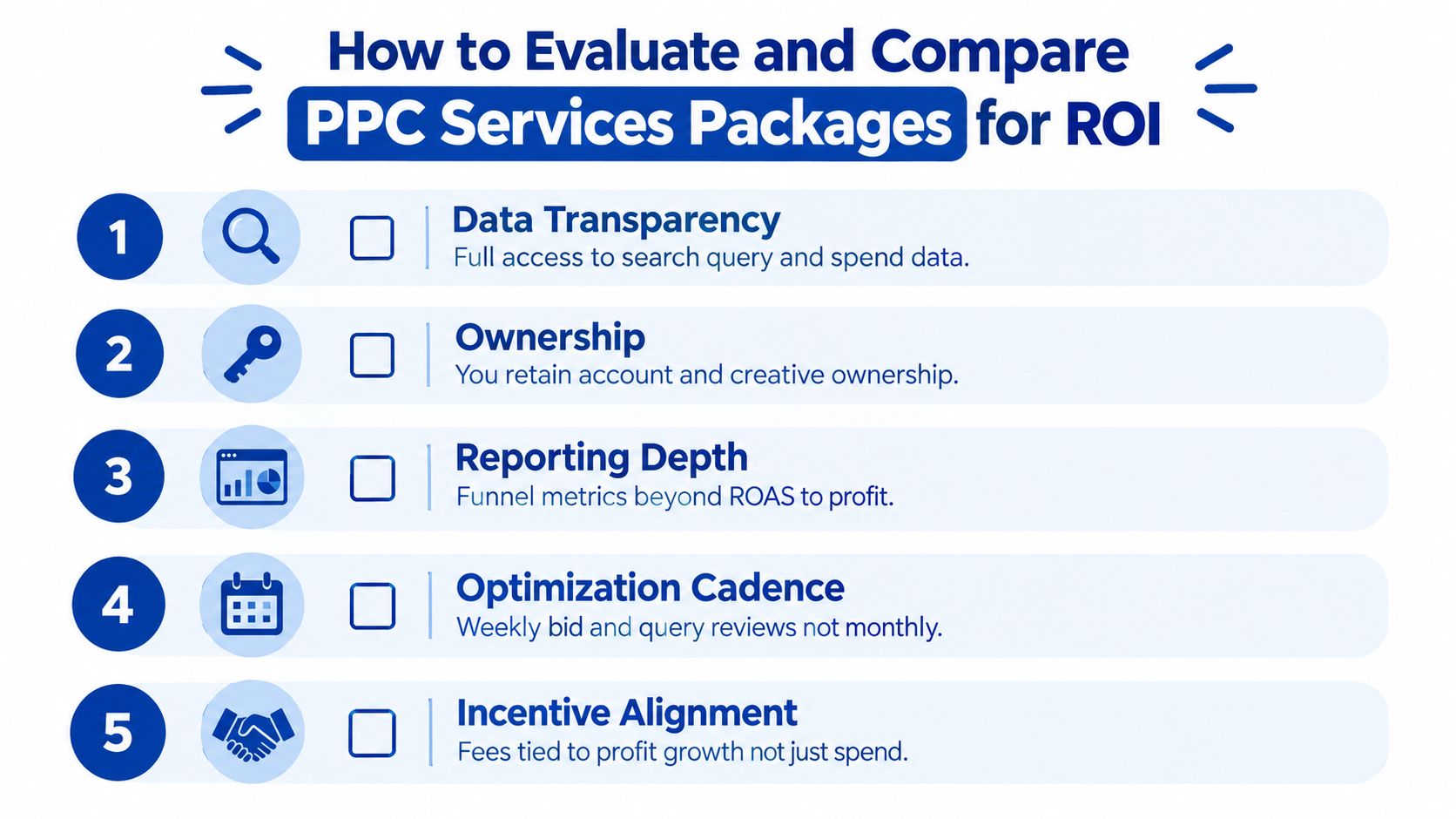
A package should answer these questions clearly:
What data will guide weekly decisions
If the answer stops at platform dashboards, the account will stay shallow.How often will optimization happen
In rising-cost environments, monthly pass-through management isn't enough.What is included beyond bids
Creative testing, listing feedback, and analytics scope should be explicit.Who owns the account and assets
You should retain access and visibility.
The red flags I'd take seriously
Some warning signs are obvious. Others hide inside polished proposals.
Watch for this: a package that sells “full management” but avoids specifics on creative, listing optimization, SQP usage, or AMC capability is usually just a bid-management service with better branding.
Use this short scoring lens when comparing options:
| Evaluation area | What good looks like | What weak looks like |
|---|---|---|
| Data depth | Uses SQP and advanced Amazon reporting | Reports only ad-console metrics |
| Optimization cadence | Frequent query and budget review | Mostly static after setup |
| Measurement scope | Can connect search, audience, and purchase behavior | Focused only on ACoS or ROAS |
| Scope clarity | States what is included and what is add-on | Uses broad promises with no boundaries |
| Business alignment | Talks margin, rank, and scale | Talks clicks, CPC, and dashboards |
For brands that are still sorting out whether an account needs cleanup before a full engagement, a structured PPC auditing service is often a smarter first step than jumping straight into long-term management. Headline Marketing Agency is one example of a firm that approaches this through Amazon-native data like SQP and AMC rather than only surface-level ad metrics.
What to ask on the discovery call
Don't ask whether they optimize campaigns. Everyone says yes. Ask better questions.
- Show me how you decide which queries deserve more budget
- Tell me how you use SQP to separate visibility problems from conversion problems
- What happens if our listing is hurting paid efficiency
- Is AMC analysis included, optional, or unavailable
- How do you judge success if ACoS improves but total share stalls
If they answer with jargon or dodge the scope, you have your answer.
Choosing the Right PPC Services Package for Your Brand
The right package depends on the job your ads need to do.
If you're launching, you need clean structure, disciplined search term learning, and fast feedback on conversion blockers. Don't overspend on enterprise analytics before you have enough signal to use them well.
If you're already spending steadily and trying to improve margin, move past starter packages. You need tighter query control, stronger negative targeting, listing support, and a reporting model that tells you which search terms are creating profitable demand versus wasted traffic.
If you're defending share in a competitive category, cheap fixed-scope management usually fails. You need full-funnel measurement, stronger creative inputs, audience insight, and the ability to connect paid activity to total query performance and organic lift.
The decision framework I'd use
Pick your package based on the constraint:
- Weak structure and limited data calls for foundational management.
- High spend with inconsistent efficiency calls for a growth-tier package with real optimization depth.
- Multi-format media, audience strategy, and long-horizon attribution needs call for enterprise capability.
The cheapest option often underdelivers because it excludes the work that moves the business. On Amazon, that usually means poor visibility into search-term quality, weak connection between paid and organic performance, and no serious measurement layer. That's not savings. That's delayed cost.
Buy the package that matches your growth problem, not the one with the nicest deliverables page. If the agency can't explain how its work improves profitability and supports organic rank, keep looking.
Headline Marketing Agency helps Amazon brands build PPC programs around profit, organic growth, and full-funnel measurement, not just bid changes and ACoS targets. If you need an agency that can connect Search Query Performance, AMC insight, Sponsored Products, Sponsored Brands, Display, and DSP into one operating model, visit Headline Marketing Agency.
Get Your Free Amazon PPC Audit
Discover untapped growth opportunities and see how our data-driven approach can improve your ROAS.
Get Free Audit →Ready to Transform Your Amazon PPC Performance?
Get a comprehensive audit of your Amazon PPC campaigns and discover untapped growth opportunities.