What Is the True Cost of PPC Management for Amazon Brands?
Amazon PPC management costs are rising — but so are the opportunities. Here's how we help brands spend smarter, not just less.

When evaluating the cost of PPC management, you'll see a wide spectrum of pricing. Typically, agency fees range from a flat $500 to $3,000 per month or are structured as 15-30% of your monthly ad spend. But framing this as a simple line-item expense is a strategic error. For savvy eCommerce leaders, the right PPC investment isn't a cost; it's a primary lever for driving organic growth, total profitability, and sustainable scale on Amazon.
The Strategic Value of PPC Management
It’s easy to get fixated on the price tag, but that’s the wrong way to look at it. Instead of asking, "How much does it cost?" the better question is, "What total business return will this investment generate?" The cheapest agency is rarely the one that delivers the highest net profit.
Why? Because expert PPC management doesn't just drive paid sales. It ignites a powerful growth flywheel that lifts your entire Amazon presence.
- Accelerates Sales Velocity: Increased ad-driven sales signal to Amazon's A9 algorithm that your product is in demand.
- Boosts Organic Rank: This sales velocity is a primary driver for climbing organic search rankings, which leads to higher-margin "free" sales.
- Builds Market Share: Consistent, strategic ad placement builds brand recall and defends your digital shelf space from competitors.
Viewing PPC through this lens reveals that its true value extends far beyond a simple Return on Ad Spend (ROAS). It's a foundational investment in your brand's long-term health on the platform.
Four Common Pricing Models
As you engage with agencies or freelancers, you'll encounter four main fee structures. Each has distinct implications, and the right model depends on your brand's scale, budget, and strategic objectives. It’s helpful to understand typical pricing structures before you start negotiating.
For small to mid-market brands, agency fees typically land between $500 and $3,000 per month. This range accounts for varying levels of account complexity and the strategic horsepower required to drive meaningful results.
Here’s a practical overview of the most common pricing models you’ll encounter.
A Quick Look at PPC Management Pricing Models
| Pricing Model | How It Works | Best For | Potential Downside |
|---|---|---|---|
| Percentage of Ad Spend | The agency charges a set percentage (e.g., 15%) of your monthly ad budget. | Brands with scaling budgets seeking a partner incentivized by growth. | Can encourage increased spend without a focus on efficiency if not tied to profitability metrics. |
| Flat Fee | You pay a fixed monthly retainer, regardless of your ad spend. | Brands requiring predictable, consistent monthly costs for budgeting. | The fee is fixed, offering less incentive for the agency to aggressively pursue growth opportunities. |
| Hybrid Model | A combination of a lower flat fee plus a performance bonus or a smaller % of ad spend. | Businesses that want both budget stability and a results-driven incentive structure. | Can be more complex to track and requires clearly defined performance targets (KPIs). |
| Performance-Based | Fees are tied directly to achieving specific outcomes, like sales revenue or leads. | Companies with clear, easily trackable conversion goals and a higher risk tolerance. | Can be hard to find and may lead to a focus on short-term wins over long-term brand building. |
Each of these models can be effective, but the key is aligning the structure with your specific business goals.
The Headline Takeaway: Don't hunt for the lowest management fee. Your objective is to find the partner who will deliver the highest net profit to your business. A slightly larger investment in an expert who understands how to connect paid advertising to organic growth will almost always deliver a superior return.
Key Factors That Drive Your PPC Management Costs

The pricing model tells you how you'll be charged, but several core factors determine the final number. It all comes down to a single question: How much expert time and strategic depth does your brand require to win? Any agency offering a one-size-fits-all fee should be a red flag, as no two businesses face the same market challenges or growth opportunities.
An agency’s fee must be commensurate with the complexity and scale of the work. Let's break down the core variables that determine the resources required to move your ads from merely running to truly dominating your category.
Your Total Ad Spend
This is the most direct driver of cost. A higher ad spend doesn't just mean bigger numbers; it represents a geometric increase in complexity and responsibility.
Managing a $5,000 monthly budget might involve overseeing a handful of campaigns. In contrast, a $100,000 budget could encompass hundreds of campaigns, thousands of ad groups, and millions of automated and manual bid adjustments daily.
More capital at play means more data to analyze, more optimization opportunities to uncover, and significantly more risk to manage. The management fee scales because the scope of work and level of strategic oversight grow in tandem with the budget. For a deeper look at this relationship, check out our guide on how to think about your Amazon ad cost.
Account and Catalog Complexity
This is where strategic nuance comes into play. Complexity isn't just about the number of products you sell; it's about the strategic depth required to market them effectively.
Here’s what adds layers to the management process:
- Number of ASINs: A brand with 50 core products requires a vastly different strategic approach than one with 5,000 ASINs. More products demand more campaign builds, deeper keyword research, and more granular performance tracking.
- Product Variations: A single product with twenty color and size variations is far more complex to manage than a single-ASIN product. Each variation requires individual performance analysis to ensure ad spend is allocated to the most profitable options.
- Marketplace Count: Expanding from the US to Canada and the UK triples the workload. Each marketplace demands a unique strategy, localized keywords, and separate performance reporting.
- Campaign Goals: A simple sales-driving objective is one thing. Simultaneously defending brand terms, launching new products, and executing competitor-conquesting campaigns is a multi-front strategic effort requiring significantly more resources.
Real-World Example: An Amazon vendor selling 200 shoe SKUs across North America and Europe requires a dedicated team to manage regional nuances and inventory-aware advertising. For a brand like this, PPC isn't just about bidding; it's about leveraging ads to manage inventory flow, support retailers, and maintain price integrity—a stark contrast to a single-market brand with 20 SKUs. This complexity is a primary factor in the cost of PPC management.
Your Industry and Competitive Landscape
The intensity of your market directly impacts management costs because it dictates the level of strategic effort required to secure profitable impressions.
Average cost-per-click (CPC) varies dramatically by industry. 2025 data shows that niches like legal services can see CPCs around $8.94, while e-commerce and retail average closer to $2.61.
An expert agency must dedicate far more time and strategic resources to hyper-competitive categories like supplements or consumer electronics, where dozens of competitors aggressively bid on the same high-value keywords. Winning in these arenas requires constant monitoring, sophisticated bidding strategies, and deep competitive intelligence. That strategic effort is a significant component of the management fee.
What to Expect: Real-World PPC Management Pricing for Amazon Brands
We've covered the factors that influence cost, but what does this translate to in practice? The answer depends entirely on your brand's stage of growth. A startup launching its first hero product has vastly different needs—and a different budget—than a category leader defending market share across multiple countries.
To make this tangible, let's walk through three common scenarios that illustrate how ad spend and complexity translate into management fees.
Scenario 1: The Emerging Challenger
This is a brand gaining real traction, ready to move from basic campaigns to a true growth strategy. The primary goal is to accelerate sales to improve organic ranking and build brand awareness.
- Typical Monthly Ad Spend: $5,000 - $15,000
- Complexity Level: Low to Medium. Likely focused on one marketplace with fewer than 50 products. The strategy centers on mastering the fundamentals: capturing high-intent keyword traffic and building a profitable foundation.
- Expected Management Fee: A flat monthly fee, typically between $1,500 and $3,500, is most common. This provides predictable costs while ensuring the agency can dedicate sufficient strategic time to the account.
Scenario 2: The Mid-Market Growth Engine
This brand is established and poised for aggressive scaling. The focus is on stealing market share, launching new products, and potentially expanding into new Amazon marketplaces.
- Typical Monthly Ad Spend: $20,000 - $75,000
- Complexity Level: Medium to High. Managing hundreds of SKUs, possibly across multiple countries. Campaigns are multi-faceted, involving brand defense, new product launches, and sophisticated competitor targeting.
- Expected Management Fee: A hybrid model is often the best fit. This typically involves a base flat fee (e.g., $3,000 - $5,000) plus a percentage of ad spend (e.g., 5-10%). This structure provides the agency with a stable foundation while incentivizing profitable scaling of the ad budget.
Scenario 3: The Enterprise Category Leader
This is a dominant brand with a massive Amazon presence. The goals are centered on protecting market share, maximizing profitability from a large catalog, and leveraging advanced tools like Amazon DSP for full-funnel advertising.
- Typical Monthly Ad Spend: $100,000+
- Complexity Level: Very High. Juggling thousands of ASINs across global marketplaces. The strategy relies on deep data analysis from platforms like Amazon Marketing Cloud, continuous A/B testing, and full integration of PPC with broader marketing initiatives.
- Expected Management Fee: A straight percentage of ad spend, typically between 8% and 15%, is standard. At this scale, the percentage often decreases as spend increases (e.g., 12% on the first $100,000 and 10% on spend above that). This model perfectly aligns the agency's success with the brand's investment.
The Bottom Line: Your brand's scale, ad budget, and operational complexity are the true drivers of cost. Use these scenarios as benchmarks to evaluate proposals and ensure the fee aligns with the level of strategic partnership you require.
To make it even clearer, the table below neatly summarizes these pricing scenarios, giving you a handy reference when comparing agency quotes.
Example Pricing Scenarios for Amazon Brands
| Brand Scenario | Typical Monthly Ad Spend | Complexity Level | Expected Management Fee Model & Range |
|---|---|---|---|
| Emerging Challenger | $5,000 - $15,000 | Low to Medium | Flat Fee: $1,500 - $3,500 / month |
| Mid-Market Growth | $20,000 - $75,000 | Medium to High | Hybrid: $3k-$5k base + 5-10% of spend |
| Enterprise Leader | $100,000+ | Very High | Percentage of Ad Spend: 8-15% of spend |
Ultimately, you are seeking a partnership where the fee is a clear and justifiable investment in the value being delivered. Expert PPC management is not an operational cost; it's a strategic investment in a partner who connects ad performance to your P&L and drives sustainable growth.
Comparing Agency vs. In-House vs. Freelancer Costs

Deciding who manages your PPC campaigns is as critical as setting the budget itself. This choice is a strategic decision that impacts your brand's growth trajectory, access to expertise, and the true, fully-loaded cost of PPC management.
The decision typically comes down to three options: a specialized agency, an in-house team, or a freelancer. Each model has a different cost structure and unique trade-offs. To make an informed decision, you must look beyond monthly fees and analyze the total investment and potential return of each.
The True Cost of an In-House Team
Hiring an in-house PPC manager offers maximum control and brand immersion. However, the salary is only the starting point. The fully-loaded cost of an in-house hire is often 50-75% higher than their base salary.
Here’s a breakdown of the real costs:
- Salary: An experienced PPC manager commands a salary of $70,000 to $105,000+ annually.
- Benefits & Overhead: Add 25-40% for health insurance, taxes, retirement contributions, and office overhead.
- Technology Stack: Professional-grade software for keyword research, competitive intelligence, and bid optimization can easily cost $5,000-$15,000 per year.
- Training & Development: The Amazon advertising ecosystem evolves constantly. Continuous training is essential to maintain a competitive edge.
Suddenly, an $85,000 salary becomes a $130,000 total annual cost. And this is for one individual. This creates a single point of failure; if they leave, go on vacation, or get sick, your campaign momentum stops.
Despite these costs, more brands are bringing this function in-house. Between 2023 and 2024, the share of marketing teams who were certain they'd keep PPC fully in-house shot up from 44% to an incredible 71%. You can explore more on this trend in recent PPC surveys.
The Freelancer Option: A Strategic Gamble
A freelancer can seem like an efficient, budget-friendly solution, offering expert help without the overhead of a full-time employee. Rates vary widely, from $50 to over $200 per hour, or a monthly retainer comparable to a small agency's fee.
This can be an effective option for brands with straightforward needs. However, it carries inherent risks. A freelancer is a single resource. They may excel at strategy but lack deep analytical skills, or be a technical wizard who struggles with creative. Their limited bandwidth can become a significant bottleneck as your brand scales.
Key Takeaway: With a freelancer, you’re buying one person’s skillset. With an agency, you’re investing in a team of specialists—strategists, data analysts, copywriters, and platform experts—often for a price comparable to or even less than a single senior in-house manager.
The Agency Advantage: Unlocking Scale and Expertise
Partnering with a specialized agency provides a different value proposition. The monthly retainer grants access to the collective intelligence and resources of an entire team. This model de-risks your investment while providing capabilities that are difficult and expensive to build internally.
- Diverse Expertise: You gain a full team—data analysts, strategists, DSP experts—for the price of one generalist.
- Proprietary Technology & Data: Top agencies build their own tools and leverage cross-category data insights. They see what’s working across dozens of brands, allowing them to spot trends and capitalize on opportunities faster.
- Continuity and Scalability: An agency provides operational continuity; someone is always monitoring your account. The structure is designed to scale with your growth.
When comparing a $5,000/month ($60,000/year) agency retainer to the $130,000+ true cost of one in-house manager, the financial logic becomes compelling. You are not just outsourcing tasks; you are onboarding a strategic growth partner.
How to Calculate the True ROI of Your PPC Management
It's easy to get tunnel vision with PPC metrics. While ACoS (Advertising Cost of Sale) and ROAS (Return on Ad Spend) are useful for campaign-level diagnostics, they tell an incomplete story. They measure ad performance in a vacuum, failing to capture the powerful halo effect advertising has on organic sales.
To understand the true value of your PPC management, you must measure its impact on your total business performance on Amazon.
Moving Beyond ACoS to TACoS
The most critical metric for a holistic view is Total Advertising Cost of Sale (TACoS). This metric connects your ad spend to your total revenue—both paid and organic—providing a clear measure of your investment's overall efficiency.
The formula is simple:
(Total Ad Spend / Total Sales) x 100 = TACoS
A decreasing TACoS over time is the ultimate indicator of a successful PPC strategy. It demonstrates that your ad spend is not only becoming more efficient but is also successfully lifting your organic sales. A healthy PPC program should make your organic sales grow faster than your ad spend.
The Key Insight: Don't chase a low ACoS at the expense of growth. Your strategic goal is a consistently declining TACoS, which proves your ad spend is an investment building organic momentum, not just a cost center.
Measuring PPC's Impact on Organic Growth
Think of PPC as the engine that powers your organic flywheel. Every ad-driven sale sends a powerful signal to Amazon’s A9 algorithm, indicating your product's relevance and popularity. This boost in sales velocity directly improves your organic search ranking.
Here’s how to connect the dots:
- Track Keyword Rank: Monitor organic ranking for your most important keywords. As you run targeted PPC campaigns, you should see your organic positions for those same terms improve.
- Analyze Organic Sales Lift: When running an aggressive ad campaign for a specific product, track the corresponding change in its organic sales. A successful campaign generates a noticeable lift in "free" organic orders.
- Calculate the Ad-to-Organic Sales Ratio: For every dollar in ad-driven sales, how many dollars are you generating organically? For a healthy brand, this ratio should improve as PPC builds a strong organic foundation.
This synergy is where the real value lies. PPC isn't just about capturing existing demand; it's about building a sustainable sales engine that drives long-term profitability.
Forecasting the True ROI of Your Investment
With a firm grasp of TACoS, you can forecast the true return on your investment, accounting for both the agency management fee and your ad spend.
Here’s a simple framework for projecting ROI:
- Establish Your Baseline: Determine your current monthly TACoS and total sales.
- Project Ad Spend and Fees: Map out your planned monthly ad spend and the cost of PPC management. This is your total investment.
- Estimate Sales Growth: Based on the proposed strategy, project a realistic increase in total sales (paid and organic). A 5-10% monthly lift is a conservative goal for a well-managed account.
- Calculate Projected Profit: Apply your product margin to the projected sales increase to find your estimated additional profit.
- Determine True ROI: Subtract your total investment (ad spend + management fee) from the additional profit. This is the true return your PPC management is generating for your bottom line.
This forward-looking analysis shifts the conversation from "What does PPC management cost?" to "What profit will this investment generate?" With global search ad spending projected to hit $351.55 billion in 2025, adopting this strategic view is essential. Discover more insights about these PPC spending trends.
For a more granular look at performance, you can also explore our guide on how to calculate return on ad spend, which dives deeper into the foundational metrics.
The Headline Takeaway: The true cost of PPC management can only be judged by its impact on total business growth. By focusing on TACoS and the relationship between paid and organic sales, you can accurately measure ROI and ensure your advertising builds long-term, profitable scale.
Choosing the Right Partner and Pricing Model
Selecting a PPC management partner is a critical strategic decision that extends far beyond comparing monthly fees. The right partner integrates into your team, aligning their success with your bottom line. The cheapest agency is almost never the one that delivers the best results. The objective is to find a partner with a clear, credible plan for driving profitable growth.
Think of it less as hiring a vendor and more as bringing on a strategic investor in your brand’s future. To make the smartest choice, it helps to see what’s out there and understand the different PPC management pricing models they use. A partner worth your investment will be transparent about their fees and, more importantly, how those fees are tied to achieving your business objectives.
Critical Questions for Any Potential Partner
Before signing a contract, you must ask probing questions that cut through sales pitches and reveal a potential partner's true strategic capabilities. A great partner won't just have answers; they'll have data-backed case studies.
Here’s what you need to ask:
- Strategy and Profitability: "Beyond ACoS, how do you measure success? Show me how you track and improve TACoS to drive organic sales and total profitability."
- Team and Expertise: "Who, specifically, will be managing my account? What is their direct experience in our product category and with brands at our scale?"
- Technology and Data: "What proprietary tools or unique data access gives you a competitive edge? How are you leveraging advanced platforms like Amazon Marketing Cloud?"
- Communication and Reporting: "Can I see an example of a performance report? What is your cadence for strategic reviews and forward-planning sessions?"
A top-tier team will welcome these questions as an opportunity to demonstrate their expertise. For a closer look at what separates the best from the rest, check out our guide on what to look for in an Amazon advertising agency.
This flowchart walks you through the process of getting from simple metrics like ACoS to the real, bottom-line ROI of your advertising.
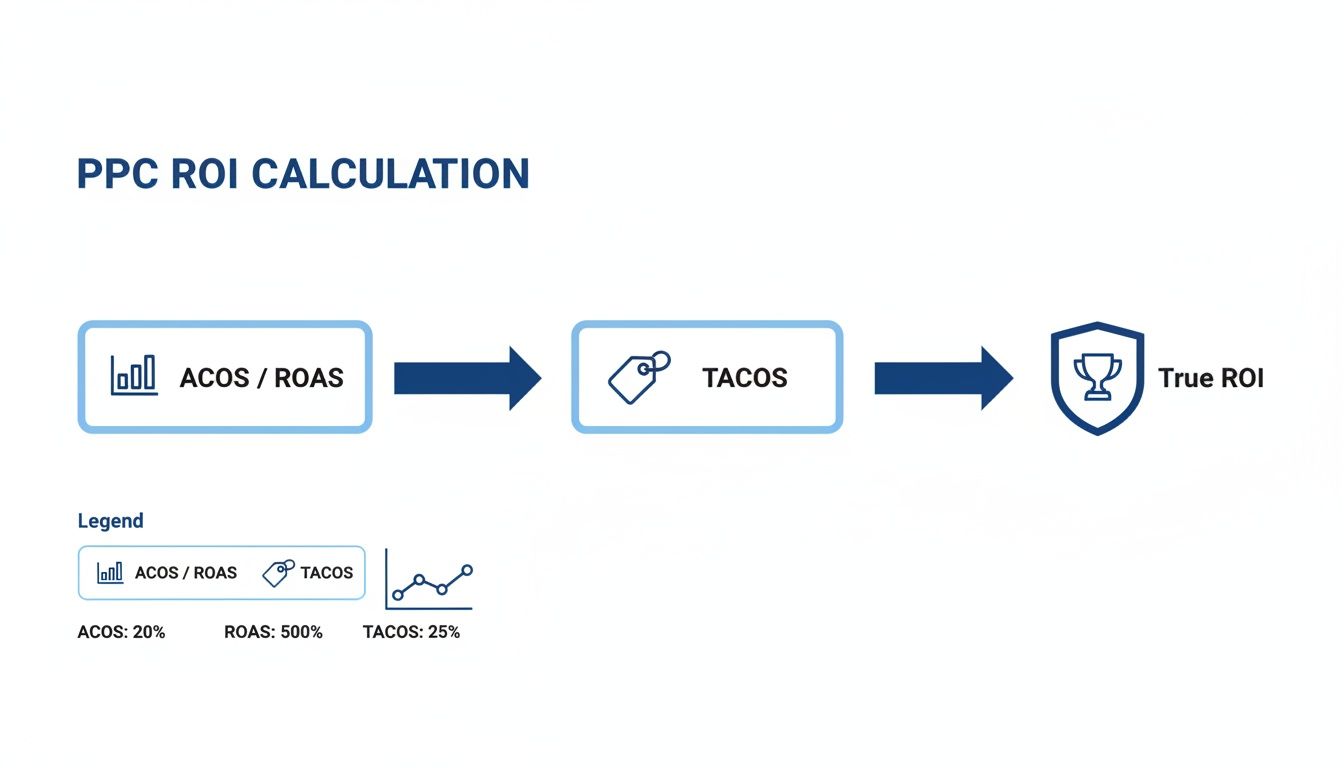
As you can see, you only get the full picture of profitability when you link your ad spend to your total sales growth by looking at TACoS.
Aligning Incentives for a True Partnership
Your agreement should be structured around a shared mission: profitable growth. When negotiating, push for a model that rewards performance. A hybrid model—a reasonable base fee plus a performance bonus for hitting KPIs like a lower TACoS or a total sales target—often works best.
This structure ensures your partner is motivated to spend your budget intelligently, not just spend more of it. Their focus will be on driving the holistic growth that builds an enduring brand on Amazon.
The Headline Takeaway: The best PPC partner isn't the one with the lowest price tag; it's the one whose strategic philosophy aligns with your business goals. Choose the team that is obsessed with your total profitability, understands how paid advertising fuels organic sales, and can prove their value with data.
Frequently Asked Questions
PPC pricing can be complex. Here are clear, no-nonsense answers to the most common questions from brand leaders evaluating their options.
Are There Hidden Fees in PPC Management Contracts?
With less reputable providers, yes. Some agencies quote a low management fee, then add charges for services that should be standard.
Be vigilant for:
- Onboarding or setup fees: A one-time charge to begin work.
- Ad creative charges: Extra costs for creative assets.
- Software platform fees: Passing on the cost of their third-party tools.
- In-depth reporting costs: Fees for the custom dashboards needed to track performance.
A transparent partner will provide a complete breakdown of what is and is not included in their fee. Always ask for an exhaustive list of all potential charges to avoid surprises.
How Long Until I See a Positive ROI From PPC?
You can often see early performance indicators—like improved click-through rates or initial sales—within the first 30 days.
However, a true, profitable ROI that accounts for all costs typically takes longer. A realistic timeframe to see a significant, sustainable return is 3 to 6 months. This allows the team sufficient time to gather data, conduct meaningful tests, and optimize a strategy for long-term success. This is about building a growth engine, not just flipping a switch.
Can a Percentage of Ad Spend Model Create a Conflict of Interest?
It absolutely can. The inherent risk is that an agency is incentivized to increase your spend, even if that spend isn't profitable, simply to increase their fee.
To mitigate this, ensure the agreement is tied to profitability. Success metrics should be based on Total Advertising Cost of Sale (TACoS) or contribution margin, not just raw ad spend. A true partner is focused on scaling your budget profitably.
At Headline Marketing Agency, we build strategic partnerships focused on profitable growth. We connect every ad dollar to your bottom line, leveraging data to drive sustainable scale. Learn how our performance-first approach can grow your Amazon business by visiting us at https://headlinema.com.
Get Your Free Amazon PPC Audit
Discover untapped growth opportunities and see how our data-driven approach can improve your ROAS.
Get Free Audit →Ready to Transform Your Amazon PPC Performance?
Get a comprehensive audit of your Amazon PPC campaigns and discover untapped growth opportunities.