PPC Agency Atlanta: 2026 Benchmarks and Vetting Checklist
Searching for a ppc agency atlanta that builds profit? Check 2026 benchmarks and a 10-question vetting checklist to spot ROAS harvesters.

Most hiring advice for a PPC agency in Atlanta starts in the wrong place. Shoppers are told to compare click costs, ask for a lower ACOS, and pick the shop with the glossiest Google Ads dashboard. Follow that playbook and you'll hire an agency that trims your ad spend on paper while your total business stalls.
Search advertising is too expensive to run on surface metrics. In 2024 alone, U.S. search advertising revenue hit $102.9 billion, accounting for 39.8% of total U.S. digital ad revenue, according to the IAB Internet Advertising Revenue Report covered by Search Engine Land. When that much capital crowds the same auctions, cheap clicks rarely translate into durable profit.
If you own a brand P&L, the hiring filter is simple. Can this partner prove that paid traffic generates incremental contribution margin and lifts organic demand, or are they just taking credit for buyers who already knew your name? The benchmarks, case evidence, and scoreable pitch checklist below give you a clear way to tell the difference before you sign a retainer.
The Numbers to Hold an Atlanta PPC Agency To
Amazon's advertising revenue hit $56 billion in 2024, according to Adweek's Amazon ad revenue coverage, after climbing steeply year after year through the first half of the decade. Marketplace media now rivals traditional search in scale, so Atlanta agencies pitch Amazon and Google services side by side, and a hard benchmark table is your fastest filter against inflated promises.
Use the operating medians from the Sellrbox Amazon advertising benchmark study as diagnostic limits during agency pitches. For context on how fast real auctions move, Headline's 2025 portfolio of 43 brands and $29.6 million in ad spend produced an average Sponsored Products CPC of $1.12 globally, $1.31 in the U.S., and $0.44 to $0.97 across major European marketplaces. Real U.S. auction costs outpace generic averages quickly, which is exactly why you demand account-level proof instead of pitch-deck medians.
The Google rows below come from a large cross-industry sample of U.S. search campaigns. Treat them as directional guidance only, because industry averages swing widely and no public dataset reflects your specific margin structure.
| Metric | Benchmark value | Source scope | Pair it with | Warning sign |
|---|---|---|---|---|
| Amazon CPC | $0.89 median | Third-party Amazon benchmark sample | Conversion rate and contribution margin | CPC climbing while conversion rate holds = auction pressure |
| Amazon CTR | 0.57% median | Same sample | Query-to-ad relevance | CTR falling after a bid change = relevance mismatch |
| Amazon ad conversion rate | 6.9% median | Same sample | Retail readiness and listing quality | Stable CPC plus falling CVR = listing or offer problem |
| ACOS | 33% median | Same sample | TACOS and margin | ACOS improving while TACOS stays flat = harvesting, not growth |
| ROAS | 3.0 median | Same sample | New-to-brand share | High ROAS concentrated on branded terms only |
| Cost per ad order | $11.78 median | Same sample | Average order value | Cost per order rising faster than AOV |
| TACOS | 14.8% median | Same sample | Organic sales share | TACOS flat as ad spend scales |
| Ad share of total sales | 43% median | Same sample | Organic revenue trend | Paid dependence not declining over quarters |
| Google Ads CTR | Directional only, varies widely by industry | Large cross-industry sample of U.S. search campaigns | Match type and location segment | Metro-level CTR far below peer norms = targeting issue |
| Google Ads CPC | Directional only, often several dollars per click in competitive verticals | Same sample | Marginal profit per click | CPC inflation with flat conversion rate |
| Google Ads conversion rate | Directional only, varies by offer and industry | Same sample | Landing-page and offer quality | Falling CVR at stable CPC = page or offer friction |
| Google Ads cost per lead | Directional only, swings sharply by vertical | Same sample | CRM revenue matching | CPL stable while closed-won revenue drops |
How to Read the Three Most Misused Rows
Benchmarks aren't universal targets. Category price points, repeat purchase rates, and fulfillment costs shift what a healthy account looks like. Treat these rows as control limits that diagnose where money is leaking.
- CPC versus conversion rate: Rising CPC paired with a steady conversion rate signals auction pressure from heavier competitor bidding. Stable CPC paired with a slipping conversion rate points straight to listing quality, pricing, stockouts, or landing-page friction. One diagnosis demands bid discipline, the other demands fixing the shelf, and an agency that can't tell them apart will burn budget treating the wrong disease.
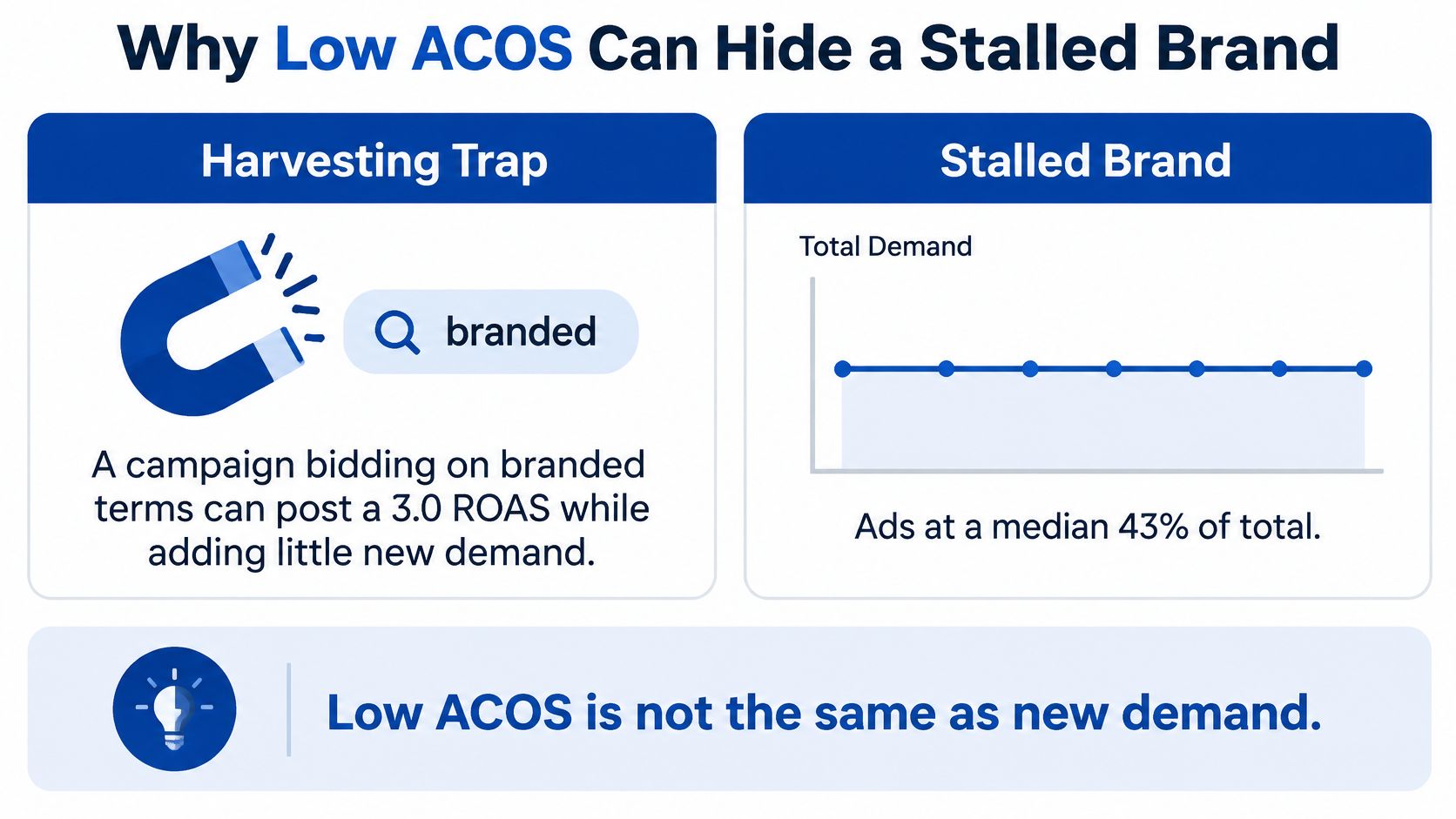
- ROAS versus new-to-brand share: A 3.0 ROAS looks tidy in a slide deck, yet it proves nothing on its own if most of those orders came from shoppers searching your exact brand name. Demand the split.
- Ad share of total sales versus TACOS: When paid ads account for 43% of total sales and that ratio refuses to budge quarter after quarter, you're renting volume rather than building marketplace equity. A growth-minded agency should be able to show that ratio compressing as organic rank improves, even while total revenue climbs.
Ask every agency you interview to benchmark your account against every row in this table. Any proposal that highlights ROAS without showing TACOS and contribution margin beside it is incomplete.
Why Low ACOS Can Hide a Stalled Brand
Say a consumer brand hands its account to a local generalist and asks for a lower ACOS. The account manager slashes bids on broad discovery keywords, shifts budget into exact-match branded terms, and comes back 30 days later with a clean 3.0 ROAS. Revenue hasn't grown, new-customer acquisition has stalled, and nearly half of total sales still depend on paid clicks.
An isolated ACOS dashboard creates three blind spots for P&L owners:
- Invisible organic momentum: ACOS only counts ad-attributed revenue, completely ignoring the unpaid search sales that ranking-focused PPC helps drive.
- Missing margin erosion: Platform dashboards don't subtract product cost, fulfillment fees, referral fees, coupons, or customer returns from reported sales.
- Credit for existing demand: Bidding heavily on your own brand terms inflates efficiency metrics by intercepting shoppers who were already ready to buy.
Running the Six-Month TACOS Test
The fastest antidote is TACOS (Total Advertising Cost of Sales), which divides total ad spend by total business revenue rather than ad sales alone. If your team isn't tracking it cleanly alongside organic share, review how to calculate TACOS before your next agency review.
Pull your last six months of account data and plot monthly TACOS beside organic sales share. If ad spend climbed while TACOS stayed flat or crept upward, your campaigns bought short-term volume instead of building durable demand.
Optimizing Search as a Causal System
Treat paid search as a cause-and-effect engine, not a bid-tuning exercise. The WordStream 2025 PPC benchmark dataset covering more than 16,000 U.S. campaigns recorded averages of 6.66% CTR, $5.26 CPC, 7.52% conversion rate, and $70.11 cost per lead, yet aggregate averages never explain why an individual account moves. Query-to-ad alignment drives CTR, detail-page continuity drives conversion rate, and catalog quality caps how high conversion rate can ever climb.
On Amazon, that causal discipline means separating Sponsored Products discovery campaigns from exact-match harvesting campaigns, promoting converting search terms systematically, and applying negative targeting to stop internal overlap. Our PPC approach goes beyond basic ACOS to improve organic ranking, maximize product margins, and defend market position. Through our proprietary analytics suite, which pairs P&L Analysis, Ads Performance, Search Query Performance (SQP), our Internal Data Analytics Suite, and Amazon Marketing Cloud (AMC) Insights, we tie query-level data to real incrementality tests like geo holdouts and time-based controls.
Judge every extra dollar of ad spend by one standard: incremental contribution margin left over after product cost, fulfillment, marketplace fees, discounts, and advertising. A partner worth hiring maps out a clear trajectory where paid share holds steady or declines while total contribution profit climbs.
What an Amazon-First Agency Actually Operates
Amazon's ad business isn't a side channel anymore; according to Amazon advertising revenue data compiled by AmazonExperts, Amazon's advertising-services segment grew 19.8% in 2024 and 22.1% in 2025, expanding faster than overall net sales of $638.0 billion in 2024 and $716.9 billion in 2025 across search, display, and video inventory.
Start your agency selection with a clear routing rule. If your revenue closes on Amazon, hire an Amazon-first specialist. If customer demand starts on Google Search and converts on your own site, apply the Google Ads checks from this guide, and only work with a local Atlanta generalist if they commit to reporting contribution margin by channel.
Here is how a full-funnel Amazon PPC system stacks together when run properly.
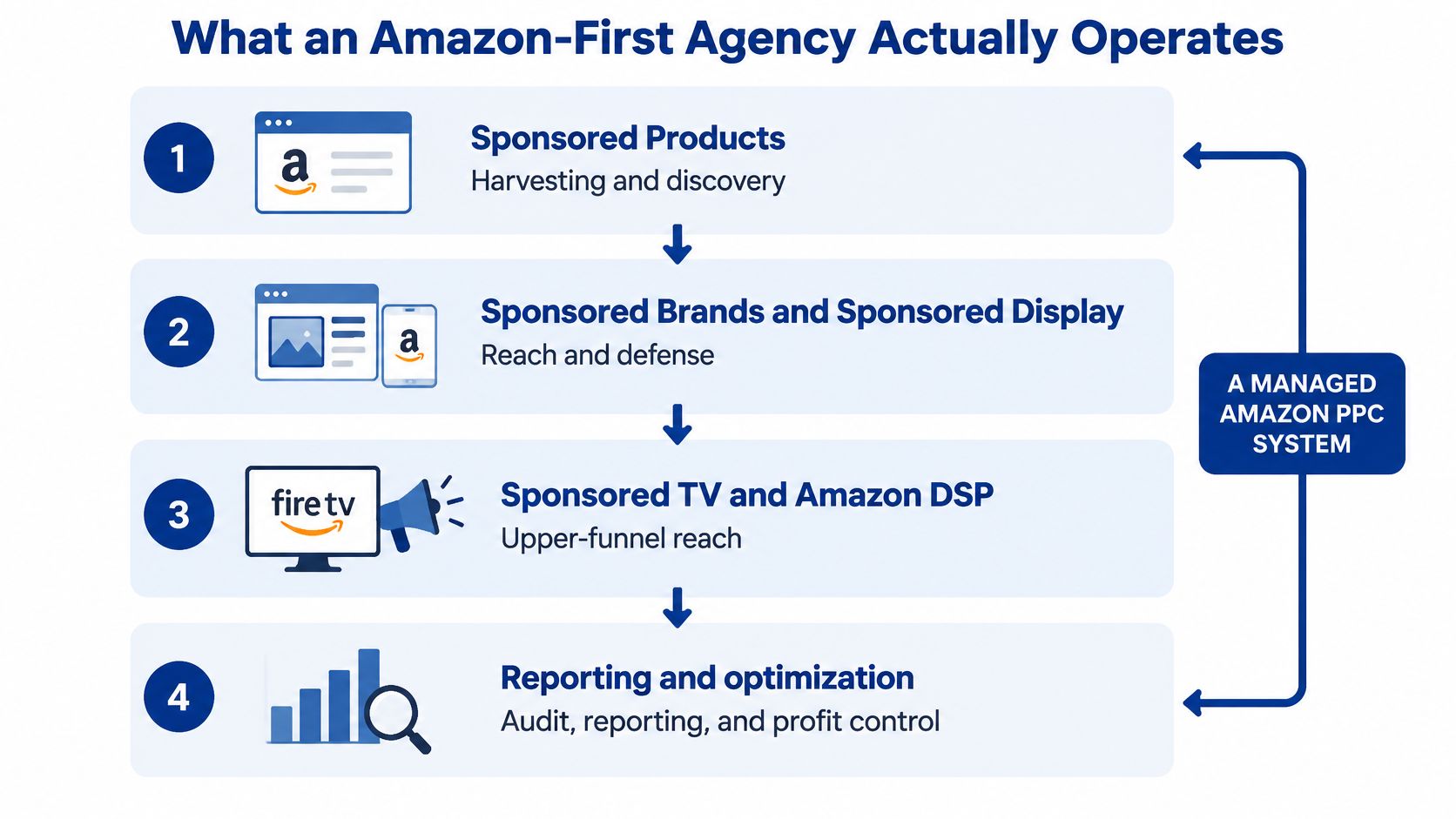
Four Operating Layers and the Decisions They Serve
- Sponsored Products for keyword-level profit: Discovery and exact-match harvesting campaigns capture active purchase intent, control wasted spend through search-term mining, and push core SKUs up organic search results.
- Sponsored Brands and Sponsored Display for reach and defense: Top-of-search banners, Store spotlights, and product-targeting placements claim branded real estate so competitors can't siphon buyers off your detail pages.
- Sponsored TV and Amazon DSP for upper-funnel audience buying: Programmatic display and streaming inventory reach 300 million average monthly U.S. ad-supported viewers across Amazon-owned properties and third-party publishers (measured internally between December 30, 2024, and January 28, 2025, per Amazon Ads audience data). Our Amazon DSP execution targets in-market segments, lifestyle and interest profiles, purchase behavior, custom audiences, and look-alike models, backed by creative A/B testing and mobile optimization.
- Amazon Marketing Cloud for privacy-safe measurement: AMC connects pseudonymized Amazon Ads signals with first-party inputs inside a secure clean room. We use AMC for campaign effectiveness analysis, budget allocation, frequency and reach control, creative insights, and ROI forecasting.
What separates an Amazon-first partner from an Atlanta generalist isn't just tool access. It's operational focus: managing bids against post-fee contribution margin, reading Search Query Performance to spot impression and click-share gaps, and treating detail-page copy and imagery as core conversion levers.
Watch how a structured marketplace system aligns paid media with organic visibility before you evaluate an agency's pitch deck.
Never sign a retainer before seeing what an agency finds inside your live data. Our free Amazon PPC audit examines organic visibility and ranking trends, brand share and competitive positioning, bleeder spend, targeting coverage gaps, target starvation, and campaign structure, alongside a free profit analysis. No media layer can outrun a weak product detail page, so verify how your prospective partner coordinates listing copywriting and A/B content tests before they raise a single bid.
Ten Questions That Reveal a Data-Driven PPC Partner
National averages never tell the whole story inside a major metro auction. As the LocaliQ/WordStream 2026 Google Ads benchmark report notes across 23 industries, local auction density, device mix, buyer intent, and landing-page friction shift real performance dramatically. A sharp agency segments accounts by Atlanta metro geography, branded versus non-branded intent, match type, and funnel stage, then links off-Amazon paid search to Amazon Attribution, new-to-brand orders, and cohort revenue instead of stopping at CTR.
Bring these ten questions into every agency pitch meeting. Score each answer as strong or weak on the spot.
Profit, Demand, and Incrementality Questions
- Which profitability metric do you manage to besides ACOS, and can you show contribution margin after fees, discounts, and fulfillment? Look for a complete P&L model or margin-based bidding rules. Walk away if they default to platform ROAS as the headline number.
- How do you separate branded, non-branded, and new-to-brand demand? Strong teams split branded from non-branded campaigns and report new-to-brand share separately. Blended account totals hide stagnant customer acquisition.
- What incrementality test will you run in my first 90 days? Demand a structured geo holdout, time-based control, or AMC experiment. Any agency relying solely on ad-console attribution isn't testing incrementality.
- How do you define and report organic lift? Expect tracking across keyword rank, organic sales share, branded-search lift, and TACOS. If they point to clicks and impressions, they aren't connecting paid media to unpaid growth.
Execution, Measurement, and Cadence Questions
- Where does PPC stop and content start in your model? Paid search and detail-page optimization have to move together through coordinated copywriting and A/B tests. Treating ads as standalone traffic sends paid clicks to leaky listings.
- What is your campaign structure and harvesting discipline? Listen for clear separation between discovery and harvesting campaigns, scheduled search-term promotion, and active negative targeting. Lumping everything into one campaign per product guarantees budget bleed.
- How do you use Search Query Performance and AMC? You want query-level funnel diagnostics and multi-touch audience evidence, not recycled Campaign Manager exports.
- What happens when platform-reported conversions and actual profit disagree? Strong operators rely on server-side or enhanced conversions, CRM revenue matching, and margin-based bidding rules. Weak agencies tell you to trust the ad platform's modeled numbers.
- What is your reporting cadence, and who owns the P&L conversation? Daily ACOS monitoring with quick bid adjustments (the exact discipline we recommend from our home goods work) paired with a monthly profitability review keeps both tactics and strategy aligned. A static monthly PDF with no P&L reconciliation is a red flag.
- What does onboarding look like in the first 30 days? The first month should audit wasted spend, targeting gaps, and campaign structure before scaling budgets. Pushing an immediate budget increase on day one means they haven't diagnosed the leaks.
| Question | Strong answer | Red flag |
|---|---|---|
| Which profitability metric do you manage to besides ACOS? | Contribution margin after fees, discounts, and fulfillment | ROAS as the headline metric |
| How do you separate branded, non-branded, and new-to-brand demand? | New-to-brand segmentation and branded-vs-nonbranded reporting | Blended reporting only |
| What incrementality test will you run in the first 90 days? | Geo holdout, time-based control, or AMC experiment | Platform attribution dashboards only |
| How do you define and report organic lift? | Keyword rank, organic sales share, branded-search lift, TACOS | Clicks and impressions |
| Where does PPC stop and content start? | Coordinated copywriting and A/B tests on the detail page | Ads treated as standalone |
| What is your campaign structure and harvesting discipline? | Discovery vs harvesting, search-term promotion, negative targeting | One campaign per product |
| How do you use Search Query Performance and AMC? | Query-level and audience-level evidence | Console metrics only |
| What happens when reported conversions and profit disagree? | Server-side or enhanced conversions, CRM revenue matching, margin-based bidding | Trust the platform number |
| What is your reporting cadence? | Daily ACOS monitoring plus monthly profitability review | Monthly PDF with no P&L |
| What does the first 30 days look like? | Audit of spend waste, targeting gaps, and structure before scaling | Immediate budget increase |
Pitch-room rule: If an agency scores fewer than seven strong answers on this table, don't ask for a fee quote. Keep looking.
Case Studies Where PPC Built Organic Demand
Real marketplace growth shows up when paid search triggers unpaid rank gains that outlast a bid adjustment. Look at four before-and-after examples where disciplined PPC functioned as a lever for organic equity rather than a permanent tax on sales.
Tight Keyword Sequencing Before Scaling Reach
Between April and June 2025, Rosy Soil resisted the urge to bid across broad gardening terms right away. According to the Amazon Ads Rosy Soil case study, the brand concentrated exact-match Sponsored Products campaigns strictly on cactus and succulent keywords to establish organic ranking and review velocity before expanding into broader, higher-volume queries.
For a senior leader reviewing that launch, immediate ACOS isn't the verdict. The right scorecard tracks keyword rank, organic sales share, detail-page conversion rate, contribution margin, and branded-search lift beside ROAS.
Aligning PPC and Listing Copy as One System
A ranking push fails fast when paid traffic hits an underperforming listing. In a documented Nectar organic keyword ranking case study, coordinating account management, advertising, and copywriting around high-impact keywords lifted monthly sales 214% in the first month and 61% in the second month while cutting TACOS 73% down to 8.21%.
That drop in TACOS is the proof point P&L owners should demand. Paid ads drove qualified traffic, upgraded copy converted it, and rising organic revenue reduced ad dependence across the entire catalog.
Separating Real Momentum From Raw ROAS
High ROAS numbers still need an organic verification check. A ROI Room pet-supplies case study reported a 500% surge in Sponsored Product sales alongside a 1,471% ROAS ($14.71 in revenue per $1 spent), with organic rankings and organic revenue climbing at the same time. Never assume organic growth came from ads automatically; verify it with keyword-level rank logs, non-ad sales, branded versus non-branded revenue splits, and post-test holdout performance.
Investing Paid Spend to Double Market Share
In our own lifestyle brand case study at Headline, we treated PPC as a deliberate investment in organic visibility rather than an isolated traffic expense. That strategy doubled the brand's market share and increased organic visibility by 156%, proving that structured paid campaigns can lower long-term customer acquisition costs when tied to ranking objectives.
Fund a tight keyword cluster, confirm listing relevance and retail readiness before raising bids, and evaluate the outcome by combined paid and organic revenue plus TACOS over a fixed testing window.
What an Atlanta PPC Retainer Should Buy
Evaluating a PPC agency in Atlanta starts with understanding the local talent and auction environment. According to the Outdoor Advertising Association of America 2025 local ad spend report, Atlanta's 2025 local advertising market totals roughly $961.3 million, with digital channels capturing about $413.9 million, or 43.1% of total local spend. Because regional, national, and marketplace advertisers all compete for both auctions and senior strategists in Atlanta, staff turnover and account ownership matter just as much as the monthly fee.
Before you compare dollar quotes, compare incentives. Every pricing structure nudges an agency toward different behavior.
| Pricing model | What it rewards | Hidden trade-off |
|---|---|---|
| Flat monthly retainer | Predictable scope and consistent effort | Can under-serve the account during Q4 or peak launch windows |
| Percentage of ad spend | Spend growth, which raises agency revenue | Can quietly reward overspending on marginal clicks |
| Hybrid base plus performance fee | Base operational coverage plus profit-linked upside | Needs a clean contribution-margin definition or it optimizes the wrong metric |
What Must Appear in Writing Before You Sign
Never evaluate a monthly fee without the exact deliverable list attached to it. For deeper pricing benchmarks across engagement models, review our breakdown of the cost of PPC management before negotiating terms.
Full-scope marketplace management should include Sponsored Products, Sponsored Brands, and Sponsored Display execution, structured creative testing, Search Query Performance and AMC analysis, and a monthly P&L review. Require every proposal to put six items in writing:
- Primary target metric: The exact profitability figure the team manages to each month, not a vague promise of "growth."
- Reporting cadence: Weekly tactical updates and a monthly margin review tied to total business revenue.
- Named account operators: The actual strategists managing your bids versus the sales director leading the pitch.
- Contract term and exit clause: Minimum lock-in length, notice window, and performance review milestones.
- Ad account ownership: Written confirmation that your brand owns all ad accounts, historical data, and creative assets from day one.
- Pre-contract diagnostics: Confirmation that account audits and profit reviews carry zero fee, the way we offer both a free Amazon PPC audit and a free profit analysis before a brand commits.
Watch closely for hidden add-ons. Creative production, DSP management fees, and third-party analytics seats are frequently billed outside the headline retainer, so demand an all-in monthly total cost view before comparing two proposals side by side.
The 2026 Traps That Sink PPC Profitability
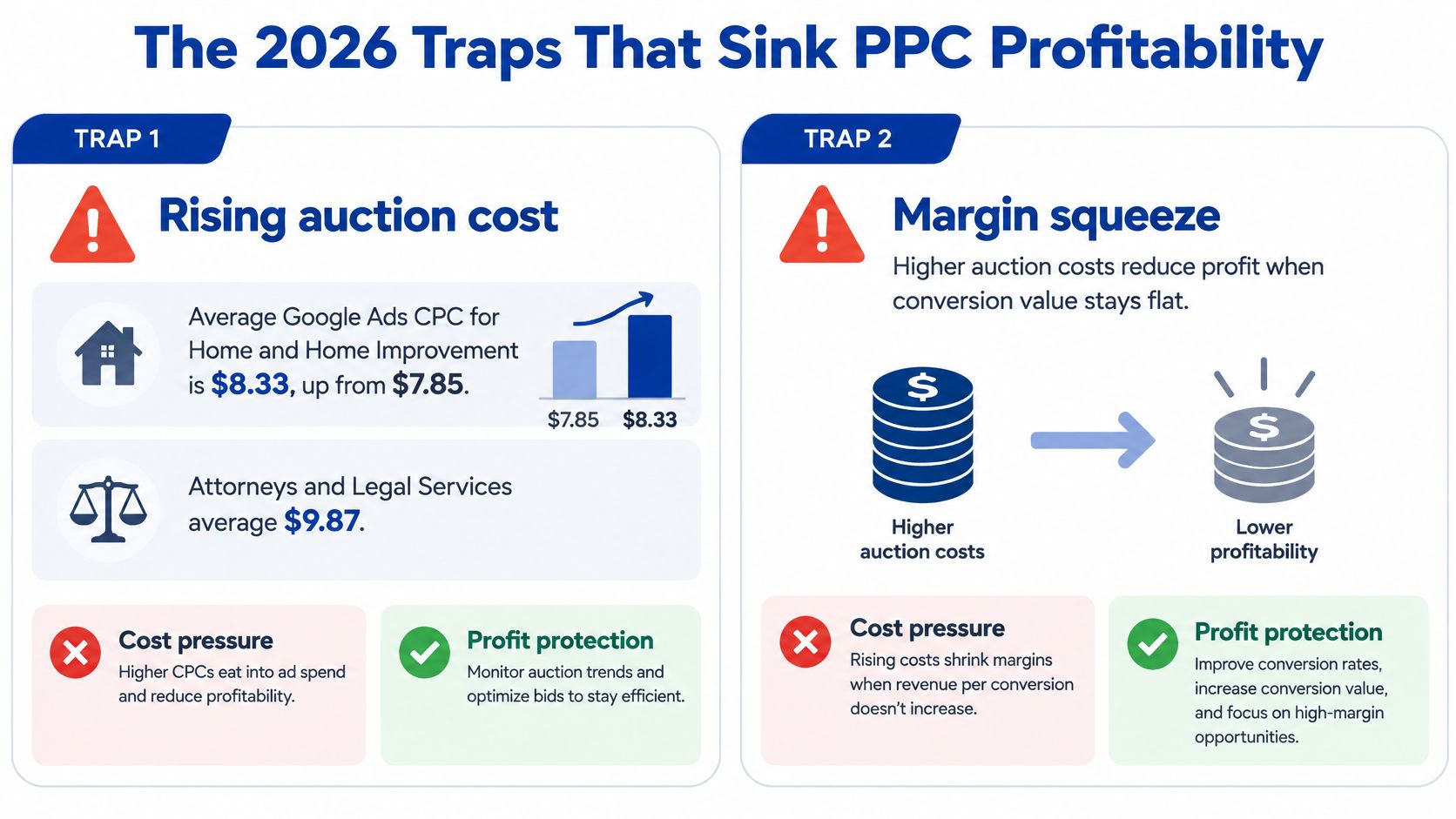
Even a sharp brand can bleed cash if its agency runs a 2022 playbook in 2026 auctions. Two structural pressures now punish autopilot management, and both require written safeguards before you hand over account access.
Trap 1 Rising Auction Costs Without a Margin Plan
Click inflation isn't slowing down in competitive U.S. verticals. Industry data cited in Make It Loud's analysis of rising PPC costs shows average Google Ads CPC reaching $8.33 for Home and Home Improvement (up from $7.85 the prior year) and $9.87 for Attorneys and Legal Services.
When CPCs climb while average order value stays flat, the exact same monthly budget buys fewer clicks every quarter. Any agency promising flat lead or order volume without a margin-per-click plan is guessing with your cash.
Written safeguard to demand: Require a quarterly volume forecast built directly from contribution margin per click, with pre-agreed bid ceilings that automatically throttle spend when unit economics slip below target.
Trap 2 Measurement Gaps and Unchecked Automation
Privacy restrictions, ad blockers, and cookieless tracking have widened the gap between platform-reported conversions and actual bankable revenue. At the same time, automated campaign types strip away manual keyword controls and push budgets toward easy-to-attribute demand while hiding delayed purchases, returns, assisted conversions, and marketplace fees.
Automation isn't always efficient. Left unmonitored, algorithms chase low-friction conversions that would have closed organically anyway, making the dashboard look green while net profit shrinks.
The disagreement rule: Whenever platform conversions, modeled conversions, and actual profit disagree, your P&L wins every time.
Written safeguard to demand: Put server-side or enhanced conversions, CRM revenue matching, new-to-brand segmentation, placement exclusion rules, and AMC or holdout validation into the statement of work. In 2026, a trustworthy partner brings a reconciled profit report to your monthly call, not a cropped dashboard screenshot.
Book the Second Call Only After the Audit
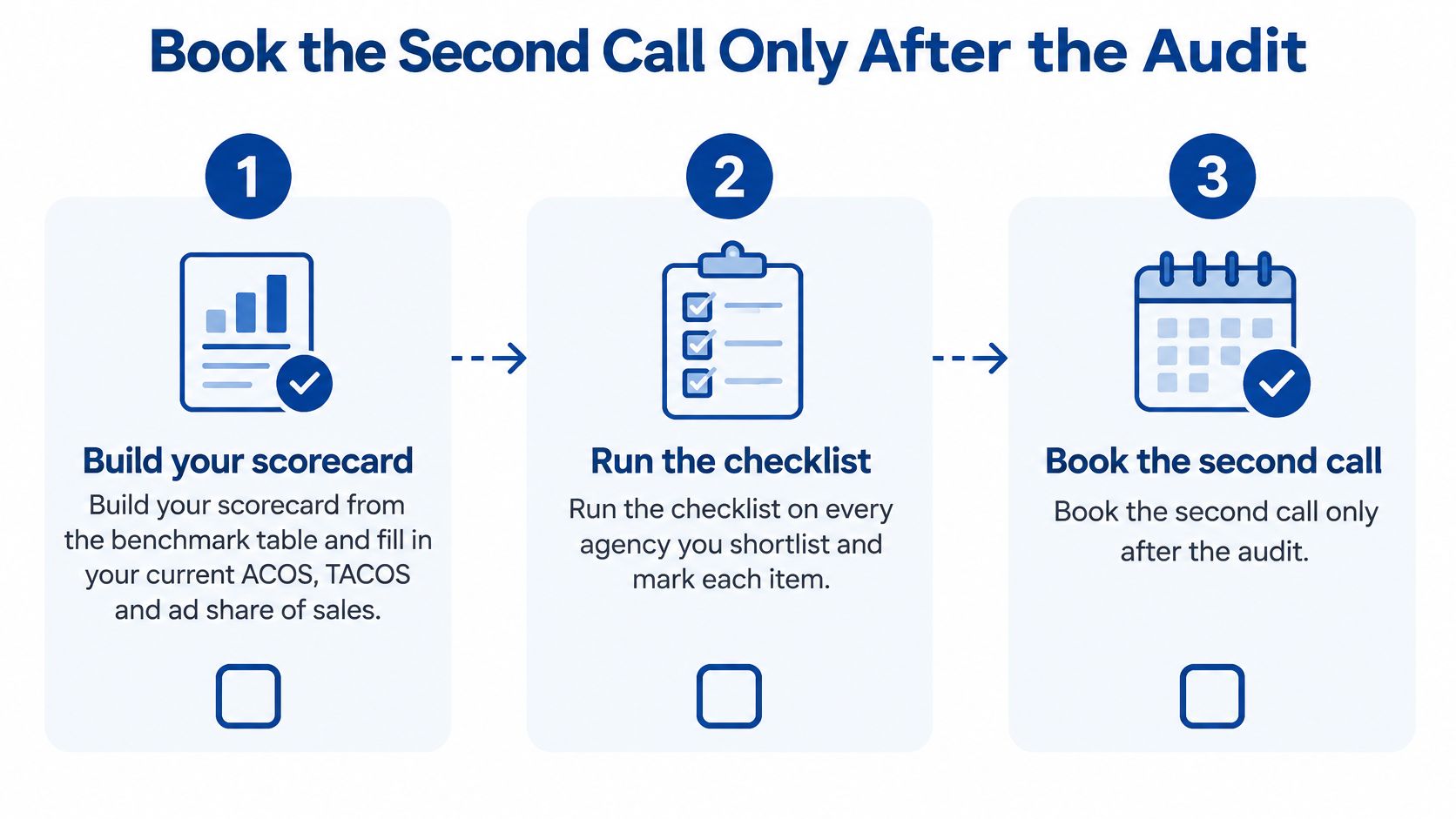
A second call is earned, not scheduled. Make every Atlanta PPC agency prove incremental profit and organic lift on your account data before anyone quotes a retainer.
Run this five-step sequence on every shortlisted PPC agency in Atlanta and every Amazon specialist you still have in the room.
- Build your baseline scorecard. Pull the benchmark table from this guide and fill in current ACOS, TACOS, ad share of total sales, and unit contribution margin. Walk into the call already knowing those numbers.
- Run the ten-question checklist. Score each agency against the strong-answer and red-flag criteria. Drop anyone who hides behind blended ROAS.
- Require a free audit before any contract. Demand findings on wasted spend (bleeder analysis), targeting coverage and gaps, target starvation, missed opportunities, campaign structure, bid strategy, and organic ranking trends. Judge the work, not the slide design. The PPC auditing service framework is the bar for what that review should cover before the next sales call.
- Define a focused 90-day test. Lock one priority keyword cluster, one listing content upgrade tied to that cluster, and one incrementality check. Tie all three to a post-fee profit metric you can read on the P&L.
- Negotiate fees and terms last. Compare retainers, contract length, and total all-in cost only after a partner has shown they understand your unit economics.
Headline Marketing Agency has managed more than $250 million in revenue, and its onboarding follows that order: a free Amazon PPC audit and a free profit analysis, then a strategy conversation that walks Amazon PPC performance line by line. The analytics behind that review include Search Query Performance diagnostics and Amazon Marketing Cloud insights.
Hire the agency that puts post-fee contribution margin and organic lift beside ROAS. That is the partner set up to scale profit, not ad spend.
Headline Marketing Agency offers that free Amazon PPC audit and free profit analysis. Request it, then review waste, targeting gaps, and organic growth with an Amazon advertising strategist before you sign any retainer.
Get Your Free Amazon PPC Audit
Discover untapped growth opportunities and see how our data-driven approach can improve your ROAS.
Get Free Audit →Ready to Transform Your Amazon PPC Performance?
Get a comprehensive audit of your Amazon PPC campaigns and discover untapped growth opportunities.