What Is Amazon Live? a Brand Guide to Shoppable Streams
What Is Amazon Live? Learn how shoppable streams work, which KPIs prove results, and when to launch your first show.

Amazon Live is Amazon's shoppable livestream, where brands and creators demonstrate products in real time and viewers can buy featured items without leaving Amazon. But treating it as a last-click sales tactic misses the more useful question: did the broadcast change what comparable shoppers searched for, considered, and bought afterward?
The popular advice is to find a creator, demonstrate a product, and measure sales. That's a production plan, not an investment case. For a brand leader, the decision starts with the customer question a demonstration can answer and ends with evidence that the answer created profitable demand.
What Amazon Live Is and Why Brands Should Care
Think of Amazon Live as a demonstration counter on the shopping floor, with checkout close at hand. A host can show how a product works, respond to objections, and help shoppers judge whether it suits their needs.
Say you sell a cordless vacuum. A polished listing can describe its attachments, but a live demonstration can show how the host switches from upholstery to a narrow stair tread. The useful content isn't another claim about versatility. It's the visible answer to a purchase objection.
A format built around retail moments
Modern Retail's account of Amazon Live's development traces its launch to February 2019, following Prime Day video experiments in 2017 and 2018; the Live Creator app arrived in February 2019 and expanded to Amazon Influencer Program members in July 2020. The same account describes Amazon reporting more than 1,200 live shows during Prime Day 2020, while Marketplace Pulse put active viewers at fewer than 1,000 on a typical day, compared with approximately 30,000 to 70,000 during Prime Day 2021.
Those are historical audience figures, not a current traffic forecast. Their practical lesson is that timing matters: don't assume shoppers will discover a broadcast because you've scheduled it.
Practical rule: Build the stream around a shopping reason, not around an empty slot in the content calendar.
Where the format earns its place
Amazon Live combines product education, creator persuasion, real-time engagement, and purchasing. That makes it a plausible fit for launches, seasonal shopping, and products whose benefits become clearer through use.
For broader content planning, FLYP LTD's resource on live shopping for brand engagement offers a useful adjacent perspective. On Amazon, keep that engagement tied to a retail question: what uncertainty will the host remove, and what should the shopper do next?
A broadcast that answers a meaningful objection has a job. A broadcast that merely repeats the listing needs a stronger reason to exist.
How a Shoppable Livestream Works, Step by Step
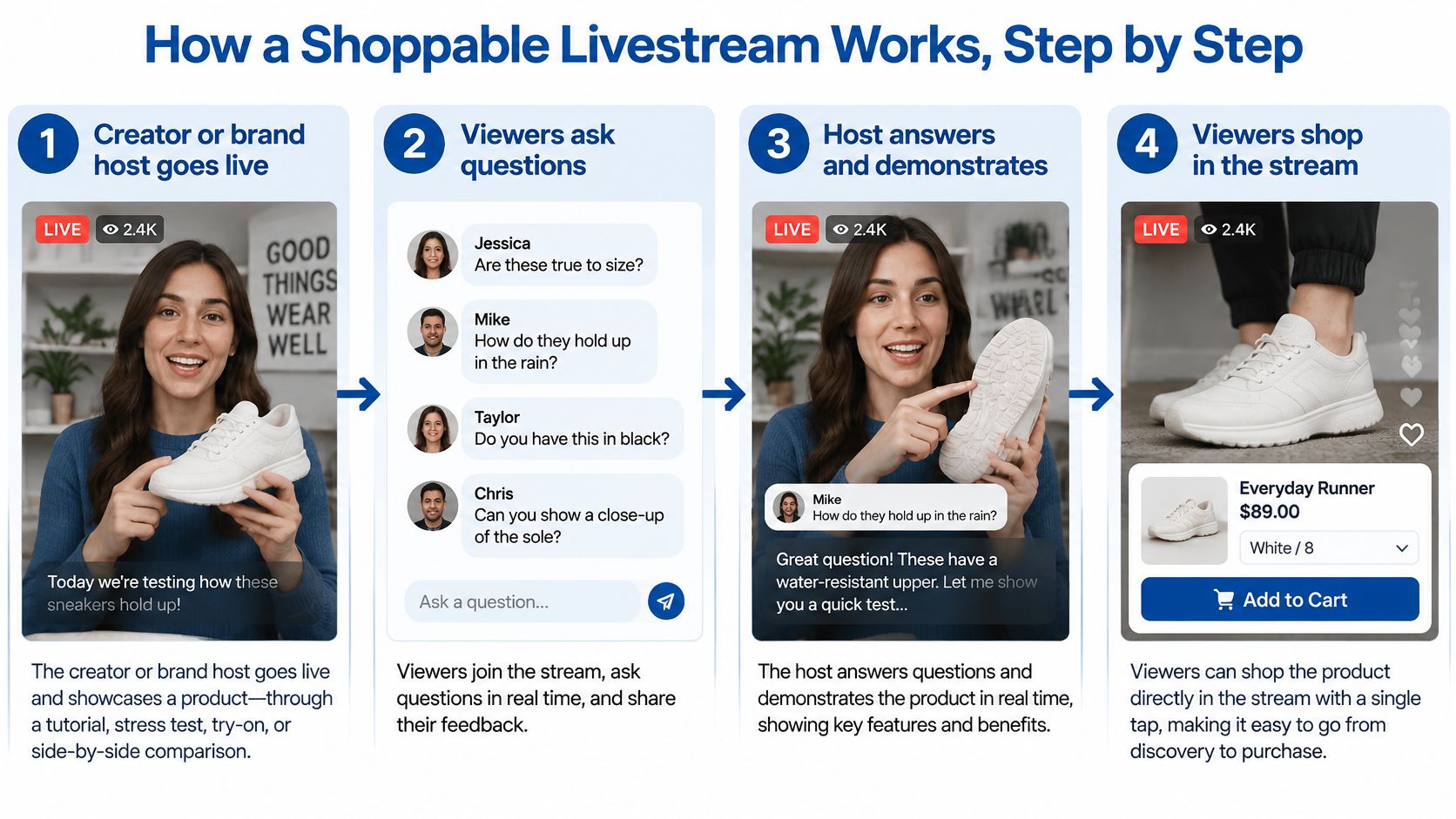
The viewing experience connects demonstration, conversation, and product selection. Amazon's livestream overview describes the shoppable format, including interactive chat and selectable products alongside the video.
Follow the shopper's path
The host demonstrates a product. A tutorial, stress test, try-on, or side-by-side comparison gives viewers something concrete to evaluate. Pick the demonstration that proves the benefit shoppers already hesitate about, not the one that is easiest to perform on camera.
Viewers ask questions in chat. The host can answer while the product is still in hand. Treat questions about fit, maintenance, compatibility, or ingredients as live objections, and answer them in language a shopper could repeat back to themselves at the detail page.
The product carousel keeps items selectable. Viewers can inspect featured products or add them to cart without leaving the stream. The host should name the exact item and variant being shown, especially when sizes, bundles, or model numbers look similar.
Product highlights synchronize with the video. Amazon IVS uses timed metadata to connect product-selection events with specific broadcast moments. The operational check is simple: the highlighted item must match what the host is demonstrating at that second.
The shopper follows the relevant detail-page path. The stream creates a reason to investigate; the detail page must finish the job with clear images, specifications, availability, pricing, and variant logic. If the live moment sends shoppers to a confusing selector or an out-of-stock child ASIN, the host's credibility cannot recover the click.
Produce measurable moments
Build the run-of-show around objection, demonstration, product highlight, and target action. For the vacuum example, show the upholstery attachment, answer the fabric-care question, highlight the correct bundle, and invite viewers to inspect its included accessories.
Assign one target event to each segment: product click, detail-page visit, add-to-cart, or purchase. Confirm which events your reporting route exposes before promising segment-level attribution. A timestamp can suggest that a demonstration mattered; it cannot prove causality unless later search, detail-page, and conversion behavior moves against comparable shoppers.
If your team also plans creator commerce on other channels, Sup's resource on TikTok Shop affiliate marketing is useful for comparing incentive structures, but keep Amazon Live planning tied to Amazon detail pages, carousel cues, and the reporting your account can access.
Before rehearsal, draft a one-page production sheet with five fields: product, shopper objection, demonstration cue, highlight cue, and desired action. Judge the format as demand generation: did the broadcast give undecided shoppers a reason to search, compare, and return with more intent?
Who Can Go Live and What Each Route Requires
Eligibility comes before production. Amazon Live isn't available to every seller, and hiring a host doesn't automatically resolve account access.
Use Amazon's seller eligibility requirements to validate the brand and creator routes. Treat market access as a separate approval question, not as a benefit that follows automatically from having a seller account.
Eligibility requirements by livestream route
| Route | Who Qualifies | Core Requirements | What to Verify First |
|---|---|---|---|
| Brand-produced livestream | Professional seller or vendor account | Brand Registry enrollment with Brand Representative or Brand Rights Owner role; approved and published Brand Store; active selling on Amazon.com | Registry permissions and Store publication status |
| Community creator route | Creator at least 18 years old, under Amazon's seller eligibility requirements | Active Influencer Storefront, or authorization to livestream for an eligible seller or vendor | Written authorization from the eligible seller or vendor when using that route |
| Market and program access | Select advertisers in the United States | Live Shopping is described as a beta product for select advertisers | Whether the account has beta access before building a multi-market plan |
Access is an operational dependency
The brand route requires coordination between whoever owns the selling account, whoever manages Brand Registry, and whoever controls the Store. Those may be different people inside an established consumer business.
Ask the account owner to confirm the actual role and publication status, not just whether the brand is registered. Then have the intended operator verify that they can access the relevant livestream workflow.
For a creator partnership, document who can broadcast, which products they may feature, and who approves product claims. Written authorization is a sensible governance step when the creator is acting for your business; don't substitute a commercial agreement for a functional access check.
Taja AI's TikTok LIVE guide is useful for teams comparing platform access processes. Keep the approvals separate: eligibility on another platform doesn't establish permission to livestream on Amazon.
Approve the route and operator before approving the shoot.
This week's useful deliverable is an eligibility sign-off, with an accountable owner for the account, Store, creator permissions, and market access. If any element remains unresolved, keep production spending provisional. Retail readiness is a prerequisite, not an administrative task to finish after filming.
Where Brands Use Amazon Live and What Results Look Like
Creator broadcasts can appear on Amazon.com/live and may receive additional onsite placements. That doesn't mean every broadcast receives every placement, so distinguish confirmed distribution from potential exposure.
A launch campaign for a kitchen appliance, for example, could use a host to demonstrate setup and cleaning while supporting retail media captures subsequent product interest. The business case depends on the distribution secured, not the maximum audience the platform could theoretically reach.
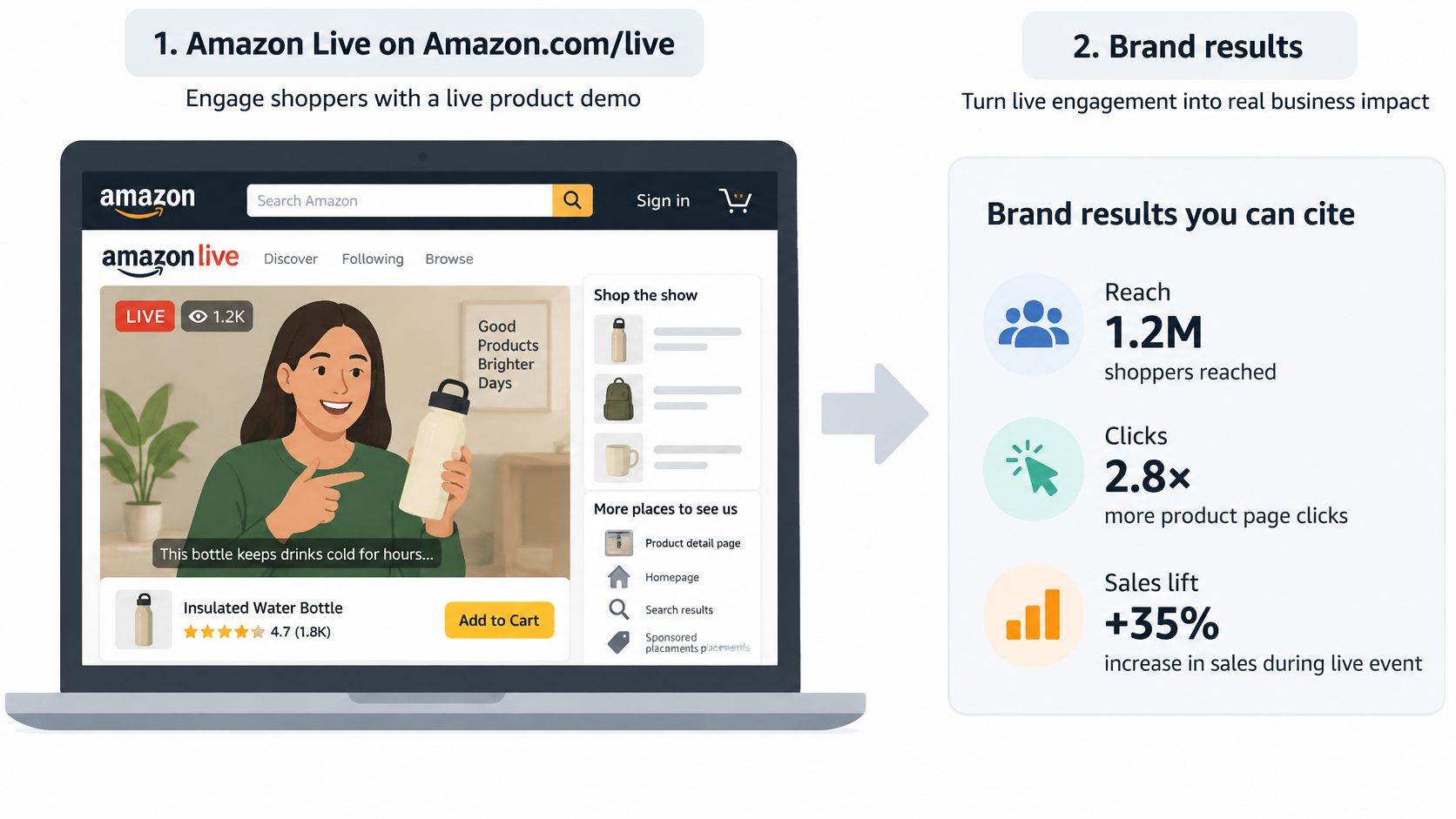
Amazon Live scale and reported results
The market and campaign figures below come from RetailWire's reporting on Amazon's livestream shopping expansion, which also describes the dedicated Prime Video and Fire TV shopping channel introduced in 2024.
| Figure | Value | How to read it |
|---|---|---|
| U.S. livestream-commerce revenue, 2023 | $31.7 billion | Tripled from 2021 to 2023; RetailWire |
| 2026 forecast | $68 billion | RetailWire forecast, not a confirmed result |
| Share of e-commerce | About 3% U.S. vs about 60% China | Reported market context, not Amazon Live's share |
| 2023 Amazon Live audience | More than 1 billion customers in the U.S. and India | RetailWire; streamed shoppable videos, not a concurrent audience |
| Prime Day 2020 programming | More than 1,200 live shows | Amazon's historical programming figure; event activity, not typical daily activity |
| Exposed vs unexposed purchase rate | 17x higher median | Amazon internal analysis of 20 U.S. campaigns, May 1 to October 31, 2024; Live plus another ad product; directional |
| Brand followers vs non-followers | 81% more views; 95% higher CTR | Matt Stern via Retail TouchPoints, 2025 |
| Creator followers | 94% more watch time; 25% more content viewed | Same Retail TouchPoints reporting |
The follower figures were published by Retail TouchPoints in 2025, citing Amazon executive Matt Stern: brand followers generated 81% more views and a 95% higher click-through rate than non-followers, while creator followers spent 94% more time watching and viewed 25% more content.
Read the evidence without overbuying the promise
The campaign comparison combines Live exposure with another advertising product. It doesn't isolate the effect of the livestream, and a median from a limited campaign sample isn't a revenue forecast for your brand.
Follower comparisons also describe different audience groups. People who already follow a brand or creator may have stronger interest before the broadcast begins.
Use these results to justify a controlled test, not a guaranteed-return claim. For launches and seasonal events, secure a credible distribution plan and ask whether the demonstration can improve product consideration. Don't buy production on platform-scale numbers alone.
Metrics That Prove Amazon Live Is Working
Evaluate Amazon Live as a full-funnel media investment, not a single sales total. The diagnostic question is where shoppers stop progressing: before viewing, during the demonstration, after clicking, or after reaching the listing.
Amazon's reporting framework includes impressions, reach, views, detail-page views, add-to-cart actions, and total sales. Brand-produced reporting can also include followers, follower growth, unmuted views, watch hours, average view duration, product clicks, minutes streamed, and livestream count.
Amazon Live metrics, what each diagnoses, and how to read it
| Metric | What It Diagnoses | How to Read It |
|---|---|---|
| Impressions and reach | Distribution: whether the stream is being seen | Low reach warrants checking promotion and placement before blaming the host |
| Views and unmuted views | Interest in the stream | Compare views with reach to identify weak entry into viewing; unmuted views add context |
| Average view duration and watch hours | Content retention | Short duration warrants reviewing the opening, pacing, and audience relevance |
| Product clicks | Merchandising engagement | Clicks per view help assess whether the host and carousel generate product interest |
| Product-detail-page views | Consideration | Detail-page activity indicates investigation beyond watching |
| Add-to-cart actions | Purchase intent | Add-to-cart per detail-page visit helps identify listing or offer friction |
| Total sales, direct plus halo | Downstream demand | Separate featured-product purchases from attributed purchases beyond those products |
| Followers and follower growth | Audience building | Track whether broadcasts develop a repeat audience over time |
These are diagnostic readings, not automatic verdicts. Short viewing duration might reflect a weak demonstration, but it could also reflect poorly matched traffic. High clicks with weak add-to-cart activity should prompt a listing and offer review before a new production brief.
Use rates and consistent denominators
Calculate product clicks per view and add-to-cart actions per detail-page visit where compatible reporting is available. Keep the definitions and reporting windows consistent between broadcasts.
Don't call the second calculation a purchase conversion rate. Adding to cart signals intent, not a completed order.
A broader customer engagement measurement framework helps separate attention from meaningful action. Watch time is valuable when shoppers learn something that moves them toward consideration, not because the host kept talking.
Measurement discipline: Diagnose distribution, content, and retail conversion separately before changing the budget.
Respect the reporting clocks
According to Amazon's Amazon Live reporting information, metrics begin populating 72 hours after a broadcast, deep analysis should wait at least two weeks, livestream-level historical data remains accessible indefinitely, and channel-level reporting covers the prior 180 days.
A different interface has different retention rules: Amazon's Creator App documentation says creators can review livestream results for one year, while the metrics graph displays the previous six months.
Record which interface produced each export. Don't assume the brand reporting window applies to a creator's dashboard, or compare an immature broadcast report with a fully developed campaign report.
Export the relevant results into your own reporting process while they're available. Review immediate conversion separately from halo outcomes, and include production, creator, promotion, and discount costs when judging profitability.
Does Amazon Live Create New Demand or Just Capture Sales
A stream can produce sales without creating demand. If the audience was already close to buying, the broadcast may have captured an existing purchase rather than changed the outcome.
Amazon's announcement about Live signals in Amazon Marketing Cloud reports that, using a 14-day attribution window, audiences exposed to Amazon Live had a 2.5x higher purchase rate, 7.6x higher detail-page-view rate, and 9.7x higher branded-search rate than audiences exposed to other ads; it also dates the Live signals integration to June 2025.
Those comparisons support a consideration hypothesis. They don't prove incrementality because audience selection, campaign setup, creator quality, and brand investment can differ between groups.
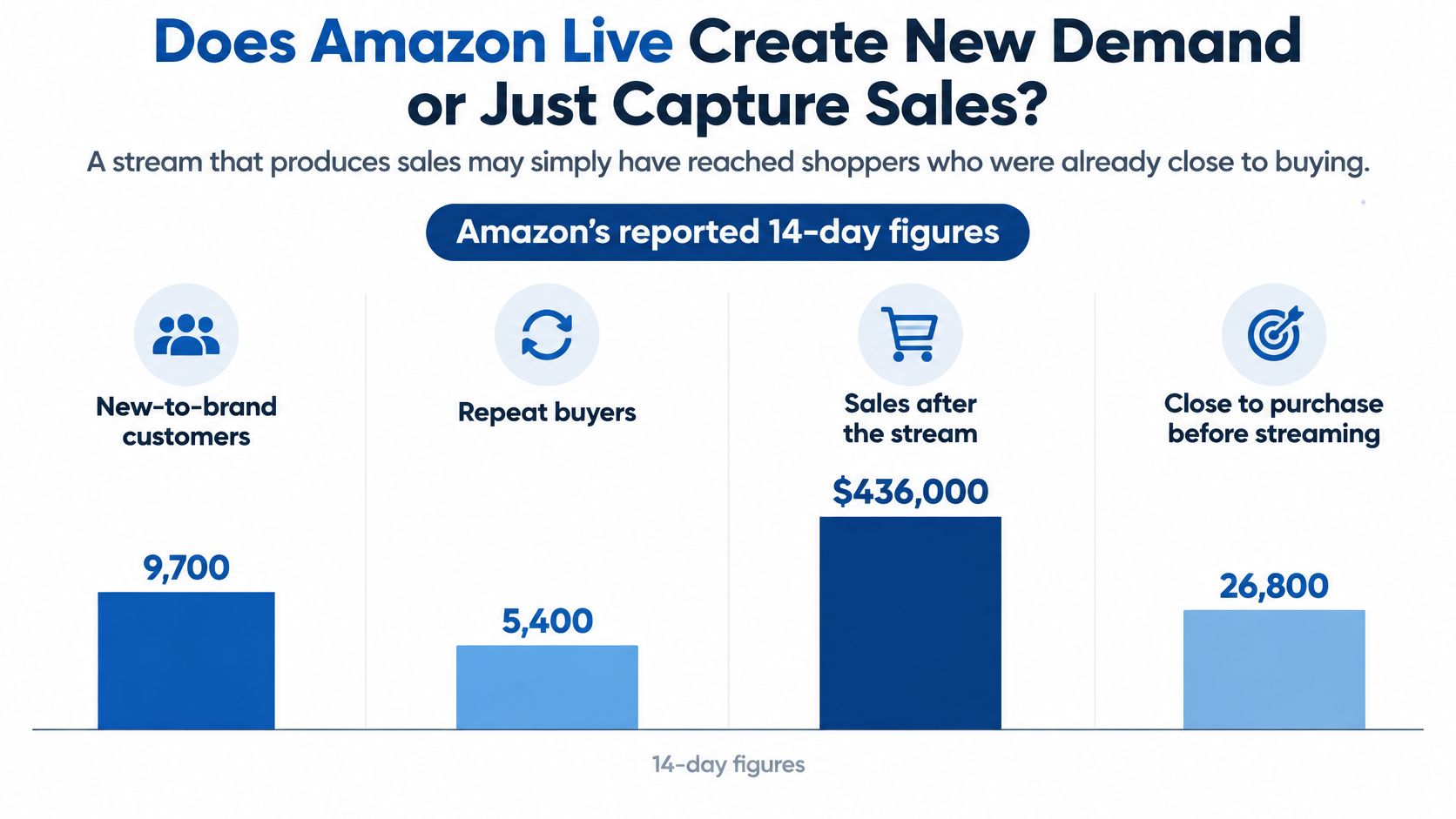
Design a comparison that can challenge the result
Amazon Marketing Cloud, or AMC, is a secure, privacy-safe, cloud-based clean room that lets advertisers analyze pseudonymized signals, including Amazon Ads signals and their own inputs. Connecting exposure with shopping behavior supports better analysis, but the analyst still needs a credible comparison.
- Define the hypothesis. Specify whether the stream should increase branded search, attract new-to-brand shoppers, improve consideration, or generate additional purchases.
- Build comparable groups. Use randomized exposure or a holdout where feasible. Otherwise, match exposed and control audiences on prior shopping behavior and advertising exposure, and acknowledge remaining selection bias.
- Compare change, not just totals. Examine branded-search behavior, detail-page engagement, and purchases over equivalent windows. Check whether groups differed before exposure.
- Separate customer and product outcomes. Examine new-to-brand behavior alongside repeat purchases. Distinguish direct sales associated with featured products from halo purchases attributed beyond them.
- Include delayed conversions. Don't restrict the test to orders placed while the host is live. Define the observation window before reviewing the result.
The difference between attributed sales and incremental revenue matters because attribution assigns credit, while incrementality asks what wouldn't have happened otherwise. A matched comparison can strengthen the evidence, but it shouldn't be described as randomized proof.
Connect the result to PPC and profitability
Say exposed shoppers later search for the brand and convert through Sponsored Products. A last-click report can credit PPC while overlooking the earlier demonstration.
The opposite mistake is to credit Live for every later purchase. Compare the change against the control group, then subtract the relevant campaign costs.
Headline's point of view is to use PPC as a lever for profitable growth and later organic demand, not just as an attribution endpoint. Test whether coordinated exposure and search coverage improve overall economics and organic performance. Don't assume paid exposure automatically improves organic ranking.
Amazon Live earns investment when it changes future search, consideration, and conversion relative to comparable shoppers, not merely when it appears somewhere in a buyer's journey.
Set Up Your First Stream and Decide If It Fits
Approve a pilot only when the account, retail offer, distribution, and measurement plan are ready. A good host can't fix unavailable inventory or an undefined success criterion.
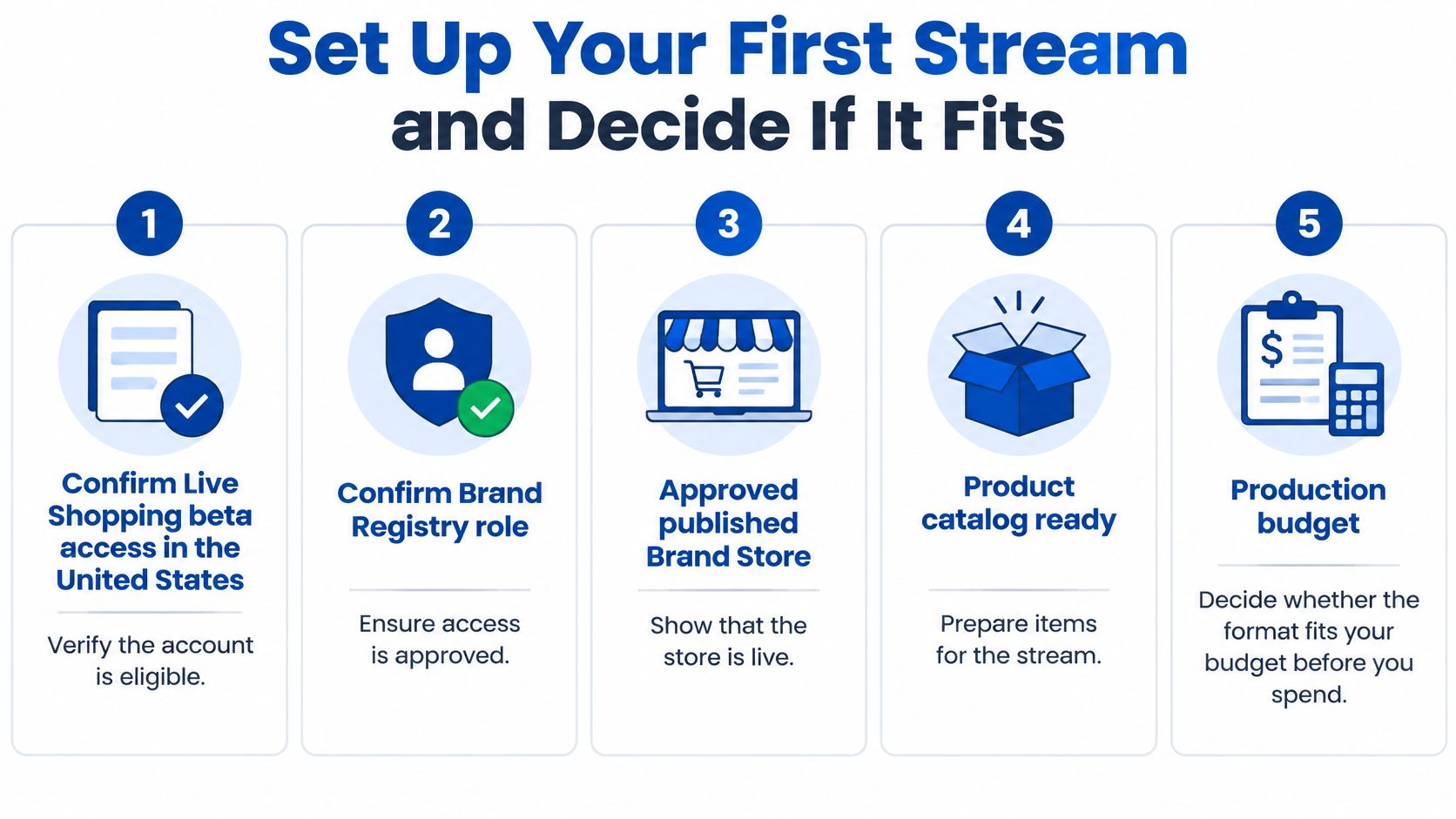
Clear the launch checklist
- Confirm program access. Verify the intended U.S. account can use Live Shopping before committing to a wider rollout.
- Approve the retail destination. Confirm the Brand Registry role, published Brand Store, and product-carousel selection. Test the exact variants shoppers will encounter.
- Align stock and deals. Check availability, promotion timing, and margin after discounts. Don't demonstrate a bundle that shoppers can't buy.
- Document creator permissions. Confirm the applicable Influencer Storefront or authorization route, product claims, and approval owner.
- Assign moderation. Prepare responses for compatibility, safety, shipping, and returns questions. Give the moderator a clear escalation path.
- Prepare tracking. Agree on product clicks, detail-page views, add-to-cart actions, sales, and the comparison design before production.
- Fund distribution. Include promotion alongside production and creator costs. Amazon's Live Shopping support documentation recommends paid media across social and digital channels to reach relevant audiences.
- Schedule the readout. Assign an analyst and export owner, and allow reporting to mature before deciding whether to scale.
Make a yes-or-no decision this quarter
Say yes when a demonstration can resolve a meaningful buying objection, the products are retail-ready, and your team can evaluate lift. Say no when the plan depends on free discovery, instant reporting, or an always-on format with little operational support.
If live interaction adds little value, start with a focused product video for Amazon. Use the simplest format that answers the shopper's question.
At Headline, we've managed more than $250 million in Amazon revenue. Our AMC services connect clients' advertising and first-party data to generate insights, which helps frame this decision around customer behavior rather than a broadcast sales total.
Pair the pilot with disciplined PPC coverage, protect contribution margin, and measure whether later branded demand and organic performance improve. Scale the evidence-backed combination, not the livestream in isolation.
Headline Marketing Agency offers Amazon PPC, DSP, AMC, and analytics services to connect media investment with profitable marketplace growth. Visit Headline Marketing Agency to discuss an Amazon Live measurement plan, coordinated search coverage, and the evidence your team needs before increasing spend.
Get Your Free Amazon PPC Audit
Discover untapped growth opportunities and see how our data-driven approach can improve your ROAS.
Get Free Audit →Wollen Sie Ihre Amazon PPC-Performance aufs nächste Level bringen?
Lassen Sie Ihre Amazon PPC-Kampagnen professionell analysieren und entdecken Sie neue Wachstumsmöglichkeiten.