A Profit-Driven Guide to Product Video for Amazon
Amazon success comes from consistent fundamentals. Our Amazon product video playbook is behind 4.2x average ROAS for clients.

A high-performing product video for Amazon isn't just another piece of creative. It's a strategic asset—a direct-response tool that demonstrates value, preemptively answers customer questions, and compresses the journey from consideration to conversion. For mid-to-senior eCommerce leaders, viewing video as anything less than a core driver of profitable growth is a critical misstep.
It’s a direct lever for improving conversion rates, lowering customer acquisition costs, and building a more defensible brand on the platform.
Why Amazon Product Videos Are a Core Profit Lever
"Engagement" is a vanity metric. Profit is not. On Amazon, video's sole purpose is to drive performance. It's a calculated investment in your conversion rate that delivers measurable returns, from higher click-through rates on your PPC campaigns to a stronger organic rank—the flywheel that underpins sustainable scale.
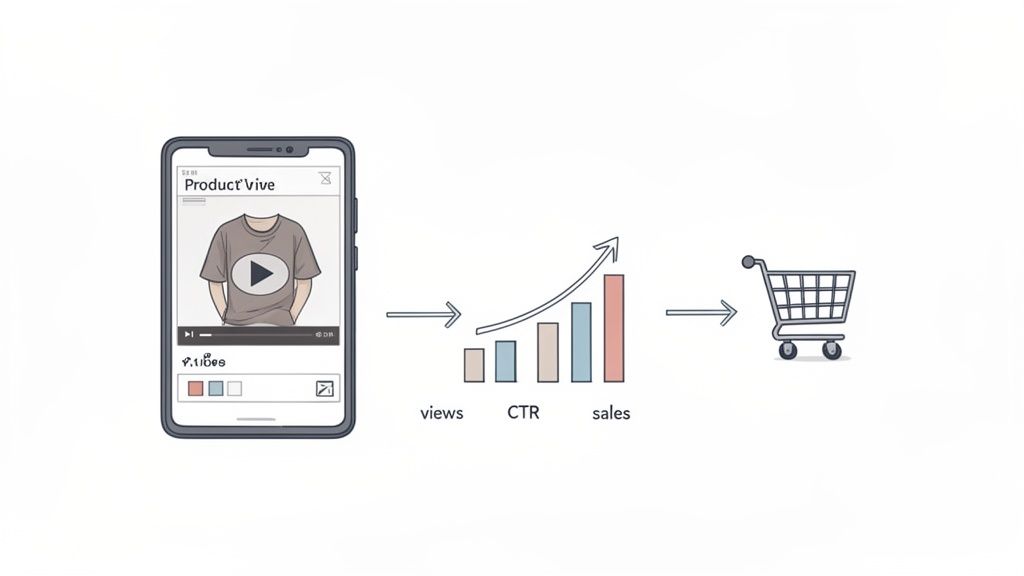
The data from Amazon itself is unequivocal. Brands leveraging Sponsored Brands Video consistently outperform those relying on static images. The average click-through rate (CTR) for these video ads is 0.89%, which is 2.6 times higher than standard image ads.
More importantly, they convert at 11.2%—a 13% lift over static formats. When you factor in that shoppers who watch a product video are up to 3.6 times more likely to buy, the business case becomes undeniable. You can read the full research on how video impacts Amazon advertising directly from the source.
Bridging the Digital-Physical Gap
Static images fail to convey texture, scale, or function. They can't demonstrate the satisfying click of a well-made component or the effortless way a fabric drapes. A well-executed product video closes this confidence gap, which is the primary barrier to online conversion. By showing your product in motion and in context, you de-risk the purchase for the customer.
This directly impacts buyer psychology:
- It Lowers Perceived Risk: Visual proof of a product working as intended transforms an abstract purchase into a tangible solution, mitigating buyer hesitation.
- It Answers Unasked Questions Visually: A 30-second clip can address concerns about assembly, size, or material far more efficiently than a dense block of text ever could.
- It Builds an Emotional Connection: By showing the product solving a relatable problem, you help shoppers visualize its role in their own lives. The decision to purchase shifts from pure logic to emotional validation.
A high-performance video doesn’t just show what your product is; it demonstrates what it does for the customer. This pivot from features to benefits is the cornerstone of all high-converting creative.
How Videos Impact Your Core KPIs
We’ve seen firsthand how integrating video drives tangible gains across key performance indicators. This isn't about a one-off sales spike; it's about architecting a more profitable and sustainable business on the Amazon platform. When video is deployed correctly, it becomes a key lever for improving your PPC-to-organic growth ratio.
Here’s the no-fluff summary of what to expect when you compare video-enhanced listings and ads to static-only strategies.
How Amazon Product Videos Impact Key Performance Indicators
| Metric | Impact of Product Video | Why It Matters for Profitability |
|---|---|---|
| Conversion Rate | Shoppers are up to 3.6x more likely to buy after watching a video. | Higher CVR directly increases sales from existing traffic, boosting total revenue and improving ad efficiency (ROAS). |
| Click-Through Rate (CTR) | Sponsored Brands Video ads have a CTR 2.6x higher than static ads. | A higher CTR lowers your cost-per-click (CPC) and improves ad relevance, making your ad spend more efficient. |
| Return Rate | Videos that accurately set expectations can reduce returns by over 25%. | Fewer returns mean less lost revenue, lower FBA fees, and better account health, directly protecting your margins. |
| Dwell Time | Engaging videos increase the time shoppers spend on your product page. | Increased dwell time is a positive signal to Amazon's A10 algorithm, which can improve organic search ranking over time. |
| Organic Rank | Higher conversion and dwell time are key inputs for better organic visibility. | Better organic rank drives more "free" traffic and sales, reducing your reliance on paid media and boosting overall profitability. |
This table makes the business case clear: video is not an expense. It is an investment that pays dividends across your entire Amazon operation.
The flywheel effect is powerful: your ads drive views, the video boosts your conversion rate and dwell time, and that engagement fuels your organic visibility, which in turn reduces your long-term reliance on paid traffic. Thinking of video as a creative cost center is a fundamental strategic error; it’s a profit-driving asset.
Scripting a Video That Converts on Amazon
Let’s be direct: a high-performing product video on Amazon is a sales tool, not a film. Forget cinematic intros or brand manifestos. Your objective is to stop a distracted scroller, solve their primary problem, and drive a conversion before they lose interest.
You must build your script around observed user behavior on Amazon: shoppers are impatient, multitasking, and almost always have their device on mute. This means your video must communicate its entire value proposition through visuals and on-screen text. Audio is a bonus, not a dependency.
The Three-Second Rule and Nailing Your Core Message
You have three seconds to earn a viewer's attention. If your video opens with a slow logo fade or a generic lifestyle shot, you've already lost. You must lead with the product in action, immediately addressing the primary pain point it solves.
Before writing a single word, define your Single Most Compelling Value Proposition. What is the one outcome your product delivers better than any competitor that a customer will actually pay for? This isn't a list of features; it's the emotional payoff.
- Selling a tech gadget? Don't say, "Features a 5,000 mAh battery." Show someone using their device all day without anxiety. The on-screen text should communicate the benefit: "All-Day Power, Zero Stress."
- Selling a home good? Skip "Made from durable microfiber." Instead, show a muddy paw print being wiped clean in one effortless swipe. The text: "Life-Proof & Easy to Clean."
This core idea is the anchor for your entire script. Every shot and text overlay must reinforce this single message. Attempting to cram in multiple benefits will only dilute your most potent selling point and confuse the viewer.
Ruthless clarity is the goal. A confused shopper never buys. Your script must be so direct that the core benefit is understood in five seconds with the sound off.
How to Script for Silent Viewing
The vast majority of Amazon videos, particularly those in ad placements, are viewed on mute. Scripting for silence is non-negotiable.
Use a simple two-column script: one for visuals, the other for on-screen text. This text is not a voiceover transcript; it’s a series of bold, concise headlines that guide the viewer through the value proposition.
This structure consistently delivers results:
- The Hook (0-3 seconds): Show the product solving the primary problem. Text states the core benefit. Example: A blender pulverizing a block of ice. Text: "Crushes Ice in 3 Seconds."
- The Demo (4-10 seconds): Quickly showcase 1-2 key features that enable the benefit. Use fast cuts and minimal text. Example: The blender pitcher rinses clean under a tap. Text: "Rinses Clean Instantly."
- The Social Proof (11-15 seconds): Build trust by showing the product in a real-world context or flashing a 5-star rating graphic. Example: A family enjoying smoothies. Text: "Join 10,000+ Happy Customers."
- The Call to Action (16-18 seconds): End with a clean shot of your product and logo. Tell them what to do. Example: "Shop Now on Amazon."
To master this skill, learning how to craft a high-converting script for advertising is essential. The core principles directly apply to the Amazon ecosystem.
Tweaking Your Story for Different Products
While the framework is universal, the narrative must adapt to the product type. A simple, visual product requires a different script than a complex one with non-obvious features.
| Product Type | Scripting Focus | Example Scenario |
|---|---|---|
| Simple Visual Product (e.g., decorative pillow) | Focus on aesthetics, texture, and aspirational context. The goal is to create desire through visual appeal. | Quick cuts of the pillow on a stylish couch, a perfectly made bed, and in a cozy reading nook. Text highlights premium material and designer look. |
| Problem-Solving Product (e.g., stain remover) | The "before-and-after" narrative is your most powerful tool. Clearly establish the "pain" before demonstrating the "relief" of the solution. | Open with a dramatic shot of a red wine spill on a white shirt. Follow with a quick application and a satisfying reveal of the completely vanished stain. |
| Complex Tech Product (e.g., smart home device) | Your job is to make the complex feel simple. Focus on the effortless setup and the "magic" outcome, not the technical specifications. | Show the device being unboxed and activated in seconds via a smartphone app. The next shot shows the user controlling their lights with a simple voice command. |
Ultimately, scripting an effective Amazon video is an exercise in strategic reduction. Cut the noise and deliver the one reason a customer must stop scrolling and purchase your product now.
Smart Production and Amazon Technical Essentials
With a conversion-focused script in hand, it's time for production. Many brands stall here, assuming a Hollywood-level budget is required to create a product video for Amazon that drives sales.
This is a myth. A strategically sound, compliant video will always outperform a glossy, expensive production that fails to connect with the Amazon shopper.
Your goal is not to win an award; it's to create a hard-working sales asset. Prioritize clear lighting, clean audio, and steady camera work over cinematic flair. Modern smartphones shoot in 4K; combined with a simple tripod and good natural light, you can produce creative that is more than capable of moving the needle on revenue.
DIY vs. Hiring a Pro: A Pure ROI Calculation
The decision to produce in-house versus hiring a professional is a straightforward ROI calculation. Consider not just the direct cost, but the opportunity cost of your team's time and the potential revenue lift from expert execution.
DIY with a Smartphone: The most budget-friendly option, ideal for straightforward products or brands in the early stages. If your product's value is easily demonstrated (e.g., a clever kitchen gadget), a well-planned DIY video can be highly effective. Invest in a tripod and an external microphone; shaky footage and poor audio are instant credibility killers.
Hiring a Freelancer or Agency: For complex products, premium price points, or brands operating at scale, engaging an expert is a strategic investment. A professional brings expertise in lighting, editing, and motion graphics that elevates your product's perceived value. Crucially, they understand visual storytelling, which can deliver a significant CVR boost that quickly justifies the cost.
Do not let perfection be the enemy of progress. An authentic, well-lit video shot on a phone is infinitely more profitable than no video at all. The data is clear: adding video can boost sales by nearly 24%. The cost of inaction far exceeds the cost of a basic production setup.
This visual guide breaks down the core elements of a winning video script, ensuring your production focuses on what truly matters to the Amazon shopper.
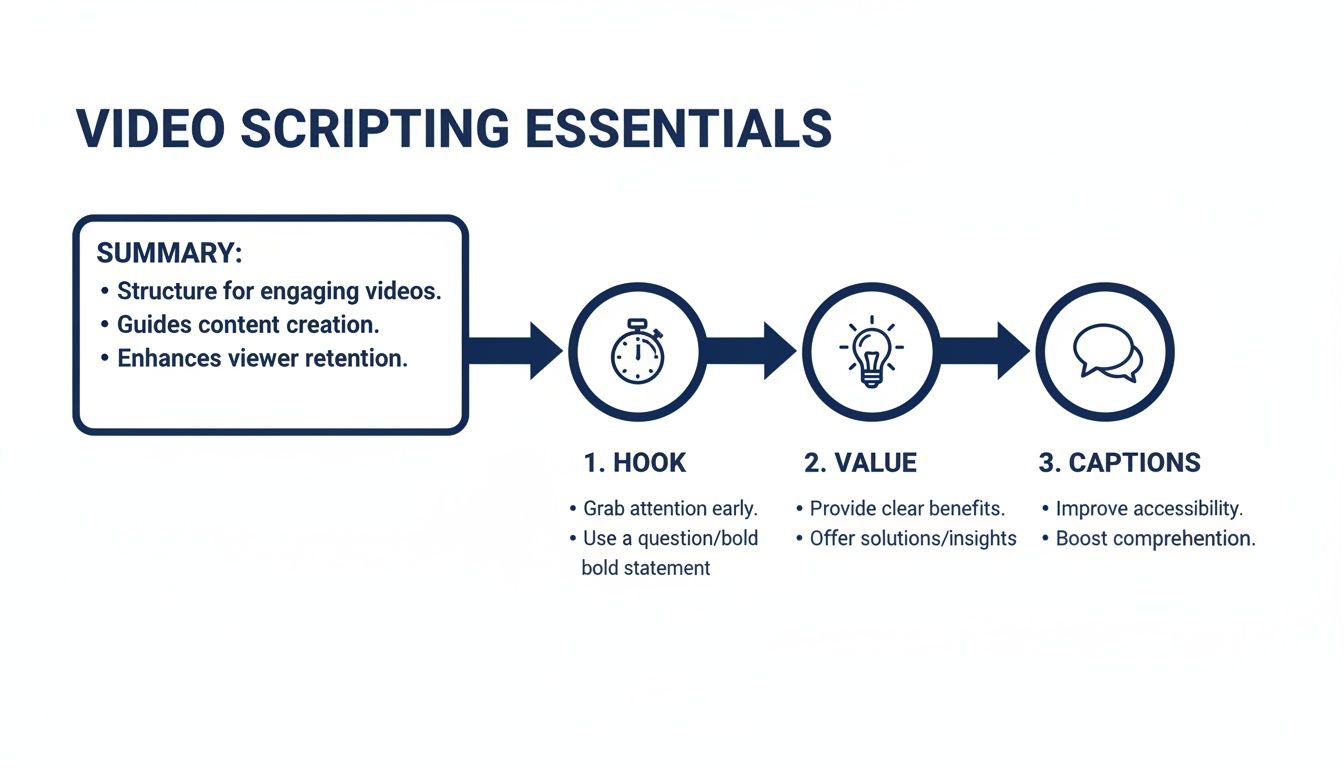
This simple flow—grabbing attention, showing the benefit, and communicating clearly without sound—is the blueprint for a video that converts.
Mastering Amazon’s Technical Specifications
Nothing derails momentum faster than a video rejected by Amazon for a technical violation. Amazon has strict, non-negotiable specifications, and understanding them upfront is critical to avoiding delays.
Your video and static images are distinct assets that must work in concert. For a comprehensive look at optimizing your entire media gallery, see our guide to product photography for Amazon.
The technical requirements vary by placement—product detail page (PDP) versus Sponsored Brands ads. Getting these wrong means your video will not go live.
Amazon Video Ad Placement Technical Requirements
This is your quick-reference guide to the essential specs for primary video placements. Adherence is the first step to a smooth approval process.
| Placement Type | Max Length | Aspect Ratio | Resolution | Key Compliance Note |
|---|---|---|---|---|
| Product Detail Page | 10 minutes | 16:9 | 1280x720p (720p) | Up to 5 GB file size. Stick to .MP4 or .MOV formats. |
| Sponsored Brands Video | 45 seconds | 16:9 | 1920x1080p (1080p) | Best practice is 15-30s. 500 MB max file size. No external links. |
| Sponsored Display Video | 45 seconds | 16:9 | 1920x1080p (1080p) | Must include audio, but be designed for sound-off viewing. |
| Amazon DSP | 3 minutes | 16:9, 4:3, 1:1 | Varies | Specs depend heavily on the specific DSP placement (e.g., Fire TV). |
Remember, these are technical guardrails. True performance comes from pairing a compliant video with a message that resonates with your target customer. Nail both to create a powerful asset that drives profitable growth across organic and paid channels.
How to Deploy Your Video for Maximum Growth
You’ve created a conversion-focused product video for Amazon. That’s a critical first step, but it’s only half the battle. A great video sitting idle in your media gallery is a wasted asset. Strategic deployment across the Amazon ecosystem is what turns a creative file into a growth engine.
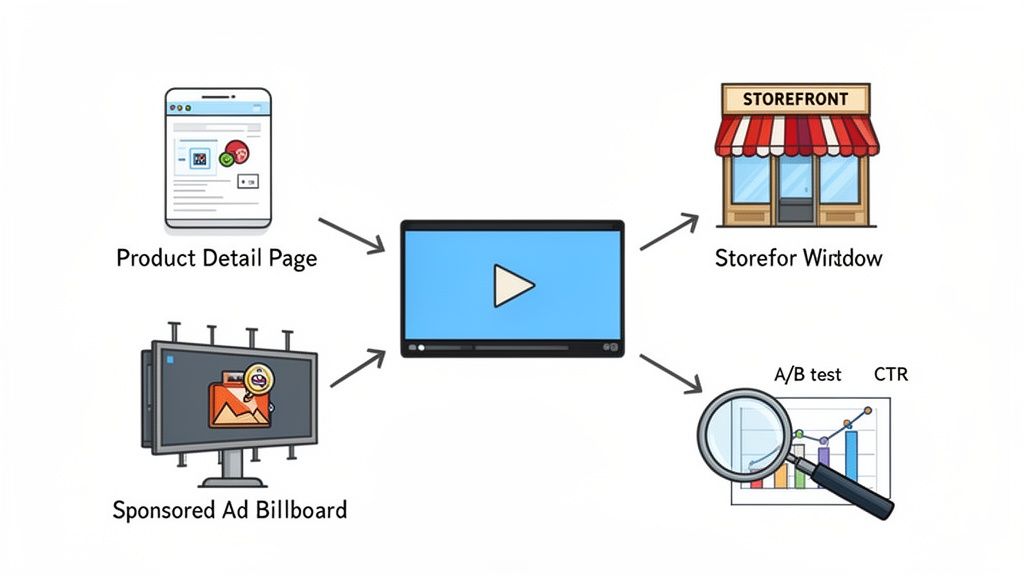
This is not about simply uploading a file. It’s about creating a performance flywheel. Your product page video increases conversions from paid traffic. Your video ads drive new, qualified shoppers to that now-optimized page. Your Amazon Storefront uses video to build a cohesive brand narrative. Each element amplifies the others.
The Three Pillars of Video Deployment
To maximize ROI, you must align your video placement with the customer's position in the buying journey. We focus on three key deployment pillars.
- Product Detail Page (PDP): This is your digital sales floor. Shoppers here have high intent. The video's job is to build confidence, demonstrate value, and be the final catalyst for conversion.
- Sponsored Brands Video Ads: These are your scroll-stoppers in the search results. They must be short, punchy, and capture attention from a colder audience to drive qualified clicks to your listing.
- Amazon Storefront: This is your brand’s home on Amazon. Video here serves to tell a broader brand story, showcase a product line, and foster loyalty beyond a single transaction.
Deploying video across all three pillars ensures you meet customers with the right message at the right time, creating a powerful, cohesive strategy.
A/B Testing Your Way to a Higher CTR
Never assume your first creative iteration is the best. The most sophisticated brands are constantly testing and refining their creative assets to maximize performance. Amazon’s ‘Manage Your Experiments’ tool is an invaluable—and underutilized—resource for this.
While you cannot A/B test video content directly on the PDP, you can test a critical variable: the video thumbnail. A compelling thumbnail can dramatically increase play rates.
Your thumbnail is the advertisement for your video. Test an action shot against a clean product photo. Pit a before-and-after graphic against a lifestyle image. We've seen minor thumbnail optimizations lead to significant lifts in video views and, consequently, sales.
This data-driven approach is essential. To build a listing that truly converts, every element should be tested. We explore this in greater depth in our guide on optimizing Amazon product listings for conversion.
Turning Performance Data into Actionable Insights
Your video is more than a sales tool; it’s a source of market intelligence. The data it generates reveals which features and benefits truly resonate with shoppers, providing insights that should inform your entire marketing strategy.
Analyze your Sponsored Brands Video campaign data, focusing on these key metrics:
- View-through Rate (VTR): What percentage of impressions result in a view? A high VTR indicates your hook is effective.
- Click-Through Rate (CTR): Are viewers compelled to click through to your product? This validates the strength of your core message.
- Conversion Rate (CVR): Of those who click, how many purchase? This is the ultimate measure of whether your video is turning interest into revenue.
Learning to interpret this data is crucial. Many principles for analyzing video performance on other platforms provide a solid framework for Amazon as well.
For instance, if a 15-second ad focused on "easy setup" achieves a significantly higher CTR and CVR than an ad focused on "durability," the market is sending you a clear signal. "Easy setup" is the more compelling value proposition.
This insight should then be leveraged across all marketing channels. Update your listing copy, A+ Content, and even your PPC keyword strategy to feature this benefit more prominently. Your product video has now evolved from a simple creative asset into a real-time market research tool, enabling you to allocate your ad budget with greater precision and confidence.
Taking Your Videos to the Next Level with PPC and DSP Campaigns
Your video is performing well on your detail page and in top-of-search Sponsored Brands campaigns. This is the foundation. To truly dominate your category, you must integrate video into a full-funnel advertising strategy.
This means moving beyond product demos and leveraging both Sponsored Brands Video and the Amazon Demand-Side Platform (DSP) to guide shoppers from initial awareness all the way through to purchase and loyalty.
This is a strategic imperative, not just an increase in ad spend. A top-of-funnel DSP video might be a lifestyle-focused asset designed to build brand awareness. Later, a bottom-of-funnel Sponsored Brands ad can retarget those engaged viewers with a direct, benefit-driven message to close the sale.
Match Your Video Creative to the Buyer's Journey
A one-size-fits-all video is an inefficient use of capital. A sophisticated strategy requires a portfolio of video assets, each engineered for a specific stage of the customer journey.
- Top of Funnel (Awareness): Reach new audiences not yet actively searching for your product. These videos should be aspirational, creating an emotional connection and introducing your brand's "why."
- Mid Funnel (Consideration): Target shoppers actively browsing your category. These videos should be educational, highlighting key differentiators and demonstrating how your product solves their problem better than the competition.
- Bottom of Funnel (Conversion): Re-engage shoppers who have viewed your product but have not yet purchased. Retarget them with direct, compelling videos that feature a specific offer, a strong testimonial, or overcome a final purchase barrier.
Mapping video creative to these stages allows you to tell a cohesive story that efficiently moves customers from discovery to purchase.
Dig Deeper with Amazon Marketing Cloud
For brands operating at scale, the Amazon Marketing Cloud (AMC) offers an unparalleled view of the customer journey, moving beyond simplistic last-touch attribution.
With AMC, you can answer critical business questions:
- What is the cross-channel impact? How many users saw a DSP video, then later searched and converted via a Sponsored Products ad?
- What is the optimal ad frequency? At what point does video exposure lead to diminishing returns?
- Does video viewership correlate with higher customer lifetime value (LTV)?
AMC elevates your video campaigns from a sales tactic to a source of strategic intelligence. It allows you to quantify the true halo effect of your advertising, justifying investment in brand-building initiatives that drive long-term, profitable growth.
The Power of Amazon DSP and Prime Video
Placing your product video for amazon ads within streaming content on Prime Video and Freevee is a game-changing opportunity. You can reach shoppers in a leaned-back, receptive mindset while they are engaged with entertainment content.
The scale is immense. Amazon Prime Video's ad-supported tier reaches over 130 million US viewers monthly, and 88% of them shop on Amazon shortly after watching. The line between entertainment and commerce is blurring, particularly with new features allowing viewers to shop for products seen in ads directly from their remote. You can discover more insights about Amazon's latest advertising capabilities to understand this evolving landscape.
DSP for video enables hyper-specific audience targeting using Amazon’s first-party shopping data. Target users in-market for your category, past purchasers, or even customers who have bought from direct competitors.
To see how leading brands are executing this, review these Amazon video ads examples. By combining precise targeting with high-impact video, you can build a brand that resonates with customers far beyond the search results page.
A Few Common Questions About Amazon Product Videos
Even the most seasoned eCommerce leaders have practical questions when it comes to execution. Here are no-nonsense answers to the most common queries we encounter.
How Long Should My Amazon Product Video Be?
The optimal length is dictated entirely by the placement.
For a Sponsored Brands Video ad, you are competing for attention. Brevity is paramount. Aim for 15-30 seconds. Our data across thousands of campaigns consistently shows a sweet spot around 18 seconds—just enough time to communicate a single, compelling benefit.
For the main video on your product detail page, you have more leeway. A length of 45-60 seconds is appropriate. The shopper is already engaged and considering a purchase. Use this time to demonstrate multiple use cases or explain a key feature in more detail.
The universal rule for both: your core message must be delivered within the first 3-5 seconds. This is non-negotiable.
Can I Just Use the Same Video for My Product Page and My Ads?
You can, but you shouldn't. This is one of the most common and costly mistakes brands make. These two placements serve entirely different functions and speak to audiences at different stages of intent.
- Your product page video is for a warm, high-intent audience. Its purpose is to educate, build trust, and close the sale.
- Your video ad is for a cold audience of scrollers. Its sole job is to stop a thumb and earn a click. It must be fast, direct, and built around a single, powerful hook.
The best practice is to create a dedicated 15-second "ad cut" from your primary video. Isolate the single most compelling moment, add bold text overlays, and get straight to the point.
Do not treat your video ad as a trailer for your main video. It is a self-contained sales pitch designed to achieve one objective: a click.
What Are the Biggest Mistakes Brands Make with Videos?
Beyond asset mismatch, several common blunders will neutralize your video's effectiveness.
The most frequent is creating a TV commercial. Amazon is a retail environment, not a broadcast network. Slow, artistic intros, vague lifestyle shots that don't feature the product, and dramatic buildups are antithetical to the platform's fast-paced nature.
Another critical error is neglecting on-screen text. The majority of videos on Amazon are viewed with the sound off. If your core message is confined to the voiceover, it will not be heard. Your video must tell a complete story visually, with text reinforcing key benefits.
Finally, failing to review Amazon’s ad policies is a rookie move that leads to rejections and delays. Prohibited content includes unverified claims ("#1 doctor recommended!"), website URLs, or embedding customer reviews directly into the video.
How Do I Actually Measure the ROI of My Product Video?
Measuring ROI is straightforward if you know where to look. The methodology differs for ads versus on-page assets.
For Sponsored Brands Video ads, the ROI is clearly displayed in the advertising console. Track:
- Click-Through Rate (CTR)
- Conversion Rate (CVR)
- Return on Ad Spend (ROAS)
Compare the performance of your video campaigns against static image campaigns. A higher ROAS on video provides a clear, data-backed justification for the investment.
For your product page video, ROI is measured by the direct lift it provides to your listing's conversion rate. The definitive way to prove this is by running an A/B test using Amazon’s ‘Manage Your Experiments’ tool. Test your listing with the video against a control version without it. The primary metric is your unit-session-percentage. A statistically significant increase in this metric proves the video is driving more sales from the same amount of traffic—that is tangible, measurable ROI.
At Headline Marketing Agency, we don't just create assets; we build performance-driven advertising systems. Our unique approach leverages PPC as a strategic lever for organic growth, profitability, and sustainable scale. If you're ready to implement a holistic Amazon strategy grounded in data, we're the partner to help you win. Learn how we drive results at https://headlinema.com.
Get Your Free Amazon PPC Audit
Discover untapped growth opportunities and see how our data-driven approach can improve your ROAS.
Get Free Audit →Ready to Transform Your Amazon PPC Performance?
Get a comprehensive audit of your Amazon PPC campaigns and discover untapped growth opportunities.