What Is Amazon Cloud? Amazon Marketing Cloud Explained
Wondering what is Amazon Cloud? Learn how Amazon Marketing Cloud works, how it differs from AWS, and how brands use its insights for profitable growth.

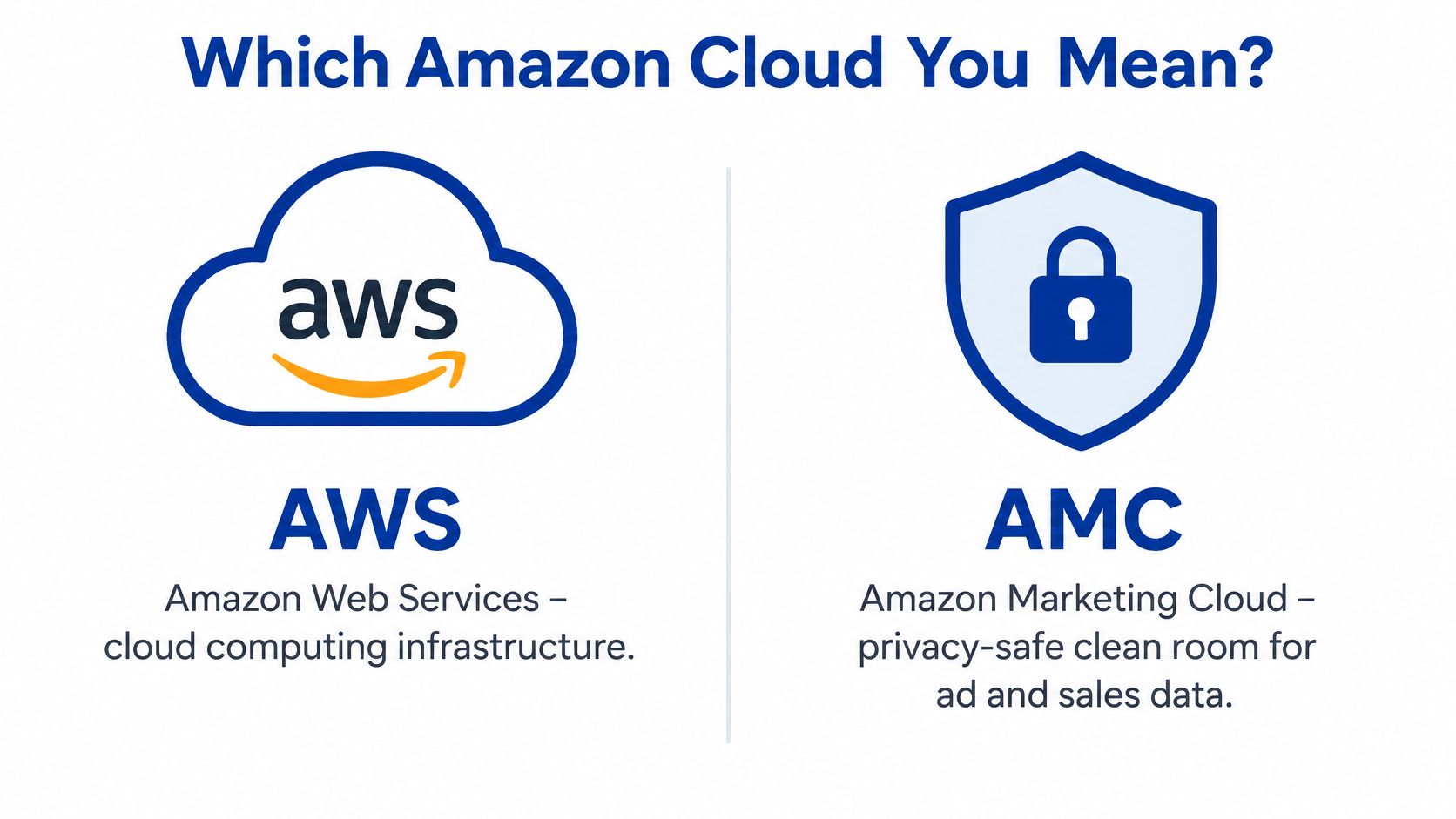
Amazon Cloud usually means Amazon Web Services (AWS), the infrastructure platform that rents out computing, storage, databases and networking on demand. In an advertising meeting, the same phrase almost always means Amazon Marketing Cloud (AMC), a privacy-safe clean room where a brand joins its own sales records to Amazon Ads signals and queries the result.
That collision matters more than it looks. The two products serve different buyers, answer different questions and carry different budgets. Getting them mixed up sends a brand owner to a developer's documentation, or sends a technical team hunting for ad attribution in a console that was never built for it.
Which Amazon Cloud You Mean and What Each One Does
AWS is an internet-delivered infrastructure platform offering compute, storage, databases, networking, analytics and security, priced by usage rather than a flat monthly fee, as the AWS overview documentation sets out. That usage-based model is the reason nobody can quote you "the AWS price" without knowing your workload. A brand that stores a nightly product feed and runs a reporting job pays for what those jobs consume, not for a seat licence.
AMC is something else entirely: a secure, privacy-safe, cloud-based clean room that runs analytics across pseudonymized signals, including Amazon Ads signals and a brand's own first-party inputs. Nobody on either side sees raw records from the other side. The brand gets aggregated output, Amazon keeps its customer data, and the join happens inside a controlled environment.
| Term | Who it serves | What it does | Question it answers |
|---|---|---|---|
| Amazon Web Services (AWS) | Developers and IT teams | Pay-as-you-go computing, storage, databases and analytics | How do we host and process our data? |
| Amazon Marketing Cloud (AMC) | Advertisers, brands and agencies | Privacy-safe clean room that analyzes ad and sales signals | Which ads drove real reach and purchases? |
| Consumer cloud services | Shoppers | Personal file or media storage tied to an Amazon account | Where are my personal files kept? |
The warehouse and the lab room is the analogy I use with marketing directors. AWS is the warehouse building your company rents to store crates and run machinery. AMC is a sealed lab inside a building you don't own, where you bring your own samples, run tests against Amazon's reference set, and walk out with a summary sheet instead of anyone else's inventory.
If your question is about ad performance and incremental sales, the rest of this article is about AMC. If you need hosting, data processing or a place to run models, that's an AWS decision with a different buyer, a different budget and a different set of vendors. For the paid-media layer that sits above AMC, our breakdown of the Amazon DSP program covers where programmatic reach fits.
What AMC Reveals That Standard Ad Reports Miss
Standard consoles answer a narrow set of questions well. They attribute clicks and orders inside defined windows, and they show every campaign on its own line. That last habit is the problem. Say a brand runs Sponsored Products on a branded term and Sponsored Display retargeting at the same shopper. Both campaigns claim the order, both look profitable, and the sum of reported sales exceeds what the brand sold.
AMC exists to break those claims apart.
| Question | Standard ad console shows | AMC can show |
|---|---|---|
| Did ads reach new-to-brand shoppers? | Attributed clicks and orders | New versus existing customer reach |
| Which campaigns worked together? | Each campaign in isolation | Cross-campaign paths to purchase |
| Did ads add sales beyond the baseline? | Attributed sales, often overstated | Incremental lift against a control group |
| Which audiences converted? | Keyword and placement reports | Audience-level conversion from custom segments |
| Is ad frequency too high? | Impressions and clicks per campaign | Frequency by audience and reach over time |
Each row changes a decision. New-to-brand reach tells you whether you're buying growth or recycling loyal customers. Cross-campaign paths show which touch opened the journey. Incremental lift against a control group answers the question finance keeps asking: would these sales have happened anyway? Audience-level conversion tells you which segment to fund. Frequency by audience tells you when you're paying to annoy people.
Working rule: use AMC to decide where the next dollar goes, and use the console to run today's campaigns. One tool sets direction, the other executes.
One caution. AMC outputs are modeled and aggregated, so they show the direction and size of an effect, not a headcount of individual shoppers. If you need a spreadsheet of customer names, this isn't the tool, and the privacy design is the reason. For how attribution windows and models shape these numbers, see our guide to attribution modeling.
Misconceptions and Limits to Know Before You Start
"AMC is a listing or storefront tool." It isn't. AMC analyzes ad and sales signals. It won't rewrite your bullet points, fix your main image or move your rank on its own. The correction costs nothing to accept. The cost of believing otherwise is a quarter spent querying data while the detail page that converts poorly stays untouched.
"Hosting on AWS makes my Amazon PPC better." AWS is infrastructure. A custom analytics workflow can run on it, and that workflow might improve decisions, but the hosting itself has no effect on auction outcomes. Treat AWS as a build decision, not a performance lever.
"Dynamic bidding is a set-and-forget optimization." Read Amazon's own terms and the scale becomes obvious. Under dynamic bids, up and down, Amazon may raise or lower a bid by up to 100% based on the likelihood a click converts, and rule-based bidding can push bids to up to five times the adjusted bid for eligible campaigns while applying a return-on-ad-spend guardrail, according to Amazon's dynamic bidding help page. A base bid that reads profitable in a report can meet a much higher auction bid in a strong placement. Set limits from unit economics first, then audit by placement, query and product.
"AMC gives me customer-level data." It gives aggregated, thresholded output. Small segments get suppressed, which is the point of a clean room.
Practical limits follow the same logic: you need someone who can write SQL, clean first-party data to join, and enough sustained spend for a test to mean anything. On data handling, Headline uses Amazon data solely for campaign management, performance analytics and client reporting, and complies with Amazon's Data Protection Policy and Acceptable Use Policy. Clients can revoke API access at any time through their Amazon account settings.
If your spend is small and your questions are simple, a spreadsheet plus a structured search-term review will outrun a clean room you can't feed.
How to Run Your First AMC Analysis
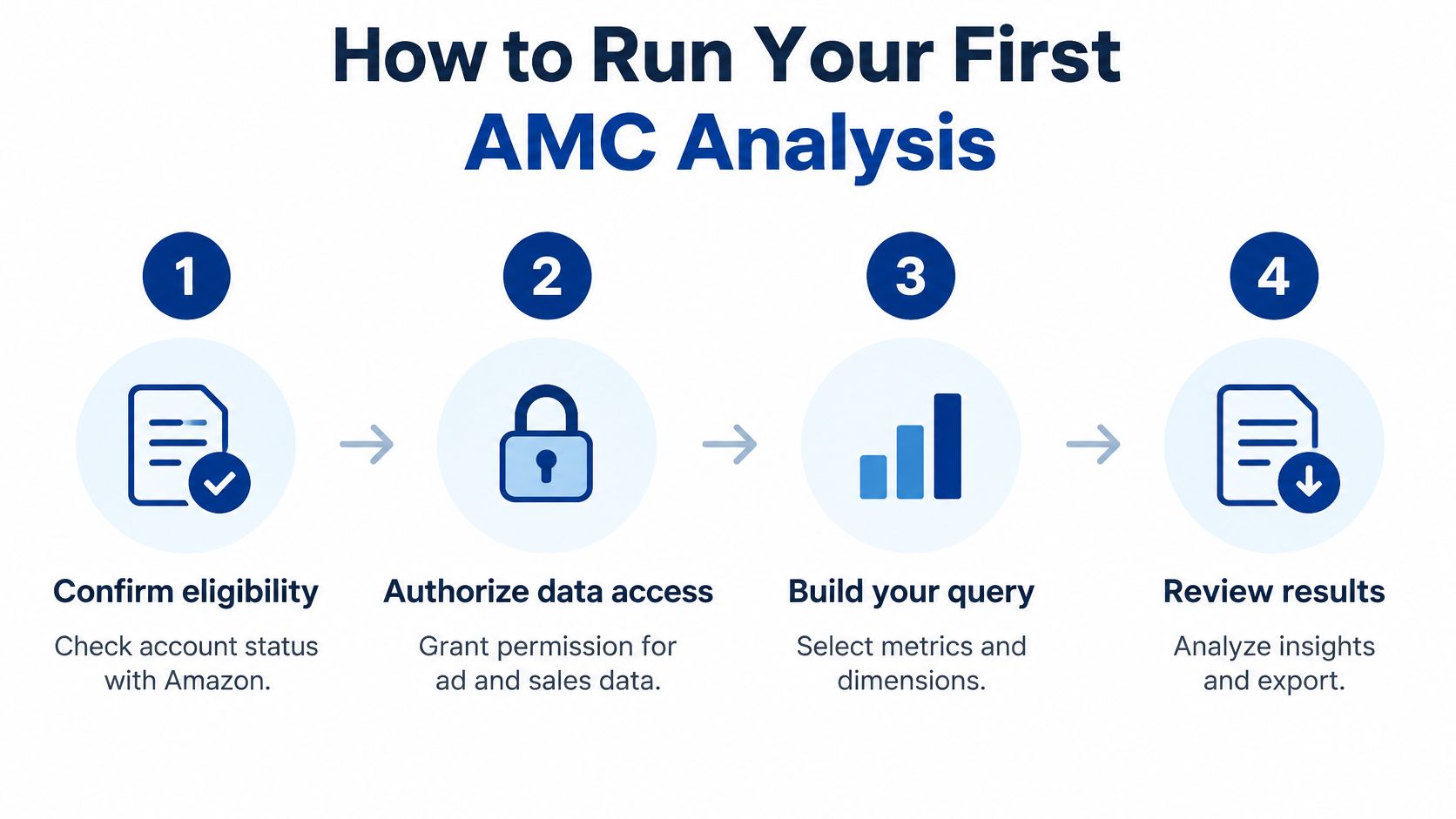
A first analysis should be small and finishable. Seven steps, in order.
- Confirm eligibility. AMC access has historically been tied to active Amazon advertising, so check account status with Amazon before you plan anything. The common slip is designing a test for an account that can't run it yet.
- Authorize data access. Connect your Amazon Ads and Seller Central accounts, and if an agency manages the work, grant API access explicitly. Headline accesses client data through Amazon's Selling Partner API and Amazon Advertising API, processed on Google Cloud Platform infrastructure and encrypted at rest and in transit, and only touches data that has been explicitly authorized through Seller Central or the Amazon Advertising console. Authorization is revocable, which is the safeguard worth knowing about.
- Add your first-party data. Link your own sales or CRM records using pseudonymized keys such as hashed identifiers. The usual mistake is joining on something inconsistent, like a promo code that changed format mid-quarter.
- Pick one question. A good first question is specific: did video ads drive purchases from shoppers who never clicked a product ad? Broad questions produce unreadable output.
- Write the query. AMC runs on SQL, so either write it yourself or hand a written specification to an analyst with explicit time windows and campaign IDs. Missing campaign ID filters are the most common cause of a result nobody can explain.
- Run and read the output. Results return aggregated with minimum audience thresholds, so small segments may be suppressed. Read totals and trends, not individual records, and don't widen a window just to force a number to appear.
- Make one decision. Turn the output into a bid or budget change within a week and log what changed and why. An insight with no decision attached is a report.
Here's a walkthrough format teams find useful before writing their own queries.
What does a usable first result look like? A clear comparison of exposed versus control shoppers, or reached versus unreached audiences, with a stated lift and a confidence level you're willing to defend internally. If the output can't support that sentence, the query needs tightening before the budget moves. Time windows too narrow to capture repeat purchases are the usual culprit, since a shopper who buys a second time three weeks later often falls outside a fourteen-day frame.
Turning AMC Insights Into Bids, Budgets and Listings
Sponsored Products runs on a cost-per-click auction. You set a maximum bid, and Amazon weighs that bid against product relevance to the shopper's context and the predicted likelihood of engagement or purchase. Winning doesn't mean paying the second-highest bid either. Amazon's Sponsored Products FAQ states that the final price can reflect placement, predicted performance, competing bids and expected return on ad spend, capped at your adjusted maximum bid.
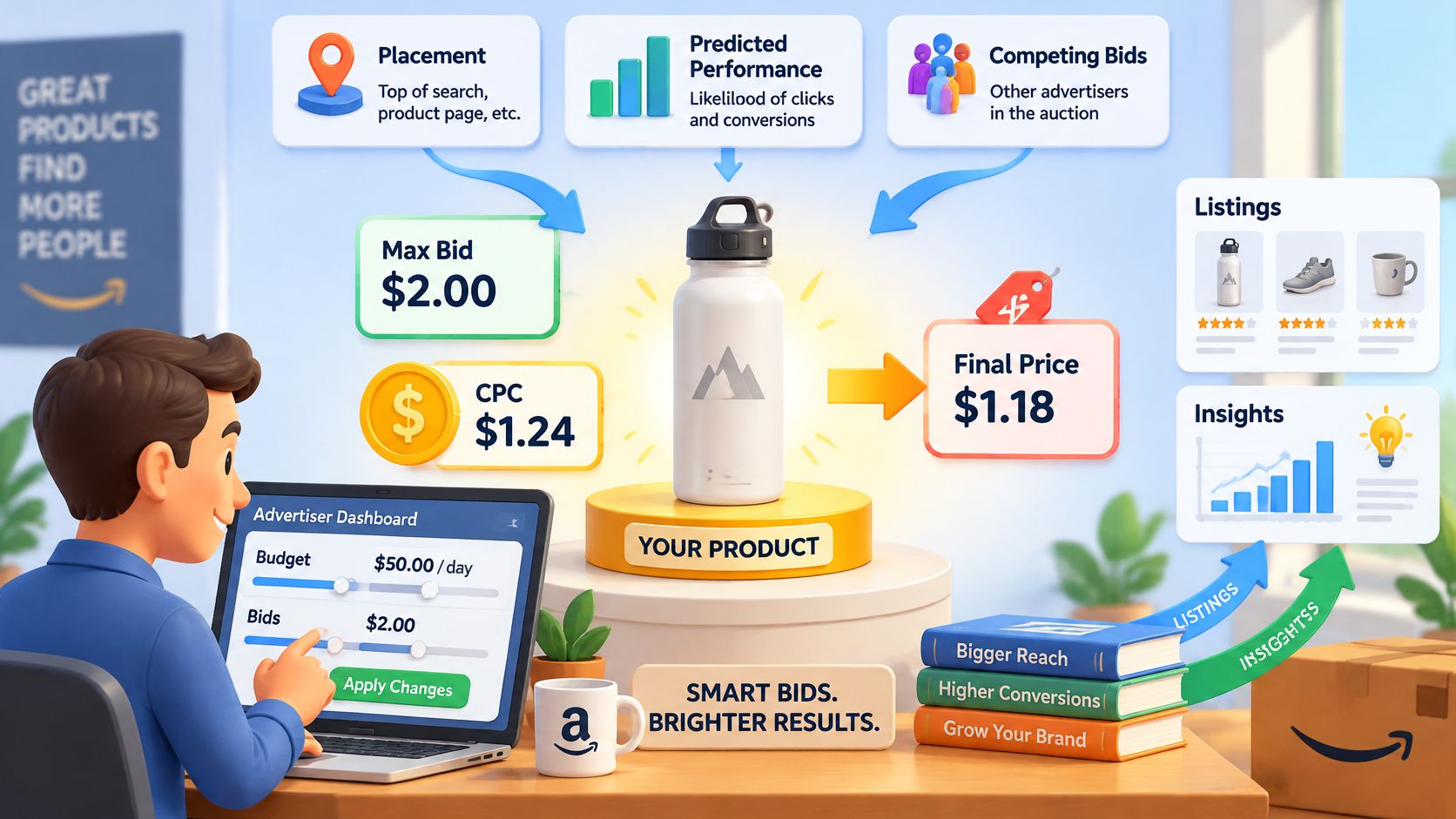
That cap is where most bid optimization stops, and it's the wrong place to stop. A higher bid on a page that converts at half the category rate buys traffic you'll pay for twice.
The path from clean-room output to a changed campaign has three moves:
- Fund what adds sales, not what claims them. Use incrementality to find queries and audiences where ads produce purchases beyond the baseline. Cut or cap the segments that only harvest demand you'd have captured anyway.
- Set ceilings from unit economics. Work out your maximum profitable cost per click, your contribution margin and your target incremental return on ad spend, then use those as hard limits. ACOS alone will let you fund a losing segment because it ignores margin and repeat rate.
- Fix the page before you raise the bid. If a non-branded query converts well only among new-to-brand shoppers, fund the query and test a main image aimed at that audience. Raising the bid on a page that speaks to the wrong shopper just buys more expensive misses.
PPC is a lever for organic growth, not a tax on it. Paid visibility builds sales velocity and search relevance for priority queries, and that supports organic rank even though a single test can't prove the causal chain.
For the mechanics of query-level optimization, SellerAI's Sponsored Products optimization walkthrough covers the structural side well, from campaign segmentation to negative keyword hygiene.
The profit test I'd apply this month: pull your top ten non-branded queries, compare their incremental lift and contribution margin, and move budget from the bottom three to the top three while holding bids flat. If profit doesn't improve, the problem is the listing or the offer, not the bidding. Our note on Amazon data-driven decision making covers how to sequence those decisions.
Real Examples of AMC Insights in Action
Three scenarios, each tied to one decision. The second and third are illustrative composites of how brands typically frame these tests, not published Amazon case studies.
Creative format, tested properly. A supplement brand runs a holdout test on video against static creative for its three best sellers. Amazon reports that Sponsored Products campaigns using video achieved a 67% higher click-through rate and a 9% higher conversion rate than campaigns without video in the comparison cited on Amazon's Sponsored Products page. The decision that follows isn't "switch everything to video." It's to run the holdout, then judge the winner on incremental sales and contribution profit, because a click-through gain that doesn't survive to margin is a vanity number.
Reach that no product ad touches. A cookware brand uses AMC reach data and finds its display campaign reaches shoppers who never saw a product ad. The decision: shift part of the budget toward that reach campaign and measure new-to-brand orders rather than total attributed sales. The lesson worth reusing is that overlap analysis, not attribution totals, tells you which channel is doing the introducing.
Credit sitting in the wrong campaign. A home goods brand maps paths to purchase and finds branded search collecting credit for journeys that started with non-branded discovery. It reallocates spend toward the discovery terms, holds branded bids steady, and tracks whether total new-to-brand orders rise. The reusable lesson: branded search is usually a closer, not an opener, and budgeting it like an acquisition channel inflates its apparent efficiency.
Every one of these tests shares a trait. The brand named the decision before it ran the query, so the result had somewhere to go.
Decide Whether AMC Fits Your Brand Now
Score yourself against four criteria before you commit budget.
| Criterion | Ready when | If missing |
|---|---|---|
| Sustained Amazon ad spend | Consistent spend across the planned test window | Start with console reports for 60 days |
| First-party sales or CRM data | Records you can join using pseudonymized keys such as hashed identifiers | Clean and structure your own data before any query |
| SQL capability | One team member who writes queries, or an analyst who does | Hire or contract an analyst before testing |
| Specific question | A named question standard reports cannot answer | Run a structured search-term review first |
The decision rule is simple. Two or more missing, wait. Spend the next 60 days on console reports and a disciplined search-term review, and clean your first-party data in the meantime. All four in place, test. Run one incrementality test over 90 days with a holdout group, and write down in advance what budget or bid change follows a win and what follows a loss.
Headline's AMC service covers setup through advanced analytics, connecting advertising and first-party data to generate insights, and feeds the Analytics Suite, which brings Seller Central, the Amazon Advertising console, third-party tools and AMC data into one view.
My take: AMC is worth the effort when it changes a budget or bid decision inside a month. If a quarter passes and the queries haven't moved a dollar, the setup was the deliverable and you paid for a report.
If this piece clarified what Amazon Cloud means for your advertising, the harder question is what your own clean-room output would say about your bids. Headline Marketing Agency builds Amazon Marketing Cloud analyses around decisions, not dashboards, joining your ad and first-party data to find the queries and audiences that add sales beyond the baseline. Visit Headline Marketing Agency to talk through a first test scoped to one question and one budget decision.
Get Your Free Amazon PPC Audit
Discover untapped growth opportunities and see how our data-driven approach can improve your ROAS.
Get Free Audit →Wollen Sie Ihre Amazon PPC-Performance aufs nächste Level bringen?
Lassen Sie Ihre Amazon PPC-Kampagnen professionell analysieren und entdecken Sie neue Wachstumsmöglichkeiten.