Amazon Data Driven Decision Making Playbook
Master Amazon data driven decision making with this practical playbook. Learn to leverage AMC, Search Query Performance, and A/B testing for profitable scale.

Most Amazon advice starts with “collect more data.” That's the wrong priority. Most brands already have more dashboards, exports, and campaign reports than their teams can use. The main advantage comes from joining disconnected data sources so you can distinguish demand you merely captured from growth your advertising genuinely created.
That distinction changes how you allocate budget, judge PPC, and protect profitability. A campaign can produce strong attributed sales while mostly harvesting shoppers who were already searching for your brand. Another campaign can look inefficient on last-click reporting while introducing new customers, improving organic visibility, or influencing later purchases. Amazon data driven decision making requires both views, connected to a commercial outcome.
Moving Beyond Last-Click Metrics
Teams we audit typically hold campaign exports, SQP reports, and AMC dashboards that no one joins together. The advantage comes from connecting those sources so you can separate demand you merely captured from growth your advertising created.
ACOS remains useful, but it is a weak operating system for an Amazon business. It shows advertising spend against attributed sales, not whether the shopper would have purchased without the ad, whether the order was profitable, or whether the campaign improved organic demand afterward. Attributed revenue is not the same as profit caused by advertising.
A campaign can appear efficient because it harvests shoppers already searching for the brand. Another can look expensive on last-click reporting while reaching new customers, strengthening branded search, or supporting later purchases. Cutting every campaign above a fixed ACOS threshold can remove activity that creates future efficiency.
Amazon Marketing Cloud supports a broader analysis. Amazon Ads says AMC launched in 2019 as a secure, privacy-safe clean room solution, with access later expanded to all advertisers. Industry coverage also records a beta announcement on January 5, 2021, for eligible agencies, advertisers, and tool providers across North America, Europe, Japan, and Australia. The progression matters because AMC provides a way to connect shopping, browsing, streaming, and advertiser-owned signals without treating the final click as the complete customer journey. Amazon's overview of AMC for Sponsored Ads provides relevant platform context.
Replace the single efficiency target
Before judging a campaign, a senior eCommerce team should answer four questions:
- Demand capture: Did the ad convert existing search or product intent?
- Demand creation: Did exposure reach shoppers outside the brand's active demand pool?
- Commercial value: Did the order or customer generate acceptable contribution after COGS, fees, discounts, and fulfilment costs?
- Marketplace effect: Did the activity support organic visibility, branded search, repeat buying, or market-share defense?
These questions place ACOS inside a wider profitability model. Use it to diagnose delivery and attributed efficiency, then pair it with contribution margin, customer quality, and evidence of incremental demand.
Practical rule: Never approve a budget increase from ACOS alone. Pair attributed efficiency with incrementality, customer quality, organic movement, and contribution margin.
PPC should function as a lever for organic scale, not only as a sales channel. Sponsored Products may capture existing demand, while Sponsored Brands, DSP, and streaming TV can help create or expand it. Search Query Performance shows what shoppers searched, clicked, added to cart, and bought. AMC connects exposure and conversion paths across eligible media signals. Joining those views helps determine whether paid visibility is supporting organic discovery or just collecting credit for demand that already existed.
For a practical view of how paid activity and search visibility work together, see Headline's Amazon advertising strategies guide. The operating principle is simple: protect profitable demand capture while funding measurable sources of incremental growth.
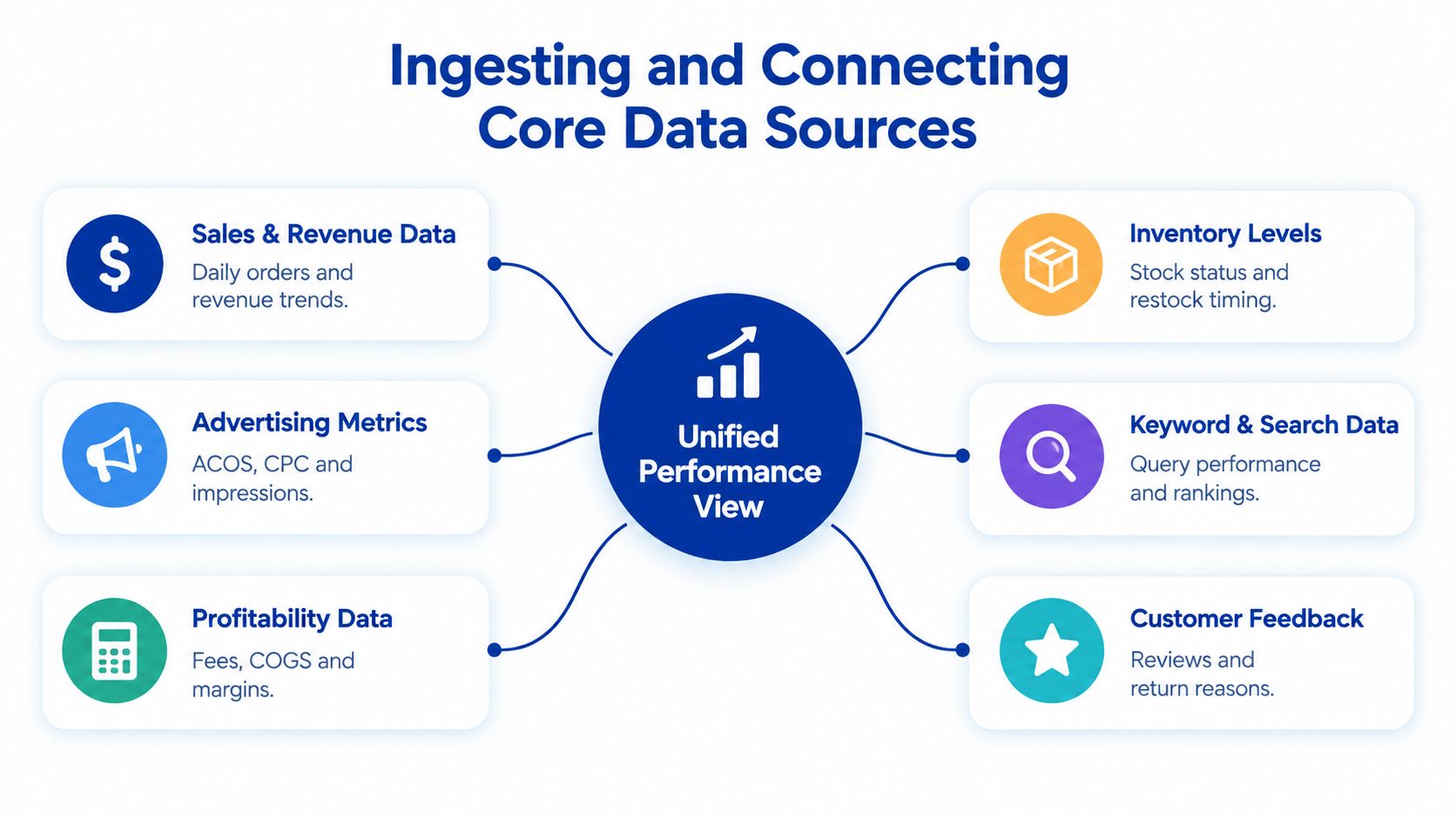
Ingesting and Connecting Core Data Sources
Amazon provides valuable datasets, but they answer different questions. Campaign reports describe delivery and attributed outcomes. AMC describes paths across eligible signals. Search Query Performance, or SQP, describes shopper behavior at the query level. None of these is sufficient by itself.
Amazon Marketing Cloud is a privacy-safe clean room built on AWS Clean Rooms. It lets advertisers analyze pseudonymized signals and onboarded data, including interactions across shopping, browsing, streaming, and advertising environments. AMC later provided access to 25 months of ad traffic signals, creating more room for long-term analysis. A 2026 industry report also notes that Amazon Retail Purchases data in AMC was made free through the end of 2026, expanding access to up to five years of purchase history. Those access conditions can change, so confirm current availability before building a reporting plan. Search Engine Journal's analysis of AMC's five-year dataset discusses the planning implications.
Use each dataset for its actual job
AMC answers path and audience questions. Use it to examine exposure sequences, overlap between media types, new-to-brand behavior, repeat purchases, and cross-ASIN effects. It's especially useful when the question is, “What happened after this audience saw or engaged with these ads?”
SQP answers query and funnel questions. Amazon's help documentation says the dashboard surfaces query volume, impressions, clicks, add-to-cart actions, and buys for brand representatives. That makes it possible to see where a keyword or query loses momentum. Amazon's Search Query Performance documentation explains the available marketplace signals.
Join the sources through shared business dimensions, not by forcing them into one undifferentiated table. At minimum, align ASIN, query or keyword family, brand, date window, marketplace, and funnel stage. Then use the combined view to diagnose the bottleneck:
- High query activity, weak impressions: address retail visibility, campaign coverage, or eligibility.
- Strong impressions, weak clicks: review the main image, price position, title, and ad message.
- Strong clicks, weak add-to-cart activity: inspect detail-page relevance, content clarity, reviews, and offer strength.
- Strong add-to-cart activity, weak buys: investigate price, inventory, delivery promise, variation structure, and conversion friction.
- Attributed purchases without broader audience growth: test whether the campaign is mostly harvesting existing demand.
Many teams go wrong here. They export every report, place it in a larger dashboard, and call that integration. A unified view is only useful when it changes an action. If SQP identifies a query with strong shopper interest but poor detail-page conversion, the answer isn't automatically a higher bid. It may be better content, a stronger offer, or a retail-readiness fix.
More data won't improve a decision until the team defines the commercial question the data must answer.
Defining KPIs for Profitability and Organic Scale
A dashboard should make trade-offs visible. It shouldn't reward a team for shifting unprofitable sales between attribution buckets.
Start with a contribution model for each ASIN. Revenue is the top line, not the goal. Subtract product cost, Amazon fees, fulfilment costs, discounts, returns, and advertising spend to establish the margin available for growth. The exact model will vary by business, but the discipline is consistent: set advertising thresholds from profit economics rather than revenue alone.
Then build a KPI hierarchy. Keep the hierarchy stable, but change the emphasis according to the ASIN's role.
Launch products need learning signals
At launch, conversion data is limited and the brand may not yet own meaningful search demand. Track query coverage, click quality, detail-page conversion, retail readiness, and the rate at which paid visibility generates useful search and content learnings. A launch campaign can justify controlled investment while the team validates the offer, but it shouldn't receive unlimited budget only because attributed revenue is growing.
The launch question is: What must we learn before we scale? That may include which query families convert, which images reduce hesitation, and which audiences respond to the proposition.
Growth products need a balanced scorecard
For a growth ASIN, combine immediate advertising efficiency with total advertising cost of sales, new-to-brand contribution, organic rank movement, branded search behavior, and contribution margin. TACoS is useful because it places advertising spend against total sales rather than only attributed sales. It can indicate whether the business is becoming less dependent on paid demand, but it shouldn't be treated as proof of causation.
Organic rank velocity also needs careful definition. Measure movement for a fixed group of strategic query families, with consistent market, ASIN, and observation rules. Don't report a broad “organic improvement” number if the underlying keyword set changes every week.
Mature products need defense and profit control
Mature ASINs often carry existing organic demand, so the main risk is paying for shoppers who would have bought without the ad. Prioritize incremental reach, branded and non-branded query economics, competitor pressure, repeat purchase behavior, and margin protection. A mature product may deserve a lower acquisition target than a launch product, but it may also require defensive spend when competitors attack its core queries.
A useful leadership dashboard can separate:
| Decision area | Primary measures | Management question |
|---|---|---|
| Profitability | Contribution margin, TACoS, advertising cost | Are we buying profitable growth? |
| Demand quality | New-to-brand behavior, audience overlap | Are we reaching additional shoppers? |
| Organic scale | Query coverage, rank movement | Is paid activity supporting discoverability? |
| Retail readiness | Conversion, add-to-cart, inventory | Can the ASIN convert the demand we create? |
| Portfolio impact | Cross-ASIN purchases, repeat behavior | Does growth extend beyond one order? |
Do not force every ASIN into one benchmark. A launch, growth, and mature product have different jobs, so their KPI weighting should differ. Headline's perspective on paid search and SEO is useful here because the strongest Amazon programs treat paid visibility and organic discovery as connected commercial systems.
Running Statistically Sound A/B Tests and Lift Studies
Amazon experimentation can support better content decisions, but only if the team respects uncertainty. A small observed lift isn't automatically a real improvement. Pausing a listing test early or changing a campaign because of noisy short-term results can erase a useful signal and replace it with managerial opinion.
Amazon's experiment framework uses random split testing and Bayesian analysis. It reports the probability that a winning treatment is truly better, along with a credible interval for the expected sales impact. Results are updated weekly, aggregated across enrolled ASINs, and projected to one year by multiplying the winning version's average daily sales lift by 365. That projection makes the framework relevant to long-horizon profit decisions, not just short-term click performance. Amazon's experiment documentation explains how the framework handles probability and projected impact.
Design the test around one business decision
Test one major variable at a time when possible. A main image test should answer whether the image improves shopper response. A title test should examine relevance and clarity. An A+ content test should focus on persuasion and product understanding. If the team changes the image, title, price, and content together, a winning result may still be useful operationally, but it won't tell you which change created the effect.
Amazon states that its advertising testing studies typically require a minimum of 600 responses to achieve up to a 4% margin of error at the 95% confidence level. Treat that benchmark as a planning reference for major-market image and message tests, not as a universal guarantee for every ASIN or experiment. The right sample requirement depends on traffic, conversion behavior, test design, and the decision's risk.
Read the interval, not just the winner label
Amazon presents median, best-case, and worst-case outcomes to reduce false certainty. The winning treatment is defined by posterior probability, not by a simple A/B percentage lift. That distinction matters when the expected outcome range is wide.
Use a decision log for every test:
- Hypothesis: State the shopper or commercial problem.
- Treatment: Record the exact content or experience being changed.
- Guardrails: Define inventory, price, availability, and profitability conditions.
- Decision rule: Specify what probability and impact would justify rollout.
- Follow-up: Check whether the result persists after implementation.
Don't stop because the chart looks exciting. Don't continue indefinitely because the result is inconvenient. A credible interval that includes outcomes with little commercial value should lead to caution, even when the headline result appears positive.
Automating Workflows and Operationalizing Insights
Analysis earns its keep only when it changes what the team does next. A good workflow turns an observed signal into a controlled action, with a human review point for decisions that could affect profitability, inventory, or brand positioning.
SQP can inform keyword harvesting, but automation should respect context. A query with strong buying behavior and weak paid coverage may deserve an exact-match test. A query with high impressions and weak clicks may need a listing or creative fix before the team raises bids. A query with strong conversion but limited inventory should not receive an automatic budget increase.
Build rules around business constraints
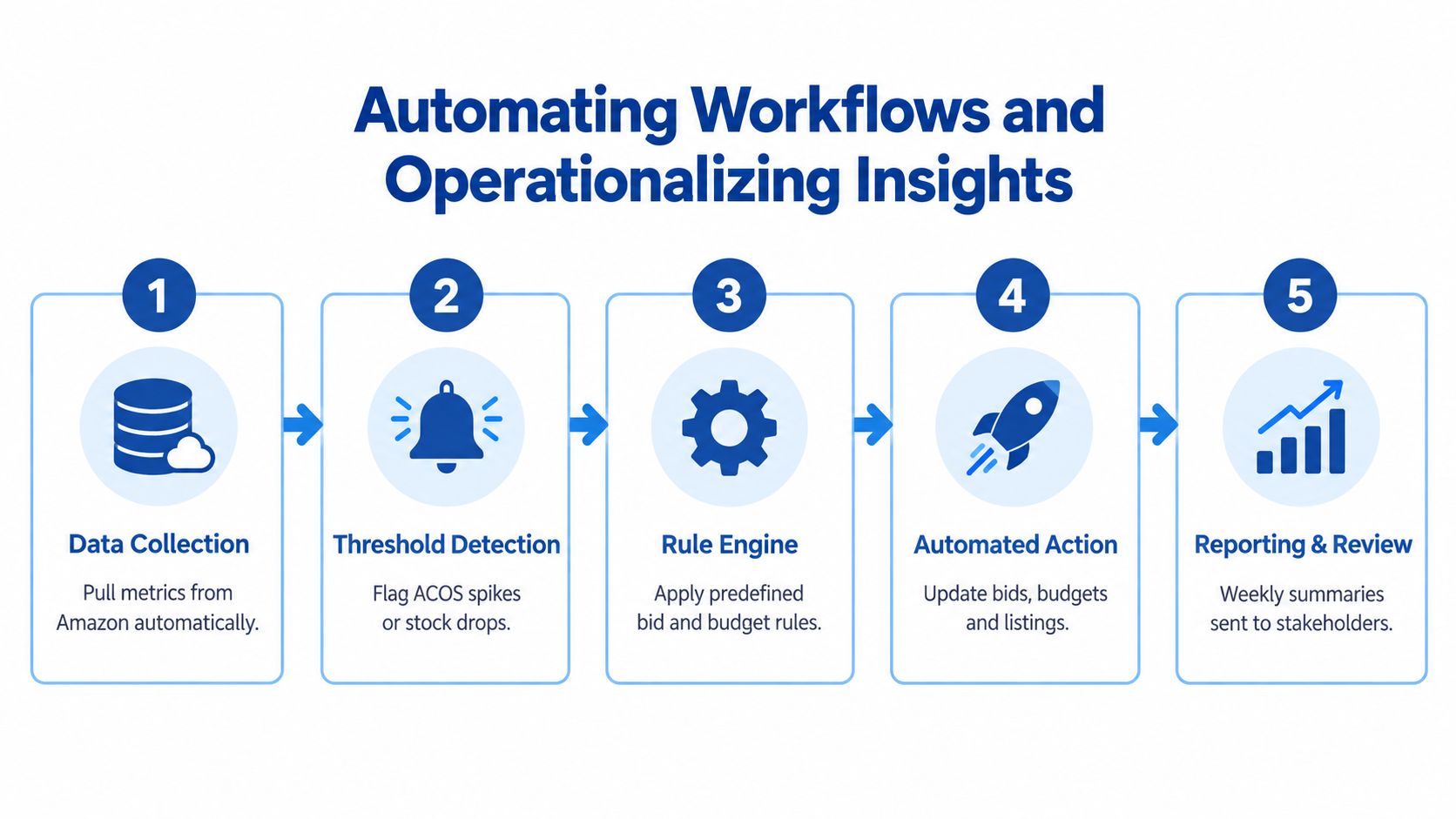
A practical operating loop looks like this:
- Collect: Pull campaign, sales, SQP, inventory, COGS, fee, and margin inputs into a consistent reporting layer.
- Detect: Flag changes such as deteriorating conversion, rising spend against fixed contribution, query gaps, or stock risk.
- Decide: Apply rules that account for ASIN role, lifecycle stage, margin, and audience quality.
- Act: Adjust bids, budgets, targeting, or content tasks within approved limits.
- Review: Send a weekly exception report to the people responsible for commercial decisions.
The strongest bid rules don't say “increase bids when revenue rises.” They say “increase exposure when the query meets the profitability threshold, inventory is healthy, the offer is retail-ready, and the activity isn't already dominated by existing demand.” That rule is harder to build, but it protects the business from buying impressive-looking sales at a loss.
Use automated listing recommendations as a queue, not an unattended publishing system. SQP can identify an important query family, but the content team still needs to judge relevance, compliance, readability, and brand voice. Amazon's experiment framework can then test the proposed change rather than relying on an unmeasured update.
Headline Marketing Agency is one option for teams that need an operating layer across sales, advertising spend, product COGS, Amazon fees, SQP, and AMC data. The important requirement is not the vendor name. It's whether the system connects insight to an approved action and leaves a clear audit trail.
Scaling with Full-Funnel Measurement and Reactivation
Full-funnel measurement becomes valuable when it answers a budget question that lower-funnel reporting can't. Streaming TV and DSP may look inefficient if the only success criterion is an immediate attributed order. AMC can connect exposure patterns to downstream behavior, helping the team evaluate incremental reach, new-to-brand outcomes, and cross-channel paths.
Amazon's Netgear example illustrates the type of evidence a full-funnel view can uncover. Streaming TV ads delivered 67% incremental reach versus Amazon DSP audiences, 69% of sales attributed to streaming TV were new-to-brand, and purchase rates were 2x higher after exposure to streaming TV ads. These are case-specific results, not benchmarks for every brand, but they show why upper-funnel media shouldn't be judged exclusively by last-click ROAS. Amazon's AMC case-study material provides the example.
Audience refinement can also change allocation decisions. In Q2 2024, audiences identified with AMC Flexible Shopping Insights contributed 36% of The Honest Company's total new-to-brand purchases while consuming 17% of the ad budget, according to Amazon's case-study library. The Honest Company AMC case study shows how a refined audience can contribute more efficiently than a broad allocation, although the result shouldn't be generalized without testing the audience and economics in your own account.
Reactivation turns seasonal learning into durable value
Peak periods create valuable audience signals, but many brands abandon those audiences once the event ends. A better approach is to identify which exposed or engaged groups later showed commercial intent, then build a reactivation plan that respects recency, product relevance, margin, and purchase history.
The Avène case provides a concrete example. Data-driven reactivation improved prospecting ROAS by 295%, from 1.01x to 3.97x, while conversion rate increased from 0.071% to 0.107% between the stated baseline and post-season periods. Amazon's Avène full-funnel case study documents those results. They support a strategic point, not a guaranteed forecast: audiences built during peak periods can become useful inputs for later prospecting and reactivation.
The operating model is a feedback loop. SQP identifies where shoppers express demand. AMC shows how exposure and purchase paths develop. Profitability data determines what you can afford to scale. Experiments improve the listing and message. Automation moves approved insights into campaigns and content workflows.
For teams building that measurement discipline, Amazon advertising attribution guidance from Headline offers a useful reference point. The recommendation is to stop asking which channel received credit and start asking which combination of exposure, query demand, content, and offer produced profitable incremental growth.
Headline Marketing Agency helps consumer brands connect Amazon PPC, DSP, Search Query Performance, Amazon Marketing Cloud, profitability data, and content testing into practical growth workflows. Visit Headline Marketing Agency to discuss a measurement and activation plan built around incremental growth, organic scale, and sustainable marketplace profitability.
Get Your Free Amazon PPC Audit
Discover untapped growth opportunities and see how our data-driven approach can improve your ROAS.
Get Free Audit →Ready to Transform Your Amazon PPC Performance?
Get a comprehensive audit of your Amazon PPC campaigns and discover untapped growth opportunities.