Amazon DSP Program: A Practical Guide for Brands
Learn how the Amazon DSP program works, who it suits, what it signals cost, and how to use it alongside Sponsored Ads for profitable, full-funnel growth.

Most advice about the Amazon DSP program starts with the wrong question: “What ROAS can I get?” That framing turns a demand-generation platform into an oversized retargeting button. The better question is whether DSP can create profitable demand, expand qualified audiences, and generate the branded searches and conversion paths that Sponsored Ads later capture.
Amazon DSP can do that, but it won't do it automatically. Brands that judge every impression by last-click revenue usually cut the channel before it has a chance to influence consideration. Brands that treat it as a controlled experimentation and audience-development program can connect paid reach with organic growth, contribution margin, and sustainable scale.
Why Amazon DSP Deserves a Second Look
The conventional view is simple: DSP is expensive retargeting for large brands. That view is incomplete. Retargeting is one use case, not the platform's strategic purpose.
Amazon DSP began as the Amazon Advertising Platform in 2012, added self-service access in 2014, and was brought under the Amazon Advertising name in 2018. The platform evolved from a marketplace advertising tool into an omnichannel demand-side platform that combines programmatic buying with Amazon shopping and behavioral signals (Amazon DSP's platform overview).
That evolution matters because Sponsored Ads mostly harvest existing intent. A shopper searches, clicks, and may buy. DSP can reach people before that search, re-engage people who considered a product, and expose audiences to a brand across multiple environments. The resulting value may appear later as a branded search, a product-detail visit, or an assisted purchase rather than as an immediate attributed order.
Practical rule: If you evaluate DSP with the same last-click ROAS target used for Sponsored Products, you'll systematically undervalue demand creation.
The right evaluation standard is broader. Start with contribution margin, then separate customer acquisition from repeat demand, and measure whether DSP changes behavior compared with a suitable control group. Organic ranking isn't a guaranteed output of advertising, but DSP can support the branded demand and product engagement that make an organic growth strategy more durable.
For mid-market brands, the decision isn't “enterprise or no DSP.” It's whether the business has enough margin, conversion evidence, audience quality, creative capacity, and measurement discipline to learn from the spend.
What Amazon DSP Does
Amazon DSP is a buying platform for audience-led media, not a retargeting shortcut. You choose who you want to reach, where ads should run, what creative fits that environment, and which outcome matters. Then you optimize for that job instead of forcing every campaign to chase the fastest attributed sale.
Start with the buying mechanism
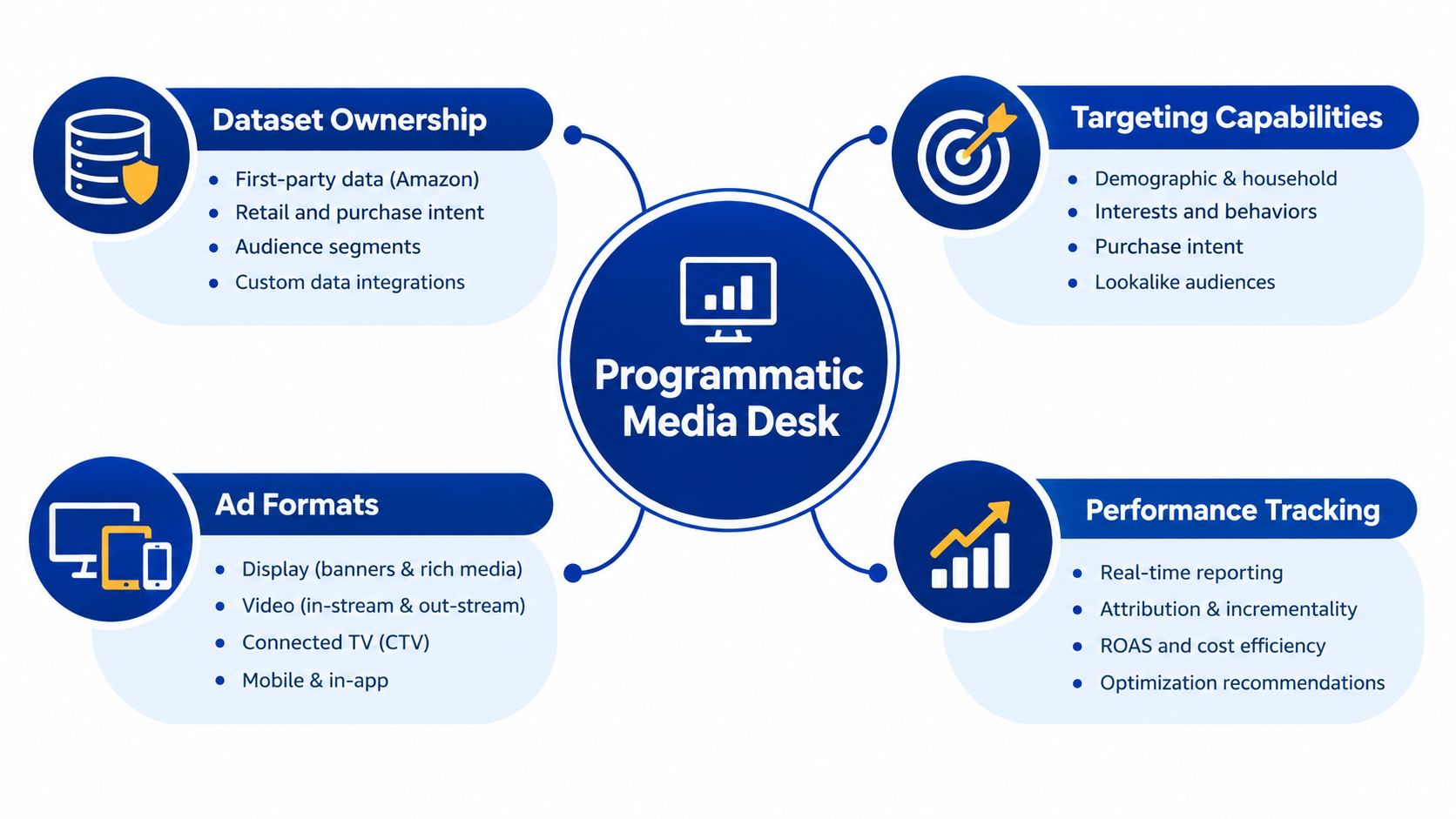
Amazon DSP supports real-time bidding, private marketplaces, and programmatic guaranteed deals across Amazon properties, including Prime Video and Twitch, as well as third-party websites and applications (Amazon's demand-side platform guide).
Each option has a clear use case:
- Real-time bidding is the workhorse for scalable testing. Use it when you need reach, faster learning, and room to compare audience segments without locking yourself into fixed supply.
- Private marketplaces give you tighter control over where ads appear. Use them when the publisher environment matters and you want more control than the open auction gives you.
- Programmatic guaranteed deals make sense when securing a placement matters more than bidding flexibility.
Choose the method that fits the decision you need to make. Prospecting usually needs scale and learning speed. A brand push in a specific premium environment can justify tighter supply control, but only if that context changes performance enough to matter.
Then define the audience
Sponsored Products answer active demand. DSP works from audience and shopping signals, so you can reach people based on product views, category behavior, purchase patterns, and broader audience attributes.
That changes the role of the campaign. A keyword campaign asks who is searching now. A DSP campaign asks who should discover the brand, move into consideration, return after showing interest, or convert after more exposure. That is why DSP works best as an experimentation and audience-development channel. It can create demand that later shows up in branded search, detail page traffic, and stronger organic momentum.
Creative has to match that job. Display can remind someone about a product they already considered. Video can explain why the product is different before the shopper reaches the detail page. Audio and streaming placements can build memory in moments when no one is browsing a results page. If your team cannot produce enough video to test angles properly, an AI product video maker can help turn product assets into usable variations, as long as the final ads still meet brand and placement requirements.
Finally, match optimization to the job
Do not default every line item to conversion optimization. Prospecting, retargeting, branded-demand development, and customer acquisition need separate audiences, creative, and KPIs. If you collapse them into one setup, the platform will spend toward easy conversions from shoppers who were already close to buying.
Inventory, Signals, and the Metrics That Matter
Amazon DSP gives you a wide mix of inventory, but breadth is not the advantage by itself. The advantage is matching the placement to the job. If you use streaming TV the same way you use retargeting display, you will overpay for exposure and learn very little.
The inventory set is broad: display, online video, audio, streaming television, Fire TV, Twitch, Prime Video, Thursday Night Football, and thousands of external publishers. Use display for reminders and product-led creative. Use online video when the product needs explanation or comparison. Use streaming television for reach and memory, then prove it earned its budget with measurement, not assumptions. External publisher supply helps you reach people before they search. Amazon-owned supply helps you connect ad exposure more closely to downstream shopping behavior.
Signals matter just as much as placements. DSP can target from shopping and behavioral patterns instead of waiting for a keyword. That is why it works best for prospecting, competitor-category consideration, re-engagement, and new-to-brand acquisition. It is also why weak audience design gets expensive fast. Overlapping audiences and loose frequency settings turn a testing channel into a repetition machine.
Use metrics as diagnostics, not decoration
Do not judge DSP with one ROAS line and call it analysis. Amazon's measurement framework includes detail-page-view rate, add-to-list actions, new-to-brand outcomes, reach, frequency, and viewability (Amazon's DSP measurement guidance). Each metric answers a different question, and each belongs to a different stage of the job.
| Funnel Stage | Primary Metric | Diagnostic Purpose |
|---|---|---|
| Exposure | Reach and frequency | Shows whether you're expanding coverage or repeating impressions |
| Delivery quality | Viewability | Indicates whether served impressions had a reasonable chance to be seen |
| Consideration | Detail-page-view rate | Measures post-impression product interest |
| Intent development | Add-to-list actions | Identifies shoppers moving toward future purchase |
| Customer acquisition | New-to-brand outcomes | Separates new customer development from existing demand |
| Conversion | Attributed sales plus controlled tests | Connects reported revenue with incremental impact |
Frequency control deserves more attention than it usually gets. Amazon DSP supports caps at the campaign, ad-group, or account level, with daily, hourly, or 10-minute settings (Amazon's frequency-cap documentation). Use that control to protect reach, reduce waste, and create cleaner tests. If you want a practical way to evaluate whether tighter caps are creating net new audience coverage, this guide to incremental reach measurement in Amazon DSP is a useful starting point.
The right readout is simple. Use frequency and viewability to judge delivery quality, DPVR to judge interest, and NTB outcomes to judge customer acquisition. Then confirm sales impact with controlled testing, especially on upper-funnel formats.
DSP Versus Sponsored Ads and When to Use Each
Sponsored Ads and DSP aren't interchangeable. Sponsored Products, Sponsored Brands, and Sponsored Display are built to capture identifiable shopping activity inside Amazon's retail environment. DSP buys audience-based exposure across Amazon properties and external inventory, often before a shopper expresses direct search intent.
| Decision Criteria | Amazon DSP | Sponsored Ads |
|---|---|---|
| Primary job | Create, develop, and recapture demand | Capture active demand |
| Signal | Audience, shopping, behavioral, and exposure signals | Search, product, and marketplace interaction |
| Reach | Amazon and off-Amazon inventory | Primarily Amazon retail placements |
| Typical creative | Display, video, audio, streaming television | Retail ad units and sponsored formats |
| Core diagnostic | Reach, frequency, DPVR, NTB, viewability, incrementality | Clicks, conversion, sales, and search efficiency |
| Cost logic | Media exposure plus applicable platform fees | Auction-based retail advertising costs |
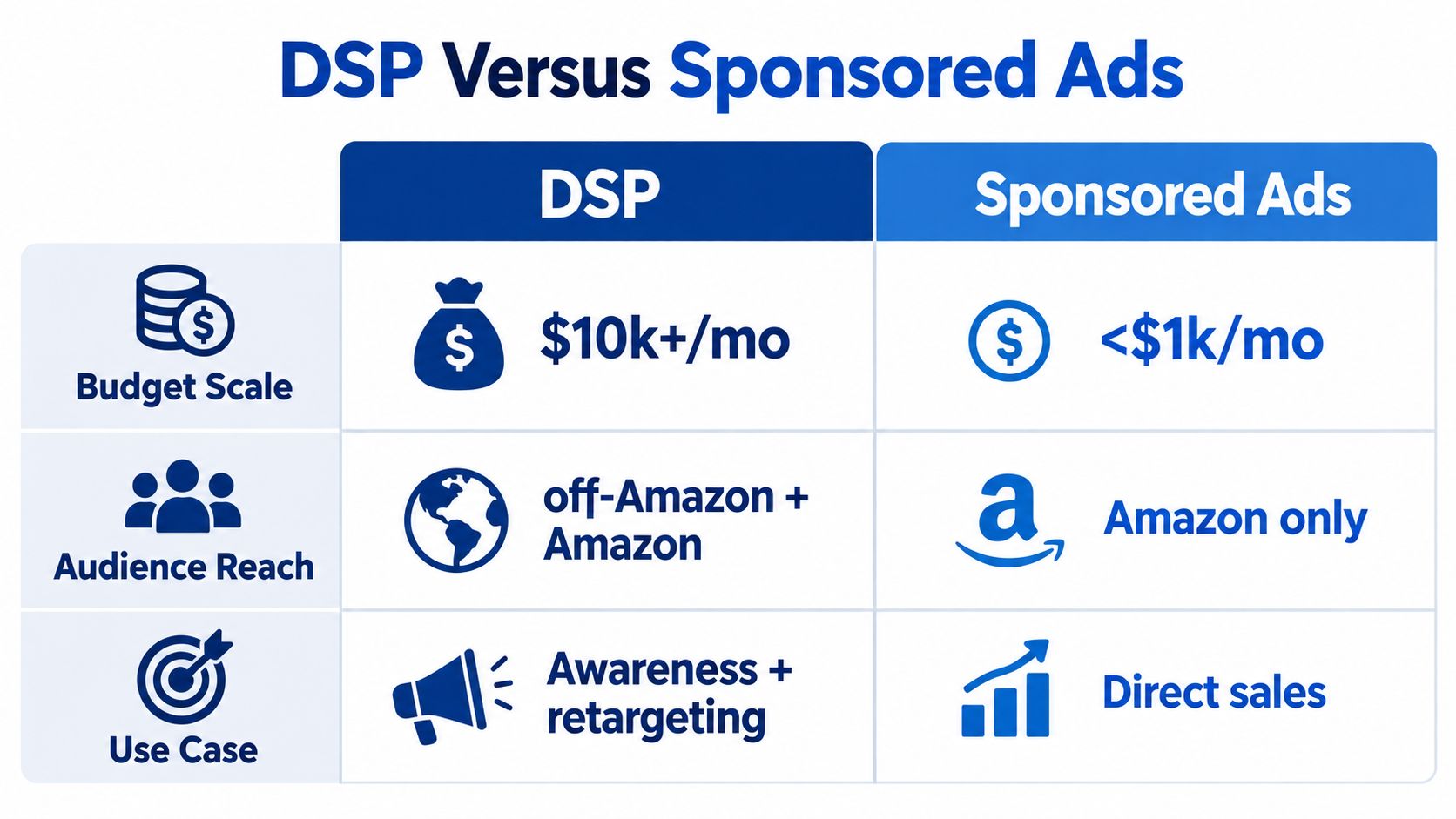
The common mistake is to fund Sponsored Ads first, then demand that DSP match their immediate efficiency. That creates a structural bias. Sponsored Ads benefit from demand that already exists. DSP may create the future search, product visit, or branded interaction that Sponsored Ads later converts.
A better allocation rule is operational:
- Protect Sponsored Ads when the brand has profitable active demand to capture.
- Add DSP prospecting when the product needs qualified reach beyond current search volume.
- Use retargeting selectively when product-page visitors have a credible reason to return.
- Separate acquisition from retention so repeat buyers don't inflate the apparent efficiency of new-customer campaigns.
- Measure overlap cohorts instead of judging channels in isolation.
Amazon's Logicool case study illustrates why overlap matters. Customers exposed to both Amazon DSP and Sponsored Products had a purchase rate 9,067 percent higher than customers exposed only to Sponsored Products, while sales of the leading trackball mouse rose 97 percent year over year (Amazon's Logicool case study). That result isn't a forecast for your brand. It is evidence that the combined exposure path can behave differently from either channel alone.
The practical test is straightforward: compare DSP-only, Sponsored-Products-only, and combined-exposure groups. Review purchase rate, new-to-brand share, contribution margin, and branded search behavior. Siloed ROAS won't show the full interaction.
What Real Brands Have Gotten From DSP
Cambridge Audio is a better DSP case study than most because it forces the right question. The issue was not whether a display impression won last-click credit. It was whether DSP created demand that later showed up in branded search and conversion paths the brand would have missed in a standard report.
An Amazon Marketing Cloud analysis across 21 months found that remarketing generated 38,000 branded searches, and DSP influenced 81 percent of total sales as either the first interaction or a meaningful step in the purchase path (Amazon's Cambridge Audio case study). After the brand reactivated campaigns based on those findings, total sales increased 19 percent and purchasing consumers increased 9 percent, according to the same case study.
That is the practical value of DSP. It can build branded demand before conversion reports give it much credit.
If you run DSP like a retargeting machine, you will miss that upside. If you run it as an audience-development channel, you look for signals that show momentum building. Branded search lift. Assisted paths. New-to-brand mix. Product-detail engagement. Those indicators matter because DSP often changes who enters the market for your product, not just who converts inside the attribution window.
A useful way to read this in practice is through path analysis. Start with the sequence, not the final click. Check whether shoppers first saw DSP, later searched your brand, then converted through Sponsored Ads or organic brand traffic. Compare that path against audiences with no DSP exposure. Then separate prospecting from remarketing so returning visitors do not make upper-funnel activity look stronger than it is.
Creative usually becomes the bottleneck first. Audience testing is only as good as the assets you put in market. Use product demos, problem-solution cuts, comparison hooks, and creator-style formats, then build enough variants to test audience and message fit properly. Tools such as ShortGenius AI UGC video ads can speed up that production cycle. They do not replace strategy, but they make it easier to generate enough creative to test incrementality instead of recycling one safe ad across every audience.
Keep the standard high. DSP deserves more budget when it expands reach, improves branded demand, and contributes to conversion paths that would otherwise stay weak or invisible. Attributed revenue alone is too small a lens for judging what the channel is for.
How Amazon Marketing Cloud Changes the Game
Amazon Marketing Cloud, or AMC, is the analytical layer that makes DSP more accountable. It provides a privacy-safe clean room for querying pseudonymized Amazon Ads events, including DSP and Sponsored Ads impressions, clicks, and relevant conversions, alongside permitted advertiser-owned inputs (Amazon Marketing Cloud documentation).
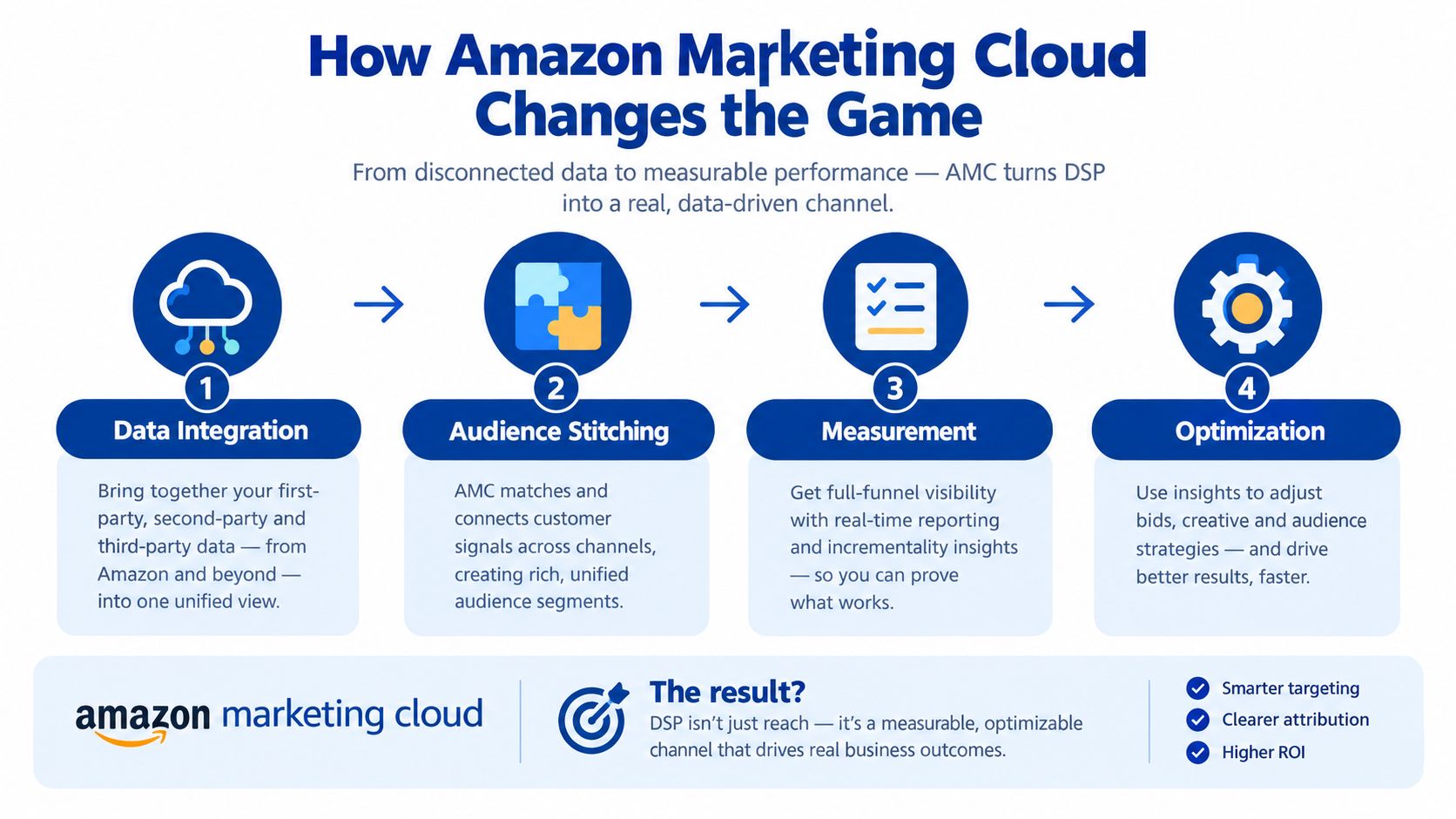
AMC lets teams analyze reach, frequency, cross-channel conversion paths, supply performance, and audience behavior in an aggregated and anonymized environment. They can then create audiences for activation in DSP or Sponsored Ads. That turns reporting into an operating loop: query what happened, identify a useful cohort, activate it, and test the next outcome.
Use AMC to find waste and opportunity
An Amazon-reported example found that a campaign had reached only 19 percent of a CRM audience. An affinity-based AMC audience expanded the targetable audience by 60 percent. The point isn't the specific audience construction. It's the diagnostic method. Overlap analysis revealed that the campaign's apparent CRM strategy had a substantial addressable-reach gap.
AMC can support decisions such as:
- Suppressing overlap: Exclude people already reached too heavily or already converted.
- Prioritizing exposure sequences: Compare audiences exposed to DSP before Sponsored Ads with audiences receiving the reverse sequence.
- Evaluating supply: Identify whether certain inventory contributes useful paths or delivers impressions.
- Expanding first-party reach: Match permitted advertiser signals with Amazon Ads events without moving underlying first-party data outside the advertiser's AWS environment.
- Building activation cohorts: Send high-value behavioral groups back into DSP or Sponsored Ads for controlled testing.
Read this practical overview of the Amazon Marketing Cloud clean room for the implementation implications. The key decision is not whether AMC produces another dashboard. It's whether your team can use path-level evidence to change targeting, exclusions, sequencing, and budget.
Without that loop, DSP remains a black box. With it, the platform becomes a measurable audience-development system.
Is Your Brand Ready for DSP
DSP readiness has less to do with getting access and more to do with whether your business can turn audience testing into profitable growth.
Amazon describes managed-service DSP as typically requiring about $50,000 in spend. It also offers self-service access to brands, agencies, tool providers, and advertisers that do not sell on Amazon. On top of media CPMs, Amazon notes a cost-plus-fees structure that can include audience, third-party pre-bid targeting, measurement, managed-service, and technology fees (Amazon DSP access and pricing information).
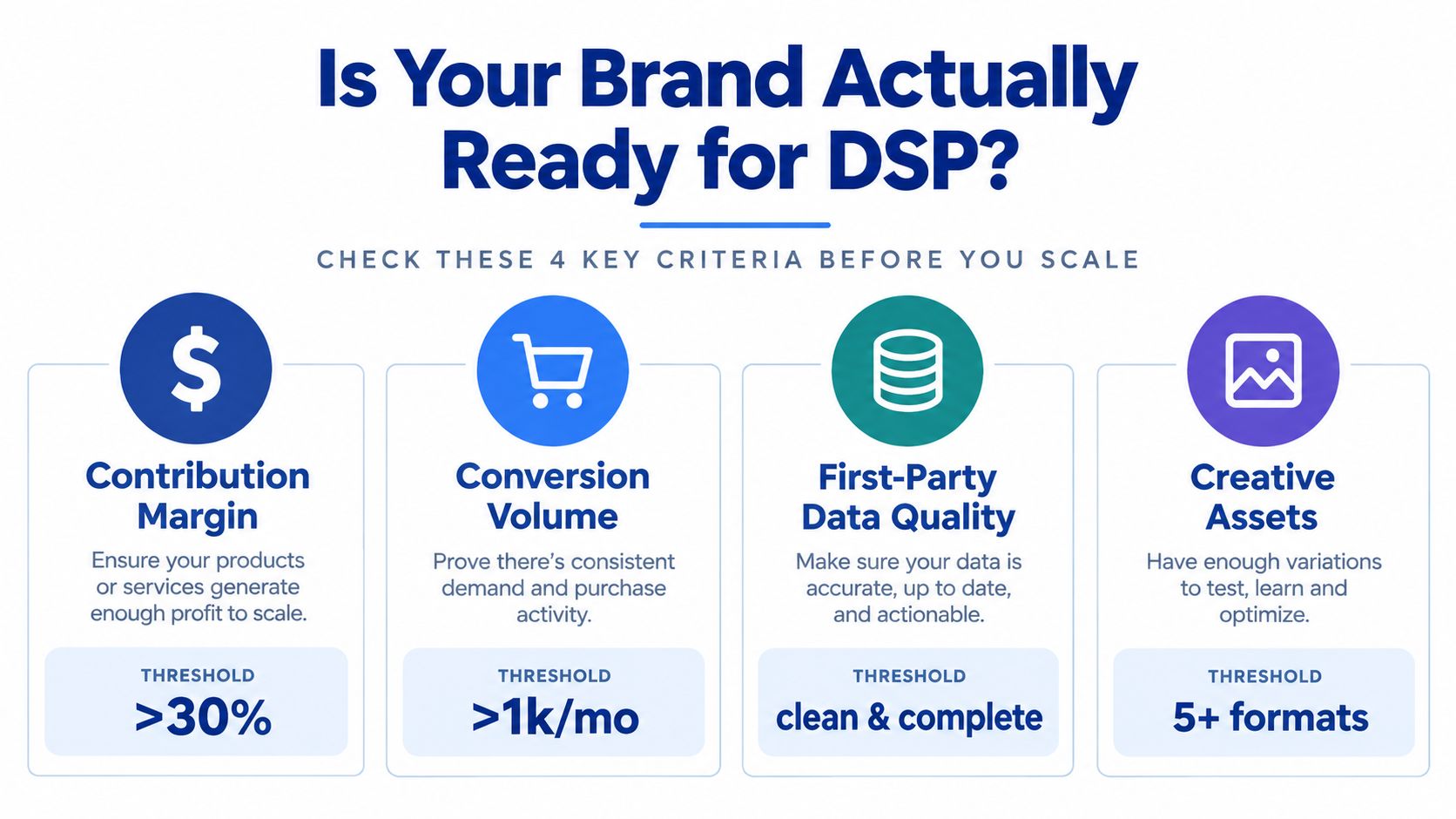
That is why the core filter is operating readiness. A lower entry point does not make DSP cheap, and it definitely does not make it forgiving. Before you scale, pressure-test four conditions.
Contribution margin comes first
If your margin structure is weak, DSP will expose it fast. Revenue is a noisy planning metric. Contribution margin is the one that matters.
Work from what remains after product cost, marketplace fees, fulfillment, discounts, agency or platform charges, and media fees. If prospecting burns through the margin on the first order, you need a believable repeat-purchase or lifetime-value case before you add budget. Otherwise you are buying top-line growth that does not improve the business.
Use contribution margin to set your maximum acceptable acquisition cost. Do not let a strong attributed ROAS distract you from an unprofitable customer mix.
Conversion volume determines learning speed
DSP is an experimentation channel. It needs enough meaningful conversion volume to separate a promising audience from random movement.
If volume is limited, keep the first test narrow and force it to answer one business question. For example, test whether a prospecting audience lifts branded demand, or whether retargeting recovers profitable orders. Do not launch multiple formats, audiences, and objectives at once and then pretend the result was informative. It was not.
First-party data improves control
Better first-party data gives you better decisions. Clean customer lists, usable purchase histories, and clear consent practices let you suppress existing customers, isolate higher-value cohorts, and reduce waste from audience overlap.
Weak first-party data does not block DSP, but it reduces control. That matters because DSP works best when you are building and testing audiences, not just following users around the web.
Testing capacity decides the outcome
Teams fail with DSP when they treat it like a reporting channel instead of a weekly decision system. You need creative variants, audience exclusions, frequency controls, detail-page or landing-page readiness, and one owner who can make changes every week.
A team that reviews attributed sales once a month is not ready to use DSP well.
Your minimum measurement setup should include:
- A financial baseline: Contribution margin by product and customer type.
- A conversion definition: The event that represents meaningful business value.
- A cohort design: Prospecting, retargeting, existing-customer suppression, and control groups.
- A creative plan: Different messages for awareness, consideration, and conversion.
- A decision rule: The threshold that earns more budget, triggers a revision, or ends the test.
If your team lacks production bandwidth, evaluate ecommerce video scaling tools. More asset volume helps, but it will not fix weak unit economics or poor test design. If you are still sorting out access, account structure, and operating model, review the Amazon DSP application process as an implementation choice, not paperwork.
Making DSP Pay and Closing the Loop
Attributed sales are useful, but they aren't the final answer. DSP should earn more budget only when controlled evidence shows that exposure caused additional business value.
Amazon and Attain used an exposed-versus-control methodology with a seven-day post period across more than 30 streaming-TV campaigns for 17 quick-service restaurant brands. The analysis reported an average incremental ROAS of $2.08, rather than relying on attributed conversions alone (Amazon and Attain's incrementality analysis).
That figure is a benchmark from a defined campaign set, not a promise for a consumer brand in another category. Its value lies in the methodology. Exposed-versus-control analysis asks what happened because of advertising, while attribution asks which conversions the platform can associate with advertising.
Build the test before scaling spend
Use the method that fits your business:
- Holdout audiences can compare exposed and unexposed groups when audience controls are practical.
- Geo experiments can test regional exposure against comparable regions when offline or cross-channel sales matter.
- Third-party measurement can help validate outcomes beyond Amazon's reporting environment.
- AMC path analysis can connect DSP exposure with later Sponsored Ads activity, branded searches, and purchases.
- Media-mix comparisons can test whether DSP changes total demand rather than shifting credit between channels.
Frequency, reach, DPVR, NTB, contribution margin, and incremental sales should sit in the same decision framework. If repeated impressions produce little additional response, tighten the cap and move recovered budget toward new prospects, high-intent audiences, or branded-demand capture.
Headline Marketing Agency's role in this model is not to chase a platform-reported ROAS target. Its Amazon PPC and DSP work connects campaign management with profitability, organic ranking, retail readiness, creative testing, and AMC-based analysis. That is the operating model brands need when DSP is expected to compound sustainable growth rather than produce a temporary retargeting lift.
Treat DSP as an experiment with a financial hypothesis. Prove incrementality, develop the audiences that create future search demand, and scale only after the measurement loop supports the decision.
If your brand is considering DSP, start with the economics, audience plan, creative requirements, and incrementality test before committing media budget. Visit Headline Marketing Agency to assess a data-led Amazon PPC and DSP program built around profitability, organic growth, and measurable audience development.
Get Your Free Amazon PPC Audit
Discover untapped growth opportunities and see how our data-driven approach can improve your ROAS.
Get Free Audit →Ready to Transform Your Amazon PPC Performance?
Get a comprehensive audit of your Amazon PPC campaigns and discover untapped growth opportunities.