Performance Marketing Explained for Amazon Brands
Performance marketing explained for leaders who need Amazon PPC and DSP to grow profit, ranking, and incremental sales.

U.S. search advertising generated $102.9 billion in 2024, growing 15.9% year over year and accounting for 39.8% of digital advertising revenue, making it the largest digital advertising category, according to the IAB's full-year advertising revenue report. Advertisers have committed serious money to measurable response. But on Amazon, measuring a sale doesn't prove you created it, and reporting revenue doesn't prove you earned a profit.
For leaders who want performance marketing explained in business terms, start there. Your job isn't to produce the cheapest attributed sales. It's to use advertising to grow contribution profit, strengthen organic visibility, and acquire customers worth keeping.
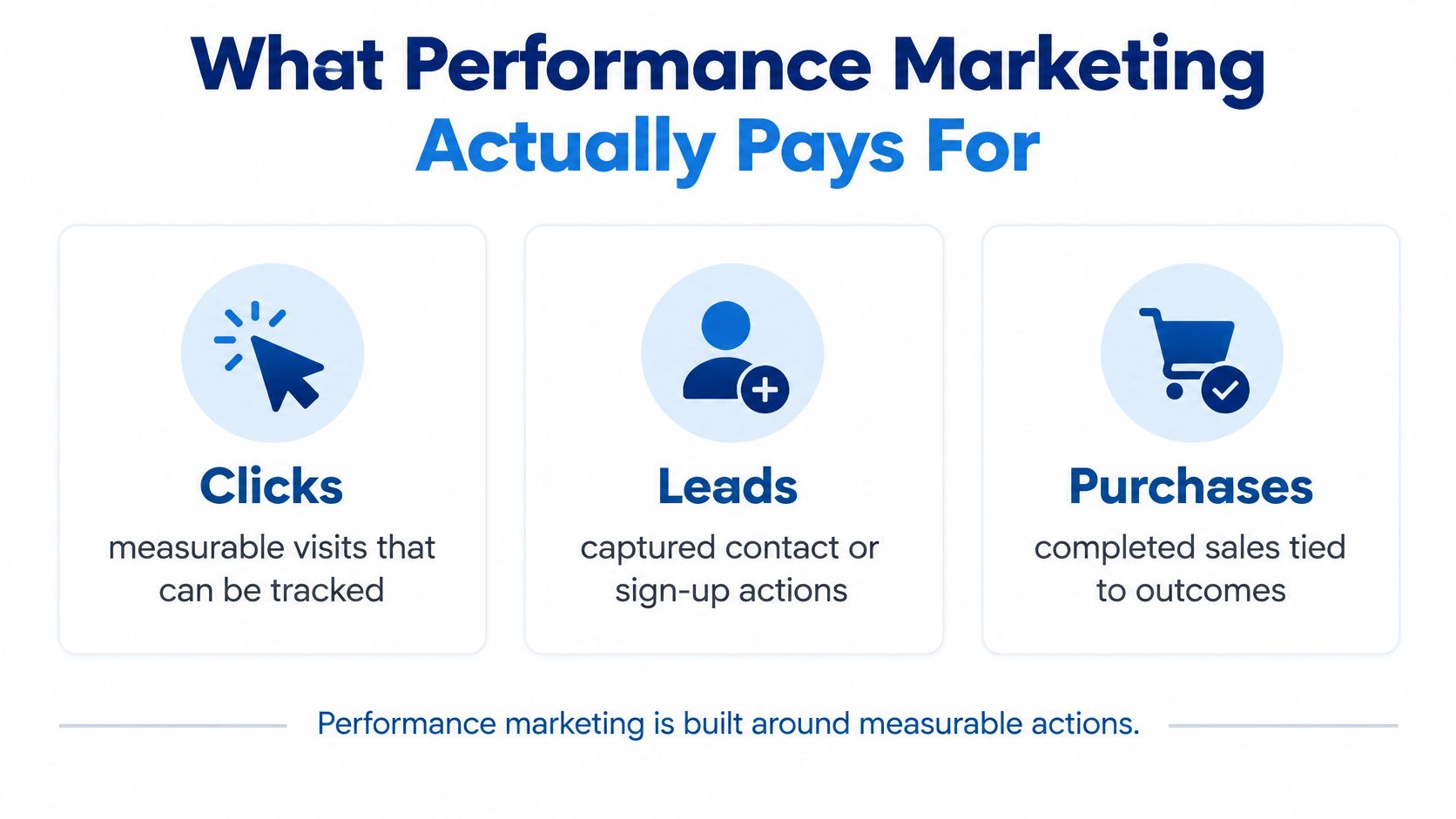
What Performance Marketing Actually Pays For
Performance marketing is an advertising model organized around measurable actions rather than exposure alone. Those actions can include clicks, leads, purchases, app installs, or attributed revenue. Tracking connects the action to advertising activity; bidding and optimization determine where the next advertising dollar goes.
That doesn't mean every campaign charges you only when a customer buys. The billing event and the business outcome are different things. You can pay for a click while managing toward a profitable purchase.
The measurable actions are straightforward. Their economic value requires more judgment.
Start with the outcome worth buying
On Amazon, an attributed sale is an intermediate result. The commercial questions extend to new-to-brand customers, contribution margin, repeat purchase, and organic-ranking effects.
Before approving more spend, decide what the campaign should accomplish:
- Generate current contribution: Sell products with enough margin remaining after advertising.
- Acquire valuable customers: Accept acquisition costs that make sense against credible repeat-purchase behavior.
- Support marketplace growth: Test whether paid visibility helps improve organic performance and future unpaid sales.
A high ROAS can still leave you losing money after product costs, Amazon fees, discounts, and fulfillment. Conversely, a modest early return may warrant continued investment if subsequent evidence supports reviews, stronger ranking, and profitable repeat demand. Treat those benefits as hypotheses to validate, not excuses for weak economics.
Automate the right objective
Tracking and bidding systems help execute decisions. They can't choose the right business objective for you. An automated campaign can become exceptionally efficient at acquiring sales you didn't need to pay for.
For teams reviewing execution workflows, AdCrunch's performance marketing automation strategies for 2026 offers a relevant resource to assess alongside your own operating requirements. Establish the profit guardrails before deciding which decisions to automate.
Operating standard: Buy measurable outcomes, but scale only when those outcomes support the business.
Headline's point of view starts with that distinction: PPC should serve profitable growth and organic strength, not become a separate revenue operation with its own definition of success.
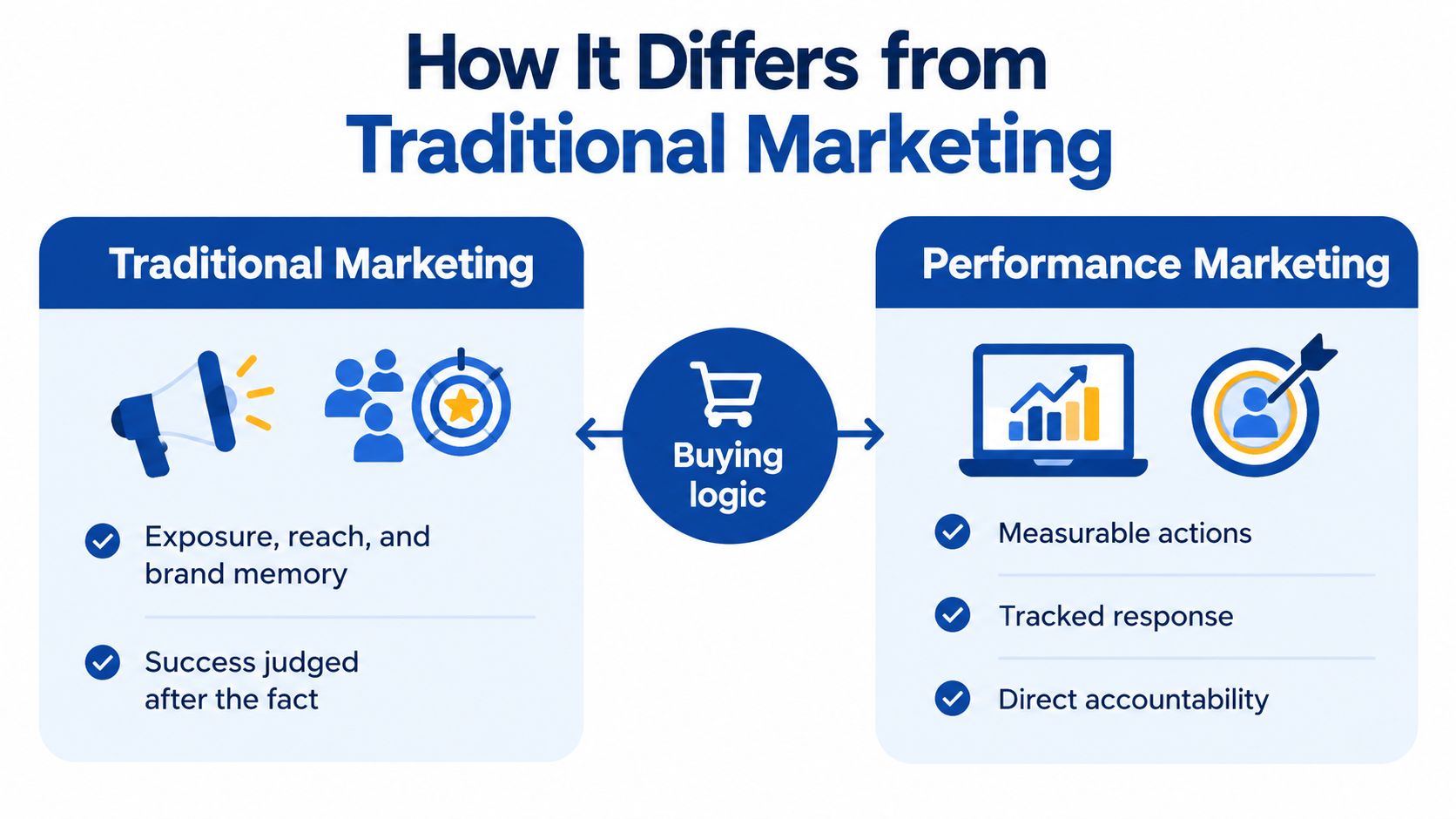
How It Differs from Traditional Marketing
Think of traditional media as renting attention in the hope of a later purchase. Marketplace performance media is closer to bidding at the shelf, where a shopper can compare your offer with alternatives immediately.
This is a distinction in buying logic, not a claim that brand advertising is wasteful. An awareness campaign and a conversion campaign can both be valuable. They need different expectations.
The comparison below separates those expectations.
Judge the campaign by its assigned job
An exposure-led plan asks who should encounter the brand, what they should remember, and whether that investment supports future preference. Leaders typically evaluate it through awareness and broader commercial outcomes rather than requiring an immediate purchase from every exposure.
An outcome-led plan begins with a defined response and an acceptable cost. The team adjusts targeting, bids, budget, and creative as results arrive.
| Buying decision | Awareness-led approach | Performance-led approach |
|---|---|---|
| Primary objective | Build recognition and preference | Generate a defined action |
| Budget logic | Purchase relevant exposure | Reallocate toward acceptable outcomes |
| Creative question | What should buyers remember? | What will make the right shopper act? |
| Evaluation | Brand response and broader sales context | Tracked response and commercial economics |
For an Amazon brand, that changes how you diagnose a weak campaign. More impressions aren't a satisfactory answer if shoppers reject the listing after clicking. Price, reviews, product content, and retail readiness belong in the same conversation as bids.
Don't confuse capture with creation
A campaign reaching shoppers who already know your brand has a different job from one introducing an unfamiliar product. Don't rank both solely by immediate conversion efficiency. You'll risk starving future demand while rewarding the easiest existing demand to capture.
Use the video as another way to frame the buying-model distinction.
The director's responsibility is to make those jobs explicit. Ask the team what each campaign should change, which evidence would demonstrate that change, and when a decision is due. A performance label doesn't make an investment accountable. A clear objective and an honest review do.
The Scoreboard Beyond ACOS and ROAS
ACOS is a campaign-efficiency metric, not a business verdict. It divides advertising spend by attributed advertising revenue. ROAS reverses that relationship, expressing attributed revenue relative to spend.
TACoS divides advertising spend by total revenue, including paid and organic sales. The Amazon seller-community discussion of TACoS and ACOS frames the distinction as overall sales impact versus immediate advertising efficiency. Neither ratio, by itself, proves profit or causality.
Which Amazon Metric Answers Which Question
| Metric | What it divides or reports | Question it can answer | What it cannot prove |
|---|---|---|---|
| ACOS | Ad spend divided by attributed ad revenue | How expensive are attributed sales? | Whether total sales are profitable |
| ROAS | Attributed ad revenue divided by ad spend | How much credited revenue accompanies spend? | Whether advertising caused that revenue |
| TACoS | Ad spend divided by total revenue | How much of total revenue goes to advertising? | Whether advertising caused organic growth |
| Contribution margin | Revenue remaining after defined variable costs | What remains to cover advertising and other obligations? | Which campaign caused the contribution |
| Customer acquisition cost | Defined acquisition spending divided by customers acquired | What does acquiring a customer cost? | Whether that customer will repeat |
| New-to-brand | Customers or sales meeting the platform's definition | Is the campaign reaching beyond established buyers? | Whether those buyers are incremental |
| Repeat purchase | Observed subsequent purchasing | Are acquired customers returning? | Their guaranteed future value |
Read the metrics together
Consider a brand with acceptable ACOS but deteriorating total profitability. The campaign report may look healthy while discounts, fulfillment costs, or a shift toward lower-margin products weaken the business. Holding ACOS steady doesn't solve that problem.
The reverse also deserves investigation. Temporarily higher ACOS may be acceptable while a product establishes demand and organic sales improve. That's a reason to examine the investment over an appropriate period, not permission to ignore contribution.
Product Metrics' discussion of how to measure profit instead of revenue per ad euro is useful context for choosing the financial objective. Define which costs your profit measure includes so finance and media teams aren't reporting different versions of success.
For a weekly review, bring together:
- Comparable periods: Review ACOS, TACoS, total sales, and contribution over the same dates.
- Product economics: Separate products with different margin structures rather than averaging away the problem.
- Customer quality: Examine acquisition and repeat behavior alongside immediate revenue.
A lower ACOS deserves praise only when the underlying business result deserves it too.
Require the team to explain changes in total revenue and organic contribution before celebrating an efficiency improvement. A cleaner dashboard is useful. A healthier business is the objective.
When a Winning Dashboard Is Not Incremental
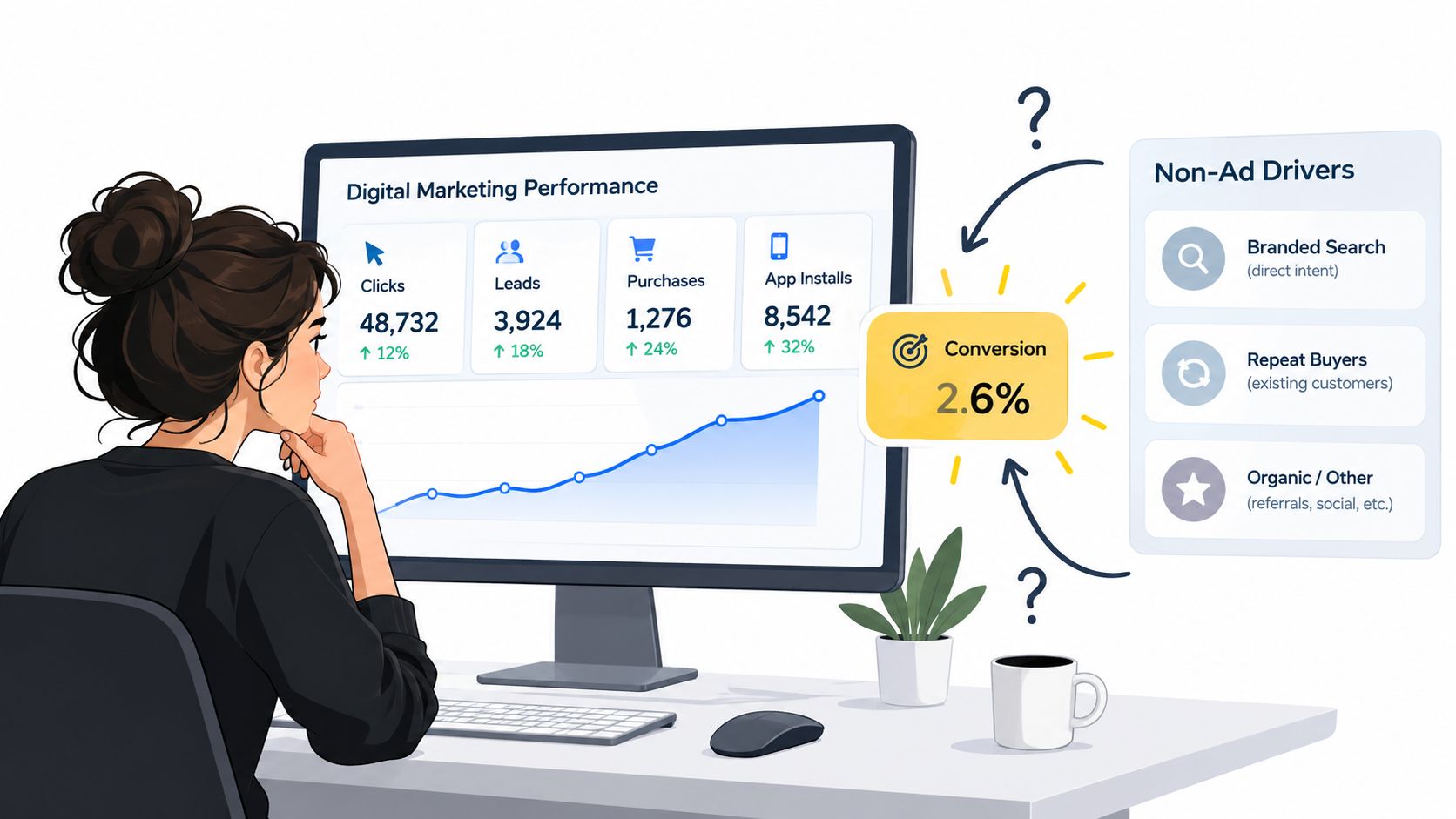
A shopper searches for your brand, recognizes your product, and purchases after clicking an ad. The platform attributes the sale correctly under its rules. That still leaves the important question unanswered: Would the shopper have bought without the ad?
On Amazon, branded searches, repeat buyers, established organic rankings, coupons, and strong purchase intent can all complicate that answer. Cheap attributed sales can be bad business when you pay to intercept purchases you would otherwise receive without advertising.
A dashboard review should therefore include a challenge to the credit being reported.
Attribution assigns credit, incrementality tests cause
Attribution allocates credit according to configured rules, including click or view windows. Incrementality estimates the difference advertising caused by comparing a treatment group with an appropriate control.
Google describes Conversion Lift as comparing conversions among people who saw advertising with people intentionally prevented from seeing it. The relevant calculation is incremental ROAS, or incremental revenue divided by advertising cost.
That distinction matters commercially. Strong attributed ROAS and weak incremental ROAS can coexist. Headline's explanation of incremental revenue provides additional context for separating credited sales from additional business.
The measurement challenge is material: 36% of CPG marketers and agency professionals report difficulty proving incrementality, 44% question the accuracy or reliability of results, and 43% struggle to apply measurement consistently, according to EMARKETER's retail-media incrementality analysis.
Challenge the easiest revenue first
Start where existing demand could plausibly explain the result. Don't cut every branded campaign on principle, but don't grant it immunity because its attributed return looks attractive.
- Separate branded and nonbranded activity: Stop blending demand capture with broader discovery.
- Inspect new-to-brand outcomes: Use them as supporting evidence, not automatic proof of causality.
- Run controlled holdouts where feasible: Use randomized audiences or appropriately comparable geographic markets.
- Test reduced spending carefully: Examine whether total and organic sales persist, rather than watching only the disappearance of attributed sales.
Keep treatment and control measurement consistent across exposure, timing, revenue, and conversions. Account for uncertainty and test quality before making a permanent budget change.
Budget warning: If sales remain stable when spend falls, investigate whether you were buying attribution rather than additional demand.
A spend-reduction test isn't automatically conclusive. Changes in price, inventory, or promotions can muddy the comparison. The point is to replace certainty based on platform credit with a testable commercial explanation.
Choosing a Measurement Model That Holds Up
Amazon, brand websites, stores, and social platforms don't form a single clean reporting environment. Retailers can define attributed sales, lookback windows, new-to-brand customers, and ROAS differently. Comparing exported figures without reconciling those definitions creates false precision.
The operational gap is substantial. In IAB Europe's retail-media research, 58% of buyers consider campaign-level metrics and integrated online/offline reporting essential; 32% of surveyed brands struggle to prove retail-media ROI, and only 24% report full integration of their advertising business with retail-media channels.
Choose an operating model, not just a dashboard
| Approach | Useful for | Main limitation |
|---|---|---|
| Isolated ACOS dashboards | Campaign execution and obvious waste reduction | Leaves wider business effects unresolved |
| Data-driven attribution alone | Allocating credit across observed interactions | Doesn't independently establish causal impact |
| Platform reporting plus lift testing | Frequent optimization and strategic budget decisions | Requires deliberate test design and coordination |
Google describes data-driven attribution as machine-learning analysis of converting and non-converting paths. Its attribution and Conversion Lift guidance says the model incorporates incrementality signals and identifies a $5,000 minimum campaign budget for the referenced study setup. That isn't a universal testing threshold or an Amazon requirement.
Use platform data for daily bids, targeting, and budget pacing. Use periodic experiments to challenge strategic allocation. Headline's guide to attribution modeling can help align stakeholders on what the credit-allocation layer does.
Build a minimum viable measurement system
Start with consistent campaign naming, product groupings, and written metric definitions. Bring in first-party customer signals and privacy-safe or clean-room analysis where available, then compare platform reporting with experiments and broader marketing-mix evidence.
For cross-channel teams reviewing how to measure Meta and TikTok conversions, Exerta's attribution discussion is a relevant companion resource. Keep those channel reports connected to commercial outcomes rather than treating each platform's conversion total as additive.
- Standardize definitions: Record attribution windows, customer definitions, and included costs.
- Connect operations: Review inventory, catalog changes, promotions, and organic performance with media results.
- Document decisions: State which evidence supports execution changes and which supports budget expansion.
A profitability-led agency model is another option. Headline combines Amazon PPC and DSP across Sponsored Products, Brands, Display, and Video with Search Query Performance and Amazon Marketing Cloud insights. Its operating priority is margin, organic ranking, and long-term brand equity, with ACOS treated as a diagnostic rather than the final objective.
How Search PPC and DSP Split the Funnel
A documented Amazon optimization case shows why budget allocation matters more than increasing spend. Over two months, monthly PPC sales rose from $8,000 to $33,000, while ACOS fell from 59% to 15% and TACoS declined from 29% to 8%, according to the AMZ Advisers case-study library.
The reported approach concentrated investment on profitable search terms and reduced inefficient traffic. Those are strong reported efficiency results, not independent proof of incrementality. The practical lesson is to improve where the budget goes before assuming the budget needs to grow.
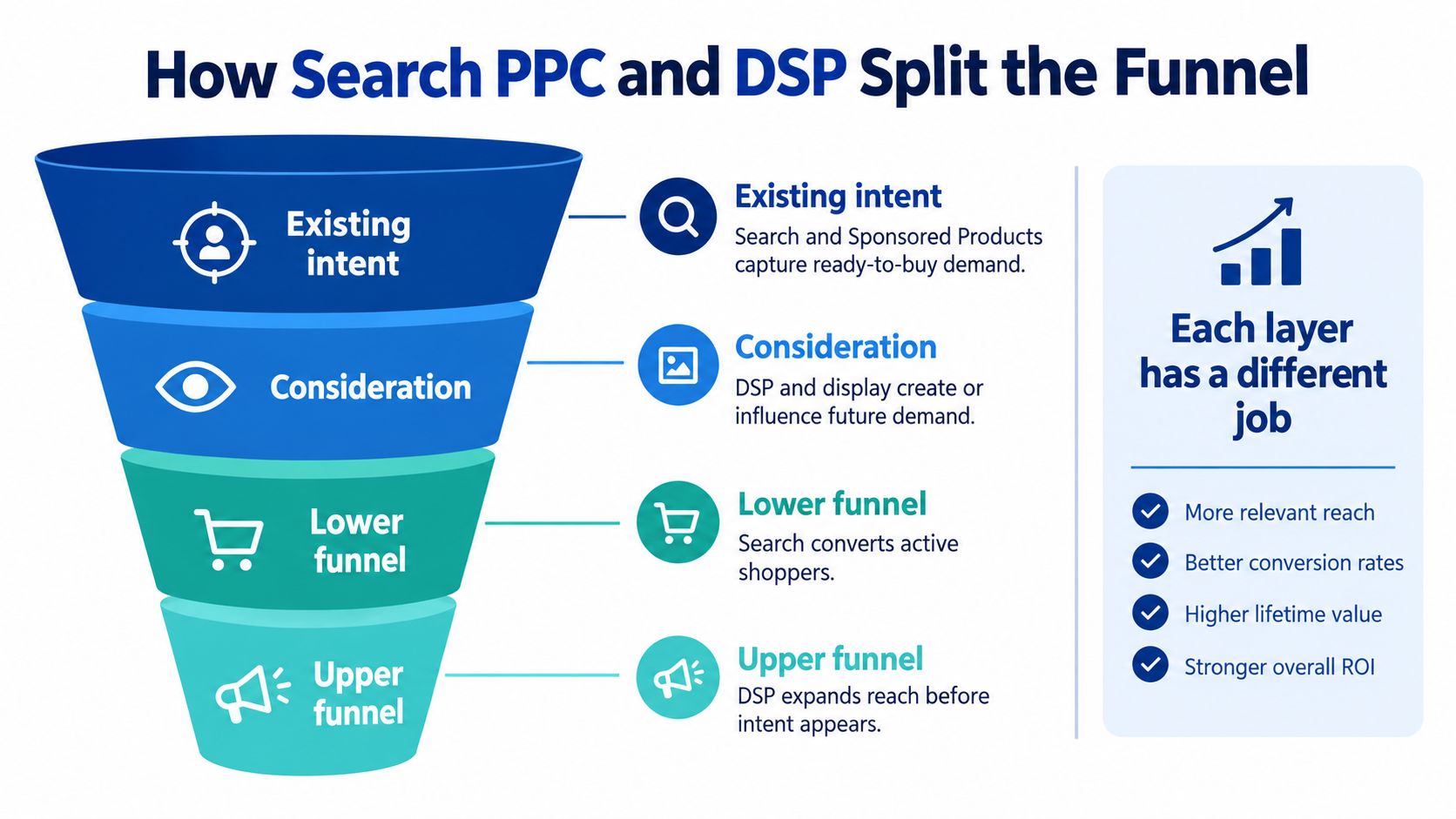
Different media layers need different assignments.
Use search to diagnose the shelf
Search and Sponsored Products capture active shopping intent. Their results depend on whether the advertised product can win the shopper's attention and purchase after gaining visibility.
Amazon's Search Query Performance documentation describes impressions, clicks, cart adds, and purchases for branded search terms, with query detail comparing a selected ASIN against the top 10 ASINs. The report covers organic and Sponsored Products activity originating from search, while the Query ASIN score combines the search-funnel signals.
Use that evidence to locate the problem:
- Visibility without clicks: Review relevance, the main image, price, and the competitive offer before raising bids.
- Clicks without cart adds: Inspect product content and whether the listing answers the query's purchase requirements.
- Cart adds without purchases: Investigate the offer and retail-readiness conditions that could stop completion.
Prioritize terms where paid visibility is present but the product loses shoppers further down the search funnel. Low ACOS alone isn't a sufficient expansion criterion.
Give DSP a distinct commercial assignment
Amazon separately reports that HEYDUDE achieved 11.4x ROAS using Amazon DSP, Buy with Prime, and a display-ad solution in its published case-study library. That example supports considering a broader media mix, but it doesn't establish the same outcome for another brand.
Use DSP and display to build or recover consideration, then evaluate the downstream commercial result. Headline's Amazon DSP program overview outlines that channel's role alongside search.
Don't force every layer to resemble a branded search campaign. Require each layer to justify its assigned job, then scale against contribution and blended business impact. Upper-funnel reach is an input. Profitable downstream sales are the result you need.
A Practical Next Step for Profitable Scale
Start with a budget review built around decisions, not another reporting deck. Bring the media lead, eCommerce owner, and finance partner into the same discussion. Agree on which costs count, which outcomes matter, and what would justify moving money.
The objective is to identify where advertising earns further investment, where the product offer needs work, and where platform credit needs testing. Keep those decisions separate so you don't use a bid change to solve a listing problem.
Establish a shared commercial baseline
Pull branded and nonbranded search into separate views. For the same recent period, record ACOS, TACoS, total sales, new-to-brand outcomes, and contribution margin using the definitions already agreed with finance.
Attach a decision to each finding:
- Protect: Retain investment where the commercial evidence supports the spend.
- Repair: Flag products where conversion or retail readiness needs attention before expansion.
- Challenge: Identify campaigns whose success depends heavily on existing demand.
- Expand: Prioritize opportunities supported by margin, customer quality, and broader marketplace progress.
Don't let the team hide mixed product economics inside an account average. A campaign can meet its target while directing spending toward the wrong part of the catalog.
Turn the review into an execution sequence
Open Search Query Performance and list queries where paid visibility is strong but click, cart, or purchase performance lags competing ASINs. Assign both a media action and a listing or retail-readiness action where the evidence warrants it.
Then select a feasible holdout or controlled spend-reduction test. Write down the hypothesis, the comparison, and the conditions that would make the result unreliable before launching it.
Finally, document the job of each media layer. Search should have an intent-capture assignment; DSP and display should have a demand-creation or recovery assignment. Review their combined downstream economics rather than allowing separate teams to claim the same commercial success.
Treat PPC as an investment in contribution profit and organic strength, not a competition to publish the lowest ACOS.
That standard changes the questions you ask your team. Instead of asking whether the account looks efficient, ask which investment should receive the next available budget, what evidence supports that decision, and what result would make you reverse it.
Headline Marketing Agency offers Amazon PPC and DSP management focused on profitability, organic ranking, and sustainable marketplace growth. Visit Headline Marketing Agency to request a profitability-first review of your catalog, campaign economics, and measurement approach, then identify where to cut waste, improve retail readiness, and invest for scale.
Get Your Free Amazon PPC Audit
Discover untapped growth opportunities and see how our data-driven approach can improve your ROAS.
Get Free Audit →Wollen Sie Ihre Amazon PPC-Performance aufs nächste Level bringen?
Lassen Sie Ihre Amazon PPC-Kampagnen professionell analysieren und entdecken Sie neue Wachstumsmöglichkeiten.