Amazon FBA vs Dropshipping for Profitable Growth
Compare Amazon FBA vs dropshipping by logistics, margins, risk, scalability, and PPC impact, then choose the right model for your brand.

The popular advice on Amazon FBA vs dropshipping is too simplistic: use dropshipping to start cheaply, then switch to FBA when you want to scale. That assumes avoiding inventory means lower costs and outsourcing fulfillment means better profitability. Neither conclusion holds without examining the product, the delivery promise, and what remains after advertising and returns.
The better question is operational: Which model produces dependable contribution profit without exposing the business to cash or service risks it can't manage? For brand owners and retail leaders, that's a more useful starting point than comparing fulfillment fees alone.
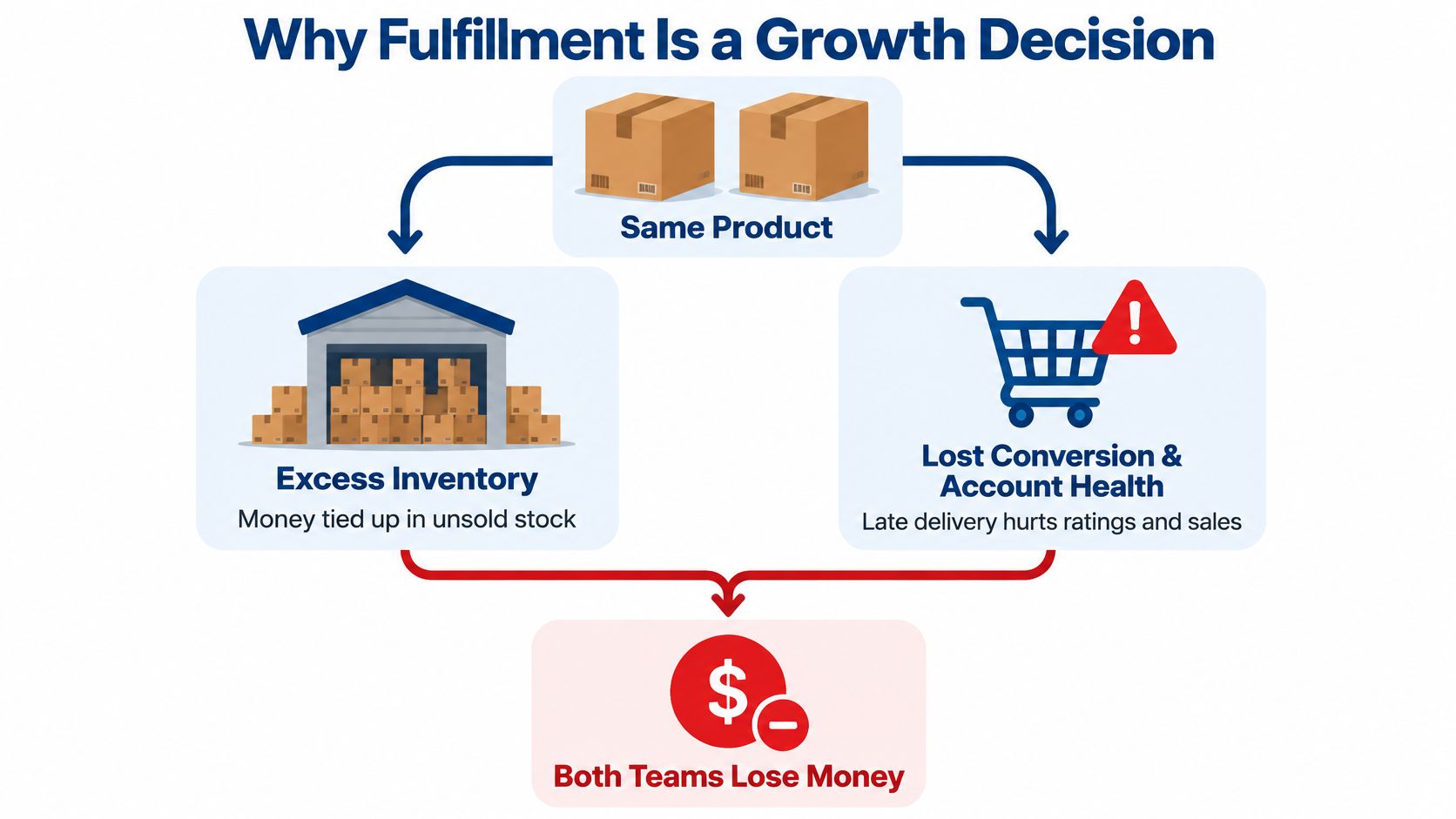
Why Fulfillment Is a Growth Decision
Consider a hypothetical comparison: separate teams advertise the same product. The FBA team buys more inventory than demand supports, while the dropshipping team relies on a supplier that can't consistently meet delivery promises. Both can lose money, but their campaign dashboards won't necessarily reveal why.
The first team needs better purchasing and replenishment decisions. The second needs tighter supplier execution before buying more traffic. Increasing advertising spend wouldn't resolve either underlying problem.
The operational paths look different, even when the financial outcome is similar.
Delivery belongs in the commercial forecast
A 2024 Forrester Consulting study commissioned by Amazon found that average expected click-to-delivery time had fallen from 5.7 days to 2.5 days over the preceding five years, while only 86% of surveyed orders arrived on time and 63% of retailers said at least one in ten orders arrived late (Forrester fulfillment report).
For a marketing leader, the implication is straightforward: the delivery promise deserves scrutiny alongside price, product content, and media targeting. A campaign can attract qualified shoppers without giving them a compelling reason to complete the purchase.
Practical rule: Don't approve a larger advertising budget until operations can support the demand you intend to generate.
Compare the complete operating outcome
Use a shared commercial scorecard rather than separate logistics and advertising reports:
- Contribution profit: Deduct referral fees, product cost, fulfillment, advertising, and expected returns from revenue.
- Inventory exposure: Evaluate cash committed, likely storage duration, and the consequences of selling more slowly than forecast.
- Service exposure: Estimate the direct costs of cancellations, supplier failures, replacement shipments, and customer support.
These are decision inputs, not reasons to favor either model automatically. A stronger delivery proposition can justify higher fulfillment costs, while an uncertain product opportunity may not justify an inventory purchase.
The key leadership distinction is between profitable demand generation and generating orders. Fulfillment determines whether the business can convert those orders into an acceptable financial outcome.
How the Two Fulfillment Models Work
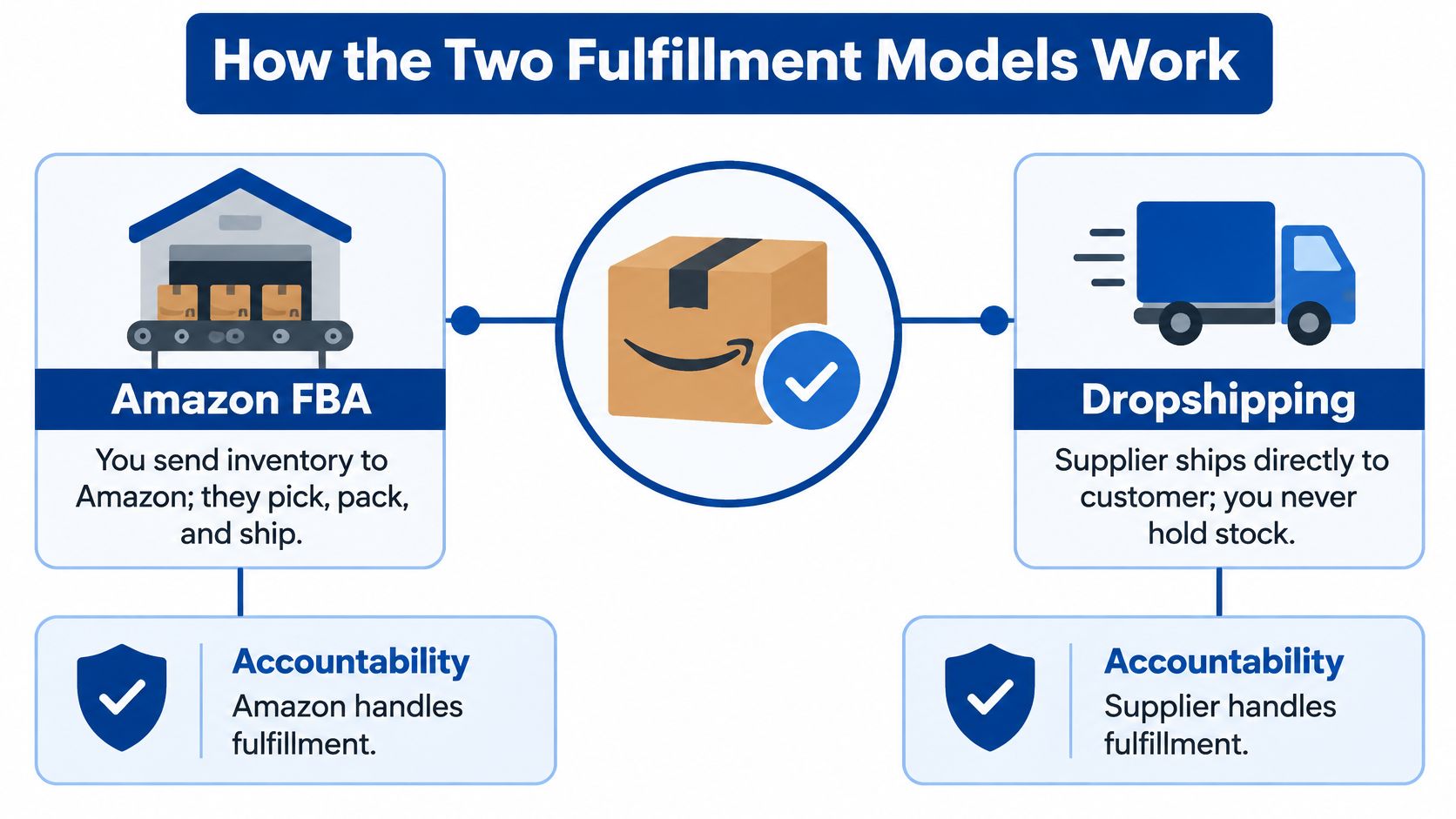
Fulfillment by Amazon means sending inventory into Amazon's fulfillment network before customers order. Amazon launched FBA in 2006, initially working with seven fulfillment centers and five founding sellers; by 2016, the program had expanded to more than 2 billion seller-fulfilled items delivered, according to Amazon's FBA history.
Under this model, Amazon handles storage, picking, packing, shipping, customer service, and returns. Sellers still make the buying, forecasting, assortment, and cash-allocation decisions.
The distinction is easiest to understand by following the product.
Delegating fulfillment doesn't eliminate accountability
With dropshipping, the merchant lists products without holding inventory, then relies on a supplier to dispatch each customer order. Instead of managing stock inside Amazon's network, the merchant coordinates availability, order transmission, shipping updates, customer communication, and return arrangements.
For broader market context, Readymerce's dropshipping forecast this year offers an additional reading resource. Use market outlooks to frame questions, not to replace supplier-level validation or product economics.
The operating boundary matters more than the label:
- FBA seller responsibilities: Decide what to purchase, how much to send, when to replenish, and how to respond to excess inventory.
- Dropshipping seller responsibilities: Verify that suppliers can execute the customer promise and provide usable information when something goes wrong.
- Shared leadership responsibility: Set realistic demand assumptions and fund only the opportunities the business can support.
A supplier may physically fulfill a dropship order, but that doesn't mean the merchant can delegate responsibility for the customer relationship. Likewise, Amazon's handling of an FBA order doesn't make a weak purchasing decision commercially sound.
The accompanying video provides another format for reviewing the fulfillment models.
Treat the choice as an accountability design. Identify who owns each failure point, what information they receive, and what action they can take before committing advertising budget.
Comparing Logistics Margins and Scale
The useful comparison isn't which model has fewer tasks. It's which tasks your organization can execute consistently at an acceptable cost.
FBA and Dropshipping Decision Comparison
| Decision criterion | Amazon FBA | Dropshipping | Leadership question |
|---|---|---|---|
| Capital commitment | Inventory purchased and shipped ahead of demand | No advance inventory holding by the merchant | How much cash can remain committed while demand develops? |
| Delivery execution | Amazon manages fulfillment | Supplier executes against the merchant's promise | Can the delivery commitment be verified? |
| Cost structure | Fulfillment plus inventory-related charges | Supplier product and shipping costs plus coordination | What remains after every variable expense? |
| Assortment expansion | Requires additional inventory decisions | Enables testing without stocking each product | Can operational controls support broader selection? |
| Main exposure | Forecast error and unsold stock | Supplier availability and execution | Which failure can the team detect and correct? |
| Customer service | Amazon handles FBA service and returns | Merchant coordinates service and returns | Is the return process workable before launch? |
FBA fulfillment fees depend on product size tier and shipping weight, while monthly storage uses daily average cubic-foot volume. Sellers also need to consider applicable removal, returns-processing, inbound-defect, and extended-storage costs, rather than treating fulfillment as an all-inclusive charge (Amazon's FBA fee guidance).
Dropshipping removes the advance stock purchase, but it doesn't remove operating expenses. Supplier shipping, software, payment processing, and customer-service requirements still belong in the commercial comparison.
Product characteristics change the answer
For a compact product with dependable demand, test whether standardized fulfillment can support enough additional contribution to justify inventory ownership. Don't assume the answer from its small dimensions alone.
For bulky or low-velocity merchandise, ask how much volume the stock occupies and how long it could remain unsold. A product can have attractive purchase economics and still be a poor inventory investment.
For fragile goods, evaluate packaging specifications and the return pathway before selecting fulfillment. For uncertain demand, distinguish a product test from a permanent operating model: avoiding an initial stock commitment can be useful without proving that supplier fulfillment is the best long-term choice.
Category resources can help teams identify the right questions. JewelryBuyDirect's discussion of pricing and fulfillment for jewelry resellers is a relevant starting point for jewelry assortment planning, while this guide to Amazon fulfillment costs can support a more complete expense review.
A larger catalog isn't scalable if each additional listing creates an exception your team can't reliably resolve.
Operational capacity deserves its own approval gate. Before expanding, ask whether stock updates, dispatch confirmations, customer inquiries, and returns remain manageable under higher demand. A model that works only when someone manually chases every order isn't ready for aggressive media investment.
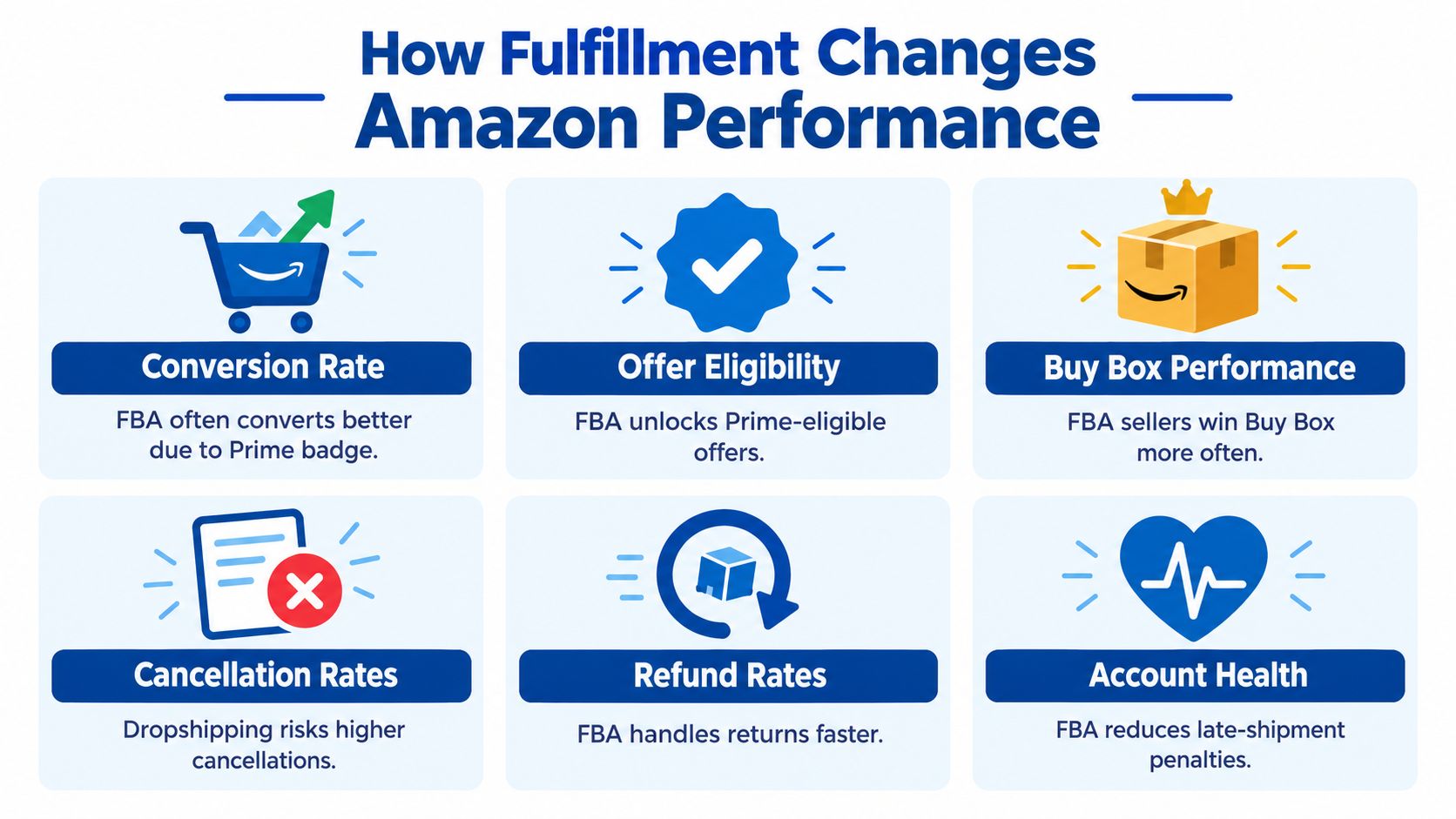
How Fulfillment Changes Amazon Performance
Advertising efficiency depends on retail readiness. If shoppers see an unattractive delivery promise, a relevant keyword and persuasive creative may still fail to produce a profitable order.
That doesn't establish a universal FBA conversion advantage. It means teams should test fulfillment as a commercial variable rather than assuming every change in campaign performance originates inside the advertising account.
The performance areas below should be measured, not treated as guaranteed outcomes.
Account health creates a hard operating constraint
Amazon requires seller-fulfilled offers to maintain a late-shipment rate below 4% and an on-time-delivery rate of at least 90% without promise extensions to remain listed; it recommends 95% or higher for a strong customer experience (Amazon's seller-fulfilled delivery requirements).
For dropship operators, these requirements turn supplier coordination into an account-health control. Configure handling times around verified capability, synchronize stock availability, and establish escalation procedures for orders that haven't progressed as expected.
Delivery terminology also needs a common definition across marketing and operations. A review of how long standard shipping takes can help teams examine the promise shoppers actually see, rather than relying on a supplier's general description.
Evaluate PPC beyond ACOS
Advertising cost of sales, or ACOS, doesn't capture the entire operating outcome. Review it alongside:
- Conversion and offer availability: Separate changes in shopper response from periods when the offer wasn't consistently available.
- Cancellations and refunds: Reconcile campaign-attributed sales with the financial outcome after order exceptions.
- Stockouts and delivery performance: Identify operational interruptions before interpreting weaker sales as a targeting problem.
- Contribution after advertising: Decide whether incremental orders generate enough profit to justify continued investment.
For a fulfillment comparison, control what you can: product content, pricing, promotional activity, and campaign targeting. Document anything that changes so the team doesn't attribute a content improvement or price reduction to fulfillment.
The strategic role of PPC is broader than purchasing immediate sales. Use it to support product discovery and test demand, then monitor whether organic sales and visibility develop alongside profitable paid activity. Don't promise organic ranking gains from a fulfillment switch, and don't assume FBA guarantees Buy Box ownership or fewer refunds.
Sustainable growth requires evidence that the entire customer journey works, not just evidence that shoppers click.
Build a SKU Level Break Even Model
Build separate FBA and dropshipping cases for each SKU. Keep product assumptions comparable, but allow delivery-related conversion, returns, and order volume to differ when your own operating evidence supports those differences.
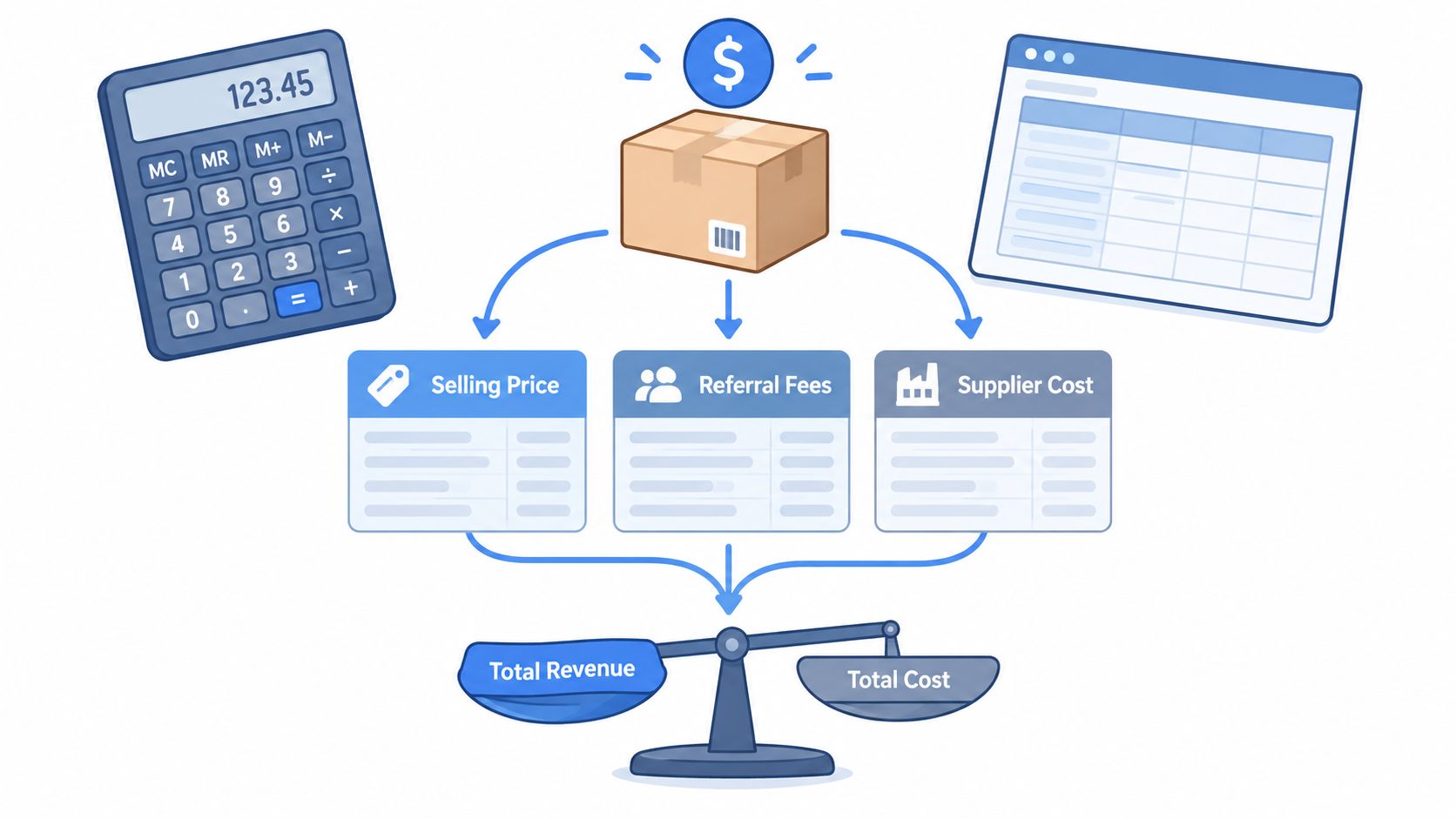
Contribution profit = net sales revenue minus product cost, referral fees, fulfillment or supplier shipping, storage, expected returns, advertising, and other variable operating costs.
The financial components need to be visible before the team chooses a model.
Separate unit economics from cash exposure
Start with selling price, packaged dimensions, shipping weight, landed product cost, and expected monthly velocity. Allocate expected storage duration and returns expense to the orders you expect to retain, not merely the orders initially placed.
Then evaluate cash separately. Include inventory carrying cost and supplier payment timing, and show the funding required before sales receipts arrive. Chern & Co's Irish business finance guide offers a complementary resource on budgeting and forecasting, while an Amazon seller profit calculator can help organize marketplace-specific inputs.
- Base case: Use observed demand and delivery performance where available.
- Slower-demand case: Extend storage duration and reduce inventory turns.
- Execution-failure case: Add direct replacement, cancellation, refund, and support costs using your own records.
Keep uncertain account-health or visibility effects separate from measurable expenses. Assigning a precise financial value without evidence creates false confidence.
Apply the correct fee assumptions
Amazon's 2026 U.S. fee schedule specifies an FBA fulfillment-rate discount of $0.86 for products below $10 versus products priced at $10 or more, a $0.25 increase for some small standard-size products priced between $10 and $50, and a 3.5% fuel and logistics surcharge in the U.S. and Canada beginning April 17, 2026 (Amazon's fee schedule and logistics updates).
Those product-specific changes aren't interchangeable with category averages. Amazon separately lists scheduled average fulfillment-fee increases of $0.08 for standard-size products priced from $10 to $50 and $0.05 for products below $10 (Amazon's price, weight, and dimension fee guidance).
For a compact, fast-moving item, test the applicable discounted rate against supplier shipping. For bulky or seasonal inventory, model the actual holding period, not just a favorable launch month.
Decision test: FBA breaks even when its incremental contribution covers its additional inventory-related costs and funding requirements. There's no universal selling price or inventory-turn threshold that answers this for every SKU.
Choose the Right Model by Scenario
An established brand and a product tester shouldn't use the same approval criteria. Their information, capital constraints, and reasons for entering the market differ.
Established brands with repeatable demand
For a proven assortment, evaluate FBA when the business can fund replenishment and wants a standardized delivery proposition. Make inventory depth a deliberate choice, based on forecast confidence and acceptable cash exposure.
The recommendation is conditional: use the SKU model to establish whether the expected commercial benefit justifies the commitment. Brand recognition doesn't protect a business from buying too much stock.
Product testing and catalog exploration
Dropshipping can be appropriate when the immediate objective is learning which products deserve inventory investment. Treat supplier qualification as part of the test budget, not as a task to complete after orders arrive.
Amazon permits dropshipping only when the merchant remains the seller of record. Packing slips, invoices, and external packaging may not display another seller's name or contact details, and the merchant must handle customer returns (Amazon's dropshipping policy).
Before launch, require:
- Written supplier commitments: Confirm seller identity, permitted packaging, dispatch responsibilities, and exception handling.
- Stock and order controls: Establish availability updates, order acknowledgments, and escalation ownership.
- A tested return process: Verify where customers send products and who authorizes refunds.
- A contingency decision: Know when to pause an offer rather than substitute an unverified supplier.
Don't confuse a product test with a supplier test. If delivery execution is unreliable, poor conversion won't tell you much about the underlying product opportunity.
Bulky, seasonal, fragile, or constrained products
For these products, the correct initial answer may be neither model yet. Resolve packaging, supply availability, forecasting, or return-cost uncertainty before deciding how to fulfill.
An established retailer can use existing product knowledge to narrow assumptions, but it should still validate the Amazon-specific operating case. A supplier-constrained brand should establish allocation and replenishment rules before advertising creates demand it can't serve.
Set launch gates around acceptable contribution, verified dispatch performance, manageable refunds, and adequate funding. Define the evidence needed to move from supplier fulfillment to stocked inventory, or to stop the test altogether.
The more useful growth strategy is sequenced commitment: increase operational and financial exposure only when the business has enough evidence to justify it.
Final Recommendation for Profitable Amazon Growth
Choose FBA when predictable demand, dependable delivery, Prime availability, and standardized customer service justify the SKU's inventory and storage commitment. Approve that choice through contribution economics and cash planning, not through a blanket preference for Amazon-managed fulfillment.
Use dropshipping selectively when demand uncertainty makes advance inventory difficult to justify and the merchant can enforce the operating controls already described. It's a testing option, not an exemption from customer-service responsibility or marketplace standards.
Fund the strongest operating case
The most important decision isn't whether the business identifies as an FBA seller or a dropshipper. It's which products deserve inventory, which deserve controlled testing, and which shouldn't receive advertising investment yet.
- Fund proven opportunities: Allocate working capital and media budget together.
- Constrain uncertain launches: Define pause conditions before spending.
- Review actual outcomes: Reconcile forecast contribution with retained sales and operating costs.
- Revisit the model: Recalculate when price, dimensions, demand patterns, or supplier capability changes.
PPC and DSP should support that commercial judgment. Evaluate advertising against profitability, organic growth, and long-term brand equity rather than treating campaign efficiency as an isolated objective.
A well-run advertising program can help a retail-ready product reach relevant shoppers and reveal where demand exists. It can't repair an unreliable supplier or make excess inventory disappear profitably.
The best fulfillment model is the one your business can finance, control, and turn into sustainable contribution profit. Choose at the SKU level, test the assumptions, and scale only after the operating evidence supports the next commitment.
Headline Marketing Agency offers data-driven Amazon PPC and DSP management focused on profitability, organic growth, and long-term brand equity. Visit Headline Marketing Agency to discuss how SKU economics, fulfillment readiness, and advertising performance can guide a more disciplined Amazon growth strategy.
Get Your Free Amazon PPC Audit
Discover untapped growth opportunities and see how our data-driven approach can improve your ROAS.
Get Free Audit →Wollen Sie Ihre Amazon PPC-Performance aufs nächste Level bringen?
Lassen Sie Ihre Amazon PPC-Kampagnen professionell analysieren und entdecken Sie neue Wachstumsmöglichkeiten.