How Long Is Standard Shipping? a Guide for Amazon Brands
How long is standard shipping in practice? Get carrier-by-carrier timelines, Amazon FBA vs seller-fulfilled differences, and tips

Standard shipping typically takes 2–5 business days for domestic U.S. ground delivery, and many packages arrive sooner. The customer-facing window is longer or shorter depending on fulfillment and handling time, weekends, order cutoffs, and the carrier's route.
For Amazon brands, that range is only the starting point. A carrier's transit estimate begins when the parcel enters its network, while the shopper cares about the time from order to doorstep. If your listing promises one thing and the package arrives another day, customers won't separate warehouse processing from carrier transit. They'll judge the experience as a whole, and that can affect conversion, reviews, and whether they buy again.
The useful question isn't only “how long is standard shipping?” It's whether your delivery promise reflects the way your orders move.
What Standard Shipping Actually Means in 2026
In the U.S., a practical baseline for standard domestic shipping is 2–5 business days. USPS Ground Advantage, the Postal Service's primary low-cost package service for items up to 70 pounds, publishes that window, with tracking included. Delivery timing depends on the origin and destination, when the carrier accepts the parcel, transportation conditions, and whether it's headed to a remote location. The estimate isn't a guaranteed arrival date or time. USPS Ground Advantage service details
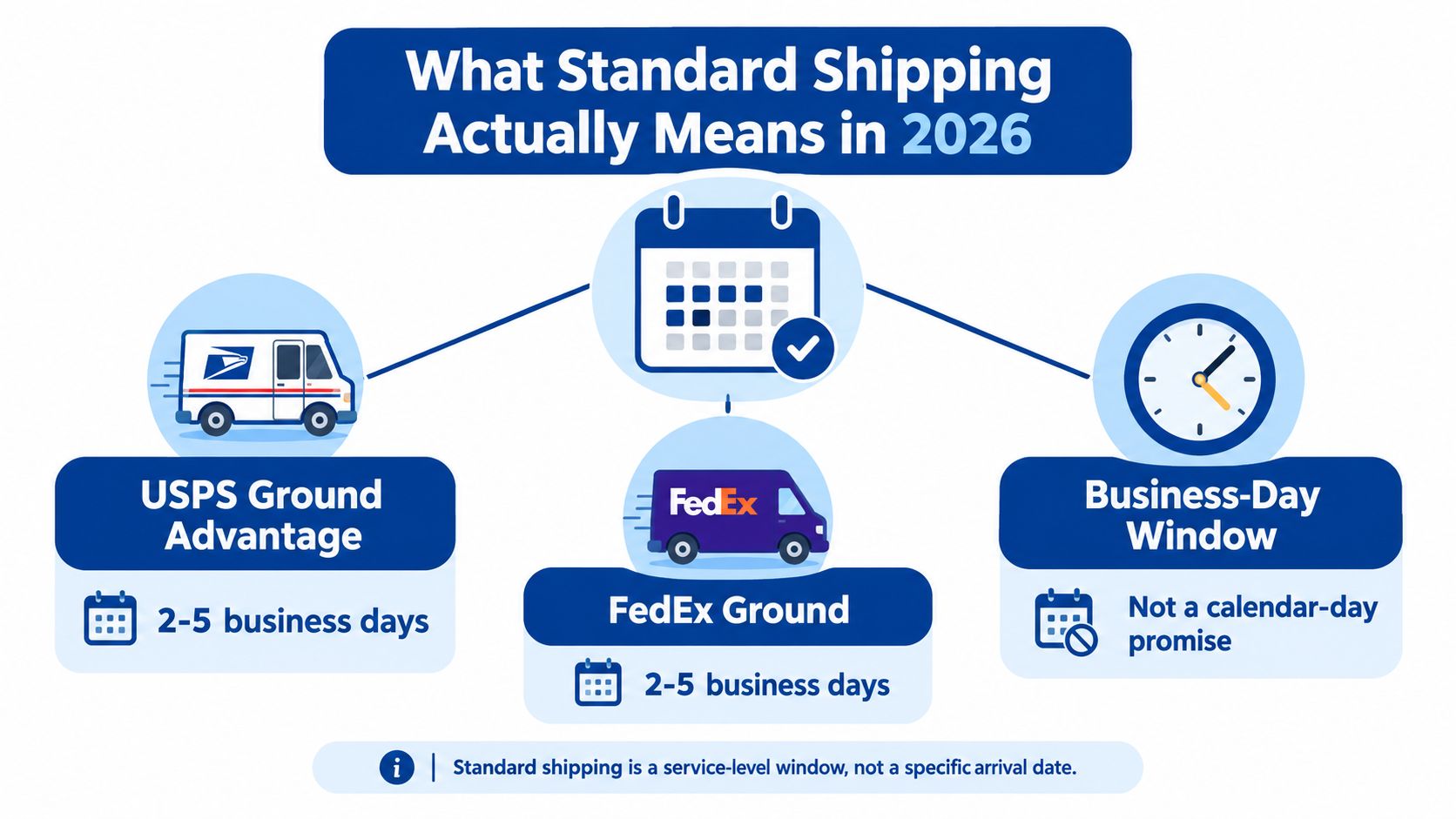
Think of standard shipping as a business-day service window, not a specific calendar date. A label printed today doesn't necessarily mean the carrier starts counting today. An order placed after the warehouse's carrier cutoff may not be handed off until the next business day. Weekends and holidays can then make a business-day estimate feel much longer in calendar days.
Set one definition across your business
A usable internal definition should distinguish handling time from carrier transit time. For example, if your team needs time to pick, pack, and hand off an order, that processing time belongs in the customer-facing estimate. Don't let a carrier's transit range stand in for the full order-to-door promise.
USPS reported a nationwide average delivery time of 2.5 days for mailpieces and packages in 2023, and said 98% of the U.S. population received mail and packages in fewer than three days. Those figures give context for domestic network performance, but they don't remove the need to calculate a promise for each shipping lane. USPS delivery performance information
For your Amazon listings and support team, standard shipping should mean a clear, defensible estimate that starts at the right point. Tell shoppers when they can expect the package, not merely which carrier label you'll use. That's the difference between a logistics setting and a customer promise.
Standard Shipping Windows by Major Carrier
The carrier name on the label matters less than the promise on your product page. Each major carrier sells a different "standard" tier, and every window carries conditions your customer never sees.
USPS Ground Advantage publishes a 2–5-day expected delivery window for packages up to 70 pounds, with estimates that vary by origin, destination, acceptance time, and remote locations. For low-cost domestic parcels inside that weight limit, it sets the price floor. USPS Ground Advantage
UPS Ground carries a published window of 1–5 business days, and UPS reports that 85% of packages arrive within three days or less. UPS domestic shipping services That three-day figure is a network average; individual lanes run faster or slower because UPS calculates transit from the ship date and the five-digit origin and destination ZIP codes. Pull the estimate for your actual shipping pair before you advertise a window.
Match the service to the address
FedEx splits its ground offering by destination. FedEx Ground serves commercial addresses; FedEx Home Delivery serves residential ones. Pick the wrong service and you invite a surcharge or a delivery problem the customer blames on you. FedEx publishes no single nationwide window for either service, so pull a lane-specific quote from the FedEx rate-and-transit tool for your origin-destination pair before advertising any delivery estimate.
For cross-border orders, DHL eCommerce services such as Parcel Direct hand off to local carriers for final delivery. Confirm whether the quoted estimate includes customs clearance, whether duties are prepaid or collected on delivery, and who owns the last mile. A window that ends at the border reads as a broken promise at the doorstep.
The U.K. shows why "standard" needs a market-specific definition. Royal Mail's First Class aims for next-working-day delivery, including Saturdays, while Second Class runs a longer target: under reliability targets taking effect April 1, 2026, 95% of Second Class items are targeted to arrive within three weekdays and 99% within five days. These are network-level objectives; individual parcels can still miss them. Royal Mail delivery aims and times
The pattern across all four carriers is the same: published windows describe the carrier's network. Your customer experiences the full order-to-door timeline. Quote the service name, the route-level estimate, and the guarantee status on every listing, or you're setting expectations you can't defend.
Side-by-Side Carrier Comparison
Use this table as a starting point for carrier selection, not as a substitute for checking your own contracted service and route estimates. Published windows and service eligibility can change, and the information below doesn't establish specific residential surcharges, rural performance, or negotiated rates.
Standard Shipping Service Comparison
| Carrier | Service | Window | Weight Limit | Best Fit |
|---|---|---|---|---|
| USPS | Ground Advantage | 2–5 days | Up to 70 pounds | Low-cost domestic package shipping where the parcel fits the service |
| UPS | Ground | 1–5 business days | Not specified here | Sellers seeking a route-based ground option with a published domestic window |
| FedEx | Ground or Home Delivery | Verify by route and service | Not specified here | Commercial or residential shipments where the selected service matches the address |
| Royal Mail | First Class or Second Class | First Class aims for next working day; Second Class has a longer target | Not specified here | U.K.-bound orders where the customer needs a clear service-tier distinction |
The comparison intentionally doesn't fill unknowns with assumptions. USPS Ground Advantage's 70-pound limit is documented, but no verified weight limits for the other listed services are established here. Likewise, a carrier's rate advantage, residential surcharge exposure, or rural reliability depends on your contract, parcel profile, and actual shipping lanes. Get those details from your carrier agreement rather than relying on a generic chart.
Choose by order profile, then validate by lane
A lower-cost service can fit a non-urgent order, while a faster option may make sense for an order where the customer's arrival date matters more. But don't choose on service name alone. Compare your shipment's origin and destination, handling requirements, delivery estimate, tracking, and total cost.
For Amazon sellers, a sensible carrier mix isn't necessarily one carrier for every parcel. It's a set of service rules that tells your operations team which option to use for the order, destination, and delivery promise. Review actual delivery outcomes against the estimates you show at checkout. If one carrier routinely misses a particular lane, change the service or adjust the promise before customers absorb the failure.
What Changes the Delivery Clock
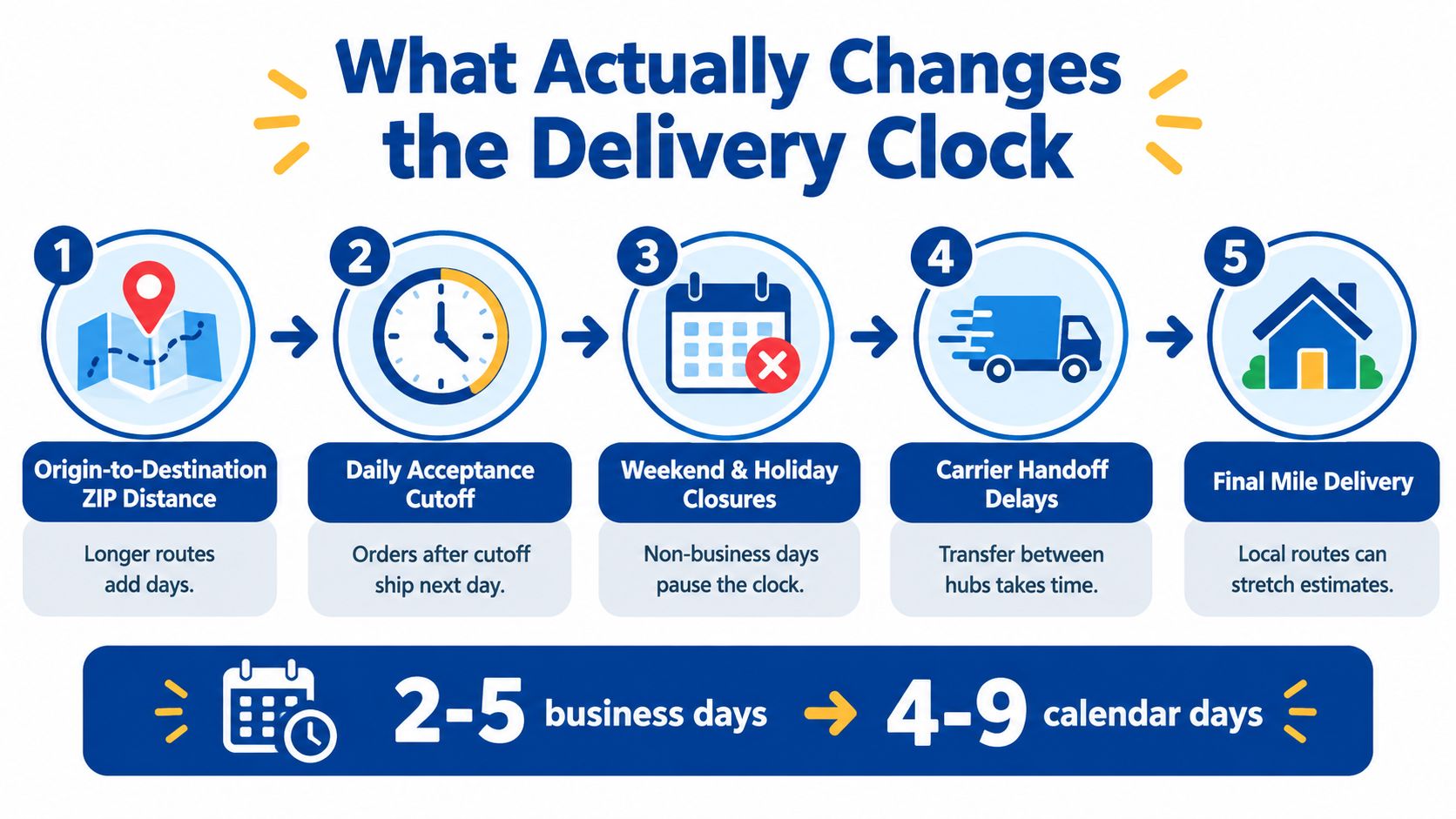
The clock that matters is the one your customer counts, and it starts at the buy button, not at carrier tender. Run the arithmetic before you quote a window: order placed Thursday, warehouse misses the Thursday cutoff, parcel tenders Friday on a five-business-day service, delivery lands the following Friday. Your listing said five business days. Your customer experienced eight calendar days and wrote the review accordingly.
Start with the origin-to-destination pair. The same service produces different transit times on different lanes, so a window that holds for a regional customer can break for one two zones farther out. Carrier tools like UPS's transit-time maps estimate that transit portion by lane, but they start counting when the carrier takes the parcel. Everything before that moment is your operation, and your customer's wait.
Separate processing from transit
Find your warehouse's daily tender cutoff and treat it as a promise boundary. An order placed after cutoff typically enters the carrier network the next business day. That lost day never appears in the carrier's estimate, but it appears on the customer's calendar, and the customer is the one writing reviews.
Then price in warehouse handling. Picking, packing, inventory checks, and label prep all happen before transit begins. A listing that displays the carrier's window without your processing time is quoting a number your operation cannot meet.
Practical rule: Calculate the promise from order placement to delivery. Keep handling time and transit time separate in your internal model, but show the shopper one combined range.
Weekends and holidays stretch the gap between business days and calendar days even when everything runs on schedule. Pick one customer-facing unit, state the range plainly, and use it everywhere the promise appears.
Remote routes need their own math. USPS notes that shipments to Alaska, Hawaii, and offshore destinations can vary from standard estimates, and the same caution applies to military addresses. Check lane-level estimates before you publish a window for those destinations, and quote a more conservative range wherever the route demands one.
Amazon FBA vs Seller-Fulfilled Standard Shipping
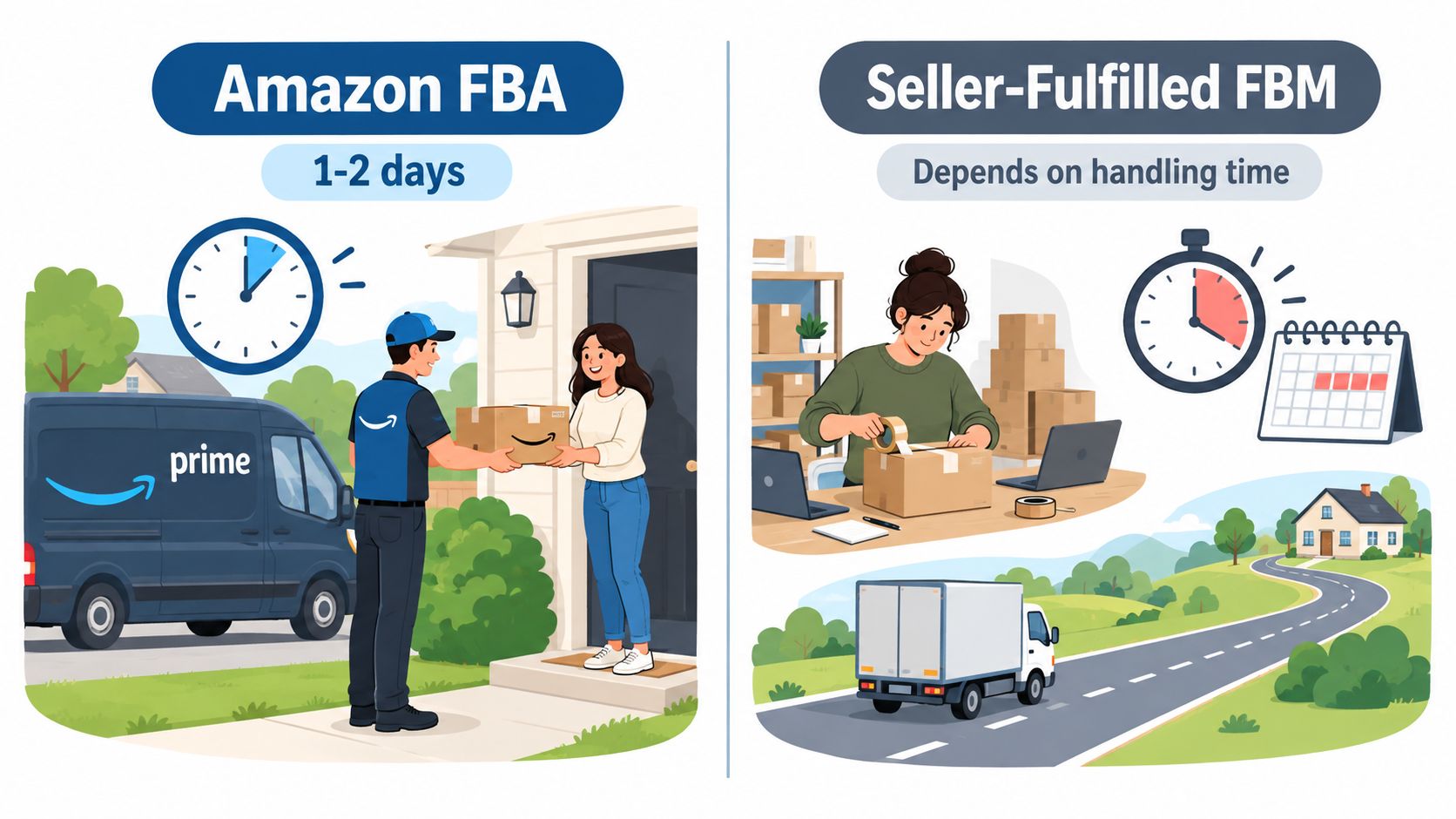
With FBA, Amazon handles storage, order processing, and delivery for inventory held in its network. Eligible in-stock products may show fast Prime delivery options in major regions, but the exact customer-facing date depends on the offer, inventory location, destination, and what Amazon displays for that order. Treat the date shown on the listing as the relevant customer promise, not a blanket assumption that every FBA order arrives on the same schedule.
With FBM, your team owns the operational pieces that determine when the order enters transit. Your warehouse location, handling time, carrier selection, and order cutoff all influence the estimate shown to shoppers. A short carrier window won't rescue a slow handoff, and an aggressive handling-time setting isn't credible unless the warehouse can meet it consistently.
Use the fulfillment model that fits the promise
Seller Central settings need to reflect your real process. Set handling time to match the time your team needs, verify that shipping templates cover the destinations you serve, and check whether the carrier and service can support the listing's delivery estimate. A label purchase doesn't guarantee that the parcel was accepted by the carrier on the date your workflow assumes.
Seller Fulfilled Prime can be a middle path for sellers who want to pursue Prime eligibility while shipping from their own operation. Amazon-partnered carrier options may also help with label purchasing and shipment workflows. Don't treat either as a shortcut around operational readiness. Confirm current program requirements and measure whether your warehouse can sustain the promise.
For a quick visual comparison of how fulfillment choices affect the shipping experience, use this explainer before reviewing your own order process.
The decision should follow the business model. FBA can reduce the fulfillment burden on your team, while FBM can preserve control over inventory and dispatch. In either case, the promise needs to match the actual customer experience. Review the listing, handling settings, and delivery outcomes together rather than optimizing one field in isolation.
The Expectation Gap Most Brands Miss
A carrier estimate isn't the customer promise. Consumer research found that 53% of shoppers expect standard orders to arrive within two to four days, but only 34% are very confident that a package will arrive by the promised date. Another 2025 mystery-shopping study found that just 34% of orders arrived exactly as promised, while 14% of brands missed their promises by an average of up to seven days. Consumer delivery expectations and mystery-shopping findings
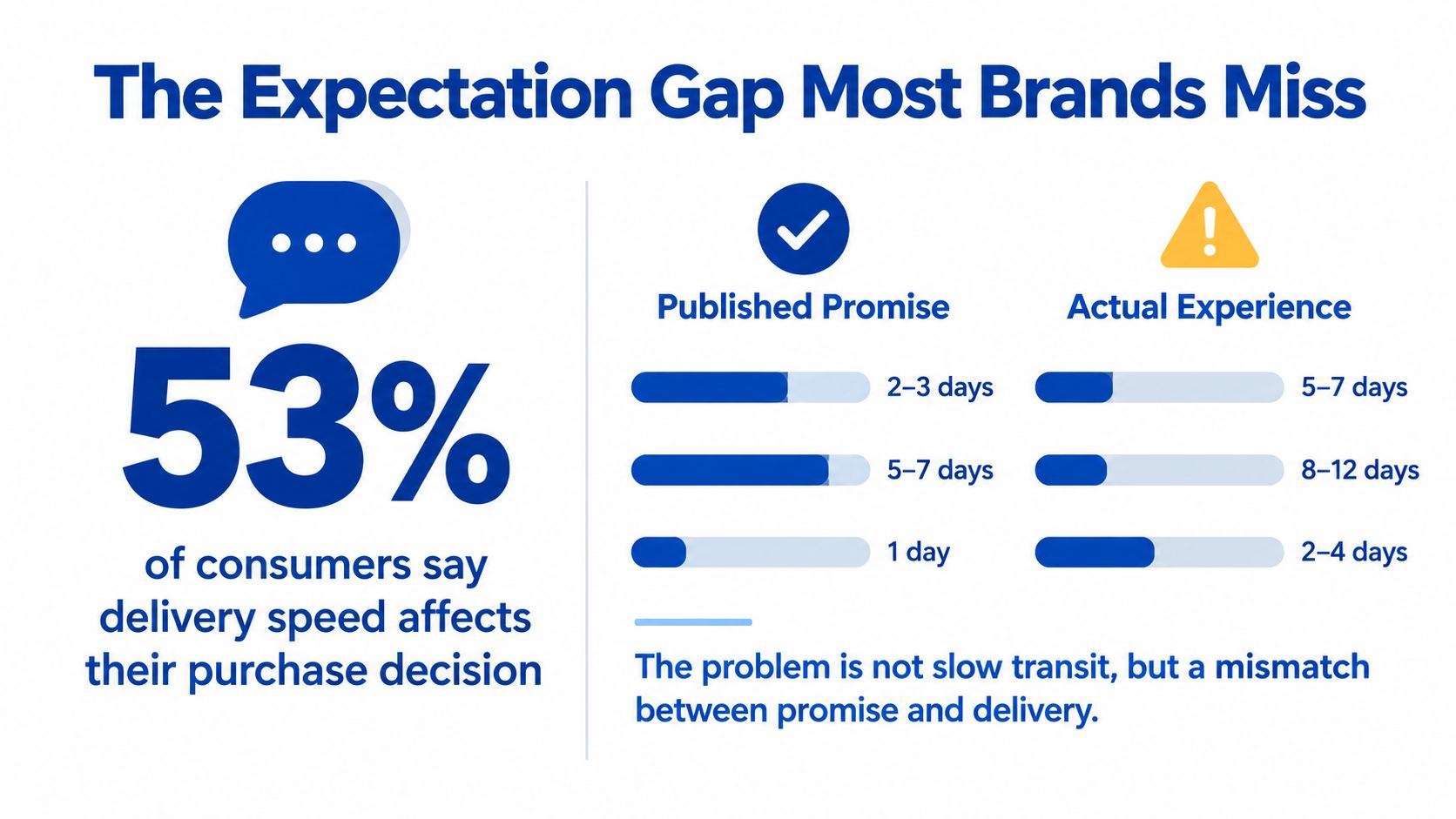
The mismatch usually starts before the parcel moves. A brand may quote carrier transit time, omit warehouse processing, and show a range that ignores cutoff timing. The customer sees one date or window, not the internal handoffs that produced it.
Make the promise a profitability decision
For an Amazon brand, an unreliable delivery estimate can put paid acquisition at risk. PPC may bring a shopper to the listing, but it can't compensate for a delivery promise the customer doesn't trust. Treat shipping as part of retail readiness and conversion, not as a back-office setting detached from advertising performance.
Build the estimate in order: start with the order cutoff, add handling time, then use the carrier's route-specific business-day estimate. Convert that into a customer-facing calendar window that accounts for weekends and holidays. If inventory may ship from different locations, use the origin that will fulfill the order or show a range that remains credible across those locations.
A realistic promise can be more valuable than a faster promise you can't keep.
Headline's Amazon strategy connects performance advertising with profitability and organic growth. The Sensalou case study combined Amazon DSP Performance+, Amazon Attribution, and sponsored ads, reporting 38% year-over-year total-sales growth and a 25% increase in organic sales. Sensalou full-funnel growth case study
That case doesn't establish a shipping effect. It does reinforce a broader operating principle: judge growth by total business outcomes, not a single dashboard metric. If your ads create demand but the delivery experience weakens customer confidence, you're leaving part of the growth equation unmanaged.
Setting Customer Expectations That Convert
Start with a delivery matrix your operations and marketing teams can both use. Map destination region, fulfillment location, handling time, carrier service, and customer-facing window. Update it when inventory placement, warehouse cutoffs, or carrier performance changes.
Make one promise visible everywhere
Use a consistent unit and wording across the listing, checkout, and post-purchase messages. If customers see a calendar-date estimate, don't switch to a business-day range in the confirmation email without explaining the difference. A clear range is better than an unsupported precise date.
- At the listing: Show the delivery estimate customers can expect for their destination. Don't present carrier transit time as total order-to-door time.
- After purchase: Confirm the expected arrival window and explain when tracking becomes active.
- When a parcel slips: Contact the customer before they need to ask. Share the updated estimate and the next tracking milestone.
Review actual delivery performance against your published promises on a regular schedule. A quarterly review is a useful operating cadence: compare routes and service levels, identify lanes that repeatedly miss the estimate, and adjust the carrier, handling setting, or promise. Keep a record of the change so support teams know what customers were told.
International orders need a separate policy. Customs clearance, product classification, documentation, and duties can add uncertainty after dispatch. Tell customers whether duties are prepaid or collected on delivery, and don't assume that paying for faster transport will solve a customs delay. Cross-border e-commerce customs challenges
Shipping is part of the offer. A credible delivery promise supports the customer experience that your PPC and organic visibility are working to create. If you need to connect Amazon advertising, profitability, and sustainable marketplace growth, Headline Marketing Agency helps brands build data-driven PPC and DSP strategies around those business outcomes. Invite your team to review its current delivery promises alongside campaign performance, then act on the gaps that put conversion and repeat purchase at risk.
Get Your Free Amazon PPC Audit
Discover untapped growth opportunities and see how our data-driven approach can improve your ROAS.
Get Free Audit →Ready to Transform Your Amazon PPC Performance?
Get a comprehensive audit of your Amazon PPC campaigns and discover untapped growth opportunities.