How to Run a Flash Sale on Amazon That Actually Scales
Run a flash sale on Amazon with a profit-first playbook. Cover Lightning Deals, coupons, PPC, DSP, inventory, and post-sale optimization in one guide.

Most advice about a flash sale on Amazon starts with the discount. That's backwards. A deal isn't a win because the sales graph spikes, and it isn't scalable because Amazon shows a badge. It's a win only when the additional units, advertising cost, Amazon fees, inventory exposure, and post-event demand add up to more contribution profit than the baseline plan.
Amazon's own Lightning Deal format can create sharp velocity, but the lift often fades quickly. In one A/B test across 15 SKUs, 12 recorded same-day sales increases, with median lifts of 118.75% on Amazon.com and 180% on Amazon.ca, while 11 of 15 SKUs later experienced weekly sales declines. The median post-deal decline reached 6.25% in the U.S. and 60% in Canada. Those results, documented in an independent Lightning Deal case study, expose the central risk: many brands pull demand forward instead of creating profitable incremental demand.
The right question before any deal window is simple: What profit survives after the discount, fees, paid traffic, and the next two weeks of normalized demand?
Why Most Flash Sales on Amazon Quietly Lose Money
A busy deal day can hide a weak P&L. The sale price reduces revenue per unit, while referral fees and FBA fulfillment costs continue to apply. Amazon's updated fee environment also makes the economics harder to ignore. Analysis of the 2025 Lightning Deal and coupon fee changes found that discounting became less attractive for at least some brands, as explained in this 2025 Amazon deal-fee analysis.
That fee stack matters before advertising. Add higher PPC bids to win scarce deal-period visibility, and a brand can trade margin for units without improving total contribution. A 25% discount doesn't merely remove 25% of the list price. It can also reduce the dollars available to absorb referral fees, FBA fulfillment, low-inventory fees, aged-inventory surcharges, promotional fees, and advertising cost.
The $28 ASIN test
Consider an anonymized ASIN priced at $28. The table below is a planning illustration, not a reported case study. It shows why unit velocity alone can't decide whether a flash sale deserves approval.
| Line Item | Baseline, 700 units, no discount | Flash Sale, 1,200 units, 25% off |
|---|---|---|
| Selling price | $28 | $21 |
| Gross sales | $19,600 | $25,200 |
| Referral fee | Model actual rate | Model actual rate |
| FBA fulfillment | Model actual rate | Model actual rate |
| Lightning Deal or promotion fee | None or applicable fee | Model actual fee |
| PPC cost | Baseline spend | Higher deal-period spend |
| Contribution profit | Baseline contribution | Must exceed baseline to justify deal |
| Following demand | Normalized baseline | Test for pull-forward |
The flash sale produces more gross sales in this illustration, but that says nothing about profit. If the deal also attracts low-quality clicks, consumes inventory that would have sold organically, and weakens the next several days, 1,200 units can generate less profit than 700 units at full price.
Practical rule: Never approve a deal from revenue, units, or ROAS alone. Approve it from contribution profit after every Amazon and media cost.
The pull-forward problem deserves its own forecast. Compare the deal period with the trailing 7 to 14 days after the event, not just the event dashboard. Amazon reported that Lightning Deals can produce an average sales lift of about 65% on the deal day and roughly 39% the following day, based on reporting covering 45,000+ Lightning Deals in a non-Prime Day month in 2019. The effect can continue briefly, but a short halo doesn't prove net-new demand. CNBC's reporting on Amazon's deal mechanics and event sales provides the broader context for why brands chase these spikes.
Build three scenarios before scheduling: baseline sales without the deal, deal-period sales with paid support, and post-deal sales after pricing normalizes. If the third scenario gives back the event gain, the promotion is a timing shift, not growth.
Choosing the Right Flash Sale Format for Your Goal
Amazon offers several ways to create urgency, and they don't serve the same purpose. The biggest mistake is treating every discount as a substitute for a Lightning Deal. Visibility, eligibility, fee exposure, and customer intent differ by format.
Amazon defines a Lightning Deal as a discounted promotion featured for several hours as a flash sale in its seller documentation. It can create concentrated traffic and ranking velocity, but the fee, inventory cap, and operational pressure make it a poor default for every SKU.
| Format | Placement Visibility | Amazon Fee | Stacks With Ads? | Best Fit Goal |
|---|---|---|---|---|
| Lightning Deals | Deal-focused placement and limited-time merchandising | Deal fee applies | Yes | Ranking velocity on a hero SKU |
| Clipped Coupons | Green savings treatment across eligible placements | Promotion economics apply | Yes | Sustained mid-funnel conversion |
| Prime Exclusive Discounts | Prime shopper pricing treatment without a deal-page dependency | No Lightning Deal fee | Yes | Compliance-sensitive brands |
| Subscribe & Save discounts | Replenishment context on eligible repeat-purchase products | Program economics apply | Yes | Retention and lifetime value |
Lightning Deals
Choose this format when the goal is short-term ranking velocity on a hero SKU and the listing can absorb concentrated demand. Don't use it for an unproven product, a weak detail page, or inventory that can't replenish. The fee and temporary pricing make the deal worthwhile only when the incremental contribution exceeds the cost of the event.
Coupons
Coupons are better for converting cold and mid-funnel traffic over a broader period. The green savings treatment can appear in search and product placements, but coupons don't deliver the same front-page deal identity as a Lightning Deal. Use them when the product needs a conversion assist, not a single-day demand shock.
Prime Exclusive Discounts
Prime Exclusive Discounts suit brands that need a controlled offer without the optics of a deep, highly publicized deal. They can support conversion while preserving more pricing discipline. The decision rule is clear: use Prime exclusives when brand presentation, policy compliance, and controlled discounting matter more than maximum deal-page exposure.
Subscribe & Save
Subscribe & Save discounts belong on replenishment products, not on occasional purchases. The objective is retained demand, so evaluate the offer against repeat behavior and customer value. A smaller initial discount that earns a replenishment relationship can outperform a deeper one-time deal.
Inventory, Pricing, and Listing Readiness Before the Window
A deal can fail before the first click if inventory, price rules, or the detail page aren't ready. Treat the preparation as a retail-readiness gate, not an administrative checklist.
Lock inventory early
For standard categories, lock FBA inbound at least 28 days before the event. For Apparel, Footwear, and other gated categories, work at least 45 days ahead. Those timing windows protect against inbound delays, stranded inventory, and a deal that sells through before Amazon can receive replacement stock.
Confirm the featured SKU has enough cover for the event and the recovery period. A flash sale that creates a stockout can erase ranking gains, interrupt advertising continuity, and leave the brand unable to capture the demand it paid to create.
Reconcile every price rule
Check the sale price against Minimum Advertised Price, internal MAP policy, existing coupons, and other promotions. Amazon may reject overlapping promotions, while a stacked offer can reduce realized price below the approved margin floor. Put the final price in writing and assign one owner to approve changes.
Confirm the ASIN is enrolled in Amazon Brand Registry and that the variation theme is consolidated. If child ASINs are fragmented or poorly structured, the deal may concentrate traffic on one variant while the rest of the family fails to inherit the intended pricing or conversion advantage.
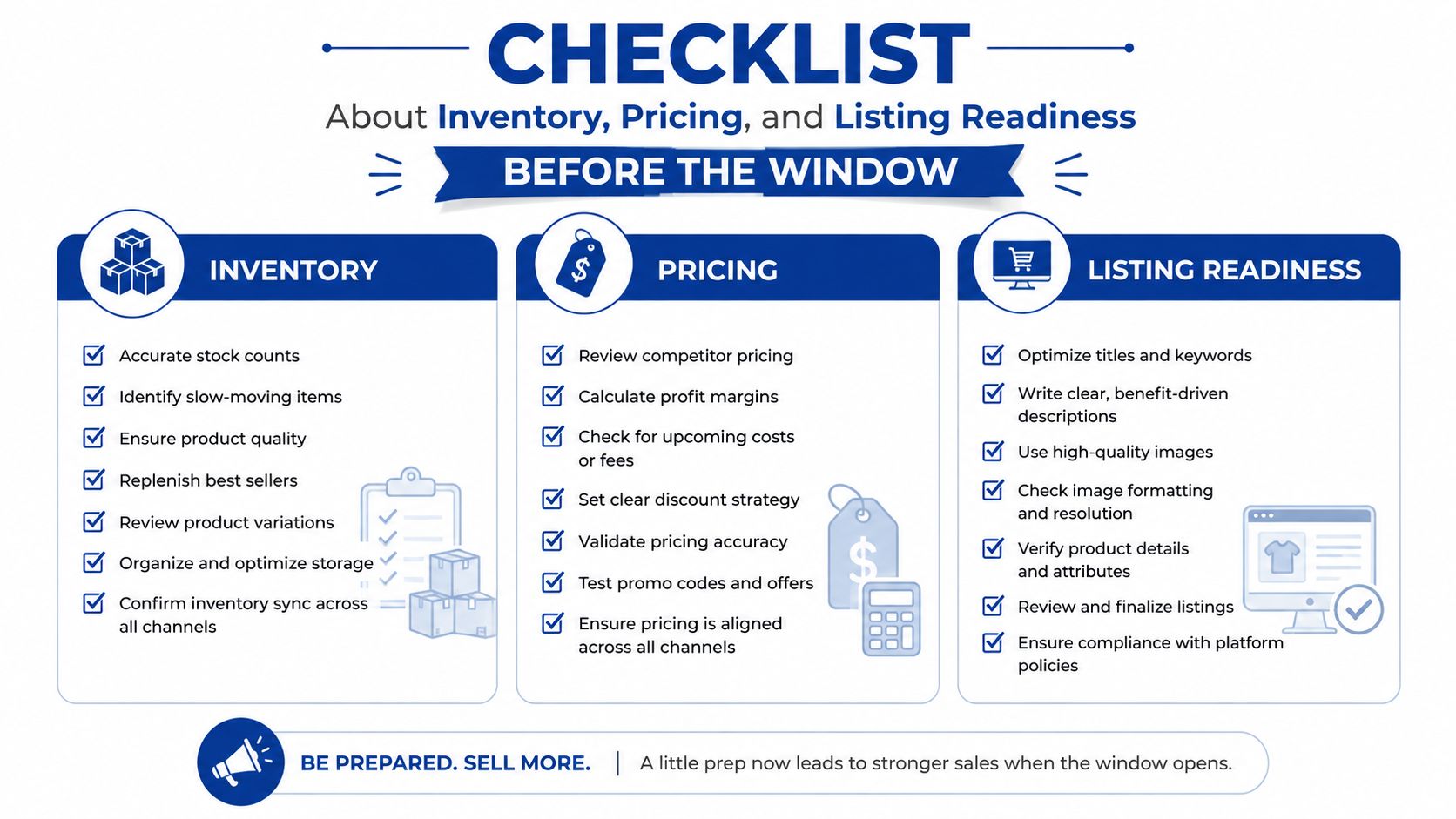
Make the listing earn the traffic
Pull the trailing 60 days of search query rank, sessions, and unit-session percentage before setting the velocity target. Use the data to distinguish a genuine conversion opportunity from a listing that lacks demand.
Refresh the main image, title, A+ Content, and video before the window. Deal traffic is impatient. If the page doesn't explain the product, establish trust, and make the value obvious, higher traffic only magnifies the conversion problem.
At the 72-hour countdown, verify four items: pricing rules are loaded, FBA inventory is settled, Brand Analytics data is pulled, and PPC campaigns are staged in drafts for activation. Don't make major creative or catalog changes during the live window unless a customer-facing error demands it.
PPC and DSP Promotion Plan That Protects Margin
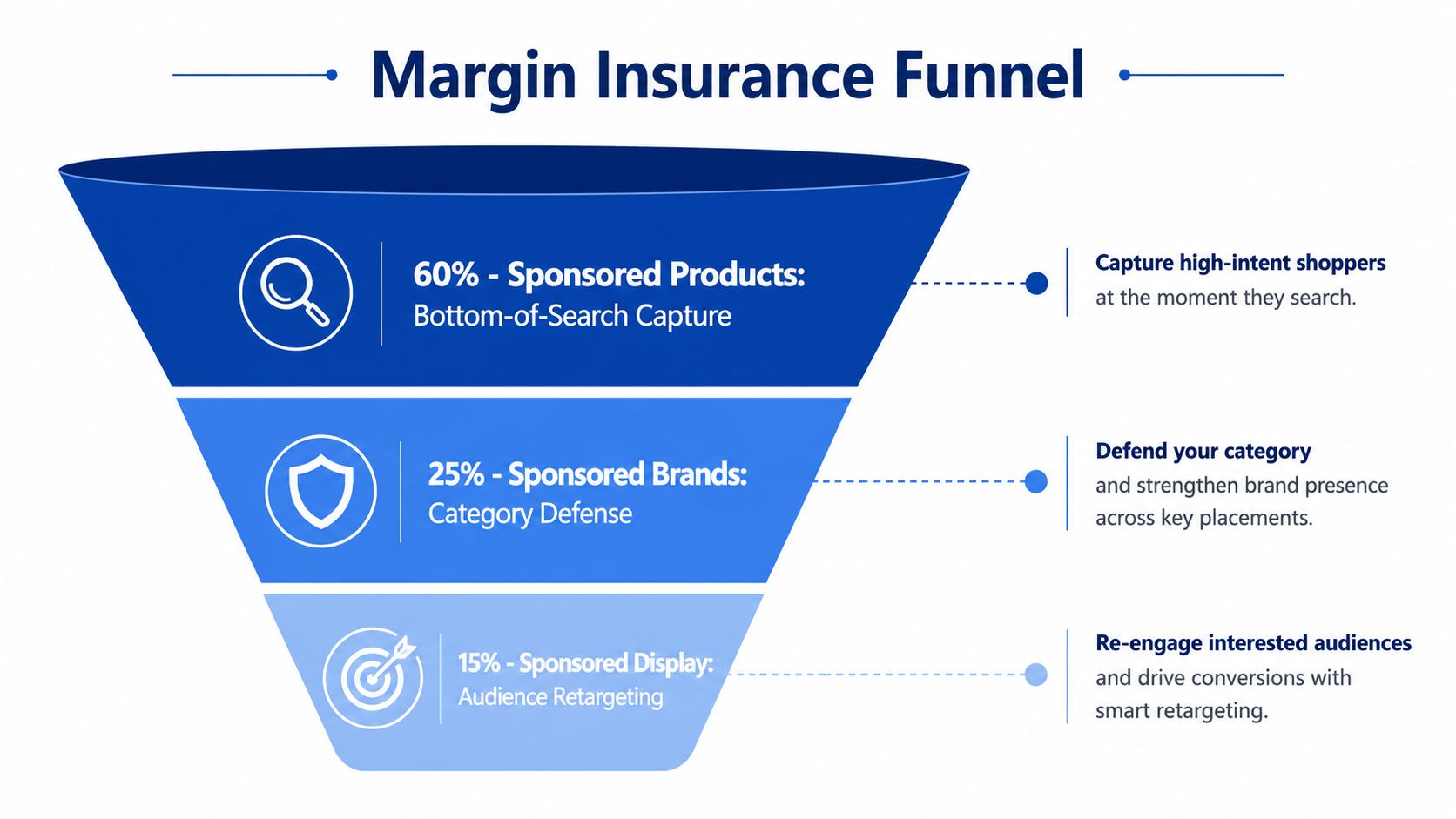
Promotion spend should function as margin insurance, not as a permission slip to buy every available impression. A practical starting allocation is 60% Sponsored Products, 25% Sponsored Brands, and 15% DSP retargeting, then adjust it according to contribution margin, inventory, and incremental conversion quality.
That allocation follows the buying journey. Sponsored Products captures high-intent searches near the purchase decision. Sponsored Brands protects category consideration and creates a controlled conquesting layer. DSP retargeting reaches shoppers who viewed, abandoned carts, or previously purchased, giving the brand a way to monetize audiences beyond the immediate search auction.
Pace by format, not by habit
Raise Sponsored Products bids 48 hours before the deal window on proven, relevant queries. The objective is to build visibility before shoppers arrive, not to force maximum spend from the first minute. During peak hours, cap or moderate bids on terms already converting through deal traffic. Paying a premium to defend traffic you would have received anyway is not incremental growth.
Amazon advertising can become more efficient during major events, but competition can also rise sharply. During Prime Day 2025, Skai reported daily averages versus the 30-day baseline of 108% higher clicks and 114% higher impressions, alongside increased CTR and decreased CPC. The Skai analysis of Prime Day 2025 media efficiency supports a disciplined approach: pace spend toward conversion quality rather than front-loading the entire budget.
Sponsored Brands need separate controls. During Prime Day 2024, Tinuiti reported Sponsored Products spend up 29% year over year, clicks up 15%, and CPC up 12%, while Sponsored Brands spend rose 10%, clicks fell 4%, and CPC increased 15%. The Tinuiti Prime Day trend analysis shows why one budget adjustment across every format is lazy management.
Use bid modifiers for deal-page placement only where the placement produces profitable incremental sales. Pause or sharply reduce branded-defense campaigns during the sale when those campaigns mostly capture shoppers who already know the brand. Reallocate that budget to category terms, competitor detail pages, and high-intent nonbrand queries.
Sequence DSP creative
Run awareness video before the event, product retargeting while the deal is live, and competitor or category conquesting after the window. Suppress recent converters from retargeting pools so DSP doesn't waste impressions selling the same customer the same ASIN immediately after purchase.
Amazon's paid-media surge during Prime Day 2024 illustrates the risk of unmanaged bidding. Skai reported global ad spend up 496%, CPC up 66%, and advertising-attributed sales revenue up 468%, with more than 200 million items sold during the 48-hour event. The Skai Prime Day 2024 report makes the operating principle clear: sales can expand rapidly, but bids must remain tied to margin and inventory.
Tracking the Metrics That Actually Matter
The event dashboard is not the final scorecard. It tells you what happened during the promotion, while leadership needs to know whether the deal created profitable demand that remains after the price returns to normal.
Start with contribution margin. Deduct Amazon referral fees, FBA fulfillment costs, Lightning Deal fees where applicable, promotional cost, advertising spend, and any inventory-related charges. Calculate the breakeven ROAS for each format separately. A Lightning Deal can require a different threshold from a coupon because the fee and visibility mechanics differ.
Separate lift from substitution
Track the deal ASIN against its pre-event baseline and watch the post-event period closely. Units sold during the event matter, but they don't prove incrementality. The Lightning Deal test cited earlier showed why weekly demand must sit beside same-day performance.
Use these signals together:
- Contribution margin: Shows whether the event generated profit after all variable costs.
- Breakeven ROAS: Sets the minimum paid-media efficiency required for the chosen offer.
- New-to-brand rate: Indicates whether DSP and Sponsored Brands reached new customers rather than existing demand.
- Branded search movement: Compare branded search volume in the 14-day post-sale window with the pre-sale pattern.
- Subscribe & Save opt-in rate: Provides an early signal of retained demand for replenishable products.
- TACoS versus ACoS: ACoS can look attractive during a sale while TACoS reveals whether total business efficiency deteriorated.
- Organic rank retention: Shows whether paid velocity produced a lasting marketplace asset.
Amazon deal reporting also emphasizes units sold, waitlists, and deal revenue as signals that allocated inventory may not have met demand. Use those signals for operational diagnosis, then connect them to margin and post-sale performance through your own reporting.
| Metric | What It Tells You | Profit-First Benchmark |
|---|---|---|
| Contribution margin | Whether the event created profit | Above the approved baseline contribution |
| Breakeven ROAS | Minimum acceptable media efficiency | Above the format-specific breakeven |
| TACoS | Total advertising burden on sales | At or below the planned ceiling |
| ACoS | Advertising efficiency during the event | Useful only with margin and organic context |
| Organic rank retention | Whether visibility persisted | Stable or improved after normalization |
| New-to-brand rate | Whether reach expanded the customer base | Strong enough to justify acquisition cost |
| Subscribe & Save opt-in | Whether demand may repeat | Positive relative to the SKU's normal behavior |
| Post-sale units | Whether demand survived the discount | No material collapse versus baseline |
Grade the result compound when profit holds, organic rank persists, branded demand expands, and retained demand improves. Grade it neutral when the event sells profitably but leaves no durable asset. Grade it destructive when margin falls, TACoS breaches its ceiling, and post-sale units give back the apparent gain.
Post-Sale Recovery and Long-Term Ranking Impact
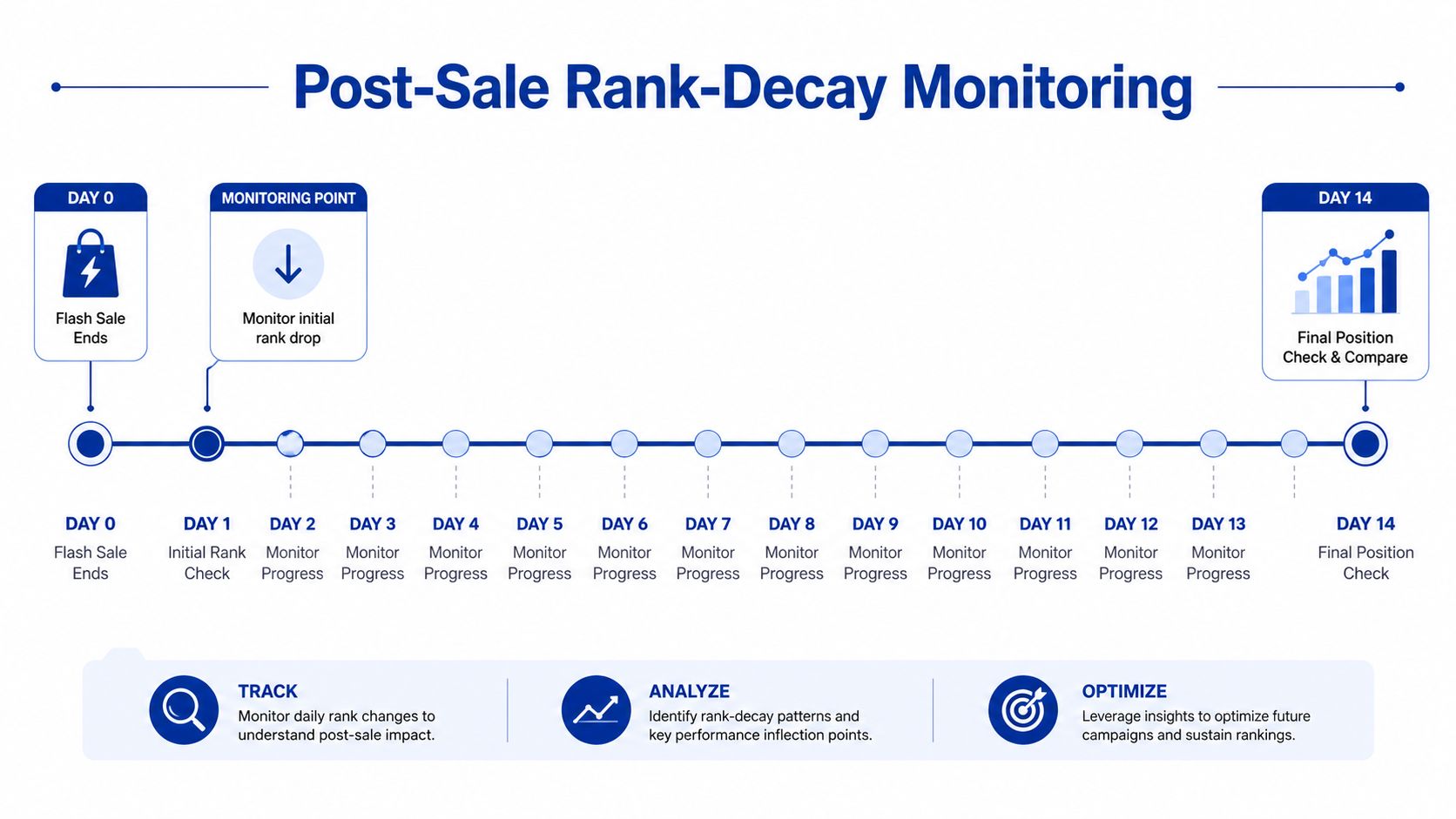
The sale doesn't end when the deal badge disappears. The following 14 days are a second campaign, and they reveal whether Amazon rewarded the ASIN with durable visibility or merely processed a temporary rush.
Check the deal ASIN's organic position daily during those 14 days. Compare each result with the pre-deal baseline and classify keywords into two groups: terms that held their position and terms that snapped back. That split tells you where paid velocity produced an asset and where the event only borrowed demand from future shoppers.
Normalize price without shocking conversion
Don't move instantly from the deal price to the highest possible price if conversion rate is still adjusting. Use a controlled price step or a coupon bridge, then monitor sessions, unit-session percentage, organic position, and advertising efficiency together.
A coupon bridge can soften the transition without recreating the original deal mechanics. Keep the bridge temporary and tied to a clear conversion objective. If the listing still needs a deep discount after the event, the issue may be product value, content, reviews, or competitive positioning rather than insufficient promotion.
Re-engage buyers selectively
Use DSP and customer audiences to cross-sell deal purchasers, suppress converters from unnecessary retargeting, and introduce Subscribe & Save for replenishable SKUs. The objective isn't to push the purchased ASIN repeatedly. It's to turn a one-time event customer into a broader relationship with the catalog.
A practical compounding plan looks like this:
- First 30 days: Stabilize price, monitor rank decay, protect profitable nonbrand terms, and identify keywords that retained visibility.
- By 60 days: Review repeat behavior, cross-sell performance, branded search movement, and post-event contribution against the original forecast.
- By 90 days: Decide whether the format deserves another event, a different SKU, a lighter coupon, or no promotion at all.
Longer event windows reward continuity. Tinuiti reported that Amazon extended Prime Day 2025 from two to four days, with Sponsored Products spend up 20% year over year across the full event. Same-store advertisers active on Amazon DSP across both Prime Day windows increased spend 31%, impressions rose 46%, and CPM fell 10%, according to Tinuiti's Prime Day 2025 recap. The lesson is operational, not merely promotional: sustain presence when the event supports it, then switch quickly to recovery and retention.
A Profit-First Playbook for Your Next Flash Sale
Flash sales compound when they have a defined job. They drain margin when the team schedules them because the calendar contains a deal slot.
Three situations, three decisions
A new ASIN that needs velocity may justify a Lightning Deal if the detail page is already retail-ready, inventory is secure, and the brand can accept a measured acquisition cost. Put most paid support into Sponsored Products and nonbrand search, then judge success by rank retention and contribution, not launch-day revenue.
A mature SKU defending against a competitor's deal usually needs a more selective response. Start with a coupon or Prime Exclusive Discount if the goal is to preserve conversion on key terms without training customers to wait for a deep discount. Use Sponsored Brands for category defense, but don't overspend to protect every branded query.
Seasonal excess inventory has a different objective. A Lightning Deal may be appropriate when liquidation value exceeds the cost of holding aged stock, but calculate the full clearance economics first. If the product is replenishable, avoid sacrificing future Subscribe & Save value merely to create a temporary unit spike.
The format decision should follow the goal:
- Ranking velocity: Lightning Deal on a hero SKU, with controlled Sponsored Products support.
- Mid-funnel conversion: Clipped Coupon supported by search and category targeting.
- Pricing discipline: Prime Exclusive Discount for a controlled offer.
- Repeat purchase: Subscribe & Save discount on replenishment ASINs.
- Clearance: The format that maximizes recoverable contribution while reducing inventory exposure.
Stop treating Lightning Deals as monthly maintenance
A reflexive monthly Lightning Deal cadence is usually a margin leak. Schedule quarterly events around real demand spikes, meaningful retail moments, or inventory decisions. Reserve coupon stacking for major category moments such as Prime Day and Q4, and only when the combined offer remains above the contribution floor.
Before approval, run a pre-mortem:
- Unit economics: Calculate contribution after referral, FBA, promotional, and advertising costs.
- Breakeven ROAS: Set the minimum paid efficiency by format.
- Inventory cover: Include the event and the post-sale recovery period.
- Listing readiness: Confirm images, title, A+ Content, video, variations, and price rules.
- Kill switch: Pause or reduce spend if TACoS exceeds the planned ceiling or contribution falls below the approved floor.
A flash sale should fund the next growth decision through residual rank, branded search, reviews, repeat purchase, or profitable customer acquisition. If it leaves none of those assets, it was an expense, not a strategy.
Headline Marketing Agency manages Sponsored Products, Sponsored Brands, Sponsored Display, DSP, and Amazon Marketing Cloud analysis for brands that need flash-sale media tied to profitability and organic growth. Visit Headline Marketing Agency to plan your next deal around fee-aware economics, PPC pacing, listing readiness, and measurable post-sale lift.
Get Your Free Amazon PPC Audit
Discover untapped growth opportunities and see how our data-driven approach can improve your ROAS.
Get Free Audit →Wollen Sie Ihre Amazon PPC-Performance aufs nächste Level bringen?
Lassen Sie Ihre Amazon PPC-Kampagnen professionell analysieren und entdecken Sie neue Wachstumsmöglichkeiten.