Sponsored Brands Product Targeting Strategy
Master Sponsored Brands product targeting to drive profitable Amazon growth. Learn ASIN conquesting, category refinement, and new-to-brand measurement.

Most Amazon teams still treat Sponsored Brands as a keyword-awareness format. That advice is incomplete, and it can leave valuable, high-intent traffic exposed to competitors. Sponsored Brands product targeting lets advertisers choose individual products or categories, turning the format into a precision tool for conquesting, retail defense, and measurable customer acquisition, not just a way to put a logo above search results.
The strategic question isn't whether Sponsored Brands can create awareness. It can. The better question is whether your budget is reaching shoppers who are already comparing products, browsing a rival detail page, or evaluating a tightly defined category. For mid-market brands, those shoppers often offer a clearer path to profitable growth and stronger organic momentum than broad keyword exposure alone.
Rethinking Sponsored Brands Beyond Keyword Awareness
Broad category keywords are a blunt way to allocate Sponsored Brands budget. They generate exposure, but they assign similar value to shoppers at very different stages. Someone entering a general search and someone comparing specific ASINs are not equivalent opportunities. Treating them alike can waste spend and leave high-intent traffic open to competitors.
Amazon's Sponsored Brands overview identifies product targeting as an option for selecting categories and individual products. Advertisers can refine category targets by brand, price range, review rating, Prime eligibility, and other product features. That control moves the ad closer to the product decision and gives brands a clearer way to select the retail context they want to win.
From awareness to demand capture
Product targeting gives Sponsored Brands a more specific commercial job. The planning question becomes: which product or category is the shopper evaluating, and which ASIN should appear next?
Use the format for three direct objectives:
- Competitor interception: Show a credible alternative while shoppers browse rival detail pages.
- Retail defense: Protect your own listings when competing brands try to redirect branded demand.
- Category expansion: Reach adjacent products and segments where your catalog offers a logical next purchase.
Amazon states that Sponsored Brands can reach audiences such as “Purchased brand's product” and “Clicked or Added to cart,” while reporting new-to-brand orders and sales through a 12-month look-back window. Amazon internal worldwide performance data from 6/1/2019 to 7/30/2021 also found that advertisers using all Sponsored Brands ad formats received an average of 79% of sales from new-to-brand customers. That historical result does not predict an individual campaign, but it supports a broader view of the format. Product targeting can contribute to acquisition and competitive share, not only upper-funnel visibility.
Strategic takeaway: Use product targeting as a conversion and market-share layer within Sponsored Brands. Keep keyword campaigns, but scale them alongside precise conquesting and retail-defense campaigns, then judge both by profitable sales and organic momentum.
Paid visibility can influence which products shoppers discover, click, and purchase. It cannot compensate for weak content, poor reviews, or an uncompetitive offer. Pointing qualified traffic toward a strong ASIN, however, gives PPC two jobs: produce profitable sales now and create demand signals that can support durable organic visibility. That is a stronger allocation case than buying broad awareness without a clear path to purchase.
The Mechanics of Manual Product Targeting
Manual product targeting is a deliberate campaign structure. Amazon allows advertisers to target specific products, categories, brands, or product attributes, rather than relying only on search keywords. In the campaign setup flow, advertisers choose either keyword targeting or product targeting, confirming that product targeting is a first-class Sponsored Brands option, not an experimental workaround.
The choice between ASIN precision and category breadth creates a clear trade-off. A tight ASIN list generally gives you more control over the shopper context and traffic relevance, but it limits the number of eligible impressions. A broad category target can expand reach, yet it also introduces more variation in price, quality, reviews, and shopper intent.
How category refinement changes the auction
Category targeting becomes more useful when you narrow the audience with product characteristics. Amazon's product targeting guidance identifies refinement options including brand, price range, review rating, and Prime eligibility. Depending on the category, age range and other attributes may also be available.
Use those filters to define the commercial situation you want to win. For example, a premium brand shouldn't automatically target every product in a broad category. Refining toward comparable price points, ratings, or fulfillment expectations can reduce irrelevant clicks and make the creative promise more credible.
The placement context matters too. Amazon says product-targeted ads can appear on product detail pages and on search results pages where the targeted product appears among the top results. A single target can therefore compete in both a comparison environment and a high-intent search environment.
A practical structure for control
Separate targets by intent instead of placing every ASIN and category inside one undifferentiated campaign.
| Target structure | Best use | Main trade-off |
|---|---|---|
| Specific ASINs | Competitor conquesting or defense of priority listings | Strong relevance, narrower reach |
| Brand targets | Competitive brand interception or portfolio defense | Clear market context, potentially uneven product fit |
| Refined categories | Adjacent demand and scalable prospecting | More reach, less precise intent |
| Product attributes | Comparable price, rating, or fulfillment segments | Better qualification, smaller eligible audience |
Create separate bidding logic for each group. A rival ASIN that converts profitably deserves different treatment from a broad category that produces useful discovery traffic but weaker purchase efficiency. Without separation, the campaign can hide those differences and encourage budget decisions based on blended averages.
For creative development, product targeting also creates a reason to test more relevant formats. If your team needs rapid visual variants for a focused product story, tools that generate video ads from text can support creative iteration, provided the final assets accurately represent the advertised products and comply with Amazon's requirements.
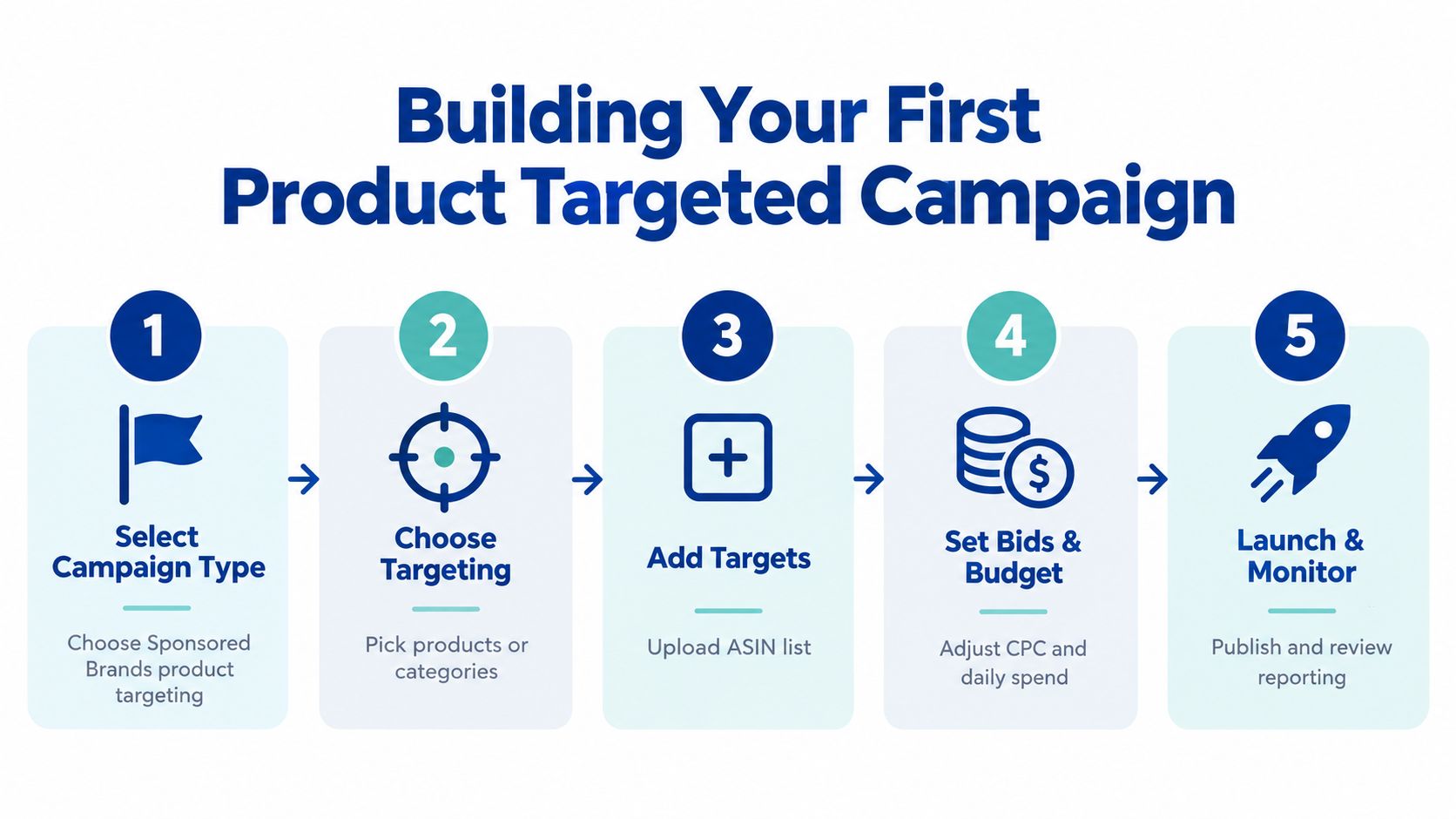
Building Your First Product Targeted Campaign
Launch structure matters more than campaign volume. A clean product-targeted Sponsored Brands campaign gives you enough control to identify profitable targets, remove waste, and connect ad performance to listing and organic priorities.
Step 1 choose the campaign objective
Start by deciding whether the campaign will acquire customers, defend branded demand, sell across your catalog, or expand into an adjacent category. Don't combine all four objectives at launch. Each one requires a different target list, headline, product selection, and landing-page experience.
In Amazon Ads, begin the Sponsored Brands setup flow and select product targeting rather than keyword targeting. Amazon's documentation identifies this choice directly in campaign creation, so the account structure should reflect the targeting method from the beginning.
Step 2 build the target set
Use Search Query Performance data to identify products and queries connected to meaningful shopper behavior. Then turn that intelligence into a working ASIN list.
Prioritize:
- Direct competitors: Products with a similar use case, price position, and shopper promise.
- Your own priority ASINs: Listings where defensive coverage protects important branded demand.
- Complementary products: Items that create a natural bundle or next purchase.
- Category segments: Groups that match your quality, price, review, or Prime proposition.
Keep the initial ASIN list commercially coherent. A premium moisturizer shouldn't share a target group with entry-level products because both sit in skincare. Similarity improves the odds that the ad headline and featured products make sense in the shopper's context.
Step 3 refine categories and set the destination
Use category refinements when you need reach beyond a fixed ASIN list. Narrow the category by brand, price range, review rating, Prime eligibility, or other available attributes. Broaden only when the data shows that the tighter segment can't provide enough useful exposure.
Match the landing destination to the objective. A conquesting campaign may work better when it sends shoppers to a focused collection that makes comparison easy. A cross-sell campaign should lead to a coherent product set, not a generic storefront page. A defensive campaign can prioritize the most relevant branded range.
Step 4 align the creative and economics
Write the headline for the target context, not for the internal campaign name. “Explore refillable cleaning solutions” can fit an adjacent-category campaign, while a stronger product benefit may be appropriate when intercepting a specific competitor segment. Feature products with healthy inventory, competitive pricing, strong detail pages, and a clear reason to choose them.
Set bids according to contribution margin, not enthusiasm. A target can produce sales and still destroy profit if the product economics can't support the click cost. Watch spend, sales, conversion behavior, and organic movement together, then cut targets that attract attention without commercially useful outcomes.
Use this Sponsored Brands campaign setup video as a visual reference for the workflow, but treat the target architecture and profitability rules as the strategic work your team must own.
Strategic Use Cases for Maximum Profitability
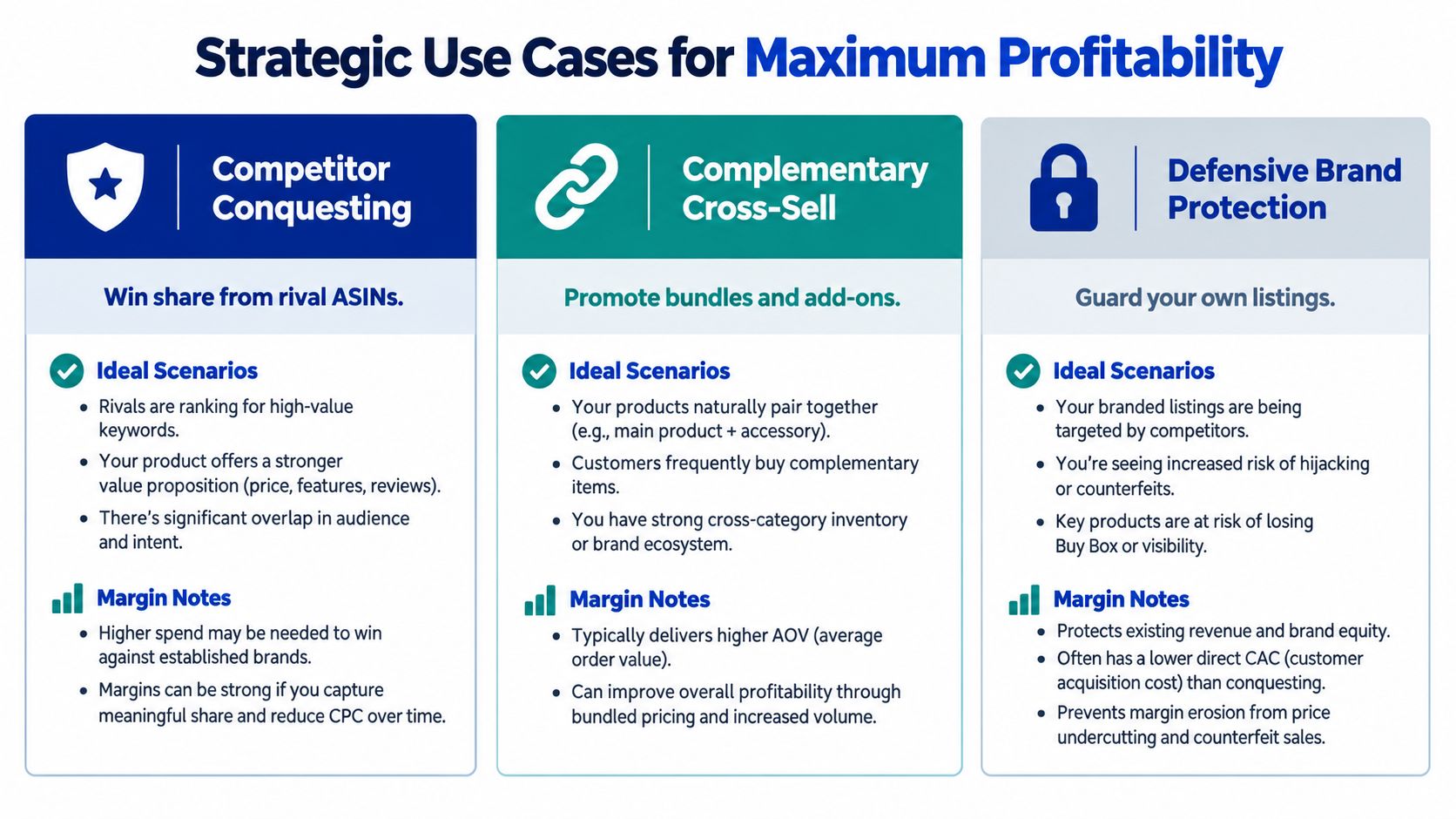
The same targeting feature supports three different commercial plays. The mistake is applying one bid rule and one creative message to all of them. Conquesting, cross-selling, and defense should have separate success criteria because they solve different business problems.
Competitor conquesting
Conquesting puts your brand in front of shoppers evaluating rival products. Select ASINs where your offer has a defensible advantage, such as a stronger bundle, a better fit for a specific use case, or a clearer value proposition.
Use disciplined bids. You may accept a higher acquisition cost on a strategically important competitor, but the target still needs a path to acceptable contribution margin. Review the detail-page context and make sure the advertised products can win the comparison. A generic “shop our brand” headline is weak conquesting. The creative should make the alternative relevant without making unsupported claims about the rival.
Complementary cross-sell
Cross-selling uses product targeting to reach shoppers who may need an adjacent item. A coffee grinder brand might target coffee makers, while a phone-accessory brand could target compatible devices. The connection must be obvious enough that the click feels useful, not intrusive.
Send the shopper to a collection designed around the use case. Feature add-ons that are in stock and easy to understand. The campaign's profitability should account for the value of the resulting order, but don't assume an attachment will happen because two products are compatible. Product detail content, pricing, and the landing experience still determine whether the click becomes revenue.
Defensive brand protection
Defense targets your own products, branded portfolio, or tightly related listings. The purpose is to keep competitors from occupying the comparison space around demand you've already created. That doesn't mean bidding blindly on every branded product. Prioritize listings with strong sales importance, vulnerable detail-page traffic, or a strategic role in your catalog.
Creative should reinforce recognition and make the next click easy. Use a focused collection rather than forcing the shopper to search your Store. Bid to protect valuable traffic while respecting the fact that some clicks may have happened organically.
Profitability rule: A defensive campaign can justify spend even when it doesn't create entirely new demand, but you still need to measure whether the protection is worth its incremental cost.
These plays should live in separate campaigns or clearly separated ad groups. Compare them on target-level efficiency, conversion quality, new-to-brand contribution, and their effect on organic priorities. Blended ROAS won't tell you whether conquesting is acquiring customers, cross-selling is expanding baskets, or defense is merely paying for traffic you already owned.
Measuring Incrementality and New-to-Brand Growth
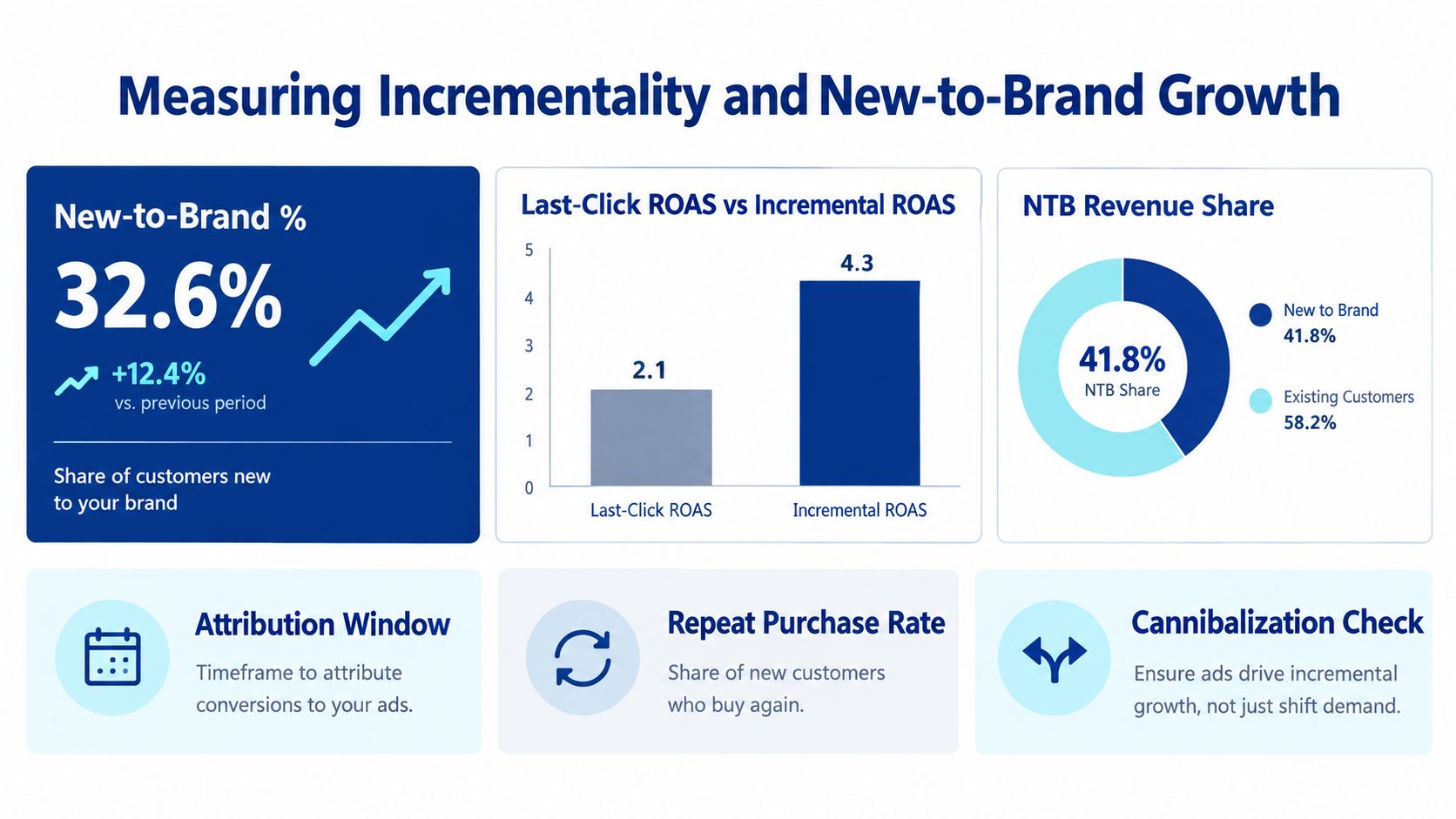
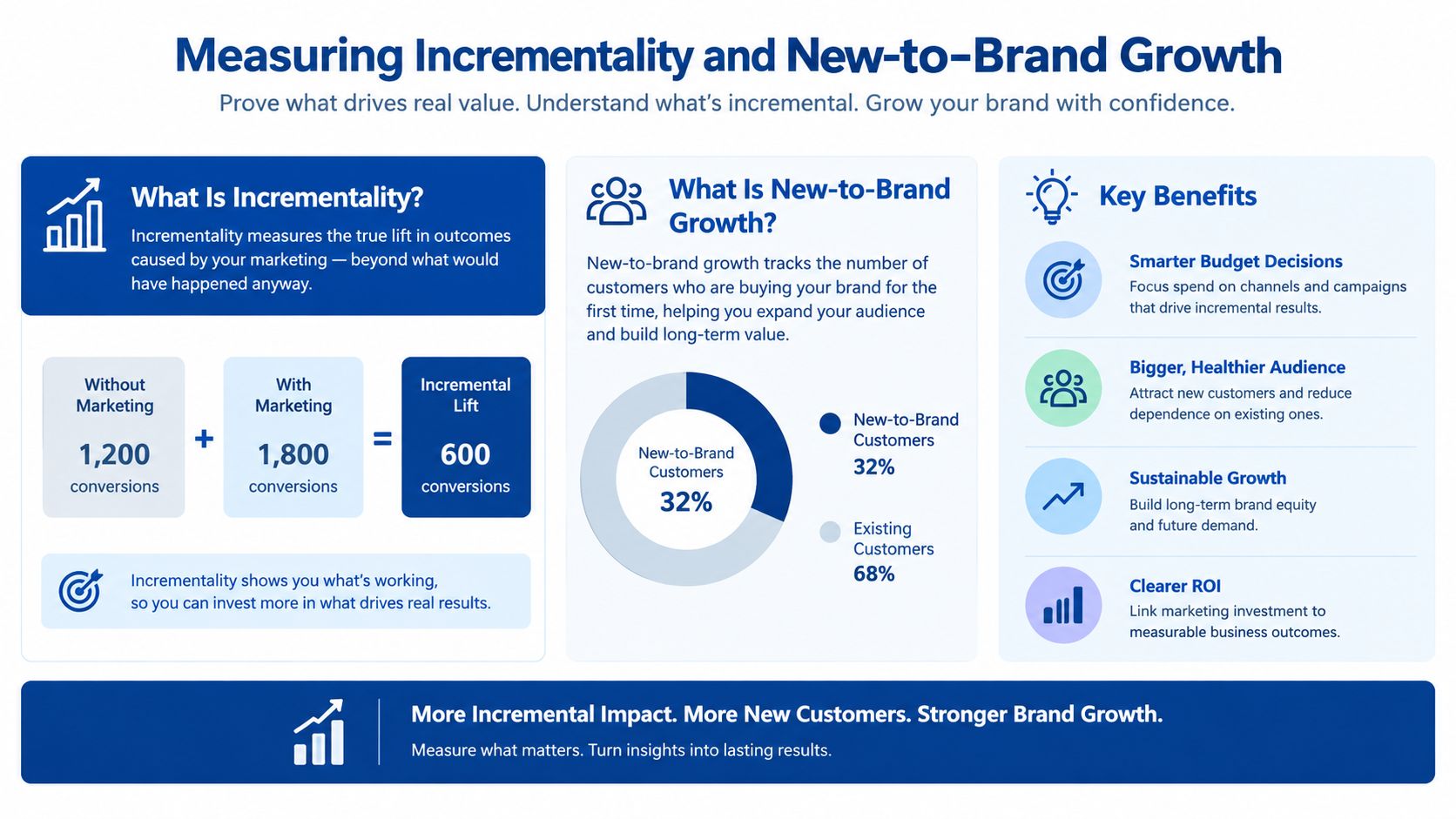
Last-click reporting can justify a bid, but it cannot prove that product targeting created demand. A shopper may already be comparing products, searching for your brand, or preparing to buy. Measure whether the ad acquired a customer, defended an existing opportunity, or diverted a purchase that would have happened organically.
Amazon provides new-to-brand reporting for Sponsored Brands and uses a 12-month look-back window, as noted earlier. The window identifies whether attributed orders came from customers who had not purchased from the brand during the relevant period. That view is more useful than ACOS alone when deciding whether conquesting and category expansion deserve further investment.
Build a measurement stack
Start at the target level, then connect advertising results to profit and organic performance.
- Target efficiency: Review spend, attributed sales, conversion behavior, and contribution margin by ASIN, brand, and category target.
- New-to-brand mix: Compare new-to-brand orders and sales with repeat-customer outcomes. Acquisition matters only when its value supports the cost.
- Organic movement: Track priority keyword visibility and organic sales beside paid activity. Treat correlation as a signal, not proof that advertising caused every organic change.
- Cannibalization signals: Check whether defensive clicks replace organic purchases or prevent competitors from capturing high-intent traffic.
- Audience behavior: Use audience reporting and Amazon Marketing Cloud where available to examine paths across exposures, visits, and purchases.
Amazon has expanded reporting with targeting reports and matched-target visibility for sponsored ads, as described in Amazon's targeting report documentation. This visibility lets analysts inspect which selected targets generated delivery instead of treating product targeting as an opaque campaign type.
Make incrementality a decision, not a slogan
Use controlled comparisons whenever account structure and available data support them. Hold out selected targets, compare carefully matched periods, or evaluate similar ASIN groups. The goal is practical judgment, not a perfect causal model from one report. Stop treating every attributed order as evidence that a target deserves more budget.
Report results in three layers: immediate efficiency, customer acquisition, and marketplace effect. A target with modest last-click ROAS may deserve funding if it acquires new-to-brand customers and supports an organic priority. A target with attractive attributed sales may need a cut if it mainly captures shoppers who were already likely to purchase. That distinction keeps product targeting focused on profitable conquesting, retail defense, and measurable organic growth.
Navigating Targeting Policies and Relevance Rules
Aggressive targeting only works when the target is relevant to the advertised product. Amazon's targeting policy guidance requires targeted keywords and products to be relevant, and restricts offensive, insensitive, or undesirable targets.
That rule is commercially sensible, not just administrative. An irrelevant ad wastes the click, weakens shopper trust, and can produce poor campaign signals before Amazon rejects the target. A policy violation also creates operational cost through rejected ads, delayed launches, and possible account-health concerns.
Audit before launch
Review every ASIN and category refinement against the product being promoted. Ask whether the shopper would reasonably see the advertised product as a relevant alternative, complement, or brand choice.
Remove targets connected to restricted examples identified by Amazon, including prescription drugs, e-cigarettes, and sexually explicit or adult products where they fall outside the applicable advertising rules. Don't rely on a bulk-upload process to catch context errors. Human review remains necessary, particularly for large catalogs and ambiguous categories.
Relevance protects profitability
A target can technically generate impressions and still be strategically wrong. If the product context doesn't support the headline, the shopper has little reason to click. If the landing page doesn't continue the promise, the campaign pays for a mismatch.
Create a pre-launch checklist covering product fit, category eligibility, inventory, pricing, creative claims, and landing destination. Recheck it when products change position or when you expand into new categories. Compliance isn't separate from performance. It prevents wasted spend and keeps the campaign structure stable enough to optimize.
Integrating Product Targeting into Holistic Amazon Growth
Product targeting works best as part of a coordinated Amazon system. Sponsored Products can capture keyword demand and support individual ASIN conversion, while Sponsored Display and DSP can extend audience and retargeting strategies where appropriate. Sponsored Brands product targeting adds a useful layer around the products shoppers are already comparing.
The PPC data should feed the rest of the business. Targets that attract qualified clicks can reveal competitor sets, adjacent use cases, and language shoppers associate with your category. Feed those findings into listing copy, Store organization, creative testing, merchandising, and product development. Don't copy every target into SEO. Use the evidence to identify themes that fit the product and improve the customer experience.
Make organic growth an operating objective
A profitable campaign isn't only one with an acceptable ad ratio. It should also help the brand earn more relevant visibility without becoming permanently dependent on paid placement. That requires strong retail readiness: accurate titles, persuasive images, competitive offers, reliable inventory, and detail pages that convert the traffic your targeting creates.
Headline Marketing Agency manages Amazon advertising across Sponsored Brands and Sponsored Products, with an approach that connects PPC and DSP execution to profitability, organic ranking, and brand equity. The right partner should work from your margin model and catalog priorities, not just move bids toward the campaigns with the most attractive last-click report.
The practical recommendation is straightforward. Separate conquesting, cross-selling, and defense. Use ASIN lists when precision matters, refined categories when you need controlled scale, and new-to-brand reporting when you need to justify acquisition investment. Then use target-level learning to improve both paid campaigns and the retail experience that supports organic growth.
Visit Headline Marketing Agency to assess your Sponsored Brands product targeting structure, target profitability, and organic-growth priorities. Headline can connect campaign management, Amazon Marketing Cloud analysis, and listing optimization into a practical plan for scaling without treating ACOS as the only measure of success.
Get Your Free Amazon PPC Audit
Discover untapped growth opportunities and see how our data-driven approach can improve your ROAS.
Get Free Audit →Wollen Sie Ihre Amazon PPC-Performance aufs nächste Level bringen?
Lassen Sie Ihre Amazon PPC-Kampagnen professionell analysieren und entdecken Sie neue Wachstumsmöglichkeiten.