Amazon Prime Day Advertising Playbook
Master Amazon Prime Day advertising with a data-driven playbook. Learn budget pacing, DSP tactics, and bidding strategies to drive profitable scale.

The most popular Prime Day advice is also the least complete: raise Sponsored Products bids, increase budgets, and chase volume. That approach can buy impressions, but it can also exhaust budgets before the strongest buying windows, push low-quality traffic into weak listings, and leave your brand with a large bill and little organic momentum.
Prime Day advertising works better when you treat the event as a planned media insertion. Search ads capture immediate demand, Sponsored Brands defend the brand and category, Sponsored Display and DSP extend reach to warm audiences, and retail readiness determines whether paid traffic converts. The objective isn't vanity revenue or an attractive event-day dashboard. It's profitable customer acquisition that strengthens organic visibility after the promotion ends.
Reframing Prime Day as a Full-Funnel Media Event
Prime Day has outgrown its old identity as a short discount event. During Prime Day 2024, a third-party analysis reported that global ad spend tied to the event surged 496% year over year, while ad-attributed sales rose 468% and average cost per click increased 66%. Amazon also sold more than 200 million items during the 48-hour event, according to the same Prime Day advertising analysis. Those conditions describe a paid-media battleground, not a routine promotion.
The wrong question is, “How much can we spend on Sponsored Products?” The better question is, “Which audiences, placements, and products deserve investment at each stage of the demand curve?” A brand that answers only the first question usually overpays for shoppers who would have converted anyway, while missing the chance to build consideration before the event and recover valuable visitors afterward.
Search is the closer, not the whole strategy
Sponsored Products remains essential because it captures shoppers who are already searching. But search capture is only one part of the Prime Day system. Sponsored Brands can protect branded queries and communicate a broader value proposition, while Sponsored Display and DSP can re-engage shoppers who viewed a product without buying.
That broader approach matters for organic growth. Prime Day traffic creates more opportunities for shoppers to discover, click, compare, and purchase your products. When your listing converts that traffic, paid media can support sales velocity and stronger relevance signals. Advertising doesn't guarantee an organic ranking lift, but it can create the conditions for one by directing qualified demand toward the right ASINs and search terms.
Strategic rule: Don't optimize Prime Day for the lowest possible event-day ACOS. Optimize it for profitable demand capture, stronger organic coverage, and a healthier post-event baseline.
Creative quality belongs in that equation. Product video can explain use cases faster than static imagery and help a shopper understand why your product deserves consideration. If your creative needs work, this practical guide to boost conversions with product videos offers a useful starting point.
Use DSP selectively, not ceremonially
Amazon DSP has a different job from Sponsored Products. It can extend your reach beyond active searchers and support retargeting across Amazon's broader media environment. That doesn't make DSP automatically right for every brand. A low-margin product with limited repeat purchase potential may struggle to justify upper-funnel investment, while a brand with strong customer lifetime value may have more room to build audiences before the event.
Your media plan should reflect category economics. Allocate search budget where conversion intent is strongest, then add audience extension where your margin, creative, and retention model can support it. Headline's Amazon demand-side platform guide is useful for evaluating where DSP fits instead of treating it as a mandatory layer.
The shift is simple but consequential. Prime Day advertising should defend market share today while creating demand and organic opportunity for tomorrow.
Phased Budget Allocation and Keyword Harvesting
Prime Day rewards disciplined pacing, not a single event-day budget spike. Assign each phase a specific job: pre-event activity builds evidence and audiences, event-day spend captures qualified demand, and post-event controls protect profitability after the offer ends.
Pre-event preparation
Start discovery early enough to make decisions. Run Auto, Broad, and exploratory campaigns against priority ASINs while there is time to assess search-term quality. Harvest queries that produce relevant clicks, add-to-carts, and profitable orders, then move proven terms into Exact campaigns with separate budgets. Isolate weak or irrelevant terms so they cannot consume funds intended for hero products.
Build a clear campaign map before Prime Day. Separate ASINs, match types, and strategic roles so later budget changes are precise rather than reactive. Confirm that each priority product has sufficient inventory, an eligible offer, and a detail page that can convert the traffic you plan to buy.
Use the pre-event window to test Sponsored Brand Video, Sponsored Brands, and Sponsored Display. Give each format enough time to show which messages earn attention and which audiences respond. Test the main image, video opening, and headline before the deal is live, not during the most expensive auction hours.
Create audiences from product-page visitors and other meaningful interactions. These shoppers may not purchase before the deal, but they can become useful retargeting pools once the offer activates.
Event-day pacing
During Prime Day, separate campaigns by format, ASIN, match type, and strategic role. A hero ASIN should not share a budget with a low-priority catalog item inside one broad campaign. Give budget headroom to campaigns with both adequate inventory and proven conversion quality.
Monitor the products and terms that matter most by hour. If a campaign converts and its ASIN has sufficient stock, shift budget toward it. If clicks rise while conversion quality weakens, do not raise bids automatically. Check the offer, listing, placement, and search-term relevance first.
Prime Day 2025 supports controlled aggression. Analysts found that Sponsored Products spend rose 20% year over year across the full four-day event, while conversions also increased 20% and cost per click fell 11%, as reported in Tinuiti's Prime Day 2025 results. The lesson is practical: sustain relevant coverage, but do not pay any price for visibility.
Post-event harvesting
The deal badge changes the economics immediately. Reduce conversion-focused bids as soon as the offer ends, then release reserved budget in stages rather than leaving event-level caps active. Keep campaigns running long enough to identify residual demand, but stop funding placements whose conversion rate has returned to the pre-event baseline.
Use the best Amazon keywords research guide to prepare the handoff from discovery campaigns to durable keyword coverage. Document the winning search terms, product-level performance, and audience signals for the team managing evergreen campaigns. That record gives the next planning cycle usable evidence without turning this phase into a second Prime Day push.
Budget pacing remains a profitability decision after the event. Preserve enough reserve for campaigns that continue to prove their value, and reduce exposure when the discount no longer supports the conversion rate.
Balancing Search Capture and Audience Extension
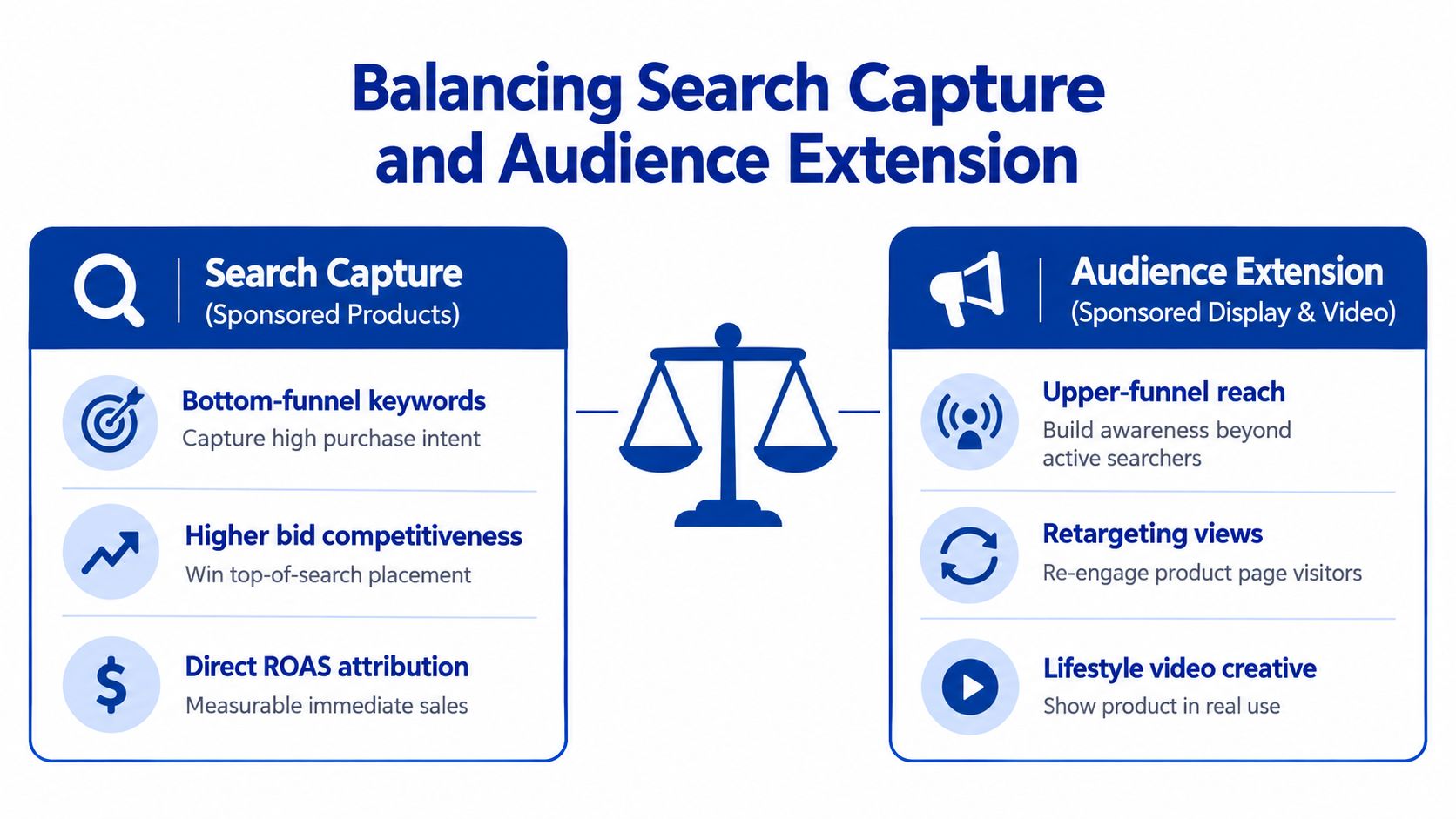
The modern format decision isn't Sponsored Products versus everything else. It's how much of the budget should capture existing intent, and how much should create or recover demand around it.
Sponsored Products is the clearest bottom-funnel tool. It captures category, branded, and competitor searches and usually gives the cleanest connection between a query and an order. That makes it the foundation for a mid-market brand, especially when budgets are constrained or product margins are tight.
Sponsored Brands serve a different purpose. They occupy prominent search real estate, help defend branded terms, and can present several products or a stronger brand message. They deserve priority when competitor conquest threatens branded visibility or when the brand needs to communicate a portfolio-level reason to choose it.
Sponsored Display sits between search and broader media. Its strongest use is often re-engagement, especially for shoppers who viewed a product but didn't buy. The format can also support cross-selling and audience-based reach without requiring the same operational commitment as DSP. See Headline's overview of Amazon Sponsored Display ads for practical campaign applications.
The format mix is changing
Recent reporting points to a broader media role for Prime Day. One 2026 dataset found Amazon DSP represented 35% of Prime Week spend and rose 59% year over year, while other advertiser mixes reduced Sponsored Display and Sponsored Brands even as Sponsored Products remained dominant. The same Prime Day recap reported that 61% of Prime Day 2026 spend in one global dataset came from categories outside shopping.
Those figures don't establish a universal allocation formula. They do expose a strategic mistake: assuming every brand should automatically scale Sponsored Products. If your category depends on education, repeat purchase, or brand consideration, audience extension can protect future demand. If your product has thin margins and weak retention, search capture may deserve the larger share.
Use a simple decision framework:
| Business condition | Budget priority | Reason |
|---|---|---|
| Strong conversion and limited margin | Sponsored Products first | Capture demand with the clearest profitability control |
| Branded search under competitive pressure | Sponsored Brands plus Sponsored Products | Defend high-value queries and direct shoppers to the right ASIN |
| Large pool of product-page visitors | Sponsored Display | Re-engage shoppers who already showed interest |
| High repeat purchase or broad category consideration | DSP and audience extension | Build reach and retargeting value beyond active search |
| Weak listing conversion | Retail readiness before scale | More traffic will magnify the conversion problem |
Measure beyond last click
Don't judge DSP or display by the same immediate ROAS standard as a bottom-funnel search campaign. Measure their role in assisted demand, branded search behavior, retargeting efficiency, and post-event customer value. At the same time, don't use “full funnel” as an excuse to fund weak creative or unprofitable audiences.
The right mix is the one your margins can carry and your retail operation can fulfill. Search captures the shopper. Audience extension increases the number of shoppers who become reachable, familiar, and recoverable.
Navigating Auction Saturation and Creative Compliance
Prime Day auctions do not reward panic. They reward preparation, relevance, and decisions made before a campaign exhausts its budget.
The 2025 event challenges the assumption that heavier competition automatically reduces efficiency. Independent analysis reported higher clicks and impressions against the 30-day baseline, alongside improved CTR and lower CPC. Those results show that high-intent traffic can offset auction pressure when campaigns align relevance, creative quality, bids, and pacing. They are directional evidence, not a promise for your account.
Control the bid system
Set bid caps and dynamic adjustments so one target cannot consume disproportionate spend. Separate branded, category, competitor, and product-targeting campaigns, then apply profitability rules to each. A broad category term may justify visibility for a high-margin hero product. A competitor target may require a much tighter ceiling.
Use schedule-based rules to protect budget throughout the event. Set decision points for spend, conversion quality, inventory, and placement performance. If a campaign reaches its planned threshold without acceptable sales quality, reduce exposure. If a proven term converts efficiently and the ASIN remains in stock, move reserve budget toward it instead of raising every bid across the account.
Auction discipline: A higher bid can win an impression. It cannot repair an uncompetitive offer, weak content, or insufficient inventory.
Prime Day performance reporting also showed lower CPC and higher CTR during the event, but those figures should guide questions, not become targets you promise to reproduce. Your account may face different competition, retail readiness, and customer demand. Judge efficiency against contribution margin, conversion quality, and inventory capacity.
Design for policy restrictions
Creative compliance creates an operational risk. Amazon's event-day policy guidance restricts Prime Day mentions in open internet self-service ads, with limited exceptions. It also restricts those mentions in onsite Display and Sponsored Ads, except where dynamically pulled product-detail-page ASIN information or deal badging applies. Review the Amazon Prime Day advertising policy before production begins.
Policy review should shape the brief, not follow it. Amazon's Sponsored Brands and Display moderation guidance belongs in the production workflow, especially when teams adapt one message across placements.
Build placement-specific variants early. Your Sponsored Brands headline, video script, Sponsored Display creative, and DSP assets may require different permissible language. Approval in one environment does not guarantee approval in another.
Assign one compliance owner, set an approval deadline, and prepare a fallback asset for every format. This keeps a rejected claim from taking an entire campaign offline during the highest-value window. Keep the fallback copy commercially clear, policy-safe, and ready for immediate activation.
Leveraging Event Traffic for Long-Term Organic Growth
Prime Day creates its most valuable marketing signal after the event. Once discounts disappear, review which queries, products, and audiences still support profitable growth. The goal is to turn event data into specific changes for the next trading period, not to preserve inflated sales reports.
Start with Search Query Performance. Compare high-traffic terms with terms that produced profitable conversions, then check each term's organic position. A query can perform well in Exact Sponsored Products while the ASIN remains buried in organic results. That gap calls for a content and retail action plan.
Turn winning queries into operating decisions
Use a worked example rather than a generic winner list. If “portable blender for smoothies” converted at 18% ACOS during Prime Day but the product ranks on page two organically, move the query into a dedicated Exact campaign, review the bid against regular-price margin, and refresh the relevant A+ Content. Align the title, bullets, imagery, and comparison modules with the query's shopper intent. Then track organic rank and conversion at the normal price.
If the same term generates clicks but loses money without the event discount, keep it in a controlled test or pause it. Do not promote it into an evergreen campaign because Prime Day urgency made the traffic look stronger. Efficiency traps require a margin decision, not automatic budget protection.
Apply the same process at the ASIN level. A query that converts for one variation may justify a clearer variation hierarchy, a bundle test, or stronger detail-page merchandising. Branded terms and strategic category queries can remain Paid defenders when losing visibility would expose the product to direct competitors, but set a profitability limit and review it outside the event window.
Record each decision in the campaign plan: query, ASIN, event conversion result, regular-price result, organic position, action, owner, and review date. That record prevents the team from treating every Prime Day term as a permanent winner.
Use AMC for cohort decisions
Amazon Marketing Cloud can connect behavior across campaigns and audiences. Use it to separate visitors who viewed but did not buy, customers who purchased during the event, and audiences suited to retention or cross-sell activity. Assign each cohort a different bid, message, and time horizon instead of building one large retargeting pool.
Post-event Sponsored Display and DSP should support the next purchase cycle. Replenishment messaging fits consumables, while complementary products or accessories suit durable goods. Recent visitors may need a reason to return, but event buyers need a relevant follow-up offer or product path.
Measure the new baseline through organic sessions, branded demand, conversion at regular pricing, and the share of sales still dependent on ads. If performance returns to its previous level, determine whether Prime Day created repeatable demand or only temporary deal response.
Organic growth principle: Paid media should produce more than attributed orders. It should identify which queries, products, and audiences deserve durable investment.
Retail Readiness and Execution Checklist
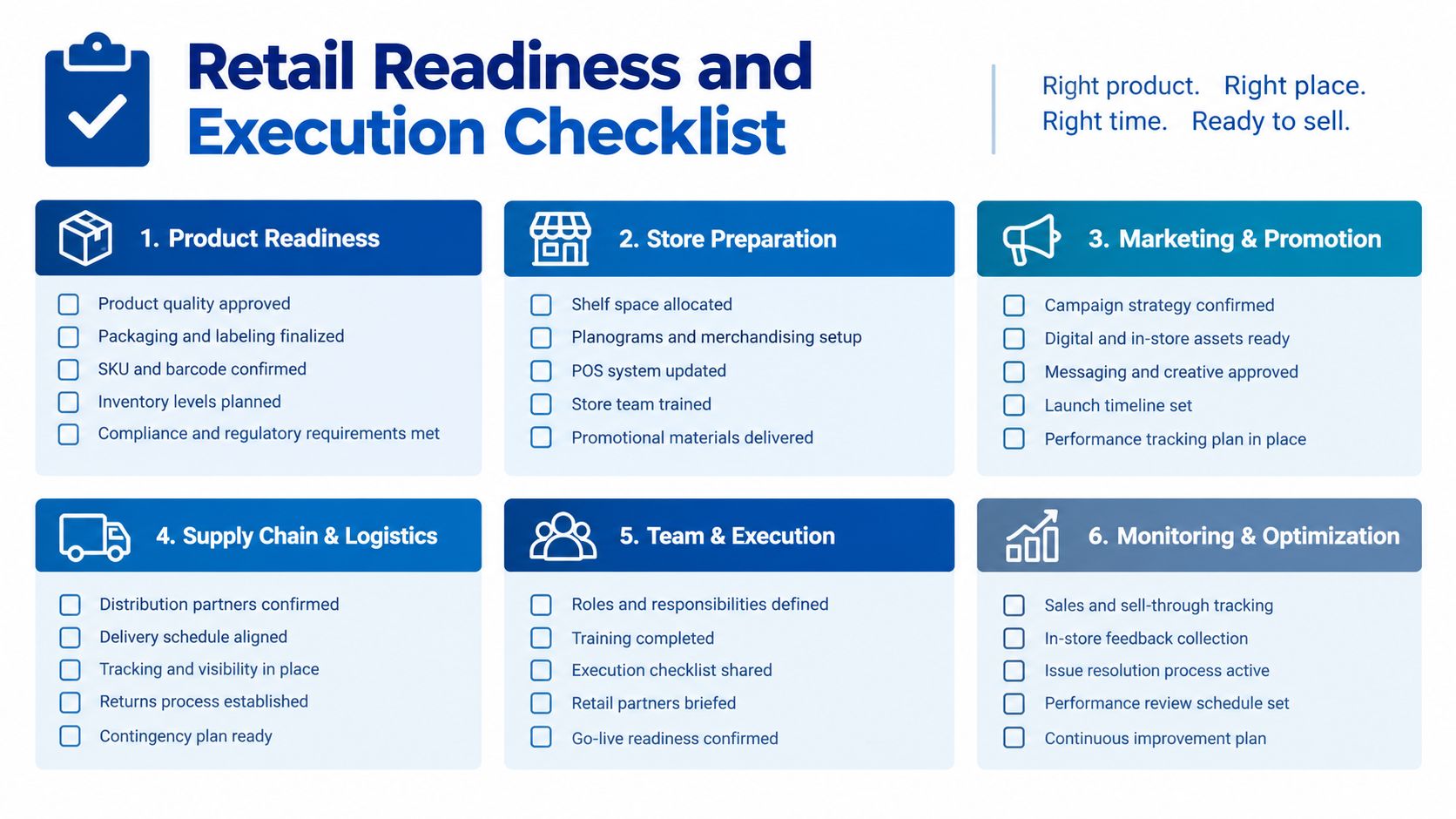
Advertising can't compensate for a product page that fails to convert. Prime Day sends more shoppers into the marketplace, but your brand still has to win the click, communicate value, close the sale, and fulfill the order. Retail readiness is therefore a media prerequisite, not an operations task that sits beside advertising.
Amazon reported that advertisers using Sponsored Products, Sponsored Brands, and display ads during Prime Day 2025 saw a 137% increase in sales versus average category growth, while Sponsored Brands plus display alone produced a 39% sales lift. Amazon also reported that advertisers using cost controls in display campaigns achieved a 2.6X uplift in ad-attributed sales per campaign, as documented in its advanced Prime Day advertising strategies. These results reinforce two points: format mix matters, and control systems matter.
Audit the commercial foundation
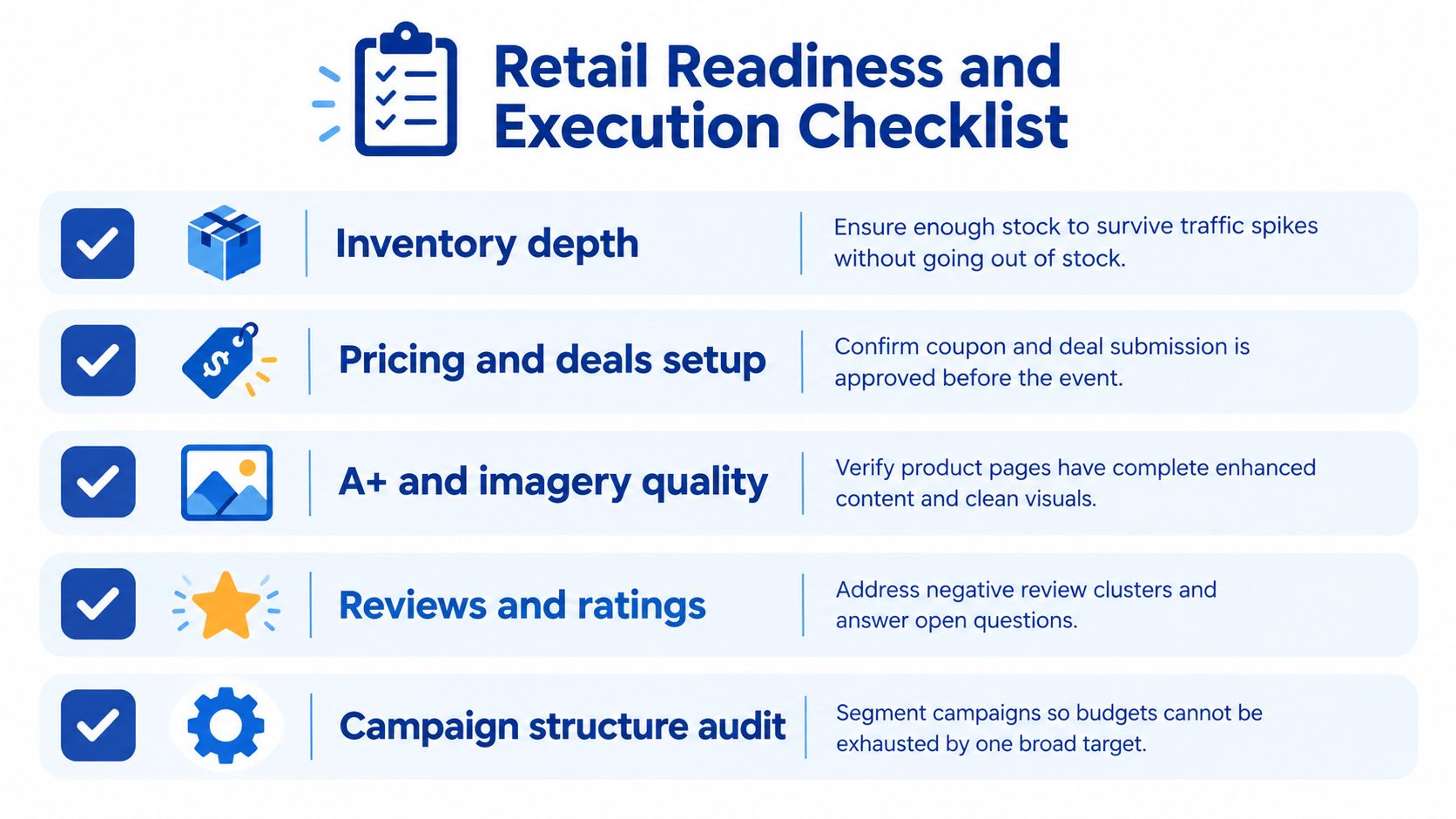
Run the audit before you approve peak budgets:
- Inventory depth: Confirm that priority ASINs can support the traffic you intend to buy. A stockout wastes the opportunity and can interrupt campaign momentum.
- Pricing and deal setup: Verify that coupons, deals, and badging are approved and display correctly. Ads should send shoppers to an offer that appears on the detail page.
- Detail-page content: Review titles, bullets, images, A+ Content, video, variation relationships, and mobile presentation. Paid traffic exposes every content weakness quickly.
- Reviews and ratings: Identify negative review clusters, recurring product objections, and unanswered customer questions. Address issues that content or customer service can realistically solve.
- Campaign structure: Isolate hero ASINs, match types, branded defense, category discovery, and competitor targeting. One broad target shouldn't be able to exhaust the budget for the whole portfolio.
- Budget headroom: Reserve funds for campaigns that prove their value during the event. A plan that spends its entire budget early isn't controlled scaling.
Troubleshoot in the right order
When performance drops, don't change bids first. Check whether the product is in stock, the deal is live, the detail page is approved, and the campaign has budget. Then inspect placement, search term quality, click-through rate, and conversion.
A high CPC with strong conversion may be an acceptable investment for a profitable hero ASIN. A low CPC with weak conversion is not automatically efficient. It may only indicate that your ads are winning cheap impressions that don't lead to orders.
Headline Marketing Agency offers Amazon PPC and DSP management that combines campaign execution with retail-readiness analysis, Search Query Performance, and Amazon Marketing Cloud insights. That kind of operating model fits brands that want Prime Day decisions tied to profitability, organic growth, and long-term marketplace strength rather than event-day volume alone.
Execution standard: Don't scale a campaign until its inventory, offer, content, compliance, and budget controls can withstand the traffic you're buying.
Prime Day advertising succeeds when media and retail operations move as one system. Audit the foundation, reserve budget for proven demand, and keep a post-event harvesting plan ready before launch.
Headline Marketing Agency can help you structure Amazon PPC, Sponsored Brands, Sponsored Display, video, and DSP around your margins, priority ASINs, and Prime Day operating plan. Visit Headline Marketing Agency to discuss a full-funnel strategy that connects event execution with retail readiness, organic growth, and sustainable profitability.
Get Your Free Amazon PPC Audit
Discover untapped growth opportunities and see how our data-driven approach can improve your ROAS.
Get Free Audit →Wollen Sie Ihre Amazon PPC-Performance aufs nächste Level bringen?
Lassen Sie Ihre Amazon PPC-Kampagnen professionell analysieren und entdecken Sie neue Wachstumsmöglichkeiten.