A Guide to Amazon Seller Analytics Tools for Sustainable Profitability
Amazon analytics tools promise a lot. We separate the ones that deliver real value from the ones that just look impressive.

Think of Amazon seller analytics tools as your business's central nervous system. They move far beyond Amazon’s native reports, unifying scattered data points to reveal what’s really happening with your profitability, advertising, and competitive positioning. For mid-to-senior eCommerce leaders, this isn't about more data; it's about smarter, performance-driven decisions.
Why Native Amazon Reports Limit Your Growth
Let's be blunt: if you're only using the reports inside Seller Central, you're operating with a strategic blind spot. Amazon provides a deluge of data in its Business Reports and Brand Analytics dashboards, but it’s a fractured, tactical view. It’s dangerously easy to fixate on vanity metrics like revenue while ignoring the only metric that guarantees sustainable scale: profit.
The core problem for sophisticated brands isn't a lack of data; it's that the data doesn't connect. Amazon's reports don't tie ad spend to your true, SKU-level bottom line. They don't account for your Cost of Goods Sold (COGS), inbound shipping, or prep fees. This creates a scenario where a campaign with a "good" ACoS could be liquidating your margin on every sale.
The Disconnect Between Data and Profit
This isn't a trivial issue. A 2023 study found that 49% of Amazon sellers aren't sure if their business is profitable. This gap is precisely why a new generation of Amazon seller analytics tools has emerged. These platforms are built on a simple premise: to scale sustainably, you must have a complete, actionable financial picture of your business.
This is where a direct comparison really highlights the difference. Native reports give you a peek, but advanced tools give you the panoramic view required for strategic leadership.
Native Amazon Reports vs Advanced Analytics Tools
| Capability | Native Amazon Reports (Seller Central) | Advanced Analytics Tools |
|---|---|---|
| Profitability View | Shows revenue and ad spend, but not true profit. | Calculates SKU-level contribution margin and net profit. |
| Data Integration | Limited to data within the Amazon ecosystem. | Connects Amazon data with external costs (COGS, shipping). |
| Competitive Analysis | Basic brand and keyword share metrics. | Provides deep competitor tracking and market intelligence. |
| Advertising Insights | Reports on ACoS and sales from ads. | Links ad spend to true profitability (TACoS, POAS). |
| Strategic Focus | Tactical (Did we make sales today?). | Strategic (Which products are driving profitable growth?). |
Ultimately, Amazon's built-in reports are a starting point, but they lack the strategic clarity needed to outmaneuver sophisticated competitors and drive real enterprise value.
Moving Beyond Basic Reporting
To break free from the limits of Amazon's native tools, performance-focused brands leverage advanced platforms. Many of these tools even use a dedicated Amazon scraper to gather richer data on competitor pricing, market trends, and product performance that you just can't get otherwise. This is the pivot from reactive adjustments to proactive, profit-driven strategy.
The core problem is that Amazon’s tools are designed to help you operate within their ecosystem. Advanced analytics tools are designed to help you win in that ecosystem by connecting every cost and every action to your actual profit margin.
Sticking with native reports means you're making critical business decisions with incomplete information. To truly scale your brand, you must shift from simply viewing data to interpreting it through the lens of profitability. This is the foundational step toward building a more intelligent, resilient, and defensible Amazon business.
The Four Pillars of Amazon Analytics That Matter
If your data is disconnected, your strategy will be too. To build a defensible, profitable Amazon business, you must move beyond chasing isolated metrics and integrate your data across four essential pillars that directly impact your bottom line. Think of these not as separate data silos, but as the interconnected systems of a high-performance brand.
The objective isn't merely data collection. It's about transforming raw information into tangible profit and strategic advantage, as this hierarchy illustrates.
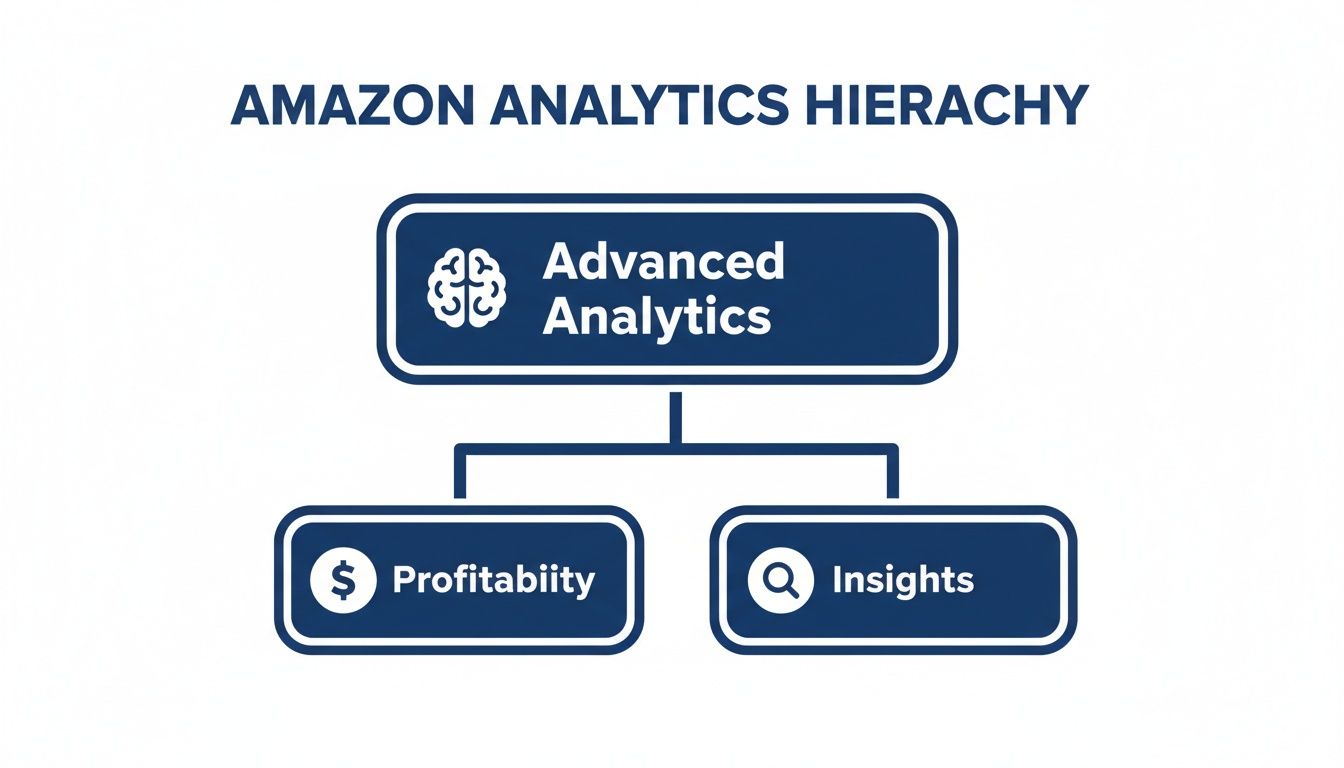
Ultimately, every piece of data you track must lead back to a single outcome: making smarter decisions that drive profitable growth.
Pillar 1: Profitability Analytics
This is the bedrock of your entire strategy. Profitability analytics transcends top-line revenue and misleading metrics like ACoS. It answers the most critical question for any business leader: is this product actually generating cash? This requires a forensic analysis of the true contribution margin for every SKU, factoring in every variable cost.
We're not just talking about sales price minus product cost. A true profitability analysis includes:
- Cost of Goods Sold (COGS): The landed cost of your product.
- Amazon Fees: Referral fees, FBA fulfillment fees, storage fees, and more.
- Shipping & Logistics: The cost to get your product to Amazon's warehouses and any 3PL fees.
- Advertising Spend: Every dollar from PPC and DSP campaigns allocated to the specific product.
Without this SKU-level clarity, you could be funneling ad spend into scaling a "bestseller" that is actually a margin-killer. The right Amazon seller analytics tools automate these complex calculations, making your true profitability impossible to ignore.
Pillar 2: Competitive Intelligence
On Amazon, you’re not just selling products; you’re competing for market share on a digital shelf. Competitive intelligence is the practice of systematically monitoring your rivals to stay one step ahead. It’s about converting market data into a distinct competitive advantage.
Effective competitive intelligence isn't about mimicry. It’s about understanding your competitors' playbooks so you can write a better one, exploiting their weaknesses, and seizing market gaps before they do.
You should be tracking competitor price changes, review velocity (a key indicator of sales momentum), keyword strategy (what terms are they bidding on?), and inventory levels. This data allows for proactive strategy. For example, if a top competitor stocks out, it's a clear signal to increase ad spend on shared keywords and capture their market share.
Pillar 3: Advertising Performance
This is where you connect advertising spend directly to business growth. It means moving beyond tactical campaign metrics and understanding how advertising influences your entire Amazon flywheel—especially organic rank. A critical metric here is Total Advertising Cost of Sale (TACoS), which measures the relationship between ad spend and total revenue, revealing advertising’s impact on organic sales.
A performance-first advertising strategy uses paid media as a lever for organic growth. For instance, an aggressive PPC campaign for a target keyword drives sales velocity, which improves your Best Seller Rank (BSR). A better BSR, in turn, boosts your organic ranking for that same keyword. This creates a powerful feedback loop where paid media directly fuels long-term, cost-free organic sales.
Pillar 4: Inventory Operations
Your inventory is your most valuable—and riskiest—asset. Mismanagement can cripple your business. Inventory analytics is about ensuring you have the right amount of product, in the right place, at the right time. Stockouts are not just lost sales; they devastate your organic rankings as Amazon's algorithm penalizes product unavailability.
Conversely, overstocking is equally damaging, leading to punitive long-term storage fees and tying up working capital that could be used for new product launches or strategic ad campaigns. The right analytics tools provide demand forecasting based on historical sales, seasonality, and promotional calendars, helping you optimize inventory levels and avoid these costly errors.
Takeaway: When you view your business through these four interconnected pillars, data transforms from an overwhelming flood into a clear strategic roadmap. This shifts your focus from reactive, day-to-day tactics to proactive, profit-driven decisions for long-term growth. It's the only sustainable way to scale on Amazon.
Moving from ACOS to True Profitability
For years, Advertising Cost of Sale (ACOS) has been the default metric for Amazon advertising. It's simple and accessible, but as a primary KPI, it's dangerously flawed. Focusing on ACOS alone is one of the fastest ways to build a high-revenue business that generates zero cash.
Relying solely on ACOS is like driving a race car with your eyes glued to the speedometer. It tells you your speed but offers no insight into whether you're winning the race or just burning fuel. A low ACOS feels like a win, but if it's attached to a product with razor-thin margins, you could be losing money on every ad-driven sale.
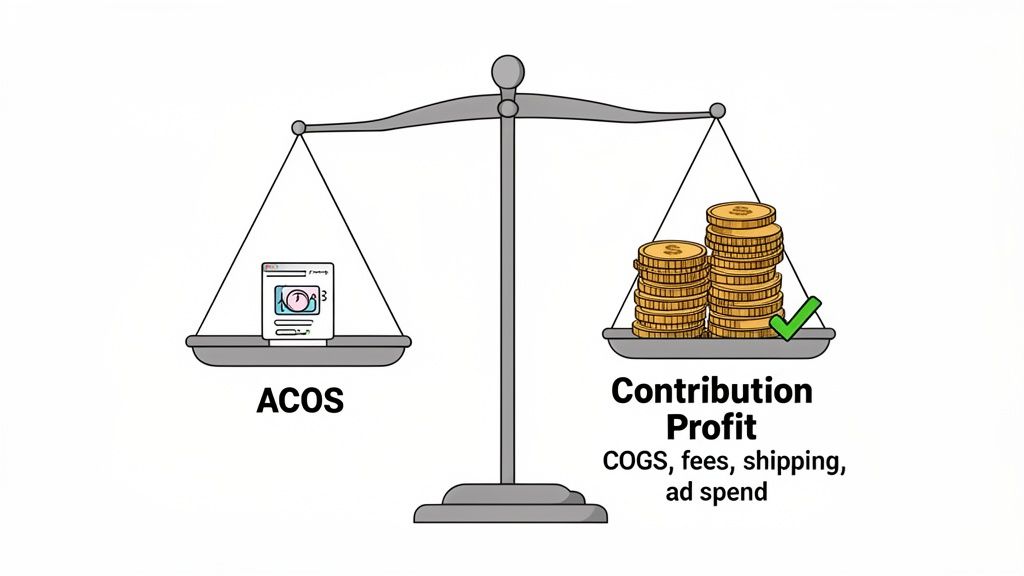
The market for Amazon seller analytics tools is maturing beyond this outdated thinking. The strategic shift is away from surface-level metrics and toward true contribution profit. Why? Because sustainable growth comes from knowing which products are padding your margin, not just which ones are moving volume.
The Superior Metric: Contribution Profit
To make genuinely intelligent business decisions, you must graduate from ACOS to Contribution Profit. This metric reveals the actual cash a product generates after all its variable costs have been paid. It is the only true measure of a product's financial health and its ability to contribute to your company's overall profitability.
The calculation is straightforward:
Contribution Profit = Retail Price - (Cost of Goods Sold + All Amazon Fees + Shipping & Prep Costs + Ad Spend)
This formula cuts through the vanity of high revenue and exposes what’s actually left to cover fixed costs and generate net profit. It is the only way to know if your advertising is creating real enterprise value or simply the illusion of it.
Why a Higher ACOS Can Actually Be More Profitable
Consider this real-world scenario. You have two products. You spend $25 on ads for each, generating $100 in ad-attributed sales. Both have a clean 25% ACOS. On the surface, their ad performance looks identical.
- Product A: Sells for $50. Its COGS, fees, and shipping total $30.
- Product B: Also sells for $50. As a premium item, its total costs are only $15.
Now, let's analyze the Contribution Profit for each unit sold via an ad:
| Metric | Product A (Lower Margin) | Product B (Higher Margin) |
|---|---|---|
| Retail Price | $50 | $50 |
| Ad Spend per Sale | $12.50 (25% ACOS) | $12.50 (25% ACOS) |
| COGS + Fees | $30 | $15 |
| Total Costs | $42.50 | $27.50 |
| Contribution Profit | $7.50 | $22.50 |
Even with the exact same ACOS, Product B is three times more profitable. This insight is a game-changer. It gives you the confidence to push a product with a higher ACOS, knowing it delivers more cash to your bottom line. Armed with this clarity, you can build far more effective PPC reports and growth strategies.
This mindset shift separates professional operators from amateurs. When you anchor your strategy in contribution profit, you stop managing ad campaigns and start managing a profitable business portfolio. You can finally make informed capital allocation decisions—which products to scale with advertising, which to maintain, and which are quietly eroding your profitability.
Using Analytics to Win on the Competitive Battleground
Selling on Amazon isn't just about managing your own listings. If you're only looking at your own numbers, you're missing half the picture. The real game is played on the competitive battleground, where winning means understanding, anticipating, and outsmarting your rivals.
Think of it less like a sprint and more like a high-stakes chess match. You have to know your opponent’s strategy to counter their moves and protect your position. Advanced Amazon seller analytics tools are what give you that board-level view. They turn raw data about your competitors into a clear playbook you can use to make smarter decisions.
This level of insight is no longer a "nice-to-have"; it's a prerequisite for market leadership. The competitive landscape is so fierce that specialized tools have emerged to track competitors in ways Amazon's native reports cannot. For a deeper edge, some brands even explore techniques like web scraping for competitive intelligence to pull data that goes beyond standard toolsets.
Reverse-Engineering a Winning Keyword Strategy
One of the most powerful strategic actions you can take is to reverse-engineer your competitors' keyword strategy. Why guess which search terms convert when you can see exactly where your top rivals are investing their ad dollars and which keywords are driving their organic rank?
This isn't just about copying their keyword list; it's about identifying strategic gaps. You might discover a competitor is spending heavily on a high-volume keyword but only achieving a page-one, below-the-fold organic rank. That's a vulnerability. It's a clear signal for you to launch a targeted ad campaign, capture that traffic, and begin building your own ranking momentum.
By identifying the gaps between a competitor’s ad spend and their organic performance, you can pinpoint the most vulnerable and profitable keywords to target. This turns their marketing budget into your market research.
This data-driven approach allows for far more efficient capital allocation in your ad spend. You’re targeting keywords with proven conversion history while exploiting the inefficiencies in your competitors' strategies.
Turning Pricing and Reviews into Market Intelligence
Keywords are just the beginning. The best analytics tools provide a real-time feed of other critical competitive signals.
- Pricing Adjustments: Did a key competitor just drop their price by 15%? This could signal an attempt to liquidate overstocked inventory or a strategic push to capture market share. This intel allows you to decide whether to maintain your pricing integrity or strategically match their price on a key ASIN.
- Review Velocity: How quickly is a competitor accumulating new reviews? A sudden spike is a clear indicator of increased sales velocity, likely driven by a new promotion or an aggressive ad campaign. Identifying this early allows you to diagnose their strategy and respond before they erode your market share.
This level of detailed intelligence is now standard for any serious brand. It's why we have a whole market of platforms designed to deliver it. A tool like atom11, for example, can keep an eye on competitor products to track pricing changes and review counts, and it can even deconstruct an ASIN to show you every keyword it ranks for. You can discover more insights about these advanced tools on atom11.co.
Takeaway: Competitive analytics isn't about spying; it's about strategy. When you systematically deconstruct your rivals' actions, you transform their data into a roadmap for your own success. It allows you to shift from a reactive posture to making proactive, data-driven decisions that keep you one step ahead.
Connecting Ad Performance to Organic Growth
Many Amazon brands view advertising as a line-item expense—a necessary cost to drive short-term sales. This is a limited and costly perspective. The most sophisticated sellers understand that PPC isn't just a sales-driver; it is the most powerful lever for building long-term, sustainable organic growth and creating a defensible "moat" around their brand.
This is where the right Amazon seller analytics tools are mission-critical. By looking beyond basic metrics, you can transform your ad strategy into a growth engine that ignites a powerful flywheel effect. The ultimate objective is to use paid placements to strategically improve your organic ranking, creating a virtuous cycle where every ad dollar invested builds lasting brand equity.
Unlocking the Flywheel with SQP and AMC
Two of the most valuable—and underutilized—datasets for this strategy are Amazon's Search Query Performance (SQP) and Amazon Marketing Cloud (AMC).
- Search Query Performance (SQP): This is a direct window into your customers' search behavior. SQP reveals the exact search terms shoppers use to find your products, detailing performance for both paid and organic traffic. It is a goldmine for discovering high-intent, non-branded keywords you never knew were driving conversions.
- Amazon Marketing Cloud (AMC): AMC is a secure data "clean room" that enables analysis of anonymized data across all your Amazon advertising touchpoints. It helps you map the entire customer journey, from the first ad impression to the final purchase, revealing how different ad formats work together to drive conversions.
These tools provide the intelligence required to architect a more integrated and effective advertising strategy.
A Practical Use Case for Driving Organic Rank
Let’s apply this to a real-world scenario. Imagine you sell premium coffee grinders. Your strategic objective is not just to sell more units this month, but to achieve a dominant organic rank for high-value, non-branded keywords.
Identify the Opportunity with SQP Data: You analyze your SQP report and find that your product has a phenomenal conversion rate for the search term "quiet burr coffee grinder," but your impression share is low. This indicates a perfect product-market fit for this query. The problem is discoverability. That's your strategic opening.
Execute a Surgical Ad Campaign: Armed with this data, you launch a hyper-focused Sponsored Products campaign targeting that exact keyword. You bid aggressively for top-of-search placements, understanding that every conversion is not just a sale, but a signal to Amazon's algorithm.
Fuel the Flywheel: As your ads drive consistent sales velocity for "quiet burr coffee grinder," the A9 algorithm takes notice. It recognizes that your product is highly relevant and satisfying to customers searching that term. This sales history directly boosts your organic ranking. You can monitor this progress with a reliable Amazon keyword rank tracker.
Achieve Organic Dominance and Scale Back: Over time, your organic rank climbs. You are now capturing both paid traffic and a growing stream of high-converting, free organic traffic. At this stage, you can strategically reduce your ad spend for that keyword, having successfully used it to secure a valuable, long-term organic position.
This process transforms a tactical ad campaign into a strategic investment in your brand’s digital assets.
Your advertising shouldn't just buy sales; it should build assets. By using data to pinpoint high-potential keywords, you can systematically convert ad spend into permanent organic ranking improvements, lowering your customer acquisition costs over time.
This performance-first approach shifts the conversation from, "What was my ACOS?" to "How did my advertising investment increase my total market share for our most strategic keywords?" This is the mindset that separates stagnant brands from enduring market leaders.
Building an Analytics-Driven Growth Strategy
To win on Amazon, you must graduate from reactive, day-to-day management to a deliberate, data-driven growth strategy. The core principle is simple: stop chasing vanity metrics and organize your business around profitability. You must connect your data points and use advertising as a strategic lever to fuel the organic growth flywheel. This is the final evolution from simply selling products to building a dominant marketplace presence.
A winning strategy doesn't just look at data; it connects the dots. Every ad campaign, inventory order, and competitive analysis should work in concert toward a single goal: profitable, sustainable scale. There are no shortcuts. It's about building an intelligent, resilient operating system for your brand.
Your Roadmap to Marketplace Dominance
Building this system requires a clear, sequential plan. Forget obsessing over a fluctuating ACOS or tracking a dozen disconnected metrics. Your strategy must be built on a rock-solid foundation of profitability, where each action reinforces the next.
Here is a three-step framework for implementation:
Establish a Profitability Baseline: Before scaling any ad campaign, you must have absolute clarity on the Contribution Profit for every SKU. This metric is your north star for all capital allocation decisions. Ensure its accuracy by using a dedicated Amazon seller profit calculator to build a reliable financial foundation.
Integrate Advertising and Organic Performance: Create a systematic feedback loop between your paid and organic channels. Use tools like Search Query Performance (SQP) to identify keywords with high conversion potential but low organic rank. Launch targeted ad campaigns to drive sales velocity for these terms. This initial investment improves your organic rank, creating a self-sustaining growth cycle that lowers your reliance on paid media over time.
Weaponize Competitive and Market Data: Continuously monitor your competitors’ pricing, review velocity, and keyword rankings. Don't just use this data for defensive maneuvers. Use it proactively to identify market gaps and strategic weaknesses. A competitor's stockout or sudden price increase is not just an observation; it's an opportunity to capture market share.
Executing this structured approach changes the game. Your analytics transform from a rearview mirror showing where you’ve been into a GPS guiding your brand directly toward its financial objectives.
The ultimate goal of an analytics-driven strategy is to make profitability predictable. It’s about building a system where growth isn’t a matter of luck or guesswork, but the logical outcome of smart, data-backed decisions repeated over time.
This isn't just a sales pitch; it's the logical next step for any brand that's tired of guessing what works. By putting this framework into action, you create a powerful engine for growth. Your ad spend stops being just an expense that brings in sales—it becomes an investment that builds lasting brand equity and market share. The data is all there, waiting for you. The key is to assemble it into a coherent strategy that pushes your business forward. This is your roadmap to turning data into dominance.
Frequently Asked Questions
Got questions about putting Amazon analytics into practice? You're not alone. Here are some straight answers to the questions we hear most often from brand leaders.
What's the One Metric I Should Care About Besides ACoS?
Hands down, it's Contribution Profit per SKU. This is the number that tells you what you're actually making on each product after all the dust settles.
Think of it as your product's true bottom line. It accounts for everything—the cost of the goods, every single Amazon fee, shipping, and, of course, your ad spend. When you focus on contribution profit, you stop guessing and start knowing which products are your cash cows, which ones need a price adjustment, and which might be secretly draining your profits.
How Long Does It Take to See Results From an Analytics-First Strategy?
You'll likely see some positive bumps in performance within the first 30 days as we trim waste and optimize campaigns. But the real magic, the kind that creates lasting growth, takes a bit longer.
We're talking about building a flywheel, where smart advertising boosts your organic rank. That momentum really starts to build and become a powerful force over a 3-to-6-month period.
This is more than a tactic; it's a long-term investment in your brand's standing on Amazon. You're not just buying sales for today—you're building a competitive advantage that makes it much harder for others to catch up.
The key is consistency. The payoff comes from the compounding effect of better organic visibility and lower acquisition costs over time. That’s what separates the market leaders from everyone else.
Can't We Just Build Our Own Analytics Dashboard?
Technically, yes, you can. But it’s a huge undertaking. Building a custom dashboard that pulls from Amazon's APIs requires a dedicated team with deep expertise in data engineering, API quirks, and business intelligence. It's a massive project.
For almost every brand, the time, cost, and headache of building and maintaining a custom system from the ground up just doesn't make sense. It's far more practical to use a specialized, road-tested analytics platform. These tools are built to handle Amazon's data chaos, so your team can focus on making smart decisions, not wrestling with data pipelines.
At Headline Marketing Agency, we turn overwhelming data into clear, profitable growth plans. Our proprietary analytics connect ad performance directly to your bottom line, building a powerful flywheel that drives both sales and organic rank. Discover how our data-driven approach can scale your brand on Amazon.
Get Your Free Amazon PPC Audit
Discover untapped growth opportunities and see how our data-driven approach can improve your ROAS.
Get Free Audit →Wollen Sie Ihre Amazon PPC-Performance aufs nächste Level bringen?
Lassen Sie Ihre Amazon PPC-Kampagnen professionell analysieren und entdecken Sie neue Wachstumsmöglichkeiten.