Your Amazon Keyword Tracker is a Growth Engine, Not a Report Card
Amazon keyword tracking ROI tools are only useful if they drive action. We share which ones our team relies on and why.

An Amazon keyword tracker is your strategic command center for the marketplace. It’s a specialized tool that eliminates guesswork, giving you a clear, data-backed path to profitability by monitoring where your products rank for the search terms driving your business.
This isn't about collecting data; it's about connecting your PPC investment, listing optimizations, and competitive strategy to a single, critical outcome: sustainable, profitable growth.
Why Keyword Tracking Is a Non-Negotiable Pillar of Growth
Without disciplined keyword tracking, you’re operating blind. Sales might fluctuate, but you’ll lack the concrete intelligence to understand why. This uncertainty makes building a repeatable, scalable growth strategy impossible.
The power of an how to track keyword rankings is its ability to tie rank movement directly to your actions. Did that new PPC campaign drive organic lift? Did the recent listing optimization move the needle? A tracker is the only way to measure the true ROI of your efforts on your most valuable asset: organic visibility.
Moving from Guesswork to Data-Driven Decisions
Effective tracking moves you beyond vanity metrics like ACoS and toward KPIs that drive long-term enterprise value and profitability.
An Amazon keyword tracker delivers the hard data required to:
- Measure PPC Impact on Organic Rank: Prove how ad spend directly lifts organic ranking for strategic terms. This reframes PPC from a sales channel into a powerful engine for organic growth.
- Neutralize Competitive Threats: Receive early warnings when a competitor gains ground on your core keywords, giving you the lead time to defend your position before market share is lost.
- Identify High-Impact Optimization Opportunities: Pinpoint keywords where you’re ranking just off page one. A targeted, surgical push with PPC or listing content can capture top-tier visibility and sales velocity.
Your keyword tracker isn't a passive reporting tool. It's a diagnostic instrument that reveals the direct cause-and-effect relationship between your inputs (ad spend, optimizations) and your outputs (organic rank, sales velocity, market share).
This data-first approach is critical. When you consider that 73% of Amazon shoppers click on the first organic search result, knowing your precise rank isn’t a luxury—it’s the difference between market leadership and invisibility. An Amazon keyword tracker is the foundation for making smarter investment decisions and scaling your brand profitably.
Connecting PPC Spend to Organic Ranking
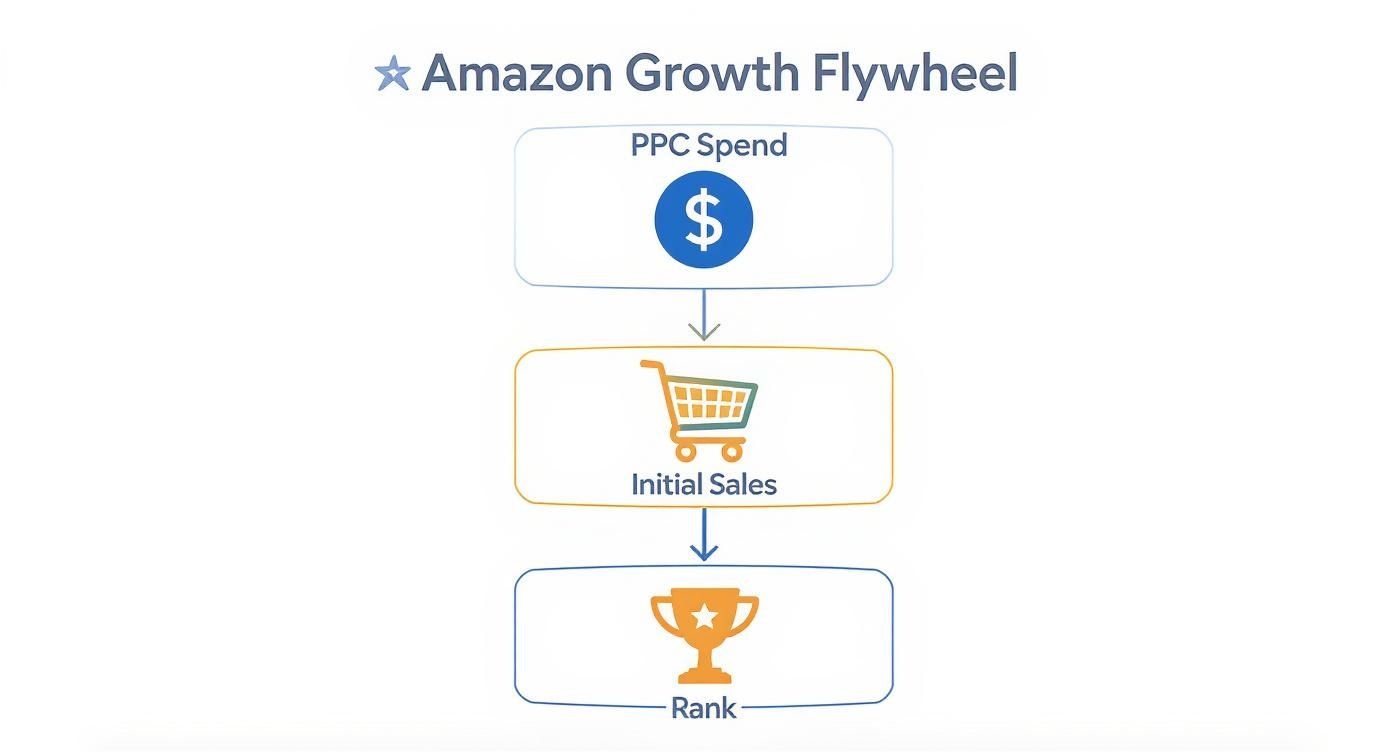
It’s a common mistake to view Pay-Per-Click (PPC) advertising as a simple cost of doing business on Amazon. You spend money, you generate sales. But this transactional view misses the bigger strategic play. A sophisticated PPC strategy, guided by a precise Amazon keyword tracker, is the catalyst for a powerful growth flywheel that links ad spend directly to long-term organic dominance.
Think of it less as an expense and more as an investment in data and sales velocity. When you run ads for specific keywords, you’re buying initial traffic. More importantly, every sale sends a powerful signal to Amazon's A9 algorithm: "This product is highly relevant for this customer search." This initial sales velocity is the primary driver of organic ranking improvement.
The PPC-to-Organic Flywheel in Action
Imagine launching a new product—a premium ergonomic office chair. On day one, with zero sales history, you're buried deep in the search results for your most valuable keyword: "ergonomic office chair for back pain."
Here’s how to ignite the growth flywheel, using an Amazon keyword tracker as your guide:
- Targeted PPC Launch: You launch highly focused Sponsored Products campaigns targeting a curated list of high-intent keywords like "ergonomic office chair for back pain" and "desk chair adjustable lumbar support."
- Driving Initial Sales Velocity: Your ads place your product in front of high-intent shoppers. As the initial sales convert, the A9 algorithm takes note. Each purchase validates your product's relevance for those keywords.
- Monitoring with a Tracker: Your keyword tracker monitors organic rank for the exact keywords you're targeting with ads. You can watch your product climb from page 10 to page 5, then to page 3, providing a direct feedback loop on your PPC effectiveness.
- Organic Lift Creates a Halo Effect: As organic rank improves, you earn "free" clicks and sales, reducing your dependency on paid traffic for that keyword. This sustained organic velocity reinforces your product's relevance, creating a self-perpetuating cycle of growth and profitability.
A targeted PPC campaign acts as a launch vehicle for your organic ranking. It provides the initial thrust needed to escape the low-visibility "gravity" of a new product and achieve a sustainable orbit of high-volume, free traffic.
This process demonstrates that PPC and SEO on Amazon are not separate disciplines; they are two interconnected levers for growth. Your paid advertising directly fuels your organic visibility. Without a keyword tracker, you're merely hoping your ad spend builds long-term value. With one, you can measure the direct ROI of your PPC investment on your organic position. For any brand serious about building a defensible market position, mastering how to improve Amazon ranking via this flywheel is non-negotiable.
Key Features Your Keyword Tracker Must Have
When evaluating an Amazon keyword tracker, it's easy to get lost in feature lists. The objective isn't to find the tool with the most options, but the one that delivers the sharpest, most actionable intelligence—the kind that translates raw data into profitable decisions. A sleek dashboard is worthless if it doesn't drive performance.
A strategic keyword tracker does more than report your daily rank. It functions as your command center for market intelligence, mapping the competitive landscape and pinpointing exactly where you need to focus your resources. This is the core of the Amazon Growth Flywheel: using ad spend and keyword strategy as the initial push to create a virtuous cycle of sales velocity and enhanced organic visibility.
To power this flywheel, your tracker must be equipped with specific, high-impact features. Let’s cut through the noise and focus on the must-haves that distinguish a basic tool from a strategic asset.
The table below outlines the essential features and their direct impact on your brand's growth and profitability.
Essential Amazon Keyword Tracker Features and Their Business Impact
| Feature | What It Does | Strategic Business Impact |
|---|---|---|
| Historical Rank Data | Logs your keyword ranking over weeks, months, and years. | Pinpoint seasonal trends, measure the true impact of ad campaigns, and diagnose performance drops by correlating them with market events. |
| Competitor Tracking | Monitors the keyword rankings of your top competitors' ASINs. | Identify competitor weaknesses, spot emerging threats, and benchmark your performance to set realistic and aggressive growth targets. |
| High-Frequency Updates | Provides ranking updates on an hourly or daily basis. | React instantly to market changes, adjust bids in near real-time, and capitalize on opportunities before competitors can respond. |
| Search Volume Metrics | Shows estimated monthly search volume for each keyword. | Prioritize your optimization and ad spend on high-traffic keywords that offer the best ROI, ensuring your budget is spent effectively. |
| Keyword Index Checker | Verifies if Amazon's algorithm has associated your ASIN with a specific keyword. | Instantly confirm if your listing optimizations are working and quickly troubleshoot why your product isn't appearing for target search terms. |
Each feature provides a critical layer of intelligence, transforming your tracker into a comprehensive tool for strategic decision-making.
Historical Rank and Trend Analysis
Knowing your rank today is insufficient. To make intelligent strategic decisions, you need context. A top-tier Amazon keyword tracker must provide deep historical data, allowing you to analyze performance over quarters and years. This elevates your tracker from a simple reporting tool to a powerful forecasting asset.
By analyzing historical trends, you can execute sophisticated strategic plays:
- Anticipate Seasonal Shifts: Identify precisely when consumer demand for your product category begins to rise or fall, enabling proactive inventory planning and ad budget allocation.
- Measure True Campaign ROI: Obtain a clean before-and-after analysis of rank changes following a major PPC campaign or listing overhaul, definitively proving the value of your marketing initiatives.
- Diagnose Performance Issues Rapidly: If your rank drops unexpectedly, you can review historical data to pinpoint the exact moment the decline began and correlate it with competitor actions or market shifts.
Competitor Tracking and Benchmarking
On Amazon, your performance is always relative to the competition. A strategic keyword tracker must provide a 360-degree view of the competitive landscape, monitoring your rivals’ ASINs with the same diligence as your own.
This competitive intelligence is where significant opportunities are found. A competitor slipping on a high-volume keyword is your signal to increase PPC bids and capture their market share. A new seller rapidly ascending to page one demands an immediate analysis of their strategy.
A great keyword tracker enables you to play chess, not checkers. It helps you anticipate competitor moves and counter them strategically, rather than reacting after you've already ceded ground.
Leading tools now offer incredible granularity, with rank updates as frequent as every hour and historical data archives spanning up to two years. This level of data is necessary to identify micro-trends and accurately benchmark your growth against the category leaders. By constantly measuring your performance against the competition, you gain a clear understanding of what it takes to win. Tracking the top Amazon keywords in your category is essential, and a robust tracker provides the data needed to capture—and defend—those crucial positions.
Turning Keyword Data Into Growth Strategies
A powerful Amazon keyword tracker will deliver a wealth of data, but raw numbers alone don't drive revenue. The value is unlocked when you translate that information into decisive, profitable actions. This is the bridge between your dashboard and the real-world maneuvers that separate market leaders from the pack.
It’s about evolving your tracker from a passive reporting tool into a proactive growth engine. You must learn to read the signals the market is sending and respond with precise adjustments to your listings and advertising campaigns.
From Diagnosis to Action
Think of your keyword tracker as a diagnostic tool for your brand's health on Amazon. If a key metric is underperforming—for instance, you're stuck on page two for a high-conversion keyword—the data has identified the problem. Your job is to prescribe the treatment.
For a product struggling to break onto page one, the solution is typically a combination of listing optimization and a targeted PPC offensive:
- Optimize Your Listing Content: Is your primary keyword present in the title? Are relevant long-tail keywords integrated into your bullet points and description? A quick audit often reveals low-hanging fruit that is suppressing your rank.
- Launch a Tactical Ad Campaign: Deploy a Sponsored Products campaign bidding aggressively on that specific keyword. This drives immediate, relevant traffic, signaling to Amazon’s A9 algorithm that your product is a strong match for the search, which in turn helps lift your organic rank.
Data tells you the what and the where—rank is declining for a specific keyword. Strategy is determining the why and the how—analyzing competitor actions, adjusting PPC bids, and strengthening your listing to reclaim your position.
Making Offensive and Defensive Plays with PPC
Your keyword tracker is your playbook for making smarter, more tactical PPC decisions. It allows you to move beyond a "set it and forget it" approach and actively manage your ad spend based on real-time market dynamics.
A core part of this is identifying high-traffic, high-conversion keywords. This is mission-critical, as roughly 70% of Amazon searches are for generic, non-branded products, and nearly 85% of clicks go to the top three organic results. Some tools even display search volumes directly in Amazon's search bar, providing instant intelligence. By focusing your efforts on the terms that matter most, you maximize your impact. You can discover more insights about how Amazon search volume works and its strategic importance.
This data enables you to run specific plays:
- Defensive Bidding: Your tracker confirms you hold the #1 organic spot for a profitable keyword. You can then place a strategic ad at the top of the search results for that same term. This "brand fortress" strategy reinforces your position, pushes competitors further down the page, and defends your most valuable digital real estate.
- Opportunistic Offense: Your tracker alerts you that a key competitor's rank for "waterproof hiking boots" has dropped from #2 to #7. This is your trigger. Immediately increase your PPC bids on that keyword to capture the traffic they're losing and capitalize on their weakness.
Ultimately, a keyword tracker isn't for passively observing your own performance. It’s for identifying competitor vulnerabilities and market gaps to create new growth opportunities. This proactive, performance-first mindset is what transforms data into a sustainable competitive advantage.
How to Measure Your Keyword Tracking ROI

You've invested in an Amazon keyword tracker. How do you prove its value to the business? To justify the cost and secure future budget, you must connect the data it provides directly to your bottom line.
Senior leaders and stakeholders aren't concerned with a rank improvement from #5 to #3. They care about financial impact. This requires moving beyond tactical metrics and focusing on KPIs that demonstrate tangible enterprise value. The objective is to prove your keyword tracker is not an expense, but a profit center that enables smarter, more efficient capital allocation across your entire Amazon operation. Before measuring ROI, however, you must know how to track your keyword rankings effectively.
Building a Dashboard for the C-Suite
Forget overwhelming spreadsheets. The key is a clean, executive-level dashboard that translates keyword data into the language of business: revenue, profitability, and market share. Your goal is to tell a clear story of growth and efficiency that validates the tool’s value.
Your dashboard should be built around three core pillars:
- Total Organic Rank Value: Calculate the "paid equivalent" of your organic traffic. How much would you have to spend on PPC to generate the same sales you currently receive from organic rankings? This metric assigns a clear dollar value to your organic performance.
- Blended ACoS (TACoS): This is the ultimate efficiency metric. It measures your total ad spend against total sales (paid and organic). A declining TACoS—even with flat or increasing ad spend—is definitive proof that your advertising is successfully lifting organic sales and improving overall profitability.
- Keyword-Specific Share of Voice (SoV): This KPI measures market dominance. SoV quantifies the percentage of time your product appears in the top search results for a critical keyword. Tracking this metric shows precisely where you are gaining or losing market share against key competitors.
Using Share of Voice to Quantify Growth
Share of Voice (SoV) has become a critical performance indicator for brands serious about category leadership. Why? Because the data is clear: research indicates that products achieving an SoV of 20% or more for their primary keywords can experience a sales lift of 30–50%. Conversely, brands falling below a 10% SoV often struggle to gain meaningful traction.
The narrative for leadership should be clear and compelling: "Our investment in this keyword tracker enables us to optimize PPC, which boosts our organic rank, which in turn lowers our blended ACoS and grows our market share—all leading to more profitable, long-term growth."
This framework shifts the conversation from operational cost to strategic investment. By connecting keyword data to high-level business metrics, you provide undeniable proof of ROI and secure the resources needed to continue scaling.
Putting Your Data-Driven Amazon Strategy Into Action
We’ve established that an Amazon keyword tracker is the backbone of any performance-focused strategy. Now, it’s time for execution. Possessing data is one thing; activating it to make intelligent, profitable decisions is what drives real growth.
Scaling on Amazon requires the right tools paired with the right strategy. This is where you operationalize the connection between PPC campaigns and organic ranking, ensuring every action is part of a virtuous cycle. You're not just managing tactics; you're building a repeatable system where every ad dollar is a strategic investment and every listing update is a calculated move to capture market share.
The objective isn't merely to track keywords—it's to own them. A winning strategy uses data to build a competitive moat around your products, making it exponentially harder for competitors to displace you.
Take a critical look at your current operations. Are you truly leveraging PPC as a lever for organic growth? This performance-first mindset is essential for winning on Amazon today. The tools provide the map, but expert strategy is what gets you to your destination.
Frequently Asked Questions
Even with a clear strategy, practical questions arise during implementation. Here are answers to some of the most common queries we hear from mid-to-senior eCommerce leaders about using an Amazon keyword tracker effectively.
How Often Should I Check My Amazon Keyword Rankings?
The required frequency depends on the keyword's strategic importance. For your most valuable "money" keywords—especially during a product launch, a major promotion, or a holiday peak like Prime Day—daily monitoring is critical. This allows for near real-time reaction to competitor moves and market shifts.
For the remainder of your keyword portfolio, a weekly check-in is sufficient for trend analysis and maintenance. Leading tools offer automated alerts for significant rank changes, ensuring you're notified of major shifts without having to live in the dashboard.
Can a Keyword Tracker Help with Off-Amazon Marketing?
Absolutely. The data from an Amazon keyword tracker is a rich source of customer intelligence. It reveals the precise language your customers use at the point of purchase, which is invaluable for optimizing Google SEO, paid search campaigns, and even social media content.
By aligning your messaging with these high-intent search terms, you can improve the performance and efficiency of your entire marketing funnel and ensure brand consistency across all channels.
What Is the Biggest Mistake Brands Make with These Tools?
The single biggest mistake is "data hoarding"—collecting vast amounts of ranking data without translating it into action. A keyword tracker is a diagnostic tool, not a historical archive.
Passively observing rank fluctuations is not a strategy. High-performing brands use this data to ask "why?" and then test hypotheses. If a rank drops, they investigate competitor actions, review listing changes, and adjust PPC bids accordingly. The goal is to build a repeatable process for turning insights into profitable action.
Ready to turn keyword data into a profitable, scalable Amazon strategy? The experts at Headline Marketing Agency combine advanced tools with hands-on expertise to connect your PPC spend directly to organic growth. Partner with us to dominate your category.
Get Your Free Amazon PPC Audit
Discover untapped growth opportunities and see how our data-driven approach can improve your ROAS.
Get Free Audit →Ready to Transform Your Amazon PPC Performance?
Get a comprehensive audit of your Amazon PPC campaigns and discover untapped growth opportunities.