Amazon Kindle Daily Deal Guide for Buyers and Authors
Learn how Amazon Kindle Daily Deal works, how to find and buy deals, and how authors can nominate titles and measure whether a promotion pays off.

You've found a discounted Kindle book, but the offer page includes other editions, related titles, and recommendations at full price. Or you're on the publishing side, weighing whether a burst of discounted sales will improve your bottom line. The Amazon Kindle Daily Deal looks simple from either side. The useful question is whether you're buying the right book or generating profitable demand.
For readers, that means checking the edition, price, and deadline. For authors and publishers, it means treating the promotion as a short price experiment, not celebrating a sales spike before accounting for royalties, advertising, and displaced full-price purchases.
What Kindle Daily Deal Is and How It Runs
Kindle Daily Deal is Amazon's recurring promotion that temporarily discounts selected eBooks, traditionally through a single-day featured offer. Its original format makes the mechanics easy to understand.
According to TeleRead's account of the launch, Amazon introduced Kindle Daily Deal on August 24, 2011, featuring Kate DiCamillo's The Miraculous Journey of Edward Tulane at $1.39 instead of $5.59, a 75% discount for a 24-hour period. The promotion reset at approximately midnight Pacific Time.
Think of a bookshop's single-day table of marked-down titles, replaced each morning. The book hasn't permanently moved into the bargain section. The seller has temporarily lowered the price to encourage readers to try it.
One title, one price, one clock
The launch established the essential comparison: standard price, promotional price, percentage saving, and expiration window. Those details let readers distinguish a meaningful offer from a book that has a low everyday price.
Buyers and publishers approach that same listing differently:
- For readers, the discount reduces the financial risk of trying an unfamiliar author or genre.
- For authors, the temporary offer creates an opportunity to attract readers who weren't buying at the standard price.
- For publishers, the fixed window makes the promotion easier to evaluate separately from ordinary trading.
Amazon also supported the launch through its website and social channels, making discovery part of the proposition rather than leaving readers to stumble across a reduced price.
Practical rule: A Daily Deal is a temporary offer, not a permanent repositioning of the book's value. Judge it by the additional demand it creates, not the discount alone.
How to Find and Buy a Kindle Daily Deal
Find the featured offer, verify it, and complete the purchase before its displayed deadline. Don't assume every book on a deals landing page carries the advertised discount.
The purchase process starts with locating the actual Kindle offer.
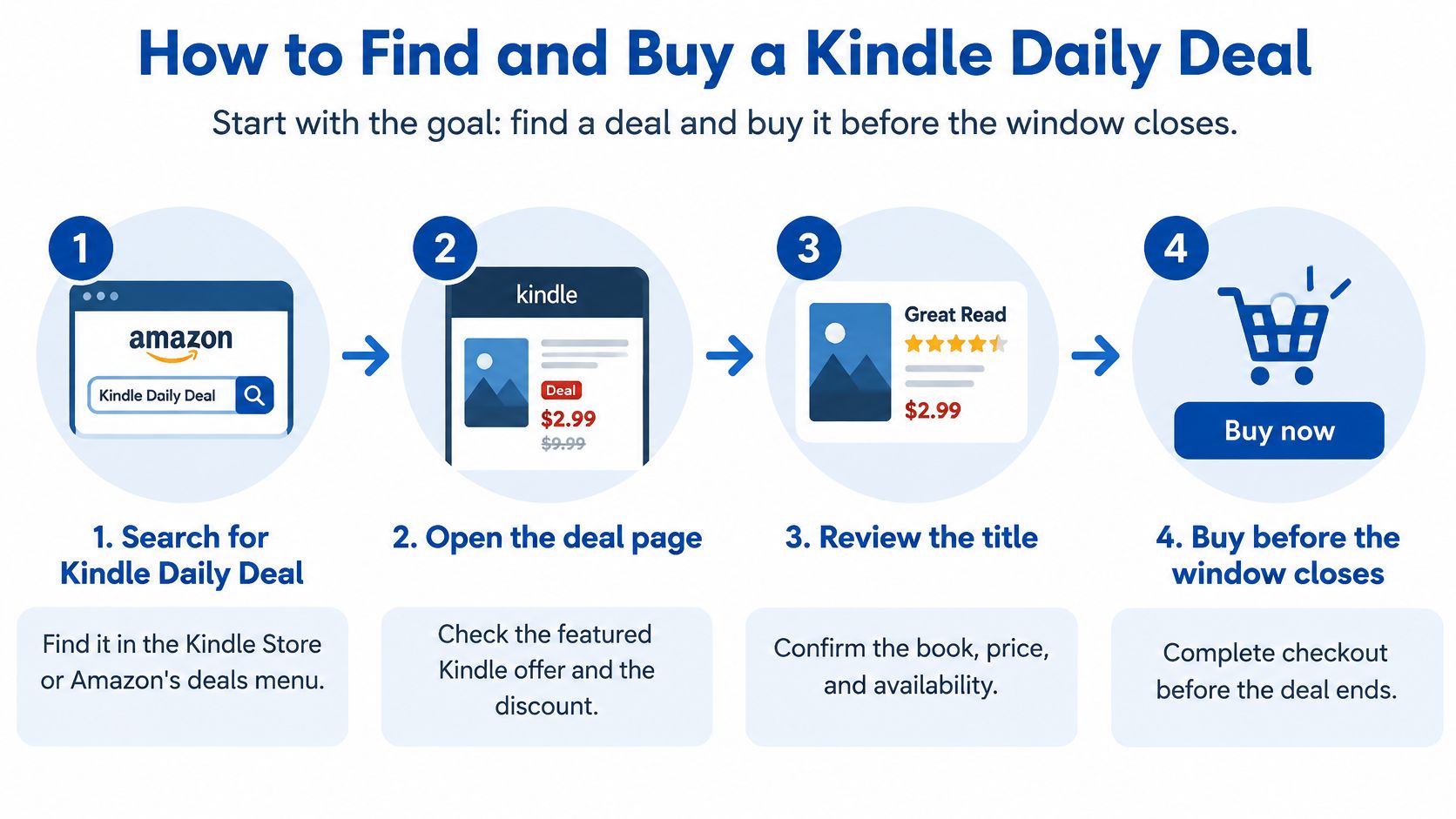
Search for Kindle Daily Deal. Use the Kindle Store search or Amazon's deals navigation rather than relying on an old bookmark, because the former Daily Deals page has moved. Open the current featured offer, not just the first recommended book.
Compare the actual prices. Check the promotional price against the standard price shown on the listing. A large savings percentage doesn't make a book useful to you, so consider what you'd willingly pay for that particular title.
Read the displayed deadline. Check the offer's countdown or expiration text before leaving checkout until later. Use the live listing as your authority, especially when shopping across marketplaces or time zones.
Confirm the edition. Make sure you've selected the Kindle eBook, not a paperback, hardcover, or audiobook linked from the same product page. Switching formats can change the price and remove the advertised offer.
Check the series position and sample. Read the description and open the sample before buying a sequel. A discounted later installment may be a poor starting point if you haven't read the earlier books.
Use the account connected to your reading app. Complete the purchase while signed into the account you normally read with, then refresh or sync your Kindle library. Check the account before assuming that a missing book means the purchase failed.
Verify the purchase, not just the banner
A common slip is selecting a related-title banner and assuming the discount follows you. It doesn't establish that the newly selected book has the same offer.
Before confirming payment, match the title, author, edition, and final price. Afterward, check the order confirmation and open the book in your reading app.
A successful purchase has a clear outcome: you were charged the deal price, the correct book appears in your library, and you can start reading. If any of those checks fails, resolve it before buying another edition.
Deal Types Compared Side by Side
Amazon promotion types compared
| Promotion | Price effect | Duration | Key requirement |
|---|---|---|---|
| Kindle Daily Deal | Discounted price, featured for one day | 24 hours | Amazon selection following nomination; 70% royalty option in the US |
| Kindle Deals | Discounted price shown beside the standard price | One day to several weeks | 70% royalty option for US KDP titles |
| KDP Select Countdown Deal | Discounted price with royalty | Scheduled promotion within the enrollment period | KDP Select enrollment; Amazon.com and Amazon.co.uk only |
| KDP Select Free Book Promotion | Free download | Up to five days per 90-day enrollment | KDP Select enrollment; eBooks only, not audiobooks |
Amazon's Kindle Deals documentation describes promotions lasting one day to several weeks, with standard and promotional prices displayed together, and generally requires the 70% royalty option for US KDP titles. Royalties are calculated from the discounted selling price, making the actual proceeds per copy central to the decision.
Separately, Amazon's KDP Select guidance permits Free Book Promotions for up to five days per 90-day enrollment, limits Countdown Deals to Amazon.com and Amazon.co.uk, excludes Amazon.co.jp, and states that audiobooks aren't eligible for either promotional tool.
Choose the outcome before the mechanism
A free promotion removes the purchase price for readers. That can support audience acquisition, but a free download isn't paid demand and shouldn't be recorded as equivalent revenue.
A paid discount asks a different question: will enough additional readers buy at the lower price to justify the reduced proceeds per copy? For a series publisher, subsequent purchases may matter. For a standalone title, the featured book may need to carry more of the financial result itself.
Match the mechanism to:
- Format, because eBook promotional eligibility doesn't automatically extend to audio.
- Marketplace, because a tool available in one storefront may not serve your whole audience.
- Objective, distinguishing reader acquisition from immediate contribution profit.
The operational discipline resembles a flash sale on Amazon: define the offer, prepare the listing, align advertising, and isolate the promotional window. However, don't assume that similarly named promotions offer identical placement or control.
A free day and a paid discount are different tools, not interchangeable versions of the same sale. Choose the one whose economics fit the result you need.
How Authors Qualify for a Nomination
Nomination is a request for selective merchandising, not a guarantee that Amazon will feature your book. Prepare a credible candidate before treating the promotional calendar as confirmed.
Separate eligibility from recommendations
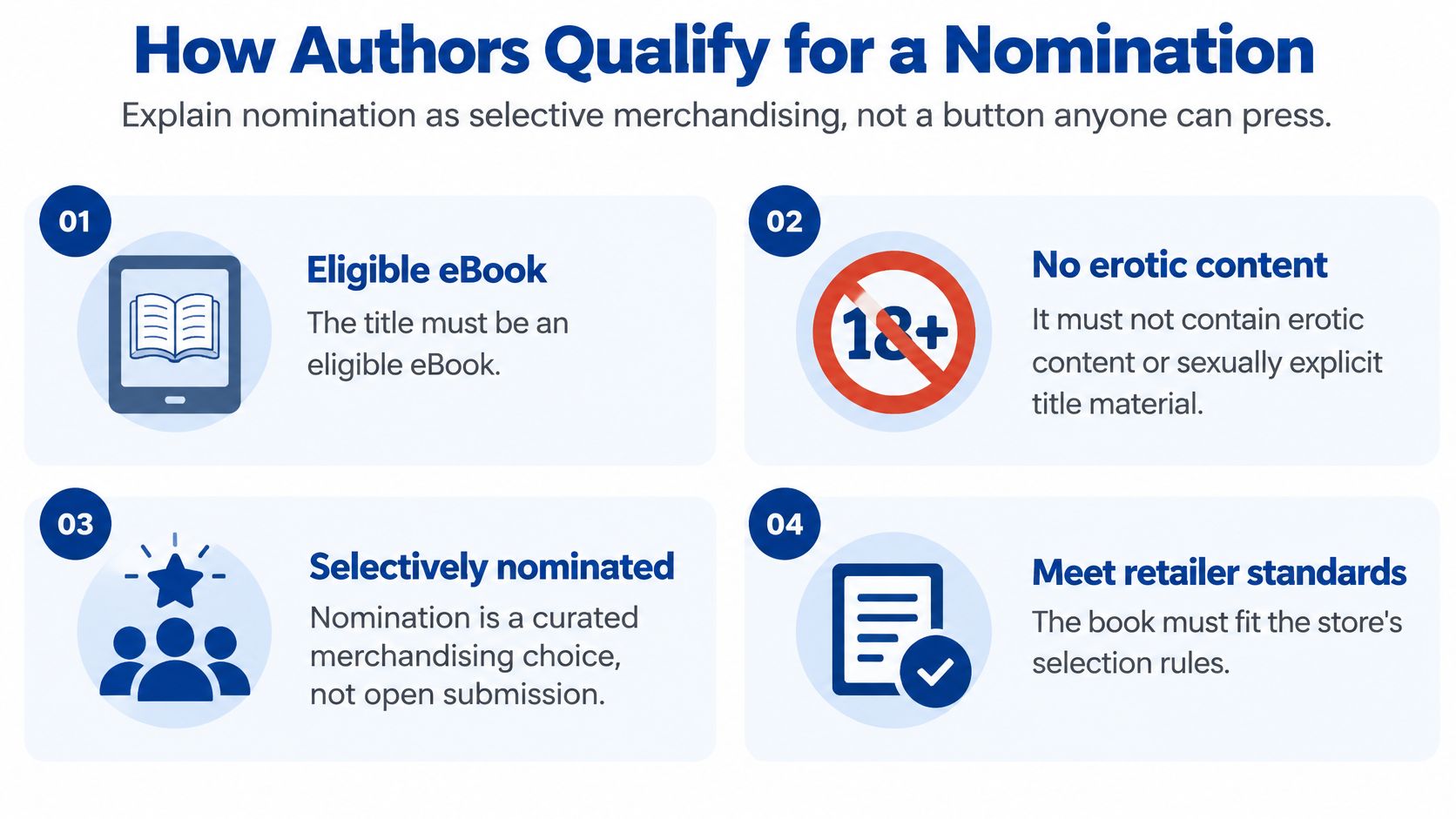
Use Amazon's Kindle Deals nomination requirements to check the title:
- Eligible format: The title must be an eligible eBook.
- Content restrictions: It must exclude erotic content and sexually explicit title language or images.
- Language and availability: It must be available in at least one marketplace where the book's primary language matches the title language.
- US royalty enrollment: US titles must use the 70% royalty option.
- Recommended history and pricing: Amazon recommends books available for at least 90 days, not featured in a deal during the previous 90 days, and normally priced between $2.99 and $12.99.
The distinction matters: the history and price guidance are recommendations, not grounds for promising acceptance. Passing the checklist makes a title worth evaluating; it doesn't reserve a slot.
Use this visual as a preliminary screen, then verify the detailed requirements in your KDP account.
Submit the strongest commercial candidate
Consider a hypothetical backlist title with four-star reviews, steady sales, and a $9.99 list price. Compare it with a six-week-old release at $2.99 with little review history. The backlist title gives the publisher more evidence of reader demand and more pricing headroom, although neither example predicts selection.
Prepare a short nomination record containing the ASIN, marketplace, normal price, sales history, review profile, previous promotion dates, and proposed reader audience. Review strength, prior sales, broad appeal, and seasonal relevance help you assess whether the commercial case is convincing.
Also inspect the product page before seeking more traffic. If the cover doesn't communicate the genre clearly, starryai's book cover design guide offers a resource for evaluating design options. Cover preparation supports presentation; it isn't an eligibility shortcut.
Nominate proven titles with room to discount, rather than using promotions to compensate for an unclear listing or an untested audience.
Using Deals Without Eroding Full-Price Sales
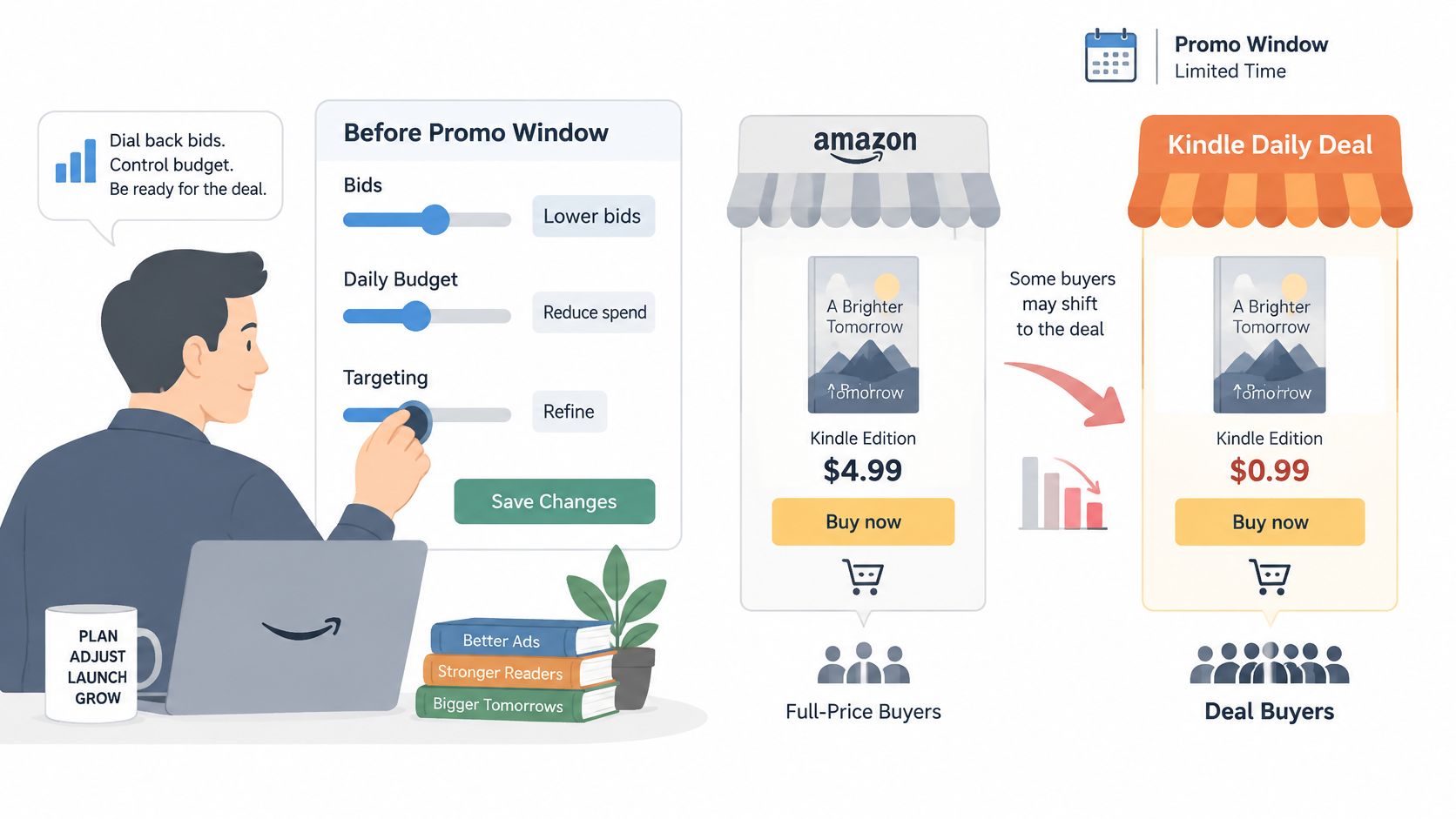
A deal can displace full-price purchases and make existing advertising bids unprofitable, because the same paid click may now generate less royalty contribution. Lower prices aren't permission to leave campaign settings untouched.
Prepare the advertising controls before the promotional price goes live.
Set bids against promotional contribution
Recalculate break-even ACOS using the royalty contribution available at the deal price, not the book's retail price. Match the revenue basis in your calculation to the revenue basis in your advertising report.
- Keep core keywords when they still convert profitably and support commercially useful search visibility.
- Reduce broad-term bids when acquisition cost exceeds the contribution available from a discounted sale.
Our home goods case study recommends monitoring ACOS daily and making quick adjustments. Apply that discipline during the deal, while allowing for reporting and attribution delays.
Avoid discounting the series opener during a full-price sequel launch when doing so would obscure the launch's results. Instead, sequence the acquisition offer so you can assess subsequent purchases separately.
For campaign preparation, use these principles alongside our guide to using Amazon ads to sell books. The accompanying video provides an additional viewing resource.
After the offer, maintain normal campaign support briefly only where contribution remains acceptable. PPC can support visibility while you test whether organic demand persists; it doesn't guarantee a lasting rank improvement.
Repeat the promotion because it improves contribution, not because the sales chart looks better.
Measuring Whether a Deal Pays Off
In a K-lytics analysis of Kindle Daily Deals, featured books averaged a 1,122% increase in units sold on promotion day, some retained sales approximately 209% above baseline for several days afterward, and the observed average discount was 66% for one day. These are directional findings from a limited sample, not a randomized experiment or guaranteed forecast.
Published Daily Deal benchmarks
| Metric | Value | Context |
|---|---|---|
| Launch offer (Aug 24, 2011) | $5.59 to $1.39 | 75% discount, 24-hour window |
| Unit increase on promotion day | 1,122% | Average across featured titles; directional |
| Sales retained after the deal | About 209% above baseline | Some titles, for several days |
| Average observed discount | 66% | One-day window |
The launch row records the historical offer described by TeleRead; the performance rows summarize K-lytics' observed sample. Neither establishes the result your title should deliver.
Calculate contribution, then investigate the lift
Use this working calculation:
Incremental contribution profit = additional units × discounted contribution per unit + post-deal read-through profit − contribution lost from cannibalized full-price sales − promotional opportunity cost.
Include incremental advertising expense in discounted contribution or subtract it separately, but don't count it twice. Also account for reduced proceeds on purchases that would have occurred at full price.
Even a hypothetical 1,000% unit lift can lose money if the discount and acquisition costs consume the additional contribution. Units describe activity; contribution describes whether that activity helped the business.
Track the experiment consistently.
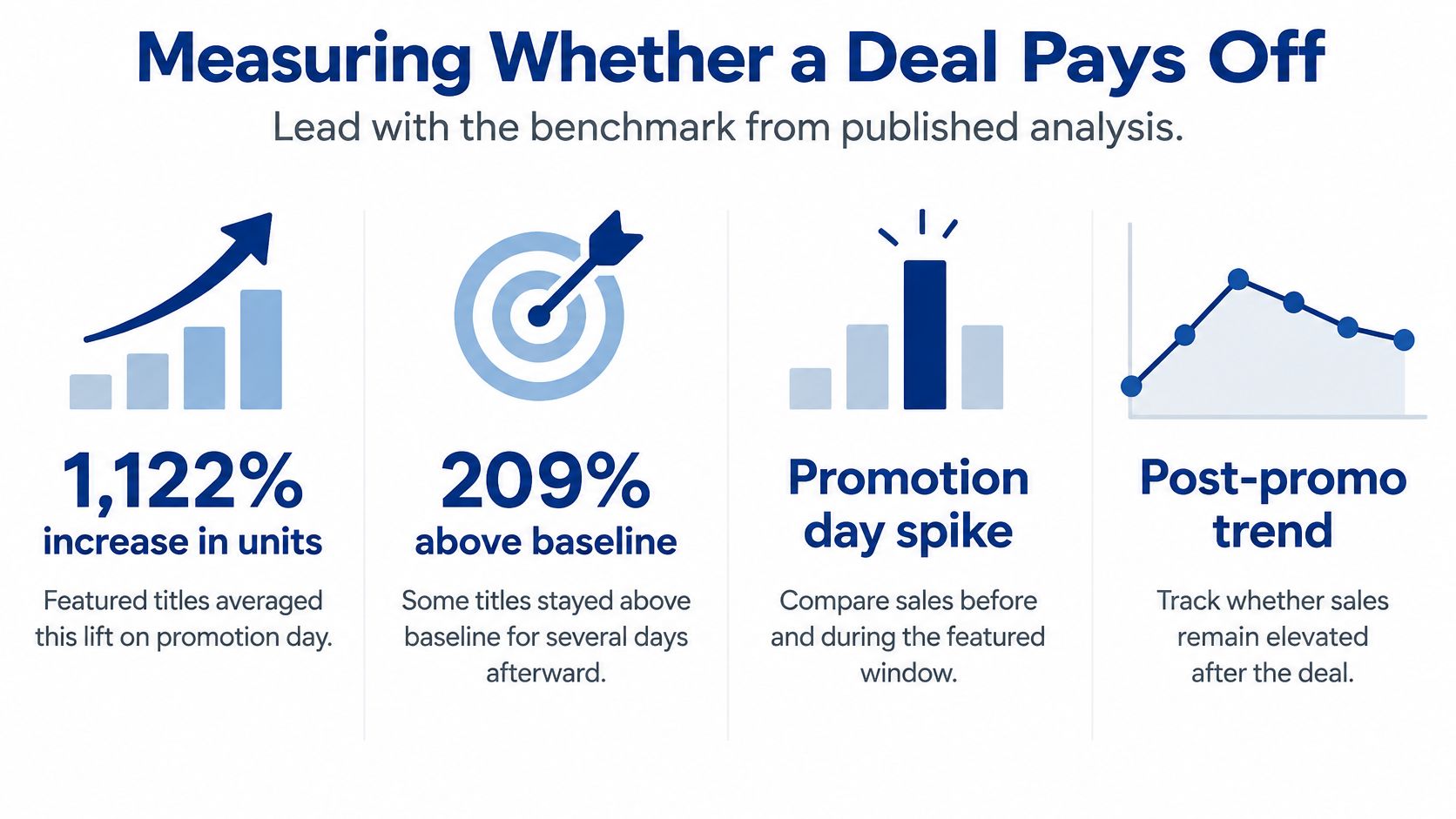
- Establish the baseline. Record ordinary units, conversion rate, sales rank, and related-title read-through using comparable trading periods.
- Isolate the window. Log price, advertising changes, email activity, and other promotions so you don't attribute everything to the deal.
- Measure the aftermath. Track sales decay, restored-price conversion, and subsequent title purchases.
Use Amazon sales rank as a supporting visibility measure, not a substitute for profit. Segment results by genre, historical sales velocity, review strength, and series position to reduce confusion between promotion effects and title selection.
For further pricing preparation, Genesize's guide can help you test which ebook prices sell. Change variables deliberately rather than mixing price experiments with unrelated listing revisions.
For a separate event-volume reference, Based Books' 2025 summer sale report recorded 1,317 free and 1,953 paid Kindle e-book sales, totaling 3,270. That was a different promotion, not a Daily Deal benchmark.
Our approach at Headline centers on contribution margin optimization and profit-based bidding. Revenue and rank help explain results, but neither replaces incremental profit.
Decide Whether to Nominate or Schedule Your Next Deal
Choose between nominating a title for Amazon's consideration and scheduling an eligible self-directed promotion. Don't build a spending commitment around an unconfirmed Daily Deal placement.
Use this decision path:
- Confirm readiness. Check eBook eligibility, content restrictions, language availability, royalty enrollment, publication history, recent promotions, and pricing headroom. Separate mandatory conditions from recommended selection characteristics.
- Record the starting position. Save baseline units, conversion rate, sales rank, and read-through before changing the price or campaigns.
- Choose the right mechanism. Match the promotion to the format, marketplace, and commercial objective. Keep free acquisition separate from paid-discount evaluation.
- Agree on spending controls. Assign an owner for daily ACOS and contribution checks, with explicit rules for reducing bids or limiting spend.
- Make the repeat decision after observation. Use a planned, hypothetical 30-day read-through review as a starting framework, extending it if your readers need longer to finish and purchase another title. Repeat only when incremental contribution is positive.
Headline's view is straightforward: a deal is a short-term lever, while disciplined paid search can help convert temporary discovery into organic demand and sustainable profit. Neither a discounted price nor more aggressive bidding can substitute for a sound contribution model.
Nominate when the title is ready. Schedule when the economics are ready. Headline Marketing Agency is not affiliated with Amazon.
Headline Marketing Agency offers a complimentary Amazon advertising audit, also called the Free Audit, to assess your PPC campaigns. Visit Headline Marketing Agency to request a review of whether your bids, budgets, and profitability targets support your next deal window.
Get Your Free Amazon PPC Audit
Discover untapped growth opportunities and see how our data-driven approach can improve your ROAS.
Get Free Audit →Wollen Sie Ihre Amazon PPC-Performance aufs nächste Level bringen?
Lassen Sie Ihre Amazon PPC-Kampagnen professionell analysieren und entdecken Sie neue Wachstumsmöglichkeiten.