Amazon Sales Rank Explained and How to Improve It
Learn what Amazon sales rank means, how BSR is calculated, what influences it, and how PPC and DSP drive sustainable rank improvement.

You're in Vendor Central or Seller Central, reviewing a product page after a strong promo week. Sales looked healthy. Ad spend was under control. Then you spot it in the product information area: Best Sellers Rank, maybe #2,431 in category. The next question comes fast. Is that good, bad, improving, or irrelevant?
That moment matters because many brand teams still treat Amazon sales rank like a vanity badge. It isn't. It's one of the clearest public signals Amazon gives you about how a product is performing relative to nearby competitors in the same category. Not perfect. Not complete. But useful, especially when you pair it with conversion data, pricing context, and ad performance.
Most confusion starts when teams expect rank to answer the wrong question. BSR doesn't tell you whether a listing is well optimized. It doesn't tell you whether your keyword targeting is efficient. It doesn't tell you whether your margin structure can support more growth. What it does tell you is whether your product is moving through the market fast enough, recently enough, to outrun peers in its category.
That's why brand leaders keep checking it. A rank shift after a retail event, pricing change, or Sponsored Products push can tell you whether demand converted, not just whether impressions rose. It's also why a decent ACOS paired with a weak or slipping rank should make you pause. You may be buying traffic without creating enough sales momentum to improve your market position.
The practical lens is this: Amazon sales rank is best used as a momentum signal. If you read it that way, it becomes far more valuable for decision-making.
Introduction Why Amazon Sales Rank Still Matters for Brands
A lot of brands are dealing with the same tension right now. Traffic is fragmented, ad costs need discipline, and every retail decision has to justify itself against both profitability and growth. In that environment, Amazon sales rank still matters because it gives you a fast read on whether your product is winning actual purchases inside its category.
Amazon calls Best Sellers Rank a category-specific metric shown on product detail pages that compares a product's sales performance against similar items in the same Amazon store category. Amazon also states that the rank is based on all-time sales for an ASIN, with recent sales weighted more heavily than older sales, and that a lower number reflects better sales performance. In plain terms, #1 means top seller in that category. You can review Amazon's own explanation in its guide to Amazon Best Sellers Rank.
That framing changes how you should use BSR in planning meetings. It's not a brand-awareness metric. It's not a creative-quality score. It's not a review score in disguise. It's a market movement signal that tells you whether shoppers are buying your product often enough, and recently enough, to move it up the category leaderboard.
Why leadership teams still watch it
Mid-level operators often look at BSR tactically. Senior leaders usually care about it for a different reason. It compresses a lot of market behavior into a simple indicator you can inspect quickly across ASINs, hero products, and launches.
A few useful applications stand out:
- Portfolio diagnosis: A rank decline can signal fading sales momentum before a broader business review catches it.
- Promo readout: After a pricing event or ad push, BSR can help confirm whether conversion accelerated.
- Competitive context: A strong rank tells you your product is out-selling similar items in the same category, not just attracting traffic.
- Organic growth monitoring: Improving rank often supports stronger retail positioning over time when the underlying demand is profitable.
Practical rule: Don't ask whether a BSR number is “good” in isolation. Ask what changed in traffic, conversion, price, and availability before that number moved.
BSR still matters because it's one of the few visible marketplace signals tied directly to sales performance. Used correctly, it helps brand leaders diagnose momentum, separate vanity from demand, and decide where PPC, content, and retail-readiness can create durable growth.
What Amazon Sales Rank Really Means
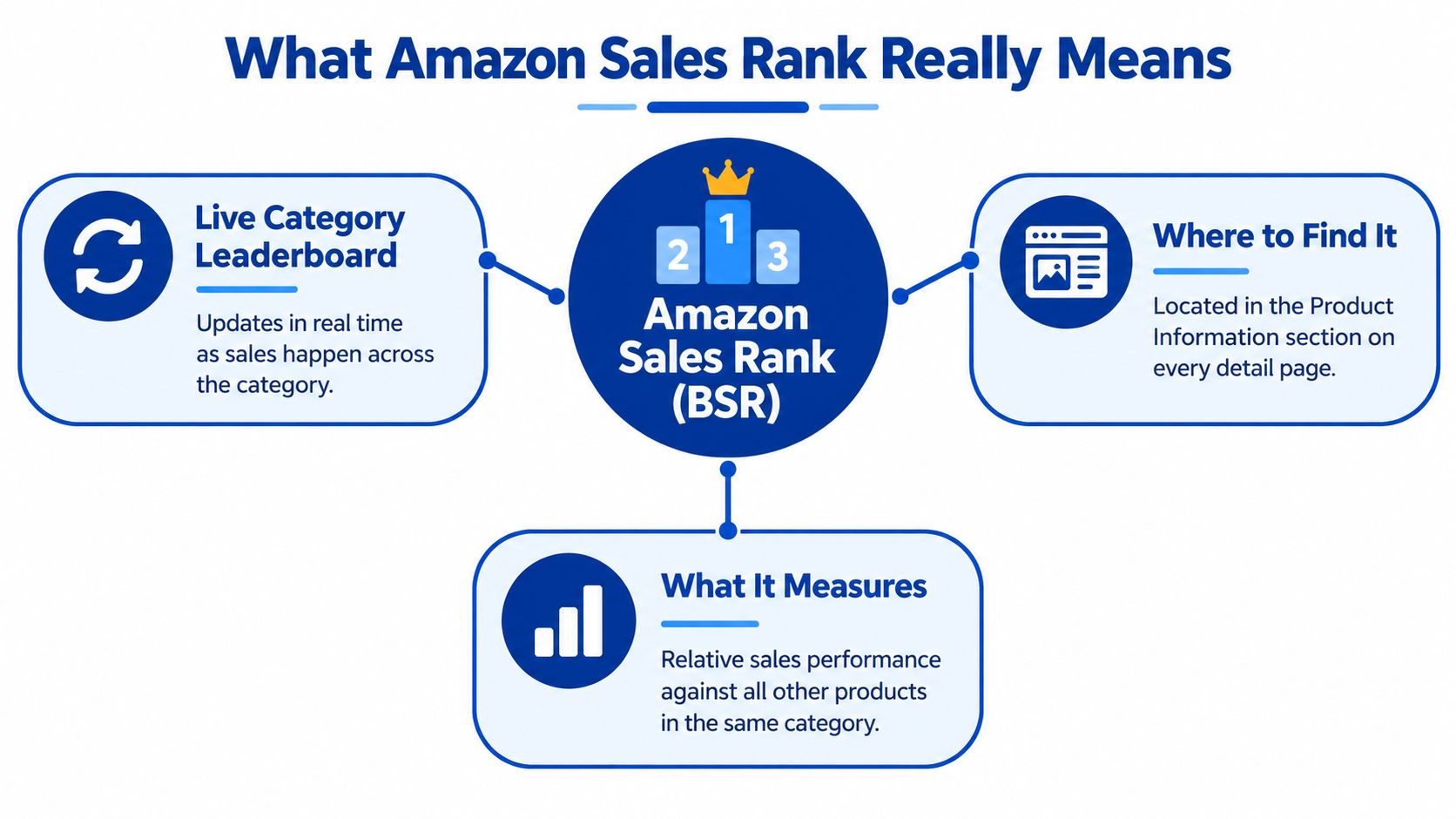
Think of Amazon sales rank as a live category leaderboard. Every time products sell across a category, that leaderboard can reshuffle. Some ASINs move up, others fall back, and the positions keep changing as buying behavior changes.
Amazon shows Best Sellers Rank on the product detail page, and it applies within a specific category rather than across all of Amazon. That's the first point many teams miss. A kitchen product and a beauty product don't sit on the same leaderboard. Each product is judged against similar items in the same store category.
The simplest way to read it
A lower BSR number means stronger sales performance within that category. If an ASIN is #1, it's the top-selling product in that category. If it's further down the list, it's selling less strongly than the products above it.
That doesn't mean the product is weak. It means its relative sales position is lower in that category right now.
Here's where teams often overread the metric:
- BSR is not a quality score. A product can have a solid rank and an average listing, or a polished listing and a poor rank.
- BSR is not a review score. Reviews may affect shopper trust and conversion, but the rank itself reflects sales performance.
- BSR is not universal. A rank only makes sense when you know the exact category context.
If you want a helpful companion read on Amazon demand signal telemetry, that resource is useful because it frames BSR as part of a larger marketplace behavior system rather than a standalone badge.
What it tells a brand leader
BSR is best interpreted as a comparative signal. It answers, “How is this ASIN selling versus similar products in the category?” It does not answer, “How strong is this listing on every dimension?”
That distinction matters when you're making budget calls. If a hero ASIN's rank improves after a traffic push, you've got evidence that shoppers bought. If rank stays flat despite high impressions, your issue may sit in pricing, creative, merchandising, or offer strength.
BSR is most useful when you treat it like market scoreboard data. It tells you who is moving product, not why that product won.
For leadership teams, that's enough to make it valuable. It's a fast check on competitive sales momentum, and it becomes much more powerful when paired with your internal funnel data.
How Amazon Calculates and Updates BSR
Amazon doesn't treat Best Sellers Rank like a static lifetime score. It behaves more like a moving calculation tied to sales history and recent momentum. That's why rank can swing after a promotion, a traffic burst, or a sudden slowdown.
Amazon states that BSR is calculated from all-time ASIN sales, but recent sales are weighted more heavily than older sales. That means two products with similar total unit history can perform very differently in rank if one is generating fresher demand. Amazon documents that weighting in Seller Central's help content on how Best Sellers Rank works.
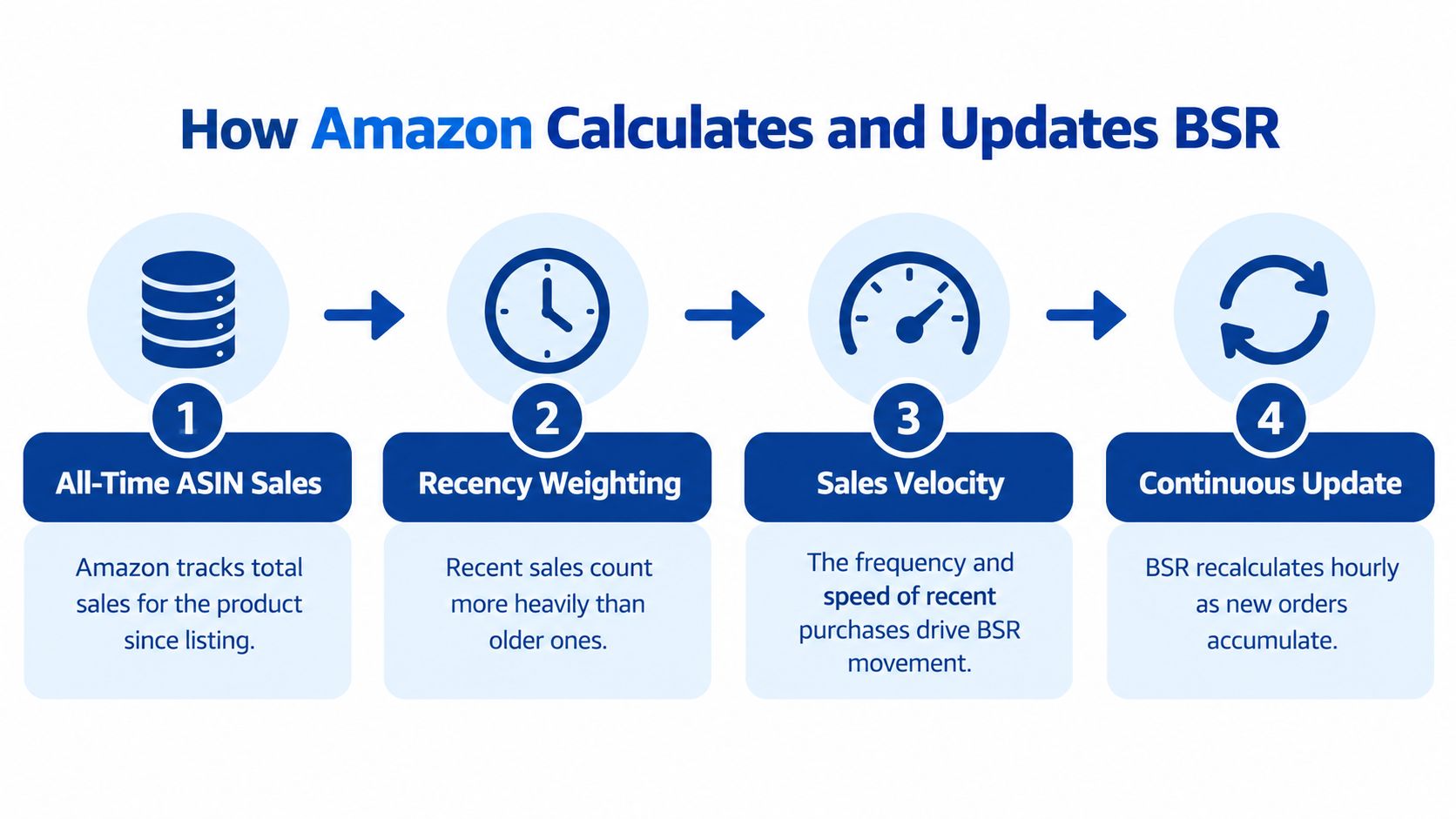
Recency matters more than most teams think
This is the operational takeaway. A concentrated burst of conversions can improve rank faster than the same volume spread thinly over a longer period. If your campaigns produce high-intent traffic that converts now, BSR is more likely to respond than if those same sales arrive slowly and inconsistently.
That's why rank often changes after:
- A sharp promotional window that compresses purchases into a short period
- A well-tuned PPC push that brings in ready-to-buy traffic
- A pricing adjustment that improves conversion quickly
- An inventory recovery after a stock disruption
Older sales still count. They just don't carry the same weight as fresh demand.
Why rank seems to change so often
Amazon-focused documentation and analysis tie BSR's update behavior to a frequent refresh system. Seller Central guidance indicates that the top 10,000 positions are refreshed hourly, positions 10,001 to 100,000 are updated daily, and lower ranks are updated monthly, which helps explain why higher-velocity products can move visibly in near real time. That update structure is noted in Amazon's Seller Central help documentation at Best Sellers Rank update guidance.
Here's the practical read:
| Rank band | Update behavior | What it means for brands |
|---|---|---|
| Top positions | Refresh fastest | Rank reacts quickly to new buying activity |
| Mid-tier positions | Refresh less often | Momentum still matters, but movement may feel less immediate |
| Lower positions | Refresh slowest | Rank changes can lag behind recent traffic and conversion work |
A short explainer video can help make that movement easier to visualize:
What this means for planning
If your team assumes historical sales will “hold” rank, you'll misread the signal. They won't. Fresh sell-through matters.
That's why high-performing Amazon operators don't just chase more traffic. They engineer periods of conversion strength. They align ad pacing, pricing, inventory, and listing quality so that recent purchases stack up when it matters most.
Operational takeaway: When BSR moves after a campaign, read it as a response to recent sell-through, not as a delayed reward for past performance.
Amazon Sales Rank Versus Organic Search Ranking
One of the most expensive mistakes on Amazon is treating sales rank and organic ranking like the same thing. They're related, but they answer different questions.
Amazon sales rank reflects how strongly a product is selling within a category. Organic search ranking reflects where a product appears for a specific shopper query. One is a category outcome. The other is a keyword placement.
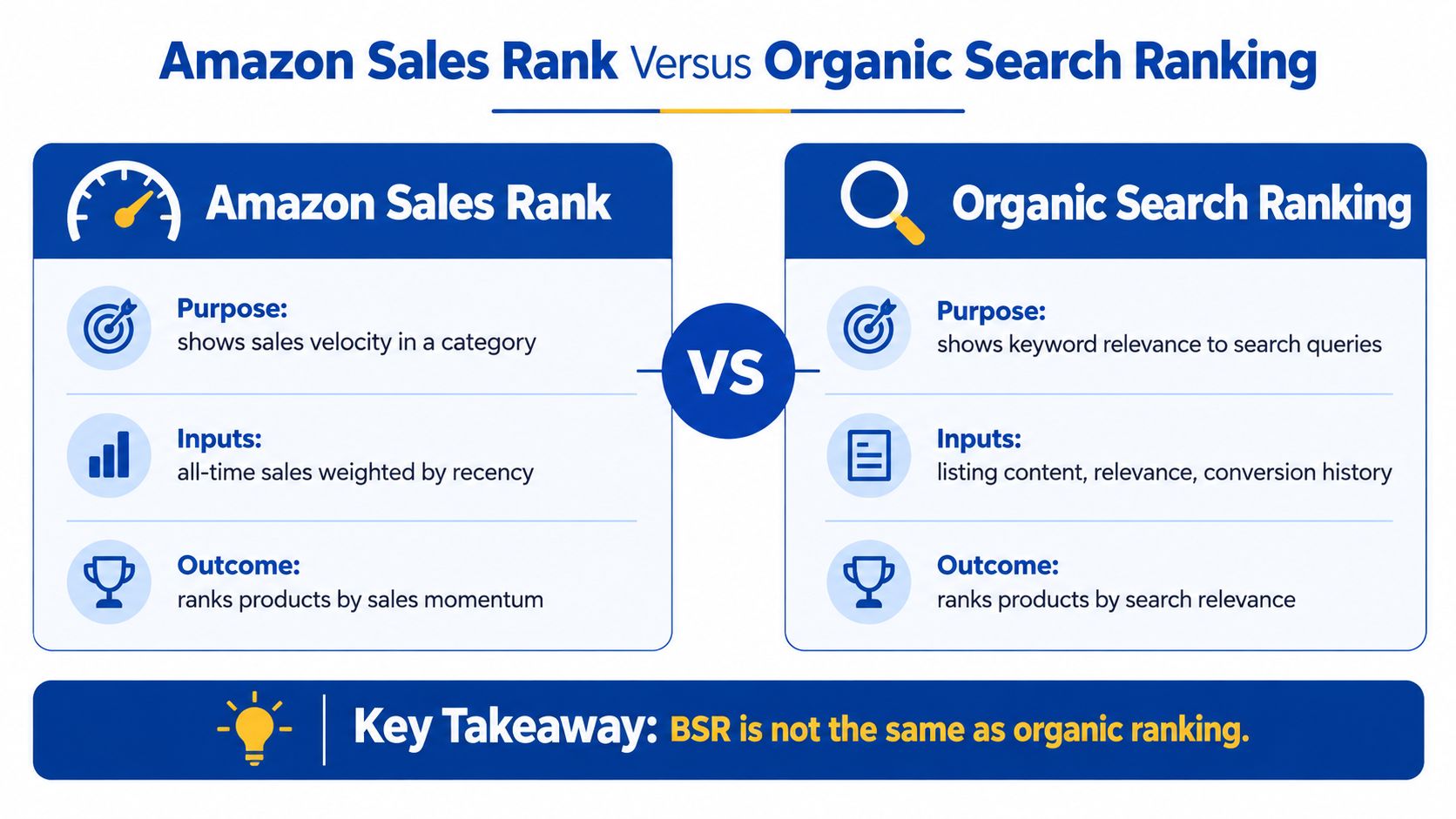
A simple side-by-side view
| Dimension | Amazon sales rank | Organic search ranking |
|---|---|---|
| Primary purpose | Shows category sales momentum | Shows keyword relevance and placement |
| Main frame of reference | Other products in the same category | Other products competing for the same search term |
| What teams usually use it for | Demand diagnosis, category performance, sales momentum | SEO, discoverability, query coverage, content planning |
| Common mistake | Assuming it reflects keyword visibility | Assuming better keyword rank guarantees stronger category sales |
The work required to improve each metric can differ.
A product may have a healthy category rank because it converts well from branded demand, repeat purchases, or detail page traffic. At the same time, it may still rank poorly for important non-branded search terms. The reverse can also happen. A product can show decent organic visibility on some queries but fail to generate enough purchases to climb its category leaderboard.
How they influence each other without being identical
Organic ranking usually depends on relevance, listing quality, and conversion history for a query. BSR reflects sales movement at the category level. They can support each other, but one doesn't automatically fix the other.
For example:
- Better keyword placement can create more traffic opportunities.
- Better conversion from that traffic can create more sales momentum.
- More sales momentum can support stronger marketplace presence overall.
But you still need the right diagnosis. If your product ranks poorly for an important query, you may need content, targeting, and retail-readiness work. If your BSR is lagging, the issue may be broader than search visibility alone.
A rising BSR doesn't prove you own the right keywords. A rising organic keyword position doesn't prove you're winning the category.
That's why mature Amazon teams track both. One tells you how discoverable you are for the terms that matter. The other tells you whether those visibility gains are becoming meaningful category sales.
What Actually Influences Your Amazon Sales Rank
Once you stop treating BSR like a mystery number, the next question is more useful: what can a brand do to influence it?
The short answer is sales. The better answer is sales created by strong retail conditions. Recent research adds an important nuance here. An arXiv study published in late 2024 found that some of the most influential factors in increasing sales rank included the number of “customers also bought” items, “customers also viewed” items, and price across multiple categories, which suggests merchandising and browse architecture matter alongside raw sales activity. That finding appears in the paper What influences Amazon sales rank across categories.
The levers worth prioritizing first
Most controllable BSR drivers fall into four buckets:
- Price and offer strength: If your price is out of step with shopper expectations, traffic won't convert efficiently.
- Conversion architecture: Main image, title clarity, A+ content, mobile readability, and review presentation all affect whether visits turn into orders.
- Browse ecosystem signals: Also viewed and also bought adjacency can improve how shoppers encounter and compare your product.
- Traffic quality: Not all sessions help equally. High-intent traffic is more likely to produce the recent conversions that move rank.
That's why rank improvement often comes from fixing retail basics before scaling media. If the page can't convert, paid traffic exposes the weakness faster.
Prioritizing Factors That Influence Amazon Sales Rank
| Factor | Impact on BSR | Brand Control |
|---|---|---|
| Recent conversion volume | High | Medium to high |
| Price positioning | High | High |
| Listing conversion quality | High | High |
| “Customers also bought” adjacency | High | Medium |
| “Customers also viewed” adjacency | High | Medium |
| Inventory health | High | High |
| Traffic relevance | Medium to high | High |
| Reviews as trust support | Indirect | Medium |
A useful way to work this is in sequence, not all at once.
First, fix pages that leak conversion. If your sessions are coming in but purchases aren't following, start with offer, price, image stack, and clarity. Teams often benefit from a deeper conversion-rate process such as this guide on improving Amazon conversion rate.
Then look at shopper pathways. If adjacent product relationships are weak, your ASIN may be missing browse support even when the listing itself is decent.
Finally, scale traffic once the fundamentals can hold. That includes Amazon media and off-Amazon demand sources that bring qualified shoppers, not just volume.
The strategic takeaway
The contrarian point is simple. BSR isn't moved only by “more sales” in the abstract. It often moves because a brand improves the conditions that allow recent sales to happen faster and more efficiently. Price, detail page conversion, adjacency, and traffic quality all shape that outcome.
For brand leaders, that means the best rank strategy usually starts with retail readiness, not bigger bids.
How PPC and DSP Strategies Move Amazon Sales Rank
PPC should do more than defend branded terms and report back on ACOS. If you use it well, it can become a lever for organic growth, profitability, and scale. That matters for BSR because recent conversion bursts carry more weight than stale sales history.
Sponsored Products, Sponsored Brands, Sponsored Display, and DSP each play a different role in that system. Together, they can create concentrated periods of high-intent demand, improve browse behavior, and strengthen the conversion flow that supports rank movement.
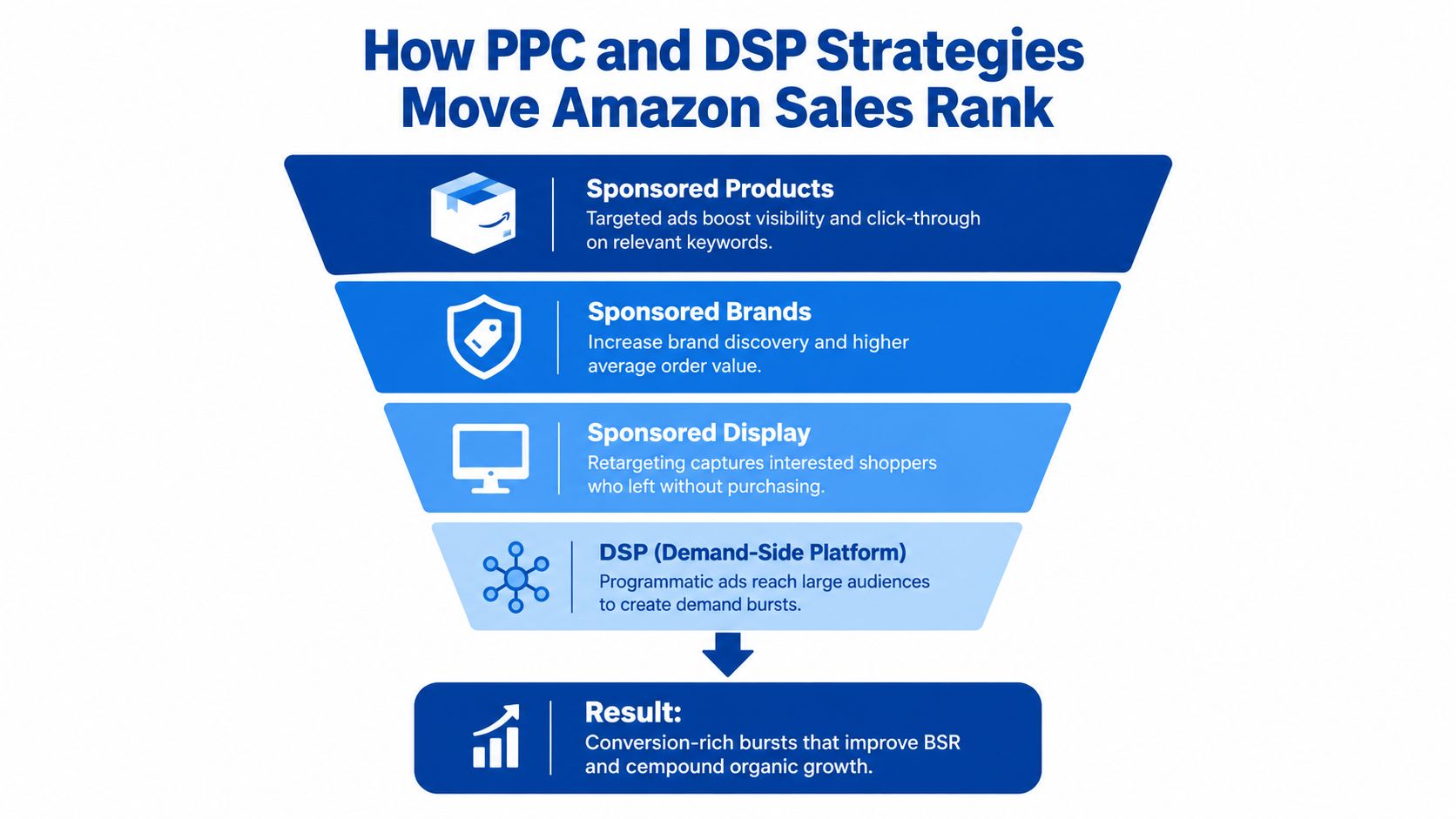
How the ad stack affects momentum
Sponsored Products usually sit closest to immediate demand capture. They help you show up where shoppers are already expressing intent.
Sponsored Brands can shape consideration at the brand level and support basket-building behavior. Sponsored Display can bring back shoppers who showed interest but didn't convert. DSP extends reach beyond immediate in-market traffic and can create broader demand pulses that later show up in branded search, detail page visits, and eventual purchases.
That combined effect matters because BSR rewards recent purchase activity, not passive exposure.
Measure the full funnel, not just the spend
Amazon's Search Query Performance dashboard gives brands a view of query volume, impressions, clicks, add-to-cart activity, and buys at the search-term level for branded products. Amazon's API changelog also confirms related Search Query Performance reporting includes impressions, clicks, cart adds, and purchases for a given ASIN and date range. That makes it one of the best tools for connecting ad strategy to both funnel leakage and organic growth. Amazon documents that capability in its help page for Search Query Performance reporting.
Use that data to ask sharper questions:
- If impressions are rising but clicks are weak, your visibility improved but your creative or placement fit may be off.
- If clicks are rising but cart adds are soft, the listing or offer is likely underperforming.
- If cart adds are healthy but buys stall, price, trust, or competitive friction may be blocking purchase.
Operators stop chasing ACOS in isolation. A campaign can look “efficient” while doing very little to build rank or category share. Another campaign may look less efficient short term but produce stronger blended outcomes if it drives profitable conversion momentum.
Spend that lifts recent conversions profitably is more useful than spend that merely keeps CPC metrics tidy.
A practical sequencing model
A performance-first sequencing approach often looks like this:
- Stabilize hero ASIN conversion first. Don't force traffic into a leaking detail page.
- Use Sponsored Products to capture high-intent demand. This is usually the cleanest path to conversion-rich traffic.
- Layer Sponsored Brands and Display where they support cross-consideration or re-engagement.
- Use DSP to widen demand selectively. It works best when the destination experience is already retail-ready.
- Check funnel movement through Search Query Performance and keyword tracking.
If you want a deeper playbook for that approach, this article on performance-driven PPC for Amazon sales rank is a useful companion. Teams that want outside support can also use platforms or agencies built around this workflow. For example, Headline Marketing Agency works with Search Query Performance, PPC, and DSP datasets to connect advertising decisions to rank, profitability, and organic growth.
The key is discipline. Ads should create better demand economics, not just louder demand.
Myths Measurement and Sustainable Ways to Improve Rank
The biggest BSR myth is that it only updates monthly. That's wrong, and it leads teams to react too slowly. As covered earlier, update speed depends on rank tier, with top positions moving much faster.
The second myth is that reviews or page views directly determine rank. They don't. They may influence shopper confidence and conversion, but BSR reflects sales performance, not attention alone.
How to measure rank without fooling yourself
Track BSR beside business drivers, not by itself. The most useful read comes from pattern matching:
- BSR up with stronger buys: Your demand engine is likely improving.
- BSR flat with higher clicks: You probably have a conversion issue.
- BSR down after stock or price disruption: The decline may reflect retail friction more than failing media.
- BSR improving while margins collapse: You've created momentum, but not sustainable growth.
For day-to-day monitoring, a structured process helps. This guide on how to track Amazon ranking is useful if your team needs a cleaner reporting rhythm across keyword rank and marketplace signals.
Sustainable ways to improve rank
Short-term manipulation isn't the goal. Durable rank improvement usually comes from repeatable execution:
- Run pricing tests carefully: Look for conversion improvement without training the market to wait for discounts.
- Improve retail readiness: Fix image hierarchy, mobile clarity, offer strength, and stock consistency.
- A/B test page elements: Better click-through and conversion improve the odds that traffic becomes recent sales.
- Use deeper analytics where available: Query-level and path-to-purchase insights can help you identify where momentum is being lost.
The no-nonsense takeaway is simple. Amazon sales rank is worth watching, but only if you treat it as a response metric. It rewards brands that create profitable, recent conversions through better pricing, stronger pages, and smarter media. That's the path to lasting marketplace position, not just a prettier number on the detail page.
Headline helps consumer brands connect Amazon PPC and DSP strategy to the outcomes that matter here: stronger conversion, healthier organic growth, and sustainable sales momentum. If you want a more disciplined way to improve rank without losing sight of margin, visit Headline Marketing Agency to see how the team approaches full-funnel Amazon growth.
Get Your Free Amazon PPC Audit
Discover untapped growth opportunities and see how our data-driven approach can improve your ROAS.
Get Free Audit →Ready to Transform Your Amazon PPC Performance?
Get a comprehensive audit of your Amazon PPC campaigns and discover untapped growth opportunities.