How to Improve Your Amazon Conversion Rate with a Profit-First Strategy
Small Amazon conversion rate gains compound into big revenue. Here's the systematic approach we use across 50+ brand accounts.

Improving your Amazon conversion rate isn't about tweaking one-off tactics. It's about building an interconnected growth engine where PPC advertising, listing optimization, and fulfillment work in lockstep to drive profitable scale.
For too long, eCommerce leaders have been told to chase vanity metrics like a low ACOS. The category leaders know better. They use paid advertising as a strategic lever to ignite a powerful flywheel: targeted ad spend drives sales, which improves organic rank, leading to sustainable, profitable growth. This is the shift from renting traffic to building a defensible business asset.
Stop Chasing ACOS—Start Driving Profitable Conversions
Obsessing over Advertising Cost of Sales (ACOS) as the primary KPI is a relic of a simpler Amazon marketplace. A low ACOS is meaningless if your total profit isn't growing. The real objective for any serious brand is to maximize the conversion rate (CVR) to build a scalable, profitable operation. This requires a fundamental shift from isolated tactics to an integrated growth strategy.
Today's marketplace is too competitive for a siloed approach. You can't optimize listings while ignoring ad campaigns, or pour money into PPC without a rock-solid fulfillment strategy. Every component is linked, and each one directly impacts your ability to convert a shopper into a customer. We call this the 'Conversion Flywheel.'
The Conversion Flywheel Explained
The concept is simple but potent: paid advertising is the force that gets the flywheel spinning. Smart, data-driven PPC campaigns deliver high-intent shoppers directly to your optimized product detail pages. This initial sales velocity is a critical signal to Amazon’s A9 algorithm that your product is relevant and desirable.
This flow illustrates how PPC, your listing, and your fulfillment process work in tandem to drive conversions.
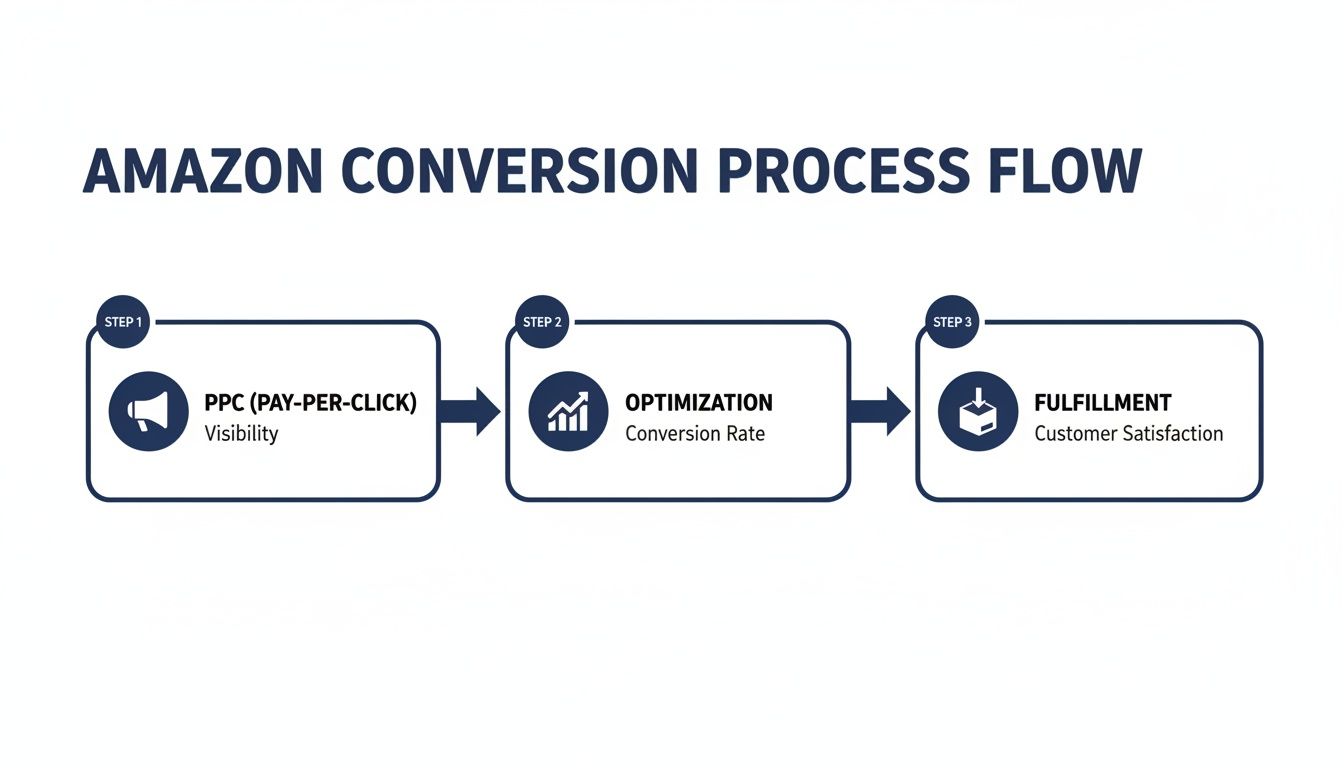
As you can see, each element fuels the next, creating a self-sustaining growth loop.
What's the result? Amazon rewards your sales velocity with improved organic rankings and a better Best Seller Rank (BSR). This organic visibility attracts more shoppers, further increasing sales and conversions. As volume grows, your ad campaigns become more efficient, allowing you to reinvest in PPC with a lower effective ACOS. This is how you transition from just renting traffic to owning your category.
Key Takeaway: A high conversion rate is the foundation of a profitable Amazon business. It lowers customer acquisition costs, increases the efficiency of every ad dollar, and boosts your organic search rank—creating a powerful growth cycle that builds on itself.
To benchmark your current performance, leverage tools like Amazon's Search Query Performance dashboard. This is a goldmine for identifying which search terms are driving impressions, clicks, and, most importantly, sales. It helps pinpoint the exact levers to pull for bottom-line growth. While Amazon-specific data is vital, understanding the broader landscape of general strategies for conversion growth can provide a significant competitive advantage.
Winning on Amazon isn't about chasing a single metric. True success comes from building a resilient, interconnected system where every component works together to drive profitable sales and establish category dominance.
The Prime Badge: Your Most Powerful Conversion Lever
Let's be blunt: if your products don't have the Prime badge, you are strategically choosing to leave sales on the table.
The Amazon Prime badge is the single most effective conversion driver on the platform. For any brand serious about scaling on Amazon, using Fulfillment by Amazon (FBA) is not an option—it's a baseline requirement for competitive performance.
Its power lies in customer psychology. Millions of Prime members are conditioned to expect free, fast shipping and frictionless returns as standard. The Prime badge is a massive trust signal that eliminates purchase friction at the critical moment of decision. Any obstacle, like an unexpected shipping fee or a slow delivery window, is enough to send a shopper to a competitor who offers that seamless Prime experience.
The Data Doesn't Lie
The performance gap between Prime and non-Prime listings is a chasm. Prime members, Amazon's most valuable customer cohort, convert at an astounding 74% on Prime-eligible products—that's over 20 times higher than typical ecommerce conversion rates. Even for general Amazon shoppers, non-Prime listings convert at an average of 10-13%, while Prime-eligible items jump to 18-25%. Top-performing listings can exceed 30%. You can explore these Amazon conversion benchmarks for a deeper dive.
The data is unequivocal. Without FBA, you are invisible to a massive segment of Amazon’s most valuable customers—those who filter for "Prime" before they even begin their search.
Building a Smart FBA Strategy
Simply enrolling in FBA isn't the complete strategy. A data-driven approach is essential to ensure profitability. Not every SKU is a fit for FBA, especially those with challenging size, weight, or margin constraints.
A robust FBA strategy involves several key steps:
- Prioritize Your Winners: Begin by enrolling your best-selling, highest-margin products in FBA. These items have proven demand. Adding the Prime badge will act as a powerful sales accelerant, signaling to the A9 algorithm that your product deserves higher organic placement.
- Model Unit Economics: Before shipping inventory, meticulously calculate your all-in costs, including FBA fees, storage, and potential returns. Use Amazon's FBA Revenue Calculator to model profitability for each SKU and make informed decisions.
- Evaluate Seller Fulfilled Prime (SFP): For brands with sophisticated in-house logistics, SFP can be a viable alternative. However, it comes with extremely strict performance metrics. For most sellers, FBA remains the most direct and manageable path to the Prime badge.
Our Takeaway: View FBA not as a fulfillment cost, but as a strategic investment in your conversion rate. The resulting lift in sales, improved organic rank, and access to Prime shoppers consistently deliver an ROI that far outweighs the associated fees.
Supercharge Your Ad Campaigns with Prime
With your key products Prime-eligible, it's time to integrate this advantage into your advertising strategy. Your PPC campaigns are now driving traffic to product pages that are built to convert at a much higher rate.
This creates a powerful, self-reinforcing loop. A higher CVR improves your ad campaign's relevance score, which can lead to lower Cost-Per-Click (CPC) and better ad placements. You’re no longer just buying clicks; you're investing in sending high-intent shoppers to a frictionless purchase experience. The Prime badge is the fuel, and your ad campaigns are the engine that propels your conversion flywheel forward.
Your Product Page Is Your 24/7 Salesperson—Treat It Like One
Your Amazon product detail page is your most critical digital asset. It's the final conversion point where a shopper decides to buy or bounce. If this page fails to perform, even the most brilliant advertising campaign will fall flat.
Effective optimization goes beyond keyword stuffing. It's about building an irrefutable case for your product by proactively answering every potential customer question. A truly optimized listing doesn't just describe a product; it sells a solution.

Translate Features Into Real-World Benefits
A common mistake is listing product specifications instead of articulating what those specs do for the customer. No one buys a drill bit; they buy a perfectly sized hole. Your bullet points are the prime real estate for this translation.
Mine your customer reviews and the "Customer questions & answers" section to understand the problems customers are trying to solve and the exact language they use.
Consider this example:
- Feature: "10,000 mAh battery."
- Benefit: "All-Day Power for Work and Play: Never hunt for an outlet again. Our 10,000 mAh battery keeps your devices running from your morning commute to your late-night flight."
This simple shift connects the product directly to the customer's needs. We cover more of these copywriting strategies in our full guide to optimize your Amazon product listing.
Let Your Images Tell the Story
Your images must do the heavy lifting of a physical retail experience. A customer can't touch your product, so your visual assets must create that tactile understanding. The goal is to build a complete "image stack" with at least seven high-quality assets.
Structure your image stack like a visual sales pitch:
- The Hero Image: Your main image must be crystal-clear on a pure white background. This is a non-negotiable Amazon requirement.
- Lifestyle in Action: Show the product in its intended environment. A photo of a backpack on a hiker is infinitely more compelling than one on a studio floor.
- Informative Infographics: Use these to highlight key features, convey dimensions, or make competitive comparisons. They deliver complex information in a scannable format.
- Product Video: A short demonstration video is a conversion powerhouse. It shows the product in use and builds a level of trust that static images cannot match.
Pro Tip: Treat your image stack as a storyboard. Each asset should reveal new information or highlight a different benefit, guiding the customer logically toward the "Add to Cart" button.
Go Premium with A+ Content
For brand-registered sellers, A+ Content is a powerful tool for differentiation. It allows you to replace the standard text description with enhanced images, comparison charts, and brand storytelling modules to create an immersive experience. This is where you leave generic competitors behind.
The data supports this. Amazon reports that listings with A+ Content see a 3-5% lift in conversions on average. In our experience, well-executed A+ Content can deliver significantly higher results.
To further expand your brand presence, learning how to create an Amazon Storefront provides a dedicated brand destination that can indirectly boost conversions across your entire catalog.
Never Stop Testing
The most successful brands operate with a mindset of continuous improvement. Your product page is never truly "done." There is always an opportunity to test and optimize for a higher conversion rate.
Amazon’s "Manage Your Experiments" tool is essential for this. It enables data-driven A/B testing of critical listing elements without guesswork. Start by testing the elements with the biggest impact on first impressions:
- Main image
- Product title
- A+ Content layouts
By making data-backed decisions, you systematically enhance your listing's performance over time, turning a good product page into a reliable conversion machine.
Using PPC to Fuel Conversions and Organic Growth
Too many brands view Amazon PPC as a simple expense—a cost center for renting traffic. This fundamentally misunderstands its strategic value. Executed correctly, paid advertising is an investment in momentum and the single most powerful lever for building long-term marketplace dominance.
Think of PPC as the engine that powers your conversion flywheel. It generates the initial sales velocity that signals to the A9 algorithm that your product is a winner. This requires a shift from a defensive, cost-focused mindset to an offensive, growth-oriented strategy. A well-managed ad account doesn't just generate sales; it builds a lasting business asset.
This strategic approach is central to improving your Amazon conversion rate. Paid traffic validates your optimized listings and initiates a powerful cycle of organic growth.
Architecting a Full-Funnel Advertising Strategy
A scattered, "spray and pray" PPC approach is ineffective. To drive meaningful growth, you need a full-funnel strategy that engages shoppers at every stage of their journey, from awareness to purchase. This means orchestrating Amazon's entire advertising suite to work in concert.
- Sponsored Products (Bottom of Funnel): These are your primary conversion drivers. Target high-intent shoppers actively searching for products like yours with specific, long-tail keywords and competitor ASINs to close sales.
- Sponsored Brands (Middle of Funnel): Use this as a brand-building tool. Target broader, category-level keywords to introduce your brand to shoppers who are still in the consideration phase. Drive traffic to your Storefront or a curated landing page.
- Sponsored Display (Top of Funnel & Retargeting): Reach audiences both on and off Amazon. Use it for broad awareness campaigns or, more powerfully, to retarget shoppers who viewed your product but did not purchase, bringing them back to complete the sale.
When these ad types are coordinated, you move beyond fighting for the last click and start building a healthy pipeline of future customers.
Uncovering Actionable Data for Smarter Targeting
Guesswork is the enemy of profitable advertising. Category leaders dig deep into advanced data to find a competitive edge. The days of optimizing solely for ACOS are over; real insights are found in more powerful tools.
The Search Query Performance (SQP) report in Brand Analytics is a game-changer. It provides brand- and ASIN-level data on the exact search terms driving your business, revealing your share of impressions, clicks, and sales for each one. Use it to identify where you're losing ground to competitors and uncover new keyword opportunities.
For brands ready for deeper analysis, Amazon Marketing Cloud (AMC) offers an unparalleled view of the customer journey. AMC allows you to analyze how different ad types influence each other and build custom attribution models to understand what truly drives conversions.
The Headline Takeaway: Your ad data is a roadmap, not a report card. Use tools like SQP and AMC to move beyond basic keyword harvesting and start making surgical, data-backed decisions that leave your competition guessing.
Setting Realistic Conversion Rate Goals
Knowing what "good" looks like is critical. Conversion rates vary significantly by ad type and strategy. Here’s a general framework for performance expectations.
| Scenario | Average CVR | High-Performer CVR | Strategic Note |
|---|---|---|---|
| Sponsored Products (Broad Match) | 6-8% | 10%+ | Captures wider traffic; a good testing ground for new keywords. |
| Sponsored Products (Exact Match) | 10-12% | 14-15% | Targets high-intent traffic; this is where you scale proven keywords. |
| Sponsored Brands | 4-6% | 8%+ | Focuses on brand awareness; CVR is secondary to visibility and brand lift. |
| Sponsored Display (Retargeting) | 5-7% | 9%+ | Re-engages warm traffic; crucial for maximizing customer lifetime value. |
| Seasonal/Holiday Peaks | 20-30% | 30-50% | During high-demand periods like Q4, conversion rates can skyrocket. |
Use these benchmarks to gauge performance, but remember that your specific product, category, and price point are the ultimate determinants.
Igniting the Virtuous Cycle of Growth
This is where all the elements converge. A successful ad campaign creates a virtuous cycle that powers your entire Amazon business.
Every ad-driven sale improves your product's sales velocity—a critical ranking factor for the A9 algorithm. As sales velocity increases, your Best Seller Rank (BSR) improves, and your organic search rankings climb. This newfound organic visibility attracts a fresh stream of shoppers, leading to more "free" sales that don't require an ad click.
This flywheel effect also improves your overall conversion rate. A higher CVR makes your product more attractive to both customers and the algorithm, which in turn makes your advertising more efficient. Your ads convert better, your quality score improves, and your CPC can decrease. You can learn more about building this type of high-performance system through a comprehensive approach to Amazon ads management.
This is how you turn ad spend into a compounding asset. You're not just buying today's sale; you're investing in a higher organic rank that will deliver sales for months and years to come. This is the real path to sustainable, profitable scale.
Building Trust and Credibility Through Reviews
On Amazon, social proof is paramount. A perfect listing, stunning photography, and a brilliant ad campaign will fail to convert if your product lacks positive reviews. Shoppers instinctively look for the star rating before they even read the product title.
This isn't just about collecting 5-star ratings; it's about signaling to both shoppers and the A9 algorithm that your product is a trusted choice. A product with zero reviews is a risk. One with hundreds of positive reviews is a safe bet.
This trust is often the final nudge a hesitant buyer needs to click "Add to Cart," directly improving your Amazon conversion rate.
Securing Those First Critical Reviews
For new products, the initial review acquisition is the biggest hurdle. Ads won't convert as efficiently, and organic traffic will be minimal. A proactive strategy is essential.
Your most valuable tool here is Amazon Vine. By enrolling a product, you provide free units to Vine Voices, a select group of Amazon's most trusted reviewers, who then provide honest, unbiased feedback. While positive reviews aren't guaranteed, a quality product will quickly gain the social proof needed to build momentum.
Actionable Insight: Don't launch passively. Use Amazon Vine to secure your first 15-20 reviews. This is the typical threshold where we see a meaningful lift in conversion rates, making subsequent ad spend significantly more effective.
Managing Your Reputation
Once reviews begin to accumulate, the job shifts to reputation management. This involves monitoring feedback and engaging with customers to protect your brand equity. A negative review is not a crisis—it's an opportunity.
Every potential customer who reads a 1-star review will also see your response. A professional, helpful, and public reply can completely neutralize the negative impact. It demonstrates that you stand behind your product and value your customers, which builds significant trust.
Our process for handling negative reviews:
- Acknowledge the specific issue. Thank the customer for their feedback and validate their complaint.
- Offer a public solution. Propose a remedy, such as a replacement, refund, or technical support.
- Move the conversation offline. Provide a clear path for them to contact your support team for private resolution.
Leverage Your Best Reviews as Marketing Assets
Your best reviews are powerful marketing assets. Don't let them sit passively on your product page. Integrate this user-generated content across all your marketing materials.
Extract compelling quotes and feature them in your A+ Content modules or as text overlays on your secondary images. A real customer highlighting a key benefit is often more persuasive than brand-generated copy. This reinforces your product's value and creates a consistent narrative of trust across your entire listing—a proven method for boosting your conversion rate.
Got Questions? We've Got Answers
When managing an Amazon business, certain questions consistently arise. eCommerce leaders need to know what "good" looks like and which levers will drive meaningful growth. Let's address the most common inquiries we receive.
What’s a Good Amazon Conversion Rate, Anyway?
The honest answer is: it depends. A "good" CVR varies dramatically based on product category, price point, and competitive intensity.
However, as a general benchmark, a target of 10-15% is a strong starting point for most brands. Top-tier sellers with fully optimized listings and advertising can often push CVR north of 20%.
For context, most direct-to-consumer websites are happy with a 1-3% conversion rate. The difference is shopper intent—Amazon is a transactional environment where users arrive ready to purchase.
With Fulfillment by Amazon (FBA), the numbers are even more compelling. Prime members have been shown to convert as high as 74% on products featuring the Prime badge.
Here's our take: Don't fixate on a universal number. The most important metric is your own performance over time. A "good" CVR for your brand is one that is consistently trending upward as you optimize your listings, ads, and operations.
How Much Does Pricing Really Affect My Conversion Rate?
Pricing is one of the most powerful—and sensitive—levers you can adjust. An incorrect pricing strategy has immediate negative consequences.
It’s a delicate balance. Price too high, and you lose the Buy Box to more competitive offers. Price too low, and you destroy your profit margins while potentially signaling low quality to shoppers.
The objective is the sweet spot: a competitive price that preserves a healthy profit margin. Manual price monitoring is impossible at scale, making an automated repricing tool a critical component of any serious strategy. These tools operate within your predefined rules to maintain competitiveness without constant manual intervention.
Beyond automated repricing, consider testing these tactics:
- Psychological Pricing: Does your product convert better at $24.97 versus $25.00? Small adjustments can yield surprising results.
- Coupons and Promotions: Digital coupons are excellent for creating urgency and driving a measurable lift in your session-to-sale ratio.
A smart, data-informed pricing strategy is not a "nice-to-have"; it is essential for winning on Amazon.
Can I Boost Conversions Without Running PPC Ads?
Yes, but it's like building a high-performance engine and refusing to add fuel.
First, the fundamentals must be flawless. Amazon calls this being "retail ready," and it's non-negotiable. This includes:
- Enrolling key products in FBA to secure the Prime badge.
- Optimizing your listing into a conversion-focused asset with compelling titles, bullets, and images.
- Establishing a foundation of positive reviews to build trust.
Executing these steps will undoubtedly lift your organic conversion rate. You will have a perfectly tuned engine.
However, PPC ads are the fuel. They drive a consistent flow of high-intent shoppers to your optimized listing, kicking your sales velocity into high gear. This velocity is a primary signal to the A9 algorithm, which rewards you with higher organic rankings. This creates the powerful flywheel effect where ads boost organic sales, leading to an even better conversion rate over time. The brands that dominate their categories master both their retail readiness and their advertising strategy.
At Headline Marketing Agency, we don't just manage ads—we build conversion flywheels. We leverage advanced data from tools like Amazon Marketing Cloud to architect PPC strategies that fuel organic growth and drive sustainable profit. See how our data-driven approach can help you win your category.
Get Your Free Amazon PPC Audit
Discover untapped growth opportunities and see how our data-driven approach can improve your ROAS.
Get Free Audit →Ready to Transform Your Amazon PPC Performance?
Get a comprehensive audit of your Amazon PPC campaigns and discover untapped growth opportunities.