A Modern Guide to Amazon Ads Management for Profitable Growth
Amazon ads management range from wasteful to transformative. Here's how to tell the difference before signing a contract.

When we talk about Amazon ads management, we're not just discussing bids and budgets. It's the strategic process of planning, executing, and optimizing ad campaigns to fuel sustainable, profitable scale for your brand.
This isn't an expense line item to be minimized. It's a direct investment into the core drivers of Amazon success: your organic ranking, total sales velocity, and the long-term defensibility of your brand in a competitive marketplace.
Rethinking Amazon Ads Beyond Simple ACOS
For years, the gold standard for measuring Amazon ad success was ACOS (Advertising Cost of Sale). The directive was simple: get your ACOS as low as possible. But this treats advertising as a cost center, a fundamental misunderstanding of its power on the platform.
In reality, your ad spend is one of the most potent levers you have to influence the entire Amazon ecosystem in your favor.
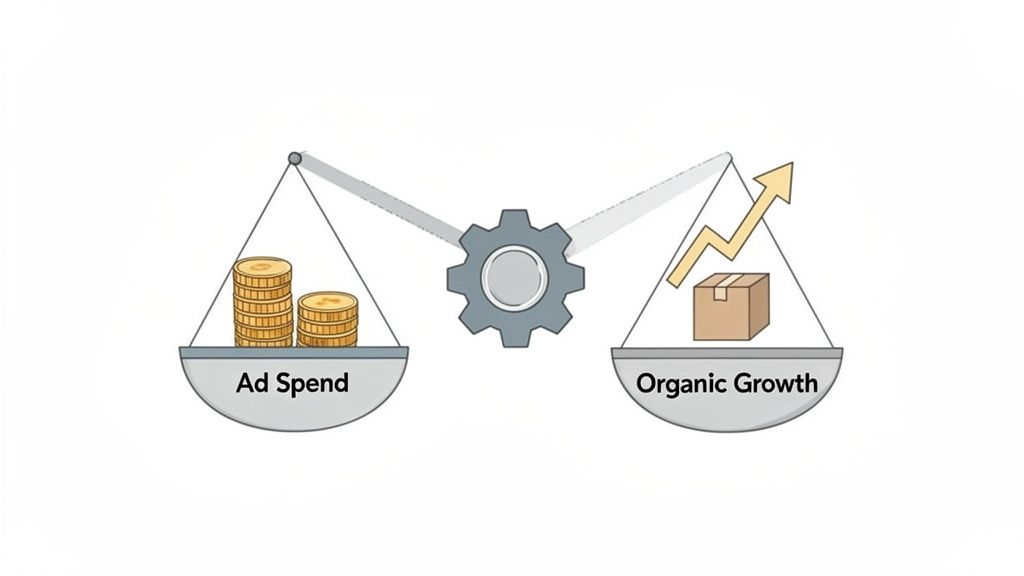
Strategic ad campaigns do more than drive paid sales. They generate the sales velocity that Amazon’s A9 algorithm rewards, boosting your products higher in organic search results. This creates a powerful flywheel: paid ads build long-term, compounding organic visibility. If you're curious, you can learn more about what ACOS means and how it fits into a bigger strategy.
The old playbook is obsolete. A modern, performance-first approach evaluates advertising based on its impact on the entire business, not just one isolated metric.
Old vs New Approaches to Amazon Ads Management
| Focus Area | Traditional Approach (ACOS-Driven) | Modern Approach (Profitability-Driven) |
|---|---|---|
| Primary Goal | Minimize ACOS at all costs. | Maximize Total Profit (TACOS) and organic rank. |
| Ad Spend View | An expense to be controlled and reduced. | An investment to fuel the entire sales flywheel. |
| Campaign Focus | Bottom-of-funnel, exact match keywords. | Full-funnel strategy: awareness, consideration, conversion. |
| Success Metric | Low ACOS. | Growth in total sales, market share, and profitability. |
| Time Horizon | Short-term, immediate returns. | Long-term brand building and sustainable growth. |
Chasing a low ACOS is like trying to win a marathon by only looking at your feet. A modern strategy lifts your head to see the entire race, focusing on building a profitable, defensible brand that wins in the long run.
The Investment Portfolio Analogy
A smarter way to approach your Amazon ad strategy is to view it as a balanced investment portfolio. You wouldn't put all your capital into a single stock. The same logic applies here. Each campaign type—Sponsored Products, Brands, Display—serves a distinct function.
- Sponsored Products (Exact Match): These are your low-risk "bonds." They target high-intent shoppers who know what they want, delivering consistent, efficient conversions.
- Sponsored Brands & Video: Think of these as your "growth stocks." They’re built to capture new-to-brand customers and build awareness among shoppers just starting their search.
- Sponsored Display & DSP: These are your long-term plays. They re-engage past purchasers and reach relevant audiences off-Amazon, building brand loyalty and driving repeat purchases over time.
Judging your entire advertising effort by ACOS is like judging your investment portfolio by the performance of one bond yesterday. It misses the bigger picture of strategic growth.
Key Takeaway: Effective Amazon ads management isn't about achieving the lowest ACOS. It's about deploying your ad budget strategically across the entire customer journey to capture market share, drive total sales, and boost organic performance for long-term profitability.
The Scale of the Opportunity
Understanding this strategic shift is critical, especially when you consider the sheer scale of the Amazon platform. Amazon's ad business isn't a side project; it's a core profit engine that tells you exactly where the competitive battleground is.
In Q1 2024, Amazon's ad revenue surged 24% year-over-year to $11.8 billion. For brand leaders, this means a well-managed ad strategy connects you with an audience of over 310 million active customers. With stakes this high, you can't afford to focus on a single, outdated metric. The objective must be total, profitable growth.
Building Your Amazon Ad Campaigns for Scale
A winning Amazon advertising strategy is built on a rock-solid, intentional structure. Without a well-architected campaign framework, your amazon ads management is a leaky bucket—you'll waste spend, generate messy data, and find it impossible to scale profitably. The goal is to build a system that provides control, delivers clean data, and guides customers from discovery to purchase.
Think of it as an irrigation system for your sales. A disorganized approach sprays the hose randomly, hoping some water hits the plants. A structured approach creates dedicated channels that deliver the right resources to the right place at the right time, minimizing waste and maximizing yield.
This setup ensures every dollar has a clear purpose, whether it's prospecting for new customers or converting high-intent shoppers.
The Full-Funnel Campaign Blueprint
A scalable structure segregates campaigns based on their role in the customer journey. This separation provides clean data and enables precise budget allocation. At its core, a strong setup has distinct campaigns for prospecting (discovery) and converting (performance).
Here’s a practical, performance-first way to build it:
- Sponsored Brands (Top of Funnel): Use these ads to capture broad, category-level demand. Target high-volume, general keywords to introduce your brand to shoppers who may not be familiar with you. The goal is new-to-brand customer acquisition, not a rock-bottom ACOS.
- Sponsored Display (Mid-Funnel): This is where you re-engage shoppers who have shown interest. Retarget users who viewed your products but didn't purchase, or use product attribute targeting (PAT) to place your ads on competitor detail pages to intercept their customers.
- Sponsored Products (Bottom of Funnel): This is your conversion engine. Here, you must separate campaigns by keyword match type to isolate performance and double down on your most profitable search terms.
This layered approach ensures you're not just fighting for the last click. You're building a healthy pipeline of future customers.
Structuring Sponsored Products for Profit
The engine room of your Amazon advertising is how you manage Sponsored Products. A common mistake is lumping all keywords and match types into a single campaign, making optimization impossible. To execute this correctly, you must get granular.
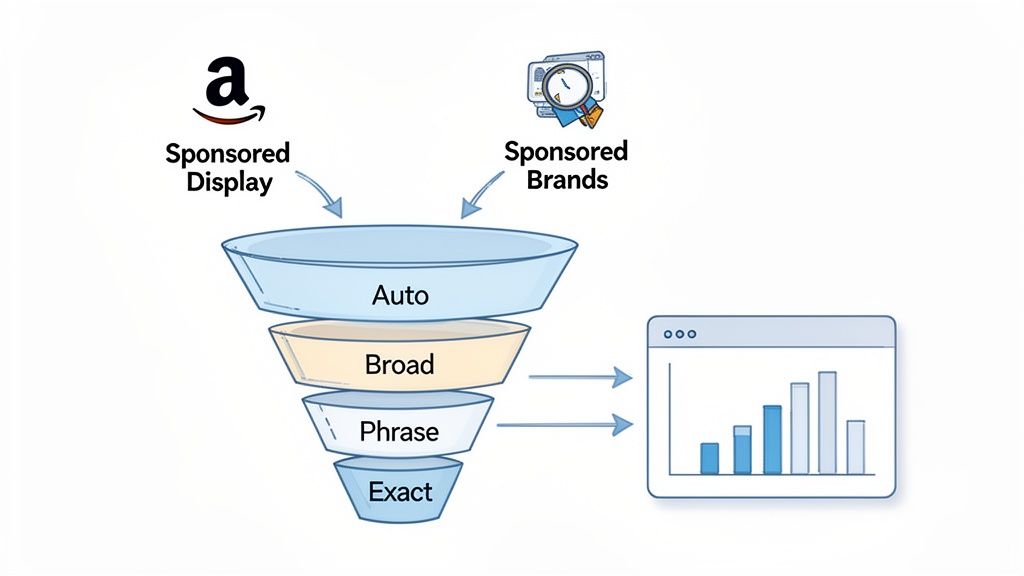
Key Takeaway: The entire game is to systematically "graduate" high-performing search terms from wide-net discovery campaigns into tightly controlled performance campaigns. This is how you transform random search queries into predictable revenue streams.
A proven method is the waterfall approach:
- Auto & Broad Match "Discovery" Campaigns: These are your research labs. Run with lower bids to cast a wide net and identify what search terms customers are actually using. Their primary job is to generate data.
- Phrase Match "Testing" Campaigns: When a search term in your discovery campaigns shows potential (e.g., drives a few sales), graduate it here. This lets you test it with more traffic and a slightly higher bid before committing significant budget.
- Exact Match "Performance" Campaigns: This is the VIP section for your proven winners. Only the most profitable, vetted keywords are promoted here. These campaigns receive your highest bids and the largest budget allocation because you know they convert.
For this system to work, you must execute one more critical step: add the converting terms as negative keywords in their originating discovery campaigns. This prevents your campaigns from bidding against each other and forces budget to flow to the most efficient placement.
This disciplined "keyword harvesting" is the foundation of scalable amazon ads management. It transforms your ad account from a chaotic mess into a predictable, data-driven machine that consistently uncovers new growth opportunities.
Mastering Advanced Targeting and Bidding
With a solid campaign structure in place, the next lever is refining who sees your ads and how much you're willing to pay for that impression. This is where we move beyond basic auto-campaigns and into precision targeting and dynamic bidding. This is the inflection point where you stop spending money and start investing it.
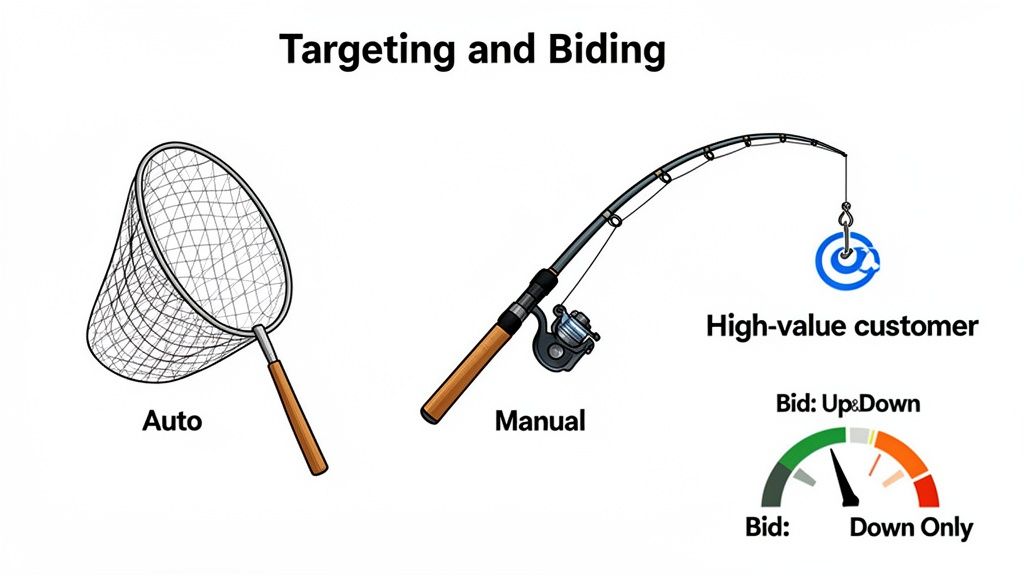
An auto-campaign is like casting a wide net into the ocean. A well-targeted manual campaign is like using high-tech sonar to pinpoint a school of trophy fish. This surgical approach separates brands that struggle for profitability from those that dominate their categories.
Unpacking Your Targeting Arsenal
Amazon provides a deep toolkit for zeroing in on your ideal customer. While keyword targeting is the bedrock of a Sponsored Products strategy, layering in other methods is how you build a full-funnel machine.
- Keyword Targeting: Your bread and butter. You're bidding on search terms people type into Amazon. As covered, splitting these by match type (Broad, Phrase, Exact) is mission-critical for budget control and optimization.
- Product Attribute Targeting (PAT): Ever wanted to place your ad directly on a competitor's product page? This is how. PAT lets you target specific ASINs, categories, or even complementary items. It's a powerful way to intercept shoppers at the point of decision.
- Audience Targeting: This is where you target shopper behaviors, primarily within Sponsored Display and Amazon DSP. You can reach "in-market" audiences (e.g., shoppers browsing for kitchen gadgets), target lifestyle segments, or retarget past purchasers. This is key for building brand awareness and driving repeat business.
Making Bidding Work for You
Your targeting strategy picks who sees your ad; your bidding strategy decides how aggressively you'll compete for their click. Amazon's dynamic bidding options automate this based on conversion likelihood, but you must provide clear instructions.
Your bidding strategy must align with your campaign's objective. A new product launch requires aggressive bidding for visibility. A mature, profitable campaign demands efficiency. There is no one-size-fits-all answer.
Here’s a breakdown of the bidding strategies and their use cases:
- Dynamic Bids - Down Only: The most conservative setting. Amazon will only lower your bid (by up to 100%) if a conversion is unlikely. This is ideal for campaigns where budget protection and ACOS control are paramount.
- Dynamic Bids - Up and Down: This gives Amazon permission to be more aggressive, increasing your bid by up to 100% for top-of-search placements if it predicts a high likelihood of conversion. This is the go-to strategy for product launches, scaling proven campaigns, or aggressively pursuing market share.
- Fixed Bids: Full manual mode. Amazon won’t alter your bids, giving you complete control. This is best reserved for experienced managers running specific tests where they need clean, predictable data without algorithmic interference.
On top of these core settings, use placement modifiers to tell Amazon you're willing to pay a premium for high-value ad real estate—specifically, "Top of search" and "Product pages." For example, a +50% top-of-search placement adjustment signals your intent to win the most visible spot. Mastering these levers is at the core of effective Amazon ads management. For a more detailed look, check out our guide on how to set the right bid on Amazon.
How Ads Fuel Your Organic Growth Flywheel
The most sophisticated brands on Amazon don't view ad spend as a cost. They see it as a direct investment in their organic success. This is the core principle of a modern amazon ads management strategy—using paid traffic to power Amazon's most potent growth engine: the flywheel effect.
This isn't a marketing buzzword; it's a mechanical process. Amazon’s A9 algorithm is designed to sell products. When your ads generate sales, your product’s sales velocity increases. This improves its Best Seller Rank (BSR) and, critically, signals to the algorithm that your product is a relevant result for the keywords that drove those sales.
The result? Your organic ranking for those specific keywords begins to climb. The more you sell, the better you rank, and the more you sell organically. This is how you transform a short-term ad campaign into a long-term, self-sustaining sales asset.
Turning Ad Spend into an Organic Asset
The ultimate goal is to shift from renting traffic to owning your search positions. This requires a deliberate process for identifying keywords that can deliver both immediate ad sales and long-term organic lift. It's a targeted investment strategy for your brand's digital shelf space.
Here’s the actionable playbook:
- Identify High-Potential Keywords: Dive into your Search Term and Search Query Performance reports. You're looking for the intersection of strong ad conversion rates and significant organic search volume. These are your prime targets.
- Launch "Rank" Campaigns: Create dedicated, aggressive Sponsored Products campaigns for these high-potential keywords. For these campaigns, immediate ACOS is not the primary KPI. The objective is to maximize sales velocity through these specific terms to prove your relevance to Amazon.
- Monitor Both Paid and Organic Performance: This is non-negotiable. You must track not only ad sales but also how your product's organic rank for the target keywords changes over time. Daily rank tracking tools are essential here.
- Sustain the Push: Maintain aggressive bidding on these campaigns until you secure a top organic spot (ideally in the top 3-5 positions). Once that rank is stable, you can strategically reduce the ad spend and allow your new organic visibility to carry the load.
This approach elevates advertising from a sales channel to a strategic weapon for category domination.
Key Takeaway: The flywheel effect is about using paid ads to "teach" Amazon's algorithm that your product is the best solution for a customer's search. Once the algorithm learns this, it rewards you with high-converting organic traffic, reducing your long-term dependency on paid media.
Measuring the Ad-Driven Flywheel
To validate that your ad spend is building a long-term asset, you must look beyond ACOS and ROAS. Tracking the interplay between paid and organic performance is essential.
This table outlines the essential metrics for measuring your ad-driven organic growth.
Ad-Driven Flywheel Performance Metrics
| Metric | What It Measures | How Ads Influence It | Target Goal |
|---|---|---|---|
| Organic Rank for Target Keywords | Your product's position in non-paid search results. | Increased sales velocity from ads signals relevance to the A9 algorithm, boosting organic rank. | Top 1-5 position for your most valuable keywords. |
| Total Sales Velocity | The total units sold over a period (paid + organic). | Ads provide the initial sales burst needed to get the flywheel spinning and attract organic buyers. | Consistent, upward trend week-over-week. |
| TACOS (Total ACOS) | Total ad spend divided by total revenue (paid + organic). | As organic rank improves, total sales grow, making ad spend a smaller percentage of overall revenue. | A decreasing TACOS while total sales are increasing. |
| Organic vs. Paid Sales Ratio | The proportion of sales from organic discovery vs. paid placements. | A successful flywheel strategy shifts this ratio heavily toward organic sales over time. | A steadily increasing percentage of organic sales. |
Monitoring these indicators provides a clear picture of your return on investment, not just in immediate sales, but in the sustainable health of your brand on Amazon.
Mini Case Study: Ad Spend vs. Organic Rank
Consider a real-world example from a client in the competitive home goods category targeting the keyword "bamboo cutting board." Initially, they were buried on page three of the search results.
- Week 1-2: We launched an aggressive exact-match "rank" campaign for this single keyword. We accepted a higher ACOS as part of the investment. By consistently securing the top-of-search ad placement, ad-driven sales for that term increased by 300%.
- Week 3: Organic movement began. Their rank for "bamboo cutting board" jumped from position 34 to 18. The sales velocity from ads was directly influencing the algorithm.
- Week 4-5: We maintained pressure. Organic rank climbed to position 7. At this point, organic sales for the keyword began to appear, adding more fuel to the flywheel.
- Week 6: The product achieved organic position #3. With the objective met, we began to strategically dial back the ad bid for that keyword, allowing the powerful new organic rank to sustain sales.
This demonstrates the direct, causal link between a calculated ad investment and a far more valuable prize. It's not just about the next sale; it's about strategically buying the data and velocity needed to win the most valuable real estate on Amazon: the top of organic search. This is the essence of advanced amazon ads management.
Finding Your Rhythm: How to Optimize and Report on Your Ads
Amazon advertising is not a "set it and forget it" channel. It's a dynamic system that requires constant monitoring and adjustment. Think of yourself as the captain of a ship, making continuous small course corrections to stay on the path to profitability.
Without a regular optimization cadence, you're flying blind. You'll waste budget on underperforming campaigns and, more critically, miss opportunities to scale your winners. A disciplined routine transforms raw data into intelligent, actionable decisions. It allows you to see beyond a single metric like ACOS and understand the why behind your performance, ensuring every ad dollar is accountable.
Your Weekly Performance-First Workflow
Your weekly check-in is tactical. This is where you make the granular adjustments that maintain campaign efficiency and respond to market dynamics. Consistency is the most important factor. Block out dedicated time for this every week to prevent small issues from becoming major budget drains.
Here’s your weekly action plan:
- Analyze Search Term Reports: This is non-negotiable. Comb through these reports to find new, converting search terms that actual customers are using. Graduate these winners into your manual campaigns as part of your keyword harvesting strategy.
- Implement Negative Keywords: Just as crucial is identifying irrelevant, budget-wasting search terms. Add these as negative keywords to your auto and broad match campaigns. This single action immediately stops inefficient spend and sharpens your targeting.
- Adjust Bids: Evaluate keyword performance against your target ACOS or TACOS. Are some keywords profitable but under-exposed? Increase bids. Are others burning cash without converting? Decrease bids. These data-driven micro-adjustments compound over time.
This weekly rhythm is what keeps your campaigns getting smarter, sharpening their focus and maximizing the value of your ad spend.
Your Monthly Strategic Review
If the weekly check-in is about tactics, the monthly review is about strategy. This is your opportunity to zoom out, assess the big picture, and ensure your advertising efforts are aligned with broader business objectives. Is advertising supporting your new product launch? Are you gaining market share against key competitors?
This is where you measure the flywheel effect—your ads should be fueling a cycle of growth that extends far beyond paid clicks.
This simple flow—Ads drive Sales, and Sales improve your organic Rank—is the engine we’re building. The monthly review is how you measure its velocity and determine how to make it spin faster.
Here's what your monthly strategic review should cover:
- Flywheel Performance: Are ad-driven sales translating into higher organic rankings? Track your organic position for top keywords alongside ad spend to validate the strategy.
- Budget Allocation: Analyze performance across different campaigns, ad types, and products. Is it time to shift budget from mature Sponsored Products campaigns to a top-of-funnel Sponsored Brands video campaign?
- Creative A/B Testing: Review the performance of your ad creative—headlines, video assets, and primary images. A 1% improvement in click-through rate (CTR) can have a massive downstream impact. Use this data to inform your next round of creative tests.
The Takeaway: A disciplined reporting cadence is the backbone of successful Amazon ads management. It provides the framework for making data-driven decisions, transforming your ad account from a cost center into a predictable, scalable growth engine.
For any ecommerce leader, this routine is essential for accountability. It's how you prove that ad spend isn't just generating clicks but is building a stronger, more profitable brand on Amazon. For guidance on creating dashboards that matter, learn more about building effective pay-per-click reports.
How to Choose the Right Amazon Ads Partner
Selecting the right partner to manage your Amazon ads is a critical business decision. This isn't about outsourcing a task list; it's about onboarding a strategic extension of your team. The wrong partner fixates on vanity metrics like ACOS. The right one is obsessed with your profitability and market share.
You need a partner who thinks like a business owner, not just an ad console technician. They must speak the language of total profitability (TACOS), organic rank, and sales velocity. Every ad dollar must be tied to a business outcome, fueling the growth flywheel.
What an Expert Partner Actually Looks Like
A top-tier agency operates far beyond the standard Amazon Ads dashboard. They bring a deeper, data-driven perspective that is impossible to achieve with surface-level reports.
Look for a partner who demonstrates expertise in these key areas:
- Advanced Analytics: Do they leverage data from Amazon Marketing Cloud or Search Query Performance reports? This is a clear signal they operate on a higher strategic level, uncovering insights your competitors are missing.
- A Full-Funnel Plan: A true partner doesn't just manage Sponsored Products. They architect a comprehensive strategy that integrates Sponsored Brands, Display, and DSP to guide customers from initial awareness to repeat purchase.
- A Laser Focus on Profit: Every conversation and report should be anchored to total sales and profitability, not just ad metrics. They understand that a low ACOS is meaningless if the business isn't growing profitably.
The Tough Questions You Need to Ask
When vetting potential agencies, you must cut through the sales pitch to understand their operational depth. Go into these meetings armed with direct, no-nonsense questions:
- How do you measure and report on the impact of ad spend on our organic ranking and total sales (TACOS)?
- Can you walk me through a specific example of how you used Search Query Performance data to inform a client's strategy?
- What is your process for systematically A/B testing ad creative, copy, and targeting?
- How do you architect a strategy that connects top-of-funnel investments (like DSP or Sponsored Brands) to bottom-of-funnel conversions?
The Headline Takeaway: The right Amazon ads management partner doesn’t just run campaigns; they build a competitive moat for your brand. They are strategic operators dedicated to your long-term, profitable growth. Choosing an agency is an investment in your brand's future—ensure their goals are aligned with your bottom line.
Frequently Asked Questions About Amazon Ads
Let's cut to the chase. Here are quick, no-nonsense answers to the questions I hear most often from e-commerce and retail leaders about managing their Amazon ads.
What Is a Good ACOS for My Campaigns?
This is the most common question, but it's also a trick question. There is no universal "good" ACOS. The right target depends entirely on your product's profit margin and the strategic objective of a given campaign.
For a new product launch, a high ACOS of 40-60% might be a smart investment to generate crucial initial sales, reviews, and data to feed the flywheel. For a mature, best-selling product, you would likely target a much lower ACOS, perhaps 15-25%, to maximize profit on each ad-driven sale.
A better question for a business leader to ask is, "What is our target TACOS?" This measures your Total Advertising Cost of Sale (ad spend / total revenue), providing a true picture of how advertising impacts overall business profitability.
How Much Should I Spend on Amazon Ads?
Your ad budget should not be an arbitrary number. It must be tied directly to your business goals. A common starting point for brands is to allocate 10% of their total Amazon revenue to advertising. However, this should be treated as a baseline, not a rigid rule.
A more strategic approach is to budget according to objectives:
- Aggressive Growth/Launch: If you are launching new products or aiming to steal market share, a more significant investment in the 15-25% range may be necessary.
- Profitability Focus: For established products with strong organic rank, a more conservative budget of 5-8% may be sufficient to maintain momentum and defend your position.
The key is to view your budget as a dynamic tool, ready to be scaled up for winning campaigns or pulled back from underperforming ones based on real-time data.
Effective Amazon ads management treats the budget as a dynamic tool. It's not about how much you spend, but how effectively you allocate every dollar to drive total business growth, not just ad-driven sales.
How Long Does It Take to See Results?
You will see immediate data like clicks and impressions. However, the meaningful results that come from strategic optimization take time to materialize.
Plan for an initial 30 to 60-day period to gather sufficient data to identify reliable trends and make confident, data-backed decisions. This "learning phase" is critical. It's when you discover which keywords truly convert, what bid levels are effective, and how shoppers are responding to your creative. Patience during this initial period is essential for building a profitable, long-term strategy.
Ready to move beyond basic metrics and build a truly profitable advertising strategy? The experts at Headline Marketing Agency use advanced analytics and a performance-first approach to drive sustainable growth for brands on Amazon. Learn how we can help you scale.
Get Your Free Amazon PPC Audit
Discover untapped growth opportunities and see how our data-driven approach can improve your ROAS.
Get Free Audit →Ready to Transform Your Amazon PPC Performance?
Get a comprehensive audit of your Amazon PPC campaigns and discover untapped growth opportunities.