What Does ACOS Mean? An Amazon Profitability Guide
Obsessing over ACOS meaning alone costs brands real profit. Our framework considers the full profitability picture.

Let's break down one of the most critical metrics in Amazon advertising: ACoS, or Advertising Cost of Sales.
At its core, ACoS tells you how efficiently your ad dollars are converting into sales. It’s a simple percentage that shows the direct relationship between what you spend on ads and the revenue those ads generate.
Think of it as the foundational health check for your Amazon PPC campaigns. But treating it as just a number to lower is a rookie mistake. For senior leaders, ACoS is a strategic lever to pull for either profit maximization or aggressive market share capture.
The ACoS Formula: Simple Math, Big Implications
Calculating your ACoS is straightforward. There's no complex algorithm, just direct math that gets right to the point of campaign efficiency.
The formula is:
ACoS = (Ad Spend ÷ Ad Revenue) × 100
For example, if you spend $84 on a Sponsored Products campaign and it generates $300 in sales, your ACoS is 28%.
This means for every dollar in revenue generated by that ad, you invested 28 cents in advertising. It’s a direct, no-fluff measure of efficiency. At Headline, we’ve seen brands transform their profitability by moving beyond a surface-level understanding of ACoS to use it as a tool for strategic growth.
A Quick Guide to ACoS Percentages
To help you translate ACoS numbers into business strategy, here’s a quick breakdown. These aren't hard rules, but a framework for evaluating campaign performance against your goals.
ACOS Percentage at a Glance: What It Means for Your Business
| ACOS Range | Performance Indication | Common Strategic Goal |
|---|---|---|
| Below 15% | Highly Efficient: Ads are likely driving strong profits on every attributed sale. | Profit Maximization: The focus is on maintaining high margins for mature, well-established products. |
| 15% - 30% | Healthy & Balanced: A common target for brands aiming for profitable, yet steady, growth. | Sustainable Scale: Balancing new customer acquisition with healthy unit economics. |
| 31% - 50% | Growth-Focused: Ad spend is aggressive. Ad-driven sales are likely at or near break-even. | Market Share Capture / Product Launch: Pushing a new product or aiming to dominate a category. |
| Above 50% | Aggressive Investment: Ads are operating at a calculated loss to achieve a larger strategic objective. | Maximum Velocity & Rank: Used for launching into a hyper-competitive space to rapidly build sales history and organic rank. |
Ultimately, a "good" ACoS is defined entirely by your product's profit margin and your current strategic objectives.
ACoS is More Than a Metric—It's a Strategy Dial
Here’s where many brands miss the opportunity: they treat ACoS as a static KPI to report on. Performance-driven leaders see it as a dial they can intentionally turn up or down to achieve a specific business outcome.
A low ACoS isn't always the win, and a high ACoS isn't automatically a failure. It all comes down to strategic intent.
When your goal is to maximize profitability: You’ll engineer for a lower ACoS. This is the correct strategy for mature products with strong organic rank. The goal is to harvest profits efficiently by trimming wasteful spend and focusing on high-conversion keywords.
When your goal is to drive aggressive growth: You’ll accept a higher ACoS. This is a classic investment strategy for a product launch or market entry. You're buying data, visibility, and sales velocity to build momentum and accelerate organic ranking. Those initial sales are an investment in the Amazon flywheel, worth far more than their immediate profit.
Your target ACoS should be a dynamic input to your growth strategy, not a fixed output. It must reflect your brand’s immediate priorities, whether that’s maximizing cash flow or capturing market share.
How to Calculate Your Break-Even ACOS
Understanding ACoS is step one. The critical next step is calculating your break-even ACOS. This isn't about chasing an arbitrary industry benchmark; it's about defining the precise profitability threshold for your specific products.
Your break-even ACOS is your profit margin before ad spend. It represents the maximum you can spend on ads before a sale becomes unprofitable. If your pre-ad profit margin is 35%, your break-even ACoS is 35%. Spend more, and you're investing in growth at a loss. Spend less, and every ad-driven sale is profitable.
Gathering the Right Inputs
To find this number, you need a clear-eyed view of your unit economics. A common error is only accounting for the cost of goods sold. For a true picture, you must include every variable cost associated with selling one unit on Amazon.
Your calculation must include:
- Product Sale Price: The final price the customer pays.
- Cost of Goods Sold (COGS): Your landed cost for the product.
- Amazon Referral Fees: The commission Amazon takes on the sale (typically 8-15%).
- FBA Fulfillment Fees: The cost for Amazon to pick, pack, and ship the item.
- Other Variable Costs: Inbound shipping to FBA, packaging inserts, or any other per-unit expense.
Once you have these inputs, you can calculate your pre-advertising profit margin—the key to unlocking your break-even ACOS.
The Break-Even ACOS Formula
The math is direct. First, determine your profit on a single sale, excluding ad spend.
Pre-Ad Profit Per Unit = Sale Price - COGS - Amazon Fees - Other Variable Costs
Then, to express this as your break-even ACoS percentage, divide that profit by your sale price.
Break-Even ACOS = (Pre-Ad Profit Per Unit ÷ Sale Price) × 100
This percentage is your profitability ceiling. Every ACoS target you set should be anchored to this number, informing whether your campaigns are structured for profit or strategic investment. For a more detailed walkthrough, you can learn how to calculate ACOS effectively.
A Real-World Calculation Example
Let's apply this to a real product. Imagine you sell a premium yoga mat on Amazon. Here’s how the unit economics might look:
- Sale Price: $40.00
- COGS: $12.00
- Amazon Referral Fee (15%): $6.00
- FBA Fulfillment Fee: $5.50
- Other Costs (e.g., shipping to Amazon): $1.50
First, calculate the profit before advertising:
$40.00 - $12.00 - $6.00 - $5.50 - $1.50 = $15.00 Pre-Ad Profit Per Unit
Now, calculate the break-even ACoS:
($15.00 ÷ $40.00) × 100 = 37.5% Break-Even ACOS
For this yoga mat, any campaign running with an ACoS below 37.5% is profitable on a per-sale basis. Knowing this number empowers you to set intelligent bids and align your ad strategy directly with your P&L.
This simple flow chart helps visualize how your ad spend and revenue come together to give you that final ACOS percentage.
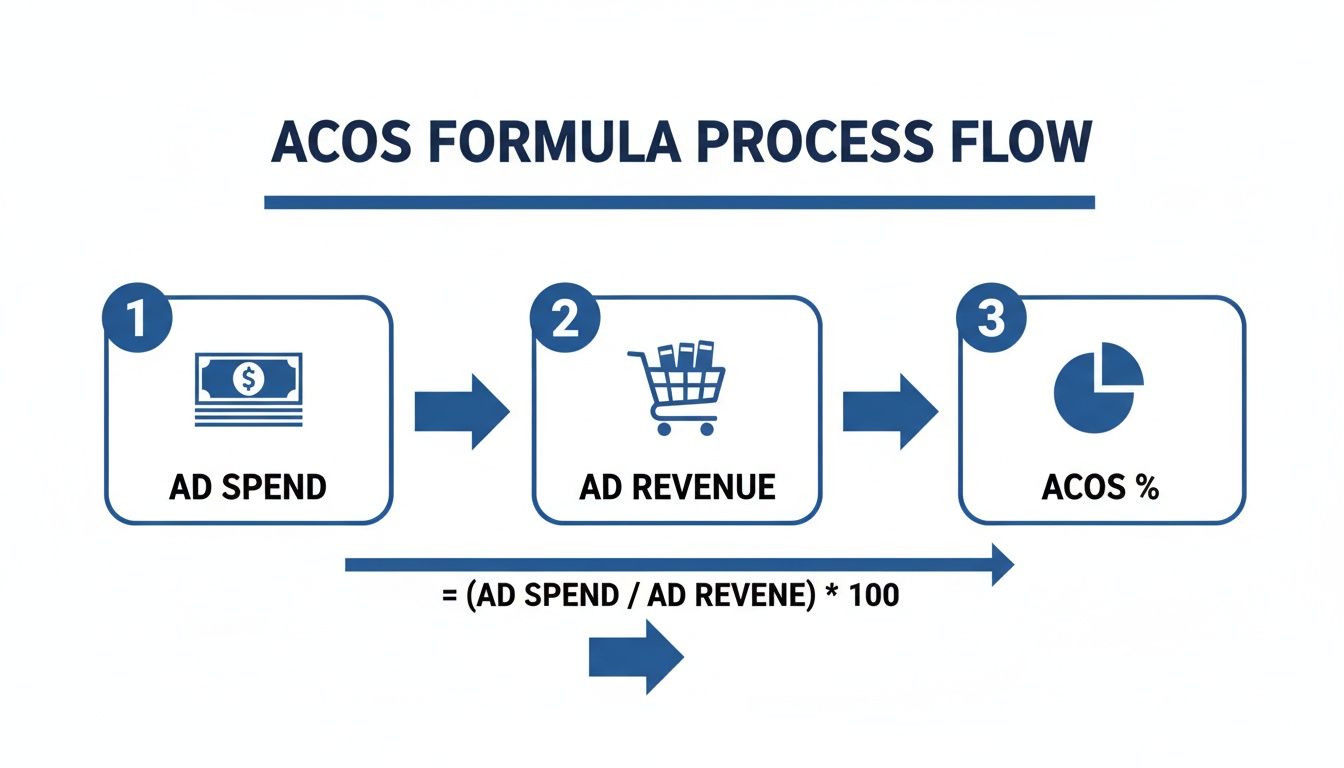
It boils down to this: you invest in ads, which generates revenue. ACOS is the metric that measures the efficiency of that investment.
When a High ACOS Is a Smart Investment
Many treat ACoS like a golf score—the lower, the better. For serious brands, this mindset is a significant limiter. A high ACoS is not always a sign of wasted spend; it's often a calculated investment in long-term growth and market positioning.
The paradigm shift occurs when leadership stops viewing advertising as an expense and starts treating it as a capital investment in an asset: your organic rank. A high ACoS becomes a tool for achieving strategic objectives that transcend immediate profitability.
The question moves from, "How low can we get our ACoS?" to a more powerful one: "What strategic objective can we achieve by deliberately over-investing in the short term?"
Fueling a New Product Launch
Launching a new product on Amazon is a battle for initial visibility and data. With no sales history or reviews, your listing is buried. A planned high-ACoS strategy is your launchpad.
By setting an aggressive ACoS target—often well above your break-even point—you are purchasing critical assets:
- Sales Velocity: Driving initial sales signals relevance to Amazon's A9 algorithm.
- Review Generation: Every sale is an opportunity for a crucial early review. An Amazon-funded case study on one CPG brand showed a 15% sales lift after acquiring their first review.
- Keyword Ranking: PPC-driven sales directly influence organic rank. An aggressive launch push helps you climb the search results for core keywords from day one.
In this phase, you are not just buying a sale. You are buying the momentum required to get the Amazon flywheel spinning.
A high ACoS during a product launch is the cost of building your digital shelf presence. You're paying a premium to get in front of shoppers, establish social proof, and teach the algorithm that your product is a serious contender.
Dominating a Competitive Market
Even established brands must sometimes play offense. A high ACoS becomes a strategic weapon when entering a new market, defending against an aggressive competitor, or maximizing share of voice during a key sales event like Prime Day.
Consider a brand entering the hyper-competitive supplements category. A "profitable" ACoS of 25% might generate zero first-page impressions. To make an impact, they might need to sustain an ACoS of 60% or higher to acquire new-to-brand customers. This isn't about losing money; it's about customer acquisition cost (CAC).
The key is to measure this aggressive spend against your customer lifetime value (CLV). If you lose margin on the first purchase but acquire a customer who makes three profitable repeat purchases over the next year, that high initial ACoS was a highly strategic and profitable investment. You can learn more about finding this balance by reading expert guides on ACOS on Amazon.
ACoS is a tool. When wielded with clear strategic intent—launching, defending, or dominating—it transforms from an expense into one of the most powerful investments you can make in your brand's long-term growth.
ACOS Is Only Half the Story: Meet TACoS
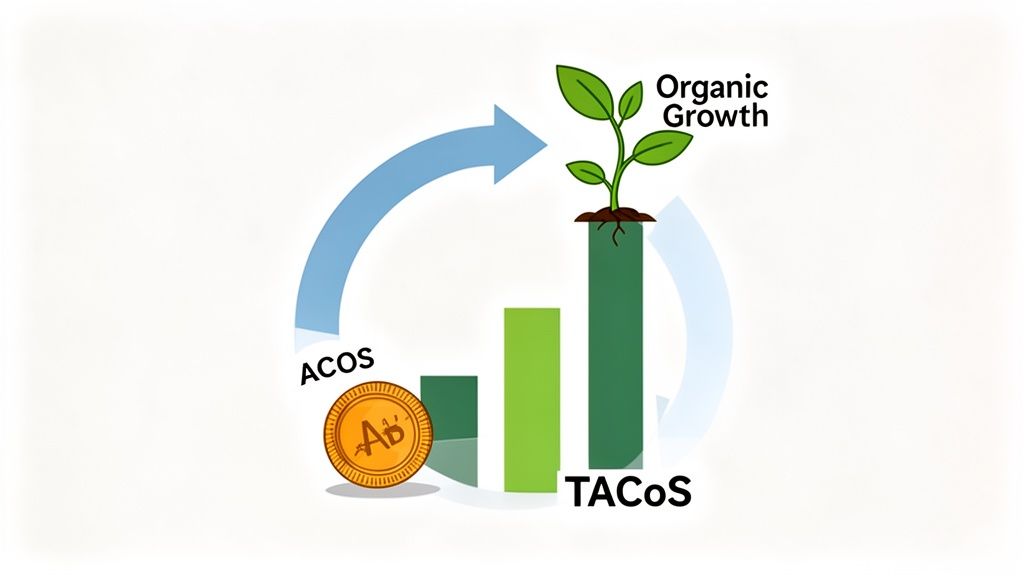
Managing your brand on ACOS alone is like flying a plane with only an airspeed indicator. It tells you one crucial thing but ignores the bigger picture of overall business health on Amazon.
To get a complete view, you must track Total Advertising Cost of Sales (TACoS). This is the metric that separates tactical campaign managers from strategic growth leaders.
TACoS measures your ad spend against your total revenue (paid + organic). It answers the single most important question for any brand leader: Is our advertising investment driving sustainable, profitable growth for the entire business?
So, How Does TACoS Work?
The formula is simple, but its strategic insight is profound.
TACoS = (Total Ad Spend ÷ Total Revenue) × 100
While ACoS provides a micro-view of ad efficiency, TACoS provides the macro-view of the symbiotic relationship between your paid and organic sales. It is the ultimate report card for your advertising as a growth lever.
This matters because it quantifies the "flywheel effect." Effective ad spend drives sales and reviews. Amazon’s algorithm rewards this with higher organic rankings, which in turn drives more high-margin organic sales. TACoS is the metric that proves this virtuous cycle is working.
ACOS and TACoS: A Powerful Duo
The most powerful insights emerge when you analyze ACOS and TACoS in tandem. Their relative trends tell a clear story about your brand's trajectory. The ideal scenario is a decreasing TACoS over time, even if your ACOS remains stable. This is the clearest possible signal that your ad spend is successfully building your organic foundation, creating a more defensible and profitable business.
For a deeper dive into the numbers and strategy behind this, our guide on how to calculate TACoS breaks it all down.
Let's examine a few common scenarios. Use this table to interpret what the data is telling you about your performance.
ACOS vs TACoS: Interpreting Your Performance
| Scenario | ACOS Trend | TACoS Trend | What It Means for Your Business |
|---|---|---|---|
| The Ideal State | Stable or Increasing | Decreasing | Success. Your ads are effectively fueling organic growth. Your dependency on paid media is decreasing as organic rank strengthens. |
| The Growth Phase | Increasing | Increasing | Strategic Investment. You are in a launch or market expansion phase, aggressively spending to build velocity and brand awareness. Monitor closely. |
| The Stagnation Zone | Decreasing | Stable or Increasing | Warning. Over-optimization of ACOS may be choking your sales velocity, causing organic rank to erode and increasing your reliance on paid ads. |
| The Red Flag | Increasing | Increasing Rapidly | Potential Crisis. Ad efficiency is declining without a corresponding lift in organic sales. This signals underlying issues with your product, pricing, or listing conversion. |
Seeing these trends makes it clear why ACoS in isolation is a misleading metric. The context provided by TACoS is what creates actionable intelligence for leadership.
Using Ads to Build a Moat
When you manage toward TACoS, your entire strategy shifts. The conversation elevates from, "How can we lower our ACOS?" to, "How can we allocate our ad budget to drive down our TACoS?" This is the core of a performance-first mindset.
Imagine a brand maintains a 35% ACOS on a flagship product campaign. In a vacuum, this might seem high. But if their overall TACoS has declined from 20% to 12% over the past six months, it’s a massive strategic win.
It proves that every $1 of ad spend isn't just generating $2.85 in ad revenue—it's also building an organic sales engine that delivers high-margin, sustainable growth.
This is how you build a category-leading brand on Amazon. You use paid advertising as a lever to create an organic foundation that becomes a competitive moat. Stop managing ACOS in a vacuum. Start tracking TACoS to measure the true ROI of your advertising and make decisions that build long-term enterprise value.
Actionable Strategies to Optimize Your ACOS
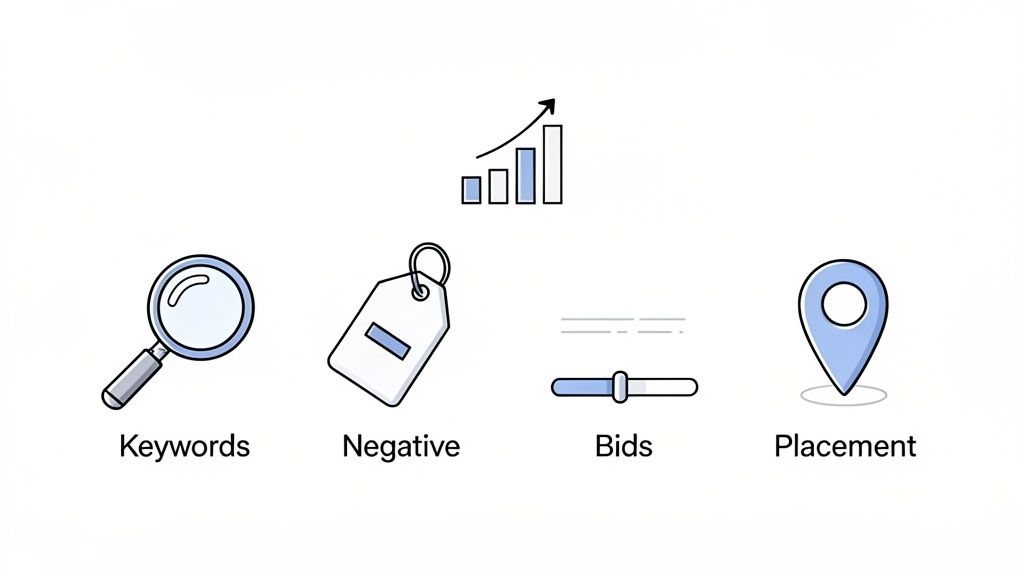
Theory is important, but execution is what drives results. Knowing what ACoS is and how it links to profitability is one thing; systematically improving it is another. Let's move to practical, performance-focused tactics.
Lowering your ACoS isn't about blindly cutting bids, which throttles sales volume. It's about increasing the intelligence of your ad spend. The goal is efficiency and control, not just cost reduction.
These are the exact plays we implement for our clients to systematically eliminate wasted spend and gain precise control over campaign outcomes.
Master Your Keyword Targeting
Your keyword strategy is the foundation of ACoS optimization. It’s where most brands waste budget, and it's where the biggest efficiency gains are found.
This starts with a disciplined use of match types. Many sellers use broad match to "discover" keywords but fail to act on the data.
- Broad Match: Use for research and discovery, with low bids to control costs. Its purpose is to generate a steady stream of new, customer-driven search terms.
- Phrase & Exact Match: This is where you deploy your budget for performance. Once a search term from your broad match campaign proves it can convert profitably, "graduate" it to a dedicated phrase or exact match campaign. Here, you can bid more confidently and aggressively.
This process of keyword harvesting and isolation is non-negotiable. By separating proven converters from exploratory terms, you can allocate budget with precision, dramatically improving ACOS on the keywords that drive your business.
Wield Negative Keywords Like a Scalpel
Negative keywords are your primary defense against wasted ad spend. They are unequivocally the fastest lever to pull to improve ACOS. Every irrelevant click you prevent is pure profit saved.
Do not wait for a poor-performing search term to accumulate significant cost. Proactively mine your Search Term Reports weekly to identify and negate queries that are irrelevant to your product.
Think like your customer, but also identify who is not your customer. If you sell premium leather boots, your initial negative keyword list should include "cheap," "vegan," "faux," and "rubber." This prevents you from paying for clicks from shoppers who were never going to convert.
This is not a set-it-and-forget-it task. A weekly search term review is the single most impactful habit for running lean, efficient campaigns. This discipline alone can often reduce wasted spend by 15-20% within a month.
Structure Campaigns for Control and Clarity
A disorganized campaign structure makes optimization impossible. Lumping branded, generic, and competitor keywords into a single campaign gives you zero strategic control.
A performance-oriented structure separates campaigns by strategic intent, allowing for precise management of bids and budgets.
A foundational structure we use for clients includes:
- Branded Campaigns: Target your own brand name. ACOS should be exceptionally low, as you are capturing high-intent searches.
- Non-Branded (Category) Campaigns: Target generic category terms like "yoga mat." ACOS will be higher, as this is your primary tool for new customer acquisition.
- Competitor Campaigns: Target competitor brand names. ACOS will be highest, as the strategic goal is market share conquest, not immediate profit.
This segmentation allows you to set distinct ACoS targets for each strategy. You can run your branded campaign for maximum efficiency while investing aggressively to acquire new customers—all without your data becoming a blended, unactionable mess.
Leverage Placement Data and Performance Reports
Finally, utilize the data Amazon provides. Two of the most underleveraged tools are placement bid modifiers and the Search Query Performance report.
Placement data allows you to set bid adjustments for Top of Search, Rest of Search, and Product Pages. If your data shows that Top of Search converts at a much higher rate, you can set a +50% bid modifier to increase your chances of winning that premium placement. It’s a simple way to focus your budget on the highest-performing ad slots.
Simultaneously, the Search Query Performance report reveals your impression share for your most critical keywords. If a high-converting keyword has a low impression share, it’s a clear signal to increase your bid and capture more of that profitable traffic. This is how you shift from reactive management to data-driven decision-making that directly impacts your bottom line.
Metrics That Drive Growth Beyond ACOS
Focusing solely on ACoS is a strategic blind spot. It's an essential metric for ad efficiency, but it says nothing about the overall financial health or long-term growth trajectory of your business. The most sophisticated brands have expanded their view to include KPIs that build enterprise value.
This is about escaping the "low ACoS trap" and adopting a holistic, business-first approach. When you begin tracking metrics like Return on Ad Spend (ROAS) and integrating Customer Lifetime Value (CLV) into your strategy, you unlock a higher level of decision-making that fuels sustainable growth.
Shifting Focus to Return on Ad Spend (ROAS)
While ACoS measures spend as a percentage of revenue, Return on Ad Spend (ROAS) inverts the equation to show a direct multiplier on your investment. It answers a simpler question: for every dollar I put in, how many dollars do I get back?
The formula is a direct measure of profitability:
ROAS = Ad Revenue ÷ Ad Spend
If you spend $500 on a campaign that generates $2,500 in sales, your ROAS is 5x. For many senior leaders, thinking in terms of a direct return multiplier (a 5x return) is more intuitive than percentages. It correctly frames ad spend as an investment, not a cost.
The Power of Customer Lifetime Value (CLV)
The brands built for long-term dominance are obsessed with Customer Lifetime Value (CLV). This metric projects the total net profit a single customer will generate over their entire relationship with your brand. Why is this a game-changer? It provides the strategic justification to run a higher ACoS for customer acquisition.
Consider this scenario:
- You sell a premium coffee maker with a break-even ACoS of 40%.
- You also sell high-margin coffee pods with a strong repeat purchase rate.
- Data shows that a coffee maker purchaser becomes a loyal, repeat buyer of your pods.
In this context, running a 50% ACOS on the coffee maker to acquire a new customer might appear unprofitable in isolation. But if that acquisition leads to $300 in future pod purchases, that initial "loss" was a highly profitable investment. Understanding your numbers at this level is key, which is why it's so important to know how to calculate profit per unit for your entire catalog.
ACOS is a vital campaign-level metric, but its true power is realized when contextualized by business-level KPIs. Learn more about prioritizing true profit-focused Amazon sales growth and start building a more resilient business. This approach enables you to make strategic short-term investments to acquire high-value, repeat customers who drive long-term enterprise value.
Frequently Asked Questions About Amazon ACOS
Even with a firm grasp of ACoS, specific questions inevitably arise when you begin implementing these strategies. Here are the most common queries we address for eCommerce and retail leaders.
What Is a Good ACOS on Amazon?
There is no universal "good" ACOS. The correct answer is always contextual. A good ACOS is one that is aligned with your product's specific profit margin and your current strategic objective.
- For Profit-Focused Campaigns: For a mature product, a "good" ACoS might be in the 10-25% range, ensuring a healthy margin on each ad-driven sale.
- For Growth-Focused Campaigns: For a new product launch or an aggressive market share push, a "good" ACoS could be 40-60% or higher. Here, the objective isn't immediate profit but the acquisition of sales velocity, reviews, and organic rank.
The optimal ACoS is a dynamic target that must adapt to your business goals and unit economics.
Why Is My ACOS So High?
A high ACoS signals either inefficient ad spend or a deliberate strategic investment. If it's unintentional, the cause typically lies in one of these areas:
- Poor Keyword Targeting: Your campaigns are likely using broad match keywords that attract irrelevant clicks, wasting budget on shoppers with low purchase intent.
- Low Conversion Rate: Your ads are driving traffic, but your product detail page is failing to convert visitors. This could be due to un-optimized copy, poor imagery, negative reviews, or uncompetitive pricing.
- High Cost-Per-Click (CPC): In highly competitive categories, the cost of advertising is inherently high, which puts upward pressure on ACoS.
Your first diagnostic tool should be the Search Term Report. It is the fastest path to identifying and negating irrelevant, cost-draining search queries.
How Does ACOS Relate to ROAS?
ACOS and ROAS (Return on Ad Spend) are two sides of the same coin, measuring the same campaign efficiency from different perspectives.
- ACOS is a percentage of cost: a 25% ACOS means you spent $0.25 for every $1.00 of revenue.
- ROAS is a multiplier of return: a 4x ROAS means you generated $4.00 for every $1.00 of spend.
They are direct mathematical inverses. A 25% ACOS is identical in performance to a 4x ROAS. Many leaders prefer ROAS as it more closely aligns with traditional return on investment frameworks.
At Headline Marketing Agency, our philosophy is to move beyond surface-level metrics. We build advertising strategies that drive sustainable growth, establish category leadership, and connect every dollar of ad spend to tangible business outcomes. If you’re ready to align your advertising with your enterprise goals, we’re here to help. Learn more about our data-driven approach.
Get Your Free Amazon PPC Audit
Discover untapped growth opportunities and see how our data-driven approach can improve your ROAS.
Get Free Audit →Ready to Transform Your Amazon PPC Performance?
Get a comprehensive audit of your Amazon PPC campaigns and discover untapped growth opportunities.