Amazon DSP Video: A Practical Guide for Brand Scale
Learn how Amazon DSP video fits into a profitable full-funnel Amazon advertising strategy, from formats and targeting to AMC measurement and creative best

Most brands are buying Amazon DSP video as if completed views were the product. They aren't. The product is profitable demand that Sponsored Ads can capture after video creates attention, and Amazon's own audience graph now connects shopping behavior with streaming signals, including Prime Video, across display, video, audio, and streaming TV inventory (Amazon DSP audience and advertising data).
That distinction changes how you plan, target, and measure the channel. Amazon has publicly cited more than 130 million U.S. monthly ad-supported Prime Video viewers by mid-2025 and about 315 million monthly viewers globally by unBoxed 2025 (Amazon advertising statistics and audience data). Reach at that scale makes video strategically important, but reach alone won't pay your margin. The brands that win connect video exposure to retargeting, branded search, Sponsored Products, Amazon Marketing Cloud, and a clear profitability decision.
Why Amazon DSP Video Is the Full-Funnel Lever Most Brands Underuse
Amazon DSP video earns its budget when it creates demand that Sponsored Ads can capture and Amazon Marketing Cloud can evaluate for incremental profit. A view count is only an input. The test that matters is whether exposed shoppers later search for the brand, visit a product detail page, or convert through another Amazon campaign at an acceptable margin.
Amazon DSP can buy display, video, audio, and streaming TV inventory across Amazon properties and third-party publishers. Its audience tools use shopping and streaming signals, including Prime Video activity, to connect exposure with retail behavior (Amazon DSP audience and advertising data). That connection gives brands a practical way to coordinate upper-funnel video with Sponsored Products, Sponsored Brands, and retargeting.
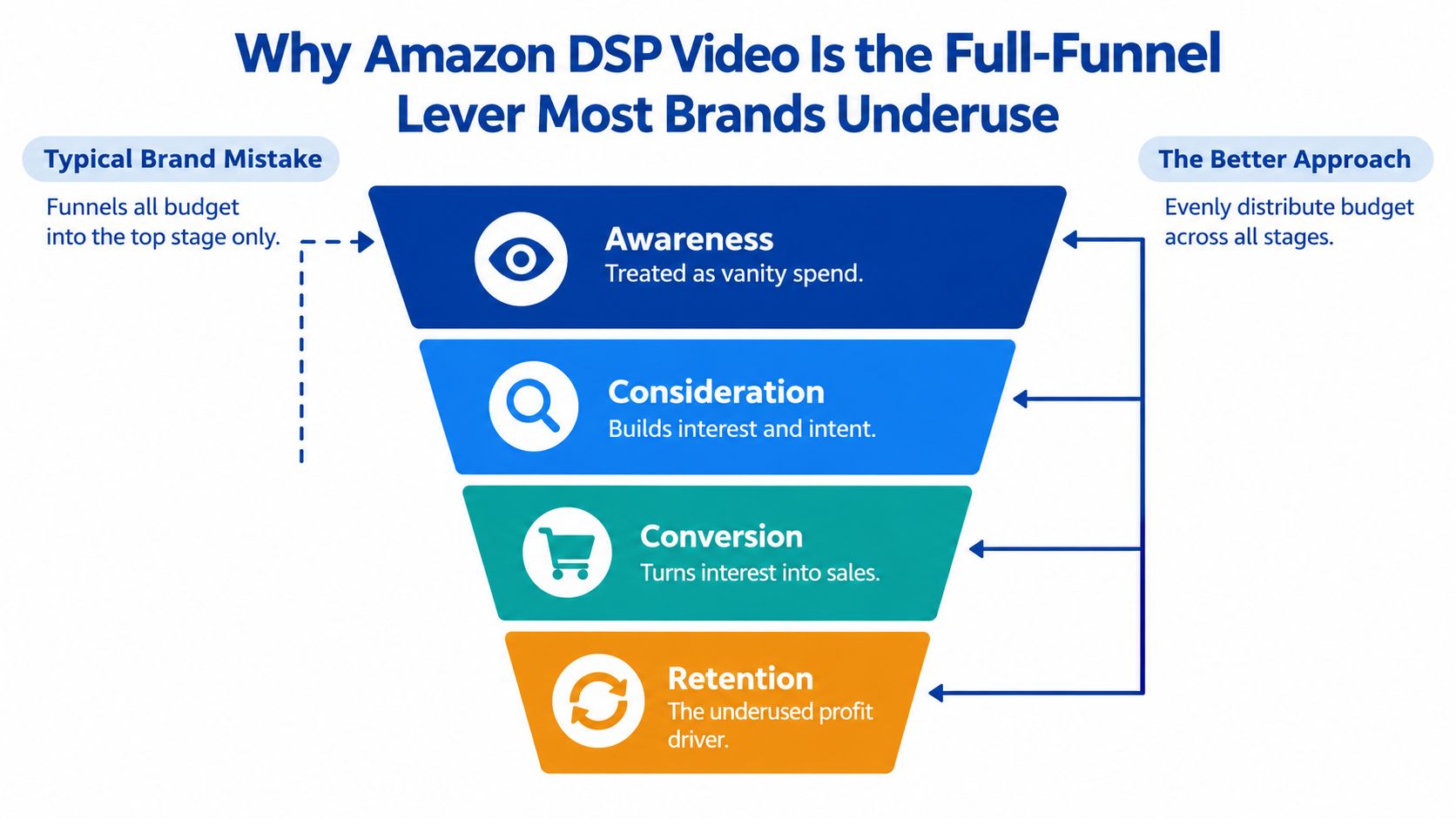
The mistake is optimizing the wrong endpoint
A completed view confirms that playback reached its required endpoint. It does not show whether the viewer was incremental, already planning to buy, or prompted to create branded demand that another campaign later captured.
Video can seed retargeting audiences, support branded search, and help defend category share when competitors bid on your terms. Build those outcomes into the campaign from the start. Cheap impressions alone will not produce them reliably.
Practical rule: Use video to open demand, Sponsored Ads to capture it, and AMC to connect exposure with outcomes.
Set the format according to the job, then apply contextual and behavioral targeting, exclusions, and frequency controls. Measure exposure-to-purchase paths in AMC, and use the findings to adjust Sponsored Products and Sponsored Brands. For brands extending their media mix beyond Amazon, the same audience logic can help convert warm viewers with YouTube ads.
The payoff reaches beyond reported DSP revenue. A disciplined loop can strengthen branded demand and product engagement, while profit-focused analysis exposes placements that look efficient in a dashboard but fail to create incremental margin. Make budget decisions on that evidence, not on completed views alone.
What Amazon DSP Video Actually Is and How It Fits the Ad System
Amazon DSP video is programmatic video buying through Amazon's demand-side platform. Advertisers choose audiences, inventory, bids, budgets, frequency controls, and creative, while Amazon serves ads across eligible placements through an auction-based media system. Sellers and vendors can use DSP, although access and operating arrangements vary by account and market.
DSP video serves a different job from Sponsored Display video. Sponsored Display operates within Amazon's sponsored advertising environment and is usually simpler to launch. DSP provides broader programmatic reach across Amazon-owned and operated properties and third-party inventory, with more control over audiences, supply, frequency, and measurement.
Amazon groups DSP under a broader Display, Video, and Audio campaign structure, reaching desktop, mobile, and connected devices across several formats (Amazon Display, Video, and Audio campaigns). Plan video as part of the advertising system, not as an isolated awareness purchase. It can support Sponsored Products, Sponsored Brands, Sponsored Display, display, audio, and streaming TV.
Sponsored Ads convert existing demand from shoppers already searching. DSP video reaches relevant audiences earlier, builds product familiarity, and can create demand that Sponsored Ads later capture. That relationship makes DSP a full-funnel profit lever, provided the campaign is judged by incremental sales and margin rather than view volume alone.
A completed view confirms playback, not business impact. A viewer may already have intended to purchase, may never have considered the product, or may later convert through a Sponsored Ads campaign. Amazon DSP can provide exposure, playback, audience, and conversion data, but attribution still requires careful design to separate incremental influence from purchases that would have happened without the ad.
Owned inventory can include Prime Video, Fire TV, Twitch, and IMDb environments. Third-party exchanges extend reach beyond Amazon properties. Choose the mix according to category economics, creative quality, audience availability, and your ability to connect DSP exposure with Sponsored Ads outcomes through Amazon Marketing Cloud.
Video Inventory and Ad Formats Worth Your Budget
Inventory choice determines whether your budget buys persuasive attention or merely cheap playback. Prime Video, Fire TV, and other connected-TV placements offer premium, lean-back viewing environments, while mobile and third-party video can provide broader reach at a different cost and attention profile. Amazon DSP can access both Amazon-owned inventory and third-party supply through publisher and marketplace relationships.
Where each format belongs
In-stream video appears within video content and can be skippable or non-skippable depending on the placement. It works best when the opening seconds communicate the product, brand, and reason to care before the viewer has an opportunity to leave. Out-stream video can extend reach on publisher pages or mobile environments, but the viewing context is usually less immersive.
Connected TV and streaming TV are strong consideration and reach tools for brands with a clear story, visual product benefit, or household-level purchase decision. They can also help manage exposure across household devices, but advertisers should resist treating every completed CTV view as equal to a product-page visit.
| Inventory | Format | Funnel Stage | Typical Scale |
|---|---|---|---|
| Prime Video and Fire TV | Streaming TV, generally in-stream | Awareness and consideration | Premium, high-quality reach |
| Twitch | In-stream video and streaming environments | Awareness and consideration | Strong contextual and interest-based reach |
| IMDb properties | Video and display environments | Awareness and category prospecting | Targeted entertainment reach |
| Third-party exchanges | In-stream and out-stream video | Awareness and retargeting | Broad, variable-quality scale |
| Mobile video | In-stream and out-stream | Awareness and mid-funnel engagement | Broad reach, lower-cost opportunities |
| Connected devices | Streaming TV and video | Awareness through consideration | Premium household exposure |
The table is a planning framework, not a promise of uniform delivery. Supply, audience size, market, bid, creative eligibility, and frequency settings will determine actual scale.
Don't confuse premium reach with business impact
Premium CTV can create stronger attention and brand memory, but it often carries a higher media cost than mobile video. Lower-cost mobile inventory can scale efficiently, yet it may produce weaker attention or more accidental playback. Your decision should follow the funnel job.
Use premium inventory when the product needs explanation, differentiation, or household consideration. Use mobile and third-party video when you need efficient prospecting, retargeting, or controlled testing. Then compare exposed audiences against meaningful downstream actions rather than rewarding the placement with the cheapest cost per completed view.
Amazon's video advertising examples and formats can help teams assess how creative execution changes by placement. The important question isn't which format looks most impressive in a media plan. It's which environment creates enough qualified demand for your Sponsored Ads and product detail pages to monetize.
Targeting Strategies That Move the Needle on Amazon DSP Video
A polished video cannot compensate for vague audience strategy. Layering is the advantage. Amazon DSP can combine shopping behavior, media engagement, and contextual relevance, but each audience needs a defined job. Build toward incremental profit, then connect exposure with Sponsored Ads and AMC rather than judging success by views alone.
Start with Amazon's first-party signals. In-market audiences reach shoppers actively researching a category. Lifestyle audiences broaden reach around relevant interests and behaviors. Prime Video viewership signals add media behavior to the plan, helping advertisers find households whose viewing patterns align with the product category, as noted earlier in the discussion of Amazon DSP audience and advertising data.
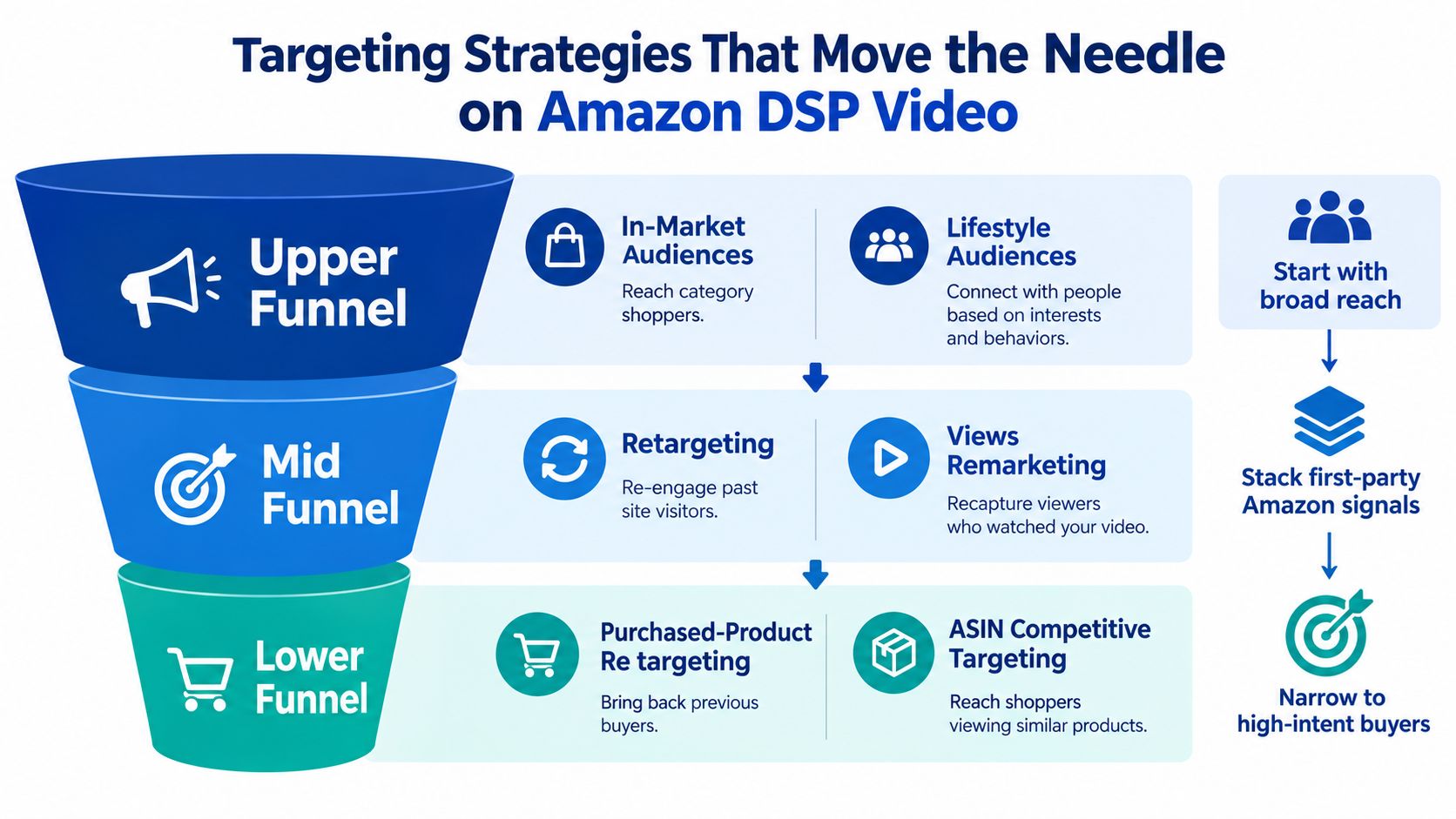
Build the funnel in audience layers
Upper funnel: Combine contextual signals with in-market and lifestyle audiences. Context keeps broad reach relevant. A home product, for example, can run alongside home improvement or design content while Amazon signals focus delivery on likely category shoppers.
Mid funnel: Retarget people who viewed a product, watched prior video, searched for the brand, or interacted with related Sponsored Brands and Sponsored Display campaigns. Give these audiences a different message, such as proof, comparison, offer context, or a sharper product benefit.
Lower funnel: Use product viewers, cart abandoners, competitive ASIN audiences, and relevant AMC-built segments. Exclude existing purchasers from acquisition campaigns unless the goal is cross-sell or replenishment.
Standard lookalikes are useful, but AMC can be sharper
Lookalikes based on purchasers or category converters can extend prospecting beyond the original audience. Their quality depends on the seed. A mixed purchaser pool may combine discount-driven first purchases with high-value repeat customers, producing a weak commercial signal.
AMC-built audiences can provide more useful decision states by combining exposures across DSP, Sponsored Products, Sponsored Brands, and streaming TV. “Saw video, visited the product detail page, did not purchase, and searched the brand” gives buyers a clearer action than a generic similarity audience. Use that segment to coordinate video follow-up with Sponsored Ads instead of paying to reacquire people who already converted.
Set frequency caps by funnel stage. Prospecting needs controlled repetition without saturation. Retargeting can support tighter repetition because those shoppers have already shown intent. Exclude recent purchasers from acquisition, remove converters from retargeting when appropriate, and separate cross-sell from pure acquisition.
Single-tactic targeting is dead. Scale comes from contextual relevance, Amazon intent, and retargeting working together.
The strongest structure separates prospecting, consideration, and conversion campaigns. Give each its own creative, budget rules, exclusions, and success criteria. Then evaluate whether video creates new demand that improves downstream margin, or only harvests demand that Sponsored Ads would have captured anyway.
Measuring DSP Video With AMC and Profit-Aware Metrics
Video reporting often rewards the easiest metric to improve. Completion rate is easy to read. Cost per completed view is easy to compare. Neither is revenue.
Amazon uses viewability logic aligned with MRC and IAB standards, counting a video ad as viewed when at least 50% of the ad is on screen for 2 seconds or longer. Amazon also exposes playback initiation, ad break position, completion rate, and cost per completed view in video reporting (Amazon video measurement guidance).
Those metrics still matter. They diagnose delivery and playback quality. They tell you whether the creative is being seen and whether viewers stay through the asset. They don't prove incrementality, profitability, or causal impact.
| Metric | What It Measures | Why It's Misleading | Profit-Aware Alternative |
|---|---|---|---|
| Viewability | Whether the ad met the on-screen viewing threshold | A visible ad can still reach an existing buyer | Incremental conversion or revenue among exposed users |
| Completion rate | How often playback reaches the end | Shorter assets naturally reduce watch-time requirements | Completion by audience, placement, and downstream purchase rate |
| Cost per completed view | Media cost for completed playback | Cheap completion can come from low-value inventory | Incremental revenue or margin per exposed audience |
| CTR | Click activity | Video can influence search and purchase without a click | Exposure-to-purchase paths and branded demand lift |
| Attributed ROAS | Revenue credited to the campaign | View-through rules can over-credit upper-funnel media | Holdout-adjusted revenue and contribution margin |
Ask AMC commercial questions
AMC turns reporting from a dashboard review into a query-design problem. Build paths that connect DSP impressions or views to product detail page visits, Sponsored Products clicks, Sponsored Brands activity, and purchases. Analyze whether exposed shoppers later converted through Sponsored Ads, and whether their behavior differs from an appropriate comparison audience.
Useful analyses include:
- Exposure-to-purchase paths: Identify the sequence from video exposure to product engagement and conversion.
- Sponsored Ads halo: Check whether exposed audiences later increased interaction with Sponsored Products or Sponsored Brands.
- New-to-brand share: Separate first-time brand customers from existing buyers where available.
- Frequency curves: Compare exposure frequency with conversion behavior to find saturation rather than assuming more impressions are better.
CPCV is a delivery diagnostic, not a profit metric. A campaign can lower CPCV by buying inventory that completes cheaply while producing little commercial value. Pair it with new-to-brand outcomes, conversion rate, contribution margin, and incremental revenue.
Teams that need a practical explanation of AMC architecture can review this guide to the Amazon Marketing Cloud clean room. The minimum viable measurement stack should include campaign-level DSP reporting, Sponsored Ads data, AMC path analysis, consistent promoted ASIN definitions, and a comparison method. When spend justifies the effort, use a holdout or geo test so the business can estimate what happened because of video, rather than just what happened after video exposure.
Creative Specs and Best Practices for Amazon DSP Video
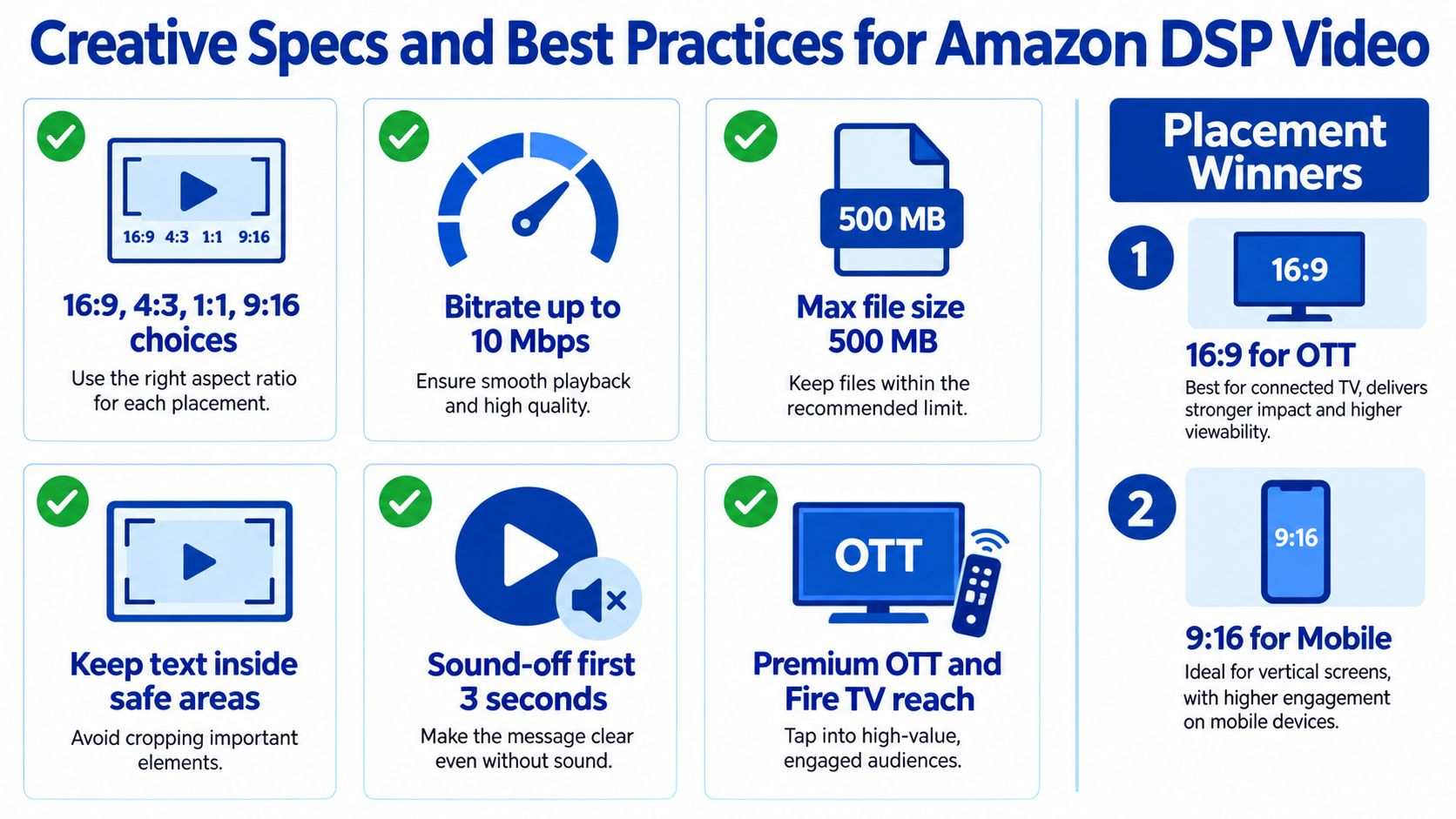
Technical compliance comes before optimization. Amazon's online video specifications require a minimum 1920×1080 frame size, a 4 Mbps minimum video bitrate, a 10 Mbps maximum video bitrate, a 24 fps minimum frame rate, and audio at 192 kbps with 44 kHz sampling. Supported video encodings include H.264, MPEG-2, and MPEG-4, while audio can use MP3 or AAC (Amazon online video ad specifications).
Amazon supports online video ads from 6 to 120 seconds and recommends 6, 15, 20, 30, or 60-second lengths. Shorter assets can produce higher completion rates, but scale for 6-second inventory may be limited (Amazon online video ad specifications).
Make the first seconds carry the argument
A full-funnel asset needs to work before the viewer understands the media context. Put the brand cue, product, and primary benefit early. Build a sound-off version with readable text, then add audio for viewers in environments where sound is available.
A 6-second cut can deliver one sharp idea. A 15-second or 30-second asset gives the brand more room to show the product, explain the problem, and create a reason to search. A 60-second version makes sense when consideration requires education, demonstration, or a more detailed offer. Don't force every message into the shortest possible edit just to improve completion rate.
Creative decision: Choose the shortest version that can communicate the commercial argument, not the shortest version that can win a completion metric.
Keep important text and logos inside safe areas. Export a master tuned for premium inventory instead of relying on aggressive platform compression. Poor bitrate or resolution can damage playback quality and create rejection risk, particularly on larger in-stream and connected-TV placements.
Watch for unsupported claims, unclear product promises, category-specific restrictions, and visuals that imply performance the product can't deliver. AI-assisted production helps with cutdowns, localization, and controlled variant testing. It hurts when it produces generic hooks, inconsistent brand cues, or visuals that look interchangeable with every competitor.
For a deeper technical checklist, use Headline's guide to Amazon DSP ad specs. The right creative process combines compliance review with a deliberate testing plan, not endless production of near-identical variants.
Connecting DSP Video to Sponsored Ads Through Amazon Marketing Cloud
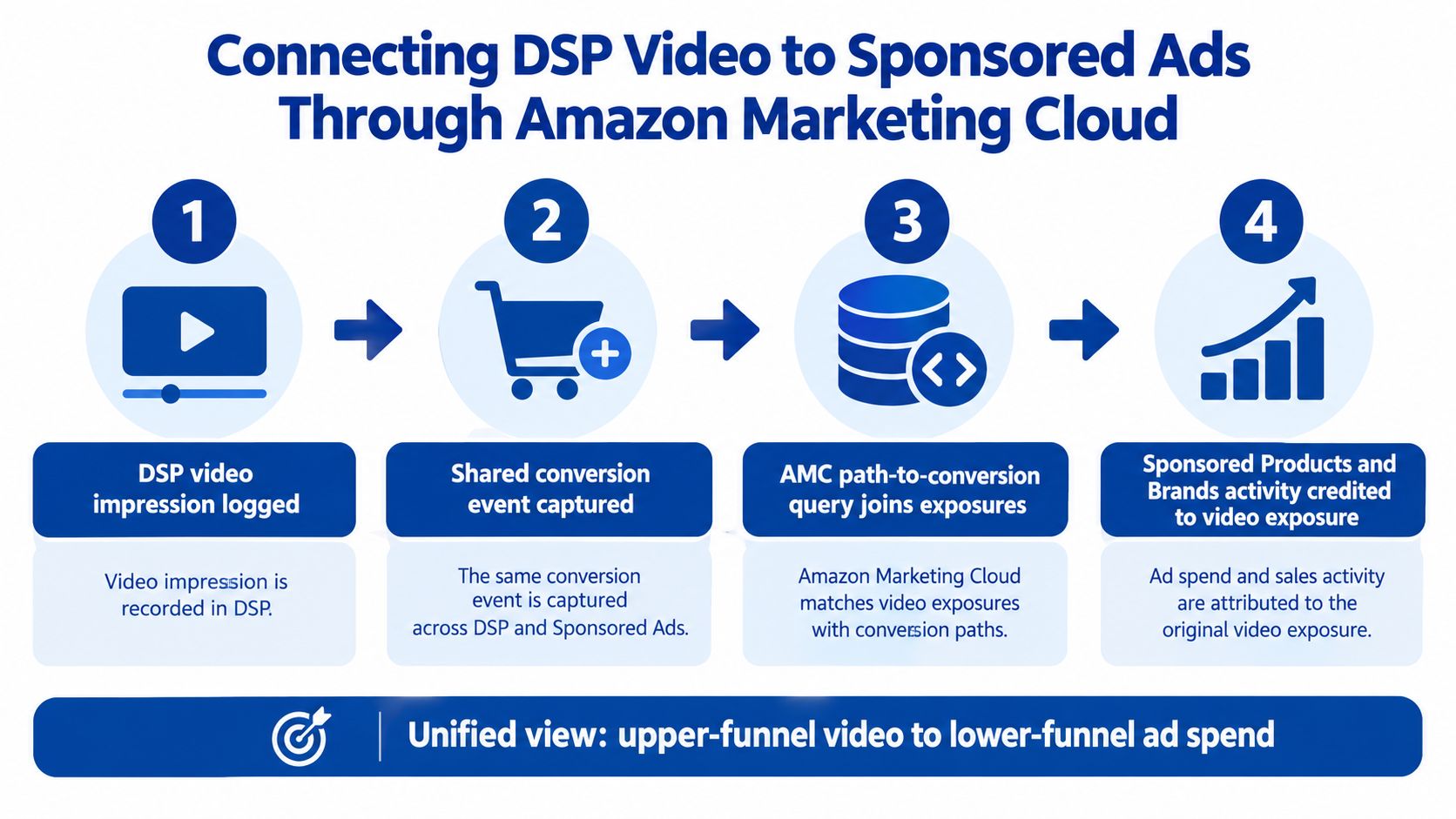
Amazon Marketing Cloud (AMC) makes DSP video useful when it answers a profit question, not just a viewing question. Start by defining the promoted ASINs, conversion event, exposure window, and Sponsored Products or Sponsored Brands actions that belong in the path. Without those decisions, reporting shows activity without proving whether video changed the result.
A practical attribution loop
- Log the DSP exposure. Capture impressions, views, audience, placement, device, and frequency for the campaign.
- Keep the promoted product consistent. Analyze the same ASIN group across detail page views, Sponsored Ads activity, and purchases.
- Join the path in AMC. Query how video exposure relates to product engagement, Sponsored Products or Sponsored Brands activity, and conversion.
- Compare exposed and unexposed behavior. Report only what the comparison design supports. A later purchase is not automatically a video conversion.
The useful question is not “How many people watched?” Ask which exposed shoppers later entered the Sponsored Ads and purchase path, then calculate whether that behavior produced incremental margin.
Amazon Ads case studies show the commercial potential. Theater used Amazon DSP and AMC audiences in a three-stage strategy, grew sales 10X, and moved contribution margin 18 points from negative double-digit to positive in nine months (Theater Amazon Ads case study).
The example supports a connected operating model, not a promise that every video campaign will produce the same result. Video should create qualified demand, Sponsored Ads should capture it, and AMC should show how the stages interact.
Your analysis still needs campaign-level margin inputs, including product costs, retail fees, promotional costs, and a defensible incrementality method. Completion rate can guide creative decisions, but it cannot justify budget on its own. If DSP video raises views while adding little profitable demand, reduce spend regardless of how attractive the dashboard looks.
When to Invest in Amazon DSP Video and How to Start
Amazon DSP video is worth serious investment when the brand has enough demand, margin, creative quality, and measurement discipline to support a full-funnel loop. It makes less sense when Sponsored Products campaigns are structurally weak, product detail pages convert poorly, inventory is unreliable, or the team can't distinguish incremental sales from retargeted demand.
Use the first 90 days as a controlled ramp:
- Days 1 to 30: Test audience layers, inventory types, frequency settings, and creative lengths. Separate prospecting from retargeting and record placement-level delivery.
- Days 31 to 60: Establish an AMC baseline. Map video exposure to product engagement, Sponsored Ads activity, and purchases. Identify which audiences create valuable downstream behavior.
- Days 61 to 90: Reallocate budget toward placements and audiences that show stronger incremental and margin signals. Cut inventory that only improves completion rate without commercial evidence.
Avoid the scale-killing habits
Don't optimize the entire program around completion rate. Don't allow uncontrolled frequency to turn a useful reminder into waste. Don't put DSP video in a siloed awareness budget with no Sponsored Ads connection. And don't skip AMC because the query work feels technical. Without measurement, the business is forced to trust surface metrics.
A practical readiness checklist is simple:
- Sponsored Products and Sponsored Brands already capture existing demand.
- Product detail pages support the traffic video will create.
- Creative exists in multiple lengths and can pass technical review.
- The brand has a clear audience exclusion strategy.
- Margin reporting can evaluate more than attributed sales.
- The team has the capacity to analyze AMC results and act on them.
Recommendation: start with a narrow, measurable test, then scale only the combinations that produce incremental demand and defensible contribution margin. Headline Marketing Agency offers Amazon DSP campaign management across audience targeting, placements, creative optimization, and video measurement, with a focus on connecting DSP to broader Amazon PPC performance. Visit Headline Marketing Agency to discuss a profit-focused Amazon DSP video plan rather than another view-count report.
Get Your Free Amazon PPC Audit
Discover untapped growth opportunities and see how our data-driven approach can improve your ROAS.
Get Free Audit →Wollen Sie Ihre Amazon PPC-Performance aufs nächste Level bringen?
Lassen Sie Ihre Amazon PPC-Kampagnen professionell analysieren und entdecken Sie neue Wachstumsmöglichkeiten.