Amazon Advertising Explained: A Profit-First Playbook
Amazon advertising explained through real ad formats, bidding mechanics, key metrics, and optimization workflows that turn PPC into a profit and ranking lever

Amazon advertising stopped being a seller-side tactic a long time ago. Amazon's ad business reached $56.2 billion in full-year 2024 and ran at about $69 billion annualized by Q4 2024, after $17.3 billion in quarterly ad revenue that quarter, up 18% year over year, according to Ad Badger's roundup of Amazon advertising stats. That scale changes the job. You're not managing a small PPC add-on anymore. You're allocating media inside one of the largest intent-rich ad systems in the market.
That's why most “Amazon advertising explained” content is behind the moment. It still treats Amazon Ads like a keyword-bidding exercise. In reality, the platform now spans search, video, display, streaming, and programmatic buying, and Amazon's own materials say AI, streaming, and creator-led discovery are reshaping the path from inspiration to purchase while EMARKETER projects Amazon's U.S. ad revenue will grow 17.9% year over year in 2026 to $56.71 billion, as summarized in Amazon Ads marketing trends for 2026.
The practical implication is simple. If you still judge Amazon purely on ACOS, you're optimizing a dashboard, not a business.
Why ACOS Is the Wrong North Star for Amazon Growth
ACOS is useful. It's also the metric most likely to make smart brands underinvest.
A low ACOS can hide a weak growth engine. A high ACOS can be exactly what a brand should tolerate when it's buying rank, defending shelf space, or forcing discovery on a SKU with healthy contribution margin. The mistake is treating ACOS like the goal instead of a diagnostic.
What ACOS misses
ACOS only measures ad spend against attributed ad sales. It doesn't tell you what happened to total revenue, contribution margin, or organic lift after the click. It also punishes the exact placements that often matter most for category momentum, especially top-of-search.
If you want the clean definition, what ACOS means on Amazon is straightforward. The problem starts when teams confuse a reporting metric with a decision metric.
Practical rule: Every bid is two things at once. A margin decision today and a ranking investment tomorrow.
That's why TACoS is the better executive lens. TACoS looks at ad spend against total sales, not just attributed ad sales. It forces one harder question: are ads strengthening the whole business, or only renting transactions?
ACOS vs. TACoS at a Glance
| Lens | ACOS | TACoS |
|---|---|---|
| What it measures | Ad spend relative to ad-attributed sales | Ad spend relative to total sales |
| Best use | Diagnosing campaign efficiency | Judging account health and growth quality |
| What it ignores | Organic lift, total revenue mix, halo effects | Individual keyword efficiency |
| Common failure mode | Over-cutting bids that drive rank | Missing waste inside campaigns |
| Best executive use | Tactical control | Strategic budget ceiling |
Here's the blunt version. A 40% ACOS can still be acceptable if margin structure supports it and TACoS is falling because organic sales are rising behind paid visibility. A 15% ACOS can still be bad if the SKU has thin margin, high fees, or weak repeat economics.
The better operating stance
CMOs should stop asking, “How do we lower ACOS?” and start asking:
- What paid traffic is improving organic rank
- Which ASINs stay profitable after ad cost
- Where top-of-search premiums compound demand
- When added spend stops creating incremental revenue
Amazon advertising works best when you treat it as a blended growth system. Paid search drives velocity. Velocity supports rank. Rank reduces your future dependence on paid traffic. That loop matters more than a pretty ACOS screenshot.
The Amazon Ads Ecosystem From Search to Streaming
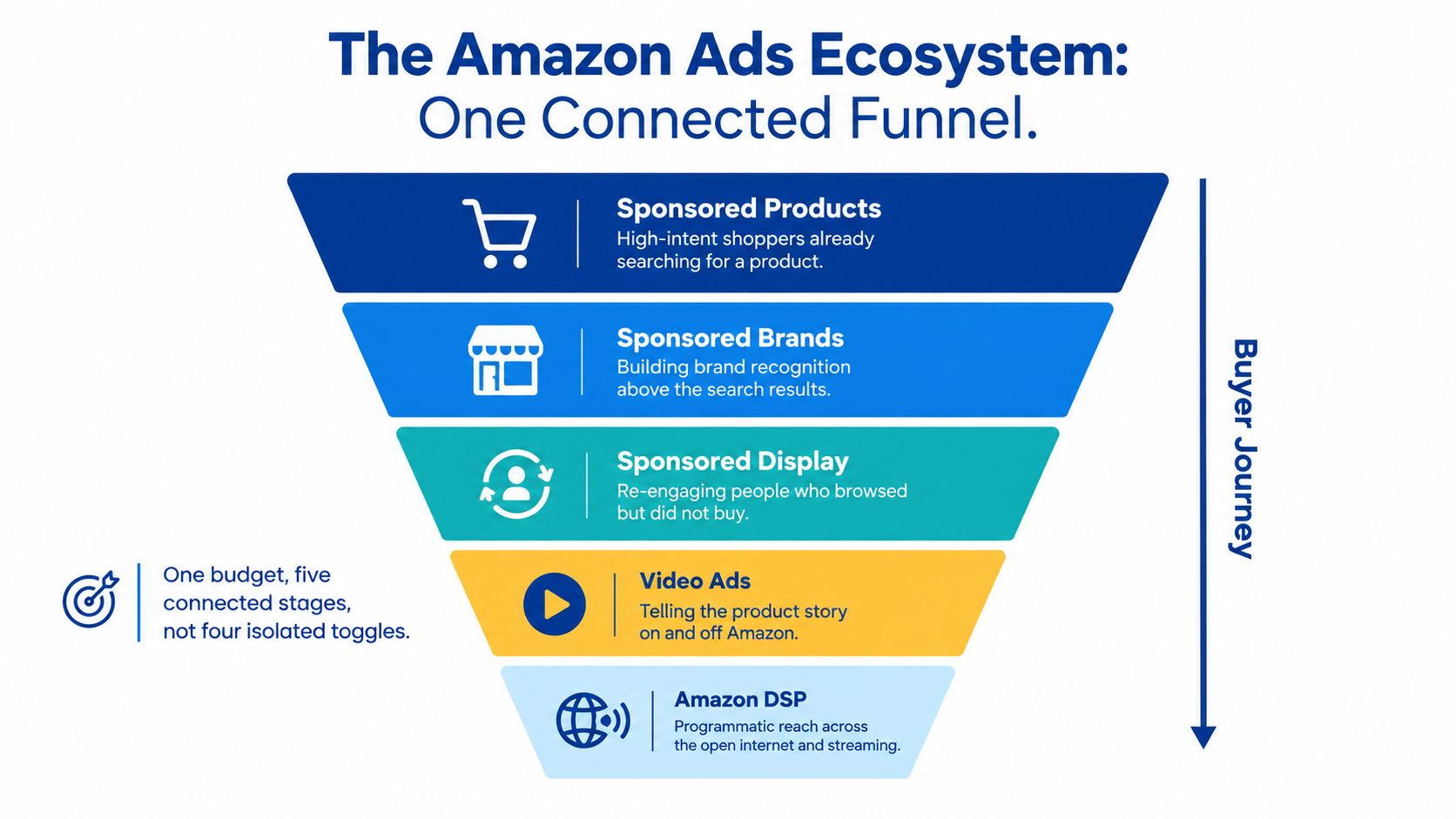
Amazon is not a single PPC console. It is a stacked demand system that can capture intent, raise branded search volume, defend consideration, and keep products visible across streaming media. Teams that treat each format as a separate budget line usually overfund bottom-funnel clicks and underinvest in the placements that improve conversion rate and branded recall before the search ever happens.
The five formats and what they actually do
Sponsored Products sit closest to the sale. They are still the core format because they influence both revenue capture and retail signals that support rank. Use them to win exact demand, harvest high-intent category traffic, and test where placement premiums pay back.
Sponsored Brands shape what happens before the click lands on a PDP. They are useful for branded defense, category ownership, and routing traffic into a Store where multiple ASINs can convert. They also give you more control over message and product selection than a single Sponsored Products ad.
Sponsored Display is your pressure layer. It follows shoppers who viewed and left, shows up on competitor detail pages, and keeps your ASIN in the consideration set after search. This matters more in crowded categories where shoppers compare three to five listings before buying.
Video ads are not just upper-funnel creative. Amazon notes that video can improve shopper response in search placements, which is why strong video often deserves performance budget, not just awareness budget, as explained in Amazon Ads guidance on video creative and reporting.
Amazon DSP gives you audience control that search formats do not. You can reach shoppers off Amazon, retarget detail page viewers, suppress recent purchasers, and sequence media across display, audio, and streaming TV. That is where Amazon shifts from keyword advertising to audience and incrementality management.
The structure matters because each format does a different job in the buying cycle. Search captures demand. Display and DSP protect consideration. Streaming video expands the audience that later converts through branded search or repeat visits.
Match the buying model to the job
Amazon does not sell every ad the same way. Sponsored Products, Sponsored Brands, and much of Sponsored Display run on CPC. Some video and display inventory can run on vCPM, and DSP extends that model across broader programmatic supply, as described in Amazon's overview of Sponsored Products and related buying options.
That pricing difference should change your planning.
- Use CPC for conversion capture, search-term harvesting, and retail-readiness tests at the ASIN level.
- Use vCPM when the objective is reach, branded search lift, detail-page revisit rate, or impression share in premium placements.
- Use DSP when you need audience exclusions, frequency control, path sequencing, or measurement beyond last-click attribution.
A CMO should care about how these layers work together, not whether they sit in different dashboards. Paid search often gets credit for the sale. Streaming, display, and retargeting often create the shopper who converts later through branded search.
Search and streaming should share one budget logic
Streaming inventory is worth adding only when the retail side is ready to absorb the demand. If your PDP conversion is weak, your review profile is soft, or your in-stock rate is unstable, more reach just creates expensive leakage.
If the retail foundation is strong, streaming can improve the economics of the whole account by increasing brand recall before the auction starts. That usually shows up later as stronger branded search conversion, lower effective acquisition cost on branded terms, and better lift on hero ASINs. Teams planning connected TV should review these Amazon Fire TV ad tips and this breakdown of how to advertise on Prime Video because the creative standards, frequency decisions, and placement mix differ from search campaigns.
What a usable ecosystem setup looks like
Keep the setup disciplined.
- Sponsored Products for exact, phrase, broad, and product targeting split by intent and margin profile
- Sponsored Brands for branded defense, category conquesting, and Store-led merchandising
- Sponsored Display for competitor detail page coverage and remarketing windows based on consideration time
- Video for top-of-search search units and streaming placements where creative can pre-sell the offer
- DSP for audience retargeting, suppression, and cross-channel reach that Sponsored ads cannot handle
- AMC for measuring new-to-brand paths, overlap, and whether upper-funnel spend is creating incremental shoppers or just duplicating search demand
The ecosystem works only when each format has a clear role, a measurement plan, and a stop-scaling point. Turn everything on without that structure and you do not get diversification. You get attribution noise and wasted spend.
Bidding Mechanics That Actually Decide Your Profit
Most brands lose money in Amazon PPC for one reason. They treat bidding like a guessing game.
It isn't. Amazon has documented enough of the auction logic to make disciplined decisions possible. Amazon says Sponsored Products auction ranking depends on more than bid alone. Ads may be ranked by bid, how well the product matches shopper context, and the likelihood of engagement, and some reserves create a threshold that must be met to win placement, according to Amazon's auction ranking explanation.
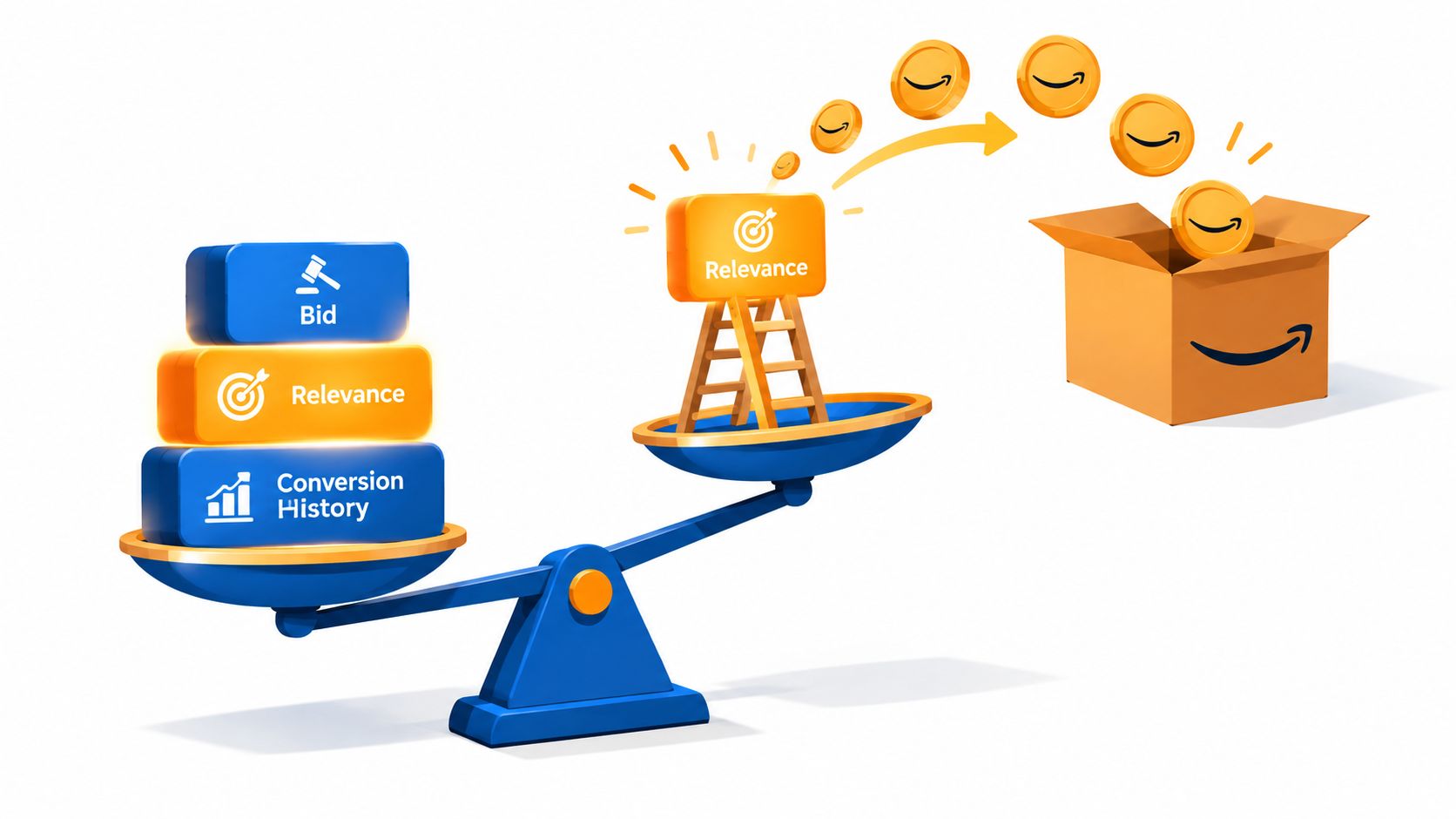
Bid does not win alone
That ranking logic changes how you should manage accounts. If your listing is weak, your click-through rate is soft, or your product has poor conversion history, the answer usually isn't “bid more.” Higher relevance often beats a higher raw bid because it improves both delivery efficiency and downstream economics.
A practical reading of Amazon's auction is this:
- Bid sets your ceiling
- Relevance affects whether you deserve the impression
- Engagement likelihood affects whether Amazon expects the click to happen
That's why listing quality is not separate from PPC. It is PPC.
Placement math changes everything
Placement modifiers are where many accounts either create opportunities or destroy margin. Amazon allows Sponsored Products placement adjustments of up to 900%, which is a 10x increase over the base bid, and defines placement buckets including Top of search, Rest of search, Product pages, and Amazon Business placements, per Amazon Sponsored Products best practices.
Here's the simple example that many teams should run before touching bids:
- Base bid: $1.10
- Top-of-search modifier: 50%
- Effective top-of-search bid: $1.65
If predicted conversion rate is 5%, the rough implied cost per acquisition is $33 before you even consider retail fees, COGS, or contribution margin. That's the math. If the SKU can't support that, the problem isn't the channel. The problem is the bid.
For teams refining bid logic, this guide on how to bid for Amazon ads is a good reference for building bid ceilings around actual economics instead of category folklore.
CPC, vCPM, and automation
Amazon states that Sponsored Products, Sponsored Brands, and Display can use cost-per-click or cost per 1,000 viewable impressions bidding, and that in CPC campaigns, each click deducts your bid amount from your daily budget, as outlined in Amazon bidding model documentation. That means your bid type directly changes how budget drains and how performance should be judged.
Rule-based bidding can help, but only when the account has enough stable history. Amazon says this feature for Sponsored Products is available only after a campaign has run for at least 10 days, uses the previous 21 days for the ROAS guardrail, and may increase bids by up to 5x the adjusted bid amount, according to Amazon's rule-based bidding overview.
My recommendation: Automate only after your query mix, retail readiness, and conversion rate stabilize. Automation amplifies signal. It also amplifies garbage.
Reverse-engineer bids from margin, target spend tolerance, and conversion rate. Don't borrow someone else's bid. Their economics aren't yours.
Metrics That Matter Beyond ACOS in 2026
If your dashboard starts and ends with ACOS, you're not measuring the business. You're measuring one slice of ad efficiency.
The fix isn't to throw ACOS away. The fix is to put each metric in its proper lane.
ACOS vs ROAS vs TACoS vs CTR vs CVR vs ACoV
| Metric | Formula | What it answers | Blind spot | Best stage to prioritize |
|---|---|---|---|---|
| ACOS | Ad spend / ad-attributed sales | How expensive are attributed sales? | Ignores total sales and organic lift | Mid-stage campaign control |
| ROAS | Ad-attributed sales / ad spend | How much revenue came back per ad dollar? | Revenue can look healthy while profit is weak | Mature accounts managing efficiency |
| TACoS | Ad spend / total sales | Are ads improving the whole revenue engine? | Doesn't show which target is leaking | Growth stage and executive review |
| CTR | Clicks / impressions | Are shoppers choosing the ad? | High curiosity can still convert badly | Pre-launch and creative testing |
| CVR | Orders / clicks | Does traffic convert after the click? | Doesn't reveal traffic scale or share loss | Scaling and SKU viability |
| ACoV | Ad spend / attributed order volume or units, depending on internal reporting method | How much spend is tied to volume movement? | Can obscure margin and rank impact | Inventory-led planning and promotions |
Which metric deserves attention when
For a new product, CTR and CVR matter first. The question is whether the market is responding to the offer, creative, and listing. For a growth-stage SKU, TACoS trajectory matters more than a pristine ACOS, because you need to see whether paid sales are pulling organic sales behind them. For mature products, ROAS against contribution margin becomes the sharper test because scale without profit is noise.
Amazon now offers benchmark reporting globally for metrics including CTR, CPC, video completion rate, and cost per completed view, according to Amazon Ads benchmark reporting details. Use that data to diagnose whether the issue is creative, targeting, or bid pressure. Don't use it as an excuse to chase averages.
The directional read that matters
Watch the slope, not just the snapshot.
- Healthy account: TACoS falls while total sales rise
- Unhealthy account: TACoS rises and revenue doesn't scale with it
- Likely root problem: Bid structure, query quality, or listing weakness. Not “insufficient budget”
If ACOS looks ugly but total sales are climbing and paid dependence is shrinking, keep your nerve. If ACOS looks clean and margin is deteriorating, cut faster.
Good operators don't ask which metric is “best.” They know which metric is useful at which stage.
A Repeatable Optimization Workflow for Amazon PPC
Great Amazon PPC management is boring in the right way. It's consistent, structured, and ruthless about waste. Most brands don't need more tactics. They need a repeatable operating loop.
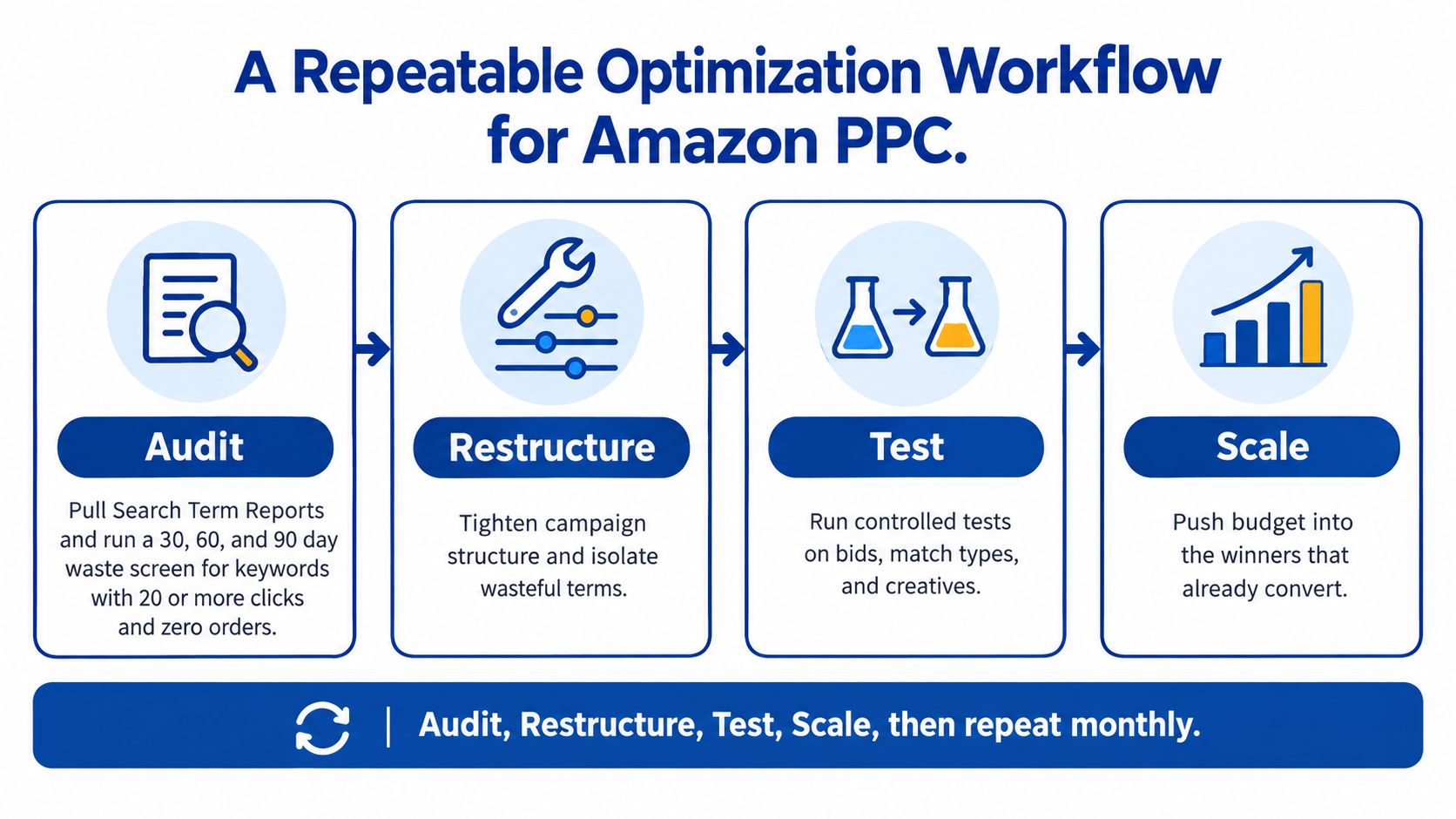
Audit
Start with Search Term Reports. Pull 30-day, 60-day, and 90-day views and screen for terms with 20+ clicks and zero orders. That doesn't mean every one gets cut immediately. It means each term must defend its existence.
Use the dashboard to answer three questions:
- Where is spend pooling without orders
- Which ASINs absorb clicks but don't convert
- Whether waste is query-driven, placement-driven, or SKU-driven
The common mistake is over-pruning during event periods. Prime-heavy traffic can distort short windows. Don't confuse temporary noise with structural waste.
Restructure
Most accounts carry too much mixed intent in the same campaign. Tighten ad groups by shopper intent, split exact from broad, and isolate product targeting from keyword targeting. Move durable winners into Sponsored Brands if the brand case is strong enough to justify a broader search footprint.
A clean structure usually includes:
- Discovery campaigns: Broader reach and query mining
- Control campaigns: Exact-match or tightly proven terms
- Brand defense campaigns: Branded queries and owned category terms
- ASIN defense or conquesting: Product-page competition where relevant
One operational option here is using an analytics layer that combines Search Query Performance and AMC-style path analysis. For brands that want outside support, Headline Marketing Agency offers campaign management across Sponsored Products, Brands, Display, DSP, and AMC reporting.
Test
Don't “optimize” ten variables at once. Run single-variable tests with a fixed 14-day window. Change one of these at a time:
- Bid level
- Placement modifier
- Match type allocation
- Creative format, especially where video can change click behavior
Add dayparting only if your order patterns are stable enough to justify it. Random bid movement isn't testing. It's account drift.
Here's a useful checkpoint before making the next adjustment.
Scale
Budget should graduate to winners only after two conditions hold. First, CVR stays stable after the added traffic. Second, organic rank improves on the target ASIN. If conversion drops as spend rises, you didn't scale a winner. You widened a leak.
The most common failure is copying competitor bids or increasing budgets before conversion stabilizes.
The account review that matters isn't daily tinkering. It's a disciplined weekly loop that asks whether each dollar created profitable momentum.
A practical cadence is a 30-minute weekly review:
- Monday: Waste scan and negative keyword review
- Midweek: Placement and bid change review
- Friday: Scale decision on proven targets only
That pace is fast enough to stay sharp and slow enough to avoid panic edits.
Two Brand Stories That Show PPC Working or Breaking
The difference between smart scale and expensive scale usually shows up before the P&L catches it. You can see it in query quality, conversion stability, and whether paid traffic lifts organic position.
Story one where PPC built rank
A supplement brand entered a crowded category with no business chasing the biggest head terms on day one. The team started with long-tail ingredient searches in Sponsored Products, then added Sponsored Brands video once the listing proved it could convert and explain the product clearly.
The account held TACoS flat at 12% while organic rank moved from page 4 to top 3 on six core terms over five months. The key wasn't heroic bidding. It was sequencing. Paid traffic introduced the ASIN on lower-friction searches first, then widened outward only after the PDP and review base could support broader clicks.
The leading indicator was clean query progression. Search terms moved from long-tail specificity into more competitive category language while conversion stayed stable enough to justify the push. When spend later came down, the organic lift stayed.
Story two where scale broke margin
A home goods brand wanted faster sales-rank movement and treated budget expansion as the answer. Sponsored Products budgets were scaled 3x in a quarter. Sales rose, but the account quality didn't.
CPCs inflated, ACoV doubled, contribution margin turned negative for two months, and organic rank didn't improve. Paid sessions were taking credit for demand the brand likely would have earned anyway. The account bought volume without improving real market position.
The warning sign is simple. If budget rises faster than conversion quality, you're not scaling. You're paying more to stand still.
The leading indicator here was cannibalization. Branded and near-branded traffic soaked up more spend, while non-branded discovery queries failed to build incremental reach. On paper, attributed sales looked fine for a while. In the business, the margin story was ugly.
What these stories actually mean
Both brands used PPC. Only one used it as a growth engine.
The first brand treated Amazon ads as a controlled way to earn rank. The second treated ads as a shortcut to rank. That's the line many teams miss. Spend doesn't create momentum on its own. It only works when traffic quality, listing quality, and retail readiness reinforce each other.
Strategic Takeaways for Profitable Amazon Scale
The brands that win on Amazon in 2026 won't be the ones with the busiest bid files. They'll be the ones that know exactly when to defend, when to press, and when to stop.
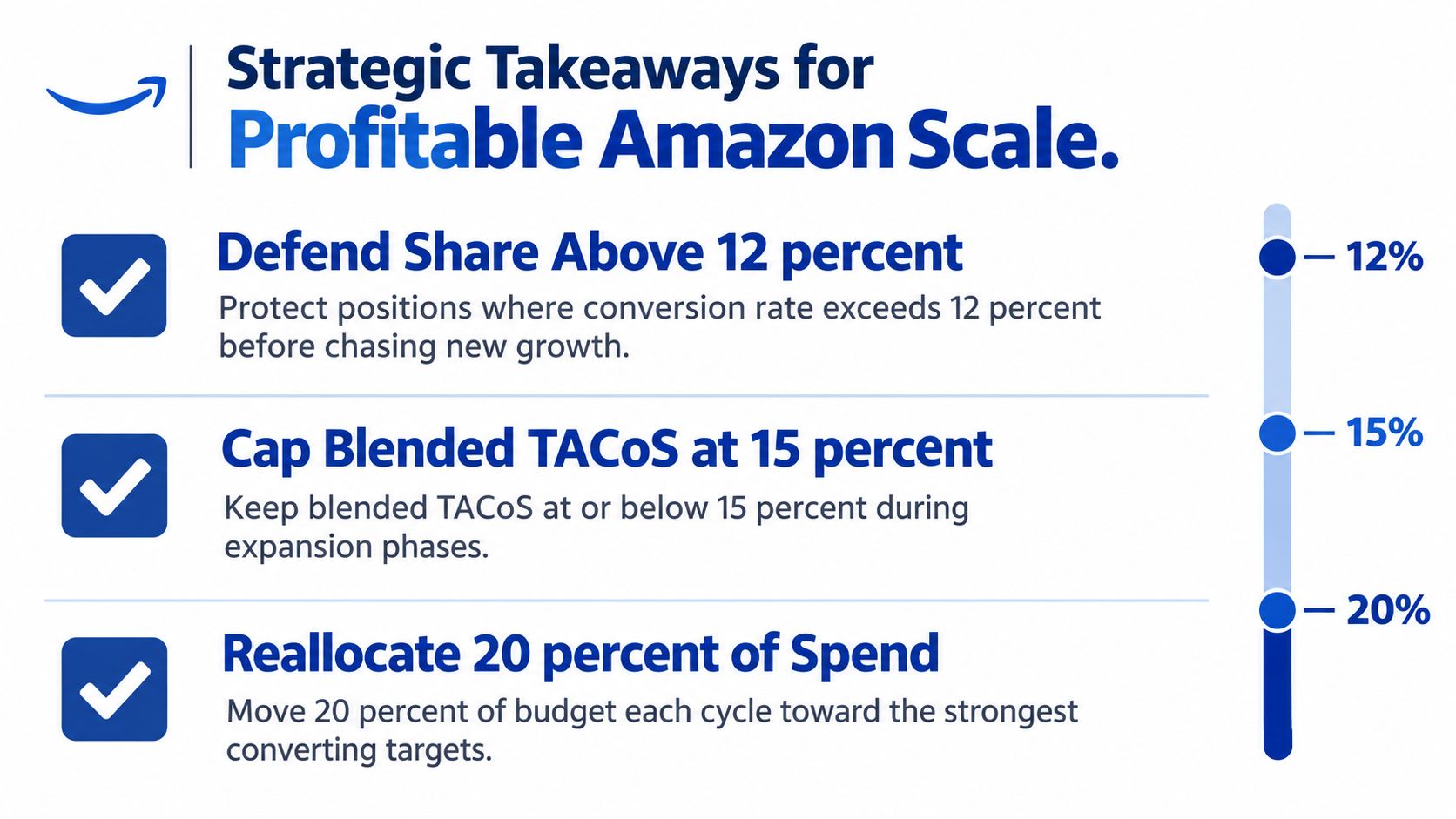
Three operating rules I'd put in every account
- Defend share where conversion rate exceeds 12%. If shoppers already convert at that level, protect the position before chasing fresh traffic.
- Cap blended TACoS at 15% during expansion phases. That keeps growth disciplined and prevents budget creep from getting rebranded as strategy.
- Reallocate 20% of spend toward Sponsored Display retargeting once new-to-brand orders exceed 40%. That's where many brands can reinforce discovery instead of overspending on the same search clicks.
These aren't universal laws. They are strong default guardrails.
Know when to stop scaling
They don't have a scaling problem. They have a stopping problem.
Use hard pause triggers. If ACoS stays above 60% for 21 consecutive days with no organic lift, stop feeding the target. Don't wait for hope to become a plan. Review the query mix, the placement mix, and the retail fundamentals behind the ASIN.
The broader market context supports that caution. One 2025 estimate put Amazon's ad business at around $62 billion, and the largest platform owners were said to capture 55.8% of advertising spend outside China, according to Advanced Television's ad market forecast. The cheap-growth era is over. Competition is tighter, auctions are denser, and sloppy spend gets punished faster.
AMC separates operators from bid tweakers
Amazon Marketing Cloud matters because it lets brands ask better questions than the ad console alone can answer. Which paths produce purchase? Which formats assist conversion without taking last-click credit? Which audiences are worth re-engaging? Which campaigns create halo outside the immediate SKU?
That's especially important when you need cross-channel path-to-purchase analysis and a cleaner read on whether Amazon media is helping Shopify or other retail channels. Console metrics tell you what got credited. AMC helps you understand what contributed.
Retail readiness still decides whether media works
Before increasing spend, audit the basics:
- Buy Box win rate: If you can't consistently win it, media spend leaks
- Inventory aged over 90 days: Old inventory can justify selective pushes, but not blind scaling
- Review velocity: Weak review accumulation limits conversion no matter how smart the bidding is
Media can't rescue operational sloppiness. It can only expose it faster.
Strong Amazon advertising is part media strategy, part merchandising discipline, and part financial control.
The rules for 2026 are simple. First, bid from margin, not from ambition. Second, judge paid media by its effect on profit and organic rank, not by ACOS alone. Third, stop scaling the moment spend stops creating incremental demand.
Headline Marketing Agency helps consumer brands manage Amazon PPC, DSP, and AMC analysis with a profit-first lens that goes beyond ACOS into contribution margin, organic ranking, and sustainable scale. If you want an expert team to audit your bidding logic, restructure campaigns, and connect Amazon media to real growth outcomes, visit Headline Marketing Agency.
Get Your Free Amazon PPC Audit
Discover untapped growth opportunities and see how our data-driven approach can improve your ROAS.
Get Free Audit →Wollen Sie Ihre Amazon PPC-Performance aufs nächste Level bringen?
Lassen Sie Ihre Amazon PPC-Kampagnen professionell analysieren und entdecken Sie neue Wachstumsmöglichkeiten.