How to Bid for Amazon: A Profit-First Framework for Growth
We've spent years in the Amazon trenches with real brands. Our bid guide distills what works from what's noise.

Winning an ad auction on Amazon is more than a momentary victory; it’s a strategic move to fuel your entire sales flywheel. The objective isn't a vanity click—it's converting that click into a profitable sale that boosts organic rank, drives sustainable growth, and builds a dominant brand. This requires a performance-first mindset that sees PPC as a powerful lever for total business health, not just an ad expense.
Rethinking Your Amazon Bidding Strategy
For too long, Advertising Cost of Sale (ACoS) has been the default metric for success in Amazon advertising. While simple to track, an obsession with maintaining a low ACoS is a flawed strategy that can starve your business of growth. It forces conservative bidding, robbing your products of the visibility needed to gain sales velocity. This risk-averse approach leads to stagnant sales and, worse, creates a vacuum for aggressive competitors to capture market share.
The conversation must shift from a siloed ad metric to a holistic business objective. The true goal isn't the lowest possible ACoS; it's maximizing total profitability and achieving sustainable scale.
From Ad Metric to Business Lever
Viewing your Amazon PPC bid as a simple advertising cost is a critical misstep. Every dollar spent on ads is a direct investment in your product's organic trajectory. A strategic bid ignites a powerful flywheel effect:
- Accelerated Sales Velocity: Winning prime ad placements is the fastest way to generate crucial initial sales and prove product viability to Amazon's algorithm.
- Organic Rank Ascension: The A9 algorithm rewards sales velocity with higher organic search rankings. In a 2022 study, Amazon found that launching a new product with a Sponsored Products campaign can lead to the first order 50% faster than launching without ads.
- Flywheel Momentum: Higher organic rank generates more organic sales, which improves sales history, solidifies keyword relevance, and cements your product's position.
This symbiotic relationship between paid advertising and organic performance is the key to scaling on Amazon. Your ad spend should, over time, decrease your dependency on ads. The most effective measure of this is Total ACoS (TACoS), which provides a clear view of how advertising spend impacts total revenue. Dive deeper into calculating and leveraging ACoS on Amazon in our comprehensive guide.
Bidding as a Strategic Move
The competitive landscape on Amazon mirrors other high-stakes bidding environments. Consider Amazon's 2017 HQ2 search, where over 200 cities vied for a $5 billion investment and 50,000 high-paying jobs. Much like those cities competed for a massive long-term economic prize, brands on Amazon must bid strategically to secure marketplace dominance. Every bid is a calculated move to outmaneuver competitors and claim prime digital real estate. Read more about Amazon's intense corporate location hunt on Wikipedia.
The Takeaway: Stop treating your Amazon bid as an isolated expense. Start seeing it as a strategic investment engineered to drive total sales, elevate organic rank, and grow net profit. The ultimate prize isn't a low ACoS; it's sustainable profitability.
Calculating Your True Profitability Bid
Let's be transparent. Amazon's "suggested bid" in Campaign Manager is convenient, but it has no connection to your business's most critical metric: profit. Setting bids based on platform suggestions or, worse, intuition, is like flying blind. You might generate clicks and sales, but you'll have no idea if you're actually making money or simply funding Amazon's bottom line.
A professional, performance-first approach dictates that every bid is anchored in your product's unit economics. This isn't just about winning an auction; it's about ensuring every paid-for sale is profitable. Forget the guesswork—let's build your bid from the ground up, using real financial data.
The Foundation: Your Product's Financials
Before placing a single bid, you must understand your profit margin per unit, before advertising costs. This figure is your financial guardrail.
To establish this, you need precise data for your product:
- Sale Price: The customer-facing retail price.
- Landed Cost: The total cost to get one unit into an Amazon fulfillment center (manufacturing, freight, duties, etc.).
- Amazon Fees: The non-negotiable costs of selling, including the referral fee (typically 15%), FBA fulfillment fees, and any storage costs.
With these figures, you can calculate your pre-ad profit per unit. This number is your north star—the absolute maximum you can spend to acquire a sale and break even.
This mindset represents a crucial strategic shift, moving away from chasing a low ACoS toward a model focused on total, sustainable profit.
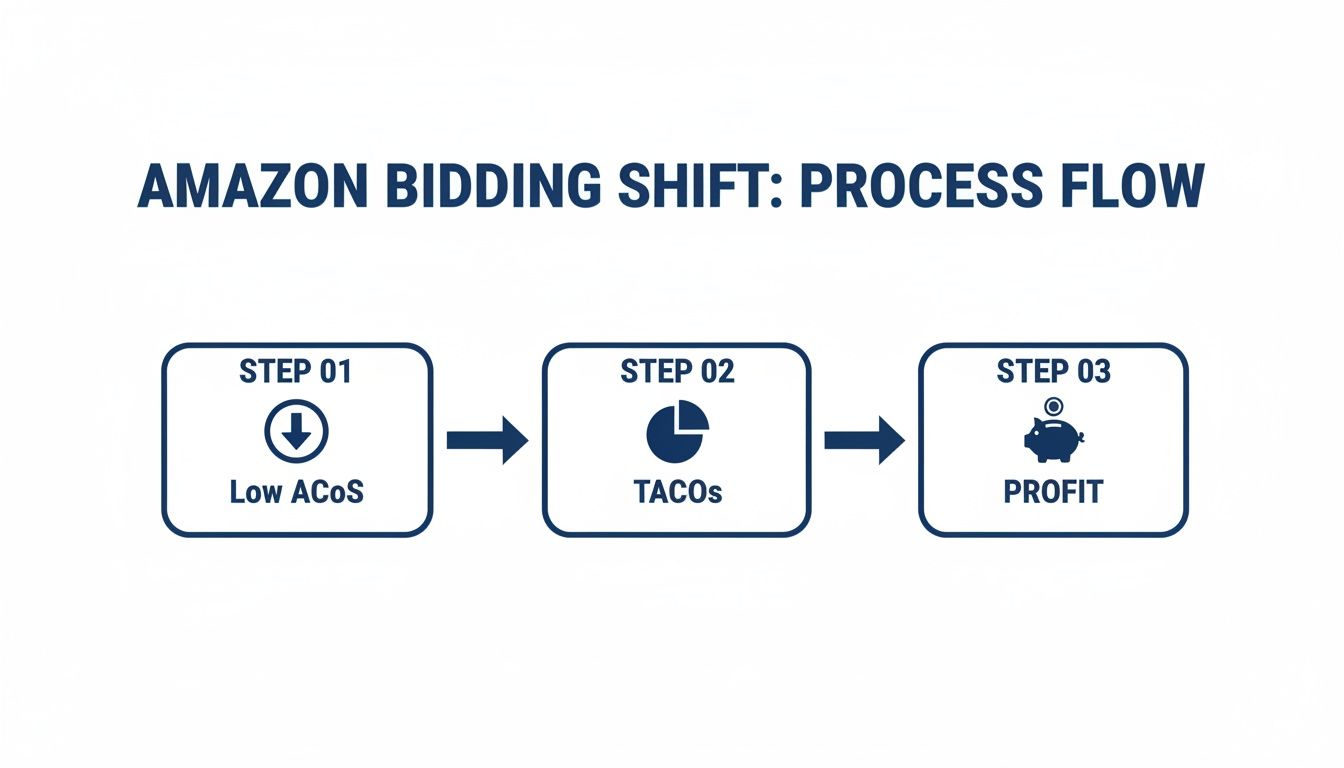
As you can see, a mature Amazon advertising strategy looks beyond simple campaign metrics and focuses on the bigger picture of overall profitability.
Turning Profit Margin into a Break-Even ACoS
Your break-even ACoS is your pre-ad profit margin expressed as a percentage. It is the highest your ACoS can be before you start losing money on a sale. Any ACoS below this threshold is profit; anything above it means you're paying customers to take your product.
Let's apply this with a real-world example.
Scenario: A $50 Product
- Sale Price: $50.00
- Landed Cost: $15.00
- Amazon Fees (Referral + FBA): $17.50
- Total Costs (pre-ad): $15.00 + $17.50 = $32.50
- Net Profit (pre-ad): $50.00 - $32.50 = $17.50
Now, calculate the profit margin: $17.50 / $50.00 = 35%
For this product, your break-even ACoS is 35%. This is your hard ceiling. At an ACoS of 35%, you've spent the entire $17.50 profit on ads to generate that one sale.
Setting Your Target ACoS for Growth
Breaking even isn't the goal. We're here to build a profitable business. This is where your Target ACoS comes in—the metric that strategically builds your desired profit margin directly into your advertising KPIs.
Continuing our example, let's assume you're targeting a 15% net profit margin after ad spend.
- Start with your Break-Even ACoS: 35%
- Subtract your Desired Profit Margin: 15%
- This gives you your Target ACoS: 35% - 15% = 20%
A 20% Target ACoS is now the primary performance indicator for this product's campaigns. It's a data-driven goal that directly aligns ad performance with your company's P&L. For a more detailed breakdown, dive into our guide on building an Amazon seller profit calculator.
From Target ACoS to a Precise Starting Bid
Now we translate the Target ACoS into an actionable starting bid. For this final step, you need one more data point: your product's Conversion Rate (CVR). For a new product, it's practical to use a category average (e.g., 10%) and refine it as you collect performance data.
The formula is elegantly simple:
Starting Bid = (Sale Price x CVR) x Target ACoS
Let's plug in the numbers from our example:
- Sale Price: $50
- CVR (estimated): 10% (or 0.10)
- Target ACoS: 20% (or 0.20)
Starting Bid = ($50 x 0.10) x 0.20 = $5.00 x 0.20 = $1.00
Your profit-driven starting bid is $1.00.
To make this process even clearer, here’s a table that walks you through the entire calculation from start to finish.
Profit First Bid Calculation Framework
This table breaks down the journey from your product's costs all the way to a calculated, profit-driven starting bid.
| Metric | Example Value | Calculation/Formula | Description |
|---|---|---|---|
| Sale Price | $50.00 | N/A | The retail price of the product on Amazon. |
| Landed Cost | $15.00 | N/A | Total cost per unit, including manufacturing and shipping to FBA. |
| Amazon Fees | $17.50 | N/A | Includes Referral Fee, FBA Fees, and other selling fees. |
| Pre-Ad Profit | $17.50 | Sale Price - (Landed Cost + Amazon Fees) | The net profit on a single sale before any ad spend is factored in. |
| Break-Even ACoS | 35% | (Pre-Ad Profit / Sale Price) | The maximum ACoS before a sale becomes unprofitable. |
| Desired Profit Margin | 15% | N/A | Your target net profit margin after all costs, including ad spend. |
| Target ACoS | 20% | Break-Even ACoS - Desired Profit Margin | The ACoS goal that ensures you hit your desired profit margin. |
| Conversion Rate (CVR) | 10% | N/A | The percentage of clicks that result in a sale. Use an estimate if needed. |
| Calculated Starting Bid | $1.00 | (Sale Price x CVR) x Target ACoS | The final, data-backed starting bid for your campaigns. |
By following this framework, you're not guessing; you're setting a bid that is fundamentally aligned with the financial reality of your business.
The Takeaway: This is not a guess. It's a calculated bid anchored in your product's unique financial reality. Starting here ensures your PPC campaigns are built on a foundation of profitability, transforming ad spend from a fluctuating expense into a predictable engine for scalable growth.
Fine-Tuning Your Bids in the Ad Console
You've calculated your starting bid based on profitability—your strategic anchor. Now, we enter the Amazon ad console to transform that static number into a responsive, intelligent bidding system.
This is where tactical execution begins. You're instructing Amazon's algorithm on the level of autonomy it has to adjust your bid based on the real-time probability of a conversion. Getting this right is the difference between efficient spend and leaving money on the table.
What Are Amazon's Dynamic Bidding Options?
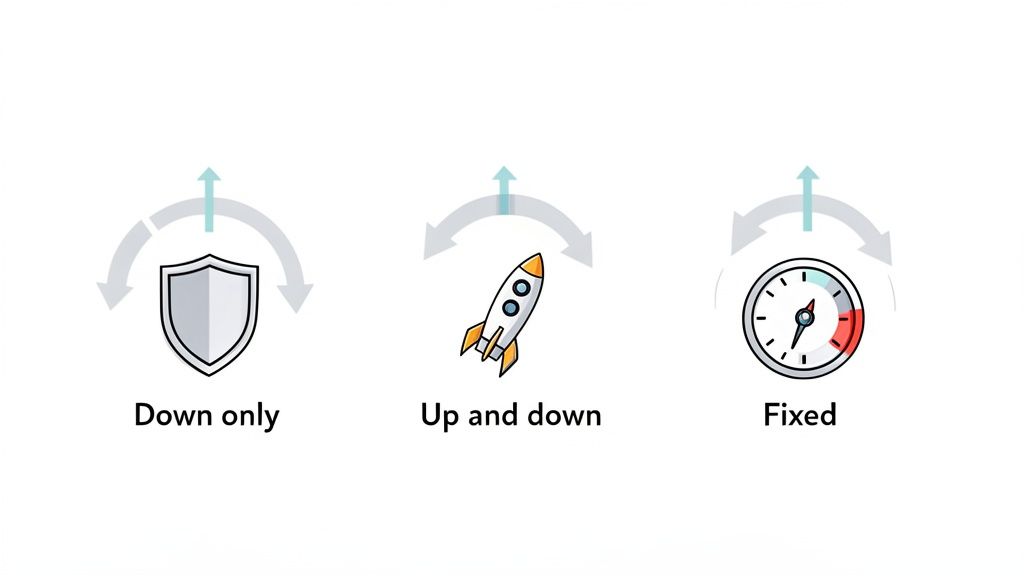
Amazon provides three core bidding strategies, each suited to a different business objective. Are you launching a new product and need maximum visibility? Defending market share for a hero SKU? Or optimizing for pure profit on a mature product? Your goal dictates your choice.
Let's examine them through a performance-first lens.
Fixed Bids: You set a bid, and Amazon uses that exact amount for every auction. It offers complete predictability but is extremely rigid. You will miss opportunities to win high-converting placements and overpay for low-intent clicks. This is best reserved for controlled experiments where a clean baseline is required.
Dynamic Bids - Down Only: This is the default setting for most mature, profit-focused campaigns. With this strategy, Amazon will only lower your bid if its algorithm predicts a lower likelihood of conversion. It is the ideal mechanism for protecting profit margins once a product is established and you are focused on maintaining a specific Target ACoS.
Dynamic Bids - Up and Down: This is your aggressive growth lever. Amazon can increase your bid by up to 100% for top-of-search placements (and up to 50% for other placements) if it identifies a high probability of conversion. Use this for product launches, key promotional periods (like Prime Day), or any scenario where capturing visibility and sales velocity is the primary goal, even at the cost of a temporarily higher ACoS.
Expert Recommendation: Align your bidding strategy with your campaign's business objective. Use 'Down only' to protect profitability on established products. Deploy 'Up and down' to maximize visibility during launches and key selling seasons. Reserve 'Fixed bids' exclusively for controlled A/B testing.
Getting Granular with Placement Modifiers
Beyond the primary bidding strategy, placement modifiers offer another layer of control. This feature allows you to increase your bid by a specified percentage for specific, high-value ad placements—namely, ‘Top of search’ and ‘Product pages.’
This decision must be driven by data, not assumptions.
Navigate to your campaign and select the 'Placements' tab. Analyze the performance data. Is your conversion rate and ACoS significantly better for ads at the 'Top of search'? That is a clear signal to act.
For example, if top-of-search placements convert at 25% while product page placements convert at only 10%, it's a data-backed decision to apply a 15-25% positive bid modifier to compete more aggressively for that prime real estate. Digging into this data is a core discipline of effective Amazon PPC optimization.
These daily bidding wars on Amazon are microcosms of larger business negotiations. When cities vied for Amazon’s HQ2, New York offered a $1.85 billion incentive package, but Virginia ultimately won with a more strategic $750 million deal. Brands face similar bidding decisions for ad placements daily.
To ensure your Amazon bidding aligns with your broader marketing efforts, it's beneficial to understand a range of paid ad strategies. At Headline, we use proprietary data to architect bids that not only win auctions but also enhance organic rank, ensuring clients secure maximum value without overpaying—a principle Amazon itself followed in its HQ2 selection.
Advanced Bid Optimization for Sustainable Growth
Establishing correct initial bids gets you into the game. Winning on Amazon long-term requires graduating from manual adjustments to scalable, automated systems. Sustainable growth isn't about tweaking a single keyword; it's about building an intelligent advertising engine that operates 24/7.
Here, we move from reactive bid management to a proactive, data-driven strategy. The objective is no longer just hitting an ACoS target in one campaign but orchestrating your entire advertising ecosystem to drive measurable business outcomes. Let's explore the advanced techniques that separate market leaders from the rest.
Automating Your Bids with Rules
At scale, manually adjusting bids for hundreds or thousands of keywords is inefficient and prone to error. Amazon's automated bidding rules are an essential tool for implementing your strategy with precision and consistency.
These rules allow you to create "if-then" logic that automatically adjusts bids based on performance criteria you define. Think of them as your custom bidding algorithm, designed to enforce your strategy at scale.
For example, you can create a rule to capitalize on profitable keywords:
- IF a keyword's ACoS is below 15% over the last 14 days…
- AND it has generated more than 10 orders…
- THEN increase the bid by 10% to capture more impression share.
Conversely, you can automate waste reduction:
- IF a keyword has over 20 clicks with zero sales in the past 30 days…
- THEN decrease the bid by 25% or pause the keyword.
Implementing these guardrails ensures you are consistently reinvesting in what works and cutting what doesn't, without requiring constant manual intervention.
Strategic Portfolio Bidding
Managing numerous campaigns with a shared business objective in individual silos is a missed opportunity. Portfolio bidding solves this by allowing you to group campaigns to manage them against a unified budget and performance target.
This approach is exceptionally powerful for strategic initiatives. For instance, during a new product launch, you can group its Sponsored Products, Sponsored Brands, and Sponsored Display campaigns into a "Product Launch" portfolio. By setting a portfolio-level budget and ACoS target, you empower Amazon's algorithm to dynamically allocate spend between campaigns to achieve the best overall result.
Key Takeaway: Portfolio bidding is a strategic tool that elevates your focus from micromanaging campaign inputs to achieving a broader business outcome, whether that's defending brand territory or dominating search results during a holiday promotion.
Manual Bidding vs Automated Bidding Approaches
The optimal bidding method depends on your campaign goals, maturity, and available resources. The most sophisticated advertisers employ a hybrid approach, leveraging each method for its strengths.
Here's a comparison to guide your strategic decisions.
| Bidding Approach | Best For | Pros | Cons |
|---|---|---|---|
| Manual Bidding | New campaigns, testing specific keywords, and controlling high-value targets. | Maximum control for precise, real-time adjustments based on strategic insights. | Extremely time-consuming, difficult to scale, and susceptible to human error. |
| Rule-Based Automation | Mature campaigns with clear performance goals; scaling management efforts. | Saves significant time, enforces consistent strategy, and reacts automatically to performance trends. | Rules can be too rigid if not monitored; requires careful setup and initial validation. |
| Portfolio Strategies | Managing multiple campaigns with a shared goal (e.g., brand defense, a new product launch). | Optimizes budget across campaigns, simplifies high-level management, focuses on a unified objective. | Cedes granular keyword-level control; requires a clear, overarching strategic goal to be effective. |
Each approach has its place. You might use manual bidding for a new, high-stakes keyword, rely on rule-based automation for established evergreen campaigns, and create a portfolio for a major seasonal push like Prime Day.
The Next Frontier: AMC and DSP Integration
The pinnacle of bid optimization involves integrating data beyond the Sponsored Ads console. True full-funnel management requires leveraging insights from every customer touchpoint to inform bidding decisions. This is the domain of Amazon Marketing Cloud (AMC).
AMC allows you to analyze anonymized signals from disparate sources—Sponsored Ads, Amazon DSP, and your brand's first-party data—to map the entire customer journey. For example, analysis might reveal that customers exposed to a DSP ad who later search a specific non-branded keyword convert at a 3x higher rate.
This is actionable intelligence. You can then build a specific audience and strategically increase your Sponsored Products bid for that high-value search term. This is how you connect upper-funnel brand building with lower-funnel conversion tactics, ensuring every ad dollar works in concert. Understanding what AI in bid optimization can add to this equation is key for staying ahead. You're no longer just managing campaigns; you’re orchestrating a fully integrated, profit-driving machine.
How to Monitor Performance and Fix Common Pitfalls
A successful Amazon bid strategy is not "set it and forget it." It is a dynamic system that requires continuous monitoring and intelligent adjustment. Launching with profit-first bids is the correct first step, but long-term success is achieved through disciplined iteration based on performance data.
Too many brands develop tunnel vision, fixating on ACoS while ignoring other vital metrics that tell the complete story of campaign health.
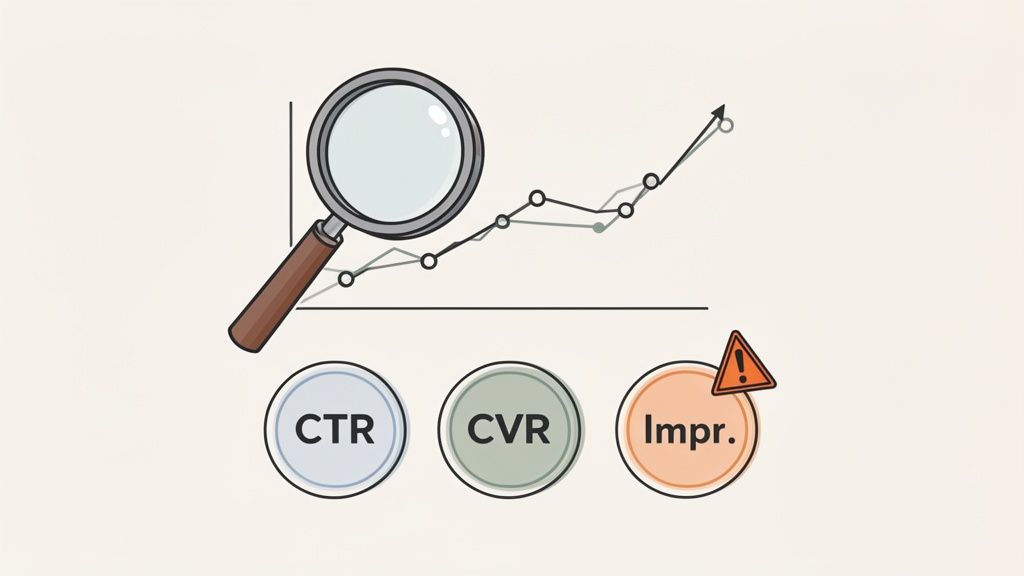
Effective monitoring involves looking beyond a single metric to understand the interplay between all performance indicators. This approach allows you to shift from reacting to a high ACoS to proactively diagnosing and solving root-cause issues before they drain your budget. The best bid for Amazon ads is only as good as the business results it drives.
Key Metrics to Watch Beyond ACoS
To get a holistic view, monitor these key performance indicators. Each reveals a different part of the customer journey, from ad visibility to final purchase.
- Click-Through Rate (CTR): Measures the effectiveness of your ad creative (main image, title, price) at capturing attention for a specific keyword.
- Conversion Rate (CVR): The ultimate measure of your product detail page's effectiveness. A strong CVR indicates that your listing successfully converts traffic into sales.
- Top-of-Search Impression Share (ToS IS): The percentage of available impressions you are winning in the most valuable ad placements at the top of search results. This is a direct measure of your visibility against key competitors.
True insight comes from analyzing these metrics together. For example, a high ToS IS coupled with a low CTR indicates your bid is winning the placement, but your creative is losing the click. This is a creative optimization problem, not a bidding problem.
A Practical Troubleshooting Guide
Diagnosing campaign underperformance is a process of elimination. Instead of blindly adjusting your bid for Amazon keywords, use this framework to identify the root cause and apply the correct solution.
Problem 1: My ACoS is great, but sales volume is flat.
This is a classic symptom of overly conservative bidding. Your campaigns are efficient but lack the reach to drive meaningful growth.
- The Diagnosis: Your bids are too low to win sufficient impression share on high-traffic placements. You are likely winning auctions for low-volume, long-tail keywords while missing out on core terms that drive scale.
- The Fix: Methodically increase bids on your highest-performing, most relevant keywords. For a defined test period, consider switching the campaign's bidding strategy from "Down only" to "Up and down" to more aggressively pursue impression share. Monitor your ToS IS; the objective is to see this metric increase.
Problem 2: My ads are getting tons of impressions, but my CTR is terrible.
You are paying for visibility, but shoppers are scrolling past your ad.
- The Diagnosis: The issue lies with your ad creative or targeting. Your main image may be uncompelling, your title may lack a clear benefit, or your price may be uncompetitive. Alternatively, you may be bidding on keywords that are too broad and not truly relevant to your product.
- The Fix: Do not adjust bids yet. Focus on A/B testing your main image. Rewrite your title to highlight a key user benefit. Conduct a competitive price analysis. Refine your keyword targeting to improve relevance.
A low CTR is rarely a bidding problem. Before you adjust your bid for Amazon, ensure your digital shelf is optimized. You cannot solve a creative problem by increasing your auction spend.
Problem 3: My CTR is high, but my CVR is in the basement.
Your ad is successfully generating clicks, but the product page is failing to convert shoppers into buyers. The ad worked; the listing failed.
- The Diagnosis: Your product detail page has a conversion blocker. This could be weak bullet points, poor-quality secondary images, negative customer reviews, or a critical issue like being out of stock.
- The Fix: Again, do not adjust the bid. Perform a thorough listing optimization. Rewrite bullet points to focus on benefits, not features. Add lifestyle imagery or infographics. Address negative reviews. Ensure your A+ Content is engaging and answers common customer questions.
Got Questions About Amazon Bids? We’ve Got Answers.
Even with a robust strategy, the realities of Amazon bidding can present challenges. Senior e-commerce leaders often encounter the same practical hurdles when implementing a profit-first bidding framework. Let's address the most common questions.
How Often Should I Actually Be Adjusting My Bids?
For established campaigns, a weekly review cadence is effective. This changes during high-stakes periods. For a product launch or a major event like Prime Day, more frequent monitoring—every 2-3 days—is necessary.
The critical discipline is to avoid reactive adjustments based on short-term data. Before making a change, ensure you are analyzing a statistically significant data range, typically 7 to 14 days, to identify a true trend. This prevents overcorrection based on normal daily fluctuations.
A Quick Word of Advice: Data patience is a competitive advantage. Adjusting bids too frequently can disrupt the learning phase of Amazon's algorithm, making it impossible to determine what is actually effective. Allow sufficient data to accumulate before taking action.
Why Are My Bids High but My Impressions Are Still Awful?
This is a common issue that is almost always rooted in relevance, not bid amount. Amazon's algorithm prioritizes showing shoppers products they are likely to buy. It considers your bid, but it heavily weights your product's historical performance for that keyword, especially its Click-Through Rate (CTR) and Conversion Rate (CVR).
If your product listing is not well-aligned with the search query, Amazon will suppress your ad—regardless of your bid. It is proactively preventing a poor customer experience. You cannot solve a relevance problem with a higher bid.
If you face this issue, conduct a listing audit:
- Title: Does it include the primary keyword naturally?
- Bullet Points: Do they directly address the needs of a user searching that term?
- Backend Keywords: Are they populated with relevant synonyms and related terms?
Improving the alignment between your keyword and your listing signals to Amazon that your product is a relevant solution for the search, which will allow your bid to become effective.
What’s a Good Starting Bid for a Brand-New Campaign?
Never guess or blindly accept Amazon's "suggested bid." This suggestion provides a general sense of the competitive landscape but is completely disconnected from your product's profitability.
The only correct method for setting a starting bid for Amazon is to work backward from your unit economics, as outlined previously. Calculate your break-even ACoS based on your pre-ad profit margin. This is your absolute ceiling.
Then, establish a Target ACoS that ensures your desired net profit. Use that target, along with an estimated conversion rate, to calculate a data-driven starting bid. This ensures your campaign is built for profitability from the very first click.
Should I Really Bid on My Own Brand Name?
Yes. Unquestionably, 100% of the time. Failing to bid on your own branded terms is one of the costliest and most common mistakes on Amazon. If you do not occupy that top ad placement, a competitor will. They will happily place their ad above your organic listing and siphon away high-intent customers who were actively searching for your brand.
This is a non-negotiable defensive strategy:
- It's Defense: It creates a competitive moat around your brand traffic, preventing poaching.
- It's Profitable: Branded campaigns consistently deliver the highest conversion rates and lowest ACoS in an ad account. They are highly efficient.
- It's Control: It gives you complete control over the top-of-search messaging and directs shoppers to your flagship product.
Consider it inexpensive insurance. You are paying a small premium to protect your most valuable asset: customers who are already seeking you out.
At Headline Marketing Agency, we transform complex bidding decisions into a straightforward, profit-driven roadmap for growth. Our team leverages proprietary data and a deep understanding of the Amazon ecosystem to architect advertising strategies that don't just win auctions—they build lasting marketplace dominance. Stop guessing and start growing with a true Amazon advertising partner.
Get Your Free Amazon PPC Audit
Discover untapped growth opportunities and see how our data-driven approach can improve your ROAS.
Get Free Audit →Ready to Transform Your Amazon PPC Performance?
Get a comprehensive audit of your Amazon PPC campaigns and discover untapped growth opportunities.