How to Use Smart Automation Solutions for Amazon PPC
Learn how smart automation solutions can improve Amazon PPC bidding, budget allocation and performance monitoring, with practical rules and guardrails.

The most automated Amazon advertising account is not the most profitable one. Automation volume and profit move on separate tracks, and treating the first as a proxy for the second is how brands end up with a tidy dashboard and a shrinking contribution margin.
The spending data points the other way, at least on the surface. The World Economic Forum's 2025 Future of Jobs Report found that 73% of employers globally planned to accelerate process and task automation, while 63% intended to use new technologies to complement or augment their workforce rather than replace it. The 2025 Enterprise Automation Index from Automation.com reported that 73.2% of surveyed businesses increased automation investments during the prior year. Nobody is debating whether to adopt anymore.
The open question is which decisions you can afford to let a machine make at speed, and which ones need a person who can see the trade-off the rule can't. Smart automation solutions earn their keep when they shorten the distance between a signal and a correct action. They cost you money when they shorten the distance between a signal and a wrong one, thousands of times, before anyone notices.
Which Amazon Ad Tasks Are Ready to Automate
Smart automation solutions are rules and models that run repeatable ad actions on a schedule, while people set the thresholds and handle whatever falls outside them. A bid rule, a budget cap, a Monday morning report and an anomaly alert are the same species: an if-then loop with a human boundary drawn around it.
The boundary is where most accounts get it wrong. Teams hand over the tasks that were easiest to build, not the tasks that are safest to run.
What separates a safe handover
Three properties decide it. The task fires often enough that a rule saves real hours. The decision can be written in one sentence. And a wrong call costs a bid change or a day of budget, not a quarter of margin. The table below sorts the core Amazon PPC tasks by that test.
| Task | Automation level | Trigger rule | Who decides |
|---|---|---|---|
| Search-term harvesting | Full automation | Converting term with 2 or more orders and no existing keyword | Rules, reviewed weekly |
| Bid adjustments on stable keywords | Full automation | ACOS outside target band for 7 days | Rules, checked daily |
| Daily budget pacing | Full automation with hard cap | Spend above 110% of daily target | Rules, capped at set maximum |
| Anomaly alerts | Full automation | Conversion rate down 30% against 14-day average | Alert goes to account owner |
| Recurring performance reporting | Full automation | Every Monday, covering the prior 7 days | Analyst reviews |
| Major budget reallocation | Automation proposes, human approves | Shift above 20% of portfolio budget | Marketing lead |
| Brand defense bids | Human-led | Competitor bidding on brand terms | Brand manager |
| Creative and listing changes | Human-led | Test result reaches statistical significance | Content team |
Every row in the top half of that table shares all three properties. The bottom two don't, and no amount of model quality fixes that.
The pattern holds outside Amazon. A Forbes Insights and Kofax benchmark survey of 302 senior executives across 16 countries found more than three-quarters believed at least 60% of their process-oriented work could be automated. The categories they automated were the structured ones: quality control at 43%, technology enhancement at 42%, financial transactions and reporting at 35%, customer experience and product delivery at 32% each.
So automate by process suitability and exception cost, not by the share of tasks a tool could technically handle. A task with clean inputs, a written rule and a cheap error belongs in full automation. A task where the error is expensive and hard to reverse, such as pushing 30% of a portfolio budget into a keyword set you've never tested, stays with a person.
Most of the fully automated rows above execute through the same place: Amazon bulk operations files, where one upload writes thousands of changes and leaves a trail you can read the next morning. Amazon PPC bulk operations is worth learning properly before you buy any tool, because every vendor is ultimately editing those same fields.
This week, put every recurring task in your account into one of three buckets: fully automated, automated with review, human-led. Write the trigger rule and the owner next to each. Any task that lands in the first bucket without a written threshold goes back to the second until it has one.
How to Set Up Automated Bidding Rules
A bid rule is an if-then loop that compares actual performance with a target and moves the bid only when the gap persists. Persistence is what separates a rule from a reflex, and it's the part most accounts skip.
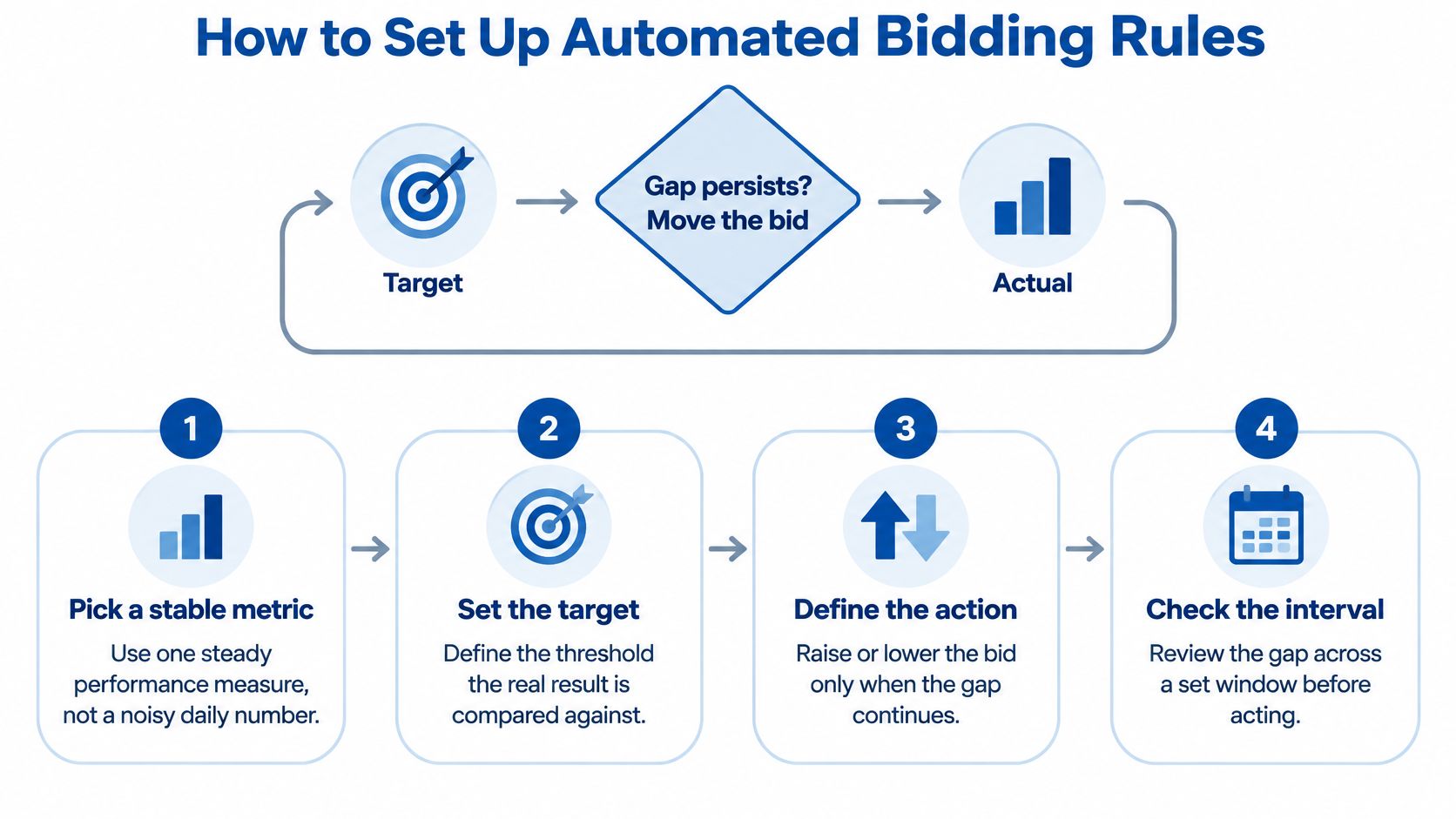
- Pick a stable keyword set with at least 30 days of history. New keywords produce noise, and a rule trained on noise will chase it. The common slip is switching the rule on across the whole account in week one.
- Set a target ACOS with a tolerance band of about plus or minus 20%. No keyword hits its target every day, so the band defines what counts as normal. Set it too tight and every ordinary fluctuation triggers a change.
- Define the trigger as seven days outside the band. One bad day is noise; a week is a pattern. The slip here is running the rule on keywords with fewer than 10 clicks in the window, where ACOS is arithmetic rather than evidence.
- Cap each change at 15% per day. The cap stops one bad data day from resetting a bid you spent months dialing in. Uncapped rules are how a bid travels from $1.20 to $0.40 in a fortnight.
- Set bid floors and ceilings. The floor keeps a temporary dip from walking a bid toward zero, and the ceiling keeps an aggressive rule from buying impressions at a loss. Set the floor too high and you block the downward correction you needed.
- Add a daily anomaly check on top of the rule. A rule responds only to the conditions you wrote into it. It won't notice a suppressed listing or a competitor's coupon push.
- Log every change with a reason, then read the log weekly. The log is the only way to tell a rule that's working from a rule that's been lucky. A log without a reason field gives you nothing to review.
For a home goods brand, we built automated bid rules with a daily monitoring system for ACOS, and the monitoring is what catches the days when a rule is technically correct and commercially wrong.
Two weeks in, a healthy setup looks uneventful. ACOS drifts back inside the band, bids move in small steps, and every change has a line in the log explaining it. If the bid history looks like a sawtooth, the band or the cap is wrong, not the keyword list.
Using PPC as a Lever for Organic Growth
Paid search can do more than generate attributed clicks. It can help create demand that supports organic sales, but automation should be judged by whether it improves decisions, not by how many tasks it removes from review.
The Sensalou full-funnel Amazon Ads case illustrates the connection. After adopting a full-funnel strategy, the brand grew organic sales 25% year over year, exceeding its 12% target, and increased new-to-brand customers by 64%. The case shows how paid activity can support demand beyond sales directly attributed to ad clicks.
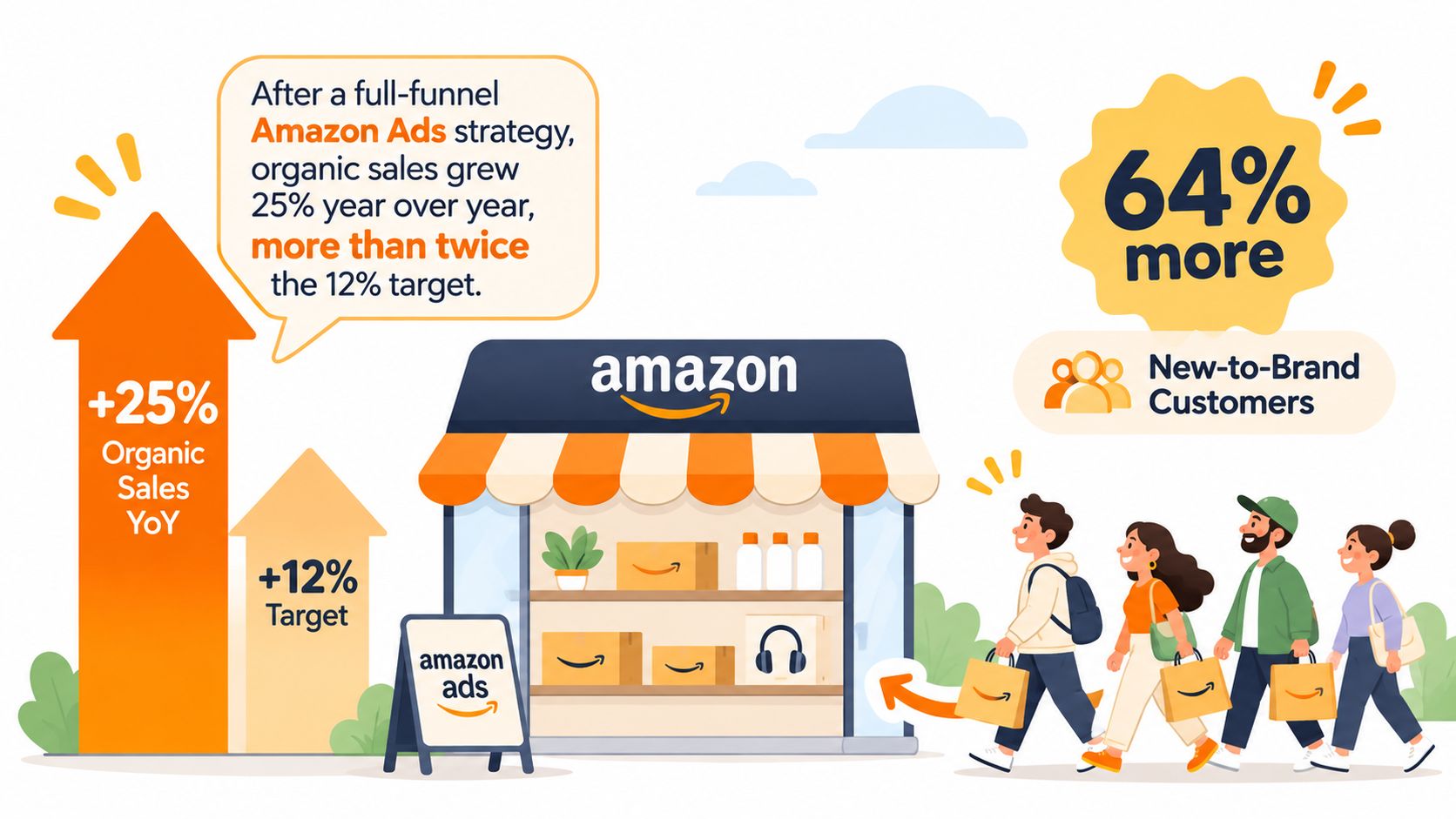
Measure PPC alongside branded search, organic sales, new-to-brand acquisition, and category momentum, rather than relying on attributed revenue alone. These signals help distinguish campaigns that build demand from those that capture existing shoppers.
Use automation to flag changes for review, not to decide what those changes mean. A rise in branded search, organic sales falling as ad spend climbs, or a slipping new-to-brand share while total sales stay flat can each prompt investigation. Check whether listing relevance, content, or campaign targeting explains the pattern before changing bids or budgets.
One test worth running: if a campaign lowers ACOS while organic share falls over a quarter, it may be buying efficient conversions while losing shelf position. Review the broader performance before calling it a win.
Budget decisions should favor campaigns that support paid efficiency and downstream organic performance, while reducing investment in those that do neither. Paid visibility only becomes durable Amazon traffic when the listing and content meet shopper intent. Use a clear guide to Amazon organic search ranking alongside the Shopify organic traffic growth steps as a general reference for turning visibility into lasting sessions.
Organic rank supported by paid visibility can make later sales less dependent on ads. Treat PPC as an investment in demand and profitability, and keep human review focused on whether the signals reflect real growth.
Automating Budget Allocation Without Trusting ACOS Alone
A budget rule tuned only to ACOS does exactly what you asked and still loses you money. ACOS rewards cheap conversions, so the rule drifts spend toward the bottom of the catalog and starves the campaigns that bring in new customers.
Kagome is the counterexample. The brand grew total sales 190% year over year after combining Amazon Marketing Cloud measurement, automated reporting, RFM-based audience segmentation and Amazon DSP campaigns. Advertising-attributed sales from new-to-brand customers rose 149% in Q4 2024, and shoppers exposed to the brand's video ads converted at a rate 111% higher than unexposed shoppers.
The mechanics matter more than the headline. The program didn't optimize to last click. It used recency, frequency and monetary value to choose audiences, then used AMC with automated reporting to price what a customer was worth and what a new one cost to find.
The signals that price a customer
| Metric | What it tells you | Act when |
|---|---|---|
| ACOS | Efficiency of attributed sales | Outside target band for 7 days, shift budget in small steps |
| New-to-brand CPA | Cost to acquire new customers | Above target for 2 weeks, cut the weakest placements |
| Organic sales share | Demand beyond paid clicks | Falling while spend rises, review branded campaigns |
| Repeat purchase rate | Quality of customers acquired | Low after 60 days, reduce broad acquisition spend |
| Revenue per user | Value of each customer | Declining against prior quarter, review audience targeting |
ACOS is one row in that table, not the table itself.
Placement evidence is just as blunt. When OMC connected more than 20 touchpoints in Amazon Marketing Cloud, it found biddable Amazon DSP private marketplaces produced a conversion-rate index roughly three times higher than non-biddable programmatic-guaranteed buys, at a cost per unique reach of $0.028 against $0.051, a 45% efficiency advantage.
On a home goods account, we put automated bid rules and daily monitoring in place. ACOS improved 18%, keyword efficiency rose 45% and profit grew 23%, which is the combination to aim for. Efficiency on its own would have been the weaker result.
Guardrail rule: move budget in capped steps, and require a second metric to confirm any shift larger than your set threshold. A reallocation that ACOS approves and new-to-brand CPA rejects shouldn't execute.
Catching Performance Anomalies Before They Cost You
An anomaly alert is valuable only when it speeds up a sound decision. Fast diagnosis protects profitability and can support organic growth by helping teams address listing or demand problems before paid performance deteriorates.
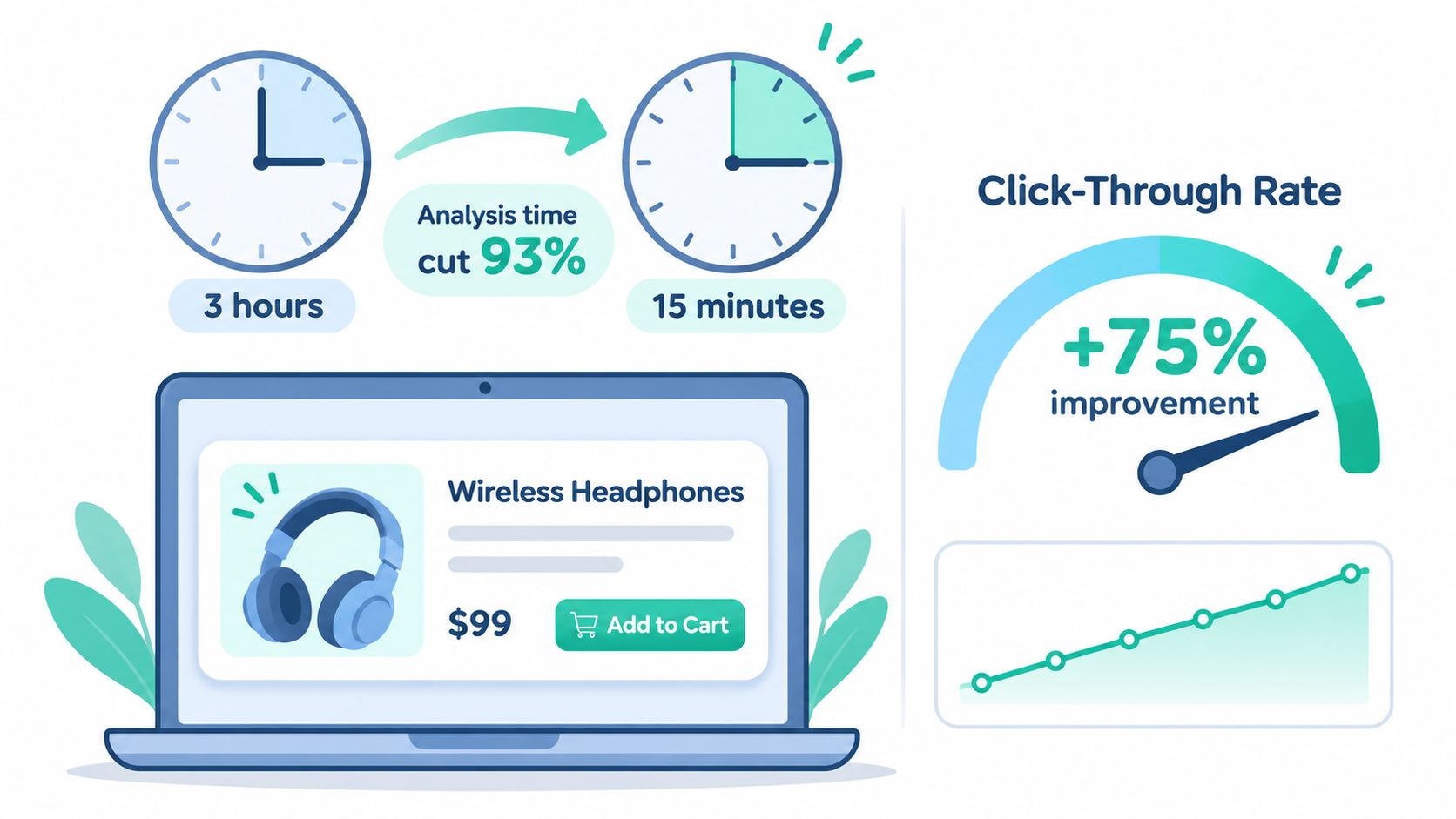
The Gala Amazon Ads case reports that AI-powered diagnosis reduced analysis time from three hours to 15 minutes per product, a 93% reduction. The faster process coincided with a 75% improvement in click-through rate, a 37% improvement in return on ad spend, and 200% overall sales growth over the longer term. The practical lesson is that diagnosis can matter as much as bid changes: a fast alert has little value if it points to the wrong cause.
Four signals merit attention in most accounts. A conversion rate falling against its 14-day average can point to a listing issue rather than targeting. Rising spend with no orders warrants a check for an ineffective keyword or a competitor change. A sudden impression drop calls for checks on listing suppression and rank. An ACOS jump on a top-spending product deserves prompt review because wasted spend can accumulate while the cause goes unnoticed.
| Anomaly | First action | Owner |
|---|---|---|
| Conversion rate down against 14-day average | Check listing status and recent changes, then review the search query report | Account owner |
| Spend rising while orders stay at zero | Pause the wasting keyword or target, then check the search query report | Media buyer |
| Sudden fall in impressions | Check listing status and suppression, then review rank | Analytics lead |
| ACOS jump on top-spending product | Check top keywords, pause the worst performers, then review bids | PPC manager |
Set a clear response for each alert: name the action, assign an owner, and specify when it should be handled. A practical data-driven decision-making framework can help teams make those responsibilities explicit. Keep the first action diagnostic when the cause is uncertain, rather than automating a pause or bid change from a single signal.
The video below shows how the monitoring layer fits alongside day-to-day campaign management:
Begin with three to five alerts per account, each assigned to an owner with a response time measured in hours. Check ACOS daily and make timely adjustments instead of waiting for a weekly review and correcting in bulk. The home goods case study recommends daily ACOS monitoring and quick adjustments. Review whether the alert led to a better decision, not just whether it removed a manual check.
Where Human Judgment Still Decides
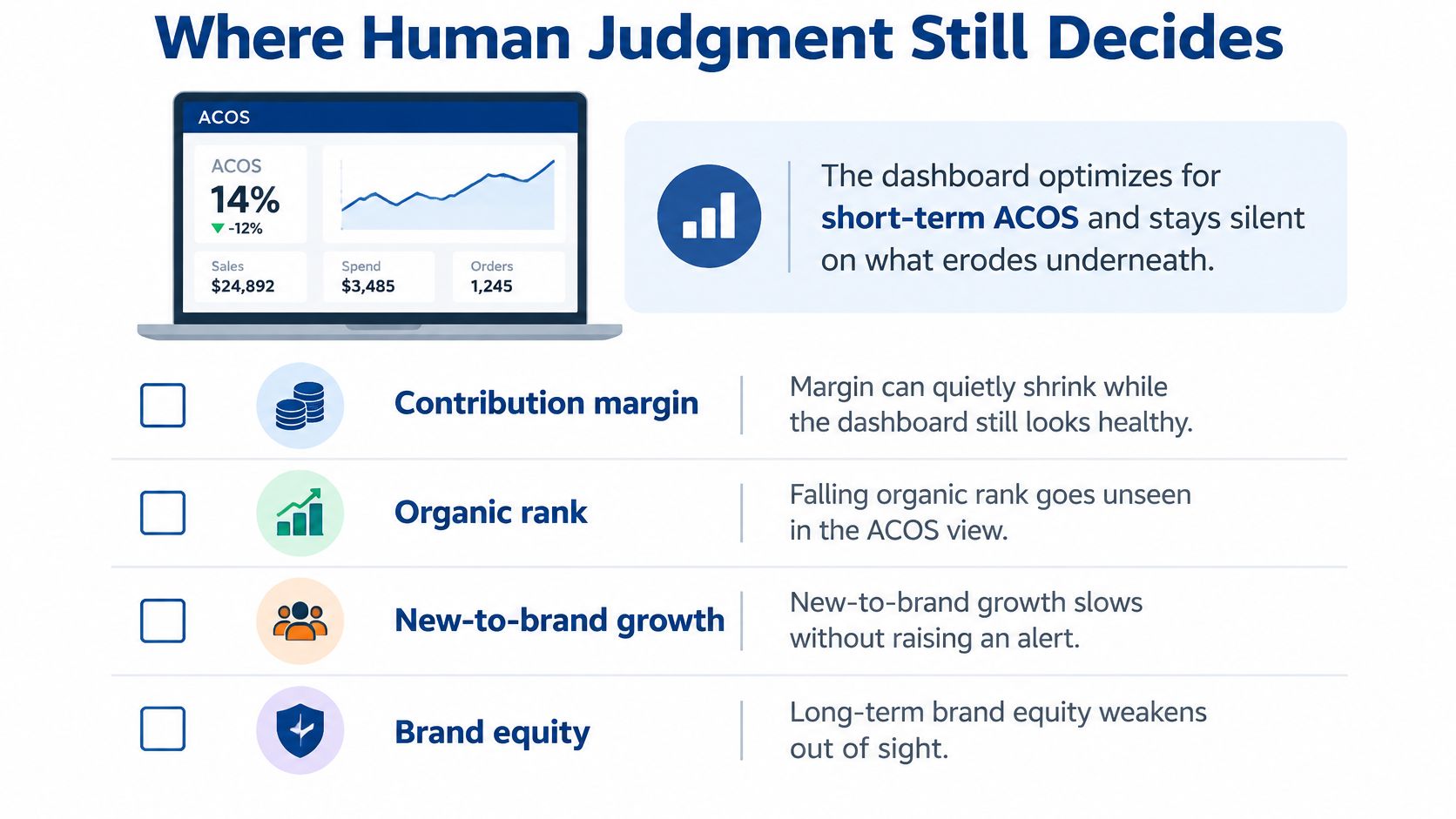
A rule tuned to short-term ACOS will weaken contribution margin, organic rank, new-to-brand growth and brand equity, and the dashboard will look healthy the whole time. Nothing in that number tells you the budget left discovery three weeks ago.
The evidence on oversight design is more useful than the usual either-or argument. In a 2026 study covering 5,000 synthetic enterprise tasks, a dynamic intervention architecture reached a 98.2% task-success rate, against 84.3% for fully autonomous execution and 99.1% for static human-in-the-loop review. It required human intervention at only 14.5% of decision steps and cut mean task latency by 89% against the static baseline. Those are benchmark results from synthetic tasks rather than guaranteed production outcomes, but the shape holds. Targeted review beats both extremes.
Translated to Amazon, that means automating routine bid, budget and keyword actions on statistically stable patterns, and reserving human approval for the four decisions where being wrong is structural: major budget reallocations, brand defense, anomalous conversion changes and marketplace-policy risk.
What to write down: a named owner for every rule, approval thresholds in numbers rather than adjectives, a rollback procedure, and a monthly audit of outcomes by product and query type.
Trust is the constraint people underestimate. PwC's 2025 global workforce study, covering nearly 50,000 workers across 48 major economies, found 54% had used AI for work during the previous year, while daily use stayed relatively low. Access isn't the bottleneck. Knowing when the output is wrong is.
That's why the audit outranks the tool. Someone on your team has to be able to look at a recommendation and say the number is right and the decision is wrong.
Confirm Your Automation Setup This Quarter
Three steps, in this order.
- Audit every live rule against the readiness table. Any fully automated task without a written threshold or a named owner moves into the review group today. That gap is common: the ABBYY state of intelligent automation report found 41% of organizations lacked an enterprise-wide intelligent-automation strategy, which is exactly how contradictory rules end up fighting each other inside one account.
- Write the guardrails down. A target ACOS band, a capped daily budget change, new-to-brand CPA and organic sales thresholds, and one named approver for reallocations above your limit. Numbers, not adjectives.
- Run one controlled test for 30 days. Split a campaign set into automated and manual budget decisions, then compare profit rather than ACOS. If the automated side wins on ACOS and loses on contribution margin, you've learned something worth more than the test cost.
We build custom dashboards, automate bid management and keep optimizing the campaigns after launch. Our Analytics Suite brings Seller Central, the Amazon Advertising Console, third-party tools and Amazon Marketing Cloud into one view, which is how you compare profit instead of comparing ACOS across tools that count differently. A live demo of the analytics platform is available, and you can schedule a platform tour if you'd rather see the workflow first.
Book the review date now and put a name against every rule. Automation should make expert decisions faster and more accountable, and a rule nobody owns is neither.
Headline Marketing Agency builds the automation layer and the judgment layer as one system: automated bid rules with hard guardrails, AMC measurement that prices new customers properly, and dashboards that show profit instead of a single efficiency number. If your account is running rules nobody has audited since launch, our team can map what to automate, what to keep under human approval and how to prove the difference within 30 days. Visit Headline Marketing Agency to see how we run smart automation for Amazon brands.
Get Your Free Amazon PPC Audit
Discover untapped growth opportunities and see how our data-driven approach can improve your ROAS.
Get Free Audit →Ready to Transform Your Amazon PPC Performance?
Get a comprehensive audit of your Amazon PPC campaigns and discover untapped growth opportunities.