Paid Search Consultant: Role, Value and Amazon Growth
A paid search consultant plans, measures and governs ad spend to lift profit and organic rank. Learn what to expect and how to vet one for Amazon.

Across Headline's 2025 portfolio of 43 brands and $29.6 million in ad spend, the average Sponsored Products cost per click reached $1.31 in the United States and $1.12 globally, with major European marketplaces ranging from $0.44 to $0.97. At those click costs, small mistakes in targeting, bid governance, or attribution drain margin fast.
Most eCommerce leaders still evaluate a paid search consultant by surface-level platform numbers like ACOS or ROAS. That standard misses how retail search builds a profitable business. On marketplaces like Amazon, paid search doesn't operate in a vacuum; every click interacts with fulfillment fees, returns, repeat purchases, and organic search placement.
Hiring the right specialist means judging them on contribution profit, incremental revenue, and organic rank momentum rather than vanity efficiency. The practical difference between a bid technician and a commercial partner shows up directly on your P&L.
What a Paid Search Consultant Does Day to Day
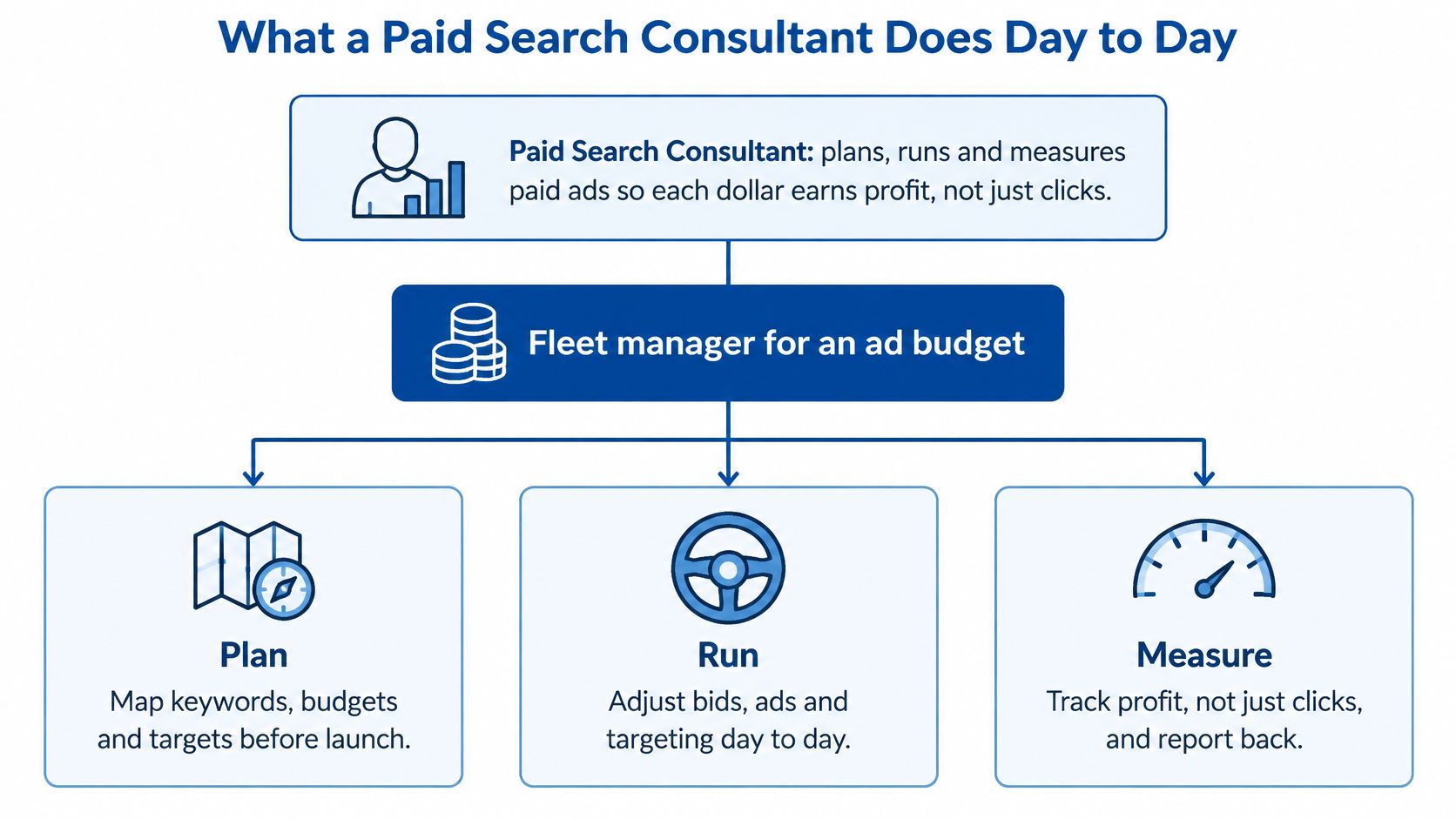
A paid search consultant plans, runs, and measures paid search campaigns so every dollar of ad spend produces profit, not just clicks or attributed revenue. Think of the role as a fleet manager for an ad budget. You aren't hiring someone to press the gas pedal; you're hiring someone to decide which routes each vehicle runs, cut routes that burn too much fuel, and measure what every trip returns.
That level of operational discipline matters because search is no longer a side channel. According to the IAB and PwC 2024 Internet Advertising Revenue Report, U.S. search advertising revenue reached $102.9 billion in 2024, up $14.1 billion (or 15.9%) from 2023. Search captured 39.8% of the country's $258.6 billion in total internet advertising revenue, giving it the largest share of any measured digital format. Its growth rate in 2024 was three times the 5.2% pace recorded in 2023.
When auctions expand that rapidly, occasional bid tweaks won't protect your margins. Competition, placement costs, and buyer search habits shift week to week, which turns paid search into an active capital-allocation job. The visual below breaks down how the consultant's daily cycle moves from pre-launch planning to live execution and profit measurement.
Five Core Areas a Consultant Owns
A capable consultant brings structure across five distinct functions. If any single area is neglected, the others lose reliability.
| Responsibility | What the consultant owns | Sign of good work |
|---|---|---|
| Account structure | Campaign, ad group and targeting layout | Clear split between branded, non-branded and competitor terms |
| Keyword and search term strategy | Which queries to bid on and which to block | Weekly search term review with documented negatives |
| Bid and budget control | Target settings and daily spend limits | Bids tied to margin rather than a fixed ACOS |
| Measurement | Conversion data and test design | Incremental impact checked, not only attributed sales |
| Reporting | Dashboards and decision notes | Every change has a stated reason and a measured result |
Notice what's absent from the right-hand column: busywork. Changing hundreds of bids a week or adding massive keyword lists proves activity, not competence.
Management test: Ask your consultant to explain your last three budget shifts in profit terms. If they can't state the hypothesis before the change and the measured outcome after it, you're paying for guesswork.
Measure Profit Beyond ROAS and ACOS
One of the most expensive traps in eCommerce advertising happens when platform ROAS looks healthy while your actual bank balance shrinks. A dashboard can show a strong return on ad spend even as contribution profit drops, because fulfillment fees, referral fees, coupons, returns, and existing branded demand all sit between ad-attributed revenue and net profit.
Pressure on marketplace margins isn't a rare edge case. The Jungle Scout 2025 Amazon Seller Report notes that nearly 40% of enterprise brands are concerned about profitability because of rising expenses, while smaller sellers face compounding pressure from fulfillment and advertising costs. The same report highlights independent measurement findings showing that only 57% of surveyed advertisers were moderately confident in their measurement accuracy, and 16% had little or no confidence at all.
Because platform dashboards don't show your true unit economics, lowering ACOS isn't automatically a win. Say a consumer goods brand slashes bids on competitive non-branded terms to push ACOS down. Short-term efficiency improves on paper, yet total velocity drops, organic placement slips, and future demand dries up. Conversely, a campaign with a higher ACOS on a high-margin product that brings in new buyers can add real cash to the bottom line.
Amazon Ad Metrics and What Each One Hides
Every reporting metric answers one specific question and leaves another unanswered. Senior leaders avoid bad budget cuts by reading each number alongside its blind spot.
| Metric | What it tells you | Blind spot |
|---|---|---|
| ACOS | Ad spend as a share of ad sales | Ignores fees, returns and organic effects |
| ROAS | Ad sales earned per dollar of spend | Credits ads for sales that would happen anyway |
| TACOS | Ad spend as a share of total sales | Moves slowly and hides channel-level detail |
| Contribution margin after ad spend | Profit left after product cost, fees and ads | Requires clean cost data for each SKU |
| New-to-brand rate | Share of buyers new to the brand | Does not show profit per buyer |
| Organic rank share | Keyword position over time | Lags ad changes by several weeks |
Tracking these numbers together keeps you from mistaking defensive branded clicks for genuine growth. For a deeper breakdown of how to structure your scorecards around commercial outcomes, review our guide to choosing the right KPI for Amazon.
Three Steps to Move From Revenue to Contribution Profit
At Headline, our approach to Amazon advertising focuses on contribution margin optimization and profit-based bidding. Instead of setting one target across an entire catalog, you build bids around what each sale leaves after costs.
- Calculate SKU-level contribution margin after ad spend: Pull landed product cost, referral fees, fulfillment fees, average return rates, and promotional discounts for every advertised ASIN. That figure gives you the true breakeven ceiling before you touch a bid.
- Isolate branded from non-branded sales: Separate queries containing your brand name into dedicated campaigns with clear budget caps. Defensive spend can make sense to protect shelf space, but mixing it with discovery campaigns hides whether your ads are winning new demand.
- Pair new-to-brand rate with total business sales: Monitor how many first-time buyers your Sponsored Brands and DSP campaigns bring in, then read that trend alongside total catalog revenue and repeat-purchase value.
A single efficiency metric should never trigger a budget change on its own. Pair every ad ratio with at least one profit measure and one total-growth measure before you cut or scale spend.
How Paid Ads Lift Organic Rank on Amazon
On Amazon, paid search isn't just a short-term rent-a-click expense. Paid visibility and organic relevance feed directly into each other inside the search results page.
An empirical study of Amazon marketplace search by the UCL Institute for Innovation and Public Purpose found that a product's organic rank and its relative position and visual prominence, described as "attention share", strongly influence its probability of appearing among the three most-clicked products. Products that win prominent placement earn more qualified clicks and conversions, which reinforces the behavioral signals Amazon uses to rank listings organically.
Paid ads are like placing your product at the front entrance of a physical retail store, where shoppers notice it. A sharp title, strong imagery, competitive pricing, and solid reviews turn that attention into purchases. Those purchases earn you better permanent shelf placement, even when you dial back promotional spend later.
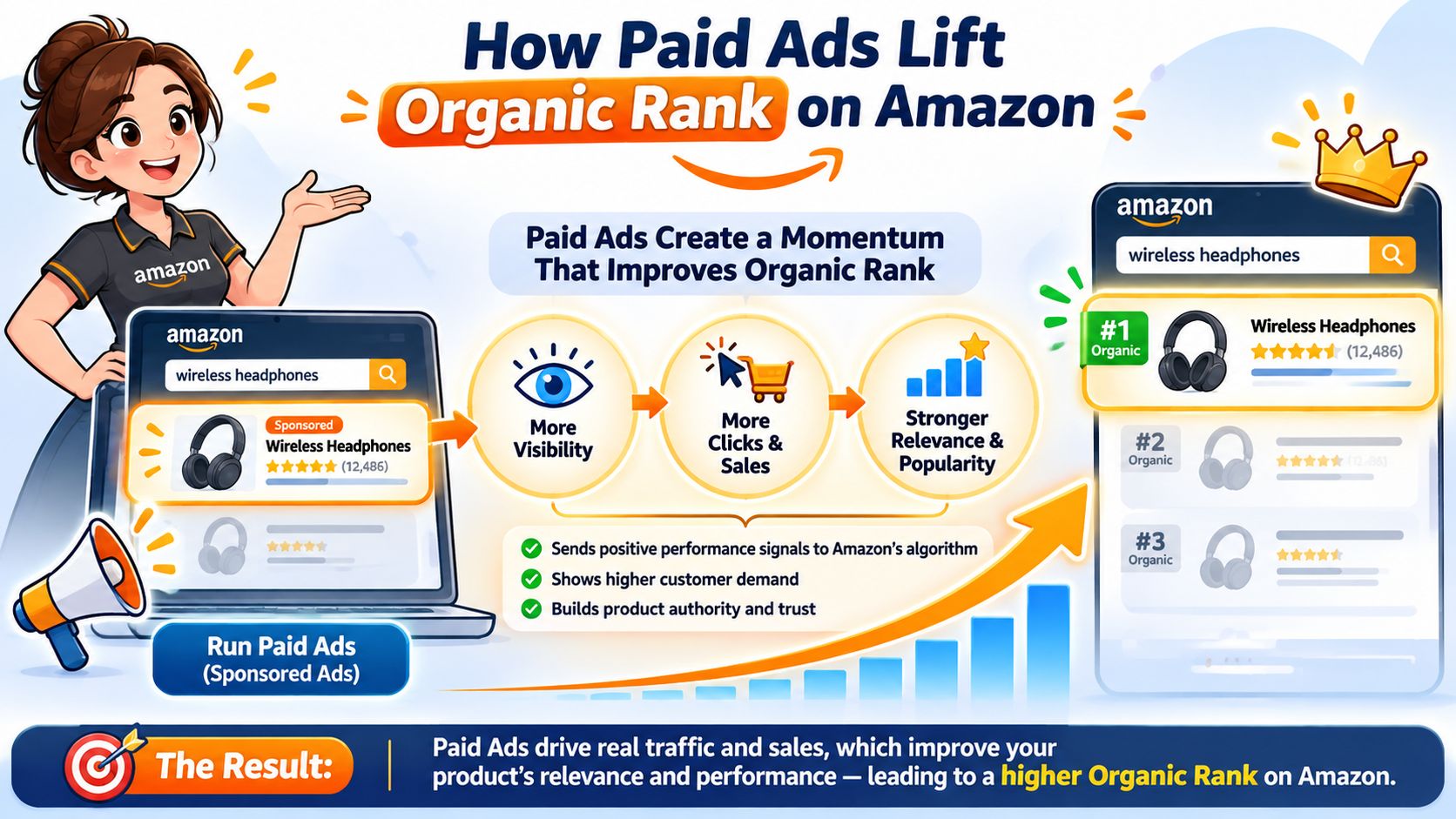
When you treat PPC strictly as an isolated cost center, you miss that compounding flywheel. In a lifestyle brand case study, we doubled the brand's market share and increased organic visibility by 156% by treating PPC as a targeted investment in organic visibility rather than chasing a rock-bottom ACOS. Understanding how paid search and SEO work together lets you allocate spend where it builds lasting equity instead of paying repeatedly for existing demand.
Testing Organic Lift Over a Fixed Window
Claiming that ads help organic rank is easy; proving it requires discipline. I recommend directing incremental spend toward a small set of strategically important non-branded keywords where your listing already converts well, rather than pouring extra budget into branded terms where you already rank first.
Run the test cleanly by locking the rules before launch:
- Set the window in advance: Define a clear evaluation period before raising bids so you don't cherry-pick a good week.
- Record a clean baseline: Log keyword-level organic rank, organic sales share, total unit volume, and TACOS across the target ASINs prior to the change.
- Read the metrics together: At the end of the window, compare organic rank, organic share, total sales, and TACOS against the baseline over the exact same timeframe. If paid spend rises while organic rank stays flat and total units barely move, the listing or offer needs work before you buy more traffic.
Amazon Results Worth Benchmarking
Abstract targets mean little until you compare them against real marketplace performance. Looking at how different Amazon brands scaled shows why "good" paid search results can't be reduced to one efficiency ratio.
Front Line Publishing shows what happens when campaign architecture matures without throwing more cash at the auction. According to the Amazon Ads Front Line Publishing case study, the publisher grew annual revenue from $316,547 in 2020 to $634,542 in 2022 without increasing its advertising spend. As its Sponsored Products execution became more disciplined, the business recorded an 80% year-over-year increase in revenue and a 60% increase in units sold. The commercial win wasn't spending more; it was extracting far higher sales volume from the same budget.
Juna, a women-owned wellness brand, illustrates a different pattern: pairing strong return on ad spend with rapid top-line growth. As detailed in the Amazon Ads Juna case study, the brand used Sponsored Products to achieve 300% sales growth within one year alongside a 5.5 return on ad spend. A 5.5 ROAS is impressive because it arrived alongside massive volume expansion, not because the brand hid inside low-volume branded queries.
Active Skin Repair demonstrates the healthiest long-term dynamic of all: growing total revenue while becoming less dependent on ads. In the Amazon Ads Active Skin Repair case study, Amazon DSP lifted the brand's new-to-brand rate from 36% to 52% (a 16-percentage-point gain), while Sponsored Ads achieved a 60% new-to-brand share of purchases and Amazon sales rose 33% year over year in 2025. Over the evaluated period, the percentage of total sales coming from advertising dropped by 210 basis points even as ad-attributed sales increased 12% and total sales grew 16%.
Comparing Three Patterns of Healthy Growth
Each case highlights a specific commercial lever you can benchmark inside your own account.
| Brand | Starting point | Result | What to copy |
|---|---|---|---|
| Front Line Publishing | Revenue of $316,547 in 2020 | Revenue of $634,542 in 2022 with no added spend; units up 60% | Better campaign structure beats a bigger budget |
| Juna | Wellness brand scaling Sponsored Products | 300% sales growth in one year; 5.5 return on ad spend | Pair strong ROAS with real sales expansion |
| Active Skin Repair | Amazon DSP new-to-brand rate of 36% | New-to-brand rate of 52%; total sales up 16%; ad share of sales down 210 basis points | Growth from new buyers shows reliance on paid demand is falling |
Multi-period benchmarking prevents short-sighted cuts. Track total revenue, units sold, total ad spend, new-to-brand share, and ROAS across quarters, then ask one blunt question: is paid search shrinking as a share of a larger, more profitable business?
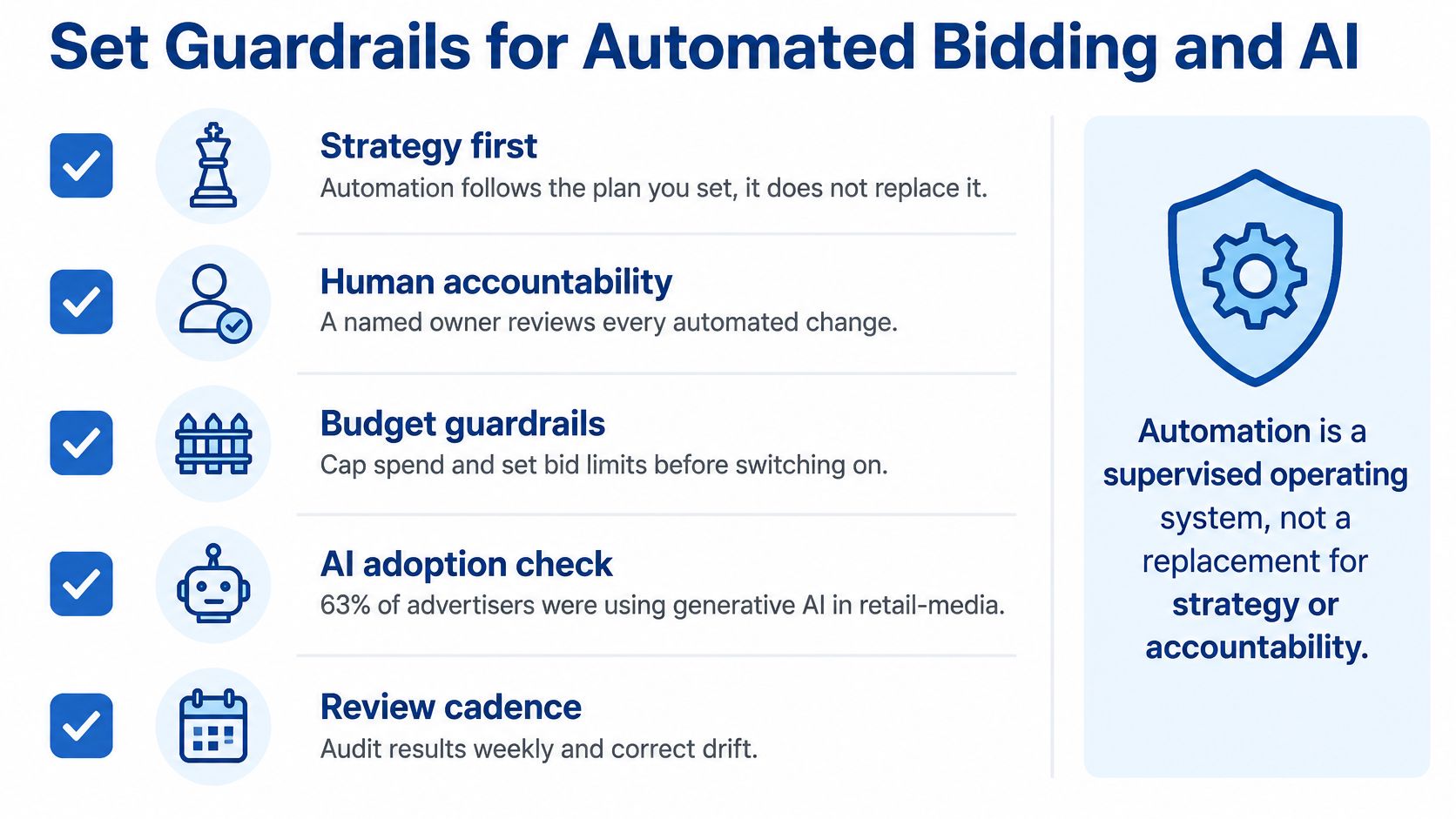
Set Guardrails for Automated Bidding and AI
Ad platforms push automation relentlessly, and many agencies treat "set it and forget it" algorithms as a selling point. In practice, turning on automated bidding without strict governance often transfers control of your budget to defaults built to maximize platform spend.
The performance gap in retail media shows how wide the divide between adoption and outcomes remains. According to Skai's Q4 2025 Quarterly Trends Report, 63% of advertisers were using generative AI in retail-media programs, yet only 25% reported noticeable results. Tools alone don't fix weak inputs or sloppy oversight.
Understanding how automated bidding operates clarifies what a consultant must manage. As the Google Ads Smart Bidding documentation explains, Smart Bidding sets bids individually for every auction using contextual signals including device, location, time of day, remarketing membership, ad creative, and the exact search query. Because the algorithm optimizes toward whatever conversion signal you feed it, a consultant's technical job shifts from manual bid schedules to conversion-data integrity, profit-weighted values, budget constraints, and avoiding excessive campaign fragmentation that starves the model of learning data.
Treat AI and automated bidding as a supervised operating system, never as a replacement for commercial strategy, merchandising judgment, or human accountability.
Five Controls to Write Into Your Automation Contract
Before letting any consultant enable automated rules or platform AI on your budget, put five concrete guardrails in writing:
- Client-controlled boundaries: Keep direct ownership of your ad accounts under your business email, and retain approval over monthly budget ceilings, target profit thresholds, and primary conversion goals.
- Spend caps and anomaly alerts: Set hard daily limits alongside automated alerts for sudden CPC spikes, pacing surges, or conversion-tracking drops so a human intervenes before budget drains overnight.
- Search term and placement change logs: Require a clear weekly log documenting query exclusions, match-type shifts, and top-of-search or product-page placement adjustments.
- Human-managed control tests: Whenever a platform recommends broad automated expansion, test it against a defined control group rather than switching the whole catalog at once.
- Full data export on exit: Specify that every report, negative keyword list, naming convention, and historical dataset belongs to your brand and transfers cleanly if the engagement ends.
Fragmented measurement makes these controls even more urgent. Siloed ad consoles, privacy updates, and the decline of third-party cookies make unified reporting harder across channels. If you sell on Amazon, ask how your consultant connects Sponsored Products, Sponsored Brands, and Amazon DSP data with retail readiness and organic trends instead of optimizing each campaign type in isolation.
Whenever an automated system claims a sudden performance jump, ask one question before celebrating: did the algorithm generate new profitable demand, shift spend into easier queries, or just take credit for buyers who were already on their way to checkout?
Vet a Consultant Before You Hire One
Credentials, badges, and polished slide decks tell you very little about how someone handles live ad spend. The fastest way to separate a genuine paid search strategist from a dashboard reader is to run a structured, numbers-first interview call.
Set up the call like an operational review rather than a sales pitch, and press for concrete mechanics behind every answer.

Five Questions to Ask on the Vetting Call
Ask these five questions in order and listen for specifics rather than buzzwords.
- "How do you measure profit beyond ROAS, and how will you calculate contribution margin after ad spend for our catalog?" A strong answer walks through pulling SKU-level product costs, marketplace fees, and return rates before setting bid targets, not relying on platform revenue alone.
- "How are your fees structured, and do they reward contribution profit or only higher spend?" Retainers, percentage-of-spend agreements, and performance-linked fees distribute risk very differently. Ask for the exact fee math at your current monthly budget and what happens if cutting wasted spend shrinks total ad volume.
- "Can you walk me through a recent search term review and explain the reasoning behind the changes?" Look for a consultant who can point to specific irrelevant queries added as negatives, winning terms graduated into exact match, and the margin impact that followed.
- "How would you prove that a campaign creates incremental sales rather than capturing demand that already exists?" A serious practitioner won't treat platform attribution as causal truth. They should explain controlled holdback or geo testing, similar to Google Ads Conversion Lift measurement, which separates exposed treatment users from an unexposed control group (calculating incremental conversions as treatment conversions minus control conversions) and evaluates lift with clear test duration and statistical rigor before scaling branded or remarketing spend.
- "How will you report to our leadership team each month, and which decisions require my approval?" Expect a clear cadence that separates strategic sign-offs (budget shifts, margin floors, major tests) from routine weekly hygiene, backed by shared live dashboards.
For a closer look at how experienced eCommerce leaders evaluate outside paid search support and spot hidden alignment gaps, watch the walkthrough below.
Red Flags and Green Flags in Consultant Proposals
Once the proposal lands in your inbox, check it against a simple pass/fail filter.
Red flags that signal wasted spend:
- ROAS-only reporting: Monthly decks that highlight attributed revenue and click-through rate while ignoring net margin, branded share, and total sales.
- Blanket ACOS promises: Guarantees of one fixed ACOS target across products with wildly different margins, price points, and lifecycle stages.
- Withheld account ownership: Any setup where the consultant runs your ads inside their own master account or restricts admin access.
- No written measurement plan: Vague promises to "optimize weekly" without pre-defined test windows or success thresholds.
Green flags that signal a commercial partner:
- Profit-based targets: SKU-level bid limits tied directly to contribution margin and strategic growth goals.
- Documented experiments: Written hypotheses, holdback controls, and post-test readouts that admit when a test fails.
- Shared live dashboards: Transparent access to raw account performance, change history, and business-level metrics.
- Clear handover terms: A documented exit process ensuring your brand retains every asset, script, and historical report.
Don't hire based on how smoothly a consultant explains platform features. Hire the person who can defend every past optimization with a specific commercial reason and a hard number.
Audit Your Amazon Ads Before You Hire
Before you book your first discovery call, pull your own baseline. Walking into a consultant interview with clean internal data changes the entire conversation; you stop reacting to pitches and start testing whether the candidate spots the genuine leaks in your account.
Take one afternoon to run three focused steps:
- Export 90 days of account and catalog data: Pull total ad spend, ad-attributed sales, total Amazon sales, branded versus non-branded spend share, new-to-brand rate, and SKU-level contribution margin.
- Isolate the hidden profit leaks: Flag the two or three SKUs where reported ROAS looks comfortable while contribution profit is thin or negative. Next, identify products where most of your budget sits on branded search terms rather than driving new discovery.
- Write down your hiring criteria: Put your requirements on one page before speaking to any provider: profit-based bidding targets, a clear incrementality testing plan, full account ownership, and monthly leadership reporting tied to total business growth.
Getting an Outside View on Your Numbers
Reviewing your own data shows where profit is slipping, and a second set of specialist eyes often uncovers structural waste inside campaign architecture, bid ceilings, and search term overlap. Knowing what a thorough Amazon PPC auditing service examines helps you separate a real diagnostic from a superficial sales pitch.
At Headline, we offer a free in-depth audit of your Amazon PPC campaigns. That audit covers a campaign structure analysis, a keyword strategy review, a search term analysis, and a growth strategy session, giving your leadership team an objective outside read on the exact same numbers before you commit to a retainer.
Every advertising dollar you deploy should earn its keep twice: first through measurable contribution profit today, and second through stronger organic visibility that lowers your reliance on paid clicks tomorrow. Judge every campaign change by both standards, and only partner with a consultant who can prove both on paper.
If you want your Amazon paid search budget managed around contribution profit, organic rank momentum, and full-funnel growth across PPC and DSP, explore how our specialists work at Headline Marketing Agency. You can request our complimentary Amazon PPC audit to pinpoint inefficient spend, tighten campaign structure, and map out a profit-first scaling plan built around your catalog's real unit economics.
Get Your Free Amazon PPC Audit
Discover untapped growth opportunities and see how our data-driven approach can improve your ROAS.
Get Free Audit →Ready to Transform Your Amazon PPC Performance?
Get a comprehensive audit of your Amazon PPC campaigns and discover untapped growth opportunities.