Sponsored Clothing Brands on Amazon: How to Grow Profit
Learn how sponsored clothing brands use Amazon Sponsored Brands to grow visibility and profitable product discovery, with data and a clear measurement plan.

Most advice on sponsored clothing brands on Amazon starts in the wrong place. Agencies and software vendors tell apparel teams to chase the lowest possible ACOS on every campaign, cut anything that misses a short-term ROAS target, and treat Sponsored Brands like a simple extension of Sponsored Products. Follow that playbook in fashion, and you'll starve discovery, shrink your organic search rank, and scale SKUs that bleed margin once size-driven returns hit your P&L.
Paid search on Amazon isn't a standalone ROAS game for apparel. It's a lever for organic growth, return-adjusted profit, and off-Amazon brand lift. Shoppers rarely buy a jacket, dress, or knit sweater on the first click without comparing sizing, fabric drape, and reviews across several tabs, which means last-click ad reports miss a massive share of how clothing demand forms.
If you lead eCommerce or retail growth for an apparel label, the central question isn't how to shave two points off campaign ACOS this week. It's how to structure Sponsored Brands alongside Sponsored Products, fix the listing gaps that trigger costly returns, and measure campaigns on true contribution margin and total sales velocity.
What Sponsored Brands Does for a Clothing Label
Standard last-click ROAS hides most of what top-of-funnel apparel ads achieve. When a shopper spots your headline banner on Monday, checks sizing notes on Wednesday, and buys a different colorway through organic search on Friday, the ad console often gives that initial discovery click zero credit.
Sponsored Brands places your brand logo, custom headline, and curated product tiles or video right at the top of Amazon search results. From that banner, you can route shoppers to your Brand Store, a curated collection landing page, or directly into a short product video.
For clothing labels, that placement solves a different problem than standard product ads. Shoppers typing specific category, style, size, or occasion queries are already in buying mode, and Sponsored Products captures that immediate intent. Sponsored Brands introduces your label to buyers who haven't searched your brand name yet, showing your aesthetic across multiple styles before they scroll down to commodity lookalikes.
Why Apparel Visibility Needs Attribution Context
Paid visibility moves inventory quickly on Amazon, though you have to read platform benchmarks with a clear head. According to Amazon's advertising guide, sellers using Sponsored Products saw 34% greater sales growth four weeks after adoption compared with sellers who didn't use the format. That same guide reports that advertised products generated 260 times more sales than products that were merely suggested.
Look closely at the fine print behind that second figure. Amazon pulled the 260x comparison from U.S. internal data between March 26 and April 1, 2023, using ad-attributed sales. It demonstrates strong correlation inside a narrow attribution window, not a blanket guarantee that every dollar of ad spend produces incremental profit.
Attribution reality check: Treat platform-reported ad sales as a directional pulse on visibility, never as your final word on profit.
In apparel, clicking an ad is only step one of a longer inspection. Shoppers compare cut, fabric weight, color accuracy, and sizing reliability across multiple detail pages before committing. Specialty apparel shoppers often consult external buying resources, such as guides showing where to buy cashmere on Amazon, before deciding which storefront deserves their trust. Your Sponsored Brands placement can win the first glance, yet only retail-ready product pages turn that glance into a keeper order.
That's the core principle behind profitable sponsored clothing brands. Sponsored Brands works as a discovery lever that feeds branded search and organic rank, so judge its return on total contribution profit and organic lift rather than the ad console's ROAS column alone.
Pick the Sponsored Brands Format That Matches Your Goal
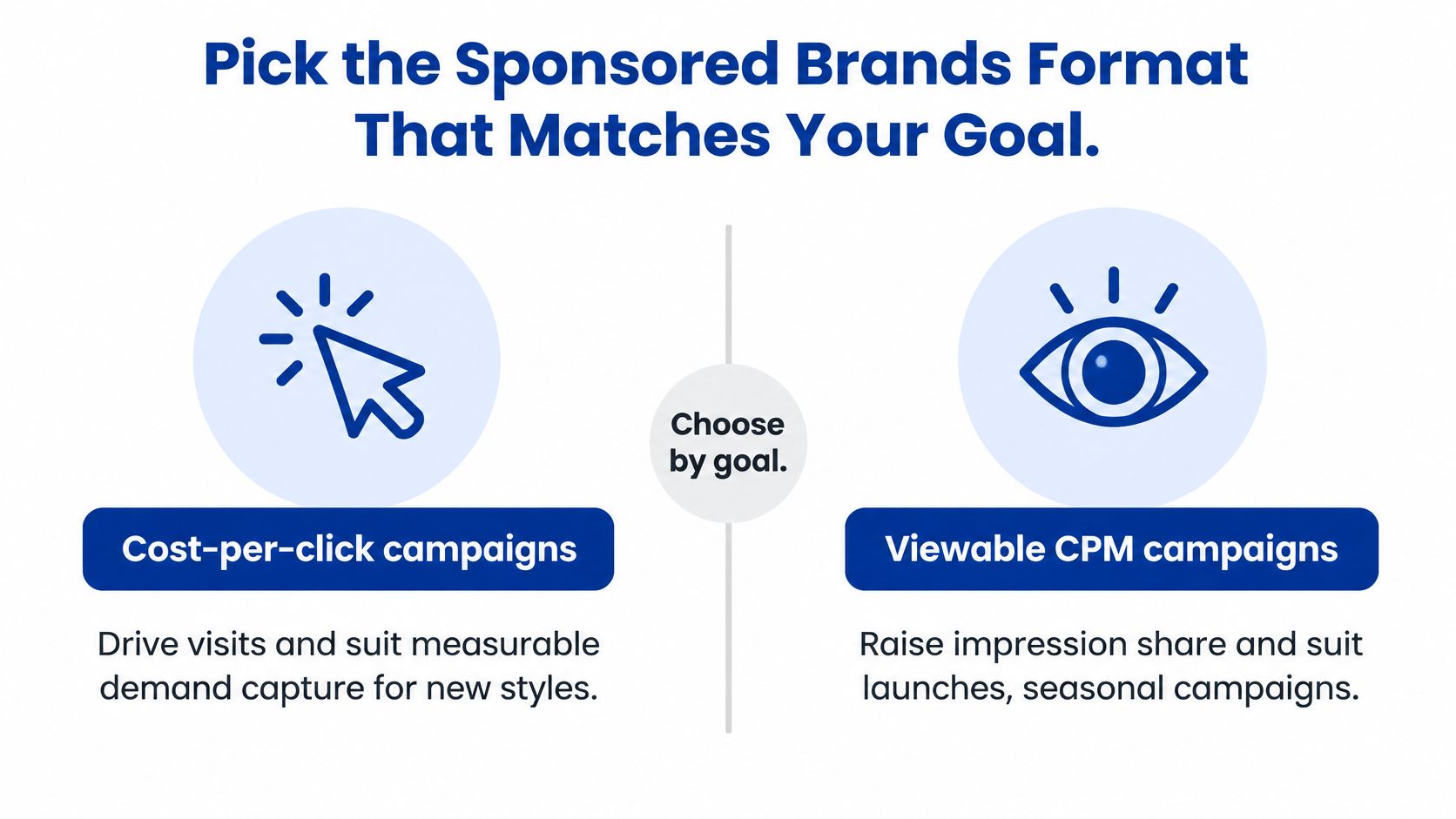
Match the buying mechanic to the commercial job before you brief creative or set bids. Sponsored Brands supports cost-per-click campaigns and viewable CPM campaigns, documented in Amazon's Sponsored Brands documentation. Treat CPC as demand capture and vCPM as reach. That distinction keeps brand teams from judging a launch campaign with the same efficiency rule they use for exact-match shoppers.
| Objective | Buying option | Minimum spend | Use it when |
|---|---|---|---|
| Drive visits to a store page or collection | Cost per click (CPC) | None; campaigns can be paused or adjusted | You need measurable demand capture for new styles or branded searches |
| Increase reach and impression share | Viewable CPM (vCPM) | None; campaigns can be paused or adjusted | You are launching a collection, a season or a new market |
| Defend a high-value branded search term | CPC | None; campaigns can be paused or adjusted | Your brand name needs top-of-search control without a fixed commitment |
A visual breakdown makes the split between traffic capture and brand reach straightforward when briefing your media buyer.
Start with margin tolerance, then choose the format. A seasonal outerwear push aimed at impression share will not behave like an evergreen denim campaign harvesting exact-match buyers. The first needs room to build recognition across a short selling window. The second needs tighter query control and a profit threshold that reflects the product's contribution after returns, discounts and fulfillment costs. If both sit under one rigid ACOS ceiling, teams often cut the awareness campaign before it has done its job.
Where Sponsored Brands Fits in Your Ad Mix
Sponsored Brands should extend a working apparel account, not replace the conversion engine. Across Headline's 2025 portfolio of 43 brands and $29.6M in managed spend, Sponsored Products typically represents roughly 70 to 80% of total brand ad spend. Build the core on Sponsored Products, then use Sponsored Brands to take more top-of-search space and move shoppers into multi-SKU collections. That order matters because branded discovery works best when the landing pages already convert.
Creative then becomes part of the media decision. Custom lifestyle headers give apparel ads context that plain white-background tiles cannot match, and the guide on Sponsored Brands custom images covers how to set those assets up cleanly. For brands trying to connect paid discovery with styling proof, creator content can support store-page discovery, including routes such as the Amazon influencer signup via Urban Totes. Keep that content tied to the same merchandising story as the ad, or the click loses momentum.
I would treat vCPM as a controlled test, not a default setting. Use it for a defined launch, season or marketplace entry, then judge it on reach, store visits and downstream branded search rather than immediate ROAS. Use CPC when the job is to capture shoppers already looking for a style, category or your brand name. Branded CPC defense is especially practical because it gives you control without a fixed upfront commitment.
The Sequence to Follow Before Committing Budget
Follow three steps in order so upper-funnel clicks do not land on weak pages:
- Verify detail-page conversion first: Make sure top SKUs convert organic and Sponsored Products traffic cleanly before paying for banner clicks.
- Select one buying model per goal: Run CPC for measurable style capture and vCPM when launching a fresh seasonal drop or entering a new geographic marketplace.
- Ring-fence budgets by objective: Give awareness campaigns and demand-capture campaigns separate daily caps so an exploratory push never drains proven converting terms.
Avoid locking into a fixed upfront reserve before branded search volume justifies the commitment. Competitor conquesting can justify a stronger defense, but the starting position should stay flexible. Apparel returns and fit-driven drop-off make early efficiency numbers noisy, so keep the buying model tied to the job it was chosen for and review contribution, organic lift and off-Amazon effect before moving budget.
Structure Campaigns by Match Type, Price Tier and Budget
A single $50-per-day campaign holding broad, phrase, and exact keywords across your whole catalog will fund loose queries like "summer shirt" while your proven high-intent terms sit idle by noon. Campaign architecture decides whether an apparel budget pays for profitable discovery or leaks into irrelevant clicks, and mixing match types with mismatched price points is the costliest structural mistake in fashion accounts.
Isolate Match Types and Build Negative Lists Early
Split broad, phrase, and exact keywords into dedicated campaigns from day one. Amazon supports all three match types alongside negative targeting in its Sponsored Products and targeting guidance, and Sponsored Brands keyword targeting follows the same logic.
Treat broad match strictly as a discovery budget. Pull search term reports weekly, harvest converting queries into exact-match campaigns, and add those harvested terms as exact negatives inside the broad campaign so it keeps prospecting instead of cannibalizing proven terms. Judge exact campaigns on contribution profit. Judge broad campaigns on new search-term discovery and downstream organic rank lift, since a converting broad term that feeds exact campaigns and lifts organic position is worth more than its standalone ACOS suggests.
Negative targeting protects apparel margins faster than bid cuts alone. Attach one dedicated negative list to every campaign to block mismatched sizes, wrong genders, discount-hunter terms like "cheap" or "clearance," and competitor styles your fabric or cut can't beat.
Segment Product Targeting by Price Tier and Rating
Apparel shoppers are fiercely sensitive to price anchors. Showing a premium merino pullover on a budget polyester sweater detail page burns clicks from shoppers with zero intention of paying your price.
Use product-targeting refinements to filter competitor ASINs by category, brand, price range, and review rating. Target listings priced equal to or higher than your item, or listings with lower star ratings where your fit and quality win the comparison cleanly. Split your own catalog by price tier too, so entry-level basics never share bids and budgets with premium outerwear.
Set Daily Budgets for Full-Day Coverage
Running out of budget at 2:00 PM hands evening shoppers to competitors, so set daily caps high enough to keep campaigns live through peak hours given your category CPC. Sponsored Products budgets operate as daily amounts averaged over a calendar month, which gives you some flexibility on slow days.
Click prices vary widely across regions, so plan caps around realistic category costs rather than guesswork. Across Headline's 2025 portfolio, average Sponsored Products CPC sat at $1.12 globally, $1.31 in the US, and $0.44 to $0.97 across major European marketplaces. At a US CPC near that level, a $10 daily cap buys fewer than eight clicks before pausing, which isn't enough data to test a multi-style collection.
- Split campaigns by match type and price segment: Keep broad discovery separate from exact conversion, and separate premium styles from budget basics.
- Assign one negative list per campaign: Block poor-fit queries, mismatched materials, and weak competitor detail pages weekly.
- Fund peak shopping windows: Raise daily budgets ahead of seasonal weather shifts and major retail weekends so winning Sponsored Brands banners never drop off the page during high-intent hours.
Fix Fit and Content Before You Pay for More Clicks
Driving paid traffic to a clothing listing with vague sizing is one of the fastest ways to lose money on Amazon. According to Solo Media Group's fashion eCommerce benchmarks, US online apparel returns reached 24.4%, and 53% of apparel decision-makers named size and fit as the leading cause of returns. Even modest fit clarity pays back quickly: a peer-reviewed study cited in that same benchmark report found that Zalando's size-advice intervention cut size-related returns by 3.8%.
The graphic below shows how tighter size guidance protects both conversion rates and ad spend.
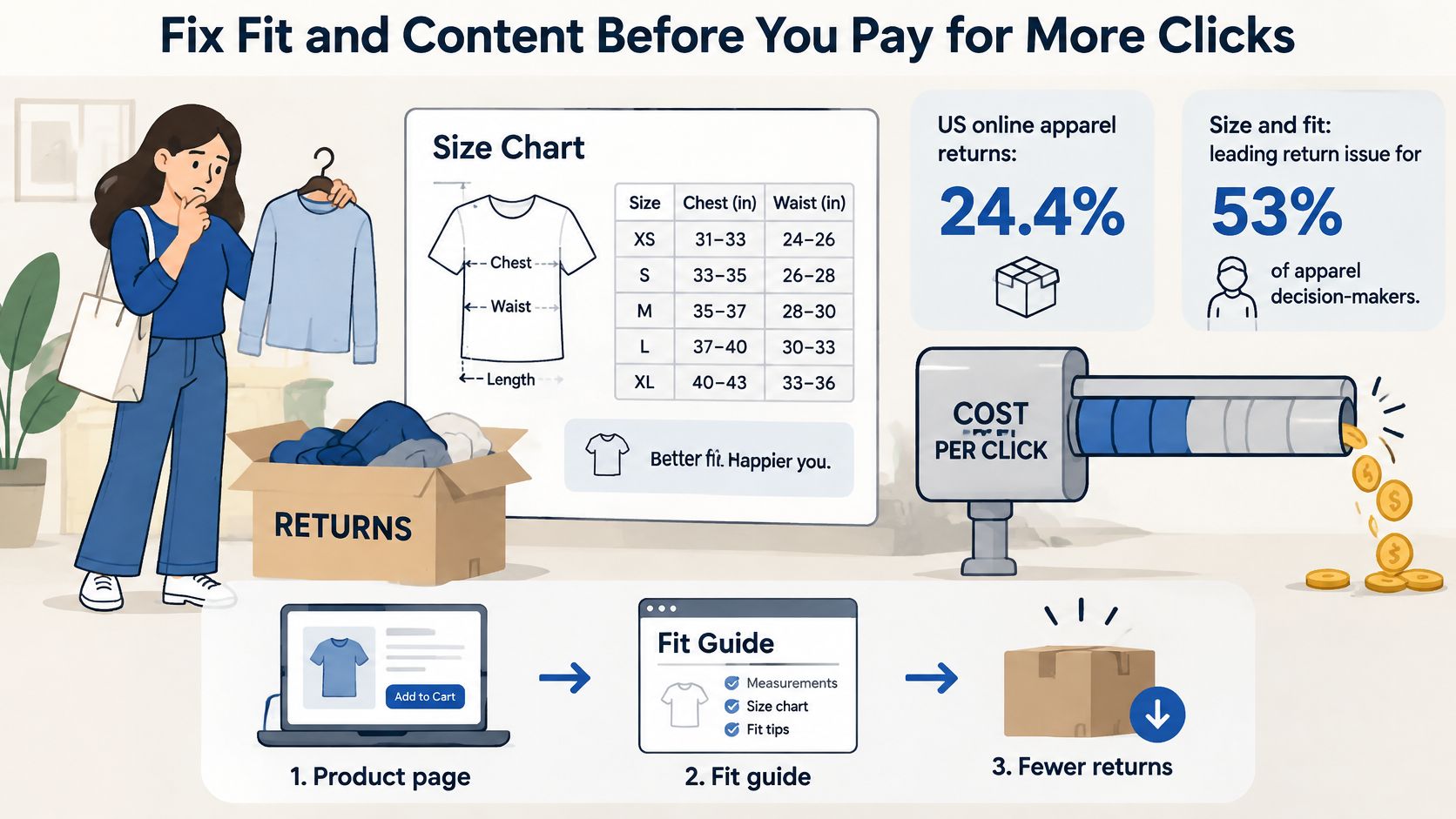
A sponsored click only buys a shopper's attention. If your gallery leaves them guessing whether a medium runs slim across the shoulders or shrinks after one wash, two bad outcomes follow. Half of those shoppers bounce without buying, depressing your conversion rate and pushing up your cost per order. The other half buy two sizes and send one back, creating refund and fulfillment losses that never appear inside Amazon's standard ROAS report.
Five Listing Fixes to Ship This Week
Before you raise bids on any sponsored clothing brands campaign, audit your top-spending ASINs and put these five elements into your primary image stack and A+ Content:
- Measurement-based size charts: Replace generic S/M/L labels with chest, waist, hip, and inseam ranges in inches and centimeters.
- Model height and worn size: Print the model's exact height, weight or usual size, and the garment size worn directly on the lifestyle photo.
- Garment dimensions laid flat: Include length from shoulder to hem and sleeve measurements so shoppers can compare against a piece already in their closet.
- Stretch and fabric behavior: State clearly whether the fabric is rigid, offers four-way stretch, or relaxes with wear. Shoppers researching technical apparel routinely look for durability details, much like buyers comparing guides to find golf shirts that hold shape after repeated washes.
- Explicit fit notes: Tell buyers in plain text whether to order their normal size or size up between sizes.
Creative upgrades move top-of-funnel engagement measurably too. In Headline's home goods brand case study, A/B testing lifestyle images against product-only images improved click-through rates by 34%. For broader retail-readiness standards across apparel listings, review our guide to selling apparel on Amazon.
Use Video to Show Drape and Movement
Static photos hide how fabric behaves on a moving body. Sponsored Brands Video solves that gap directly in search results, letting shoppers see fabric stretch, hem drape, and real movement in fifteen seconds before they even click.
Fashion buyers increasingly expect ads to look and feel like watchable content rather than sterile catalog tiles. In a 2026 Vogue Business and Amazon Ads survey of 1,009 US luxury and aspirational fashion consumers, 81.4% of luxury shoppers preferred premium or luxury advertising to fit naturally into the content they watch. The same survey found 46.3% of luxury consumers use Amazon when shopping for premium or luxury fashion, ahead of physical department stores at 39% and online department stores at 38.1%.
Watch how structured creative and sizing communication work together in practice for Amazon apparel sellers.
Don't judge a fit-communication upgrade on CTR or ACOS alone. A cleaner size guide might lift conversion slightly while producing a much bigger jump in contribution profit by cutting return volume.
To validate your changes, run a clean cohort test. Compare paid traffic sent to SKUs with updated fit charts and video against a control group of similar styles, tracking click-through rate, detail-page conversion, return rate, refund cost, and net contribution margin together. Reconcile Amazon Ads exports against your finance and returns ledger before scaling a single bid.
Measure Profit and Off-Amazon Lift, Not Just ACOS
A 2025 Amazon Ads apparel case study reported that 64% of the measured advertising impact occurred off Amazon. Independent academic research noted in that same study examined more than 122,000 brand-category combinations across awareness, consideration, and purchases rather than immediate ad clicks alone.
Pause on what that number means for an apparel P&L. If you slash a Sponsored Brands campaign because its 14-day attributed ACOS looks high, you risk choking off demand that would have converted days later through organic Amazon search, your direct-to-consumer site, or retail stores.
At the same time, blind spending without profit guardrails wrecks cash flow. You need a measurement dashboard that connects immediate ad efficiency, total organic velocity, and return-adjusted unit economics in one view.
| Metric | What it tells you | Decision it drives |
|---|---|---|
| Break-even ACoS | Maximum ad cost of sales before an order loses money after margin, returns and fees | Sets the bid ceiling for each SKU |
| TACOS | Total ad spend as a share of total sales, including organic | Shows whether ads are lifting organic sales |
| New-to-brand sales | Sales from shoppers who have not bought the brand before | Decides whether broad or generic terms deserve more budget |
| Branded search growth | Change in searches for the brand name over time | Measures the off-Amazon effect of visibility |
| Return-adjusted contribution margin | Profit per order after returns, refunds and fulfilment costs | Decides whether to scale a style, size or colour |
How Each Metric Changes Your Next Move
Start with break-even ACoS. Don't borrow a generic 10 to 11% cross-category conversion assumption when setting apparel bids, because clothing converts noticeably lower than staples. A compiled industry dataset from Autron's Amazon advertising benchmark reports a 7.3% median conversion rate for Clothing & Apparel, alongside a $0.69 median CPC, 0.44% CTR, and 57% median ACoS. Treat those figures strictly as a directional baseline and replace them with your own rolling 30 to 90-day SKU cohort data. Calculate true break-even ACoS from product contribution margin, return-related costs, fulfillment fees, and each style's real conversion rate, then segment reporting by query intent, variation, placement, and new-to-brand status.
Next, watch TACOS (total advertising cost of sales) alongside new-to-brand sales. If TACOS falls while ad spend holds steady, your paid clicks are pushing organic rankings up and lowering your blended acquisition cost. If a generic-keyword Sponsored Brands campaign carries a steep ACOS yet brings strong new-to-brand share on styles with healthy repeat rates, keep funding it instead of starving customer acquisition.
Track branded search growth every month inside Search Query Performance and Google Search Console. Rising queries for your label name confirm that upper-funnel impressions are creating genuine brand memory both on and off Amazon. For a deeper framework on connecting upper-funnel exposure to search lift, see our breakdown on how to measure brand lift.
Finally, gate every scaling decision on return-adjusted contribution margin at the variation level. One colorway or tall-size variant often carries double the return rate of your core fit. Scaling ad spend on a high-return variant inflates top-line revenue while eroding net profit.
What Happens When Reporting Shifts From Ranking to Profit
Aligning ad reports with unit profit and total organic sales produces real P&L improvements. In Headline's home goods brand case study, shifting the account's focus from chasing rank to protecting profit through keyword research, pausing underperforming terms, and disciplined ACOS management delivered a 23% profit increase. In another client engagement with a lifestyle brand, pairing full-funnel paid search with organic growth tracking cut TACOS by 10% while expanding total organic search reach.
Profit first, rank second: Put organic sales and total sales right next to ad sales on every weekly report, because PPC's real job is building profitable organic velocity.
Two Campaigns That Show the Trade-Offs in Practice
Theory is clean, yet apparel accounts force hard weekly trade-offs between near-term efficiency and category share. Two real-world campaigns show how disciplined structure turns those trade-offs into durable growth.
The Two-Layer Playbook From NYKD Innerwear
Innerwear is one of the fiercest apparel subcategories on Amazon, packed with legacy names and aggressive price competition. According to Amazon's NYKD innerwear case study, the brand rolled out a deliberate two-stage Sponsored Products sequence. First, NYKD launched product-specific campaigns to support newly introduced styles and capture high-intent searches. Once those listings established traction, the team expanded onto generic category keywords to reach shoppers beyond existing branded demand.
Between February and May 2023, that layered structure drove a 64% increase in ad sales, lifted new-to-brand sales by 58%, and cut ACOS by 32% to its lowest level at that point.
The timeline below maps that sequence so you can see why order of execution matters.
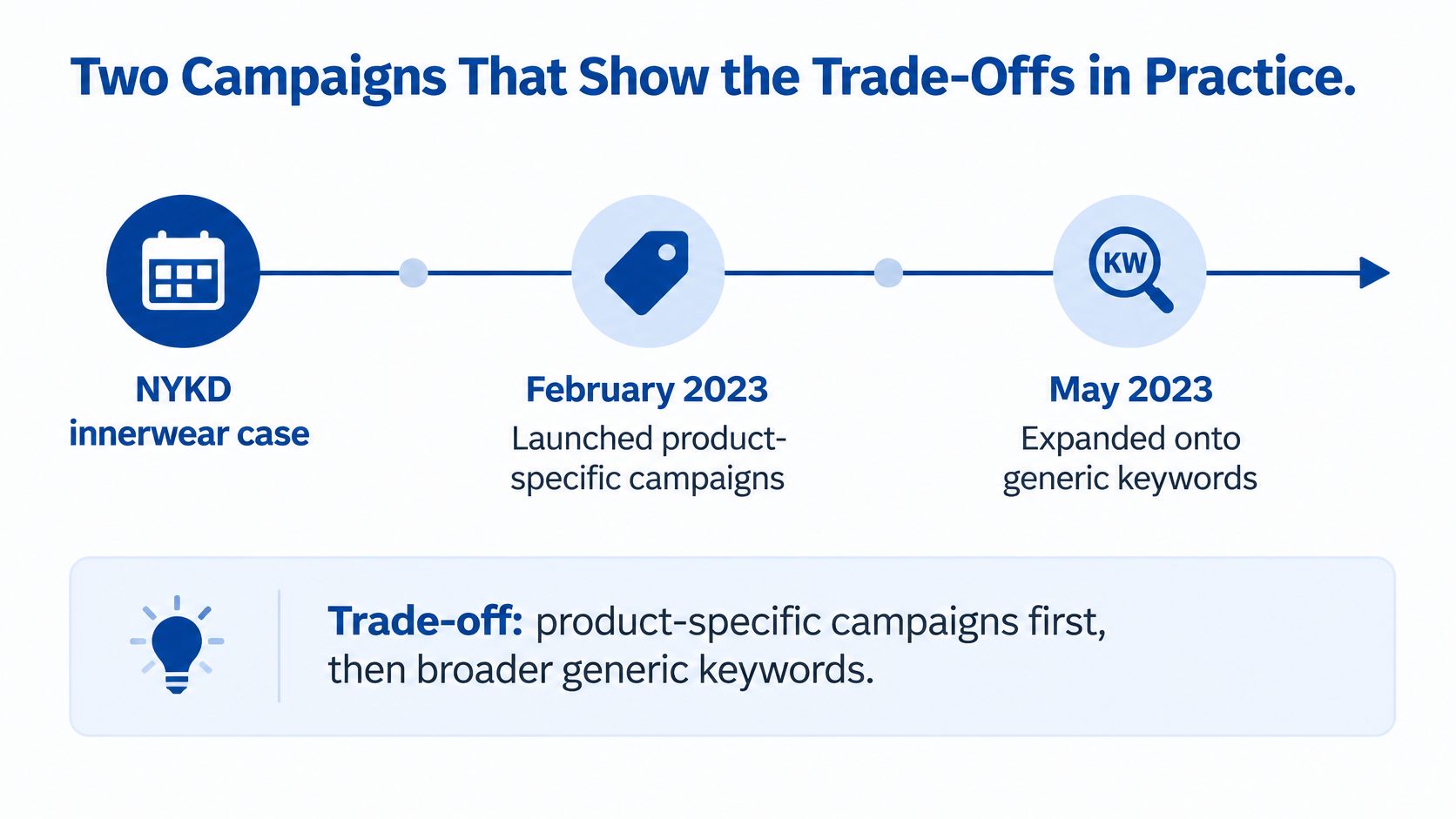
Notice the operational lesson here. Product-specific campaigns protected newly launched styles and kept conversion tight, while generic category keywords built a fresh pipeline of new shoppers. Judging scaling decisions on new-to-brand sales, category reach, and declining acquisition costs gave NYKD room to expand without losing margin discipline.
Buying Velocity With Planned Guardrails
Sometimes an apparel or lifestyle label needs to capture category share fast, which requires accepting temporarily unprofitable ACOS on purpose. At Headline, we managed a lifestyle brand investing $75,000 in monthly Amazon ad spend where the objective was aggressive market-share expansion rather than short-term ad-console ROAS.
We launched aggressive broad-match campaigns, ran all available Amazon campaign types simultaneously, and applied high-bid strategies for top-of-search placements. We defined strict phase benchmarks upfront so leadership knew exactly what each dollar of early loss was buying:
- Months 1 to 2 (Investment Phase): We accepted ACOS between 45 and 60% to drive rapid sales velocity. Over those sixty days, impressions jumped 300% and market share climbed 25%.
- Months 3 to 4 (Momentum Phase): As higher sales velocity lifted organic search positions, ACOS tightened to 35 to 45%, organic traffic rose 80%, and market share reached +50%.
- Month 6 Outcome: Target keywords reached an average position in the top 3 of search rankings, organic search visibility grew 156%, and the brand doubled its market share within six months.
An early ACOS loss isn't a mistake when it's a funded investment with pre-set exit gates. It becomes a mistake only when teams overspend without tracking whether impressions are converting into organic traffic, top-three keyword ranks, and rising category share by month three.
Confirm the Two-Layer Plan Before Scaling Spend
Paid search doesn't just defend home markets; it also proves whether a clothing catalog can win abroad before you overcommit inventory. In an Amazon Ads European expansion case study, a Guangdong-based clothing brand used Sponsored Products to back its push into Europe. Within three months of launch, impressions increased 210%, total sales rose 145%, and UK sales grew 11%.
That outcome works only when you pair paid visibility metrics with organic sales and keyword-rank trends before raising budgets. Throwing extra ad dollars at a new country or new seasonal collection without confirming organic stickiness just rents temporary volume.
Five Steps to Lock In Before You Increase Budgets
Run every apparel catalog through this exact five-step sequence before scaling sponsored clothing brands spend:
- Calculate break-even ACoS by SKU: Pull unit margin, average return rate, refund processing costs, and Amazon fulfillment fees for each style so every bid ceiling reflects real profit.
- Launch a two-layer campaign split: Build one branded-defense campaign and one non-branded category discovery campaign with completely separate daily budgets.
- Fix fit visuals and video before raising bids: Add measurement-based size charts, model sizing callouts, fabric notes, and Sponsored Brands Video to your priority SKUs first so paid clicks convert into low-return orders.
- Audit total-funnel metrics at 30 and 90 days: Review TACOS, new-to-brand sales, organic keyword movement, and branded search volume together instead of reacting to weekly ACOS swings.
- Scale only positive-contribution SKUs: Shift incremental budget toward styles, sizes, and colorways whose return-adjusted contribution stays positive, and cap or pause chronic high-return variants.
Executing that sequence across a multi-SKU clothing catalog requires coordinating every ad format under one profit model. For the lifestyle brand detailed earlier, Headline ran Sponsored Products, Sponsored Brands, Sponsored Display, and video campaigns together while mapping 500+ relevant keywords across every funnel stage. Before you commit next quarter's apparel ad budget, run a full-funnel audit that stress-tests your SKU margins, fit content, and two-layer campaign structure against your own 90-day cohort data.
Headline Marketing Agency manages full-funnel Amazon PPC and DSP programs across Sponsored Products, Sponsored Brands, Sponsored Display, and Sponsored TV, built around return-adjusted profitability, organic ranking, and measurable brand lift rather than surface-level ACOS targets. If you want an honest look at where your clothing campaigns are leaking margin and where paid search can grow organic share, request a funnel audit with Headline Marketing Agency.
Get Your Free Amazon PPC Audit
Discover untapped growth opportunities and see how our data-driven approach can improve your ROAS.
Get Free Audit →Ready to Transform Your Amazon PPC Performance?
Get a comprehensive audit of your Amazon PPC campaigns and discover untapped growth opportunities.