In House Marketing vs Agency: Which Wins on Amazon?
In House Marketing vs Agency: compare costs, skills, KPIs and workflows for Amazon brands, plus a decision framework for 2026.

82% of surveyed ANA member companies had an in-house agency in 2023, up from 42% in 2008, yet 92% still worked with at least one external agency, according to the Association of National Advertisers. Internal teams handled an average of 61% of total marketing work, compared with 58% in 2018. That's not an agency replacement story. It's a capability-allocation story.
Why Brands Are Rebalancing In-House and Agency Work
The useful question in in-house marketing vs agency isn't which model wins outright. It's which work your employees should own, which expertise you should buy, and how you'll hold both accountable for profit.
An in-house marketing team consists of employees responsible for strategy, execution, or both. An agency is an external partner engaged through a retainer, project agreement, or performance-based fee. A hybrid model combines them, ideally with distinct responsibilities rather than overlapping control.
For Amazon brands, that distinction matters because campaign decisions don't stop at attributed sales. Your team has to consider search visibility, product economics, stock availability, and the quality of the listing receiving traffic. Winning more orders on a low-margin product that's approaching a stockout isn't necessarily good execution.
Ownership matters more than location
An internal operator may know that a replenishment shipment is delayed before the advertising dashboard shows a problem. An outside specialist may identify wasted search-term spend or a poorly structured audience test that the internal team hasn't challenged.
Neither advantage works without communication. The internal team must translate commercial knowledge into usable constraints, and the specialist must turn those constraints into campaign decisions.
Practical rule: Keep commercial accountability inside the business. Assign execution to whoever can make the best decisions within those boundaries.
Headcount alone doesn't tell you whether you have the right capabilities. Neither does an agency's service list. You need a comparison of operating strengths, a fully loaded cost calculation, and a shared performance scorecard.
That's the decision facing marketing directors and eCommerce leaders who must justify a hire, defend an agency budget, or redesign an Amazon operating model without sacrificing growth.
In-House vs Agency Side by Side
| Factor | In-House Team | External Agency |
|---|---|---|
| Speed to launch | Fast once hired; hiring lead time sets availability | Fast once onboarded; access and scope set readiness |
| Brand and product knowledge | Deep, and compounds over time | Built from briefs; must be taught and refreshed |
| Specialist depth | Limited to the people you hire | Available across accounts and disciplines; verify who's assigned |
| Capacity for spikes | Fixed; difficult to reduce after peaks | Flexible when the agreement permits scope changes |
| Data ownership | Direct control of accounts and reporting | Contract terms and account permissions determine control |
| Independent perspective | Can drift toward internal assumptions | Outside scrutiny of what's working |
| Best-fit work | Ongoing, brand-sensitive execution | Specialist builds, testing, and seasonal surges |
Speed to launch is an operational question, not a label. An employee waiting for creative approval can be slower than an agency with approved assets and clear decision rights. An agency without Seller Central access, campaign history, or an agreed product scope can't move intelligently either.
Brand knowledge becomes valuable when it changes action. Knowing which formulation solves a shopper's problem should influence keyword selection and listing content. Knowing product-level margins should change bid ceilings, not remain buried in a finance spreadsheet.
Match the skill to the work
Specialist depth matters when the work extends beyond familiar Sponsored Products campaigns into DSP audiences, Amazon Marketing Cloud analysis, or structured creative experiments. Ask an agency who performs each discipline. Access to a broad team means little if your account receives only generalist support.
Capacity is a separate issue. Before hiring another strategist to clear an operational backlog, distinguish campaign judgement from repeatable administration. LatHire's resource for businesses looking to hire latin american virtual assistants is relevant when evaluating support for documented reporting, asset coordination, or listing workflows, rather than strategic bidding authority.
- Protect account access: Keep brand-controlled administrator access and exportable reporting, regardless of who executes.
- Invite challenge: Require evidence when either team recommends continuing an established tactic.
- Define peak coverage: Agree on who handles launch periods, promotional events, and absences before they occur.
The core trade-off is compounding internal knowledge versus specialist breadth and flexible capacity. Keep recurring work that requires intimate business context close to the business. Buy scarce skills or temporary execution capacity through a clearly bounded engagement.
What Each Model Really Costs Per Year
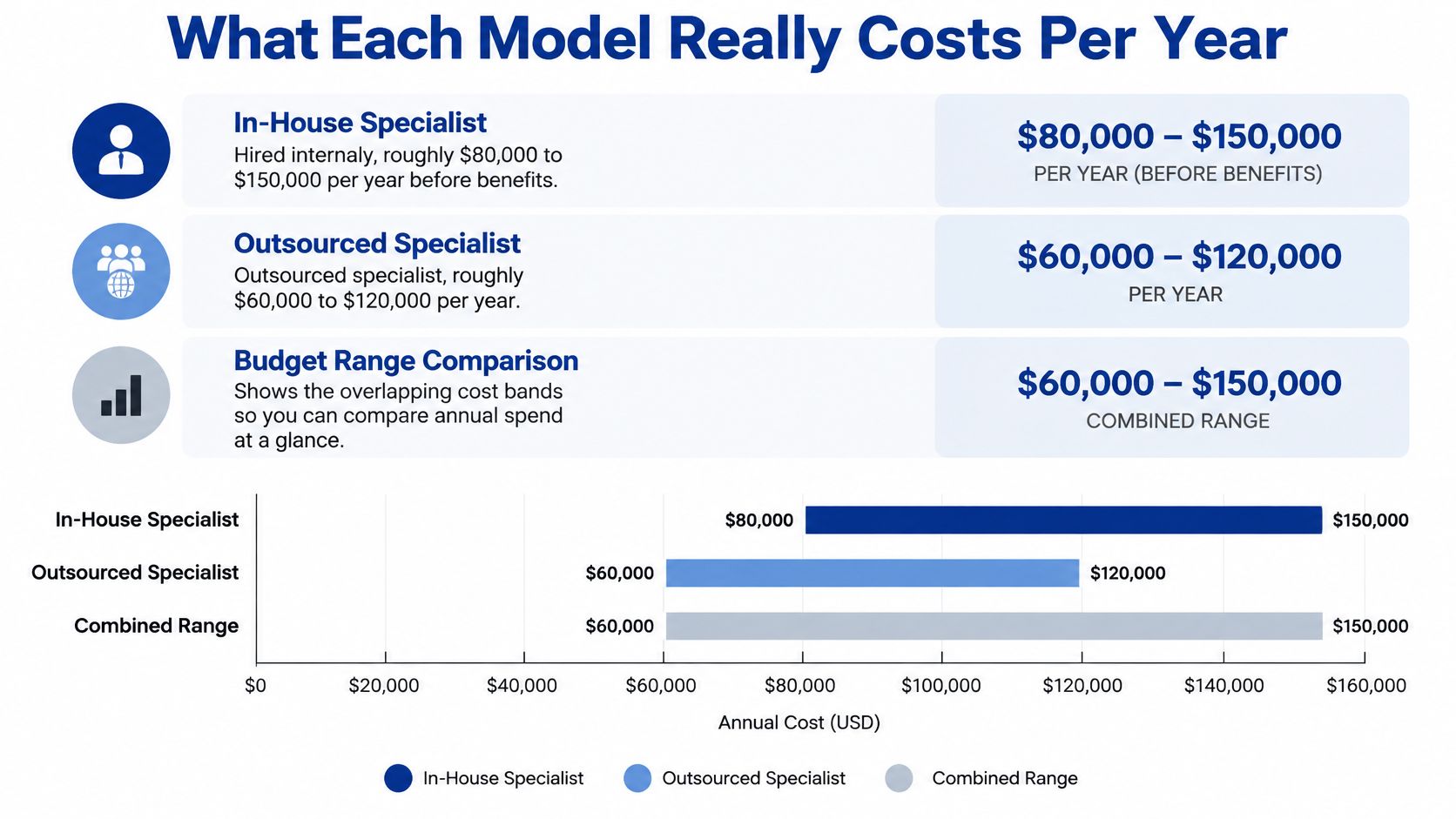
MarketerHire's outsourcing guide reports approximately $80,000 to $150,000 annually for an internally hired specialist before benefits and other overhead, $60,000 to $120,000 annually for an outsourced specialist, and $10,000 to $25,000 or more monthly for a full-service agency retainer. These are broad marketing benchmarks, not Amazon-specific quotes or equivalent service packages.
| Cost Model | Reported Range | What It Leaves Out |
|---|---|---|
| In-house specialist | $80,000 to $150,000 a year | Benefits, management time, software, training, recruiting, coverage gaps |
| Outsourced specialist | $60,000 to $120,000 a year | Internal management time and brief-writing |
| Full-service agency retainer | $10,000 to $25,000 or more per month | Internal oversight and data access work |
The overlapping specialist cost bands illustrate why the cheaper-looking option isn't automatically the better operating model.
Compare complete operating systems
Salary against retainer is the wrong comparison. A salary buys a person's available time and skills. An agency retainer buys a defined scope, which may include several disciplines but won't necessarily provide unlimited access to each specialist.
Build a cost worksheet with separate lines for compensation, benefits, recruitment, tools, training, management, and absence coverage. For an external model, include the fee, internal coordination, implementation work, and any analytics or creative services excluded from the agreement.
Then compare equivalent deliverables. Does each option include search-term analysis, budget pacing, creative testing, DSP execution, and commercially useful reporting? The cost of PPC management deserves its own scope review before you compare proposals.
Utilization changes the answer
An internal specialist becomes easier to justify when the workload is steady and requires sustained judgement. Hiring a DSP expert for occasional campaign builds leaves you paying for capability you don't consistently use. Conversely, continually outsourcing a dense, predictable workload may create unnecessary briefing and coordination.
Evaluate the economics using:
- Fully loaded operating cost: Include every resource required to deliver the agreed scope.
- Incremental contribution profit: Estimate additional profit after product costs, marketplace fees, advertising, and the relevant operating costs.
- Decision throughput: Track completed experiments and how quickly the team acts on meaningful search-query changes.
Don't mistake attributed revenue for incremental revenue. Where practical, use controlled tests, comparable product groups, and pre-agreed baselines to assess what advertising added.
A cheaper team can still be expensive if it leaves profitable decisions unmade.
A clear warning sign is a specialist who spends more time assembling recurring reports than interpreting them. Fix data preparation and reporting ownership before concluding that you need another senior hire.
KPIs That Show Which Model Is Working
Judge advertising by profit and organic growth, not ACOS alone. An efficient-looking campaign can favor branded demand, underfund promising discovery terms, or push products with weak contribution margins.
Use a shared scorecard, with definitions precise enough that internal and external teams can reproduce the same result.
| KPI | What It Reveals | Blind Spot |
|---|---|---|
| Blended ROAS | Attributed return across all ad types | Ignores organic lift and product-margin differences |
| TACOS | Ad spend as a share of total sales | Can improve after excessive spending cuts, even while organic sales decline |
| Contribution profit | Profit after product costs, fees, and ad spend | Requires accurate internal cost data |
| Organic rank movement | Changes in unpaid search visibility | Needs a baseline and doesn't establish causation alone |
| New-to-brand rate | Share of measured customers new to the brand | Doesn't establish repeat purchase or profitability |
| Test velocity | Controlled experiments completed per month | Experiment volume without usable learning produces noise |
Read the measures together
Define blended ROAS explicitly. Use combined attributed advertising sales divided by combined advertising spend if you want a paid-media efficiency measure. If you use total sales instead, label that separately so nobody confuses paid attribution with total business performance.
TACOS needs similar care. Organic sales declining on their own would push TACOS upward, not downward. The ratio can still fall during a business decline if the team cuts advertising spend faster than total sales fall, so always inspect the numerator and denominator.
Contribution profit should determine whether growth is worth pursuing. Organic keyword positions help diagnose visibility, while new-to-brand measures help distinguish acquisition from harvesting familiar demand. Test velocity tells you whether the team is learning, but each completed test should produce a documented decision.
A practical Amazon KPI framework should connect these measures rather than appoint a different winner for each dashboard.
What the Rosy Soil sequence demonstrates
In Amazon's Rosy Soil case study, the brand focused exact-match Sponsored Products campaigns on cactus and succulent keywords from April to June 2025, then expanded toward broader category terms; Amazon reports later monthly revenue growth of 344% year over year, a garden-soil Best Sellers Rank improvement from #41 to #8, reviews increasing from approximately 300 to approximately 2,000, a 567% increase, and an 83.6% new-to-brand customer rate.
The actionable part is the sequencing. The team started with searches where the formulation had a relevant advantage rather than buying broad category exposure immediately.
Don't confuse Best Sellers Rank with organic position for an individual keyword. The case also doesn't establish that paid campaigns alone caused every downstream outcome. It does demonstrate why a useful assessment includes retail results alongside advertising efficiency.
Write a shared KPI definition sheet specifying sales sources, attribution windows, returns treatment, cost inputs, and reporting periods. Then require each team to explain what changed, why it matters, and what decision follows.
How to Decide Which Tasks Stay Internal
The 2025 In-House Agency Benchmarking Survey found that 55% of in-house agencies still sought external agencies for skills and talent, down from 77% in 2023. Building internal capability doesn't remove the need to decide which expertise is worth maintaining permanently.
Use a task inventory rather than a department-level argument. A team can own advertising strategy without personally executing every audience build, report, or campaign adjustment.
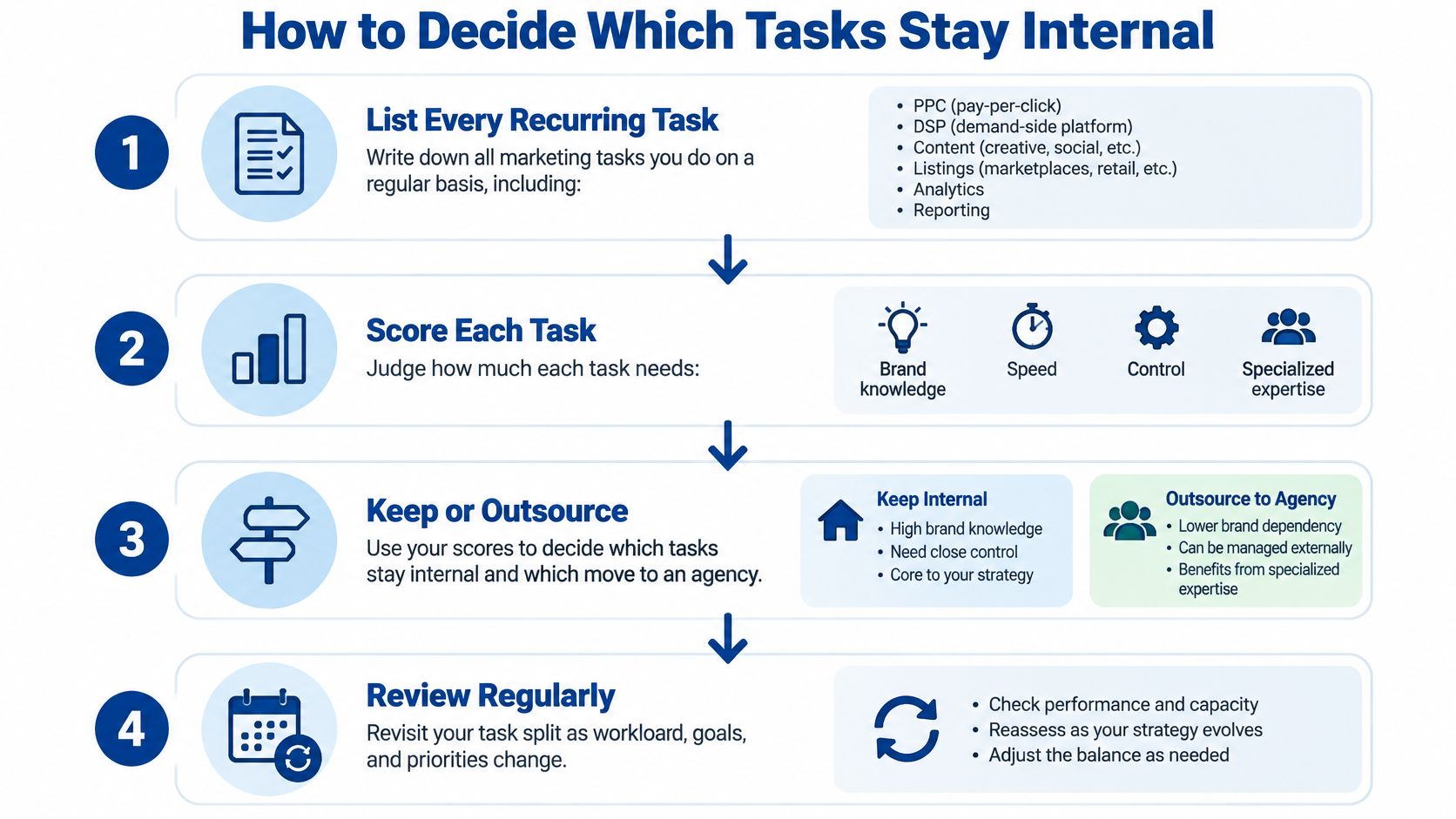
The decision process starts with individual workflows, not job titles.
Allocate work through explicit decisions
List every recurring task. Include PPC structure, DSP audience management, content briefs, listing updates, analytics, and reporting. Split broad labels such as campaign management into actual decisions and production tasks so you don't outsource an entire function to solve a narrow bottleneck.
Score the operating requirements. For each task, assess dependence on product, margin, and inventory knowledge; recurrence; required response speed; and scarcity of the necessary skill. Use a consistent low-to-high scale and have the commercial owner and execution lead score separately before resolving disagreements.
Compare build cost with marginal external cost. Include recruiting, training, tooling, management, and backup coverage in the internal estimate. Ask what adding the specific task would cost externally, rather than assigning the entire agency retainer to a small piece of work.
Reserve commercial authority internally. Keep brand strategy, pricing, inventory coordination, compliance ownership, and final budget authority with named employees. The agency should receive actionable rules, such as product-level spending constraints and escalation conditions, instead of being expected to infer commercial priorities.
Scope specialist work precisely. Assign complex architecture, experimental design, advanced measurement, or seasonal support through defined deliverables and acceptance criteria. For administrative workflows, evaluate Amazon virtual assistant services separately from specialist campaign strategy so routine execution doesn't absorb senior attention.
Establish shared data and change control. Give both teams access to the approved cost model, performance definitions, experiment log, and campaign change history. Specify which changes require approval and which the execution owner can make independently, then revisit assignments when workload or business priorities change.
Allocation test: High internal-knowledge requirements plus steady recurrence favor building. Rare expertise plus temporary demand favor buying.
A fast-response task doesn't automatically belong internally. If an external specialist has the required access and pre-approved decision rights, they may act faster than an employee waiting for several approvals.
Use Cases Where Each Model Wins
| Situation | Lean Toward | Why |
|---|---|---|
| Stable spend across several SKUs in one category | In-house, with specialist support | A consistent workload can keep specialists fully utilized |
| New product launch needing fast keyword capture | Agency | Relevant launch experience can improve sequencing |
| Brand with proprietary margin and inventory data | In-house owns strategy | Internal information improves bid limits and budget choices |
| Full-funnel program across PPC, DSP, and audiences | Hybrid, with agency measurement | Requires joined-up measurement infrastructure |
| Seasonal surges and temporary capacity gaps | Agency on flexible scope | Avoids permanent hiring for temporary peaks |
| Early-stage brand with limited spend | Outsourced or part-time specialist | Workload may not justify a full-time specialist |
These are starting positions, not automatic awards. Test whether the people involved can deliver the capability the situation requires.
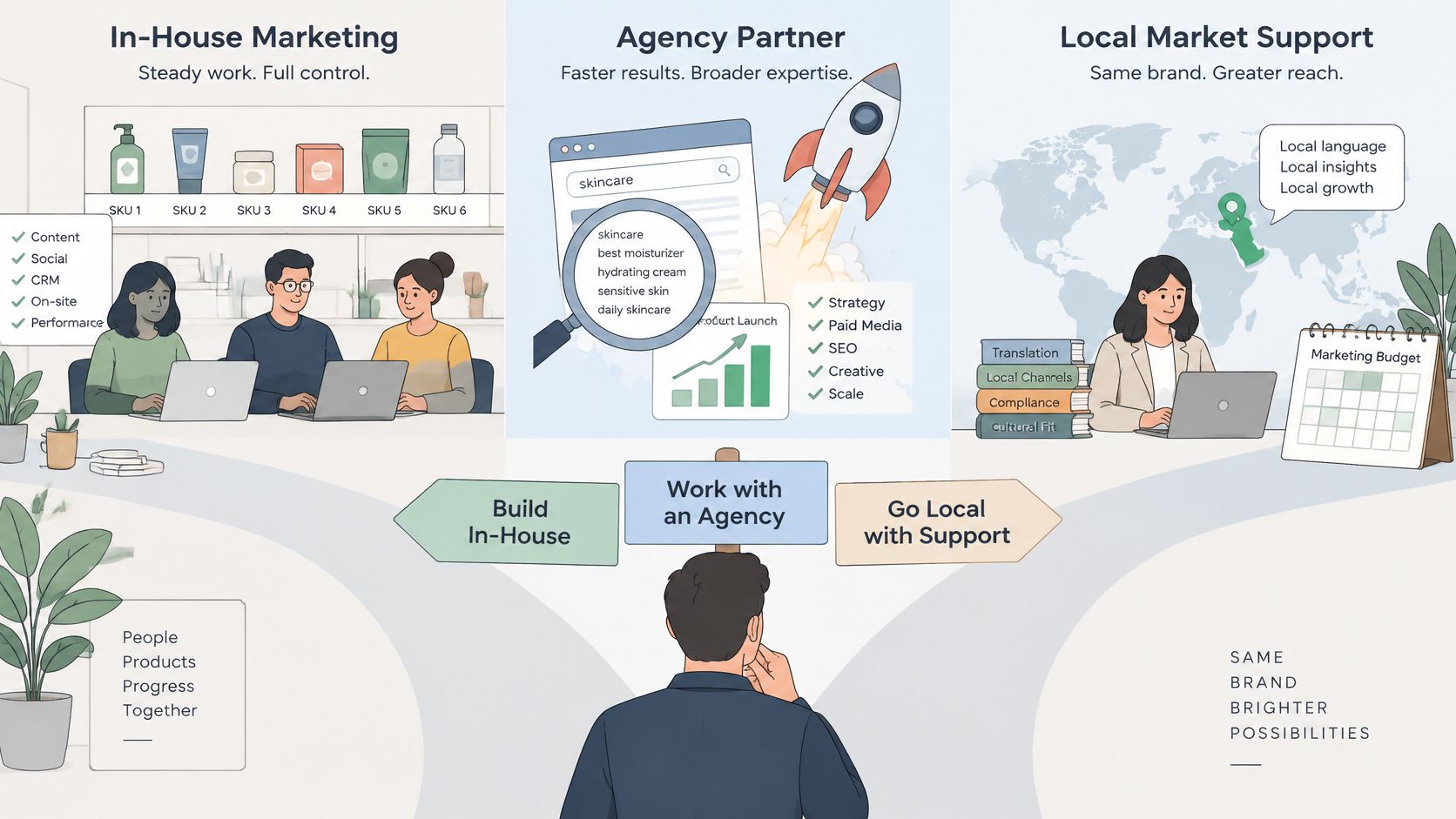
The operating choices below illustrate why specialist support and internal ownership can coexist.
When integration justifies external expertise
A mature Sponsored Products account doesn't automatically give an internal team the capability to measure a full-funnel program. Connecting DSP exposure, subsequent searches, and purchases requires more than placing channel reports next to one another.
In Amazon's Optibac case study, connected upper-funnel activity and Sponsored Products produced a 0.5% purchase rate versus 0.2% for Sponsored Products alone, a 2.5-times relative improvement; Amazon also reports 26.7 million impressions, 32% incremental reach, a 119% increase in brand searches against a 30% target, a 17% increase in purchasers, and 1.66 percentage points of market-share growth.
The practical lesson is to connect exposure and conversion paths through Amazon Marketing Cloud instead of evaluating each channel in isolation. Those reported outcomes are a case example, not a forecast for another brand or proof that every additional purchase was incremental.
Ask a prospective partner to explain the audience comparisons, exposure windows, exclusions, and measurement limitations behind its recommendation. If the answer is only a collection of channel-level ROAS charts, you haven't established a full-funnel measurement capability.
Use the same commercial lens when reviewing an operating-model discussion.
When control earns its keep
Say a brand sells products with different margins and replenishment constraints. An internal commercial lead can prioritize available, profitable products while limiting exposure for items that can't support additional demand. The external team can execute within those boundaries without owning the underlying pricing or inventory decisions.
For an early-stage brand, a tightly scoped specialist may be more useful than a full-service engagement. Start with retail readiness, relevant search demand, and a manageable testing agenda. Buying channels you aren't ready to evaluate creates complexity rather than capability.
Seasonal support requires a different agreement. Specify the peak-period deliverables, response expectations, and handback process, and confirm how the scope contracts afterward. Flexibility isn't useful if the contract locks the business into permanent peak capacity.
- Choose in-house execution when proprietary knowledge and sustained workload justify dedicated expertise.
- Choose an agency when breadth, measurement depth, or temporary capacity outweigh the coordination burden.
- Choose a hybrid when commercial decisions need internal context but execution requires capabilities you don't need full time.
An internal team with weak measurement can be cheaper and still underperform. An agency without access to commercial constraints can be technically competent and still make the wrong spending decisions.
Moving Work Between Models Without Losing Rank
Treat a move between teams as an operational handover, not an opportunity to rebuild everything immediately. Changing ownership, campaign structure, bidding logic, and reporting simultaneously makes it difficult to diagnose a subsequent decline.
The receiving team should first understand which decisions protect existing demand and which assumptions deserve testing. Preserve useful history even when the account structure needs improvement.
Use a controlled handover
Freeze the baseline. Record blended ROAS, TACOS, contribution profit, and organic keyword positions across a representative pre-change period. Annotate promotions, pricing changes, stock interruptions, and category seasonality so the incoming team doesn't mistake unusual conditions for normal performance.
Transfer decision history in writing. Document account structure, bid ceilings, negative-keyword logic, search-term history, inventory rules, and previous experiments. Explain why priority terms receive support, including whether the objective is efficient sales, discovery, or a defined visibility test.
Run an overlap with a single execution owner. Let both teams review the shared KPI sheet, but don't allow competing edits to the same campaigns. The receiving team should demonstrate that it can interpret the account, maintain the agreed commercial baseline, and explain deviations before the outgoing team disengages.
Set a recovery trigger. Agree in advance on the duration and severity of deterioration that warrants intervention. First distinguish ownership problems from price, stock, listing, or competitive changes; then return the work or bring in a specialist if the receiving team can't correct the issue.
Protect the reasoning behind the account, not just the campaign exports.
Apply the same discipline in either direction. An agency-to-internal transition isn't safer than an internal-to-agency move.
Avoid promising that a handover will preserve every keyword position. The defensible commitment is a documented baseline, controlled changes, clear accountability, and a recovery plan that protects contribution profit.
Choose Your Model and Take the Next Step
A selective hybrid is the strongest default for Amazon brands whose commercial complexity exceeds their internal specialist capacity. Keep the business accountable for its commercial decisions, and engage outside expertise against specific capability gaps.
That's a recommendation, not a requirement to retain an agency forever. A stable operation with capable employees may need only occasional specialist audits. A business entering unfamiliar channels may need a broader external execution layer.
Make the decision testable
- Choose a bounded scope. Apply the task-allocation method to a product category or launch rather than reorganizing the entire account at once. Name the person accountable for the commercial result.
- Audit the economics. Compare the relevant internal operating costs and external fees with contribution profit across representative trading periods. Separate spending required to maintain performance from investment intended to create additional growth.
- Agree on measurement before commitment. Resolve attribution, cost inputs, organic visibility tracking, and experiment ownership before signing a contract or approving a hire. A disagreement about success after implementation is expensive to untangle.
- Run a controlled pilot. Set a review window appropriate to the buying cycle and seasonality, with explicit success criteria and a fallback plan. Require evidence of commercially useful learning as well as the headline performance result.
Demand decisions, not activity
Ask whoever owns execution to connect each recommendation to a business outcome. A campaign restructure should solve a defined problem. A new audience should test an explicit acquisition hypothesis. A keyword investment should have a credible relationship to shopper relevance and retail performance.
The sustainable approach is to use PPC as a lever for profitable acquisition and stronger organic visibility, not as a permanent substitute for competitive products and conversion-ready listings. Paid dependence should be evaluated alongside total profit, rather than reduced mechanically at the expense of growth.
The question isn't which model is cheaper. It's which arrangement helps your people make profit decisions faster and more accurately.
Headline Marketing Agency offers data-driven Amazon PPC and DSP strategy, campaign execution, and measurement focused on contribution profit, organic ranking, and sustainable scale. Visit Headline Marketing Agency to discuss where specialist support could strengthen your internal team and how to evaluate that partnership beyond ACOS alone.
Get Your Free Amazon PPC Audit
Discover untapped growth opportunities and see how our data-driven approach can improve your ROAS.
Get Free Audit →Ready to Transform Your Amazon PPC Performance?
Get a comprehensive audit of your Amazon PPC campaigns and discover untapped growth opportunities.