Ecommerce Advertising Agency: Services, KPIs and Selection
Learn what an ecommerce advertising agency does, which services matter, the KPIs that prove profit, and how to evaluate and choose the right partner.

Amazon's advertising revenue reached about $68.6 billion in 2025, according to Amazon's regulatory filing. Amazon is now a media owner as well as a store. For brands, that changes the agency question: you're not just hiring someone to adjust bids, you're choosing who will turn paid visibility into profitable, lasting demand.
An ecommerce advertising agency should be accountable for that outcome. Attributed sales and a tidy ACOS say nothing about whether spend lifted organic rank or protected contribution margin. The right partner measures incremental profit and can separate revenue it created from revenue that would have happened anyway.
What an Ecommerce Advertising Agency Does and When You Need One
An ecommerce advertising agency runs paid media inside marketplaces and retail sites, including sponsored search, display, video and off-site audiences. A performance-first agency connects those activities to product economics and judges them on profit, not just platform-reported sales.
Think of traditional advertising as the shop window, where shoppers first notice a brand. Retail media puts advertising at the checkout counter, close to the buying decision. WARC's retail media analysis describes the shift toward commerce-linked environments where retailers combine audience information, shopping behavior and transaction outcomes.
The operating case for outside help
For one brand, the challenge is coordination. Search managers, audience buyers and analysts need to work from the same product margins, inventory constraints and commercial priorities. Otherwise, separate teams can claim credit for the same customer while nobody checks whether the business earned more money.
The work requires shared analysis, not isolated channel reports.
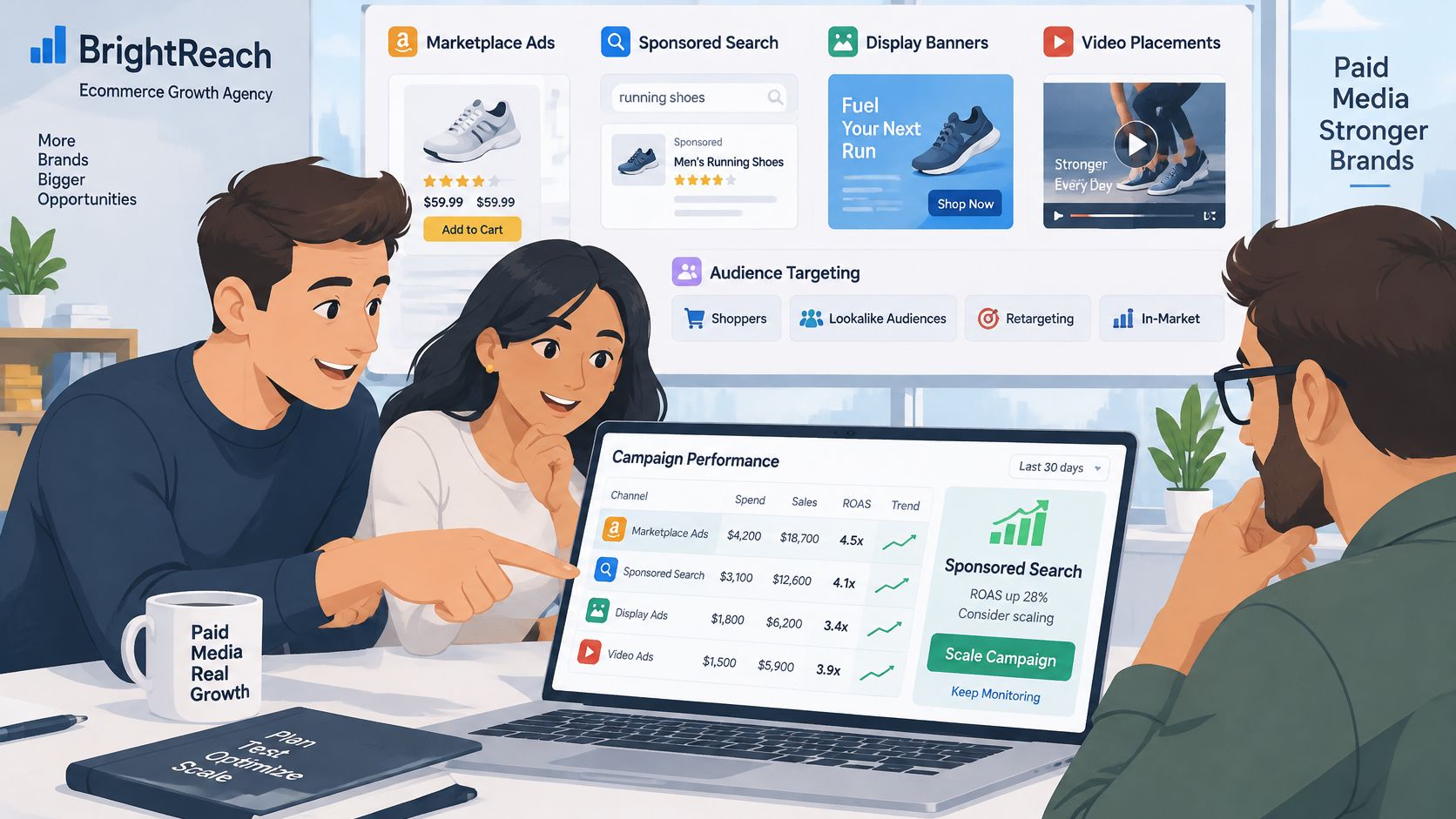
An agency makes sense when it supplies capabilities and operating capacity your team lacks. If you're deciding between marketplace execution and a broader growth remit, the growth agency insights from Grumspot offer useful context for defining that scope.
Look for these signs that outside help could be worthwhile:
- Spend outpaces profit. Advertising revenue rises, but finance can't see a corresponding improvement.
- Organic performance has no owner. Nobody connects paid search decisions with product discoverability.
- Daily execution slips. Your team lacks time to review bids, budgets, stock issues and campaign exceptions.
Hiring an agency won't fix unclear commercial priorities. Give it a defined profit objective, reliable cost inputs and an internal decision-maker who can resolve pricing and inventory problems.
Core Services an Ecommerce Advertising Agency Runs
Core ecommerce advertising services and what they cover
| Service | What It Covers | Best For | Core Metric |
|---|---|---|---|
| Sponsored Products PPC | Keyword and product-targeted ads in search results and on product detail pages | Launches and capturing existing demand | Contribution profit per click |
| Sponsored Brands and Display | Brand-led search banners and retargeting of shoppers | Brand discovery and defending brand terms | Branded search lift and new-to-brand share |
| Sponsored TV and Video | Video ads placed in search and across streaming and online video | Consideration and category growth | Incremental sales from holdout tests |
| Amazon DSP | Programmatic audience buying across Amazon and beyond for awareness through conversion | Scale and full-funnel growth once search is efficient | Incremental sales and downstream profit |
| Amazon Marketing Cloud analytics | Clean-room analysis of pseudonymized Amazon Ads signals combined with a brand's own data | Measuring whether ads create additional sales | Incremental return on ad spend |
| Creative optimization | A/B tests on images, video, headlines and copy | Lifting click-through and conversion rates | Contribution margin per tested variant |
Start with the commercial bottleneck
Most brands start with Sponsored Products because it captures demand shoppers already express. Add Sponsored Brands and Display when you need stronger brand discovery, brand-term coverage or shopper retargeting. Broader video and DSP investment should follow retail readiness, not an agency's desire to expand its service scope.
The adoption sequence isn't rigid. A brand entering an unfamiliar category may need discovery activity early, while an established catalogue might need better search execution before broader reach makes sense. Choose the service that addresses the constraint, rather than buying every available format.
At Headline Marketing Agency, we offer Amazon PPC, Amazon DSP, Amazon AMC, and Analytics & Insights. Those service lines let us connect campaign execution with the analysis needed to decide what deserves more investment.
Know what analytics can answer
Amazon Marketing Cloud, or AMC, is a secure, privacy-safe, cloud-based clean room. It lets advertisers analyze pseudonymized signals, including Amazon Ads signals and their own inputs, without treating customer-level information as an exportable prospect list.
An agency can use that environment to investigate exposure paths, audience overlap and downstream purchasing. But access to AMC doesn't automatically establish causality. Testing whether advertising creates additional sales still requires a credible comparison and a clearly defined outcome.
Before signing a scope, ask:
- Which services are included? Separate campaign management, creative production, analytics implementation and strategic consulting.
- Who owns each metric? Name the person responsible for explaining changes and recommending action.
- Does reporting cover the whole scope? A search-only dashboard won't explain a full-funnel engagement.
The useful deliverable isn't a longer service menu. It's a clear account of what the agency will change, why that change matters and how you'll judge it.
How PPC Drives Organic Growth and Profit
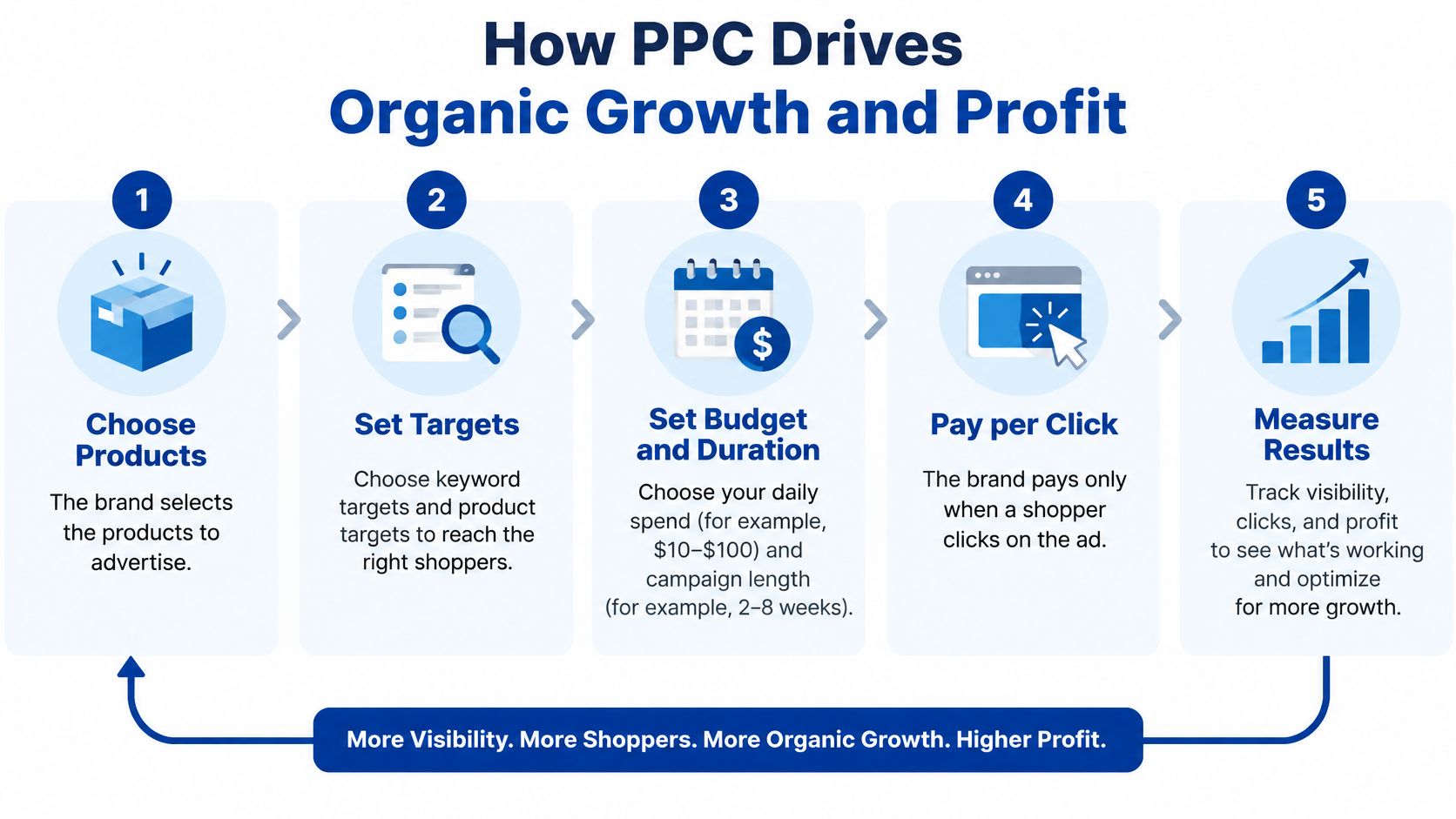
With Amazon Sponsored Products, you choose products, select keyword or product targets, set bidding parameters, establish a budget and duration, and pay only when a shopper clicks. Ads can appear in shopping results and on product detail pages, and advertised listings generally need Featured Offer eligibility.
The mechanics are straightforward. The economics need more discipline.
This workflow shows the operational sequence, from product selection to measurement.
Set bids from allowable acquisition cost
Start with contribution before advertising: sales less product costs, marketplace fees, fulfillment and other variable costs. Then decide how much contribution you can spend acquiring an order while retaining the required profit.
A practical bidding relationship is:
Practical rule: Allowable cost per click equals allowable acquisition cost multiplied by the expected click-to-order conversion rate.
That's a planning ceiling, not a reason to bid the maximum everywhere. Actual CPC, placement quality and conversion rate determine whether the campaign produces acceptable contribution. Repeat-purchase value can support a higher acquisition allowance, but only when your customer cohorts justify it.
Our approach focuses on contribution margin optimization and profit-based bidding. Our paid search for ecommerce guide develops the connection between campaign structure and commercial outcomes.
Build organic relevance rather than renting visibility forever
Paid ads are a rented spotlight. The objective is to make the product easier to find after you switch that spotlight off.
Relevant paid traffic can generate converting sales that support organic rank. If rank improves and the listing continues to convert, organic orders can reduce dependence on paid acquisition. That doesn't mean the auction CPC automatically falls, or that every paid sale improves rank.
The distinction matters: an academic analysis of Amazon search results examined approximately 2 million organic and 638,000 sponsored results, finding sponsored listings represented nearly 30% of observed results. The same analysis found sponsored results ahead of the top organic result in 85% of first-page cases, and prominent sponsored products with organic rankings beyond position 100.
Paid visibility therefore doesn't prove organic relevance. Track query-level purchase performance and organic-position movement before claiming an organic-growth benefit.
Use discovery campaigns for broad and category exploration. Move proven queries into harvest campaigns, including exact-match and product targeting, only when the detail page, price, reviews and inventory can support conversion.
For additional context on PPC execution, watch this walkthrough.
Also inspect placement allocation. Amazon's off-Amazon delivery guidance states that off-Amazon Sponsored Products uses existing targeting, bids and budgets, so those clicks consume the same campaign budget as on-Amazon delivery.
Before scaling, confirm Featured Offer eligibility, positive contribution after ads, and organic rank moving in the intended direction. Our PPC approach uses those commercial considerations to improve ranking, maximize product margins and protect market position, rather than treating ACOS as the endpoint.
KPIs That Show Profit, Not Just ROAS
Cutting ACOS can damage growth when it removes profitable customer acquisition or suppresses demand that converts later. A campaign with higher reported ACOS can still be the better investment if it produces more incremental contribution over the customer relationship.
According to Digiday's reporting on Amazon's long-term measurement, Amazon estimates roughly 20% of a brand's value appears after the typical 7–30-day attribution window, based on more than 2 million campaigns. Separately, Amazon's advertising FAQ states attribution windows of 7 days for Sponsored Products and 14 days for Sponsored Brands.
KPIs for profit-led ecommerce advertising decisions
| Metric | What It Tells You | Blind Spot |
|---|---|---|
| ACOS | Ad spend as a share of ad-attributed sales | Ignores margin, repeat orders and organic lift |
| ROAS | Ad-attributed sales per dollar of ad spend | Same blind spot as ACOS, plus credit from the attribution window |
| Contribution margin after ads | Profit left after product cost, fees and ad spend | Needs accurate cost data from the brand |
| New-to-brand share | Share of buyers classified as new to the brand under the reporting definition | Needs access to new-to-brand reporting |
| Organic rank and share of search | Whether key-term visibility improves alongside paid activity | Movement alone doesn't establish causality |
| Incremental sales from holdout tests | Sales that wouldn't have happened without the ads | Needs controlled test design and time |
| Repeat purchase rate and customer lifetime value | Value of customers after their first order | Longer horizon that delays the decision |
Compare customer cohorts, not dashboard snapshots
Consider an illustrative scenario: campaign A reports 18% ACOS, while campaign B reports 31%. B acquires more new buyers who reorder over the next two quarters, producing greater contribution profit across the period despite weaker immediate efficiency.
That outcome isn't permission to excuse every inefficient campaign with future lifetime value. Separate first-order contribution from observed repeat-order value, include inventory-related costs, and challenge whether the additional orders would have happened anyway.
Our team specializes in CLV-based advertising strategies aimed at long-term profitability. The practical reporting requirements are outlined in our advertising performance metrics guide.
Attach a decision to every review
Combine contribution after ads, new-to-brand share, repeat purchasing, organic sales movement and controlled holdout results. Longer-horizon evaluation is especially useful for launches, competitive defense and replenishment categories.
A monthly review should contain a profit number, a growth number and a test result, each with a decision attached.
For example, maintain the profitable acquisition cohort, reduce exposure to an overlapping audience, or continue a launch test until its agreed evaluation window closes. A dashboard without a decision is documentation, not management.
DSP, Video and Creative Beyond Search Ads
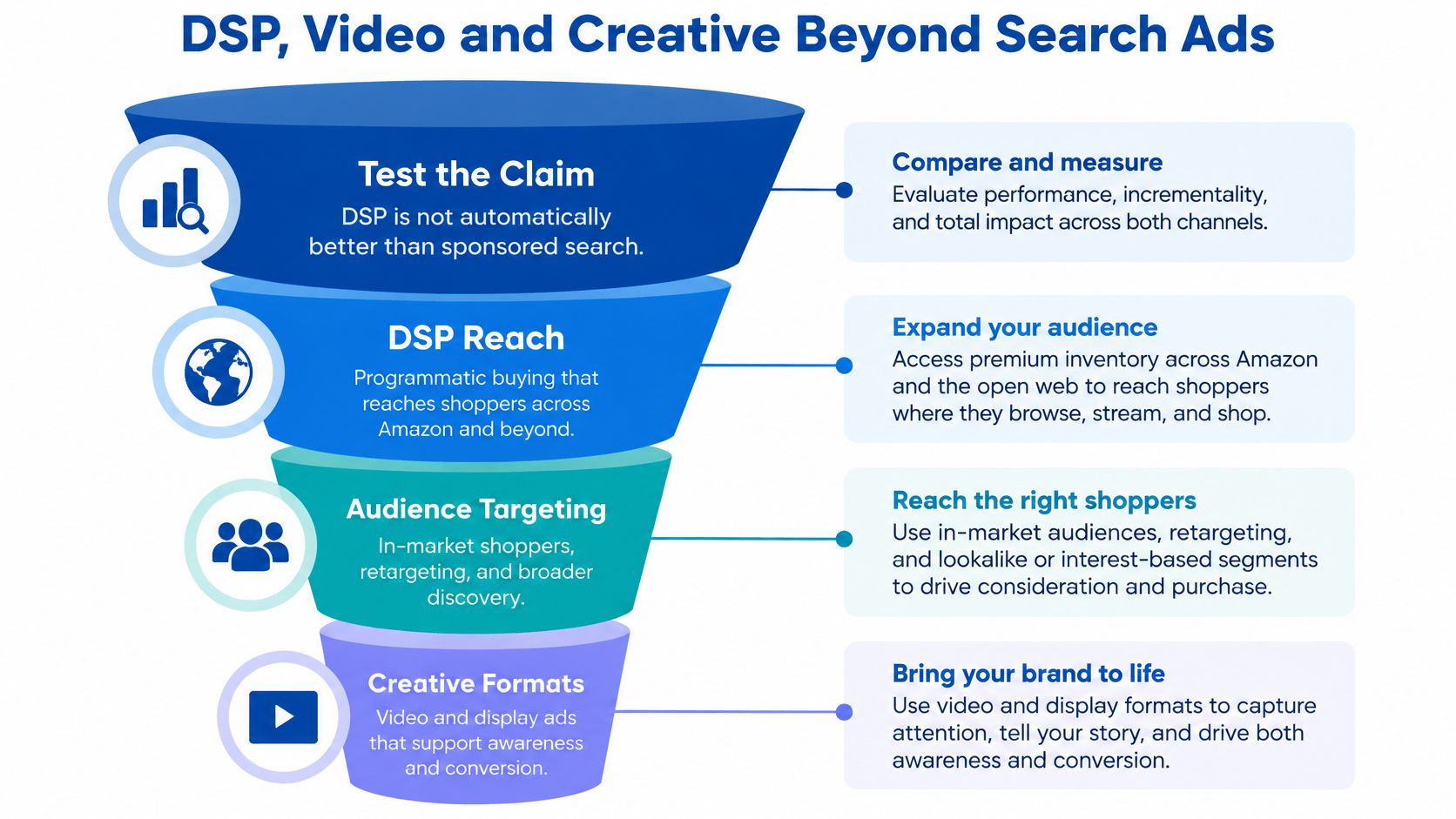
DSP isn't automatically better than sponsored search. It buys different opportunities, often with less immediate purchase intent. Moving budget makes sense only when those opportunities create additional profitable demand.
Amazon DSP uses programmatic buying to reach shoppers across Amazon and beyond. Audience options include in-market segments, lifestyle and interest targeting, purchase behavior, custom audiences and look-alike models. Match the message to the journey: introduce the problem at awareness, demonstrate differentiation during consideration, and resolve objections near conversion.
Digiday reports advertisers increasing DSP, connected TV and online video investment as measurement improves; a study it cites found campaigns across multiple Amazon streaming properties delivered $2.08 in incremental sales per dollar, 77% higher than single-platform campaigns in that study. That's a reason to test, not a forecast for your brand.
The funnel below connects broader reach with audience and creative decisions.
Pass the escalation gates in order
- Retail readiness. Fix listing weaknesses, uncompetitive pricing and inventory gaps before buying broader exposure.
- Audience size. Confirm the reachable audience can support a readable test result.
- Margin. Model whether expected acquisition costs leave positive contribution.
- Repeat-purchase potential. Establish whether the category supports subsequent orders rather than assuming it does.
- Category competition. Identify a defensible message against incumbents. Reach alone won't overcome an undifferentiated offer.
- Test design. Set a holdout group, a clean control and a fixed evaluation window. Use geographic holdouts where appropriate and prevent audience contamination.
Make creative testing commercially useful
Our DSP creative optimization includes an A/B testing framework, creative performance analysis, dynamic creative optimization, brand consistency review and mobile optimization. Compare variants under similar targeting, placement, budget and retail conditions so the result can guide a decision.
For scripting exploration, ClipNova AI's script to video generator can be considered as part of a production workflow. Keep human review for product claims, demonstrations and brand accuracy. Our video ads for ecommerce guide provides further context for format decisions.
Amazon's Sponsored Products product page reports 67% higher click-through rate and 9% higher conversion rate for campaigns using Sponsored Products video compared with campaigns without video. Those engagement improvements still need to produce contribution profit.
After a flat test, examine the holdout result, frequency, audience exclusions and cross-channel overlap. Decide whether the expected learning and potential lift justify another test, rather than extending spend because the creative looks good.
Engagement Models Matched to Your Brand Stage
The fee model shapes incentives. A fixed retainer pays for agreed ongoing work, while a percentage-of-spend arrangement can reward budget growth even when profit doesn't improve.
Performance-linked fees can align interests, but only if both parties agree on the accounting. A revenue bonus isn't a profit bonus, and an attributed-sales bonus isn't necessarily an incrementality bonus.
Agency engagement models and when each fits
| Model | Best For | How Fees Work | Main Watch-Out |
|---|---|---|---|
| Monthly retainer | Brands with a steady catalogue and ongoing optimization needs | Fixed monthly fee for agreed scope | Paid even in slow months; scope must be written down |
| Percentage of ad spend | Brands with large, stable budgets | Share of managed ad spend | Can reward spending over profit; tie goals to contribution margin |
| Performance-linked fee | Brands that want shared risk | Base fee plus bonus against an agreed KPI | Agree on the KPI definition before work starts |
| Project or audit only | Brands wanting a diagnosis or a single launch | Fixed price per project | No ongoing optimization unless added later |
| Hybrid model | Scaling brands moving into DSP and video | Retainer plus performance component | More contract complexity to manage |
Verify the result behind the proposal
A VP of E-Commerce at a US home goods brand with approximately $5 million in annual Amazon revenue said Headline Marketing Agency increased its ROAS by 92% within three months. That's a customer-reported performance signal, not a guarantee of your outcome or proof of incremental profit.
Before using any case study to justify an engagement, request the baseline period, evaluation timeframe and ROAS calculation. Establish whether the comparison includes promotions, price changes, product mix shifts or inventory recovery.
Contract safeguard: Define the outcome, the cost inputs and the exclusions before agreeing to a performance bonus.
For contribution-based compensation, specify which product costs and marketplace charges count. Agree on how returns, discounts and changes in product availability affect the calculation. Otherwise, the same campaign can generate different bonus figures depending on who prepares the report.
Match the model to the work
A stable catalogue with ready listings usually suits a retainer, provided the scope covers ongoing optimization and reporting. A new launch may benefit from a project phase followed by a retainer, separating setup work from recurring management.
For a scaling brand moving into DSP and video, a hybrid model can work when incremental-profit goals are written down and independently verifiable. Don't negotiate the fee in isolation from the work: a lower retainer that excludes analysis, creative iteration or implementation may leave your internal team carrying the hardest tasks.
Evaluate Agencies and Start With a Free Audit
Use an agency evaluation to expose how the team makes decisions, handles your information and responds when results disappoint. A polished sales presentation won't answer those questions on its own.
Ask questions that require evidence
- Does reporting show contribution and incremental sales? Request a sample decision, not just a dashboard of ACOS and ROAS. Ask what the team would stop spending on despite attractive attributed revenue.
- Who owns the data, and how is it accessed? Keep account ownership and revocable permissions clear. We access client data through Amazon's Selling Partner API and Amazon Advertising API, process it on Google Cloud Platform infrastructure, and encrypt it at rest and in transit. We use Amazon data solely for campaign management, performance analytics and client reporting.
- Is partner status verifiable? We hold Certified Amazon advertising partner status. Confirm credentials directly, and distinguish partner certification from affiliation with Amazon.
- Can the team explain its experiments plainly? Ask how it selects holdout groups, prevents overlap and handles attribution windows. You should understand what would count as a failed test.
- When would it advise against expansion? Require a clear explanation of when search should remain the priority instead of adding DSP or video.
- Can finance verify the fee outcome? Reconcile performance measures with your own cost and profit records before accepting outcome-linked charges.
Use the audit to establish a testable plan
Keep the wider storefront in view too. ServeApps' guidance to improve your online store's SEO is useful when assessing owned-store discoverability alongside marketplace investment, though the implementation differs between environments.
We offer a complimentary Amazon advertising audit, also called the Free Audit, including a thorough check of Amazon PPC campaigns. Compare its diagnosis with your own numbers and prioritize recommendations by commercial impact, implementation effort and confidence.
Start with a 90-day test plan: record the current contribution-margin baseline, run a holdout test on a single campaign group, and review the result at day 90 before committing to a longer contract. Agree on the decision criteria before launching so neither side can redefine success afterward.
Headline Marketing Agency offers Amazon PPC, DSP, AMC, and Analytics & Insights focused on profitable marketplace growth. Visit Headline Marketing Agency to request a Free Audit and identify where your advertising can better support contribution margin, organic visibility and sustainable scale.
Get Your Free Amazon PPC Audit
Discover untapped growth opportunities and see how our data-driven approach can improve your ROAS.
Get Free Audit →Ready to Transform Your Amazon PPC Performance?
Get a comprehensive audit of your Amazon PPC campaigns and discover untapped growth opportunities.