10 Best Product Marketing Strategies for Amazon in 2026
Discover 10 best product marketing strategies for Amazon brands: PPC launches, TACoS bidding, query mining, and DSP retargeting with real examples.

Amazon's case study on Kazi reports the home-goods brand increased Amazon sales by more than 350% year over year, with 80% of its Amazon sales attributed to Amazon Ads and a reported ROAS of 4, according to Amazon's case study on Kazi. That's the right lens for the best product marketing strategies on Amazon. Ads aren't just buying attributed orders. They're building the sales history, relevance, and customer base that make organic growth possible.
Teams still judge that work on ACOS alone, which guarantees they'll cut the campaigns creating rank before the payoff shows up. In one lifestyle brand case study, we doubled market share and increased organic visibility by 156% by using PPC as an investment in organic visibility, not as a cost line to minimize. TACoS fell 10% over the same period.
The ten strategies below follow that logic. Each one states the mechanism, the implementation step, and the trade-off you need to accept before you commit budget. If a tactic doesn't improve profit, rank, or repeatable demand, it doesn't make this list.
1. PPC-Seeded Launch Strategy to Accelerate Organic Rank
A new listing has no sales history, and Amazon's ranking system weighs sales velocity, conversion rate, and relevance. Sponsored Products creates those signals faster than waiting for organic discovery. Amazon's own multi-market analysis found advertisers who used Sponsored Products achieved 34% more sales growth than advertisers who did not, measured four weeks after adoption, in Amazon's multi-market Sponsored Products analysis.
Start broad and phrase match on high-intent category terms, plus exact match on your tightest brand-plus-category combinations. After two to three weeks of data, shift budget toward terms converting at or above your detail page average and cut the rest. In the lifestyle brand work, we mapped 500+ relevant keywords across all funnel stages and ran aggressive broad match with high bids for top-of-search at launch.
The exit matters more than the entry
Set the ramp-down rule before you launch. Track organic rank weekly for ten priority keywords, and reduce paid spend only where organic position has held in the top results for several consecutive weeks.
- Set a launch budget and exit point: Decide the spend ceiling and rank target before the first campaign goes live.
- Watch organic share of sales: Total sales can rise while paid dependency stays flat, and that's the failure mode.
- Protect inventory cover: A stockout during ramp-down destroys the velocity you paid to create.
The risk is real. You'll spend at a loss-making ACOS for weeks. Judge it on blended TACoS over the full launch period and the ranking you keep after spend falls, not on week-one efficiency.
2. Search Query Performance Mining for Keyword Harvesting and Negation
Say your broad campaign spends well but you can't tell which shopper language buys. Search Query Performance, available through Brand Analytics for brand-registered sellers, shows impressions, clicks, and purchases at the query level. That turns a cleanup task into demand intelligence you can reuse in ads and listing copy.
This process flow shows the four-step mining cycle.
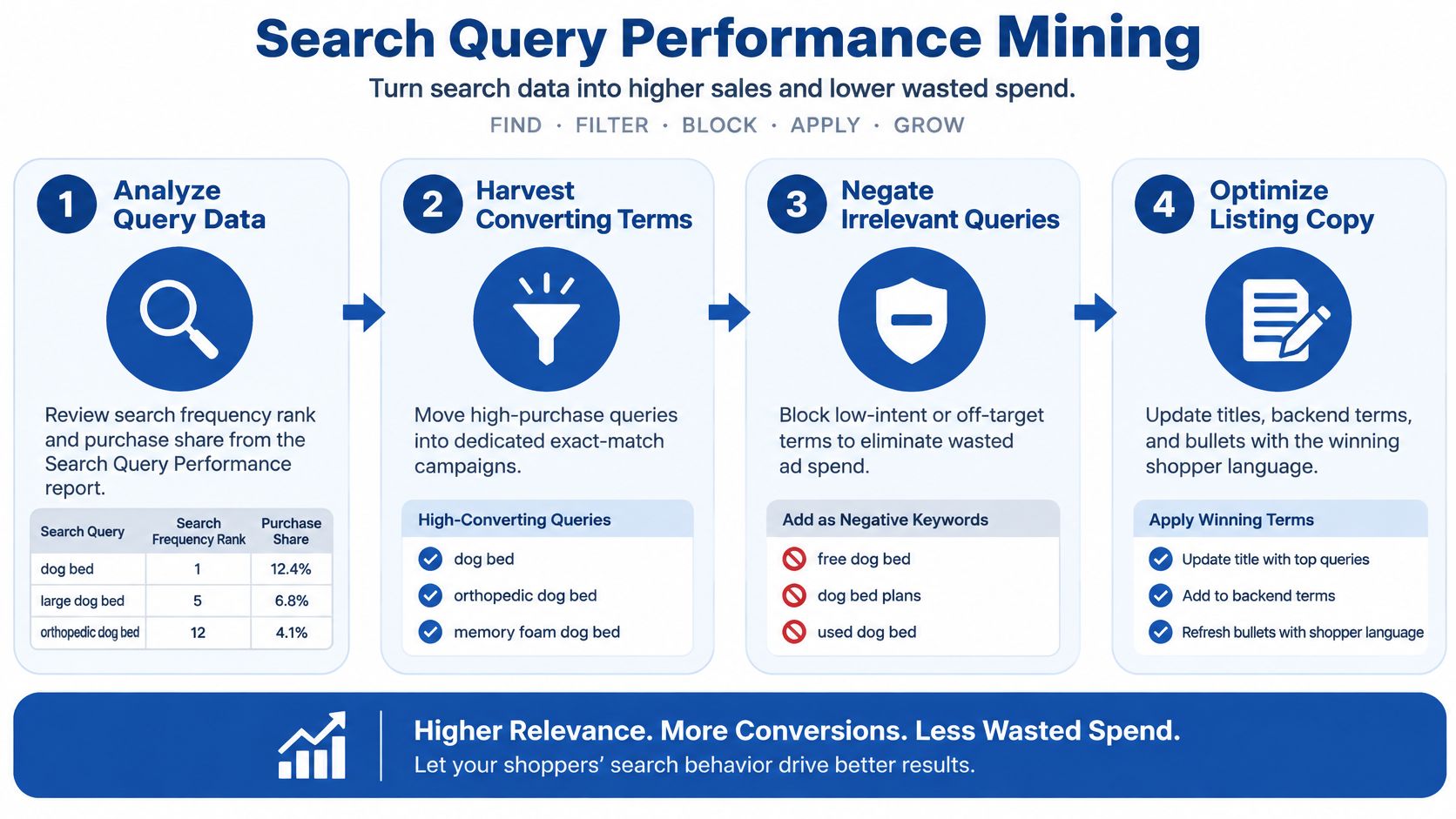
Harvest queries with strong purchase share into exact-match campaigns with dedicated bids. Then feed the winning phrase into your title, bullets, and backend search terms so organic relevance compounds the paid result. Negate high-click, low-purchase queries instead of lowering bids across the whole campaign and punishing terms that work.
Discovery is fragmented, so query data is how you see it. Research found 69.3% of consumers discover products weekly and typically research products at least three times before buying, in impact.com's modern customer journey research. A query that doesn't convert today may still be research language worth owning organically.
- Review on a fixed weekly cadence: Log every harvest and negation so you can reverse bad calls.
- Prioritize purchase share over clicks: Click volume without purchases is a cost signal, not demand.
- Separate brand defense from discovery: Mixing them hides which job each campaign is doing.
The trade-off is discipline. This only works if someone owns the weekly review and the listing updates that follow it.
3. Profit-Based Bidding Using TACoS and Contribution Margin
ACOS compares ad spend to ad-attributed sales, so it ignores the organic lift your ads create. TACoS compares total ad spend to total sales, which tells you whether advertising is growing the business or just renting revenue. Use ACOS as a campaign control and TACoS as the account health metric.
Patience pays here. Amazon reports sellers running Sponsored Products continuously for 12 months achieved an average 11.2% higher ROAS in month 12 than in their first month, in Amazon's sales growth guidance. Efficiency improves as you harvest search terms and kill weak targets, so judging month one like month twelve leads to bad cuts.
Worked example
Say a hero SKU carries a 30 percent contribution margin before ads. Your break-even ACOS sits near that level, and launch campaigns can run above it briefly while the account TACoS target holds. A low-margin accessory in the same catalog gets a much tighter ceiling, even if its click-through rate looks great.
For the underlying math on return thresholds, see AdCrafty's guide to ad profitability.
- Calculate break-even ACOS per SKU: Use current fees, shipping, and returns, and update it quarterly.
- Build a margin-after-ads dashboard: Review contribution margin after ads by SKU, not revenue by campaign.
- Check organic share monthly: Rising spend with flat organic share points to cannibalization.
Practical rule: If TACoS is falling while total sales grow, your ads are building an asset. If ACOS looks perfect and TACoS is flat, you're probably just harvesting demand you'd have won anyway.
4. Conversion Rate Optimization Through Listing Content and Structured A/B Testing
A click only creates value when the detail page converts. Listing content determines whether shoppers understand the offer, trust it, and see why it fits their needs.
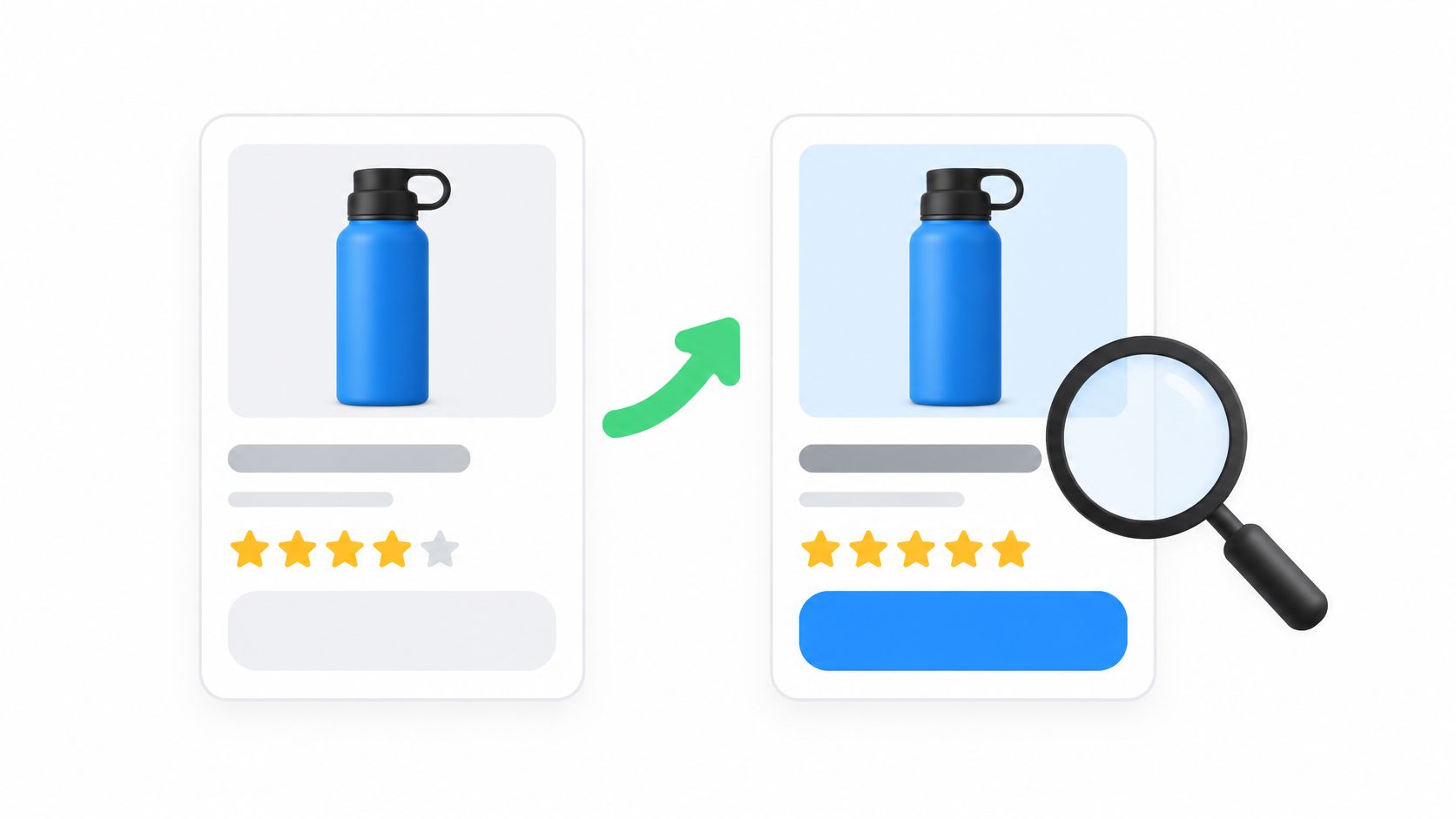
Baymard found that only 49% of leading US and European e-commerce sites achieved a “decent” or “good” overall product-page UX rating, according to its product page research. Use that gap to prioritize clear product information and remove friction before increasing media spend.
Use Amazon's Manage Your Experiments to test the main image and A+ Content against a control. Change one variable at a time so the result points to a specific creative choice. In a home goods brand case study, Headline A/B tested lifestyle images against product-only images, improving click-through rates by 34%. The case study also reports a 23% profit increase after Headline shifted the focus from ranking alone to profit through keyword research and ACOS management.
This short video walk-through covers how to structure testing in practice.
What to test first
- Primary image and image sequence: Check whether the product remains clear at mobile thumbnail size. A detailed image can fail if shoppers cannot read it quickly.
- Benefit-led title and bullet hierarchy: Put the customer outcome first, followed by the specification that supports it. Avoid burying the differentiator in a long list of features.
- Comparison modules in A+ Content: Address a recurring shopper objection with a direct comparison. Keep the claims consistent with the product detail page.
- Full weekly test cycles: Run tests long enough to include weekday and weekend shopping patterns. Short tests can make normal demand fluctuations look like a creative win.
Testing slows changes, but untested revisions make it harder to identify which listing improvements support conversion and profitable growth. Use a clear control and a single variable when the expected gain justifies the wait.
5. Brand Registry-Driven Defense and Sponsored Brands Full-Funnel Coverage
Branded search is your highest-converting, lowest-cost traffic, and it's the first thing competitors bid on. Brand Registry enables Sponsored Brands, Sponsored Brands Video, and a Brand Store, which together let you defend your name and capture consideration-stage shoppers before they reach a rival listing.
This illustration captures the defensive posture, your store protected while rival ads get turned away.
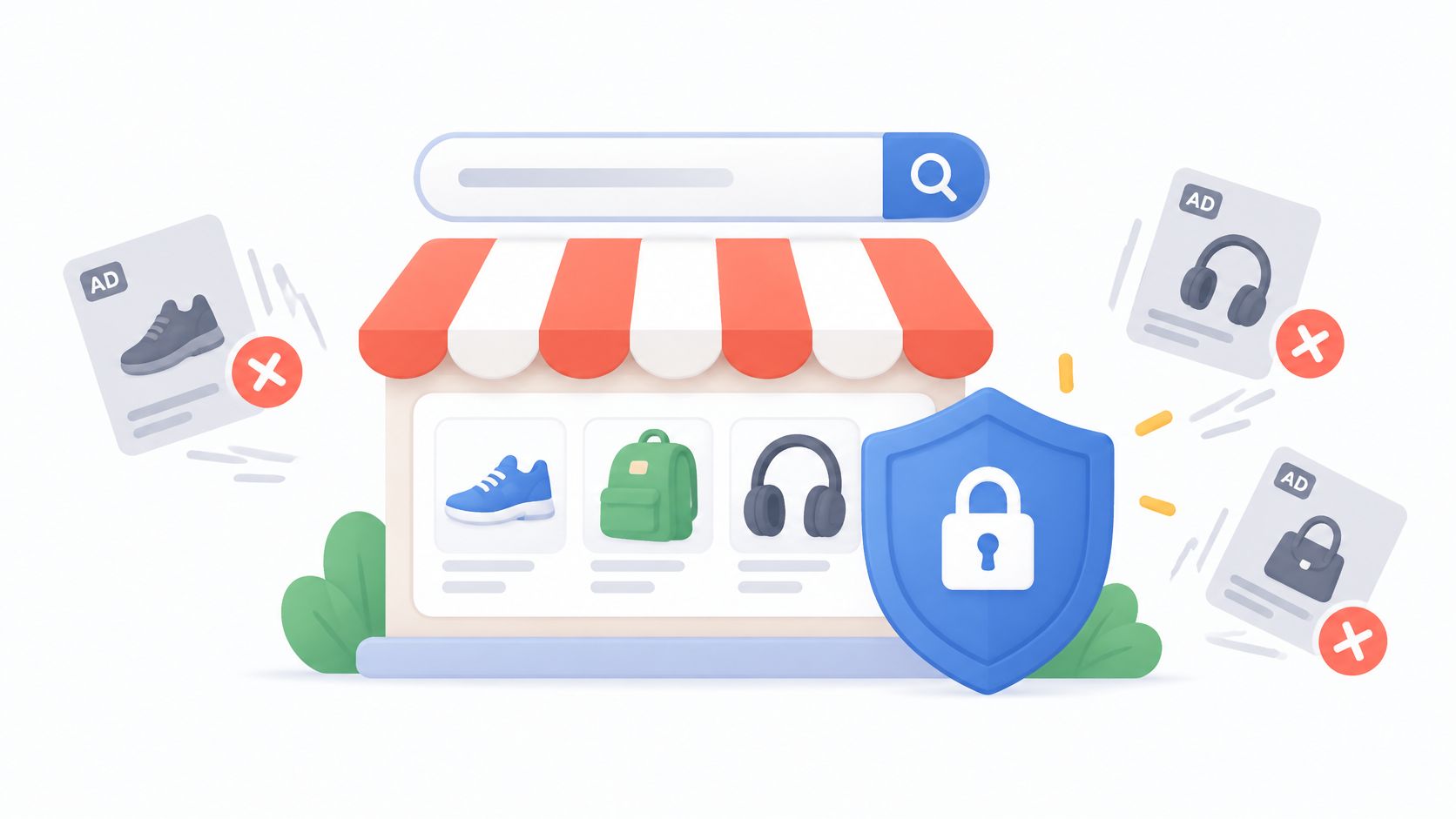
Run a branded defense campaign with its own budget and bid floor so category campaigns can't starve it. Then use Sponsored Brands to route category shoppers to a Store page built around their search intent, not your internal product taxonomy. Add Sponsored Brands Video when you need to introduce a line to shoppers who don't know your name yet.
Creative relevance drives whether that coverage works. Nielsen's global 2021 study found consumers showed the greatest interest in advertisements built around humor, family, and values, with 49%, 47%, and 43% respectively selecting those themes, reported in The Drum's coverage of Nielsen's trust findings. Test the promise and emotional framing, not just bids.
- Ring-fence the defense budget: Branded terms shouldn't compete for funds with conquesting.
- Match Store pages to intent: A problem-based search needs a problem-based landing page.
- Track share of voice weekly: Competitor entry on your terms shows up there first.
The risk is paying for clicks you'd win organically. Accept some of that cost. Losing the top slot on your own name costs more.
6. Amazon Marketing Cloud and DSP for Full-Funnel Retargeting and Audience Building
Search ads capture demand that already exists. Amazon DSP lets you create and recapture it with display and video across Amazon and third-party sites, using audiences built from detail page views and purchases. Amazon Marketing Cloud then shows you whether that upper-funnel exposure changed downstream behavior, using aggregated, privacy-safe analysis instead of last-click credit.
That privacy-safe measurement matters more every year. 95% of advertising and data decision-makers expected continued signal loss or privacy legislation in 2024 and beyond, according to the IAB's 2024 State of Data report summarized by Econsultancy's retail media statistics. First-party retail signals inside a clean room are a sturdier foundation than third-party tracking.
A sensible sequence
Start with retargeting shoppers who viewed your detail page but didn't buy, sequenced from video to display. Then use AMC to test whether DSP exposure lifts Sponsored Products conversion before you fund broad prospecting. Our Amazon DSP page displays results including +84% New-to-Brand Sales and 3.8x ROAS, and the strategy covers awareness, consideration, and conversions with messaging aligned to each stage.
- Define the incrementality test first: Decide the holdout or comparison before launch, not after results arrive.
- Set frequency caps: Over-serving the same shopper burns budget and goodwill.
- Tailor creative by stage: Awareness messaging repeated at conversion stage wastes the retargeting premium.
The trade-off is complexity and minimum viable budget. DSP without AMC measurement is just expensive reach.
7. Competitive Conquesting and Keyword-Level Competitive Intelligence
Conquesting means targeting competitor brand terms and ASINs with Sponsored Products and Sponsored Display while shoppers are actively comparing. It works when your listing wins the comparison on something a shopper can verify in seconds, such as price per unit, a missing feature, or a stronger rating. It fails when you outbid rivals for traffic your page can't convert.
Say a rival's hero ASIN has a weaker main image and a recurring complaint in reviews. Run a dedicated campaign against that ASIN at a conservative bid, put the comparison in your A+ Content, and review conversion and margin after two weeks. If your page doesn't close, raising bids only raises the cost of losing.
Intelligence before spend
- Monitor competitor price and stock weekly: A rival stockout is a brief window where conquesting spend earns displaced demand cheaply.
- Cap conquesting at a fixed budget share: Set the ceiling in advance so a bidding war can't eat your defense budget.
- Track rank on shared terms: If a competitor gains organic position, your conquesting costs will rise with their relevance.
- Judge on contribution margin: Conquested orders often carry higher return risk, so ACOS alone flatters them.
Conquesting without a defensive campaign on your own brand terms is borrowing share while lending yours out.
Expect retaliation. Competitors will bid back, and category CPCs can inflate for everyone. That's why the budget cap and margin review aren't optional governance, they're the strategy.
8. Inventory-Aware Advertising to Protect Buy Box and Rank
A stockout is the most expensive invisible loss in an Amazon account. Ads keep spending, conversion collapses, and organic rank decays within days because the velocity signal disappears. Inventory-aware advertising ties bids and budgets to days of cover, reorder timing, and Buy Box status so spend only amplifies a product that can ship.
Post-click friction destroys media value everywhere, not just on Amazon. Baymard reports a global average cart-abandonment rate of 70.19%, in Baymard's checkout usability research. Amazon controls its checkout, but you control availability, delivery promise, price, and coupon clarity, and those are your equivalent friction points.
Say a high-volume SKU drops below your days-of-cover threshold while inbound stock is three weeks out. Reduce bids gradually to stretch remaining units, rather than pausing campaigns outright and surrendering rank. Then restore spend in steps once inventory is confirmed received, not merely shipped.
- Set days-of-cover thresholds per SKU: Tie each threshold to a specific bid or budget action.
- Plan budgets with supply chain: Seasonal pushes should start only after inbound inventory is confirmed.
- Watch Buy Box percentage: It's a leading indicator that ad efficiency is about to deteriorate.
- Diagnose before you bid up: Separate weak results caused by availability from weak query relevance.
The trade-off is foregone short-term sales. Throttling a converting SKU feels wrong, but a full stockout costs you rank you already paid to earn.
9. Subscribe & Save and Coupons as Conversion Levers Within the Ad Mix
Discounts work when they're visible at the decision moment and funded from margin you have. Coupons put a visible badge in search results and on the detail page, which lifts click-through and conversion. Subscribe & Save trades a recurring discount for predictable repeat revenue on eligible consumables.
The illustration below ties the mechanism together, offer, velocity, and the sales trend that follows.
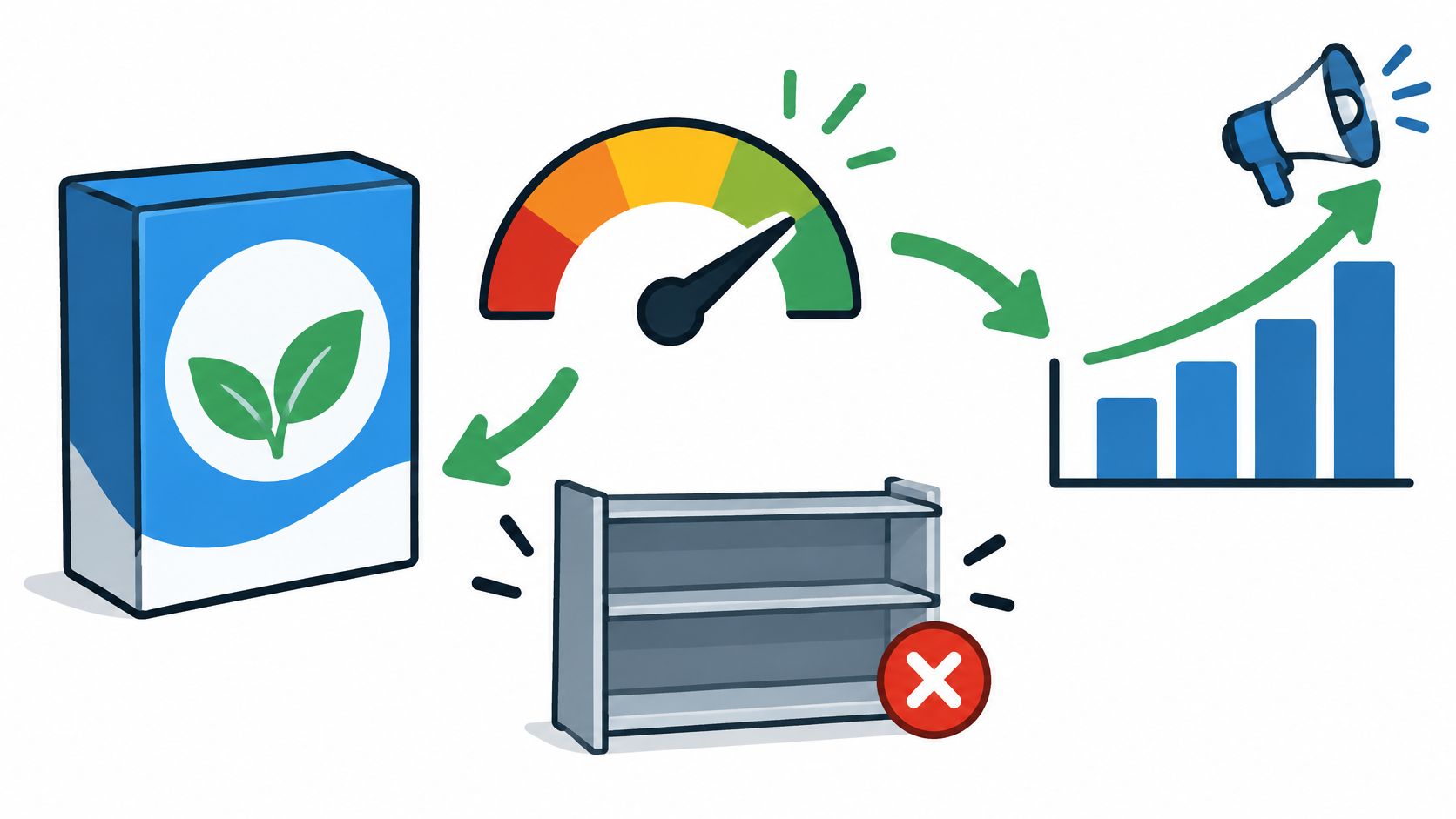
Relevance is what converts the offer into a purchase. Separate 2025 research found 77% said relevant product recommendations make them likely to purchase from a brand, reported in eMarketer's personal care and beauty consumer survey. A coupon on the right product for the right shopper beats a deeper blanket discount.
Say a consumable SKU competes in a crowded search result. Run a coupon during a defined ad flight, measure conversion against the prior period, and extend only if margin after ads holds. For the mechanics of structuring recurring offers, see our guide to Amazon Subscribe and Save deals.
- Set discount depth from contribution margin after ads: List price discounts hide the true cost.
- Time coupons with ad flights: Otherwise you can't separate offer lift from media lift.
- Track repeat purchase rate: First-order conversion understates Subscribe & Save value badly.
The risk is training shoppers to wait for discounts. Test in windows, don't run permanent promotions by default.
10. Review Velocity and Amazon Vine as a Conversion and Rank Flywheel
Reviews decide whether the traffic you buy converts. Nielsen's 2021 Trust in Advertising Study surveyed more than 40,000 consumers across 56 countries and found 88% trusted recommendations from people they knew more than any other measured advertising channel, in Nielsen's 2021 Trust in Advertising Study. Paid media amplifies confidence, it can't substitute for it.
Amazon Vine lets brand-registered sellers enroll products so trusted reviewers provide early feedback, which accelerates review accumulation when a launch needs it most. For program details, see our explainer on what the Amazon Vine program is. Enroll a new SKU, track rating and review count over the first 90 days, and scale ad spend only once conversion reaches your target band.
Use reviews as product intelligence
- Track conversion by rating band: Find the star rating and review count thresholds where your category's conversion shifts.
- Mine review language for bullets and images: If reviewers keep praising or questioning the same thing, your listing should answer it.
- Time scaling to rating strength: Heavy spend into a weak rating buys expensive disappointment.
Compliance line: Use only Amazon-approved review programs and tools. Any incentive arrangement that violates policy risks the listing, and no conversion lift is worth that.
The trade-off is patience and product risk. Vine surfaces honest criticism early, which is uncomfortable and exactly why it's valuable before you scale spend behind a flaw.
How the 10 Amazon Product Marketing Strategies Compare
| Item | Core Metric | Primary Tool or Data Source | Best Suited For | Main Risk |
|---|---|---|---|---|
| PPC-Seeded Launch Strategy to Accelerate Organic Rank | Organic rank and blended TACoS | Sponsored Products and keyword rank tracking | New launches targeting competitive keywords | Short-term losses or stockouts can undermine gains |
| Search Query Performance Mining for Keyword Harvesting and Negation | Query purchase share and conversion | Amazon Brand Analytics Search Query Performance report | Finding converting search terms and reducing wasted spend | Noisy low-volume data can lead to poor targeting |
| Profit-Based Bidding Using TACoS and Contribution Margin | TACoS and contribution margin | Unit economics and Amazon ad reports | Managing spend against actual profitability | Inaccurate cost data can distort targets |
| Conversion Rate Optimization Through Listing Content and Structured A/B Testing | Conversion rate | Amazon Manage Your Experiments | Improving listing performance across traffic sources | Low traffic can make test results unreliable |
| Brand Registry-Driven Defense and Sponsored Brands Full-Funnel Coverage | Branded share of voice and conversion | Brand Registry, Sponsored Brands, and Brand Store | Defending branded searches and supporting cross-selling | Creative and Store investment may not pay off |
| Amazon Marketing Cloud and DSP for Full-Funnel Retargeting and Audience Building | Incremental conversions and audience reach | Amazon DSP and Amazon Marketing Cloud | Retargeting shoppers and measuring upper-funnel impact | Setup and measurement complexity |
| Competitive Conquesting and Keyword-Level Competitive Intelligence | Conquesting conversion and contribution margin | Sponsored Products, Sponsored Display, and competitor monitoring | Capturing shoppers comparing alternatives | High CPCs and lower conversion rates |
| Inventory-Aware Advertising to Protect Buy Box and Rank | Days of cover and Buy Box percentage | Inventory forecasts and ad reports | Scaling advertising in line with stock availability | Forecast errors can cause stockouts or excessive pauses |
| Subscribe & Save and Coupons as Conversion Levers Within the Ad Mix | Conversion lift and repeat purchase rate | Amazon Coupons and Subscribe & Save reporting | Improving conversion and repeat purchases | Discounts can erode margin or condition shoppers to wait |
| Review Velocity and Amazon Vine as a Conversion and Rank Flywheel | Review count, star rating, and conversion rate | Amazon Vine and Request a Review | Building social proof for new or growing products | Reviews are not guaranteed to be positive |
Turn These Strategies Into a Profit-First Amazon Plan
Don't roll all ten strategies across your whole catalog at once. Start with one SKU where the margin can fund learning, ideally a hero product with a credible rating, stable inventory, and a listing you've already tested. Pick the two or three strategies that match its stage and ignore the rest until the data says otherwise.
A launch SKU needs PPC seeding, Vine enrollment, and query mining. A mature SKU losing branded share needs defense, Sponsored Brands coverage, and competitive intelligence. A profitable consumable with repeat potential needs Subscribe & Save, DSP retargeting, and CLV-based bidding. In our supplement brand case study, the growth strategy ran in three phases over twelve months, CLV Foundation, then Scale & Optimize, then Efficiency & Growth, and produced 2.5x revenue growth with new customers up 189% by aligning ACOS toward customer acquisition.
Set the numbers before you spend
Calculate break-even ACOS per SKU from real fees, shipping, returns, and cost of goods. Set an account TACoS target you review monthly, and separate launch-phase learning costs from mature campaign efficiency so early spend doesn't get judged by steady-state rules. If you need to sanity-check your unit economics first, Supply Automate's FBA calculator comparison is a useful starting point for comparing tools.
Then build the monthly review around outcomes, not activity. Look at organic rank on priority keywords, organic share of sales, contribution margin after ads, Buy Box percentage, and repeat purchase rate alongside CTR and conversion rate. When TACoS falls while total sales and organic share rise, your advertising is building an asset. When attributed ROAS improves but total sales don't move, you're optimizing a report, not a business.
Keep the operating cadence boring and consistent. Mine search queries weekly, review inventory cover against budgets weekly, test one listing variable at a time, and revisit break-even math quarterly as fees and return rates shift. That discipline is what lets efficiency improve over a year instead of resetting every time someone panics over a daily ACOS spike.
We work with consumer brands on exactly this model across our four Amazon services, Amazon PPC, Amazon DSP, Amazon AMC, and Analytics & Insights. Our PPC approach goes beyond basic ACOS, focusing on improving organic ranking, maximizing product margins, and protecting market position, measured on profit and long-term share rather than first-week efficiency.
If your Amazon ads are being judged on ACOS while organic rank and margin go unmeasured, we can rebuild that scorecard with you. Headline Marketing Agency manages Sponsored Products, Sponsored Brands, Sponsored Display, and Sponsored TV campaigns, plus DSP and AMC programs, all tied to profitability and organic growth targets. Visit Headline Marketing Agency to see how we'd approach your catalog.
Get Your Free Amazon PPC Audit
Discover untapped growth opportunities and see how our data-driven approach can improve your ROAS.
Get Free Audit →Ready to Transform Your Amazon PPC Performance?
Get a comprehensive audit of your Amazon PPC campaigns and discover untapped growth opportunities.