What Is Amazon Choice
What is amazon choice. Learn what Amazon's Choice really means, how the badge is awarded at the keyword level, and what brands can do to earn and keep it


Amazon's Choice is a keyword-specific endorsement awarded to a highly rated, well-priced, Prime-eligible product for a particular search term, not a universal seal of quality. Only 1.32% of products in one independent study received the badge, which makes it a selective distribution signal rather than a routine listing feature (independent audit research).
That distinction changes how sellers should manage it. Amazon's Choice doesn't belong permanently to an ASIN, and it isn't proof that a product is the best option across a category. It reflects how well one listing satisfies one query at a specific point in time, based on relevance, price, ratings, availability, and fulfillment conditions. PPC and conversion data matter because they influence the demand signals that determine which ASIN Amazon can confidently place in front of shoppers.
What Amazon's Choice Really Means for Sellers and Shoppers
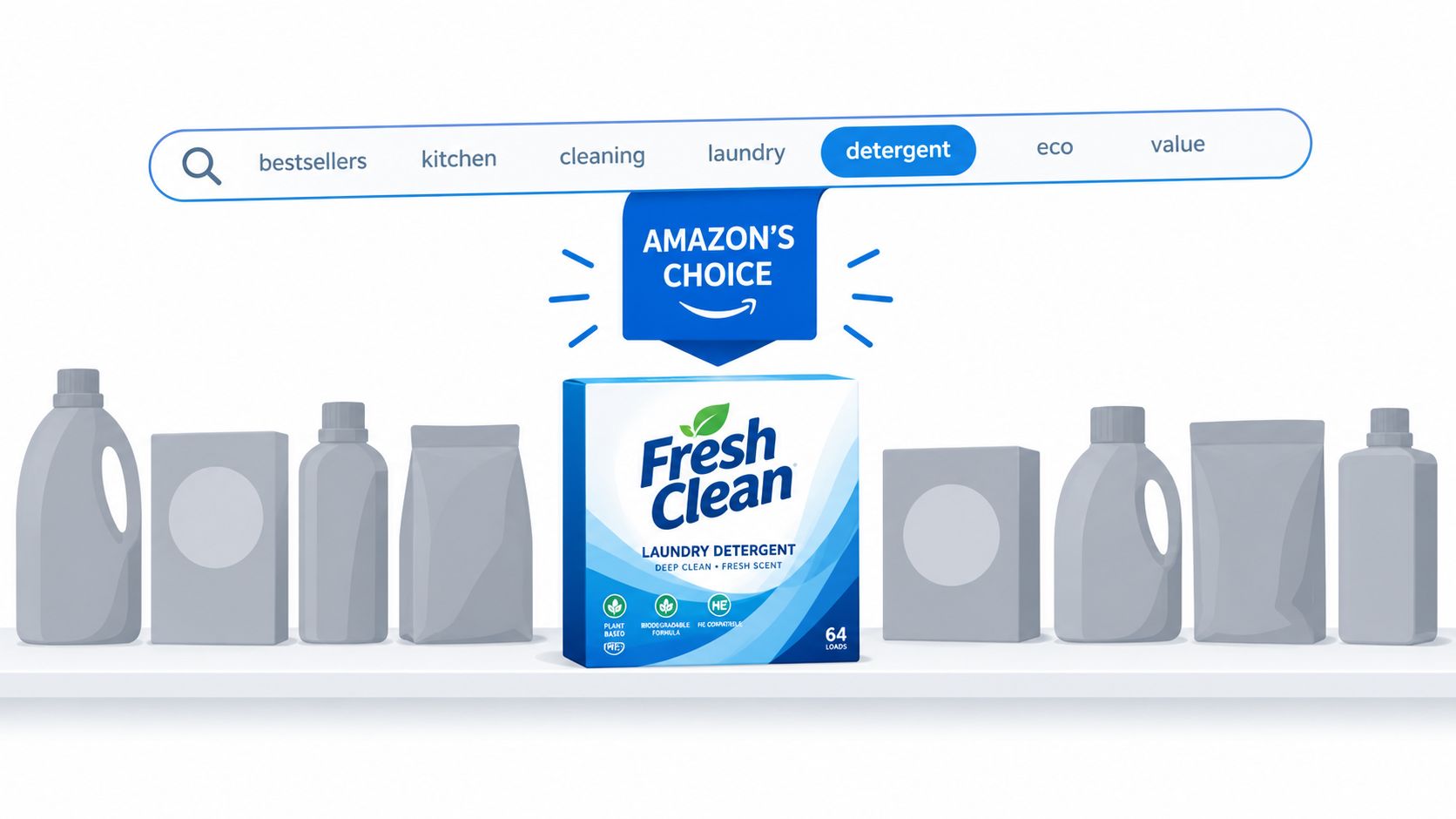
Amazon's Choice is a query-level endorsement, not a permanent ASIN attribute. Amazon applies it to one listing for a specific search term when the product aligns with shopper demand, pricing, ratings, Prime eligibility, and delivery availability. Amazon's public explanation describes highly rated, well-priced products ready for prompt delivery, rather than products that pass a universal quality certification (Wired's explanation of Amazon's Choice).
The query determines the commercial meaning. A stainless steel bottle can receive the badge for “stainless steel water bottle”, while another ASIN receives it for “insulated water bottle.” Amazon is evaluating the match between search intent and listing performance, not assigning a category-wide award. One ASIN can therefore hold the badge for one keyword and lose it for another.
Shoppers typically see a dark gray ribbon above the title in search results. That placement matters on mobile, where product cards leave little room for differentiation. Research on platform endorsement badges found that hiding the badge reduced click and add-to-cart rates for Amazon's Choice products, indicating that the interface element can change shopper behavior rather than merely describe existing preference (academic discussion paper).
The badge is therefore a distribution signal shaped by relevance, PPC exposure, conversion data, and operating conditions. It can improve visibility and click-through for a query, but its value depends on whether the resulting traffic converts at an acceptable contribution margin.
Practical rule: Track Amazon's Choice by keyword and ASIN pair. A catalog-level badge report conceals the volatility that affects revenue.
For voice shopping, the badge began as a way to give Alexa a default product for broad commands. In conventional marketplace browsing, it functions as a visible trust cue and a possible conversion-rate lever. Sellers should test which queries produce the badge, whether those queries convert profitably, and which changes in price, inventory, fulfillment, or conversion cause it to disappear.
The Origin Story of the Amazon's Choice Badge
In 2015, Amazon introduced Amazon's Choice for the Amazon Echo, giving Alexa a deterministic response to broad shopping requests. Voice interfaces could not display a long list of products, so the system needed a default option. The badge initially represented a voice-shopping function rather than a general marketplace award (seller coverage of Amazon's Choice).
Amazon brought the feature to desktop and mobile shopping in June 2016. The badge then became visible inside search results, changing from a largely invisible voice-commerce mechanism into an on-site endorsement. Its commercial role expanded, but its operating logic remained tied to reducing friction when a shopper faced several plausible choices.
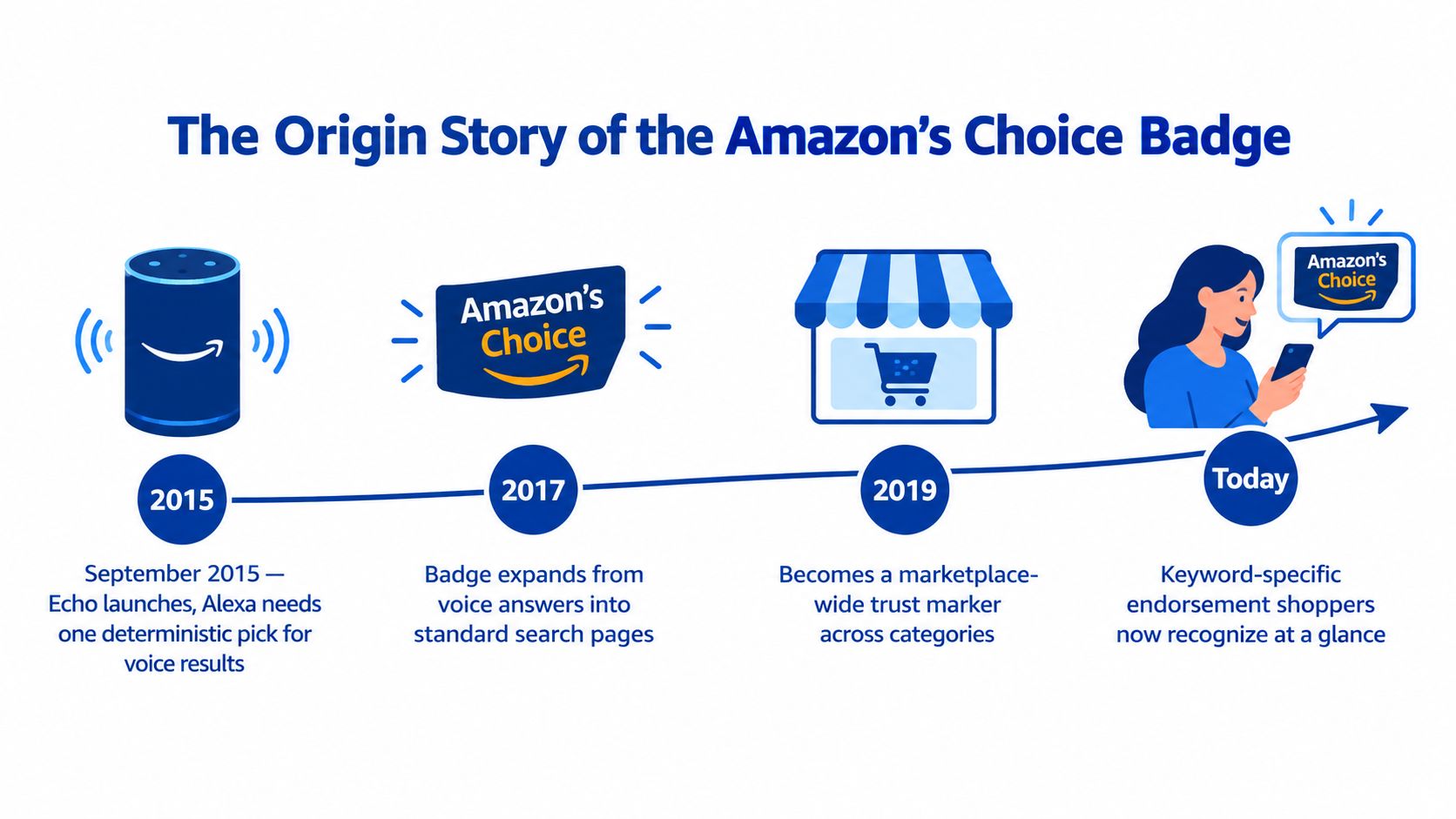
That history explains why treating Amazon's Choice as a permanent quality trophy produces bad seller decisions. Amazon built it to support product selection, first through Alexa and later through search interfaces. The badge can therefore change with the query, offer, inventory position, and customer response rather than remaining attached to an ASIN as a fixed certification.
Independent audit research found that badged products in its sample were disproportionately lower-priced, higher-rated, and more likely to be sold or fulfilled by Amazon (independent audit research). That pattern supports a practical reading of the badge: Amazon is concentrating attention on offers that appear easier to select and safer to deliver.
For brands, the origin story leads to a specific operating principle: Amazon's Choice rewards a low-friction purchase decision. Product superiority can improve conversion, but it does not replace query relevance, a credible offer, dependable fulfillment, and the conversion data Amazon can use to distribute a product with confidence.
How Amazon's Choice Criteria Actually Work
Amazon does not publish a complete weighting formula for Amazon's Choice. Sellers can still audit the mechanism by separating documented criteria from marketplace signals they can observe. The badge is best treated as a query-level distribution outcome, not a permanent quality score attached to an ASIN.
Amazon describes the badge around high ratings, competitive pricing, relevance, and immediate shipping availability. These conditions apply to the relationship between a specific query and offer. A product may fit one search term well yet fail to earn the badge for another because relevance, engagement, or offer competitiveness changes.
Shipping and inventory affect the same decision. Prime-eligible stock gives Amazon a dependable delivery promise. Stock interruptions weaken that promise and can remove the platform's ability to present the offer confidently. Retail readiness therefore matters alongside product appeal.
| Signal | Status | Typical Weight | How to Measure It |
|---|---|---|---|
| Query-to-listing relevance | Documented role | Not publicly disclosed | Compare target terms with title, bullets, attributes, and search-query performance |
| Ratings and reviews | Documented role | Not publicly disclosed | Monitor rating quality and review sentiment by ASIN |
| Price position | Documented role | Not publicly disclosed | Track the offer against relevant competing listings |
| Prime and fast delivery | Documented role | Not publicly disclosed | Check Prime eligibility, delivery promises, and fulfillment method |
| Inventory availability | Operational requirement | Not publicly disclosed | Review in-stock status and fulfillment continuity |
| Click and add-to-cart behavior | Inferred marketplace signal | Not publicly disclosed | Measure query-level CTR, add-to-cart rate, and conversion |
| Sales momentum | Inferred marketplace signal | Not publicly disclosed | Compare keyword sales performance across consistent reporting periods |
| Returns and complaints | Operational quality signal | Not publicly disclosed | Monitor return reasons, negative feedback, and customer-service patterns |
The available research supports viewing the badge as a distribution signal rather than decoration. Badged products were associated with stronger search visibility and sales performance in an independent study. Endorsement badges can also influence clicks and add-to-cart behavior, as documented in the platform endorsement appendix. Those findings do not establish Amazon's private formula, but they support monitoring the shopper behaviors that feed marketplace visibility.
PPC belongs in that operating model. Sponsored traffic can generate query-specific clicks, purchases, and conversion history. It cannot buy the badge directly, yet it can strengthen or expose the engagement pattern associated with a query. Poor targeting can send more shoppers to a listing that fails to convert, making the weakness visible in the same data stream.
Variant structure creates another source of leakage. Amazon evaluates the relevant child ASIN for the query, rather than treating the parent as one undifferentiated product. A color, size, pack count, or formulation can therefore win or lose independently. Splitting demand across children may leave the exact variant shoppers want with weaker sales and engagement signals.
Audit the query, child ASIN, offer, and fulfillment promise together. A detail-page review alone misses the distribution mechanism behind the badge.
A disciplined operation should place query relevance, PPC conversion data, pricing, inventory, and fulfillment in one view. A retailer assessing its broader Buy It Now store on Amazon should use the same framework, because shoppers evaluate the visible offer while Amazon measures the combined result of content, advertising, and operations.
Myths and Misconceptions That Distort the Badge
Myth one, it's a universal quality seal. Amazon's Choice belongs to a specific query and ASIN combination. An ASIN may receive the badge for one search term and lack it for another, because the relevant evidence is query-level performance, not a permanent catalog rating. Sellers should therefore track badge ownership by keyword and child ASIN.
Myth two, only one product in a category can hold it. The badge is selective, but it is not a category championship. An independent audit found 1.32% of studied products receiving the badge and reported that endorsements were distributed across search contexts rather than operating as one permanent category title (independent audit research). A competitor can hold the badge for a different query, variant, or offer.
Myth three, the badge is purely organic. Amazon does not provide a paid route to purchase Amazon's Choice. Advertising still affects the data environment around a query. Sponsored clicks and purchases can build conversion history, while poorly targeted traffic can send more shoppers to a listing that fails to convert. PPC is a demand-generation input, not a badge fee.
Myth four, an automated system makes every decision without human influence. Amazon has not disclosed the complete formula. Sellers should avoid claiming that category teams or voice-query curation determine every outcome. The defensible view is narrower: automated relevance and retail signals matter, while the precise division of responsibility remains private.
Myth five, the badge cannot be manipulated. Price, inventory, and shopper behavior can be altered to create temporary conditions, but those tactics do not create durable query fit. A short eligibility window can cost margin, create policy exposure, and leave the ASIN without the badge when normal demand returns.
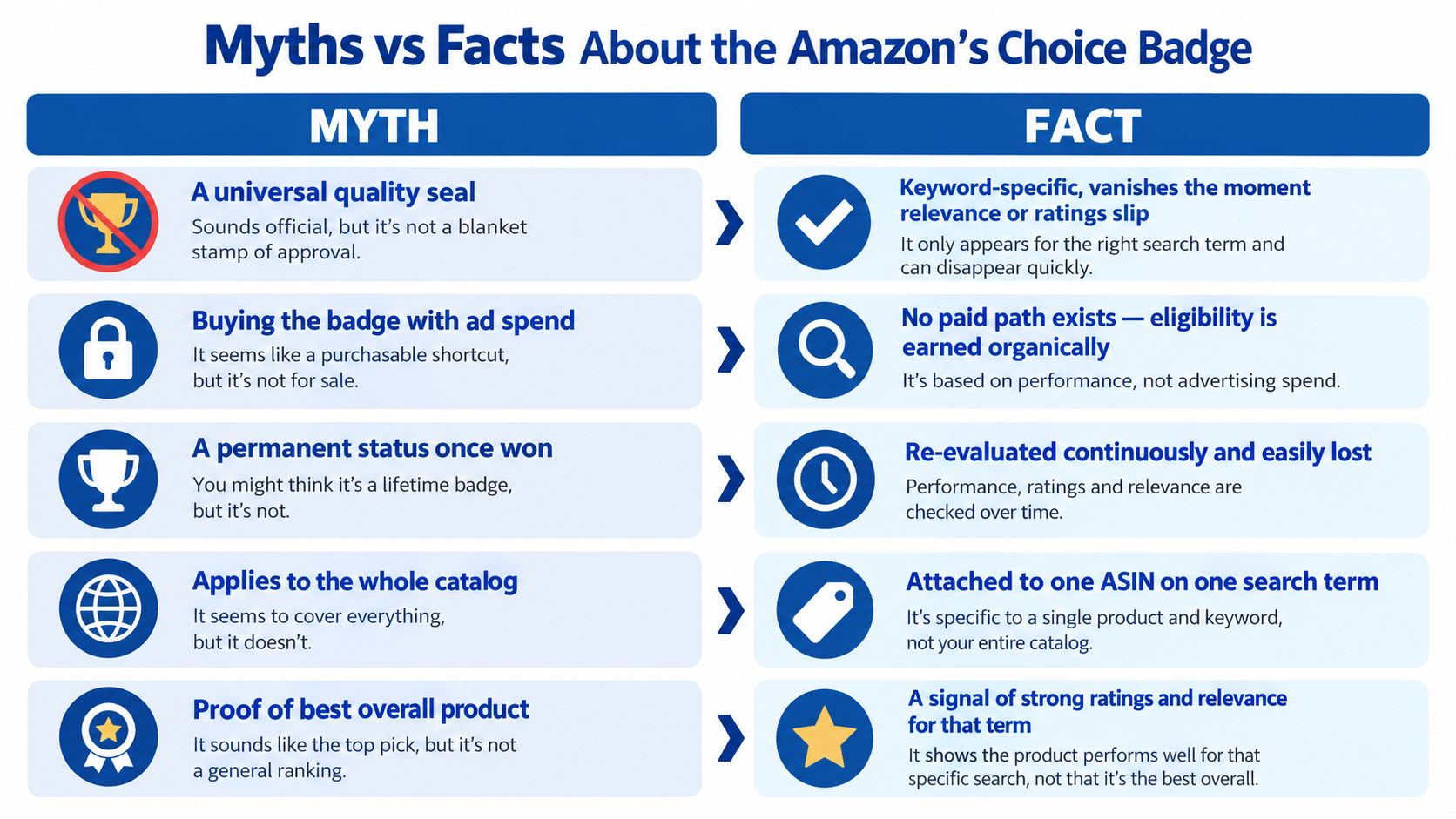
The practical correction is consistent across all five myths: treat the badge as volatile, query-specific evidence of marketplace fit. It can indicate that an ASIN is currently satisfying searcher expectations for a query. It does not establish durable brand preference, guarantee future visibility, or replace measurement of conversion, contribution margin, and rank.
Quantifying the Impact on CTR, Conversions, and Rank
The clearest reported effect is an average 3.1-position improvement in search rank when the badge is present. Independent analysis associates badge ownership with that difference, but the finding does not prove a guaranteed causal lift for every ASIN or keyword (Titan Network analysis). Treat the figure as a query-level distribution signal, not a fixed ranking bonus.
Rank is only the first economic step. A higher position can expose an ASIN to more shoppers, while the badge may reduce decision friction at the results page. Experiments that hid endorsement badges found lower click and add-to-cart rates for Amazon's Choice products (academic discussion paper). The result supports a directional CTR and engagement effect, not a universal conversion multiplier.
Measure the badge through revenue per visitor, not visibility alone:
- Record organic sessions for the exact query and child ASIN.
- Compare conversion rate and contribution margin during periods with and without the badge.
- Separate paid from organic traffic so PPC does not receive credit for an organic effect.
- Subtract advertising, referral, fulfillment, and product costs to calculate contribution profit per visitor.
| Metric | Without Badge | With Badge | Delta |
|---|---|---|---|
| Search visibility | Lower relative visibility in the cited research | Associated with stronger visibility | Depends on query and category |
| Search rank | Unbadged comparison point | Associated with an average 3.1-position improvement | 3.1 positions on average, not a guarantee (Titan Network analysis) |
| Click behavior | Lower when endorsement is hidden in experiments | Higher when endorsement is visible | Directional experimental effect (academic discussion paper) |
| Add-to-cart behavior | Lower when endorsement is hidden in experiments | Higher for endorsed products in experiments | Directional experimental effect |
| Unit economics | Depends on traffic quality and conversion | Depends on margin, traffic quality, and conversion | Calculate by ASIN and query |
A badge can improve the path from impression to click, yet still produce weak economics if price, conversion, or contribution margin is misaligned. Its value depends on baseline position, query intent, offer quality, and how long the badge remains attached to the ASIN.
Use the CTR improvement framework to assess the listing's visual and relevance performance, then compare those results with badge ownership. If rank improves while revenue per visitor does not, the constraint is probably conversion, pricing, or the offer, rather than visibility.
Practical Steps to Earn and Defend Amazon's Choice
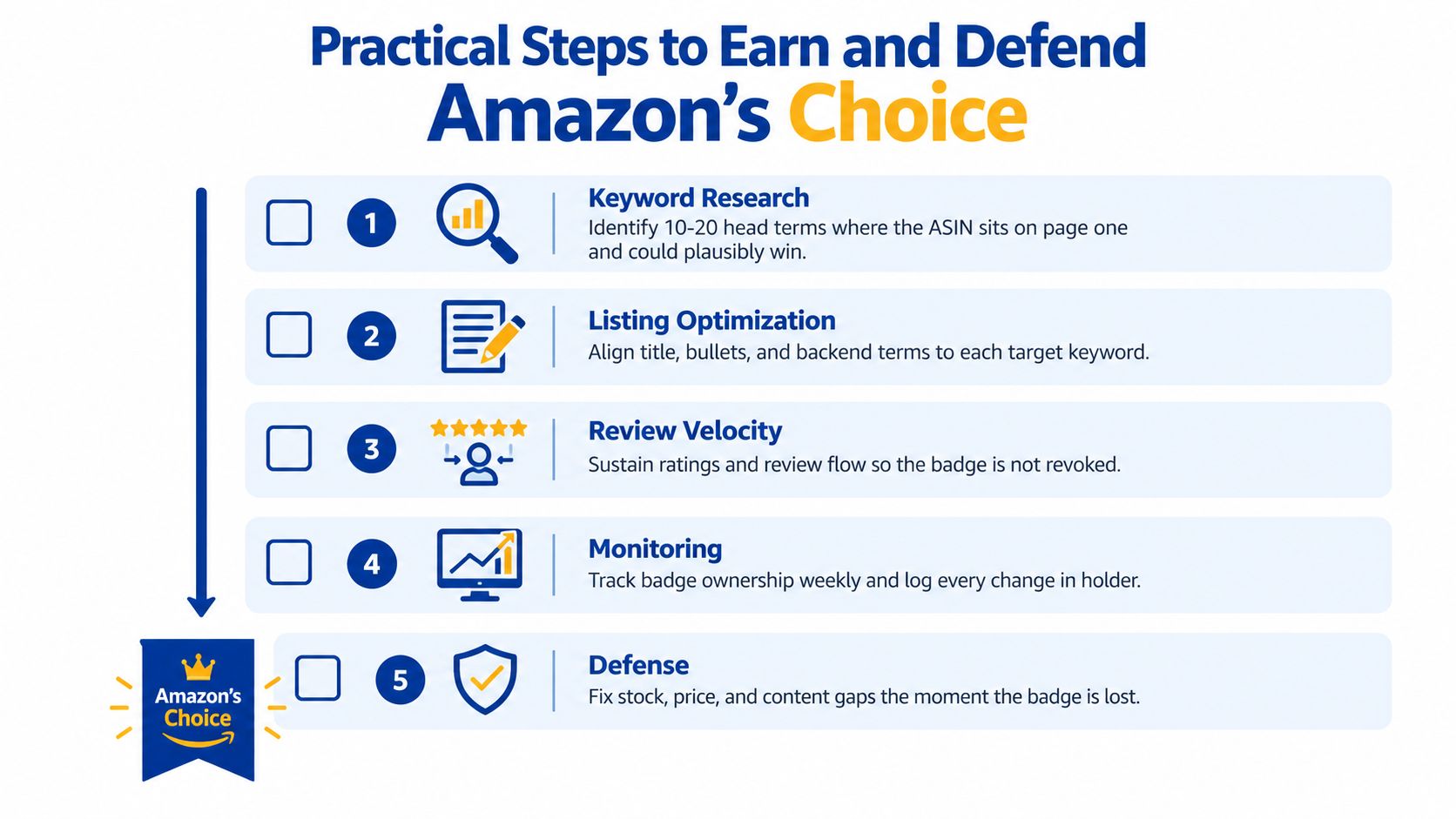
Start with a keyword set, not a badge hunt. Select the commercially important head terms where the ASIN already has meaningful relevance and a credible path to stronger visibility. Amazon's Choice is query-specific, so your monitoring sheet should record the exact keyword, ASIN, date, price, Prime status, stock position, organic rank, and paid placement.
Start with relevance
Align the title, bullets, attributes, and backend terms with the language shoppers use for the target query. Don't stuff unrelated phrases into the listing. A listing that attracts the wrong shopper may generate traffic without producing the engagement Amazon needs to keep recommending the ASIN.
Protect the offer
Price competitiveness and delivery reliability sit close to the badge's documented purpose. Audit the offer against relevant competing products, maintain Prime-eligible fulfillment where appropriate, and treat inventory interruptions as a ranking risk rather than a warehouse-only issue. If the offer becomes unavailable or delivery slows, Amazon has less reason to use it as a default recommendation.
Keep ratings and customer experience healthy
Strong ratings support shopper confidence, but review acquisition must follow Amazon's policies. Use permitted tools such as Amazon Vine and Request a Review, improve the product where recurring complaints appear, and analyze return reasons by variation. A high rating attached to the wrong child ASIN won't solve a relevance or availability problem.
Use PPC to create useful demand
Build exact-match campaigns around the queries you want to win, then evaluate search-term conversion, contribution margin, and organic movement together. PPC shouldn't be used to buy the badge. It should put a relevant ASIN in front of qualified shoppers, generate profitable sales where possible, and reveal which queries produce real demand.
Headline Marketing Agency manages Amazon advertising across Sponsored Products, Sponsored Brands, Sponsored Display, DSP, and related performance workflows. For a brand testing this strategy, an agency or internal team should connect ad data with organic rank, inventory, listing changes, and query-level badge observations rather than optimizing ACoS in isolation.
Monitor the badge like a volatile signal
Review the target keyword set on a consistent schedule. When the badge disappears, check the last changes to price, stock, delivery promise, rating, variation availability, content relevance, and paid traffic quality before rewriting the entire listing. This diagnostic order prevents teams from treating every loss as a copy problem.
Defense is usually less expensive than recovery. A stable offer, clean variation structure, and query-level monitoring help prevent a temporary operational issue from becoming a visibility problem.
Turning the Badge Into Sustainable Amazon Growth
Amazon's Choice should sit inside a PPC-to-organic growth loop, not at the end of a vanity-scoreboard. A paid campaign can identify high-intent queries, expose a listing to qualified shoppers, and generate sales data. If the ASIN converts while maintaining competitive pricing and dependable fulfillment, organic visibility may strengthen. The badge can then reinforce shopper confidence, but the underlying economics still decide whether the strategy deserves more budget.
The flywheel works only when the team measures profit at the query level. Separate branded and non-branded terms, compare paid and organic contribution, and watch whether a badge win produces incremental demand or merely shifts existing shoppers between placements. A badge that improves traffic but requires unsustainable discounts or inefficient bids isn't a growth asset.
Use a compact operating checklist:
- Pricing audit: Review competitive positioning and contribution margin before changing price.
- FBA restock cadence: Protect Prime availability and avoid preventable stock interruptions.
- PPC bid ladder: Increase exposure only where query-level conversion and margin justify it.
- Review acquisition: Use compliant review programs and fix recurring product complaints.
- Rank-tracked keyword set: Record badge ownership, organic rank, paid visibility, and conversion by query.
- Listing control: Keep images, titles, bullets, and variation logic aligned with the shopper's intent. A structured Amazon listing design process supports that alignment, but it can't compensate for weak availability or an uncompetitive offer.
The conclusion is deliberately narrower than most Amazon explainers. Amazon's Choice isn't proof of the best product, and it isn't a badge a seller can purchase directly. It's a selective marketplace signal that tells you Amazon currently sees one ASIN as a low-friction answer to one query. Manage the inputs, measure the profit, and treat every badge win as a hypothesis to validate rather than a status to celebrate.
Headline Marketing Agency can audit your Amazon PPC, query-level organic performance, listing readiness, and badge opportunities as one connected system. Visit Headline Marketing Agency to discuss a data-driven plan for turning paid demand into profitable organic growth and more defensible marketplace visibility.
Get Your Free Amazon PPC Audit
Discover untapped growth opportunities and see how our data-driven approach can improve your ROAS.
Get Free Audit →Ready to Transform Your Amazon PPC Performance?
Get a comprehensive audit of your Amazon PPC campaigns and discover untapped growth opportunities.