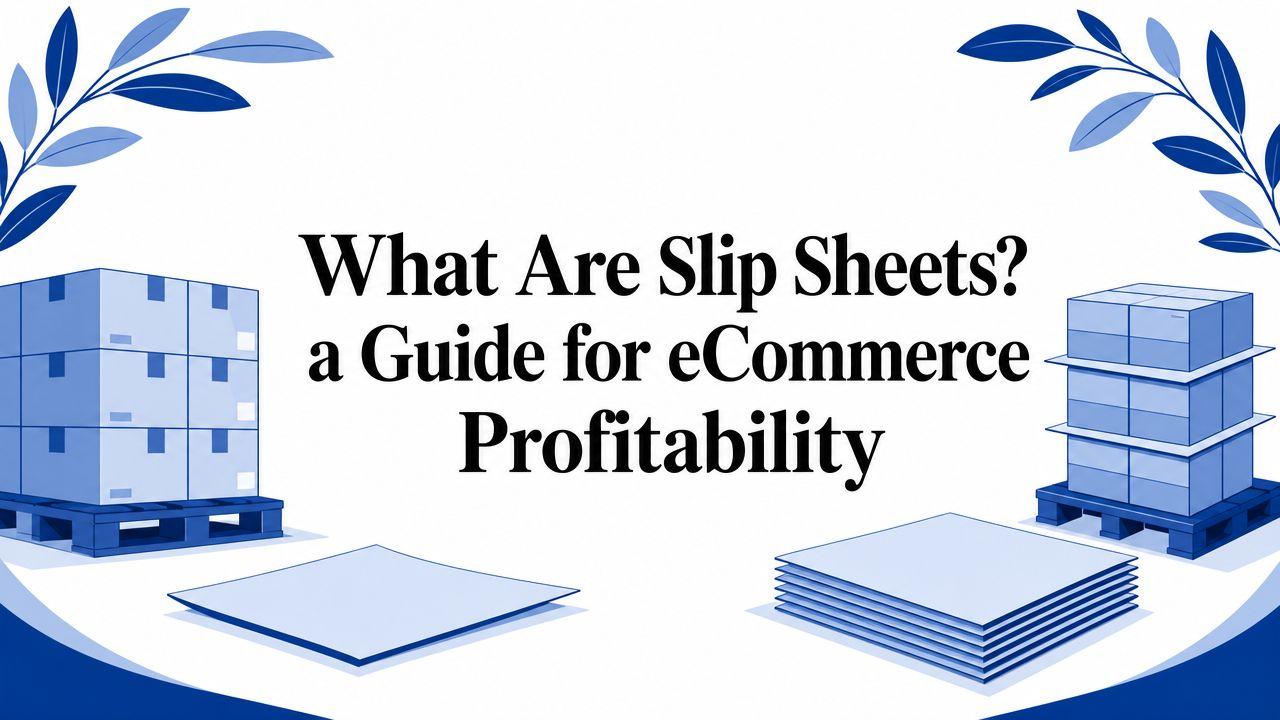
What Are Slip Sheets? a Guide for eCommerce Profitability
What are slip sheets and should your brand use them? Our guide covers costs, benefits, and hidden risks for Amazon FBA & eCommerce to boost profitability.

Most advice on slip sheets is too simplistic. It treats them like an obvious pallet swap: lower unit cost, less weight, less space, done.
That's not how real operations work.
If you're running a fast-growing eCommerce brand, logistics isn't just overhead. It's one of the few places where a packaging decision can improve margin, warehouse density, freight efficiency, and partner compliance at the same time. But slip sheets only help if your network can handle them. If it can't, the “savings” get eaten by equipment retrofits, handling friction, damaged loads, and receiving problems.
So, what are slip sheets? They're thin load-support sheets, usually made from fiberboard or plastic, used instead of traditional pallets for storage and transport. The smart question isn't what they are. The smart question is whether they reduce your total landed cost in your specific network.
The Pallet Problem You Did Not Know You Had
Your P&L probably doesn't label it clearly, but pallets create hidden drag across the business.
They take up floor space. They add shipment weight. They force you to store bulky empties. They introduce disposal headaches. If you ship internationally, they can also create extra handling and compliance complexity that nobody celebrates but everyone pays for.
That's why slip sheets get attention. On paper, they look like a clean win. They're lighter, thinner, cheaper to buy, and easier to recycle. For the right operation, that can turn into better container utilization and lower logistics cost per unit shipped.
The mistake is assuming that “cheaper packaging” equals “better system.”
Practical rule: Don't evaluate slip sheets as a packaging line item. Evaluate them as a warehouse and network design decision.
A lot of operators learn this too late. They switch the load base, then discover that a receiving partner can't unload it efficiently, a legacy forklift fleet can't handle it, or a humid shipping lane weakens the material enough to create product loss risk. At that point, the pallet wasn't the problem. The rushed decision was.
If you've been asking what are slip sheets, ask a harder follow-up. Where in your network do pallets create avoidable cost, and where do they still protect you from larger operational failure?
That distinction matters. For a mature operation with the right equipment and route profile, slip sheets can be a profit lever. For an unprepared one, they become another “efficiency project” that burns time and capital.
Slip Sheets vs Pallets A Head-to-Head Comparison
Pallets keep winning by default because they hide their real cost inside freight, storage, labor, and partner friction. That default gets expensive fast. Slip sheets deserve attention because they strip out a lot of that overhead, but only if your network can support the change.
According to Smart Packaging Solutions, slip sheets are approximately 80% lighter than traditional wooden pallets while maintaining a comparable load capacity of up to 1,400 kg, and one pallet of slip sheets can be equivalent in volume to 1.5 containers of pallets. For a brand shipping at scale, those are not minor packaging specs. They affect landed cost, storage density, and how much dead weight you pay to move across the network.
Most slip sheets are made from recyclable fiberboard, kraft paperboard, or HDPE plastic, while traditional pallets are usually wood or plastic. The strategic difference is straightforward. Pallets give you built-in handling tolerance. Slip sheets remove that buffer and replace it with lower material cost, lower weight, and a higher dependence on process discipline.

Where slip sheets win, and where they do not
Slip sheets usually win first on transport economics. Lower tare weight means less waste in every shipment. Thinner load bases also free up cube, which matters if you are paying for container space, staging space, or overflow storage.
They also reduce empty packaging burden. You are not storing stacks of bulky wood platforms between turns, and you are not paying people to keep moving them out of the way.
Material choice can also improve cleanliness and disposal. Cardboard versions are 100% recyclable, and plastic slip sheets can fit environments where reusable, cleaner handling matters.
The trade-off is blunt. Pallets are more forgiving.
That forgiveness has financial value. A fragmented 3PL network, mixed retailer requirements, or an inbound program with inconsistent dock equipment can erase the paper savings from slip sheets in a hurry. If your business depends on broad carrier compatibility and easy handling at every node, pallets still buy reliability. If you run repeat lanes, standardized loads, and tightly managed partners, slip sheets can remove cost that pallets keep hiding.
Side-by-side decision view
| Metric | Wooden Pallet | Slip Sheet | Impact for E-commerce |
|---|---|---|---|
| Base material | Typically wood or plastic | Fiberboard, kraft paperboard, or HDPE plastic | Material choice affects cleanliness, disposal, and route fit |
| Unit economics | Higher purchase, storage, and handling burden | Lower material and storage burden in many programs | Better margins if the rest of the network can handle the format |
| Weight | Heavier platform | Approximately 80% lighter than wooden pallets | Lower shipment weight can reduce freight cost |
| Load support | Standard rigid base | Comparable load capacity up to 1,400 kg | Works for many loads, but only with controlled load building and handling |
| Empty storage footprint | Bulky and space-hungry | One pallet of slip sheets can equal 1.5 containers of pallets in volume | Better storage density and less wasted warehouse space |
| Compatibility | Broad forklift and receiver acceptance | Depends on equipment, workflow, and partner readiness | Higher implementation risk if your network is not standardized |
| Hygiene and recyclability | Reusable, but wood can create cleanliness issues | Cardboard versions are 100% recyclable and hygienic | Helpful for brands selling into stricter retail, food-adjacent, or compliance-sensitive channels |
One point gets missed in simple comparisons. Slip sheets do not fix a weak load. They remove the rigid base, which makes load quality more important, not less. If your team needs better load stabilization, edge protection, or strapping discipline before making the switch, review how to secure your shipping pallets.
For eCommerce operators using outsourced prep, this comparison should include partner capability from day one. A cheap unit cost means nothing if your inbound prep provider adds labor charges, slows turns, or rejects non-palletized freight. Brands using FBA prep services for Amazon inbound flow should confirm handling standards before treating slip sheets as a savings project.
Slip sheets cut cost in the right system. Pallets reduce failure risk in the wrong one.
That is the comparison. Do not choose based on packaging price alone. Choose based on total cost of ownership, partner compatibility, route conditions, and how much operational margin for error your business has.
The Operational Shift How Slip Sheets Are Handled
Slip sheets are not a drop-in replacement. They change how your warehouse moves freight.
A standard forklift lifts a pallet from underneath with forks. A slip sheet load doesn't work that way. The sheet has a protruding lip, and a push-pull attachment grabs that lip, pulls the load onto a platen, then pushes it back off at the destination. If your team hasn't worked with that system before, the difference is immediate.

What changes on the warehouse floor
The biggest change is equipment setup. Your forklift doesn't just “pick up” a slip sheet load. It has to grip, pull, and place with control. That means operators need the right attachment and the right training.
The second change is workflow discipline. Slip sheets reward consistent load building. If cartons overhang badly, if the lip is damaged, or if loads aren't stacked cleanly, handling gets harder fast.
Teams using prep partners should think about this early. If your operation relies on external staging or relabeling before inbound, your provider needs to understand non-palletized handling. That's one reason it helps to align slip sheet decisions with the broader prep flow, especially if you already use FBA prep services.
What operators need to get right
- Load presentation: The slip sheet lip must stay accessible and intact or the attachment can't engage cleanly.
- Stack quality: Uniform cases and stable footprints matter more because you've removed the rigid pallet base.
- Receiver readiness: Your outbound savings disappear if the receiving dock can't unload the load efficiently.
A quick handling demo makes the mechanics easier to understand:
What this means for cycle time
In the right building, slip sheets can run smoothly. In the wrong one, they slow everything down.
That's why I don't recommend starting with a full conversion. Start where the lane is repetitive, the team is stable, and both shipper and receiver can work the same handling method. Slip sheets are an operations choice first and a packaging choice second.
The True ROI Uncovering Hidden Costs and Savings
Cheap packaging does not guarantee lower logistics cost.
That mistake shows up all the time in slip sheet business cases. A team swaps pallet cost for slip sheet cost, sees an immediate per-unit saving, and approves the change. Then the full bill arrives through equipment upgrades, labor friction, rehandling, dock exceptions, and claims.
As noted earlier, slip sheets are inexpensive to buy. The decision gets expensive when the network is not built for them.
Apex Material Handling points to the core problem. Many warehouses do not have forklifts fitted with push-pull attachments, and retrofit costs can materially slow adoption. That matters because the attachment is not a side note. It is the gatekeeper for whether slip sheets reduce cost or create it.
Here is where ROI usually breaks down:
- Capex gets ignored: Forklift attachments and related modifications belong in the model from day one.
- Labor assumptions stay unrealistic: Operators need training, supervisors need new SOPs, and receiving teams need a process that prevents delays and damage.
- Network gaps get treated like exceptions: One transfer point without compatible handling can force palletization mid-route and erase the expected savings.
- Damage risk gets underpriced: If the lane includes humidity exposure, long dwell time, or rough transfer points, the wrong material choice can turn packaging savings into product-loss cost.
- Finance models stop too early: Unit cost matters less than total landed cost per sellable unit.
That last point is the one eCommerce brands should care about most. Slip sheets can reduce spend on materials, improve cube utilization, and lower freight cost on the right lanes. They can also raise total cost if your inbound flow depends on mixed 3PLs, unstable receiving standards, or facilities that still operate around pallet assumptions. If you already track Amazon fulfilment costs, evaluate slip sheets inside that same P&L logic, not as a packaging line item in isolation.
Transport design matters too. Brands shipping import containers often focus on warehouse savings and ignore what happens at the handoff points. If a slip sheeted load saves space in the container but creates extra touches during drayage, transload, or final delivery, your margin gain disappears. Teams running port-heavy lanes should test the packaging decision against real operating constraints, including UK container haulage solutions where relevant.
My advice is simple. Approve slip sheets lane by lane, not company wide.
Use them where the origin can build consistent loads, the route does not introduce predictable material failure, every handling node is compatible, and the receiver can unload without improvising. If any of those conditions are weak, your ROI model is too optimistic.
Selecting the Right Material For Global Shipping
Material choice is where a lot of brands get burned. They treat slip sheets as one category when they should treat them as multiple risk profiles.
The split isn't paper versus plastic as a sustainability talking point. It's route conditions versus failure tolerance.

Corrugated works until humidity becomes the problem
In controlled conditions, corrugated slip sheets can make sense. They're hygienic, recyclable, and cost-effective. But once you move into wet or humid shipping environments, the risk profile changes sharply.
According to the data cited in this analysis from the referenced industry video, corrugated slip sheets can lose 35% of their load-bearing strength in high-humidity environments above 85%, and a 2024 study found 22% of corrugated slip sheet loads shifted or collapsed on trans-Pacific voyages, compared with 3% for plastic equivalents.
That isn't a small technical footnote. It's a product loss issue.
Plastic costs more but can be the right financial choice
Plastic slip sheets are tougher in harsh conditions. They're often the better option for long international moves, port exposure, and humid lanes where load integrity matters more than unit purchase price.
That doesn't mean plastic is always better. It means material should follow route risk.
Use corrugated when:
- The environment is controlled
- The shipping cycle is shorter
- The receiving process is predictable
Use plastic when:
- The freight crosses humid or unstable environments
- The goods are heavy or shift-sensitive
- The cost of load failure is higher than the extra material spend
Choose the material based on the cost of failure, not the cost of purchase.
A simple decision lens
Ask three questions before you spec material:
- Where will this load sit? Think ports, trailers, containers, and dwell time.
- What happens if the load shifts? Damaged units, relabeling, chargebacks, and stockouts all count.
- Can the receiving team handle a more delicate material consistently?
If you can't answer those clearly, don't default to the cheapest option.
For global eCommerce brands, that's the takeaway. Material selection is part of risk management. A slip sheet that survives your warehouse but fails in the lane is the wrong slip sheet.
Integrating Slip Sheets into Your Amazon and 3PL Strategy
Slip sheets fail at partner handoffs far more often than they fail on your warehouse floor.
That is the key integration question for an Amazon brand. Can every node that touches the load receive it, move it, store it, and pass liability cleanly to the next node? If the answer is unclear at any point, your projected savings are fiction.
The biggest mistake I see is treating slip sheets as a packaging decision. They are a network decision. Your warehouse can run them well and still lose money if a 3PL repalletizes inbound loads, your forwarder adds handling fees, or a receiving site rejects the shipment and delays appointment intake.
What to verify before rollout
Set the rule early. No partner approval, no rollout.
Ask every 3PL, carrier-facing warehouse, and freight partner the same set of questions, and get the answers in writing:
- Equipment capability: Do you have push-pull attachments available on every shift that will touch these loads?
- Receiving process: Will your team unload, inspect, and store slip sheet loads without converting them to pallets?
- Exception handling: What happens if a trailer arrives late, damaged, or floor-loaded with mixed handling requirements?
- Fee structure: Do you charge extra for slip sheet unloading, restacking, or pallet conversion?
- Claims ownership: If product is damaged during transfer or repalletization, who owns the claim?
- Throughput impact: Does handling this format slow dock turns or appointment processing?
If you use Amazon FBA freight forwarders, map the full chain, not just the first handoff. Origin warehouse, drayage, transload, linehaul, destination 3PL, and final Amazon-facing prep all need to support the same load format.
Where Amazon brands get burned
Amazon sellers already operate under tight margin pressure. Inbound delays, relabeling, prep exceptions, and missed check-in windows can wipe out the freight savings that made slip sheets look attractive in the first place.
This matters even more for brands shipping into Fulfillment by Amazon. Amazon may sit at the end of the chain, but your risk usually shows up before that. It shows up at consolidation points, at transload facilities, and inside 3PL SOPs that were built around pallets.
Slip sheets can simplify some international moves because they avoid wood pallet issues. That advantage only matters if your downstream partners accept the format without adding labor, delay, or damage exposure.
A rollout plan that protects margin
Start small and make the pilot hard to misunderstand.
Use one origin, one receiver, a narrow SKU set, and a documented handling SOP. Track actual exceptions, not just freight cost. You want to know how often loads get converted, how long receiving takes, whether dock teams create damage during transfer, and whether invoice surcharges start appearing after the first few shipments.
Do not approve a network-wide switch based on a spreadsheet model alone.
Approve expansion only after three things are true:
- Partners have confirmed acceptance in writing
- Handling equipment is available consistently
- The lane shows lower total landed cost after fees, labor, and claims
If any of those conditions fail, keep pallets on that lane. Standardization is valuable, but bad standardization gets expensive fast.
Conclusion From Logistics Savings to Growth Investment
Slip sheets can improve profitability. They can lower material cost, reduce shipping weight, free up storage space, and support cleaner operations.
They can also create expensive operational mistakes if you treat them like a universal pallet replacement.
That's the answer to what are slip sheets. They're not just thin sheets of fiberboard or plastic. They're a strategic logistics choice with downstream consequences for equipment, labor, freight reliability, and partner compatibility.
My recommendation is straightforward. Use slip sheets only where the full system supports them. Validate the lane. Validate the receiver. Validate the material against climate and handling risk. If the network fits, the savings are worth capturing.
Then do something useful with those savings.
Don't let them disappear into general overhead. Reallocate them into growth levers that compound. For Amazon brands, that often means stronger retail readiness, better inventory planning, and more disciplined paid media around Fulfillment by Amazon and marketplace scale.
The best operators don't stop at cost reduction. They turn logistics efficiency into investment capacity.
If you want to turn operational savings into profitable marketplace growth, Headline Marketing Agency helps Amazon brands do exactly that. Their team builds PPC and DSP programs around margin, organic rank, and long-term brand equity, so the cash you free up from better logistics decisions doesn't get wasted on inefficient ad spend.
Get Your Free Amazon PPC Audit
Discover untapped growth opportunities and see how our data-driven approach can improve your ROAS.
Get Free Audit →Ready to Transform Your Amazon PPC Performance?
Get a comprehensive audit of your Amazon PPC campaigns and discover untapped growth opportunities.