PPC Services Chicago: How to Judge Profit
PPC services Chicago for Amazon brands: use 2026 category benchmarks, margin tests, and a hiring scorecard instead of one ACOS.

The most common advice for choosing PPC services in Chicago is to compare retainers, ask for a target ACOS, and pick a team that knows the local market. For an Amazon brand, that's the wrong starting point. A competitive fee and a clean dashboard don't tell you whether advertising increased contribution profit or paid for orders you would've won anyway.
Start with the commercial result you need: profitable customer acquisition, stronger organic visibility, or protected market share. Then judge the agency on whether it can connect bidding decisions to those outcomes. A lower ACOS isn't the objective. A stronger Amazon business is.
What PPC Services in Chicago Should Include
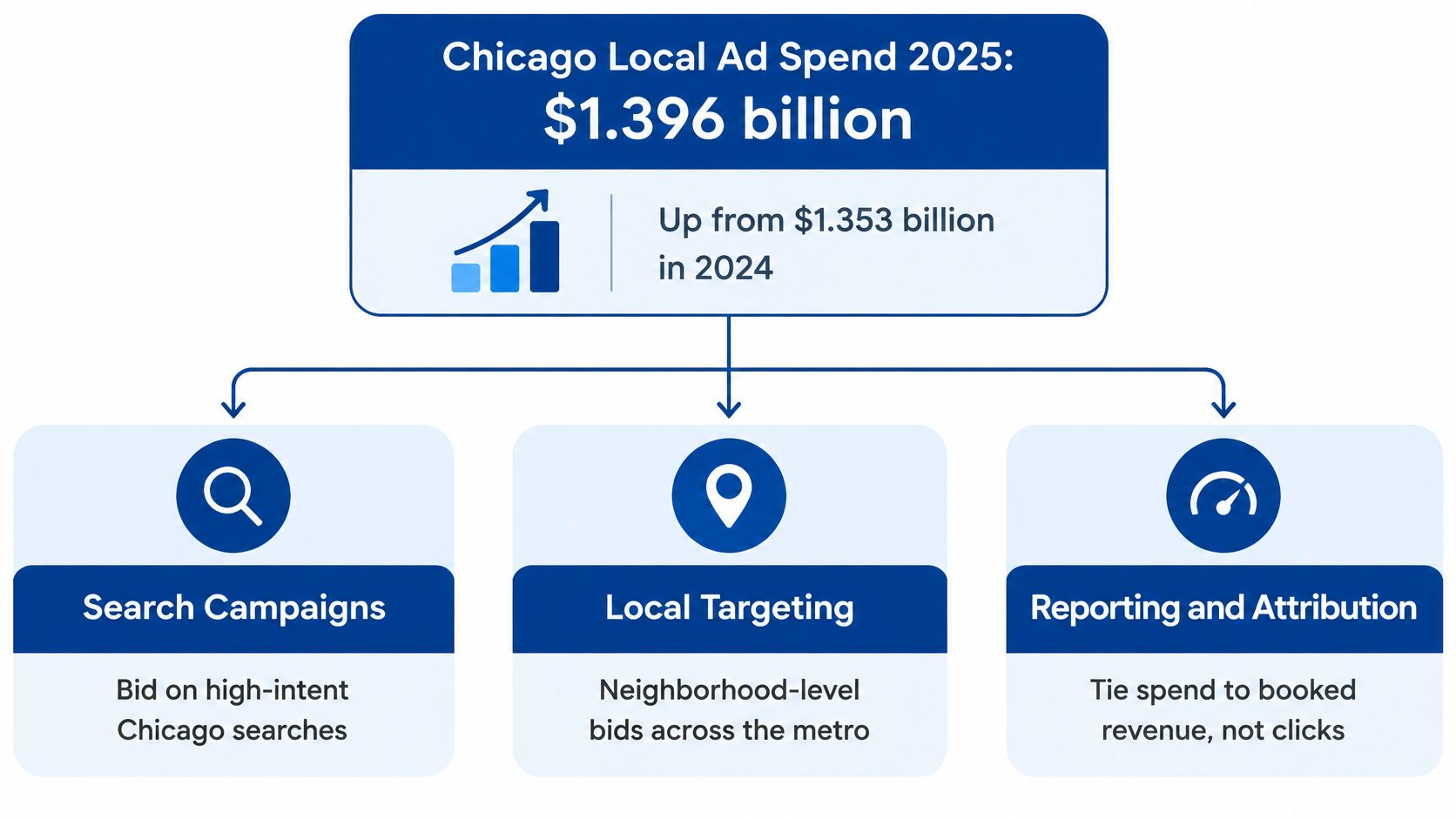
Chicago local advertising spend reached $1.396 billion in 2025, up from $1.353 billion in 2024, according to Gaugius's Chicago advertising-services estimate. That's a substantial vendor market, but its size doesn't tell you which team understands marketplace economics.
For an Amazon brand, PPC services should mean marketplace media plus the measurement that decides what stays funded. That's different from local-lead Google Ads, call tracking, and store-visit campaigns. Those services can suit a Chicago storefront; they don't establish expertise in Amazon contribution margin.
The local advertising environment is useful context, not an Amazon campaign blueprint.
Name the Job Before the Format
Decide whether you're buying launch visibility, defending existing share, or scaling profitable demand. Then assign each format a commercial job and a funding test.
Amazon PPC formats a Chicago engagement should cover
| Format | Job | Metric that decides funding | When to fund |
|---|---|---|---|
| Sponsored Products | Search harvest and rank | Break-even ACOS and organic rank | Launch, defense, and scale |
| Sponsored Brands | Headline queries and Store traffic | New-to-brand and branded search | Consideration and brand defense |
| Sponsored Display | Retargeting and competitor pages | Detail-page views and incremental sales | After search coverage is solid |
| Sponsored TV | Streaming awareness | Branded-search lift | When search demand is the constraint |
| Amazon DSP | Full funnel on Amazon and off Amazon | New-to-brand and 30-day outcomes | Scale and upper funnel |
| Listing experiments | Convert the paid click | CTR and conversion rate | Always alongside media |
Build the stack in that order, but don't fund every format automatically. Sponsored Products gives you query-level control. Sponsored Brands connects broader brand consideration with the Store, while Sponsored Display addresses audiences and product-page opportunities. Sponsored TV and DSP belong where the business needs additional demand, not more campaign types.
At Headline, our Amazon PPC management covers Sponsored Products, Sponsored Brands, Sponsored Display, and Sponsored TV. DSP serves a separate full-funnel role, including reach beyond Amazon.
Include the Detail Page in the Engagement
Listing experiments belong beside media management. Test the main image for click-through, then evaluate content, offer clarity, and conversion. Paying for additional exposure while ignoring a weak detail page makes every bidding decision harder.
For teams coordinating Amazon with wider discovery channels, Verbatim Digital's discussion of AI Overviews impact on ecommerce brands provides useful context for evaluating visibility beyond marketplace ads. Keep that work distinct from Amazon's campaign economics.
A proposal that can't map format to job and profit test is a media menu, not a service.
2026 Amazon Benchmarks by Category
2026 Sponsored Products benchmarks to use as controls
| Slice | ACOS | CPC | Conversion |
|---|---|---|---|
| Sponsored Products, cross-source 2026 | 30–35% | $1.10–$1.22 | 10–11% |
| Food and Grocery median | 23% | Not reported | 13.7% |
| Clothing and Apparel median | 57% | Not reported | 7.3% |
| Headline 2025 portfolio, global SP | Not reported | $1.12 | Not reported |
| Headline 2025 portfolio, US SP | Not reported | $1.31 | Not reported |
| Headline 2025, major European marketplaces | Not reported | $0.44–$0.97 | Not reported |
The cross-source and category rows reflect Hector AI's 2026 Amazon advertising benchmark comparison: Sponsored Products sits near 30–35% ACOS, $1.10–$1.22 CPC, and 10–11% conversion, while Food and Grocery reports median ACOS of 23% and conversion of 13.7%, versus 57% and 7.3% for Clothing and Apparel.
The Headline rows are Headline internal account data, not category medians. Our 2025 portfolio covered 43 brands and $29.6 million in spend, with average Sponsored Products CPC of $1.12 globally, $1.31 in the US, and $0.44–$0.97 across major European marketplaces. Our Amazon PPC benchmarks analysis provides context for interpreting those marketplace differences.
Compare Economics, Not Just Percentages
A category benchmark tells you where to investigate. It doesn't tell you what you can afford.
Calculate break-even ACOS as contribution margin before advertising divided by selling price, expressed as a percentage. Use the margin dollars left after the SKU's non-advertising variable costs, not gross margin from a merchandising presentation.
Consider a grocery product with healthy contribution economics. Its campaign could look expensive against its category median yet still leave money after advertising. An apparel product could outperform its category's advertising benchmark and still lose money because returns, promotions, and fulfillment consume the available margin.
The reverse comparison is equally dangerous. Applying an apparel benchmark to grocery could excuse unnecessary spend, while forcing grocery-style efficiency onto apparel could eliminate viable acquisition opportunities.
Practical rule: Put the SKU's break-even ACOS beside the category row before deciding whether the campaign is efficient.
Segment Before You Set Targets
Don't give branded defense and non-branded discovery the same threshold. Separate targets by intent, placement, product margin, and operating objective.
A branded term should face scrutiny for capturing demand the brand already owns. A launch term needs a defined investment rationale. A scale term needs evidence that additional spend produces acceptable contribution, rather than merely extending an attractive historical average.
Placement matters too. Top-of-search performance shouldn't disappear inside an account-level blend that includes product pages and weaker placements. Review the query and placement together before changing the base bid.
These figures are diagnostic controls, not promises. Category mix, marketplace, period, and attribution methodology differ across datasets. Write your own break-even ACOS beside the closest row, then carry that threshold into the actual profit decision.
Attribution Windows That Change the Verdict
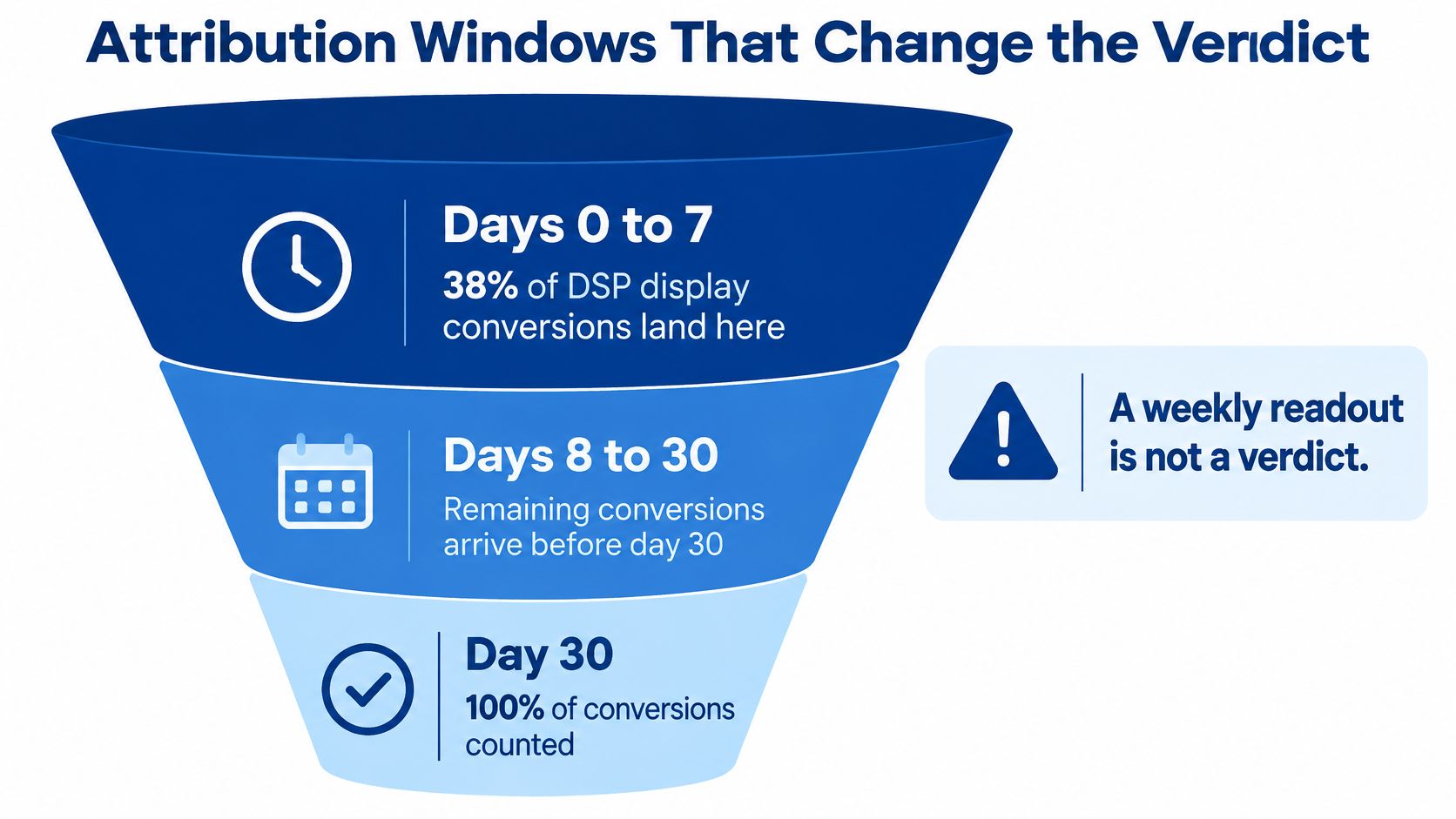
A weekly DSP report can understate the outcome you're buying. Sequence Commerce's Amazon advertising analysis reports that DSP display receives 38% of conversions within a 7-day window, reaching 100% within 30 days in the analysis cited. That's a reason to inspect reporting windows, not a universal conversion schedule for your brand.
The difference is easier to see when conversions are allowed to mature.
Report Comparable Outcomes
Native campaign ROAS isn't a verdict when formats use different windows and interaction rules. Keep the reporting pair explicit:
- Search harvest: Use short-window efficiency to monitor Sponsored Products terms with established purchase intent.
- Display, Video, and DSP: Review longer-window outcomes alongside customer acquisition and engagement.
- Customer composition: Separate new-to-brand from repeat purchases rather than treating every order as equivalent.
- Demand signals: Include branded-search movement, Store visits, and detail-page engagement before removing an upper-funnel budget.
Amazon Attribution can connect Google, Meta, email, influencers, and publisher display with Amazon outcomes, but each external channel needs appropriate tags and interpretation. Copying native Sponsored Products ROAS into a cross-channel comparison doesn't solve that measurement problem.
Our guide to attribution modeling is useful when the leadership team needs to agree on how campaign credit should be assigned. Make those rules visible in the proposal, including treatment of view-through activity and incomplete reporting periods.
Separate Credit From Causation
An attributed sale isn't automatically an incremental sale. To test causation, hold out comparable audiences or geographies where feasible, define the primary outcome before launch, and compare incremental revenue with media cost. Time-based tests can help when audience holdouts aren't practical, but promotions and seasonality need careful control.
Amazon's multi-touch attribution paper combines randomized controlled trials with machine-learning models to estimate touchpoints' likely causal contribution. That supports using experiments alongside reporting rather than assuming the final interaction created the entire purchase.
Amazon Marketing Cloud adds another analytical layer. It's a privacy-safe clean room where advertisers can analyze pseudonymized Amazon Ads signals alongside their own inputs.
Don't cut DSP solely because its last-click ROAS trails Sponsored Products. Judge whether it creates valuable demand that search later converts.
Search should earn funding through incremental profitable conversion. Upper-funnel media should demonstrate customer acquisition, meaningful engagement, and the demand it helps create.
Profit Tests That ACOS Cannot Pass
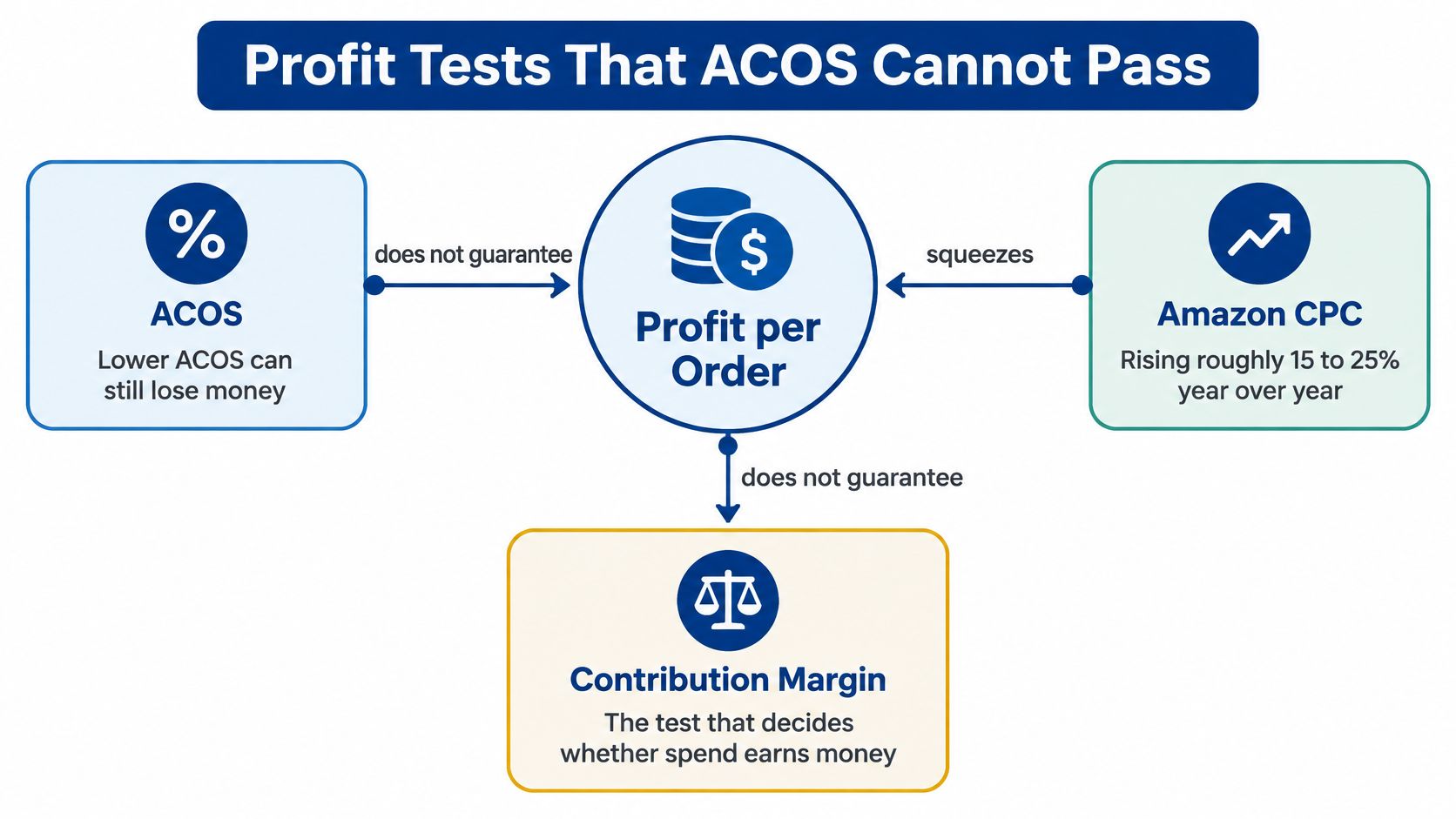
Reject a universal target ACOS. Lowering the percentage doesn't prove the business made more money, especially when the remaining orders carry weaker margins.
Improvado's Amazon ads analytics discussion reports Amazon CPC increases of roughly 15–25% year over year and describes how strong ROAS can coexist with declining SKU contribution once fees, product costs, discounting, and paid-traffic substitution are included. An old efficiency target can become harder to sustain without any deterioration in campaign execution.
Keep the difference between advertising metrics and business profit visible.
Run the Profit Test in Order
Build contribution margin at SKU level. Subtract product cost, referral fees, fulfillment, expected returns, and promotions from realized selling revenue. Include relevant inventory-related variable costs. Don't use a catalog-wide average to authorize bids for products with different economics.
Translate margin into bidding limits. Break-even ACOS is pre-ad contribution margin divided by selling price. Break-even CPC is conversion rate multiplied by contribution dollars per order, using conversion rate as a decimal. Set an operating target below break-even when the business needs contribution left after media.
Check total advertising against total sales. TACoS is total advertising cost divided by total sales. Evaluate its movement alongside organic-sales share and test results to judge incremental efficiency. TACoS alone doesn't isolate incrementality, and relabeling it won't separate newly created demand from paid substitution.
Value acquisition separately. Give new-to-brand activity its own economic case instead of blending it with repeat orders. Amazon's measurement definitions classify new-to-brand purchases using the previous 365 days and describe long-term sales as immediate attributed sales plus projected engagement value over the following 12 months. Projected value isn't cash already earned, so keep it separate from realized contribution.
The apparel-versus-grocery decision now becomes practical: fund the query whose expected contribution supports its click cost, not the query that looks best against a borrowed category percentage. Refresh the calculation when discounts, return expectations, or the offer change.
Cut Waste Without Cutting the Growth Engine
Reducing ACOS can remove profitable upper-funnel demand and stall the organic visibility you were deliberately funding. That doesn't justify unlimited launch spending. It requires a named objective, an investment boundary, and evidence of progress.
Our operating stance is contribution-margin optimization and profit-based bidding, with PPC judged on organic ranking, product margins, and market position rather than ACOS alone.
Use this video alongside the financial review, not instead of it.
The agency review should end with a concrete question: Which SKUs generated more contribution profit, not which campaigns produced a prettier ACOS?
How Paid Clicks Built Organic Share
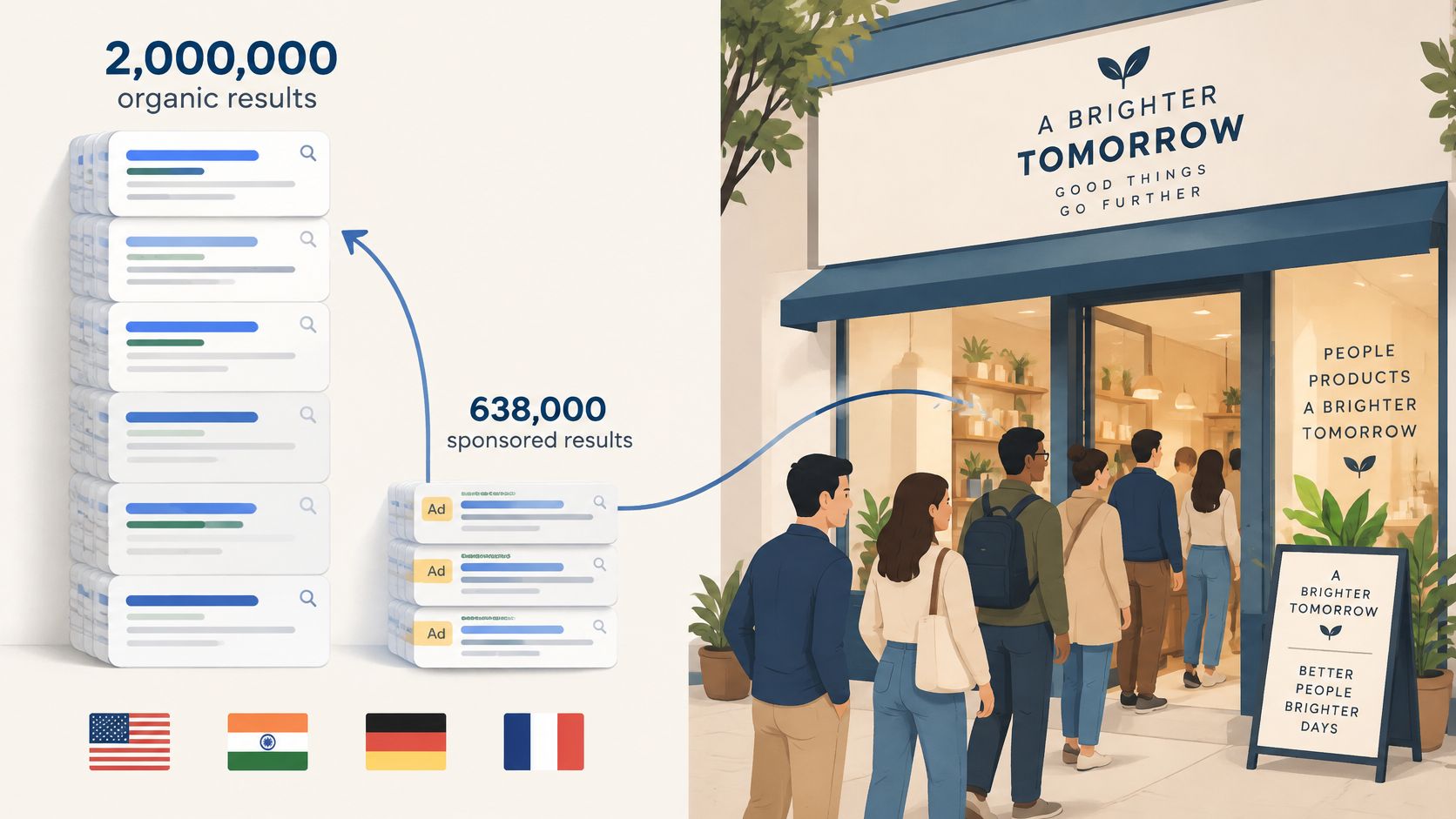
An academic analysis of Amazon search results examined 2 million organic results and 638,000 sponsored results across the United States, India, Germany, and France; sponsored placements represented nearly 30% of observed results, with a sponsored result ahead of the top organic result in 85% of cases. In the US sample, 64.55% of top sponsored products had no organic position within the first three search-results pages.
That finding establishes a visibility opportunity, not proof that advertising automatically improves organic rank. Paid placement can expose a product that shoppers wouldn't otherwise encounter. The brand still has to convert that exposure.
Treat paid and organic discovery as connected commercial work, not interchangeable traffic sources.
Copy the Mechanism, Not the Bid
In Headline's lifestyle brand case, we launched aggressive broad match campaigns and high-bid strategies for top-of-search, using PPC as an investment in organic visibility. The brand's market share doubled, and organic visibility increased 156%.
The useful lesson isn't to bid aggressively everywhere. It's to connect paid exposure with the product's ability to earn a stronger position.
For a brand applying this approach:
- Choose terms deliberately: Prioritize queries that match the product and have strategic value beyond an isolated attributed order.
- Repair conversion friction: Improve listing relevance, imagery, and offer clarity while measuring whether shoppers respond.
- Monitor the handoff: Track query-level organic position and paid contribution together before reducing bids.
- Protect the economics: Keep exploration within an explicit investment allowance rather than hiding it inside blended efficiency.
Our discussion of organic search ranking expands on the relationship between paid visibility and marketplace positioning. The operating decision remains product-specific: additional exposure is useful only when the product can turn it into commercially valuable demand.
Know When Not to Push
A SKU with unstable inventory, an uncompetitive price, or insufficient review confidence may not support the traffic. Buying top-of-search placement won't repair those constraints.
Likewise, don't mechanically pull bids because organic position improves. First check whether paid and organic results reach different shoppers, whether competitors are taking the placement, and whether total contribution holds when exposure changes.
Copy this: Link paid exposure to organic share and margin. Don't copy a high bid when the SKU's break-even CPC is already broken.
A Chicago partner should bring organic rank movement and share evidence, with a clear account of the investment required. A screenshot of rising spend proves only that the agency bought more media.
A Scorecard for Hiring a Chicago Partner
Use the same tests for every proposal. A polished presentation shouldn't compensate for missing financial access or an inability to distinguish demand creation from demand capture.
Pass or fail tests for a Chicago Amazon PPC partner
| Test | Pass | Fail |
|---|---|---|
| Contribution margin | SKU profit after fees, COGS, and discounts | Blended ACOS only |
| Branded versus non-branded | Separate efficiency thresholds | One account ACOS |
| Incrementality | Holdouts, new-to-brand, or AMC | Last-click ROAS only |
| Organic link | Rank and TACoS reported with spend | Paid sales only |
| Category context | Benchmarks used as diagnostics | A promised universal ACOS |
| Decision tooling | SQP, P&L, and clean-room insights drive the next change | Weekly screenshot with no action |
Require the Commercial Foundation
A pass requires the first four tests. Category fluency and advanced tooling strengthen an engagement, but they can't rescue a team that doesn't understand what each order contributes.
Consider a proposal showing improved ACOS after shifting budget toward branded terms and discounted products. The dashboard looks better. Yet the brand may retain less contribution and reach fewer new customers.
That proposal fails unless the partner can reconcile the advertising improvement with SKU profit and customer acquisition. Don't accept a blended explanation for a product-level problem.
Location doesn't fix this. A remote Amazon specialist who can evaluate contribution economics is a better fit than a Chicago generalist whose operating model revolves around calls and local leads.
Make Tooling Produce a Decision
For enterprise catalogs, analytical depth should shorten the path from a finding to an action. Search Query Performance should identify a query opportunity or competitive weakness. A P&L view should expose the products whose apparent advertising efficiency doesn't survive costs.
Our proprietary analytics suite includes P&L Analysis, Ads Performance, Search Query Performance (SQP), Internal Data Analytics Suite, and Amazon Marketing Cloud Insights. The useful output is a specific bid, query, audience, or creative change, not another dashboard.
Apply the tooling row strictly:
- Pass: The strategist identifies what changes, why it changes, and which business outcome will validate the decision.
- Fail: The team presents historical charts but can't name the next action or explain its economic consequence.
Inspect the Fee Incentive
Ask how fees are set. A retainer tied to SKU contribution profit can align payment with the margin you're measuring, provided the agreement defines attribution, exclusions, and controllable inputs.
A percent-of-spend fee pays the agency more as media expenditure rises, even when contribution falls. If a Chicago partner quotes that model, require a profit clause, explicit spending controls, and agreement on when scaling stops.
Other red flags belong directly against the scorecard: a universal ACOS promise fails category context, while a promise to lower CPC without naming the profitable queries being removed fails contribution discipline.
Score your current agency and an alternative on the same six rows. Don't let either team substitute its preferred dashboard for your evaluation.
Book the Audit When the Score Fits
Proceed only when the scorecard's first four tests can be answered with your own account and financial inputs. If they can't, resolve access and measurement before committing to a new retainer.
The next step is a free thorough audit of your current Amazon PPC campaigns. Our audit evaluates:
- Organic visibility: Ranking trends and changes in discoverability.
- Competitive position: Brand-share growth and marketplace positioning.
- Bleeder spend: Inefficient expenditure that needs investigation.
- Targeting coverage: Gaps, target starvation, and missed opportunities.
- Campaign execution: Structure and bid strategy.
Require a Commercial Readout
The readout should connect recommended actions with contribution margin and organic movement. Use the relevant category benchmark as a control, not a contractual performance goal.
For a launch-stage catalog, a higher ACOS can be acceptable where the investment boundary and new-customer economics support it. For a mature catalog, require evidence that paid activity isn't purchasing demand the brand already owned.
Headline fits brands that want Amazon PPC, DSP, and clean-room analytics aimed at profit and rank. A strategy conversation gives the team a place to review the audit and challenge the proposed priorities. If the need is local lead-generation search for a Chicago storefront, this audit is the wrong tool.
Fund the partner who can demonstrate incremental profit and organic share. Pause the one whose entire case rests on a lower ACOS.
Headline Marketing Agency offers a free Amazon PPC audit, alongside PPC, DSP, AMC, and analytics services focused on profitability and organic growth. Visit Headline Marketing Agency to request your audit and schedule a strategy conversation about where your advertising should scale, change, or stop.
Get Your Free Amazon PPC Audit
Discover untapped growth opportunities and see how our data-driven approach can improve your ROAS.
Get Free Audit →Ready to Transform Your Amazon PPC Performance?
Get a comprehensive audit of your Amazon PPC campaigns and discover untapped growth opportunities.