Performance Marketing Agency: What It Does and Who to Hire
Performance marketing agency explained: PPC, DSP and attribution services, KPIs beyond ACOS, real Amazon results, and how to choose a partner.

The most popular advice about a performance marketing agency is to hire the one that promises the highest return on ad spend. That's a weak buying rule. Platform ROAS can reward ads for sales that would have happened anyway, while missing profitable demand that later appears as organic sales. Hire for incremental profit and durable growth, not the prettiest dashboard.
What a Performance Marketing Agency Actually Does
A performance marketing agency is an outside team paid to grow measurable business outcomes, such as sales, profit, and new customers. Think of a pit crew: its job isn't to make the car look impressive in the garage, but to help it finish the race faster. On Amazon, the equivalent is connecting campaign decisions to commercial results, not just impressions and clicks.
Say a brand sells a kitchen product and wants to launch a new variation. The agency researches shopper queries, builds Sponsored Products and Sponsored Brands campaigns, sets keyword and placement bids, and monitors budgets. It may add Sponsored Display retargeting or Amazon DSP audience campaigns, test video and other creative, and identify listing issues that weaken conversion. The work should end in a report that ties media spend to the brand's economics, including contribution profit and the role of organic sales.
A brand agency typically concentrates on positioning, awareness, and creative. A freelance media buyer may manage bids and budgets well, but may not own the broader measurement picture, including marketplace fees, discounts, returns, inventory, and organic visibility. A capable performance marketing agency joins those pieces so the team can make budget decisions based on what the business earns.
The commercial stakes are growing. Dentsu's 2025 Global Ad Spend Forecasts forecast 13.9% growth in global retail-media advertising spending in 2025. More investment makes disciplined measurement more important, not less. A larger budget can magnify both good decisions and wasted spend.
The test: Ask what the agency gets paid when it succeeds, and which business metric it will be held to.
PPC, DSP and Attribution Services Side by Side
| Service Model | What the Agency Runs | Best For | Main Metric | Blind Spot |
|---|---|---|---|---|
| Sponsored Products and Brands PPC | Keyword, product, and placement bids on Amazon search and product pages | Launches, defending rank, capturing search intent | ACoS, TACoS, ROAS | Credits sales shoppers would have made anyway |
| Sponsored Display | Retargeting and product-page placements | Converting shoppers who viewed but didn't buy | ROAS, new-to-brand share | Overlaps with search credit in attribution |
| Amazon DSP | Programmatic display and video targeted by audience, on and off Amazon | Reaching new audiences and lifting consideration | Reach, new-to-brand sales, incremental sales | Hard to isolate without holdout tests |
| Attribution and measurement | Search Query Performance analysis, Amazon Marketing Cloud queries, holdout and geo tests | Deciding where budget creates new demand | Incremental sales, incremental profit | Needs test volume and time before results are reliable |
| Full-funnel management | Combines PPC, DSP, and measurement under one scorecard | Brands scaling beyond a single campaign type | Contribution profit, organic share | Requires agency access to raw data and cost inputs |
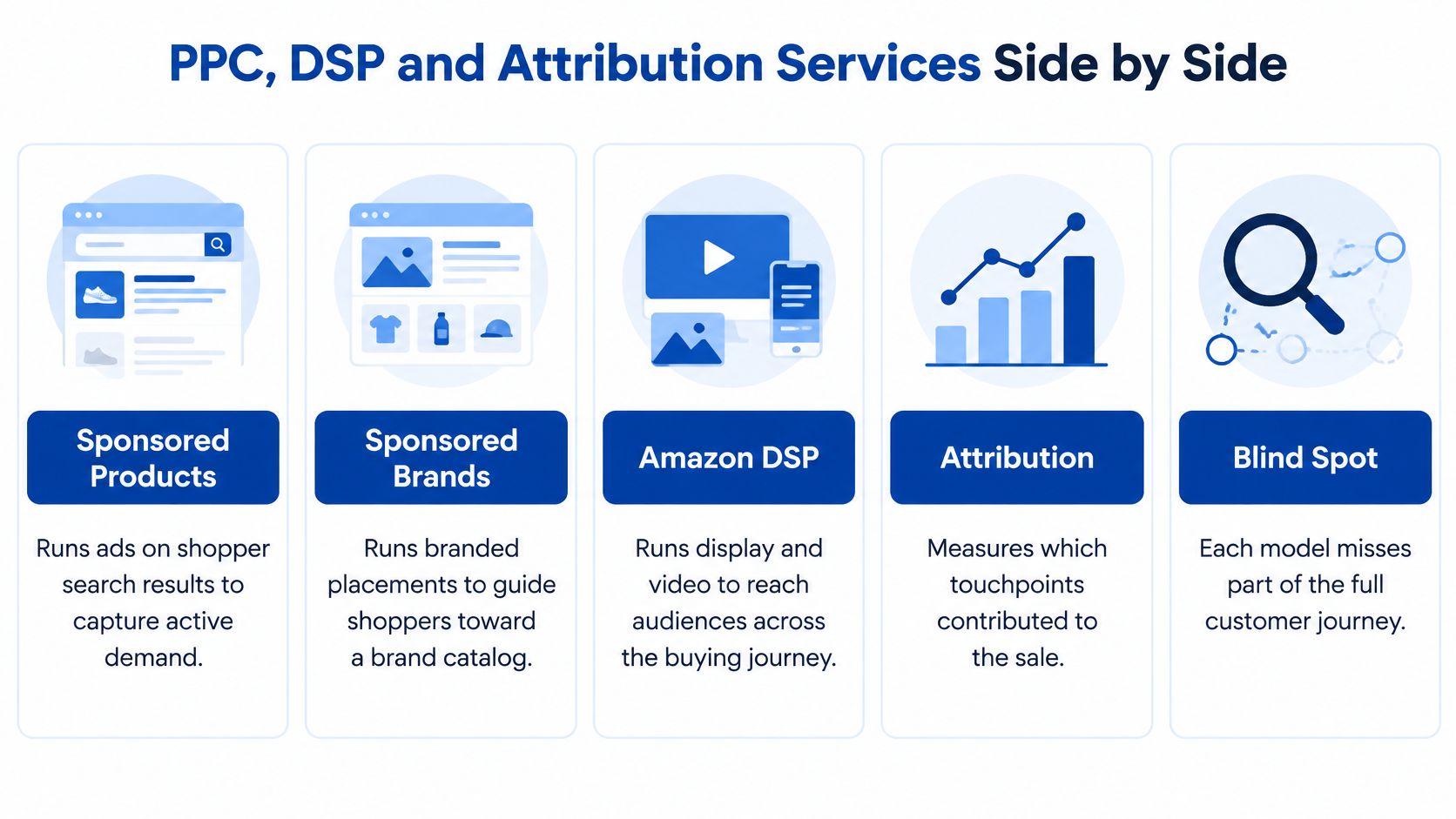
Sponsored Products and Sponsored Brands put products and brand collections in front of shoppers actively searching on Amazon. They're natural starting points for a launch or for defending priority queries, but their attributed sales can include purchases that would have happened without the ad.
Sponsored Display can bring back shoppers who viewed a listing without buying. Amazon DSP uses display and video to reach audiences across the buying journey, including beyond Amazon. Both can support consideration and new-customer acquisition, but teams need a way to separate incremental impact from overlapping exposure.
Attribution and measurement help assess how those touches relate to purchases. Amazon's Search Query Performance dashboard reports query-level impressions, clicks, add-to-cart actions, and purchases across organic listings and Sponsored Products. Its Query Detail view compares a selected ASIN with the top 10 ASINs for a query using a score built from search-funnel activity. Use those signals to assess whether paid visibility is moving shoppers through the funnel, not only whether it gets ad credit.
Verdict by goal: Start with PPC for launches and rank defense. Add DSP when the objective includes reaching new audiences. Before scaling either, establish a holdout test so the team can judge added demand, not just attributed activity.
KPIs That Matter Beyond ACOS
ACoS is useful, but it sees only ad-attributed sales. A campaign can look efficient while total sales barely grow, or look less efficient while generating profitable demand the ad platform doesn't credit. A serious scorecard needs to show whether advertising creates incremental value and whether that value lasts.
| Metric | Formula | What It Tells You | Watch Out For |
|---|---|---|---|
| ACoS | Ad spend ÷ ad-attributed sales | Efficiency of ad-driven sales | Ignores organic sales and profit |
| TACoS | Ad spend ÷ total sales, paid and organic | How dependent the whole business is on ads | Needs a multi-month trend, not one week |
| Incremental sales | Sales in exposed group minus sales in holdout group | True lift created by advertising | Requires a control group and fixed test design |
| Contribution profit | Revenue minus COGS, Amazon fees, discounts, returns, and ad spend | Whether growth actually makes money | Needs clean cost data from the brand |
| New-to-brand share | Share of sales from first-time buyers | Acquisition versus harvesting existing shoppers | Depends on how Amazon defines new-to-brand |
| Organic share of target queries | Organic and paid share of search impressions and clicks on priority keywords | Whether paid activity lifts free visibility | Needs query-level tracking over time |
| Repeat purchase rate | Share of buyers who purchase again within a set window | Durable demand after the first order | Long lag; pair with cohort analysis |
A dataset covering 66 Amazon accounts across North America, Europe, and Australia reported a median ACoS of 34.2%. In that same analysis, the median account devoted 55% of Sponsored Products spend to search terms that generated clicks but no sale. The account benchmark analysis also found that top-of-search placements converted at 13.1% with 26% ACoS, compared with 5.5% conversion and 39% ACoS on product pages. Treat these as diagnostic comparisons, not automatic targets. Your margin, product, and competitive context still determine what counts as profitable.
Read the metrics together. ACoS answers whether attributed ad sales are efficient; TACoS puts spend against all revenue, including organic sales. Incremental sales and contribution profit reveal whether media creates additional business value, while new-to-brand share and repeat rate help distinguish customer acquisition from short-term harvesting.
Practical rule: Shift budget toward placements and queries that convert profitably, then check whether TACoS falls as organic sales expand.
For a practical reference on how to define and use Amazon scorecard measures, see Headline's guide to Amazon KPIs. Creative belongs on the same review cycle as bids: a useful creative testing guide for performance marketers can help teams make asset tests more structured instead of changing copy and visuals without a clear hypothesis.
How PPC Turns Into Organic Growth You Can Prove
A campaign with weaker ROAS can be the better investment if it creates profitable demand that platform attribution doesn't credit. The right question isn't whether the ad got a sale. It's whether advertising changed what shoppers did, and whether the business kept more profit as a result.
Relevant paid placements can introduce a product to shoppers searching specific queries. Those shoppers may click, add the product to cart, or buy. Search Query Performance can then help the brand examine activity through the funnel and compare its ASIN's performance against competitors. Paid activity doesn't guarantee organic ranking gains, so treat improved organic visibility as something to measure, not assume.
The measurement problem is substantial. A study based on 2,226 Meta advertising experiments reported that a model trained on randomized trials achieved an out-of-sample R² of 0.88 for incremental conversions per dollar, versus 0.19 for standard seven-day last-click attribution. Its campaign decisions disagreed with randomized-test conclusions in 8–12% of campaigns, compared with 12–20% for last-click measurement, according to the study of experiment-calibrated incrementality prediction. The platform differs from Amazon, but the lesson is relevant: attributed conversion records can inform analysis without proving that advertising caused the conversion.
Run a test that can change a budget decision
Choose one campaign family, such as branded search, and define the test period, eligible audience, and control group before launch. Use a holdout or geo-based test where feasible, then compare treatment and control outcomes. Report a confidence range with the result; a small measured lift without uncertainty is not enough to justify a major reallocation.
Evaluate the test against incremental contribution profit after product costs, Amazon fees, discounts, returns, and inventory effects. Include ACoS, TACoS, organic share, and new-to-brand sales as supporting indicators, not substitutes for the profit calculation.
Use clear decision rules:
- Scale when incremental contribution profit is positive and the confidence range excludes zero.
- Fix when lift is positive but the margin is thin. Adjust placements, bids, or product mix, then test again.
- Cut when there's no measurable lift and spend mainly captures existing shoppers.
An ROAS decline is acceptable when incremental contribution profit rises. For a broader view of how paid search can support organic performance, see this guide to paid search and SEO. This week, ask two or three agencies to propose the same holdout design and explain how its result would change their budget recommendation.
Amazon Brand Results From Full-Funnel Agency Work
| Brand and Campaign | Campaign Target | Reported Result | Lesson for Brands |
|---|---|---|---|
| The Honest Company, 2024 | Find high-value audiences with AMC Flexible Shopping Insights | Audiences produced 36% of new-to-brand purchases on 17% of budget | Allocate budget by audience quality, not spend volume |
| Bumble Bee Foods, nine-month Snackers campaign | $24.5M ordered revenue, TACoS below 10%, 50% sponsored-ad conversion, 10% repeat purchase | $30M ordered revenue, 5.51% TACoS, 52% sponsored-ad conversion, 12.5% repeat purchase | Score campaigns on revenue, efficiency, acquisition, and retention together |
| Bumble Bee Foods, new-to-brand customers | Repeat purchase versus 10.5% pre-launch baseline | 22% repeat purchase among AMC-identified new-to-brand customers | Retention targeting can compound acquisition returns |
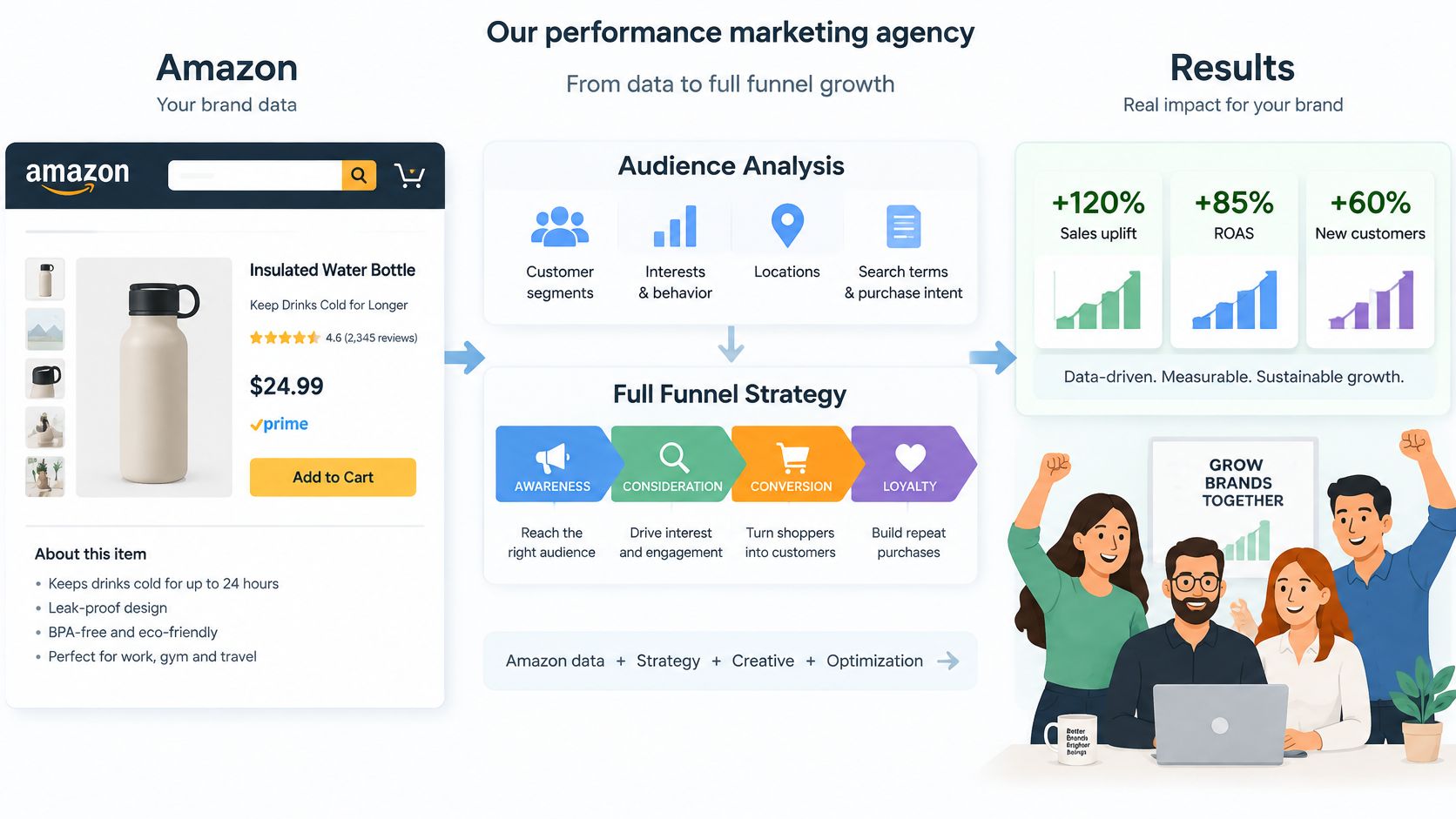
The Honest Company example points to audience quality as a budget question. In a 2024 campaign, Amazon Marketing Cloud Flexible Shopping Insights identified audiences that generated 36% of total new-to-brand purchases while receiving 17% of the advertising budget, according to Amazon's case study with Tinuiti. That gap is a reason to examine who an audience brings in, not how much money is assigned to it.
Bumble Bee Foods' nine-month Snackers campaign tracked ordered revenue, TACoS, sponsored-ad conversion, and repeat purchase together. Amazon's Bumble Bee Foods case study reports that the campaign targeted $24.5 million in ordered revenue, TACoS below 10%, sponsored-ad conversion of 50%, and repeat purchase of 10%. It ultimately generated $30 million in ordered revenue, 5.51% TACoS, 52% sponsored-ad conversion, and a 12.5% repeat-purchase rate. Among AMC-identified new-to-brand customers, repeat purchase reached 22%, compared with the cited 10.5% pre-launch baseline.
The lesson isn't that your catalog should expect the same result. These are selected, publisher-reported case studies, not forecasts. Ask an agency for the campaign baseline, test or control design, time period, and cost assumptions behind every claimed result. Then verify whether the claimed lift holds against your own marketplace economics.
The following video offers another view of how full-funnel Amazon advertising work is presented in practice.
What Agencies Charge and What to Expect
Agency fees shape behavior. Compare the payment model before comparing proposals, because the wrong incentive can steer an agency toward budget growth or attributed ROAS rather than profit.
| Fee Model | How It Is Charged | Incentive Risk |
|---|---|---|
| Monthly retainer | Fixed fee for agreed scope | Paid regardless of results |
| Percent of ad spend | Share of managed media budget | Rewards larger budgets, not profit |
| Performance fee | Bonus tied to an agreed metric | Metric may be ROAS, not contribution profit |
| Hybrid | Base retainer plus performance component | Depends on the metric and the control group |
A retainer can work when the scope and deliverables are specific: campaign management, test planning, reporting, and named account ownership. A percentage-of-spend model needs a spend cap or a separate profit safeguard, because the agency earns more when the media budget grows.
Performance fees sound aligned, but the metric defines the incentive. A ROAS bonus can reward ads that harvest existing purchase intent; a contribution-profit bonus is closer to the outcome the brand wants, provided the calculation and test method are agreed in advance. For a plain-language overview of the mechanics and trade-offs, consult Clipatra's guide to performance-based marketing.
A hybrid can pair stable service coverage with a bonus tied to tested business results. Before signing, require a baseline audit, written test plan, and transparent fee calculation. Headline's overview of PPC service packages is one reference for framing scope discussions. If a proposal can't show how fees are calculated, or rewards attributed ROAS alone, resolve that before the agency gets access to your budget.
How to Evaluate and Select a Performance Marketing Agency
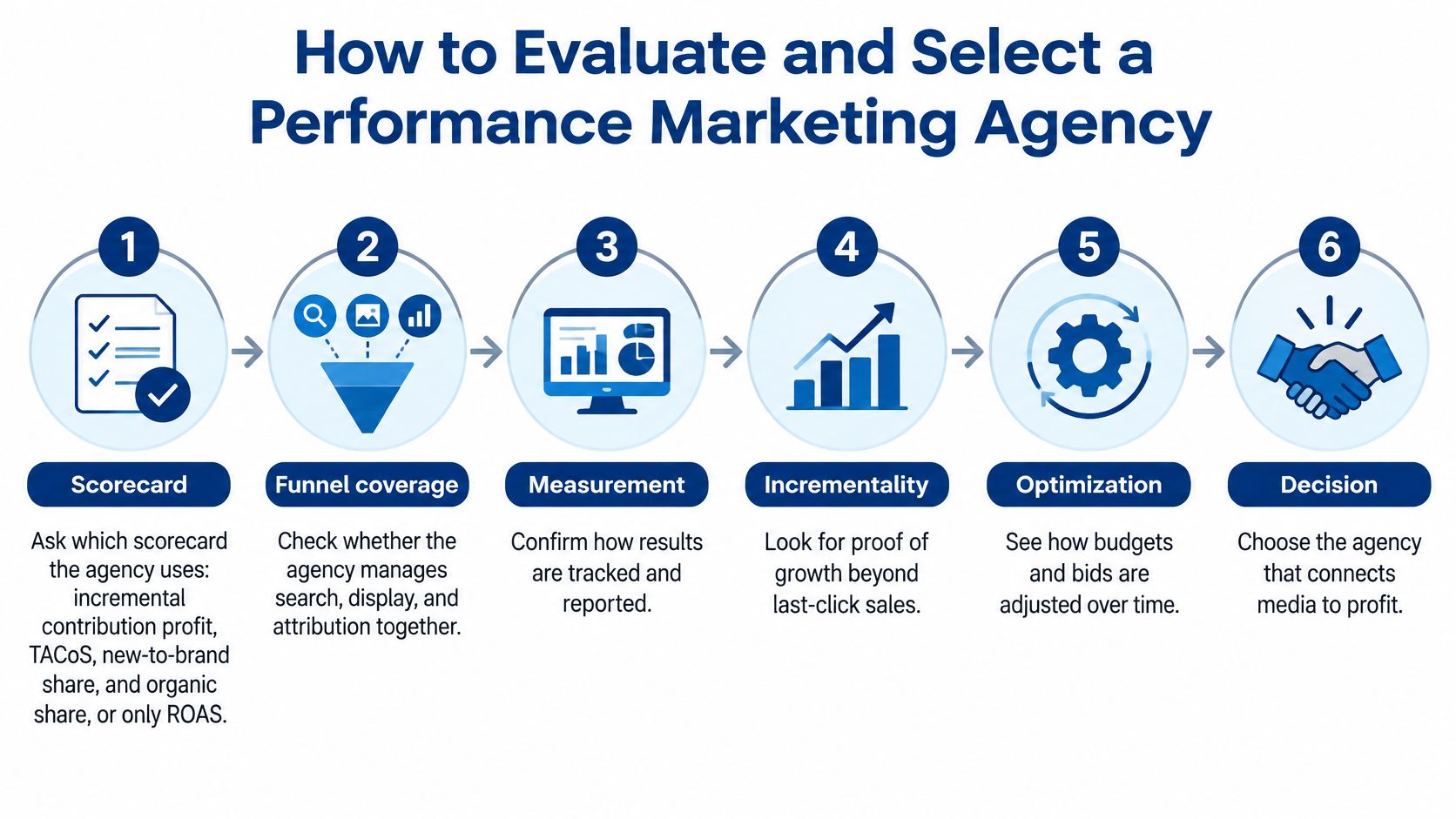
Ask for the scorecard. It should include incremental contribution profit, TACoS, new-to-brand share, and organic share, not only ROAS. A ROAS-only scorecard can reward campaigns that take credit for existing shoppers.
Confirm data access. Put ownership and access to raw campaign data, Search Query Performance exports, and Amazon Marketing Cloud outputs in the contract. Define retention rules too, so your team can audit results and preserve useful analysis if the relationship ends.
Request the test design before launch. The agency should define exposure, eligibility, treatment, control, and reporting before it sees outcomes. Ask how it will report confidence intervals and what it considers enough evidence to scale.
Ask how models are validated. Look for out-of-sample error, calibration, and agreement with experiment results, not attributed ROAS alone. The 2026 State of Marketing report from Clutch found that 45% of agencies lacked visibility into which content influenced conversions. Ask what your prospective partner can see, and what it cannot.
Make automation auditable. Ask which bid and budget changes run automatically, who can override them, and how the team reviews recommendations that shift spend toward high-ROAS branded queries. Automation should speed execution, not remove human accountability for a budget decision.
Set the operating rules. Name the account lead, agree on a reporting cadence, and make fee calculations explicit. For a broader hiring checklist, Class A Media's ecommerce agency hiring advice can help structure questions about fit and working practices.
Red flags include guaranteed ROAS, reporting without raw data or a control group, and refusal to run a holdout. Headline Marketing Agency is one option that uses Search Query Performance and Amazon Marketing Cloud insights in its Amazon advertising work; judge any partner by the access, test design, and profit reporting it can demonstrate. Choose the agency that treats PPC as a lever for organic growth and profit, not merely as a ROAS line.
Headline Marketing Agency manages Amazon PPC and DSP with measurement focused on profitability, organic visibility, and sustainable growth. If your team needs a clear test plan and a scorecard that connects media to marketplace outcomes, visit Headline Marketing Agency to discuss your growth goals.
Get Your Free Amazon PPC Audit
Discover untapped growth opportunities and see how our data-driven approach can improve your ROAS.
Get Free Audit →Ready to Transform Your Amazon PPC Performance?
Get a comprehensive audit of your Amazon PPC campaigns and discover untapped growth opportunities.