Organic Search Ranking on Amazon: How It Works in 2026
Learn how organic search ranking works on Amazon, which signals drive it, and how PPC and listing changes lift visibility and profit.

The most repeated advice in Amazon marketing is also the most misleading: get to page one and the sales will follow.
Reaching page one is a scoreboard, not a lever. Plenty of products sit in the top three for their most important keyword and still lose money, because rank tells you where a listing sits in a queue, not whether the shopper in front of it decides to buy. Amazon doesn't publish a "rank higher" button, and no amount of keyword stuffing installs one.
What separates the brands that compound from the ones that plateau is how they read the numbers underneath the position: whether the listing earns the impression, wins the click, earns the cart, and closes the purchase at a margin that funds the next cycle. That's the whole argument, and the rest of this piece builds it.
Why Organic Search Ranking Matters on Amazon
Organic search ranking is the position a product holds in Amazon search results when nobody paid for that placement. Think of it as the difference between a sign you rent by the day and a location you earn and keep. Sponsored Products placements are the rented sign. Organic position is the storefront shoppers walk past on their own.
That position pays three ways. It delivers unpaid visits, it puts the product in front of shoppers before competing listings get a look, and it lowers the ad spend required to produce each sale.
Clicks concentrate hard at the top. An analysis of roughly 4 million Google search results put the average click-through rate of the first organic result at 27.6% (Statistics Global), and the fall after that is steep. Web benchmarks are also shifting: the average organic click-through rate for Google's position one fell from 28% in 2024 to 19% in 2025, a 32% decline (GrowthSRC). Read both as directional context, not as Amazon law.
Rank alone proves little. A product can sit high and sell poorly, which makes organic position a visibility metric and a demand asset at the same time. Track it next to three numbers: impression share, click-through rate and sales velocity.
Practical rule: a rank movement you can't tie to a change in clicks, units or contribution margin is a data point, not a result.
The sections that follow cover how Amazon orders results, which shopper behaviors move a listing, how to diagnose a problem by funnel stage, where PPC supports organic growth, and what to fix first. The through line stays the same. Organic rank is an outcome of relevance and shopper behavior, never a setting you switch on.
How Amazon Decides Which Products Rank
Amazon ranks in two stages, and merging them into one mental model is the most expensive mistake in listing work. Stage one decides whether a product is allowed into the results for a query at all. Stage two decides where it lands among everything that qualified.
The diagram below is the map to keep in view when a brand asks why a product "isn't ranking."
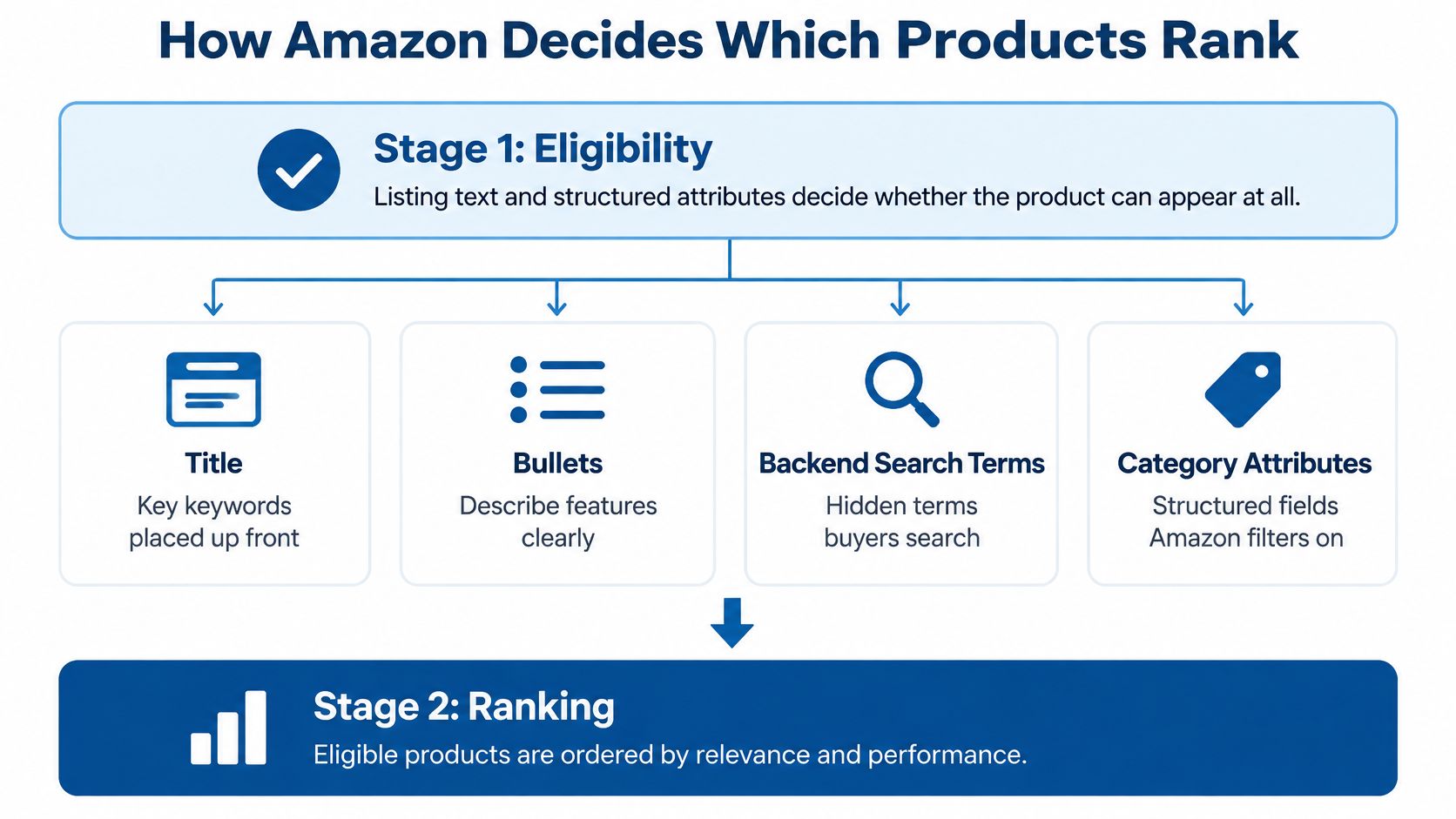
Eligibility is built from text and structure. The title carries the terms that matter most, the bullets describe features shoppers search for, the backend search terms cover variants and misspellings that would clutter visible copy, and the category attributes feed the filters Amazon uses to narrow results. Miss a priority term across all four and the product never enters the race, whatever its conversion rate.
| Stage | What drives it | Metric to watch |
|---|---|---|
| 1. Eligibility | Title, bullets, backend search terms, category attributes | Impressions by search term |
| 2. Ordering among eligible products | Clicks, add-to-cart activity, purchases, sales velocity, reviews | Click-through rate, add-to-cart rate, purchase rate |
| Diagnostic rule | Low impressions point to relevance; strong impressions with weak clicks point to persuasion | Both compared by search term and ASIN |
Read the two stages as a chain with a break in the middle. Better keyword coverage lifts eligibility and impressions, and that's roughly where its influence stops. Higher placement needs the shoppers who arrive to click, add to cart and buy in numbers that beat the listings beside them.
Ordering Decides Position Among Eligible Products
Once a product is eligible, behavior sets the order. Clicks, add-to-cart activity, purchases, sales velocity and reviews tell Amazon whether shoppers who saw the listing chose it. Amazon's own Search Query Performance documentation treats impressions, clicks, add-to-cart activity and purchases as the measurable outcomes of the search funnel, and states that the dashboard covers both organic and Sponsored Products traffic originating from search results (Amazon Seller Central).
Amazon doesn't publish the weights it assigns to those signals. Anyone presenting a fixed percentage contribution for click-through rate, conversion rate or sales velocity is guessing, and it's fair to ask what experiment produced the number.
Diagnostic rule: low impressions mean a relevance problem. Plenty of impressions with weak clicks mean a persuasion problem. Those need different fixes, and running one against the other burns a quarter.
Before you change a single asset, identify which stage the product fails. Get the stage wrong and every downstream optimization makes the data messier.
Why Shopper Behavior Outweighs Keyword Text
The advice I trust least in Amazon marketing is that more keywords mean more rank. Coverage sets the ceiling on who can find you. It doesn't set the order.
An academic description of Amazon Search engineering reported that ranking models use customer-action labels like clicks, add-to-cart events and purchases, alongside sales, reviews and text-query matching, and characterized behavioral features as contributing substantially more to Amazon ranking variance than they typically do in general web search (Mr. Prime's analysis of Amazon SEO). Eligible is table stakes. Chosen is the signal.
The direction is industry-wide. Google's record runs from Panda in February 2011, which targeted low-quality and copied content across roughly 12% of queries, through Penguin and Hummingbird, to RankBrain in October 2015, each step moving weight from keyword matching toward intent and observed behavior (Moz's Google algorithm change history). Amazon's search team works from the same premise, which is why a perfectly indexed listing can still sit on page four.
The Chain a Brand Can Actually Influence
- Search-result click-through rate: test the main image and price first, because no copy fix rescues a listing nobody clicks.
- Uncertainty at the detail page: tighten the title, bullets and visual proof at the exact point the shopper hesitates.
- Purchase conversion: clear stock and fulfillment constraints that stop qualified demand from becoming an order.
Track results at query and ASIN level: impressions, clicks, add-to-cart rate, purchase rate, ordered units and organic position. Control for promotions, seasonality, placement mix and inventory, or you'll credit a payday sale for a ranking gain the sale didn't cause.
Inflating clicks without purchases buys a short bump at best. Because ranking systems learn from observed behavior, the durable goal is incremental profitable demand, which is why I'd evaluate a PPC dollar partly as an organic-ranking investment rather than purely as attributed revenue.
Worked example: a product clicks well from search and converts poorly. More traffic makes it worse, not better. Compare price, review count and delivery promise against the three listings above it, fix the weakest of the three, then remeasure.
Change one variable at a time over a defined window. Two changes in the same 30 days produce a result nobody can attribute.
Diagnose Ranking Problems by Funnel Stage
Most ranking complaints arrive one stage too late. A brand notices soft sales, decides the listing needs more traffic, and pours spend into a funnel that was already leaking somewhere above the ad. Read the funnel from the top down instead. A failure at impression level makes every metric beneath it meaningless.
| Symptom | Likely cause | First fix |
|---|---|---|
| Few impressions on priority search terms | Missing or weak keyword coverage in title, bullets or backend terms | Add priority terms to listing copy and test them with Sponsored Products |
| Healthy impressions but low clicks | Weak main image, price or title in search results | Test the main image and price one at a time |
| Clicks but low add-to-cart rate | Thin proof: short bullets, weak A+ content, no comparisons | Strengthen visual proof and answer the top buyer objection |
| Add-to-cart but few purchases | Price, reviews or delivery promise weaker than rivals | Compare price and delivery with the top three competitors |
| Strong sales but stalled rank | Stock gaps or fulfillment limits that interrupt the buying flow | Fix inventory coverage before adding more spend |
Work the Rows in Order
The rows are sequential, not a menu. Fix the earliest failure you can find and leave the later stages alone until that one clears, because a click-through test means nothing if the listing only surfaces for a fraction of the searches that matter.
The fourth row is the one teams misread most often. Add-to-cart without purchase isn't a traffic problem, it's a comparison problem. Shoppers put the product in the cart, then met a better price, a faster delivery promise, or a review count they trusted more. Buying more clicks sends more people into that same comparison.
The final row is a spend trap. Strong sales with a flat rank usually means stock or fulfillment interrupted the buying flow long enough for Amazon's ordering to reset. Add inventory coverage before you add budget.
Run a 90-Day Baseline and a 30-Day Test
- Pull 90 days of query-level data for priority terms: impressions, clicks, add-to-cart activity, purchases and organic position.
- Find the first stage where the funnel trails peers. Compare against the listings that outrank you, not against your own last quarter.
- Write one hypothesis for that stage in a sentence you could hand to a designer or a copywriter.
- Change one variable and hold the pre-change baseline steady for a 30-day test window.
- Review on three measures: organic rank, paid share and contribution margin, with the query-level funnel beside them.
If you can't name the metric your change is supposed to move, you're not running a test. You're redecorating.
Ninety days is the baseline because it spans a full promotional cycle and enough of a season to separate trend from noise. Thirty days is the test window because shorter windows get swamped by weekday patterns and inventory swings.
Using PPC as a Lever for Organic Growth
Run advertising as a cost per click and you'll cap it at the first month of inefficiency. Run it as an investment in position and the maths changes.
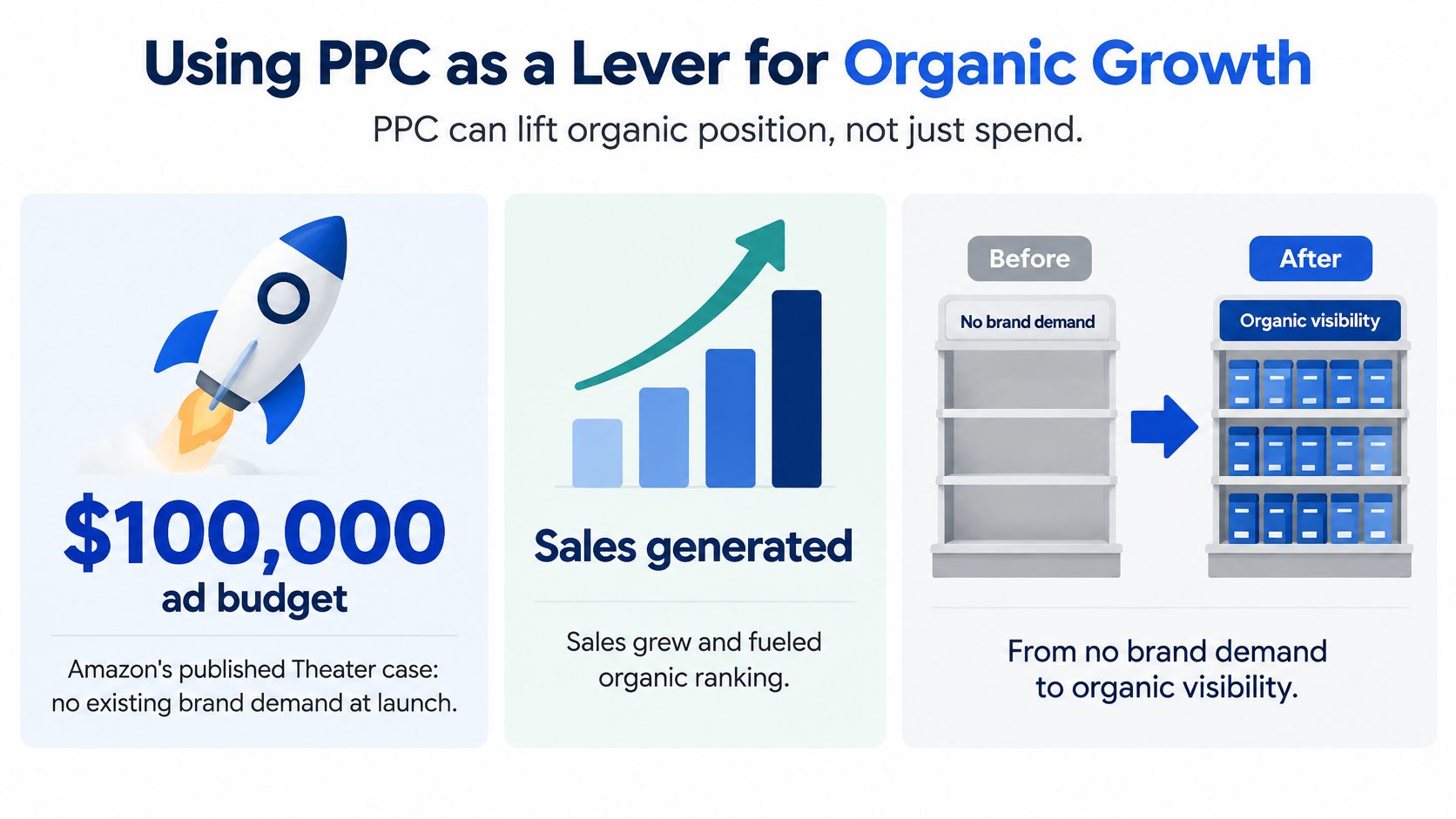
Amazon's published Theater case is a useful benchmark for what full-funnel advertising can produce. With a $100,000 budget and no existing brand demand, sales rose tenfold in nine months, contribution margin improved by 18 percentage points from negative double digits into positive territory, conversion rate rose 163%, branded searches climbed 377% from 17,700 to 84,600 a month, and Best Seller Rank moved from 424 to 64 (Headline's analysis of organic keyword ranking).
| Metric | Before | After |
|---|---|---|
| Monthly branded searches | 17,700 | 84,600 (+377%) |
| Best Seller Rank | 424 | 64 |
| Contribution margin | Negative double digits | Positive, up 18 percentage points |
| Conversion rate | Not published | Up 163% |
| Sales | Not published | Up tenfold in nine months |
Those five numbers moving together is the point. A scorecard built only on ACOS would have called this campaign inefficient somewhere in month two and cut it. Senior teams get further by setting success criteria across contribution margin, branded-query growth, conversion rate and sales rank, then judging ad investment by whether those indicators compound.
Here's the mechanism, and I'd walk a brand through it before they spend a dollar.
Early paid spend does two jobs at once. It buys the sale today, and it builds the branded demand and conversion history that organic placement harvests later. Seed capital works the same way: nobody expects the first season to return the harvest. The test isn't one efficiency ratio, it's whether the layers move together over two or three quarters.
Our own work with a lifestyle brand followed that pattern, doubling market share while organic visibility rose 156% with PPC funded as an investment in visibility rather than a cost line.
Treat the Theater figures as one published case, not a promise, and check the pattern against your own query data before reallocating budget. Then fund and optimize PPC as a demand-generation and market-share lever, reviewed on a quarterly scorecard rather than a weekly ACOS target.
Balancing Ad Spend Against Profit
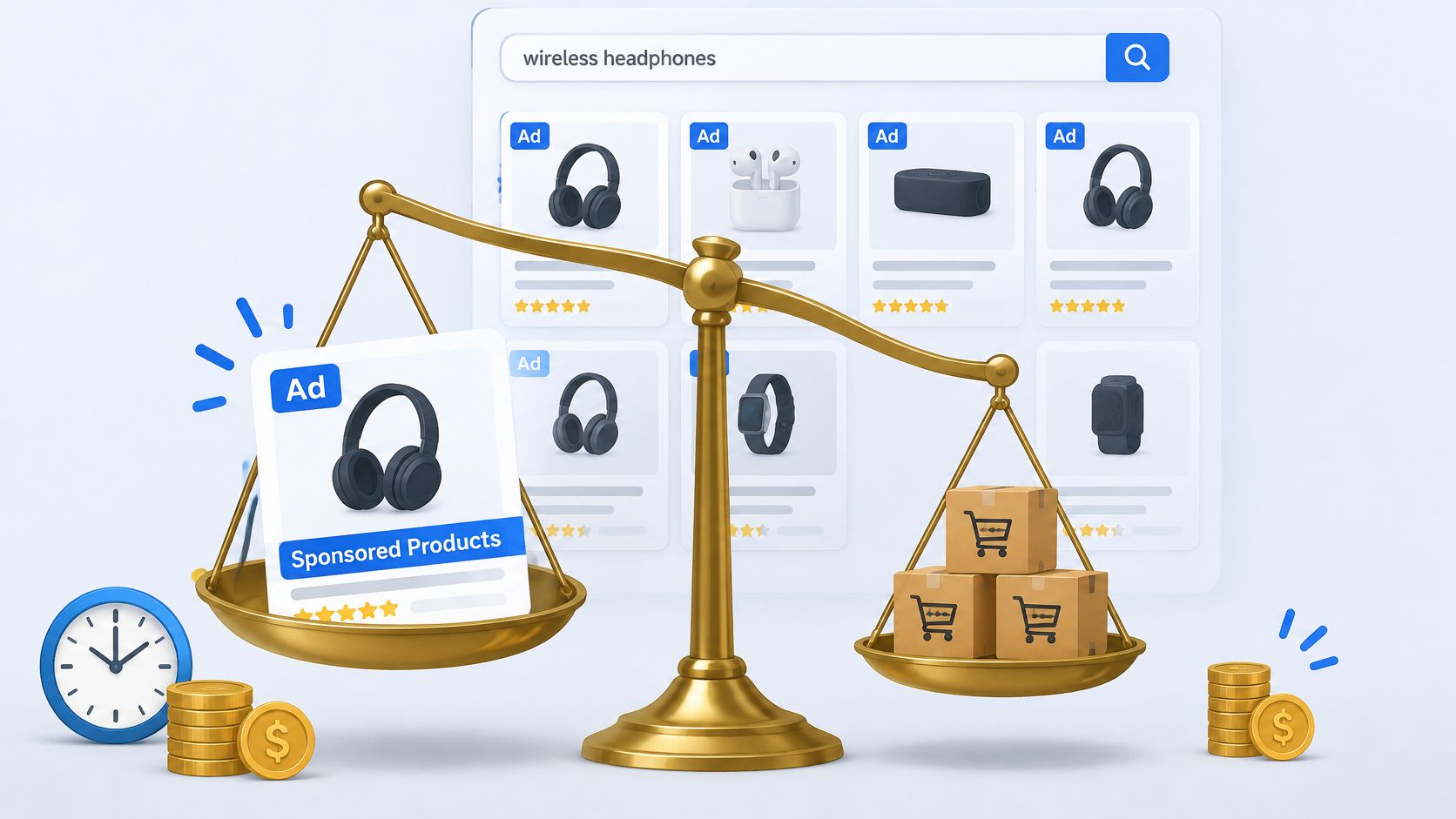
Paid placement isn't a rival to organic position. It's a parallel shelf, and on Amazon it's a crowded one. A third-party study of 4,996 Amazon.com first-page product searches found at least one Sponsored Products ad on 74% of them, with sponsored listings carrying a median of 207 reviews against 650 for organic listings, while average ratings were nearly identical at 4.39 versus 4.41 stars (Suff Digital's Sponsored Products study).
That review gap is the key story. Paid placement buys time for a product that converts but hasn't accumulated review scale. It can't buy permanence for a listing with weak retail readiness, and comparable ratings with a third of the reviews means the paid shelf is doing work the detail page hasn't earned yet.
Four guardrails keep the balance honest:
- Run a contribution margin check per priority query before you scale spend on it. Revenue that arrives at negative margin isn't growth.
- Keep a bleeder list. Terms that consume budget without profitable orders get cut on a fixed review cycle, not whenever someone remembers.
- Read ACOS as one signal among several, beside contribution margin, branded-query growth and sales velocity. It's a diagnostic, not a goal.
- Step paid share down as organic holds. When a query keeps its position and velocity without ad support, redirect that budget to the next gap.
That last one is where most accounts leave money on the table. A home goods brand we worked with had spent years chasing rank. After we moved the focus to profit through keyword research and ACOS management, reported profit rose 23%. The ranking didn't disappear. The spend got smarter about which positions were worth defending.
Use PPC to capture priority searches, measure incremental profit and conversion by query, and reduce reliance on paid placement as organic visibility and sales velocity hold. A query that still needs paid support after two quarters of organic growth is telling you something about the listing, not the bid.
Start With a Baseline Audit
The first decision a leader should make is the least glamorous one: lock a baseline before you change anything. Without 90 days of query-level history, every later claim about ranking becomes an opinion.
Our free audit is the fastest route to that baseline, and it's not a shortcut around the work. It covers campaign structure analysis, a keyword strategy review, search term analysis, and a growth strategy session, and it produces the exact inputs the procedure needs: query-level impressions, clicks, add-to-cart activity, purchases and organic position for priority terms, the first funnel stage where the listing trails its peers, and a contribution margin view for each paid query. The audit also reviews organic visibility and ranking trends, brand share against competitors, bleeder spend and targeting gaps.
Where teams want to run the 30-day test window and track the result properly, our services cover Amazon PPC, Amazon DSP, Amazon AMC and Analytics & Insights, using Search Query Performance and Amazon Marketing Cloud data to connect query-level behavior with what happens to organic position.
The next step is specific: request the audit with 90 days of query-level data ready, so the strategy session starts from numbers rather than estimates. Organic rank is the result of profitable demand, and a clear baseline is the first decision a leader should make.
Headline Marketing Agency builds Amazon PPC and DSP programs that treat organic search ranking as a growth outcome rather than a vanity metric, using Search Query Performance, Amazon Marketing Cloud data and a profit-first scorecard to find the funnel stage worth fixing first. If you want a baseline you can defend in a board meeting, bring 90 days of query-level data and we'll show you where the leaks are. Visit Headline Marketing Agency to start with the free audit.
Get Your Free Amazon PPC Audit
Discover untapped growth opportunities and see how our data-driven approach can improve your ROAS.
Get Free Audit →Ready to Transform Your Amazon PPC Performance?
Get a comprehensive audit of your Amazon PPC campaigns and discover untapped growth opportunities.