A Guide to Amazon Global Selling: Turn International Markets into Performance Engines
International Amazon global selling is a profit multiplier when done right. Lessons from managing campaigns in 12 Amazon markets.

You've conquered your domestic market. Sales are consistent, your brand has traction, and you're asking the right question: "What's the next lever for growth?" The answer isn't just finding more customers—it's about unlocking entirely new markets and building a more resilient, scalable business.
This is where Amazon Global Selling moves from a "nice-to-have" to a core strategic initiative. It's the infrastructure that lets you list your products on Amazon's international marketplaces, putting your brand in front of millions of new customers without the crippling overhead of building a global operation from scratch.
Why Going Global Is Your Next Performance-Driven Move
International expansion is more than another sales channel; it's a strategic imperative for building a diversified, high-valuation brand. Historically, going global meant navigating a labyrinth of logistics, currency conversions, and local customer support.
Amazon’s framework systematically dismantles these barriers. It provides the operational leverage to test new markets with calculated risk and a fraction of the traditional investment. For performance-focused leaders, Amazon Global Selling isn't just a fulfillment service; it’s a strategic tool for uncovering new pockets of demand and driving sustainable, profitable growth.
The Scale of the Opportunity: A Data Snapshot
The numbers behind Amazon's global ecosystem are staggering, and this scale is your primary strategic advantage. You aren't starting from scratch; you're plugging into a pre-built audience of millions of high-intent buyers.
Consider the data: Amazon recently generated $638 billion in net sales worldwide, an 11% year-over-year increase. Its net income soared to $59.2 billion. With over 240 million Prime members globally, your products gain immediate access to a loyal, purchase-ready consumer base. You can dig deeper into Amazon's market performance to understand the full scope.
This scale unlocks critical strategic advantages:
- Market Diversification: Hedge against economic volatility. By selling across different economies, you mitigate the impact of seasonal slumps and become less dependent on a single market's performance.
- First-Mover Advantage: Secure a defensible position in less-saturated product categories before competitors arrive, establishing your brand as a market leader.
- Increased Brand Valuation: A brand with a proven international footprint is fundamentally more valuable. It signals operational strength, stability, and a significantly larger total addressable market.
Headline's POV: View Amazon Global Selling not as a sales channel, but as a strategic framework for de-risking international expansion. Leverage Amazon's logistics, payment infrastructure, and customer trust to test, learn, and scale in new countries. It’s your opportunity to transform global markets into your next primary growth engine.
Evaluate Your Brand's Readiness for Expansion
Jumping into Amazon Global Selling without a data-driven plan is a recipe for burning cash. Before committing a single dollar to international inventory, a rigorous internal audit is non-negotiable. This is about operational and financial readiness, not just ambition.
First, analyze your domestic performance. Strong, profitable sales in your primary market are the single greatest predictor of international success. If your products are struggling at home, global expansion will only amplify existing problems. Isolate products with a proven sales history, strong positive reviews, and healthy profit margins that can absorb the added costs of international logistics, tariffs, and advertising.
Analyzing Product-Market Fit and Operational Capacity
Warning: Your top-performing product in the US could be a complete non-starter in Germany or Japan. Cultural nuances, local competition, and consumer preferences can radically alter product viability. Move beyond assumptions and into data.
Start with your existing metrics. Are you seeing any organic sales from international customers on your home marketplace? This is a powerful leading indicator of untapped demand. If not, leverage Amazon’s tools to research search volume and competitor performance in target countries.
Next, conduct a frank assessment of your operational backbone. Can your supply chain handle increased demand and the complexities of international freight?
- Inventory Management: Do you have the capital and production capacity to stock a new international market without compromising your domestic supply? Stockouts kill launch momentum.
- Financial Resources: Have you budgeted for the full landed cost, including international fees, currency conversion, customs duties, and a sufficient initial advertising spend? Underfunding a launch is a self-fulfilling prophecy of failure.
- Legal and Compliance: Are your products compliant with target country regulations, from safety standards to labeling requirements?
Securing Your Brand Is a Non-Negotiable First Step
Do not list a single product in a new country without protecting your brand. Entering a market without a registered trademark is an unacceptable risk. Counterfeiters and listing hijackers are rampant, and without legal ownership of your brand, your recourse is limited.
This is where Amazon Brand Registry becomes your most critical asset. Enrollment requires a registered trademark in each country where you plan to sell. While it demands an upfront investment of time and capital, the protection is invaluable. It provides the tools to control your listings, remove fraudulent sellers, and unlock powerful advertising and analytics features like A+ Content and Brand Analytics.
Enrolling in Brand Registry isn't a "nice-to-have"—it's the foundational requirement for any serious brand operating on Amazon. It provides the security and control necessary to build a profitable, defensible international business.
Skipping this step exposes you to costly legal battles and reputational damage before you even begin. It's the difference between a strategic, long-term investment and a short-sighted gamble.
A Data-First Approach to Market Selection
So, you’re operationally ready. The next critical decision is where to launch. The default move is to target large, familiar markets like the UK or Germany, but this is often where competition is most intense and customer acquisition costs are highest. A smarter, performance-driven approach is to let data guide you to the market where your products have the highest probability of winning—and winning profitably.
The goal isn't just to find demand; it's to find the optimal intersection of strong customer demand and manageable competition. This requires looking beyond top-line market size and analyzing the metrics that truly impact your P&L.
Building Your Market-Selection Scorecard
A successful expansion is built on data, not assumptions. Systematically analyze your options across four key pillars: customer behavior, competitive landscape, category saturation, and logistical feasibility.
- Analyze Existing Data: Your Seller Central account is the first place to look. Are you already seeing a trickle of international orders? This is the strongest possible signal of existing, unmet demand.
- Gauge Keyword Search Volume: Use Amazon's tools and third-party platforms to measure search frequency for your primary keywords in target countries. High search volume indicates strong interest, but it's only one piece of the puzzle.
- Evaluate Prime Adoption: In markets with high Prime penetration, like the UK and Germany, fast, free shipping is a baseline expectation. If you're prepared to leverage FBA, this is a significant advantage. In markets with lower Prime adoption, Fulfilled by Merchant (FBM) might be a more viable entry strategy.
Looking Beyond the Obvious Metrics
The most common metrics can be misleading. To identify the market with the highest potential ROI, you must analyze the data that directly impacts profitability—customer acquisition cost and your ability to rank.
I see this constantly: a brand targets a market solely based on its size. A smaller, less-contested market where your product is highly differentiated can be far more profitable than a massive market where you're forced to burn cash just to achieve page-one visibility.
Here are the advanced indicators we analyze for our partners:
- CPC-to-Sales Ratio: This is critical. What is the average Cost-Per-Click (CPC) for your core keywords compared to your product's average selling price in that market? A marketplace with low CPCs and a healthy price point provides a longer runway for profitable advertising—the key to driving initial sales and organic rank.
- Competitor Review Velocity: Analyze the top sellers in your category. How many reviews are they accumulating monthly? High velocity indicates a mature, highly competitive space. Lower velocity signals an opportunity for a new entrant to establish social proof without an insurmountable climb.
- Language and Cultural Alignment: Do not underestimate "soft" data. For English-speaking brands, markets like Australia and Canada offer a lower barrier to entry, allowing you to validate your model before investing in deep localization for non-English markets.
This data-driven approach shifts your decision from a guess to a calculated investment. The objective of Amazon Global Selling isn't just to sell in more countries—it's to be profitable in them. This analytical framework ensures your first international launch is built for sustainable success.
Key Amazon Marketplace Comparison for New Global Sellers
This high-level comparison provides a starting point for your analysis. Use it to frame your thinking, then dive into the specific data for your product category.
| Marketplace | Primary Language | Market Maturity & Competition | Logistical Complexity | Strategic Advantage |
|---|---|---|---|---|
| Canada | English, French | Moderate | Low | Easiest entry point for US sellers due to NARF program and cultural proximity. Ideal for testing expansion. |
| United Kingdom | English | High | Moderate | Large, mature eCommerce market with high Prime adoption. English language simplifies initial setup. |
| Germany | German | High | High | Largest European market, but requires full German localization and strict adherence to regulations (e.g., VerpackG). |
| Japan | Japanese | High | High | A massive, tech-savvy market with unique consumer preferences. Demands deep localization and cultural adaptation for success. |
| Australia | English | Growing | Moderate-High | Less saturated than the US/EU, offering a potential first-mover advantage, but logistics can be challenging. |
| Mexico | Spanish | Moderate | Moderate | A rapidly growing market with lower competition, but logistical and payment infrastructures are still developing. |
The "best" market is product- and brand-specific. Use this table to initiate a strategic discussion, then let your data provide the final answer.
Navigating Logistics and Fulfillment with FBA
Market selection is strategic, but logistics are operational. Flawless execution is what separates a successful expansion from a costly failure. This is where Fulfillment by Amazon (FBA) becomes your single greatest operational advantage in Amazon Global Selling.
Using FBA is more than outsourcing shipping; it's your key to unlocking the Prime badge. The Prime badge is a powerful driver of conversion in any marketplace. Consumers trust it, filter for it, and convert at a higher rate because of it. FBA instantly puts your products on a level playing field with established local sellers.
For a deeper dive, our comprehensive guide to Amazon FBA covers the mechanics. FBA removes the immense operational burden of building an international fulfillment network, freeing you to focus on high-value activities: marketing, brand building, and strategic growth.
Choosing the Right FBA Strategy for Europe
For European expansion, Amazon offers several FBA models. The optimal choice depends on your sales velocity, inventory depth, and the number of countries you're targeting.
- European Fulfilment Network (EFN): The simplest entry point. You ship inventory to a single FBA fulfillment center in one EU country (e.g., Germany), and Amazon fulfills orders across all its European marketplaces from that central location. It's ideal for testing the European market with minimal initial tax compliance complexity.
- Multi-Country Inventory (MCI): A more strategic approach where you store inventory in specific countries you choose. For example, stocking products in both Germany and France reduces cross-border fulfillment fees and speeds up delivery times to customers in those regions. However, it requires VAT registration in each country where inventory is stored.
- Pan-European FBA: The most integrated option. You send inventory to one fulfillment center, and Amazon dynamically distributes it across its entire European network based on anticipated demand. This provides the fastest delivery times and lowest fulfillment fees, maximizing your competitiveness. The trade-off is the requirement to register for VAT in multiple countries.
Headline's Recommendation: Start with EFN. It allows you to gather sales data and identify your top-performing EU markets with the lowest initial compliance burden. Once the data confirms your winners, strategically upgrade to MCI or Pan-European FBA to optimize fees and delivery speed—two critical factors to win the coveted Buy Box.
This infographic provides a visual framework for your market entry and logistics planning.
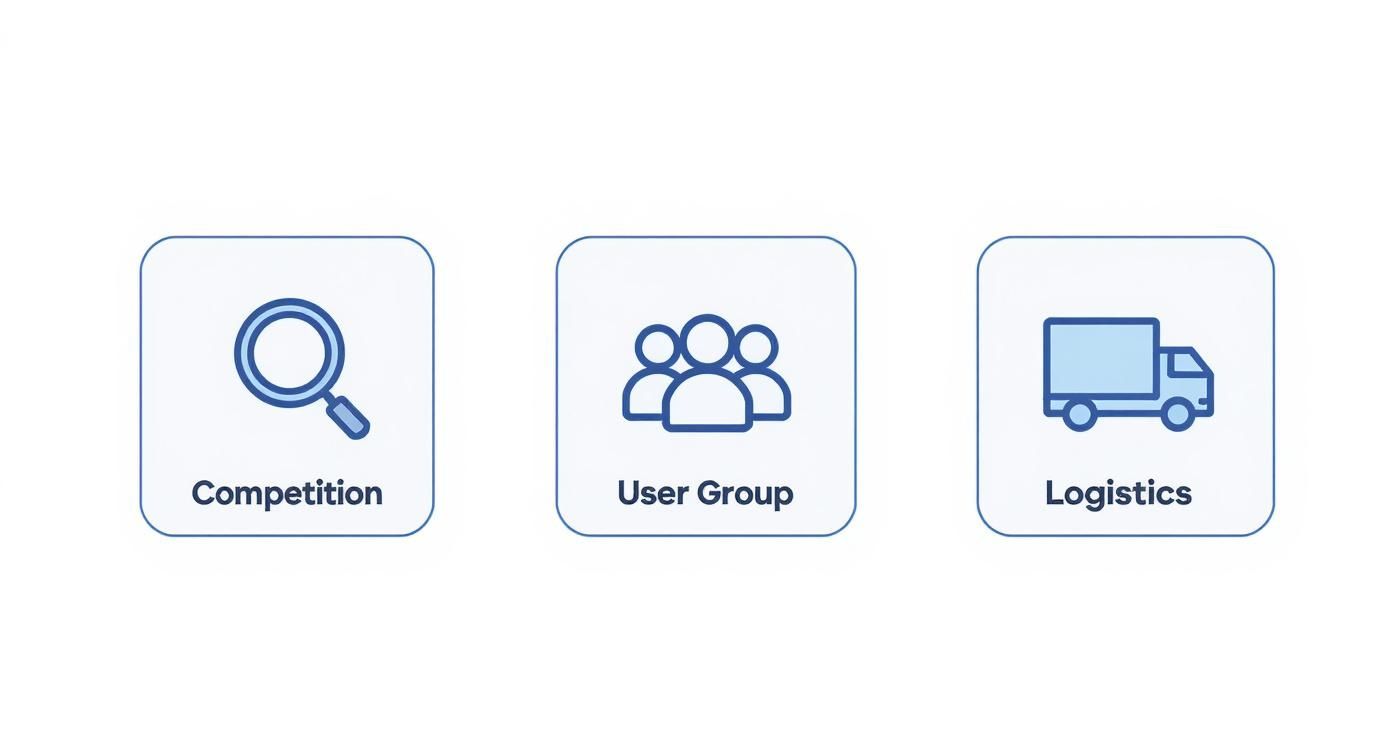
As you can see, competitive analysis, consumer demand, and logistical feasibility are interconnected. Your FBA strategy must be informed by all three.
Tackling Customs, Duties, and Taxes
Logistics isn't just about moving inventory; it's about navigating a complex web of regulations. Customs, import duties, and local taxes like VAT (Value Added Tax) are non-negotiable hurdles. Mismanagement can lead to seized inventory, delayed launches, and account suspension.
When you ship inventory to an international FBA fulfillment center, you are the Importer of Record (IOR). This means you are legally responsible for ensuring compliance with all local import laws and for paying all associated duties and taxes. These costs must be factored into your pricing model to protect your profit margins.
Amazon’s Global Selling program offers tools and services like FBA Export and North American Remote Fulfillment (NARF) to simplify some of these processes. However, the smartest operational decision is to partner with an experienced customs broker or freight forwarder specializing in FBA shipments. They will manage the paperwork, ensure correct product classification (HS codes), and navigate customs efficiently. Attempting this process without expertise is a recipe for costly mistakes that can derail your launch.
Fine-Tune Your Listings and PPC for a Global Audience
Getting your products live in a new country is just the beginning. To truly scale with Amazon Global Selling, you must win the trust of local customers. This requires far more than a simple translation of your domestic strategy.
The belief that you can simply duplicate your US listings and PPC campaigns is a critical, and common, mistake. It’s the fastest path to wasted ad spend and stagnant growth. Sustainable international success is rooted in deep, strategic localization.
Treat each new marketplace as a distinct business unit. Search behavior, cultural drivers, and the competitive set are entirely different. A message that resonates in Texas will likely fail in Tokyo. Your listings and advertising must work in concert, speaking the local language—both literally and culturally.
Go Beyond Translation: Localize for Conversion
Automated translation tools miss the nuance and colloquialisms that drive purchase decisions. A German shopper searches for a "Handyhülle," not a "cell phone case." A direct translation renders your product invisible to organic search.
Effective localization is a multi-layered process:
- Cultural Keyword Research: Move beyond direct translation to uncover the slang, regional terms, and specific phrases that real customers use to find products like yours.
- Creative Adaptation: Your A+ Content and primary images must reflect local culture. This includes everything from the models and settings used to the color psychology and lifestyle scenarios depicted.
- Technical Localization: Ensure all units of measurement (inches to centimeters), sizing charts, and even date formats are adapted to local standards. This prevents customer confusion and reduces return rates.
Think of your product listing as your 24/7 digital salesperson. If it cannot speak the local language fluently and persuasively, you are sending an amateur to do a professional's job. Brands that invest in professional localization consistently achieve higher conversion rates from day one.
PPC: The Engine for Organic Growth and Profitability
When you launch in a new market, you have zero organic ranking. You must force the Amazon algorithm to take notice. Your most powerful lever is Pay-Per-Click (PPC) advertising. An aggressive, localized PPC strategy is non-negotiable for generating the initial sales velocity required to climb the organic ranks.
Every ad-driven sale sends a powerful signal to Amazon's A10 algorithm, validating your product's relevance in the new marketplace. This sales history is a primary driver of organic search ranking.
In short, your PPC campaigns are the catalyst for your entire organic growth flywheel.
A high-performance international PPC strategy is not a clone of your domestic campaigns. It requires a tailored, data-gathering approach.
Structuring Campaigns for International Success
Build your campaign structure from the ground up, focused on learning what works in the new marketplace.
- Launch with Discovery Campaigns: Start with broad match and category targeting campaigns with controlled budgets. The objective is not immediate profitability; it is data acquisition. Your goal is to identify the local search terms that convert.
- Isolate and Scale Winners: As conversion data comes in, move high-performing search terms into their own exact match campaigns. This provides granular control over bidding, allowing you to allocate budget to proven, profitable keywords.
- Create a Data Feedback Loop: The search terms that convert within your PPC campaigns are your most valuable asset. Systematically integrate these proven keywords into your product title, bullet points, and backend search terms to accelerate your organic ranking.
This cycle—using paid media to discover what converts, then optimizing your organic listing based on that data—creates a powerful flywheel effect. Paid advertising drives sales, which improves organic rank, which in turn generates more sales at a lower total advertising cost. This is the blueprint for building a profitable, sustainable presence in any new market.
Common Questions About Amazon Global Selling
Even for seasoned eCommerce leaders, mapping an international expansion raises critical questions. The financial stakes are high, and operational details are paramount. Here are no-nonsense answers to the most common questions we address for brands preparing to scale globally.
This is your final pre-launch checklist, designed to cut through the ambiguity and empower smarter decision-making.
How Much Does It Cost to Start Selling Internationally?
There is no single figure, as the initial investment is dictated by your strategy and market choice. However, your budget must account for several key cost centers beyond your Professional Selling Plan fee:
- Inventory Investment: Typically the largest single upfront cost. You must have sufficient capital to fund inventory for the new market without causing stockouts in your primary market.
- Landed Cost: This includes international freight, customs duties, and taxes (like VAT/GST). You must calculate the full landed cost per unit to accurately model profitability.
- Compliance and Legal Fees: Budget for trademark registration in new countries, required product safety certifications, and professional tax advisory services.
- Localization Services: Professional translation and localization of your listings, A+ Content, and packaging is not an optional expense; it is a prerequisite for success.
- Advertising Budget: A dedicated and sufficient launch budget for PPC is non-negotiable. It is the primary tool for generating initial sales velocity and gathering critical performance data.
A common and fatal mistake is underfunding the launch, particularly the advertising budget. You must be capitalized to give your products a realistic chance to gain traction and achieve profitability.
What Is the Best Way to Handle International Taxes?
Tax compliance is one of the most complex aspects of global selling. The rules are intricate and vary significantly by country. For international sellers, for example, understanding what an ITIN number is is essential for US tax compliance.
The most important takeaway is this: do not attempt to manage international tax compliance in-house. The risks, including substantial fines and seized inventory, are too great.
Your optimal strategy is to engage a third-party service specializing in eCommerce VAT and GST. Amazon’s Service Provider Network is an excellent resource for finding vetted experts who can manage everything from VAT registration to filing returns. This is a core operational cost of doing business internationally, not a luxury.
Can I Use the Same Listings in Different Countries?
Technically, yes. Strategically, you absolutely should not.
Simply translating your existing listings is a guaranteed way to underperform. True localization goes far beyond words; it’s about adapting your entire value proposition to resonate with a local audience.
This requires conducting new keyword research to match local search behavior, rewriting bullet points to align with cultural priorities, and redesigning A+ Content to reflect local aesthetics and lifestyles. The goal is to make your product feel native to the market, not like a foreign import.
The Bottom Line: A copy-paste strategy signals to both customers and the Amazon algorithm that you aren't serious about their market. Investing in deep localization builds credibility, drives higher conversion rates, and creates a significant competitive advantage from day one.
The Amazon ecosystem is vast and competitive. There are over 9.7 million registered sellers globally, with more than 2.5 million actively selling across 20+ marketplaces. With 82% of sellers leveraging FBA, the operational standard is high. To win, your brand must execute flawlessly. You can discover more insights about Amazon's seller landscape to understand the competitive environment.
At Headline Marketing Agency, we transform these complexities into a clear roadmap for profitable growth. Our data-first approach to Amazon advertising and marketplace management empowers brands to scale intelligently, turning global expansion from a logistical challenge into a powerful performance driver. Let's build your global strategy together.
Get Your Free Amazon PPC Audit
Discover untapped growth opportunities and see how our data-driven approach can improve your ROAS.
Get Free Audit →Wollen Sie Ihre Amazon PPC-Performance aufs nächste Level bringen?
Lassen Sie Ihre Amazon PPC-Kampagnen professionell analysieren und entdecken Sie neue Wachstumsmöglichkeiten.