The Performance-First Amazon Brand Guide: From Strategy to Scale
We've spent years in the Amazon trenches with real brands. Our performance-First Amazon Brand Guide guide distills what works from what's noise.

This is not a guide about making your brand look good on Amazon. It's a blueprint for eCommerce leaders who measure success by the bottom line—profitability, market share, and sustainable growth. On Amazon, a strong brand isn't a vanity project; it's the engine that fuels your advertising flywheel, turning every dollar spent on PPC into an investment that builds lasting enterprise value.
Building Your Performance-First Amazon Brand
Let's ditch the generic checklists. Building a dominant brand on Amazon demands a fundamental mindset shift. Stop treating branding as a siloed creative task and start viewing it as your primary growth lever.
Every tool in your arsenal—from Brand Registry and A+ Content to your Amazon Store—directly impacts performance. Pulling the right levers improves ad efficiency (lower ACOS, higher ROAS), boosts organic rank, and increases customer lifetime value. This is about creating a connected brand ecosystem where every element works in concert to build an unshakeable competitive moat.
When this is executed correctly, marketing stops being a cost center. You'll stop asking, "What's our ACOS?" and start asking the more strategic question: "How is our brand investment reducing our reliance on paid advertising over time?"
The Strategic Value of a Strong Brand
A powerful brand is a moat around your business. It’s what earns you trust, allows you to command a premium price, and keeps customers coming back. On a marketplace flooded with millions of sellers, a recognizable brand isn't just nice to have—it's the ultimate differentiator and your most defensible asset.
Just look at Amazon's own playbook. The company’s brand value is projected to rocket to $866 billion by 2025, a nearly 100-fold jump from 2006. That astronomical growth proves the power of a solid brand identity in capturing customer loyalty on a global scale. You can dig into more data on Amazon's brand valuation on Statista.
You can apply the same principles using Amazon's own tools. For example, a well-executed A+ Content strategy isn't just for aesthetics; Amazon data shows it can boost conversion rates by an average of 5.6%. For a brand doing $1M in annual sales, that's an extra $56,000 in revenue from a one-time branding investment.
Key Takeaway: A performance-first brand strategy is your most powerful tool for profitable scaling on Amazon. It directly connects brand assets to advertising outcomes, creating a virtuous cycle where a strong brand improves ad efficiency, and effective advertising builds greater brand equity.
By weaving your brand story into your ad strategy, you move beyond chasing short-term sales. You start building an asset that grows in value, drives organic demand, and cements your place as a leader in your category. The rest of this guide provides the tactical playbook to make it happen.

Amazon Brand Levers And Their Performance Impact
To connect brand-building with performance, it's crucial to understand how each component directly influences the metrics that matter. This table breaks down the key brand levers and their tangible impact on your Amazon business.
| Brand Component | Key Function | Direct Performance Impact |
|---|---|---|
| Brand Registry | Protects intellectual property, unlocks advanced tools. | Reduces revenue loss from counterfeiters, enables access to powerful analytics (Brand Analytics), and improves customer trust. |
| Amazon Storefront | Creates a branded, multi-page shopping experience. | Increases repeat purchases and customer lifetime value (LTV). Provides a high-conversion destination for external traffic and Sponsored Brands campaigns. |
| A+ Content | Enhances product detail pages with rich media and text. | Boosts conversion rates (up to 10%), reduces bounce rates, and improves customer understanding of product features, leading to fewer returns. |
| Sponsored Brands | Top-of-search ads featuring your logo and products. | Drives brand awareness and consideration. A strong creative and landing page (Storefront) directly lowers Cost-Per-Click (CPC) and grows new-to-brand customers. |
| Sponsored Display | Retargeting and audience-based display ads. | Re-engages interested shoppers, builds brand recall, and protects your product detail pages from competitor ads. |
| Posts | Creates a social media-style feed for your brand. | Drives free, organic traffic to your Storefront and product pages. Builds a community and keeps your brand top-of-mind. |
These aren't isolated features. They are interconnected parts of a system designed to build brand equity while simultaneously driving measurable performance improvements.
Securing Your Foundation With Amazon Brand Registry
Building your brand on Amazon is like constructing a skyscraper. You wouldn't put up the 50th floor before pouring a steel-reinforced foundation. For any serious brand, Amazon Brand Registry is that non-negotiable foundation.
Viewing it as just an IP protection tool is a massive strategic oversight. Brand Registry is the key that unlocks the entire suite of tools separating brands that dominate from those that merely exist. It’s not just a shield; it's the prerequisite for building an offensive growth strategy.
Without it, you're fighting with one hand tied behind your back—vulnerable to hijackers and unable to access the data or creative tools needed to compete effectively.
It's A Performance Enabler, Not Just A Protection Tool
The most immediate benefit of Brand Registry is control. It gives you the power to lock down your product listings, ensuring only you (and authorized partners) can alter titles, descriptions, and images. This is critical for stopping bad actors from tanking your conversion rates overnight with inaccurate information.
But the real value is what Brand Registry unlocks. Enrollment is your all-access pass to:
- A+ Content: Ditch boring, text-only descriptions for rich media that tells your brand story, explains product benefits, and directly increases conversion rates.
- Brand Stores: Build your own dedicated, multi-page shop on Amazon—a perfect, distraction-free destination for loyal customers and ad traffic.
- Sponsored Brands: Access powerful top-of-search ads featuring your logo and a custom headline, ideal for building brand awareness and driving sales simultaneously.
- Brand Analytics: This is the goldmine. Get exclusive data on customer search behavior, competitor performance, and basket analysis. This information is the bedrock of any intelligent advertising strategy.
This suite of tools is designed to work in sync. Your Brand Store becomes the perfect landing page for Sponsored Brands ads. Insights from Brand Analytics inform the exact content needed in your A+ modules to proactively answer customer questions.
Proactive Controls That Protect Your Bottom Line
Nothing erodes profitability faster than losing the Buy Box to a counterfeiter. It’s a direct hit to sales and reputation. Brand Registry provides automated protections and simple reporting tools to combat these threats.
In 2023, Amazon’s systems proactively stopped over 700,000 bad actor accounts before they listed a single product for sale. This powerful, automated defense system shows how committed Amazon is to protecting legitimate brand owners. When you enroll, you get that entire system working for you around the clock, which is why more than 16,000 brands have used the IP Accelerator program to get access faster.
Combine that protection with tools like A+ Content—which can increase sales by up to 10%—and enrollment becomes a clear driver of profitability. You can explore more of Amazon's brand protection stats to see the full impact.
Headline’s Takeaway: Stop looking at Brand Registry as just another box to check. Treat it as the prerequisite for high performance on Amazon. It unlocks the data, the creative control, and the ad formats you absolutely need to build a brand that’s profitable, scalable, and can defend its turf.
If you skip this foundational step, any money you spend on advertising is built on shaky ground, leading to wasted dollars and a weaker brand. Protecting your brand isn't just about playing defense; it’s about setting yourself up to win. To get a deeper look at the specific advantages, check out our complete guide on the strategic benefits of Amazon Brand Registry.
Crafting High-Conversion Brand Experiences
With Brand Registry as your foundation, it’s time to transform standard Amazon listings into a powerful brand destination that sells.
Your mission is to move beyond transactional product pages and create an experience that tells your story, anticipates customer questions, and makes the "buy" button irresistible.
Your two most powerful assets in this mission are your Amazon Brand Store and A+ Content. Think of them not as optional creative projects, but as core conversion tools. Executed properly, they will have a measurable impact on sales, reduce returns, and build a loyal customer base.
Your Brand Store: The Hub of Your Amazon World
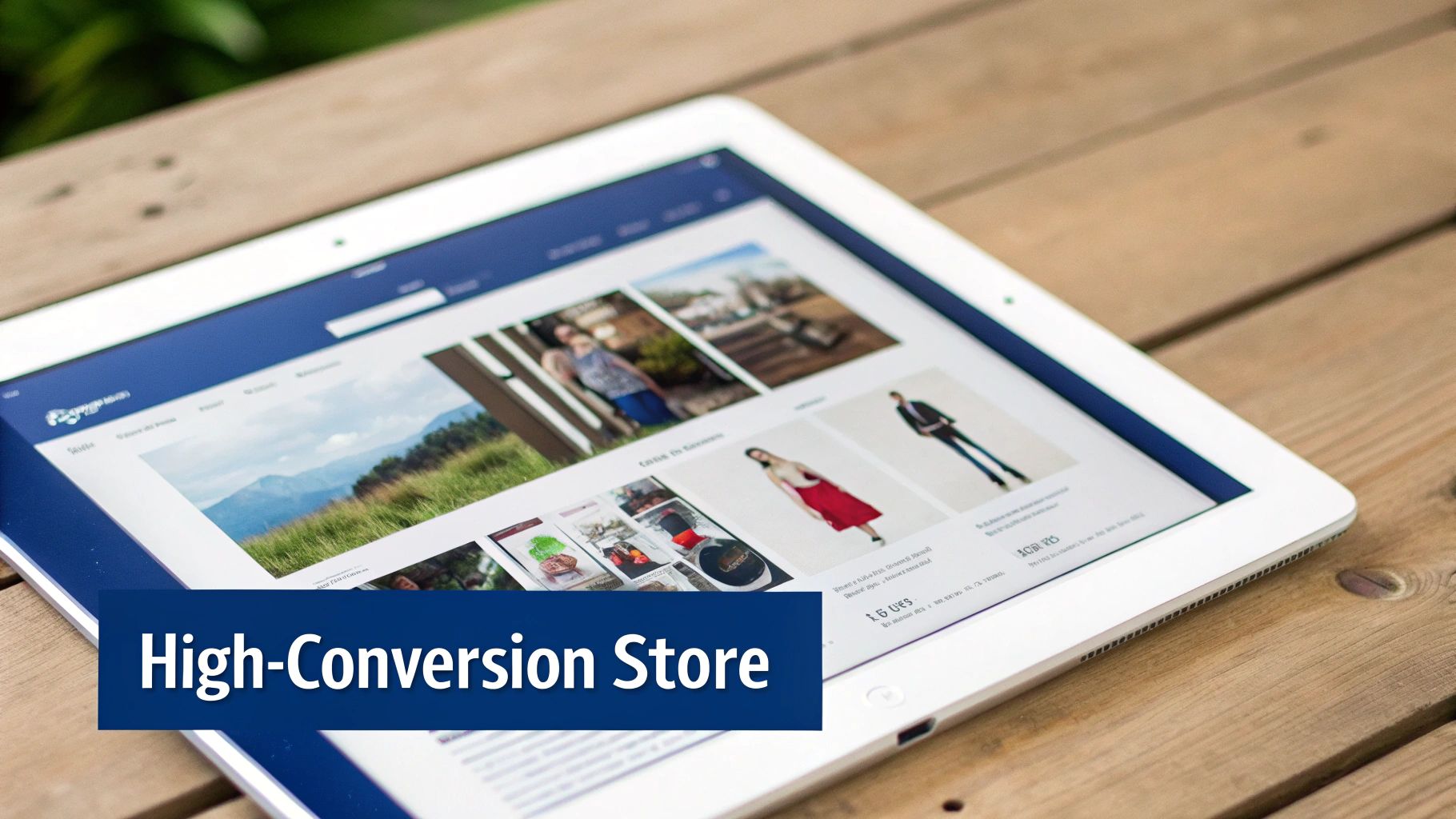
Imagine a dedicated, multi-page corner of Amazon where you control the entire experience. No competitor ads, no distractions. That’s your Brand Store. It's your digital flagship, giving you a chance to guide shoppers through your brand’s world, not just a single product.
A high-performing Brand Store is far more than a simple product catalog. It’s a curated journey. Use it to:
- Tell Your Brand Story: Create a page that shares your mission and what makes you different. This builds a real connection that price alone can't beat.
- Showcase Your Full Catalog: Organize products into clear categories. Make it easy for people to find what they're looking for and discover other items they might love.
- Build Curated Collections: Group products by seasonal themes, use cases, or best-sellers to guide shoppers and simplify their decision-making process.
- Drive Traffic Strategically: Your Store is the ideal landing page for Sponsored Brands ads or external traffic from social media, providing a clean, focused environment to measure marketing ROI.
A well-designed Store encourages repeat visits and increases the lifetime value of your customers.
A+ Content: Turning Shoppers into Buyers
If the Brand Store is your flagship, then A+ Content is your best salesperson, working 24/7 on every product page. This tool lets you replace the plain-text product description with a rich, visual experience filled with lifestyle images, comparison charts, and compelling copy.
Amazon's own data shows that listings with A+ Content see a conversion rate lift of 3% to 10%. Why? Because you’re anticipating and answering your customers' questions at the exact moment of decision, building critical trust.
Key Insight: A+ Content is all about reducing purchase friction. When you clearly show how your product works, highlight its best features with real-world images, and compare different models, you remove doubt. The "Add to Cart" click becomes a logical next step.
The most effective A+ Content modules include:
- Comparison Charts: Help customers self-select the right product for their needs. This reduces choice paralysis and drastically cuts down on returns from incorrect purchases.
- Lifestyle Imagery: Show your product in use. Help shoppers visualize it in their own lives. Static shots on a white background are necessary but no longer sufficient.
- Brand Story Modules: Briefly connect the product to your brand’s mission. This builds confidence, especially for first-time buyers, and reinforces your value proposition.
And to help create compelling copy for these modules, you can explore some of the best AI content creation tools designed to streamline the process.
Headline's Takeaway: Don't treat your Brand Store and A+ Content as "set it and forget it" tasks. They are living assets that drive performance. Optimize them like you optimize your ad campaigns. A/B test your A+ Content, analyze Store traffic sources, and constantly refine your creative based on performance data. That’s how you turn branding into a reliable sales engine.
Getting Your Listings Ready for Prime Time
A strong brand is essential, but if your product page doesn't convert, that brand power goes to waste. Before you spend a dime on a new ad campaign, you must ensure your listings are optimized for both shoppers and Amazon's algorithm. We call this retail readiness, and it’s the non-negotiable first step for profitable advertising.
Driving paid traffic to an unoptimized listing is like pouring water into a leaky bucket. You'll generate clicks, but sales will dribble away. A retail-ready listing, however, acts as a high-conversion landing page, making every ad dollar work harder to drive sales and improve your organic rank.
This isn't a one-and-done task. It's a continuous optimization process that separates brands that grow profitably from those that burn through ad budgets.
Optimizing Your Digital Shelf Space
Think of your product title, bullet points, and images as your digital shelf. A shopper gives you seconds to grab their attention. Every element of your listing must be crafted for clarity, relevance, and conversion.
Your title is the most important element for on-page SEO. It must contain high-volume, relevant keywords while remaining readable and compelling to a human. Avoid "keyword stuffing"—a jumbled mess that repels shoppers and harms your click-through rate.
- Titles: Start with your brand and main product name. Add critical keywords describing its use, size, or core benefit. The goal is instant comprehension.
- Bullet Points: Focus on benefits, not just features. Each bullet should solve a customer problem or answer a key question, weaving in secondary keywords naturally.
- Backend Search Terms: This is your space for keywords that don't fit naturally in the title or bullets—synonyms, common misspellings, and long-tail phrases. This expands your search visibility without cluttering the customer-facing content.
The Power of Mobile-First Visuals
Let's be blunt: your images and videos do most of the selling. With over 70% of eCommerce sales happening on mobile devices, your visuals must be optimized for small screens.
High-quality visuals are non-negotiable. Knowing how to photograph clothes for crisp, pro-level shots, for example, is the kind of skill that makes a product pop off the page. High-resolution photos, lifestyle shots showing your product in context, and infographics explaining key features build trust and dramatically improve conversion rates.
Key Insight: A customer can't touch or feel your product online. Your images and video are the closest they can get. Investing in professional, mobile-friendly creative isn't just a cost—it's a direct investment in your conversion rate.
Behind-the-Scenes Operations Fuel Performance
Retail readiness extends beyond the product page to your warehouse operations. Two factors are critical: inventory and customer reviews.
Your Inventory Performance Index (IPI) score is a key operational metric. A low score can lead to storage limits and FBA restrictions, effectively capping your sales potential. Maintain healthy stock levels, especially before launching a major ad campaign. Nothing kills momentum faster than driving traffic to an out-of-stock product.
Simultaneously, you need a robust strategy for generating reviews. A product with few reviews (or poor ones) will struggle to convert, no matter how much traffic you send. Proactively use Amazon’s "Request a Review" button and consider the Vine program to build essential social proof quickly and ethically.
Headline's Takeaway: Total retail readiness is the foundation for profitable advertising. By obsessing over listing content, investing in high-impact visuals, and mastering your operations, you create a powerful conversion engine. This upfront work maximizes the return on every ad dollar, drives organic growth, and sets the stage for long-term success.
Integrating Brand Strategy With Performance Advertising
This is where your carefully crafted brand identity directly drives sales and market share. Too many leaders treat brand building and performance advertising as separate functions. On Amazon, that's a costly mistake. They are two sides of the same coin, creating a powerful feedback loop.
A strong brand makes your ads more efficient. Smart advertising builds your brand's presence and authority. This is the playbook for turning your ad spend from a cost of doing business into a strategic investment that fuels organic growth and builds lasting brand equity.
Forget siloed thinking. Your advertising campaigns must be a direct extension of your brand story, designed to engage customers at every stage of their journey.
A Full-Funnel Approach To Brand And Performance
A successful Amazon ad strategy isn't just about chasing last-click conversions with Sponsored Products. It's about building a complete, full-funnel plan where every ad format plays a specific, strategic role.
Think of it like building a relationship. You don’t ask for a sale upon first meeting. You introduce yourself, build familiarity, and then offer a solution when they're ready to buy.
Here’s how to map Amazon’s ad tools to this journey:
- Top of Funnel (Awareness): Use Amazon DSP and Sponsored Brands Video to introduce your brand to new, relevant audiences who aren't yet searching for your products. The focus is on building brand recall and seeding future demand, not immediate sales.
- Mid-Funnel (Consideration): Retarget shoppers who have visited your product pages or Brand Store using Sponsored Display. This keeps your brand top-of-mind as they compare options, nudging them toward a decision.
- Bottom of Funnel (Purchase): This is where Sponsored Products shines. Capture high-intent shoppers actively searching for solutions you provide. Your previous brand-building work makes this final conversion cheaper and more likely.
When these efforts work in concert, you create a seamless path from discovery to purchase that makes every ad dollar work harder.
The table below breaks down how each funnel stage aligns with specific ad solutions and brand goals, giving you a clear map for your strategy.
Advertising Funnel And Brand Goals Alignment
| Funnel Stage | Primary Ad Solution (PPC/DSP) | Brand-Building Goal | Key Metric |
|---|---|---|---|
| Top-Funnel: Awareness | Amazon DSP, Sponsored Brands Video | Introduce the brand to new audiences and build brand recall. | Impressions, Brand Searches, New-to-Brand Metrics |
| Mid-Funnel: Consideration | Sponsored Display (Retargeting), Sponsored Brands | Re-engage interested shoppers and showcase the brand's value proposition. | Detail Page Views (DPVs), Click-Through Rate (CTR) |
| Bottom-Funnel: Purchase | Sponsored Products, Sponsored Display (Product Targeting) | Capture high-intent demand and drive immediate sales. | Conversions, Return on Ad Spend (ROAS), ACOS |
By mapping your campaigns this way, you ensure your ad spend isn't just generating clicks; it's methodically building your brand's presence and value over time.
Turning Data Into A Competitive Advantage
Your brand strategy shouldn't be based on guesswork, and neither should your ad campaigns. Amazon Brand Analytics is a goldmine of data that connects brand performance directly to your advertising tactics. Use it to understand what customers are actually searching for, see which competitors they're buying instead of you, and spot new keyword opportunities.
Our Takeaway: Stop treating PPC as just a sales channel. PPC is your most powerful market research tool. The search terms driving your ad conversions are a direct line into your customers' minds—use that intelligence to refine your A+ Content, update your product titles, and even inform new product development.
By digging into this data, you can build a much smarter bidding strategy. For instance, if Brand Analytics shows you're losing sales to a specific competitor on certain keywords, you can launch targeted Sponsored Products campaigns to defend your turf and win back that market share.
This diagram shows how a solid listing is the true foundation for any effective advertising. Without it, you're building on sand.

This hierarchy makes it clear: successful advertising isn't just about bids and budgets. It's built on a solid foundation of retail readiness, from having products in stock to creating compelling brand content.
Aligning Creative With Performance Goals
Finally, your ad creative needs to be perfectly aligned with both your brand voice and your campaign goals. A Sponsored Brands ad designed for awareness should feature lifestyle imagery and a headline that tells your brand story. A Sponsored Products ad, on the other hand, is all about the conversion—it needs a clear, compelling main image that stops the scroll.
Always be testing. A/B test your ad creative, your headlines, and even the landing pages you're sending traffic to. Sometimes the smallest tweaks can lead to huge improvements in click-through rate (CTR) and return on ad spend (ROAS). By continuously optimizing, you ensure your ad spend isn't just driving clicks; it's building a stronger, more profitable brand on Amazon.
Using Advanced Analytics For Sustainable Growth
Standard Amazon metrics like ACOS and ROAS are just the tip of the iceberg. They're table stakes. To build real, long-term brand equity and find sustainable growth, you have to dig deeper. The best brands on the platform separate themselves by moving past surface-level data to embrace the analytics that reveal the why behind what customers do.
This is the point where you stop just managing campaigns and start truly understanding your customer's journey. By tapping into powerful datasets like Amazon Marketing Cloud (AMC) and Search Query Performance (SQP), you can finally answer the tricky questions that should be driving your strategy. Which ad exposure actually led to the purchase? How do people discover your brand for the very first time? This is the data that unlocks real, durable profitability.
Moving Beyond Standard Attribution
The default attribution models in the Amazon Ads console are helpful for a quick snapshot, but they're limited. They often fail to capture the full, winding path a customer takes from initial curiosity to the final click to buy. This leaves you with a fuzzy picture of which ads are truly creating value.
This is where a more sophisticated view becomes absolutely critical. Tools like Amazon Marketing Cloud let you see how different ad formats—say, a Sponsored Brands video followed by a Sponsored Products ad a week later—work together to influence a single sale. This multi-touch perspective is essential for accurately valuing all those top-of-funnel, brand-building efforts you're investing in.
Headline's Takeaway: A performance-first mindset means measuring the entire customer journey, not just the last click. When you understand how different ads contribute at each stage, you can invest more intelligently across the funnel, building a brand that gets stronger and more efficient over time.
Unlocking Deeper Insights With Advanced Tools
Two of the most powerful tools for gaining a real competitive edge are Amazon Marketing Cloud (AMC) and Search Query Performance (SQP) reports. These aren't just extra reports; they are fundamentally different ways of looking at your business.
- Amazon Marketing Cloud (AMC): Think of AMC as your own secure data clean room. It lets you analyze ad signals alongside your own datasets to get a granular view of audience behavior and the true impact of your ads. You can track complex paths to conversion, measure how different audiences respond to campaigns, and build a much more detailed model of what’s actually working. For a more detailed breakdown, learn more about mastering Amazon advertising attribution through these advanced methods.
- Search Query Performance (SQP): This report is a goldmine for understanding your brand's organic health. It gives you brand-level and ASIN-level data on search query volume, impressions, clicks, and sales—for both your paid and organic performance. It's the ultimate tool for seeing how your PPC spend is influencing your organic rank and for uncovering new keyword opportunities you might have missed.
By combining insights from both, you can create a powerful feedback loop. Your paid advertising strategically lifts your organic visibility, which in turn reduces your long-term dependency on ad spend. It's a win-win.
Establishing A Framework For Brand Governance
Finally, all this fantastic data is only useful if it's applied consistently across your entire brand. A strong brand governance model is the framework that ensures every part of your Amazon presence—from ad creative and A+ Content to your customer service replies—is perfectly aligned.
This isn't about creating rigid, suffocating rules. It's about delivering a consistent, high-quality customer experience at every single touchpoint. A clear governance plan prevents off-brand messaging, ensures creative assets are always fresh, and maintains a unified voice that builds the kind of trust that keeps customers coming back.
This disciplined approach is what ties everything together. It ensures the insights you get from advanced analytics are translated into smart actions that reinforce your brand’s position, driving both immediate performance and long-term, sustainable growth.
Frequently Asked Questions
When you're deep in the trenches of building a brand on Amazon, a lot of specific questions pop up. Let's tackle some of the most common ones we hear from brand leaders to help clear things up and guide you toward the right decisions.
How Long Does Amazon Brand Registry Take?
Patience is a virtue here—the standard Brand Registry process can take a few weeks. It all hinges on how quickly Amazon can verify your active, registered trademark.
But what if you can't wait? For brands on the fast track, the Amazon IP Accelerator program is a lifesaver. This program can get you access to crucial Brand Registry perks like A+ Content and Brand Stores in as little as two weeks, all while your official trademark application is still being processed.
What’s The Difference Between A+ And A++ Content?
Think of it like upgrading from business class to first class. Both are a huge step up from the basic product description.
A+ Content is the new standard for any brand in the Brand Registry program. It lets you swap out that plain block of text for a much richer layout with custom images, formatted copy, and handy comparison charts.
Premium A+ Content (A++) is the next level up. It’s an invite-only feature, usually offered to bigger brands with high sales volume. It gives you access to more dynamic, interactive modules that really make your page pop:
- Full-width video loops that auto-play
- Clickable Q&A sections
- Interactive carousels for showcasing product features
- Larger, more immersive images
The impact on your bottom line is real, too. While standard A+ Content can lift sales by up to 10%, we’ve seen Premium A+ push conversion rates up by 15% or even more.
Can I Run Sponsored Brands Ads Without A Brand Store?
Technically, yes. You can run a Sponsored Brands ad campaign without having a full Brand Store built out. Amazon lets you point that ad traffic to a simple landing page that shows at least three of your products.
Expert Recommendation: Just because you can doesn't mean you should. We almost always advise directing Sponsored Brands traffic to a well-designed Brand Store. It creates a focused, branded shopping experience without any competitor ads. You can tell your story, show off your entire catalog, and ultimately drive a higher average order value and a much better return on your ad spend.
At Headline Marketing Agency, we turn these complex questions into a clear, profitable growth plan. Our team takes a performance-first approach, weaving your brand strategy into a powerful advertising flywheel that makes every dollar count. Partner with us to build your dominant Amazon brand.
Get Your Free Amazon PPC Audit
Discover untapped growth opportunities and see how our data-driven approach can improve your ROAS.
Get Free Audit →Ready to Transform Your Amazon PPC Performance?
Get a comprehensive audit of your Amazon PPC campaigns and discover untapped growth opportunities.