Paid Search for Ecommerce: A Profit-First Playbook
Master paid search for ecommerce with channel strategy, bidding frameworks, and incrementality-based measurement that drives profitable, sustainable growth.

Most ecommerce teams still treat paid search as a checkout button. They celebrate ROAS, lower ACOS, and attributed orders, even when many of those customers would have purchased without the ad. That dashboard can look efficient while the business adds little incremental demand.
The better view is more demanding. Paid search for ecommerce is a portfolio of demand capture, demand creation, and organic-rank influence. It rents visibility in the moments shoppers show intent, while potentially strengthening the product signals that support future organic discovery. Leadership should judge it through contribution profit, incremental sales, branded demand, and marketplace equity, not attributed revenue alone.
Why Paid Search for Ecommerce Is Broken for Most Brands
The problem isn't that ROAS is useless. The problem is that teams often treat it as a complete answer.
Search advertising has become one of the largest commercial infrastructures connecting consumers with products. In 2024, worldwide advertisers spent nearly $1.1 trillion across all advertising channels, up approximately $75 billion, or 7.3%, from 2023. Digital advertising represented 72.7% of global ad investment, exceeding $790 billion, while search platforms captured roughly 40% of digital spend and generated more than $316 billion in search-ad revenue. Those figures come from DataReportal's global advertising trends analysis.
This scale changes the management question. Paid search isn't a small acquisition experiment that can be judged by clicks and attributed orders alone. It is an auction for access to product, category, brand, competitor, and problem-oriented demand.
The dashboard can reward the wrong behavior
A branded campaign often reports excellent efficiency because it reaches people who already know the brand. A competitor campaign may produce fewer orders but introduce genuinely new shoppers. A broad category campaign may create consideration that appears later through organic search, direct traffic, or repeat purchase.
Those campaigns perform different jobs. One blended ROAS target makes the first look better than it may be and pressures the second to stop before it has created market demand.
Leadership rule: Ask which purchases would disappear if the ad stopped running. If the answer is unclear, the campaign isn't fully measured.
WARC expected Google to generate $197.7 billion in search advertising revenue in 2024, representing 90.1% of search-ad revenue outside China. The report also estimated that one in five advertising dollars spent outside China went to Google search. The same source estimated global digital retail-media spending at $136 billion in 2024. These figures are detailed in WARC's global ad-spend outlook coverage.
Amazon brands should respond by replacing a single efficiency dashboard with a portfolio view. Track immediate sales, incremental sales, new-to-brand customers, organic visibility, branded search, detail-page engagement, and margin-adjusted profit. If your reporting cannot separate demand you captured from demand you created, it is describing media activity, not business growth.
How Paid Search Actually Works for Online Sellers
Think of paid search as renting a shelf at the exact moment a shopper reaches for a product. You pay for the opportunity to occupy that shelf, usually through a cost-per-click auction. Organic visibility is different. It is closer to building a permanent position through relevance, conversion, sales history, and a strong retail offer.
Amazon Sponsored Products illustrate the model clearly. They are cost-per-click ads that place individual product listings in search results and on product-detail pages. The ad connects media cost to shopper intent, but the quality of the product information and retail experience determines whether that click has economic value. Amazon reports that advertised ASINs experienced an average 50% increase in weekly units ordered and a 30% increase in glance views within one year of launching Sponsored Products. Those are directional averages, not guarantees, and Amazon recommends treating campaign outcomes in context. The figures appear in Amazon's Sponsored Products overview.
Separate the job before setting the bid
Start with the query, not the campaign name.
- Branded queries capture existing demand. They may defend visibility from competitors, but they can also intercept shoppers who would have found the organic listing.
- Non-branded category queries reach shoppers who know what they need but haven't committed to your brand. This is usually the clearest demand-creation territory.
- Competitor queries influence consideration when a shopper has already chosen another brand.
- Product and problem-oriented queries connect specific needs with a relevant offer.
The platform weighs more than the bid. Relevance, product information, expected shopper response, and the quality of the destination listing affect whether the placement is useful and what it costs. A higher bid can't rescue a product with weak images, unclear attributes, poor availability, or an uncompetitive offer.
Auction competition also matters. More advertisers can push costs upward even while impressions and clicks rise. That means traffic growth isn't proof of better economics. Evaluate the query's role, conversion behavior, margin, and incremental contribution together.
The operating model is simple: use paid search to capture demand that already exists, create demand where the brand lacks organic reach, and invest selectively where paid exposure can improve future marketplace strength. Don't ask whether a keyword has a good ROAS in isolation. Ask what role it plays in the portfolio.
Comparing the Main Paid Search Channels
Each channel rents a different kind of shelf. Amazon placements reach shoppers inside a commerce environment. Google Shopping reaches demand across the wider web. Bing can offer additional reach where auction pressure and audience behavior differ. The right choice depends on where the shopper is in the decision and where your product has a credible chance of converting.
| Channel | Funnel Role | Primary Metric | Best For |
|---|---|---|---|
| Amazon Sponsored Products | Direct conversion capture | Incremental contribution profit and conversion rate | New ASIN launches, high-intent product queries, and profitable catalog expansion |
| Amazon Sponsored Brands, including video | Brand and category consideration | New-to-brand sales, branded demand, and assisted purchases | Brands building category presence or defending branded visibility |
| Amazon Sponsored Display | Consideration and retargeting | Incremental sales and audience quality | Re-engaging detail-page visitors and supporting broader product consideration |
| Google Shopping | Off-Amazon demand capture | Incremental profit by product and channel | D2C brands and sellers that need demand beyond Amazon |
| Bing Ads | Additional search reach | Incremental profit and conversion quality | Brands with available budget after core coverage and useful audience overlap |
Platform concentration makes channel economics uneven. Google dominated search advertising outside China in the WARC estimate cited earlier, while retail media places ads inside environments where shoppers are already browsing products. Amazon therefore isn't just another search engine. It combines query intent with product detail pages, retail readiness, reviews, fulfillment, and marketplace competition.
Sequence the portfolio by catalog maturity
For a new ASIN, activate Sponsored Products around the most relevant product and category terms first. Make sure the listing converts before expanding aggressively into broad discovery. Add Sponsored Brands when the brand has enough creative and product depth to make the placement useful.
An established catalog needs a different sequence. Defend branded demand, protect priority categories, and identify where competitors are taking visibility. Use Google Shopping when the brand can profitably convert off-Amazon demand and has a credible landing experience. Test Bing after the core programs have clear measurement and sufficient budget.
The recommendation is firm: don't spread a small launch budget across every channel for the appearance of sophistication. Build reliable conversion and query data in the channel closest to purchase, then add channels that solve a specific growth constraint.
Building the Foundation With Retail Readiness and Feed Quality
Scaling bids into a weak listing is an expensive way to discover that shoppers can read.
Sponsored Products send traffic directly to the product-detail page. The page's images, title, descriptions, attributes, price, reviews, inventory, and delivery promise determine whether the click becomes a sale. A campaign can have excellent targeting and still destroy margin if the listing fails after the auction is won.
Fix the page before buying more traffic
Use an ordered pre-spend check:
- Refresh the product presentation. Improve descriptions, images, comparison content, and benefit communication. LIPPS combined refreshed product descriptions and images with Sponsored Products, then reported twofold-to-threefold sales growth between 2019 and 2022. Amazon identifies the data as advertiser-provided, so the case isn't a controlled causal experiment. It does show the operating mechanic clearly in Amazon's LIPPS case study: paid traffic works alongside stronger detail-page content, not independently of it.
- Correct the feed. Product titles, identifiers, price, availability, variants, category placement, and attributes must match the actual offer. Yassine Malti's feed optimization guide is a useful practical resource for reviewing feed structure before scaling shopping activity.
- Check retail readiness. Confirm inventory, pricing, buyability, fulfillment, review health, and variation logic. A paid click is less valuable when the customer encounters a missing offer or an unclear choice.
- Map campaign segments. Separate branded, non-branded, competitor, and category campaigns. This keeps bidding, budgets, and incrementality analysis tied to a clear business role.
Amazon listing design also deserves its own operating process. Teams can use Headline's Amazon listing design resource when reviewing the relationship between visual hierarchy, product communication, and conversion behavior.
Practical rule: Never solve a conversion problem with a higher bid until you've checked the page, the offer, and the feed.
Use PPC as a feedback system
Paid search doesn't only send shoppers to the listing. It reveals the language shoppers use, which benefits attract clicks, which products win comparison moments, and where the page creates friction. Feed quality and listing quality should improve alongside query learning.
Once the page is ready, scale qualified traffic in controlled segments. If a category term produces clicks but weak conversion, test the relevance of the product, the message, and the destination before lowering the target. If a branded term converts efficiently, test whether it protects demand or merely captures organic shoppers. The correct order is page, feed, segmentation, controlled spend, then expansion.
Bidding and Budget Frameworks That Protect Profit
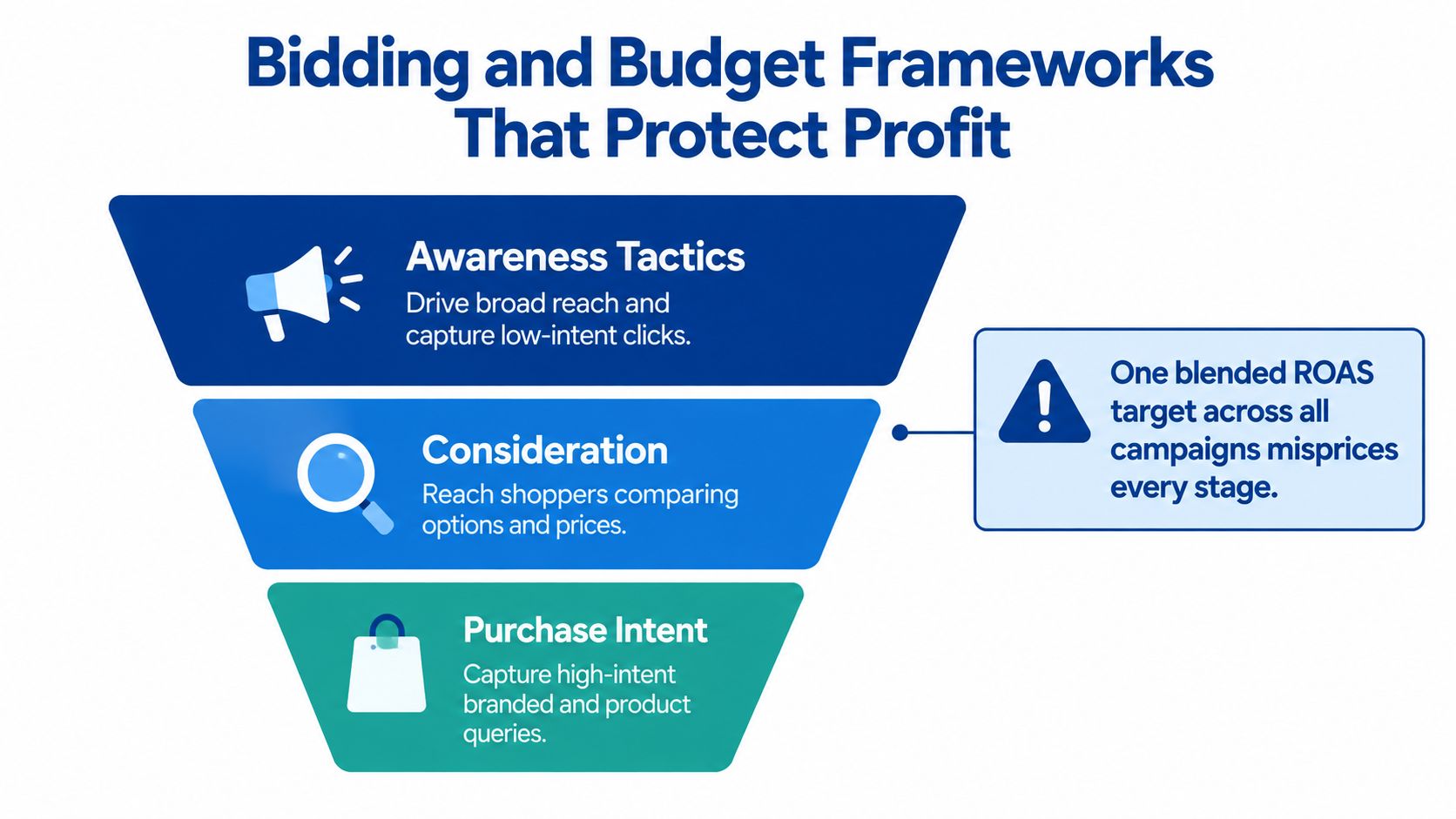
The most common budgeting error is applying one blended ROAS or ACOS target to every campaign. Awareness activity introduces qualified shoppers. Conversion activity harvests existing intent. Those jobs have different timelines, costs, and proof requirements.
Give each stage its own scorecard
Awareness tactics should be assessed through reach, qualified audience development, product visibility, and downstream engagement. A campaign may deserve funding even when immediate attributed efficiency is lower if it creates measurable consideration.
Consideration tactics should be judged through detail-page views, engaged audiences, comparison behavior, new-to-brand signals, and assisted conversion paths. The question is whether the brand is entering more relevant decisions.
Purchase-intent tactics need harder controls: conversion rate, incremental sales, contribution margin, and margin-adjusted return. These campaigns should carry the strongest efficiency expectations because the shopper is closer to purchase.
Amazon's Flywheel case demonstrates why this separation matters. Amazon reported that ROAS increased 2% for awareness tactics and 53% for conversion tactics, while Amazon Ads accounted for 30% of the brand's year-over-year total growth. The case is summarized in Amazon's Flywheel example. The lesson isn't to spend blindly at the top of the funnel. It is to avoid forcing awareness activity to meet a purchase-intent target before you measure its downstream contribution.
Set budgets around business roles
Use query-level bidding to distinguish branded defense from non-brand expansion. Cap budgets by segment so a highly efficient branded campaign doesn't absorb all available funds while category discovery starves. Reallocate toward campaigns that produce incremental orders, new-to-brand customers, organic visibility, or contribution profit.
For practical Amazon bid mechanics, Headline's guide to bidding for Amazon offers a useful reference point. The operating principle remains straightforward:
- Defend selectively: Bid on branded terms when competitors can take meaningful visibility or when the ad protects conversion share.
- Expand deliberately: Fund non-branded and category terms when they acquire shoppers the brand isn't already reaching.
- Control by margin: Set different limits for products with different contribution economics.
- Review by stage: Don't cut an awareness campaign solely because it can't match a bottom-funnel target.
Budget should follow incremental growth, not the prettiest attributed ROAS.
Using PPC as a Lever for Organic Growth
Headline's central position is simple: PPC should help build marketplace equity, not just harvest existing demand.
HP provides a useful example. After increasing Sponsored Brands video investment by 206% year over year in 2023, HP saw organic branded-keyword coverage rise across major categories. Printer keywords increased 17%, supplies keywords increased 10%, and laptop keywords increased 30%. Amazon also reported an 80% year-over-year increase in revenue and a 60% increase in units sold in the program. The results and purchase-path comparisons appear in Amazon's HP Sponsored Brands video case study.
The case matters because the reported outcome extends beyond ad-attributed orders. Amazon reported that purchase paths including Sponsored Brands video produced a 954% higher purchase rate and 30% higher ROAS for printers, plus a 709% higher purchase rate and 44% higher ROAS for laptops. Those figures don't prove that every organic improvement came from advertising, but they show why brand visibility, purchase paths, and organic coverage belong in the same analysis.
Fund the demand you want to own
Kenmore's case adds a customer-acquisition perspective. After sales declined 51% in a difficult fourth quarter, Kenmore increased sales 25% in the following quarter and achieved a 720% year-over-year increase in total sales in April 2024. Sponsored Products and Sponsored Brands supported appliance-shopping queries alongside Amazon Posts. Amazon reported that 75% of sales came from new-to-brand shoppers, digital-shelf ownership increased 38% in the first quarter of 2024 compared with the previous quarter, and branded search volume rose 45% versus the prior month. The figures are detailed in Amazon's Kenmore growth case study.
The mechanism is practical. Qualified exposure brings more shoppers to the detail page. Sales velocity can strengthen future discovery. Stronger organic visibility then reduces dependence on paid placement for some searches, while branded demand gives the business more direct market pull.
Track the following alongside ACOS:
- Branded search growth
- Organic keyword coverage
- New-to-brand customers
- Detail-page views and assisted purchases
- Organic-rank movement
- Contribution profit after media
Use Headline's paid search and SEO perspective when aligning paid-query priorities with organic visibility. A campaign that creates durable demand can be worth funding even when its immediate ROAS looks less attractive than a branded defense campaign.
Measuring Incrementality Instead of Vanity ROAS
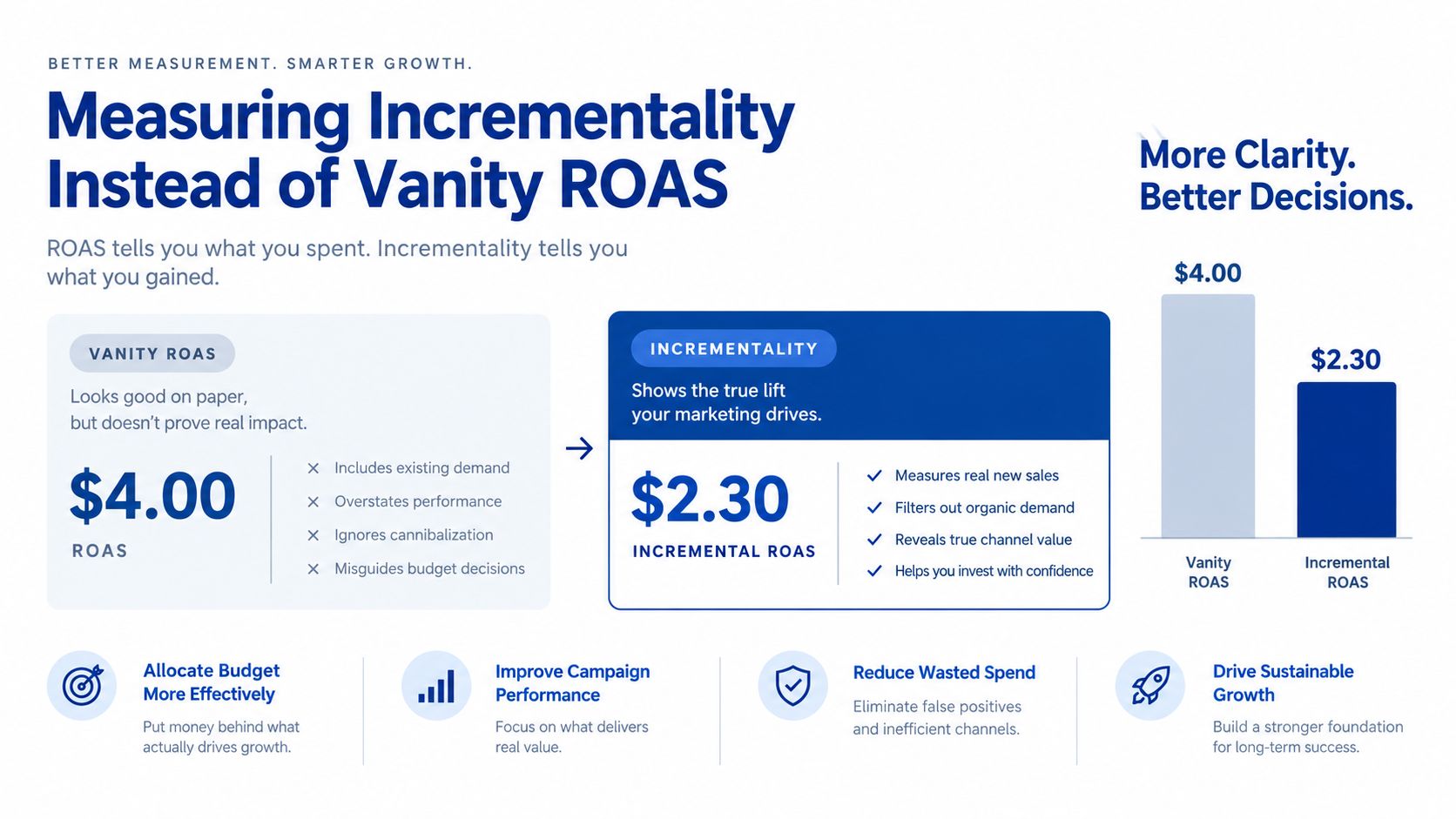
Attribution tells you which ad received credit. Incrementality asks whether the business would have received the sale without that ad. Those are not the same question.
Brand bidding exposes the gap. In a geo-based search experiment summarized by independent incrementality testing analysis, pausing brand-keyword ads caused paid clicks to fall, but approximately 99.5% of the lost click traffic was captured by natural search. In a non-brand experiment, paid clicks fell 41%, while total clicks fell only 2%, implying that roughly 42% of non-brand paid clicks represented newly acquired traffic.
The implication is uncomfortable. A platform can attribute a sale to an ad even when the ad intercepted a shopper who would have clicked the organic result. Teams that optimize only attributed ROAS may overfund branded defense and underfund non-brand acquisition.
Build a testable measurement protocol
Segment the account before testing. At minimum, separate branded, non-branded, competitor, and category campaigns. Then use the strongest feasible design:
- Create treatment and control areas. Use geo holdouts where market conditions support them, or controlled campaign pauses where the risk is acceptable.
- Compare total business outcomes. Measure total orders, total revenue, new-to-brand customers, organic orders, and contribution profit, not just ad-attributed conversions.
- Control for operating changes. Record price, promotions, inventory, reviews, seasonality, and retail-readiness changes during the test.
- Make the budget decision explicit. Increase funding where the test shows incremental growth. Reduce or redesign activity that mostly captures organic demand.
A clear explanation of how attribution modeling works helps teams understand why credit allocation and causal measurement answer different questions.
Apply the results across Sponsored Products, Sponsored Brands, DSP, and Google. Brand defense may still be rational when it protects conversion share or blocks competitors, but it shouldn't receive automatic credit for total growth. Allocate media according to the sales that disappear when the media disappears.
What AI Search Means for Your Paid Search Strategy
AI search changes discovery, but it doesn't eliminate the fundamentals of ecommerce advertising. It makes product information, brand authority, visual relevance, and measurement discipline more important because shoppers may reach an answer without clicking a conventional ad.
Digiday cited BrightEdge data showing a 44% month-over-month increase in ChatGPT referral traffic, while ChatGPT still represented less than 1% of overall search-market share. The same coverage referenced a 2024 Search Engine Land study, reported by CallRail, that found AI Overviews appearing in 47% of searches, with nearly 60% of searches being zero-click. These figures are reported in Digiday's analysis of AI search trends.
Prepare for discovery without abandoning intent
When a shopper doesn't click a conventional ad, brands need more than a bid. They need complete structured product information, accurate attributes, strong images, useful video, clear brand identity, and a retail-ready offer. On Amazon, that means monitoring impressions, detail-page views, add-to-cart events, organic-rank movement, branded search, and assisted conversions alongside orders.
AI-era discovery also increases the value of semantic language. Product titles, descriptions, creative, and feed attributes should explain what the product is, who it serves, what problem it solves, and how it differs. Tools such as a landing page tool for agencies can support structured content workflows, but content production shouldn't replace product-data governance or marketplace testing.
The right response isn't to abandon keyword campaigns. AI referral growth is rapid, yet the reported market share remains limited. Preserve profitable demand capture while testing creative and content that can perform across multimodal search, AI assistants, image results, video environments, and zero-click journeys.
Make the transition measurable
Use Amazon Marketing Cloud insights and Search Query Performance to study exposure paths, query behavior, new-to-brand customers, and downstream outcomes. Pair those signals with controlled tests wherever possible. If AI discovery creates an impression or product consideration without a click, your measurement system must still identify whether that exposure changes demand.
Headline Marketing Agency manages Amazon PPC and DSP across Sponsored Products, Sponsored Brands, Display, and Video, with a focus on profitability, organic ranking, retail readiness, and long-term brand equity. The recommendation is to manage paid search as an integrated portfolio, protecting measurable demand capture while funding the exposures that build future marketplace strength.
Headline Marketing Agency can audit your Amazon PPC structure, separate incremental growth from branded cannibalization, and connect bid decisions to retail readiness and organic visibility. Visit Headline Marketing Agency to build a profit-first paid search program designed for sustainable marketplace growth.
Get Your Free Amazon PPC Audit
Discover untapped growth opportunities and see how our data-driven approach can improve your ROAS.
Get Free Audit →Wollen Sie Ihre Amazon PPC-Performance aufs nächste Level bringen?
Lassen Sie Ihre Amazon PPC-Kampagnen professionell analysieren und entdecken Sie neue Wachstumsmöglichkeiten.