Organic Keyword Ranking Explained for Amazon Brands
Organic keyword ranking on Amazon depends on relevance, conversion and paid demand. Learn how to measure it and grow it with profit in mind.

Why does a product sitting at number four sell steadily while a near-identical listing with better photos sits on page four and barely moves? Most brand leaders read that gap as a marketing problem and buy more ads. It's usually a rank problem first, and a rank problem is only worth solving when the traffic it brings converts at a margin you'd defend in a board meeting.
Organic keyword ranking is the unpaid position your product holds in Amazon search results for a term a shopper types, like insulated water bottle or toddler lunch box. It decides who gets considered at all. NielsenIQ found that in 2024, roughly 80% of products placed in shoppers' baskets appeared within the top 10 Amazon search results for the relevant keywords (NielsenIQ). The shopper rarely scrolls to page four to discover you.
What Organic Keyword Ranking Means and What Moves It on Amazon
Think of Amazon search as a shopping street. Your listing must be on the right street before anyone can walk past the window, and then it has to earn the front-row spot among every shop standing there. Amazon runs these as two distinct stages, and conflating them is a common diagnostic error.
The first stage is query eligibility. Your listing text (title, bullet points, description and backend search terms) establishes whether your product can appear for a query at all. Miss the phrase a shopper uses and you're invisible, no matter how good the product is.
The second stage is performance ordering. Once a set of products is eligible, Amazon sorts them by query-specific shopper response. That's why the two listings in the opening scenario diverge: both may be eligible for the same term, but only one proves it deserves the visibility.
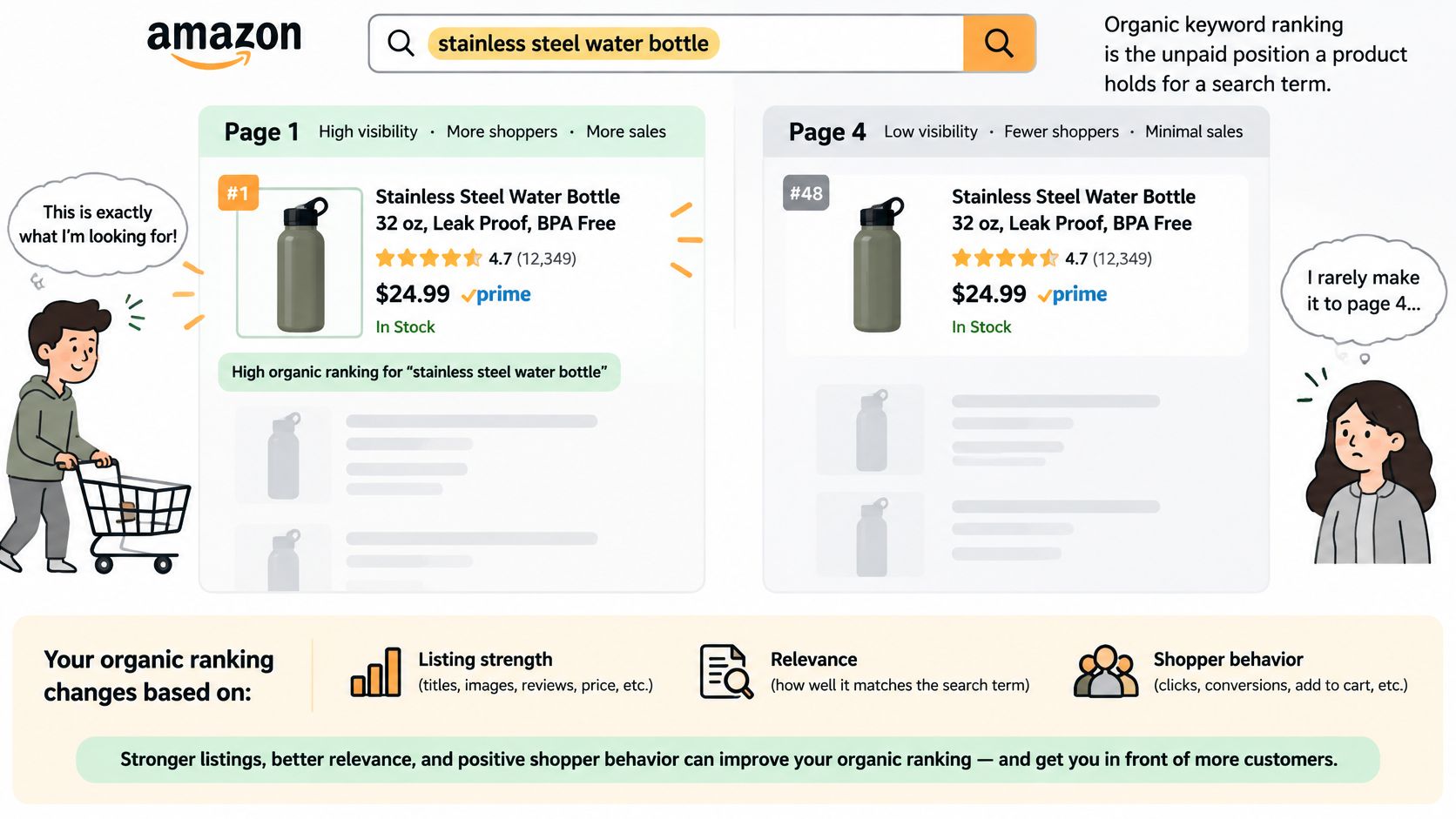
Stage one builds the shelf. Stage two sets the order on it. Patrick Stox's breakdown of marketplace SEO and Amazon ranking mechanics makes the same split explicit: listing text establishes relevance, then click-through rate, conversion rate, sales velocity, price competitiveness, availability and customer-experience signals do the ordering among eligible products.
Ranking signals by stage
| Signal | Stage | What It Controls | How to Check It |
|---|---|---|---|
| Title, bullets and description | Eligibility | Whether the product matches a query | Check that target queries appear in the copy |
| Backend search terms | Eligibility | Matches on variants and misspellings | Audit the field for missing relevant terms |
| Click-through rate | Ordering | Whether shoppers click from results | Compare CTR by search term |
| Conversion rate | Ordering | Whether the page satisfies the query | Session-to-order rate per search term |
| Sales velocity | Ordering | Recent sales momentum on the query | Ordered units per query each week |
| Price and availability | Ordering | Competitiveness and buyability | Review price history and stock levels |
| Ratings and reviews | Ordering | Shopper trust at click and checkout | Compare rating and review count with top results |
The causes run both ways. Improving keyword coverage without improving post-click conversion may widen your indexing without moving rank. Improving conversion on a precisely matched query is much stronger evidence that your product satisfies that query, and Amazon reads it that way.
The practical rule: rank is the outcome of relevance plus conversion. You can't switch it on. You can only improve the inputs and wait for the algorithm to notice.
Position drives clicks, but it doesn't guarantee them
There's a hard limit on how much a rank gain returns. A 2023 academic study of 67,000 keywords across more than 40 U.S. e-commerce domains, covering about 24 million search-result impressions and 6 million clicks, found position was consistently the most influential variable affecting organic click-through rate, followed by the keyword itself and the presence or type of search-page features (arXiv). The same study found that SERP features generally reduced CTR for traditional organic listings.
That's the honest version of the rank promise: better position materially increases visibility, but rank alone doesn't guarantee proportional traffic or sales. Titles, images, reviews, price and the surrounding layout all influence whether a shopper clicks. A move from page two to page one can be worth real money. Movement between the top three spots may return far less than the spreadsheet assumes.
Amazon publishes no complete ranking formula. Anyone quoting exact factor weights is guessing. Treat ranking factors as hypotheses to test against your own query data, not constants.
What to test, and where to start
I would start with the cheapest fix available: segmentation by search term. Pull your business reports and Search Query Performance data and look at each query separately rather than at listing-wide conversion rate. Track impressions, clicks, ordered units and session-to-order rate for each term.
Then sort into three buckets:
- Eligible and converting: protect these. Don't touch the copy for cosmetic reasons.
- Eligible and underperforming: relevance is established but conversion lags competitors. This is a copy and offer problem, and it's usually the fastest win.
- Not eligible: the query never appears in your impressions. This is a listing text or indexing problem.
For the algorithmic mechanics behind all this, our breakdown of the Amazon A9 algorithm walks through how ranking shifts get triggered.
Rank is a snapshot, not a setting. It moves with price, stock, competitor activity and shopper behaviour. What you control is the input quality.
Organic Ranking Beyond Amazon Search
Amazon is where the purchase happens for most categories, but it isn't where the research starts. Plenty of shoppers run a Google search first, and the economics of that click are deteriorating fast.
In 2024, the first organic Google result averaged a 37.15% click-through rate against 14.91% for second position, and about 58.5% of U.S. Google searches ended without a click to an external website at all (Higher Visibility). Position one is still a powerful asset. It's just a smaller asset than it was five years ago.
AI summaries compound the squeeze. A 2025 Pew Research analysis of 68,879 searches found traditional results were clicked in 8% of searches when an AI Overview appeared, against 15% when it didn't, while a separate 300,000-keyword analysis reported a 34.5% CTR drop for the top desktop result when an overview was present (Lumirank). The same analysis body found outcomes varied by query type rather than following one pattern.
Yet organic search still supplied an average 33% of total website traffic across seven industries in 2024, per Conductor's analysis of more than 800 global domains (Conductor). The channel isn't dying. The click is being redistributed.
Report rank beside click share and CTR, never instead of them. When search features absorb clicks, hold the demand with paid placements rather than assuming a ranking will deliver it.
Test by query type. Informational terms behave nothing like commercial ones, and a single blended average will hide the difference entirely.
Measure Keyword Rank With Search Query Performance and AMC
Here's the reporting trap. A single rank number blends marketplace, variation, device, personalization, fulfillment status, category competition and shifting search intent. Search Console's position metric is an average across geography, device, time and search appearance, so it can conceal materially different visibility patterns, and Amazon rank reporting carries the same limitation (Inet Ventures). One number tells you almost nothing worth acting on.
Segment instead. Break rank down by query intent, marketplace, device, product variation and date. Then reconcile it against first-party demand data, which is where Amazon Search Query Performance earns its keep.
Amazon reports for rank and profit
| Metric | Source | What It Shows | How to Read It |
|---|---|---|---|
| Search query volume | Search Query Performance | Demand size for a query | Rising volume with flat share means market growth |
| Impression share | Search Query Performance | Share of query impressions you hold | A low share on a high-volume query marks the rank gap |
| Click share | Search Query Performance | Share of clicks among brands on the query | Click share below impression share points to weak listing appeal |
| Purchase share | Search Query Performance | Share of purchases on the query | Purchase share below click share points to conversion problems |
| Branded search volume | Search Query Performance | Demand for your brand name | Growth here often follows strong sponsored campaigns |
| Influenced sales | Amazon Marketing Cloud (AMC) insights | Purchases tied to ad exposure across the funnel | Compare exposed and unexposed audiences to judge lift |
The gaps between those rows are the diagnosis. Impression share far above click share means shoppers see you and reject you: fix the main image, price or rating. Click share above purchase share means they click and leave: fix the detail page or the offer.
A rank-confidence checklist
Before you react to any movement, run this:
- Use a four-week minimum observation window. Shorter readings are noise, especially during promotions.
- Combine a keyword tool with first-party query data. Tool estimates drift; your own impression and click data doesn't.
- Flag confounders. Note promotions, stockouts, price changes and advertising shifts on the same timeline as the rank line.
- Check the direction of causality. Rank rising after a stockout recovery isn't a strategy win, it's a return to baseline.
If you're pulling position data programmatically across markets and variations, a rank tracking API removes the manual re-checking that makes most rank reports stale before they're reviewed.
The test that actually matters isn't whether the position improved. It's whether incremental organic sales and profit on that query improved with it.
Build one monthly sheet for your three priority queries: impression share, click share, purchase share, contribution margin and rank, side by side. That single view settles more arguments than any dashboard.
How PPC Lifts Organic Rank and Profit
Paid and organic visibility are related, but they aren't the same lever, and confusing them wastes money in both directions. A 2024 analysis of roughly 2 million organic results and 638,000 sponsored results across Amazon marketplaces in the U.S., India, Germany and France found products ranked beyond the 100th organic position could still appear as sponsored placements above top organic results (arXiv). Advertising buys visibility even when organic discoverability is weak.
What it doesn't do is automatically transfer into organic rank. Ad impressions alone don't move you up the unpaid list. PPC earns rank only when it changes the query-level signals Amazon measures: clicks, conversion rate and sales velocity on a specific term.
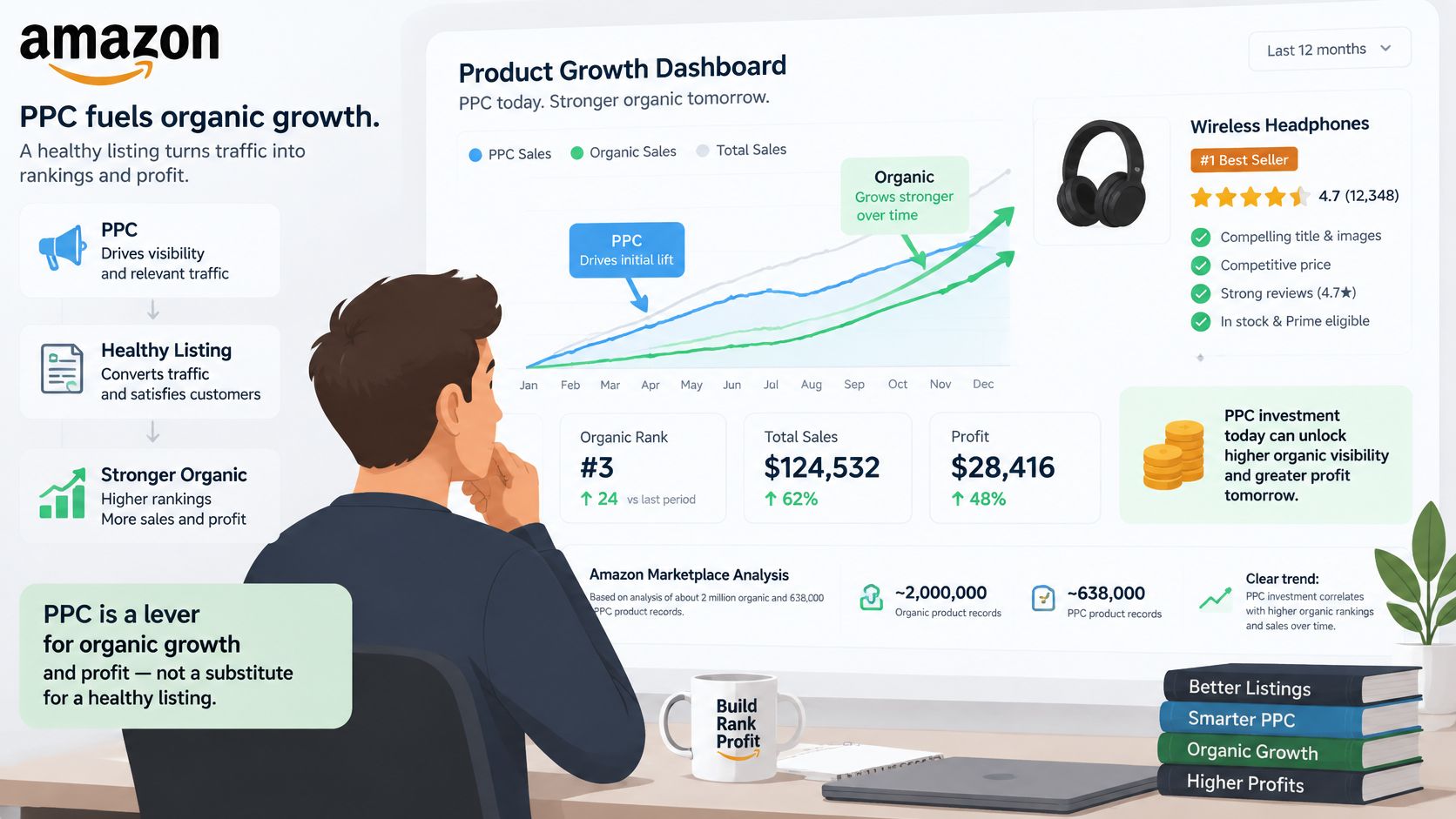
That reframes the job. PPC isn't a substitute for a healthy listing; it's a controlled demand instrument you point at strategically important terms to generate the conversion evidence that rank responds to.
Design the test properly
Hold price, content and inventory stable. Vary only qualified paid traffic. Then measure rank across repeated, localized query observations, because results differ by marketplace, shopper context and personalization. Isolate exact-match campaigns on your priority terms so you know precisely which query received the traffic.
The rest of the discipline is unglamorous: keep retail readiness tight, keep stock levels above the point where a stockout kills your availability signal, and log rank movement against paid clicks, orders, conversion rate and branded-search lift on the same timeline. Treat any organic-rank gain as an outcome to validate.
What the evidence looks like in practice
Amazon's published case study for Front Line Publishing is worth studying for its structure, not its numbers as a benchmark. The publisher used Sponsored Products to advertise only the first book in a series, paired manual keyword targeting with negatives drawn from search-term reports, and annual revenue rose from $316,547 in 2020 to $634,542 in 2022, roughly 101% growth, with no increase in ad spend (Amazon Ads). Entry-book buyers then fed later series purchases.
That's the mechanism worth copying: concentrate spend where conversion creates halo revenue across a portfolio, and cut waste aggressively. One case, not a benchmark. But it demonstrates the pattern clearly.
Judge PPC on contribution margin, not ACOS. A campaign at 60% ACOS that lifts organic share of a high-margin product can be a better investment than one at 25% ACOS that simply harvests demand you'd have captured anyway.
That's the core of how we work at Headline: profit-based bidding and contribution margin optimization, with ranking and sustainable market share treated as the outcome rather than the vanity metric.
How to Build Organic Keyword Rank Step by Step
The routine is mechanical. What separates brands that compound rank from brands that chase it is doing these seven steps in order, every month, without skipping the boring ones.
- Pull 12 months of search term data. See the queries shoppers use. The slip is building your list from competitor titles or keyword tool guesses instead of your own data.
- Map several hundred relevant keywords by intent stage (problem, comparison, brand). The slip is mixing branded and generic terms in one bucket, which makes every downstream number meaningless.
- Rank queries where relevance exists but conversion lags. The slip is chasing the highest-volume term first, which is usually the most competitive and least winnable.
- Rewrite title, bullets and backend terms for your top 10 to 20 queries. The slip is stuffing until the copy is unreadable, which trades a rank gain for a conversion loss.
- Run exact-match sponsored campaigns on priority queries to test conversion. The slip is launching broad match without negatives and calling the resulting traffic a test.
- Pause underperformers and move budget to terms converting at your target margin. The slip is cutting before a term has enough clicks to judge, which kills slow starters.
- Review query-level rank, CTR and purchase share monthly for 8 to 12 weeks. The slip is checking weekly and reacting to noise.
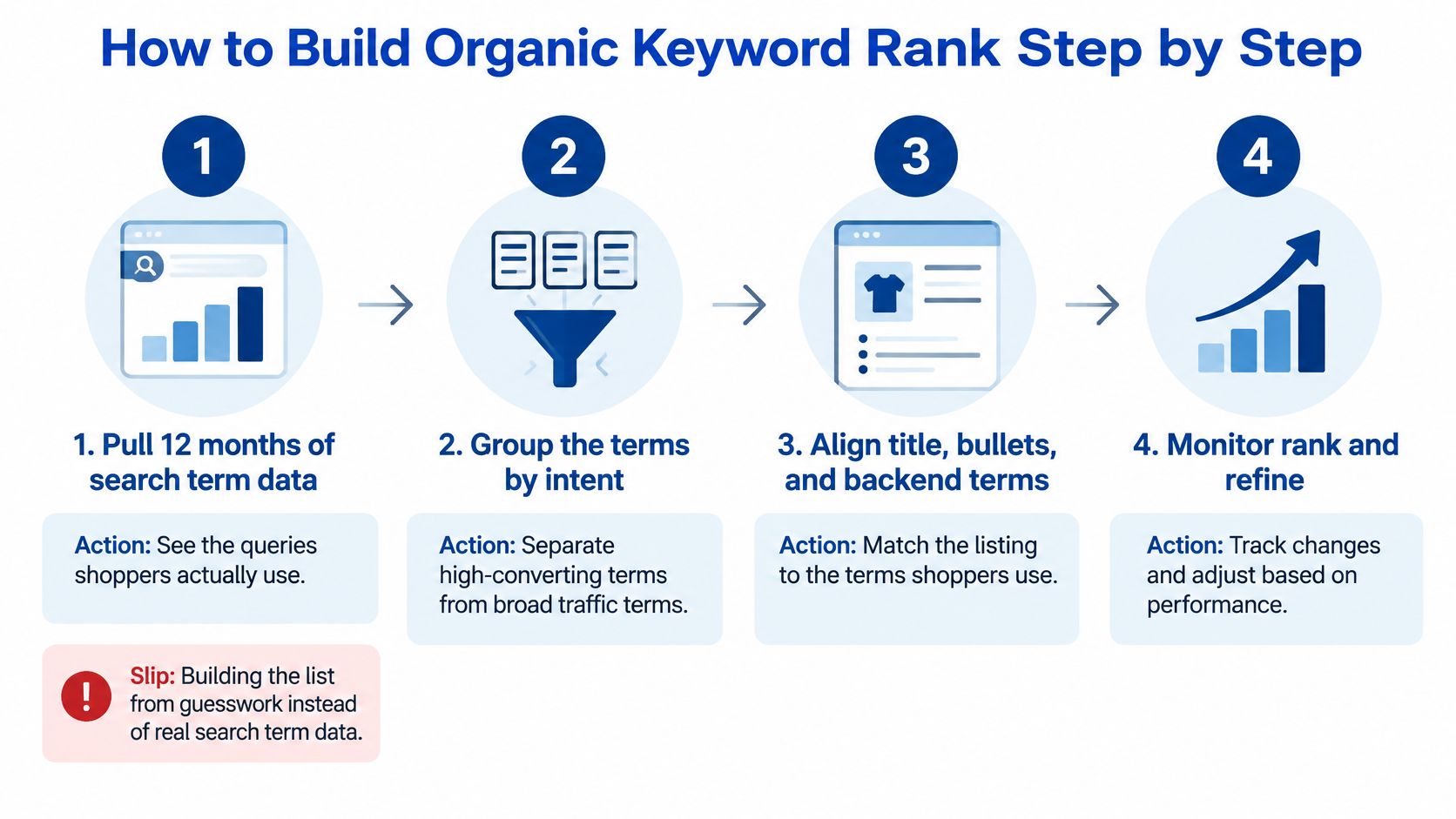
The sequencing matters more than most guides admit. Steps 1 through 3 are research, and research without step 4's copy changes produces nothing. Steps 5 and 6 are the validation loop, and they're where rank moves, because that's where conversion evidence gets generated on a specific query.
For teams deciding which queries deserve the rewrite in step 4, a structured keyword gap analysis usually surfaces faster wins than reviewing terms you already rank for.
What a healthy result looks like
You're looking for a pattern, not a spike. Click-through rate rising on priority queries. Purchase share climbing above click share, meaning the page satisfies what the query promised. Organic share of total sales growing while ad spend holds or falls relative to revenue. Branded search volume creeping up, which is the clearest sign that paid and organic are working together rather than one covering for the other.
If CTR is flat and purchase share is flat while you're spending more, the campaign is buying sales, not building rank. That's fine for a launch window. It's not fine as a permanent state.
Diagnose Rank Drops and Stalled Sales
A useful benchmark for what "working" looks like comes from Amazon's published Theater case study. With a $100,000 budget and no existing brand demand, the brand grew sales 10 times in nine months, improved contribution margin by 18 percentage points from negative double digits to positive, lifted conversion rate 163%, grew branded searches 377% from 17,700 to 84,600 monthly, and moved Best Seller Rank from 424 to 64 (Amazon Ads). Every one of those metrics moved together.
That's the diagnostic principle: rank drops and sales stalls rarely appear alone. Read the pattern across metrics, not a single line.
Symptoms, causes and fixes for rank and sales
| Symptom | Likely Cause | Fix |
|---|---|---|
| Rank rises but sales stay flat | Query is low-intent or irrelevant to the product | Cut the query or improve the listing for conversion before raising bids |
| Impressions rise but clicks fall | Main image or price is weaker than results around it | Test the main image and price, then compare CTR with top competitors |
| Clicks hold but conversion drops | Title, bullets or reviews do not match the query | Rewrite copy for the query and address the objections shown in reviews |
| Rank drops after a stockout | Availability signal lost during the gap | Restock with a buffer and bridge with exact-match sponsored ads after restock |
| Rank swings week to week | Short window or promotions distort the data | Read four-week trends and flag promotion weeks |
| Organic share falls while ad spend rises | Paid is covering demand that would have converted organically | Test paused branded terms against a holdout group |
The last row is the one that costs brands the most money, and it's the one almost nobody tests. If you pause branded exact-match for a fortnight and total sales don't fall, you were paying for demand you already owned.
Change one variable at a time and read the result over a two-week window. Two changes at once gives you a number, not a cause.
Two weeks is the floor for a clean read. Four is better if you're adjusting price, because price changes ripple through conversion and sales velocity simultaneously and you need the second-order effects to settle.
Audit Organic Rank Against Profit Before You Scale Spend
Run this audit this week. It takes an afternoon and it will change where your next dollar goes.
- Pick the ten highest-volume queries that matter to your business. Not the ten you rank best for, the ten that would move revenue.
- Pull impression share, click share and purchase share for each from Search Query Performance.
- Add contribution margin per query. This is the step everyone skips, and it's the one that changes decisions.
- Flag queries with strong rank and weak profit. These are the expensive ones, because you're holding position you can't monetize.
- Decide for each flagged query: fix the listing, adjust PPC, or pause the spend and let the position drift.
Most portfolios come out of this with a handful of high-rank, low-margin queries carrying a disproportionate share of ad spend. Fixing those is usually worth more than any new campaign.
Our free audit covers organic visibility and ranking trends, brand share growth and competitive positioning, bleeder analysis on inefficient spend, targeting coverage and gaps, target starvation and missed opportunities, plus campaign structure and bid strategy. The lens is deliberate: ranking, profitability and protecting market position, rather than ACOS alone.
A rank gain only counts when it adds contribution margin. Everything else is a screenshot.
Treat PPC as an organic growth lever, measure it by profit rather than position, and verify the economics before you scale the spend. That's the whole discipline in one line.
Headline Marketing Agency builds Amazon advertising strategies around contribution margin rather than ACOS alone, using Search Query Performance and Amazon Marketing Cloud data to connect rank movement to actual profit. If you want to know which of your keyword positions are earning money and which are just costing you, our team will run the numbers with you. Book a conversation at Headline Marketing Agency and find out what your organic visibility is really worth.
Get Your Free Amazon PPC Audit
Discover untapped growth opportunities and see how our data-driven approach can improve your ROAS.
Get Free Audit →Wollen Sie Ihre Amazon PPC-Performance aufs nächste Level bringen?
Lassen Sie Ihre Amazon PPC-Kampagnen professionell analysieren und entdecken Sie neue Wachstumsmöglichkeiten.