Amazon Sales Growth: Smart Ways to Promote Tik Tok
Learn how to promote tik tok for Amazon sales with organic posts, creator deals and paid ads. Measure real lift and protect margin.

The popular advice is simple. Find a video that's getting views, boost it, and watch sales follow. For an Amazon brand, that's bad advice. Views don't pay referral fees, storage, or PPC bills. When you promote TikTok content, you're buying a test, not a result. The test has to prove it created profitable Amazon demand you wouldn't have won anyway. If it can't prove that, stop it, no matter how cheap the views look.
TikTok Promotion Options Compared at a Glance
Choose a promotion route by the job it needs to do. Each option gives you a different balance of control, cost, and evidence about whether TikTok is creating demand that Amazon PPC can capture.
| Route | Cost Model | Creative Control | Best Use | Main Risk |
|---|---|---|---|---|
| Organic posts | Staff time | Full | Testing hooks and building an audience | Slow, unpredictable reach |
| Promote boost | Low-cost, pay-per-boost pricing | Limited to the existing post | Quick views and profile visits | Cheap reach can mean weak purchase intent |
| Creator partnership | Flat fee or commission, plus usage rights | Shared with the creator | Social proof and trust | Hard to attribute without codes or links |
| TikTok ad campaigns | Set by bid and budget | Full | Conversion and full-funnel goals | Requires pixel setup and disciplined testing |
Organic posts give you full control and cost staff time, making them a practical place to test hooks before paying to distribute them. The trade-off is speed: reach is unpredictable, so a strong video may get little attention while a weaker one travels farther.
Matching the Route to the Job
Promote, TikTok's in-app boost, adds distribution to a post you have already published. It offers limited control beyond the post itself, so use it for a simple reach or profile-visit test, not as proof of profitable Amazon sales. Creator partnerships exchange a flat fee or commission for a creator's audience and trust. They make more sense when that audience fits your product category; without a unique link or code, tracing sales back to the partnership is difficult.
Ads Manager campaigns provide control over objectives, targeting, and bidding. That control suits conversion-focused tests, but it also means you need a clear measurement plan and disciplined setup. For a plain-English comparison of campaign objectives, see Wojo Media's TikTok objectives guide. If you want to run a creator or brand post as an ad, TikTok Spark Ads for Amazon brands explains how Spark Ads fit that approach.
Audience size is not a sales forecast. TikTok's potential global advertising reach fell by almost 100 million accounts between October 2024 and January 2025, a 5.7% quarter-over-quarter decline, according to DataReportal's Digital 2025 platforms report. Reach estimates describe potential exposure, not the number of likely buyers.
TikTok remains a substantial paid channel. It was projected to receive almost one-seventh of US social-network advertising spending in 2025, according to EMARKETER's social network ad spending chart. For an Amazon brand, the decision still comes down to whether promotion creates incremental demand and whether PPC can capture it profitably.
Pick one primary route for this quarter. One clearly measured starting point is easier to assess than four underfunded experiments.
Measuring Real Lift Beyond Views and Clicks
Low cost per view can coexist with poor profitability. When an audience has little purchase intent, promotion buys attention from people unlikely to buy. Cheap reach is not a result. The test is whether TikTok generates incremental Amazon profit, not whether it generates inexpensive views.
TikTok's Promote guidance focuses on views, website visits, and followers, but does not explain how to distinguish incremental customers from people who would have seen a post organically. The TikTok's Promote FAQ guide makes the tool's stated focus clear. That leaves the advertiser responsible for measuring lift. Last-touch attribution can miss longer-term effects, so assess outcomes such as branded search and repeat purchases alongside immediate conversions.
Build a Holdout Before You Spend
Split comparable geographies or audiences into two groups. Show the promotion to one group and withhold it from the other. Compare branded-search lift, product-page visits, conversions, repeat purchases, and contribution margin. The gap between groups helps show whether promotion added value beyond what would have happened anyway.
Compare promotion with ordinary organic distribution to see whether boosting adds anything. Compare it with a full-funnel paid campaign to judge whether the simpler tool can do enough. Holdouts across these conditions help separate incremental sales from demand that other activity would have captured.
Ads that invite comments or co-creation may be better predictors of repeat purchases than passive views. Treat that as a hypothesis, not a result: include interactive creative in the holdout and check whether the group exposed to it shows stronger repeat-purchase behavior. Engagement alone does not prove profit.
| Metric | What It Tells You | Decision Rule |
|---|---|---|
| CPM and reach | Cost to reach and size of audience | Use for awareness goals only; not proof of sales |
| CPA or ROAS | Cost or return per purchase | Scale only if it holds across the full test window |
| Click-through and landing-page sessions | Interest and qualified traffic | Keep only if sessions convert at or near the product page average |
| Branded search and direct traffic lift | Halo effect on later Amazon purchases | Count as value when holdout groups show a gap |
| New-to-brand sales | Customers the brand has not sold to before | Prioritise when growth targets focus on new buyers |
| Contribution margin | Profit after product, fees and ad cost | Final test: a route that fails here does not scale |
Reading the Table Honestly
CTR alone cannot establish success. A strong click rate paired with weak landing-page conversion suggests the hook promises something the listing does not deliver. Fix that mismatch before increasing spend.
TikTok and Amazon reports will not align neatly. Treating them as directly comparable can lead to budget decisions that double-count sales or overlook demand created by TikTok and captured later through branded PPC. The guide to cross-channel marketing attribution for Amazon brands explains how to interpret mismatched reports without double counting.
Wait for the full test window before judging contribution margin. Early results can flatter weak campaigns because the most interested buyers convert first. PPC can capture branded demand TikTok creates, but that demand only supports more investment if the incremental sales leave enough profit after product costs, fees, and advertising. Scale only when the margin holds at the end of the test.
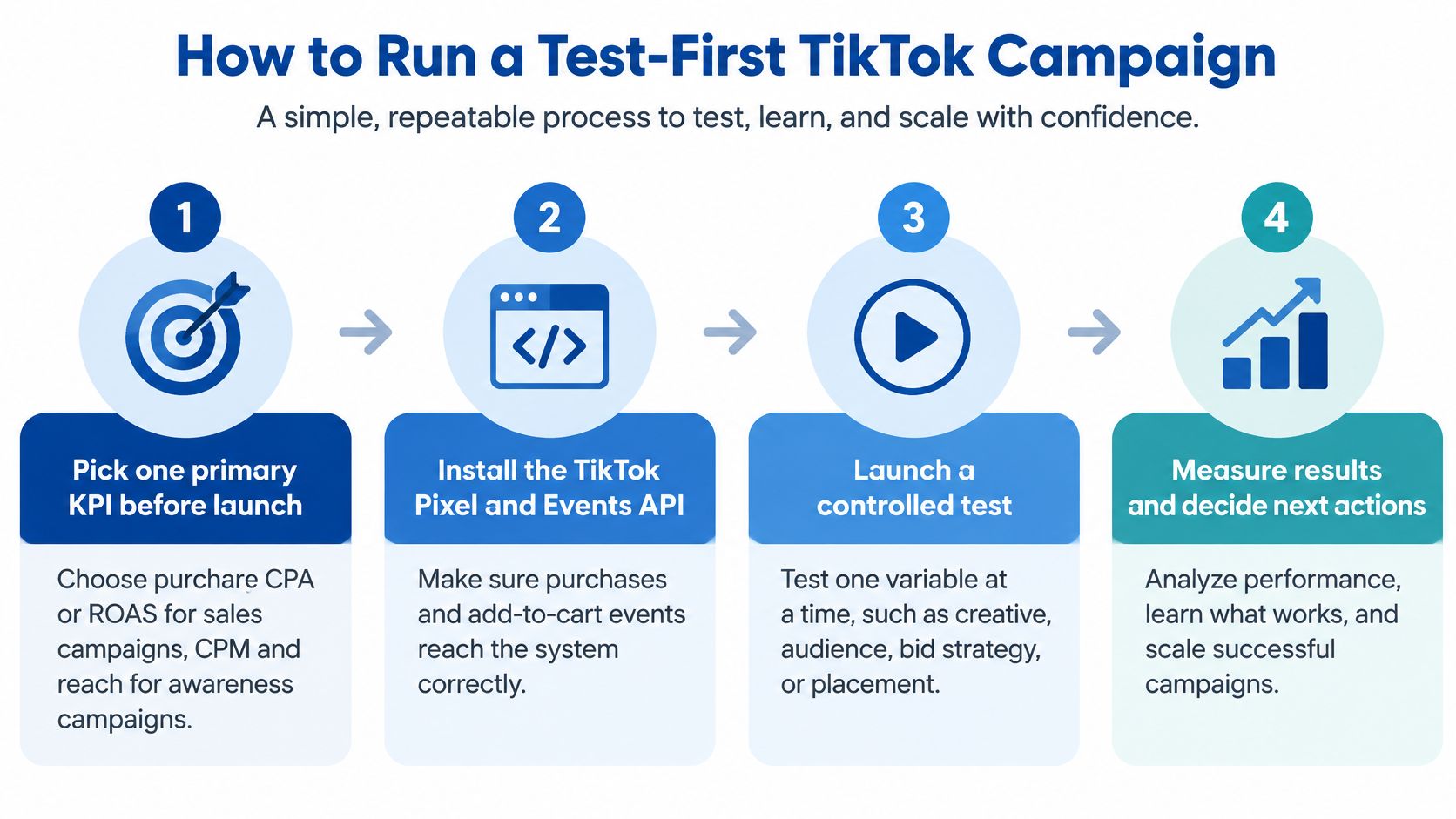
How to Run a Test-First TikTok Campaign
Run one controlled experiment at a time. Change several variables together and you'll never know which one moved the result. TikTok's measurement best practices guide lays out this split-test approach, and it's the right discipline for conversion-focused promotion.
The Seven Steps
- Pick one primary KPI before launch. Use purchase CPA or ROAS for sales campaigns. Use CPM and reach for awareness. One campaign gets one primary number.
- Install the TikTok Pixel and Events API. Purchases and add-to-cart events need to reach the platform, or TikTok optimizes toward clicks instead of buyers.
- Build a split test that changes one factor only. Audience, bidding strategy, optimization event, video length, hook, or call to action. Pick one.
- Keep the audience large enough for stable results. Don't stop when one variant leads on day two. Early leaders are often random variation, and stopping early produces false winners.
- Test creative first, then test audience or bid strategy. Keep the winning concept and change the next variable in a second, separate experiment.
- Compare attribution windows, including view-through. Default reporting can misclassify upper-funnel influence, which matters when TikTok drives a later Amazon search.
- Write the decision rule in advance. Scale the winner only when its CPA or ROAS holds across the full test window. Decide the threshold before you see the data.
For incrementality, TikTok's Conversion Lift methodology randomly assigns eligible users to treatment or control groups. That random split is what lets you separate measured lift from conversions that would've happened without advertising. Preserve holdout or geo controls where you can, even on smaller tests.
If you're setting up your first campaigns, it's worth learning how to track early TikTok campaign performance before you judge any variant. Early reads are noisy, and knowing what to watch stops you killing a good test on day three.
A Worked Example
Say you sell a cable organizer and you promote TikTok demos of it. Film one demonstration, then cut two versions that differ only in the first three seconds. Version A opens on a tangled desk. Version B opens on the finished, tidy result. Same product shots, same voiceover, same call to action, same audience, same bid.
Run both until performance stabilizes. Judge them on purchase CPA, then reconcile clicks against qualified landing-page sessions, Amazon Brand Referral Analytics, new-to-brand sales, and contribution margin. If Version A wins on clicks but loses on margin, Version B is your winner. That's the whole method. One variable, one KPI, one written rule.
Creative Patterns That Drive Clicks and Sales
Start with the hook. The first two seconds decide whether the viewer keeps watching, so open on the problem your product solves, not on your logo. A brand intro burns the only seconds you can't get back.
A simple before-and-after shot does this work well, because the problem and the payoff are both visible without sound.
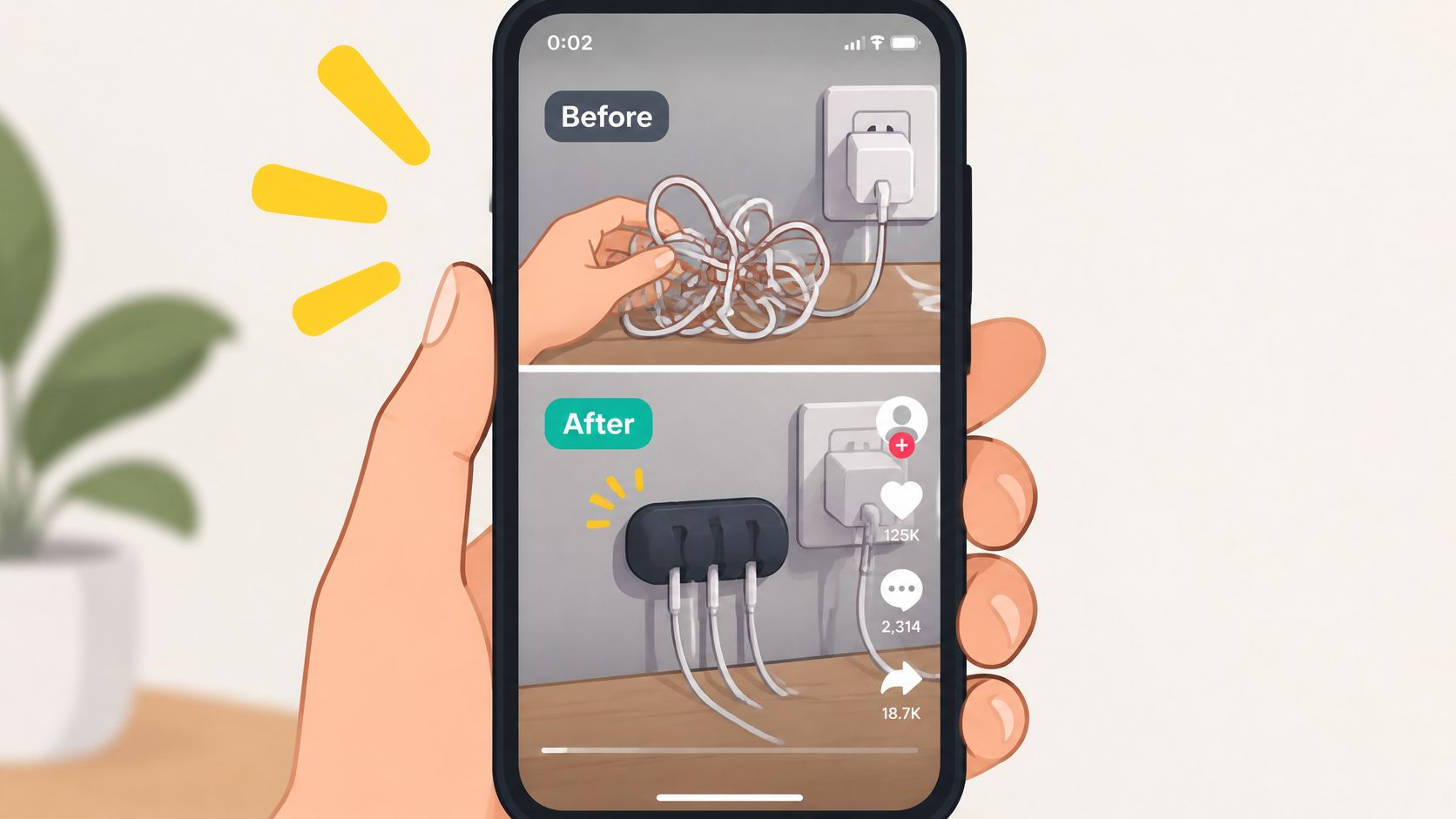
Show the product in use within the first five seconds, with the result clearly demonstrated. Add short on-screen text so the point survives sound-off viewing, which is how a large share of your audience will watch. Keep the call to action to one action, such as tap to shop or follow for the restock. Two competing asks split the response and weaken both.
Turn Opinions Into a Test Grid
Build a small grid instead of arguing about creative in a meeting. Three hooks crossed with two cut lengths, such as 15 and 30 seconds, gives you six variants you can read within one budget cycle. Each variant answers a specific question. Does the problem hook beat the result hook? Does the short cut hold its conversion rate, or does the longer demo earn its extra seconds?
The video below walks through how a demonstration-first structure holds attention. Watch where the product appears and how early the result shows.
Format matters on Amazon too, which is why demonstration video is worth testing against static images rather than assuming either one wins.
| Source | Comparison | Result |
|---|---|---|
| Amazon's Skin Grip case study | Video matched to shopper decision points vs static search results | 3.7x higher CTR; 15% higher conversion rate at flat ACOS |
| Amazon's Binh Bui Ngoc case study | Video campaign vs static-image campaign | 27% higher conversion rate; ROAS up 13% to 4.28; ACOS down 12% |
| Amazon's Sponsored Products overview | Sponsored Products campaigns with video vs without | 67% higher CTR; 9% higher conversion rate |
Treat those as a reason to test, not as a promise. Your category, price point, and listing quality will move your numbers. Amazon advises segmenting reporting by placement, target, and creative format, and using profitability, not CTR alone, as the release criterion for more budget.
Pre-Launch Checklist
- Problem first: The viewer's problem appears in the first two seconds.
- Product visible: The product is in use by five seconds.
- One call to action: A single next step, stated once.
- Captions on: Short on-screen text carries the point without sound.
- Tracking attached: A link or code identifies the source of every sale.
Working with Creators Without Wasting Budget
Choose creators on audience fit and recent engagement, not follower count. A large account with the wrong viewers is an expensive way to reach people who won't buy.
Selection Checks Before You Reach Out
- Buyer match: Do their viewers match your buyer in age, budget, and use case?
- Comment quality: Read comments on recent product posts. Real questions about price and fit signal purchase intent.
- Growth pattern: Reject accounts with sudden spikes that suggest bought followers.
- Category history: Have they sold products like yours before, and did followers respond?
Then write a short brief. Include the product facts, one claim you want made, the required disclosure, and the unique link or code that tracks the sale. Keep it short. Creators who get a script read like a script, and audiences can tell.
Deal Terms to Agree Before Filming
A flat fee gives you predictable cost, which suits a first test with a fixed budget. A commission shifts risk to the creator, but it makes clean attribution essential, because disputes start when sales can't be traced. A hybrid, a smaller fee plus commission, often works best for new partners. Both sides have something at stake.
Negotiate usage rights up front. The strongest creator videos are usually the ones you'll want to boost as paid ads later, and rights get expensive after a video has already performed. Agree the usage period, the channels covered, and whether you can edit the cut.
Test one creator at a time with a unique code. Where you can, hold back a comparable product page or audience so you can see the lift rather than guess at it. Expect some videos to fail. That's normal, and it's cheaper to learn it on one fee than on five.
Judge creators on profit per video, not on views. When you promote TikTok content from a creator, the question is the same as with any other route. Did this audience buy at a margin you can live with?
Keep the creators whose audience buys, renew those deals, and move budget away from creators who only deliver views.
Feeding TikTok Traffic Into Your Amazon Funnel
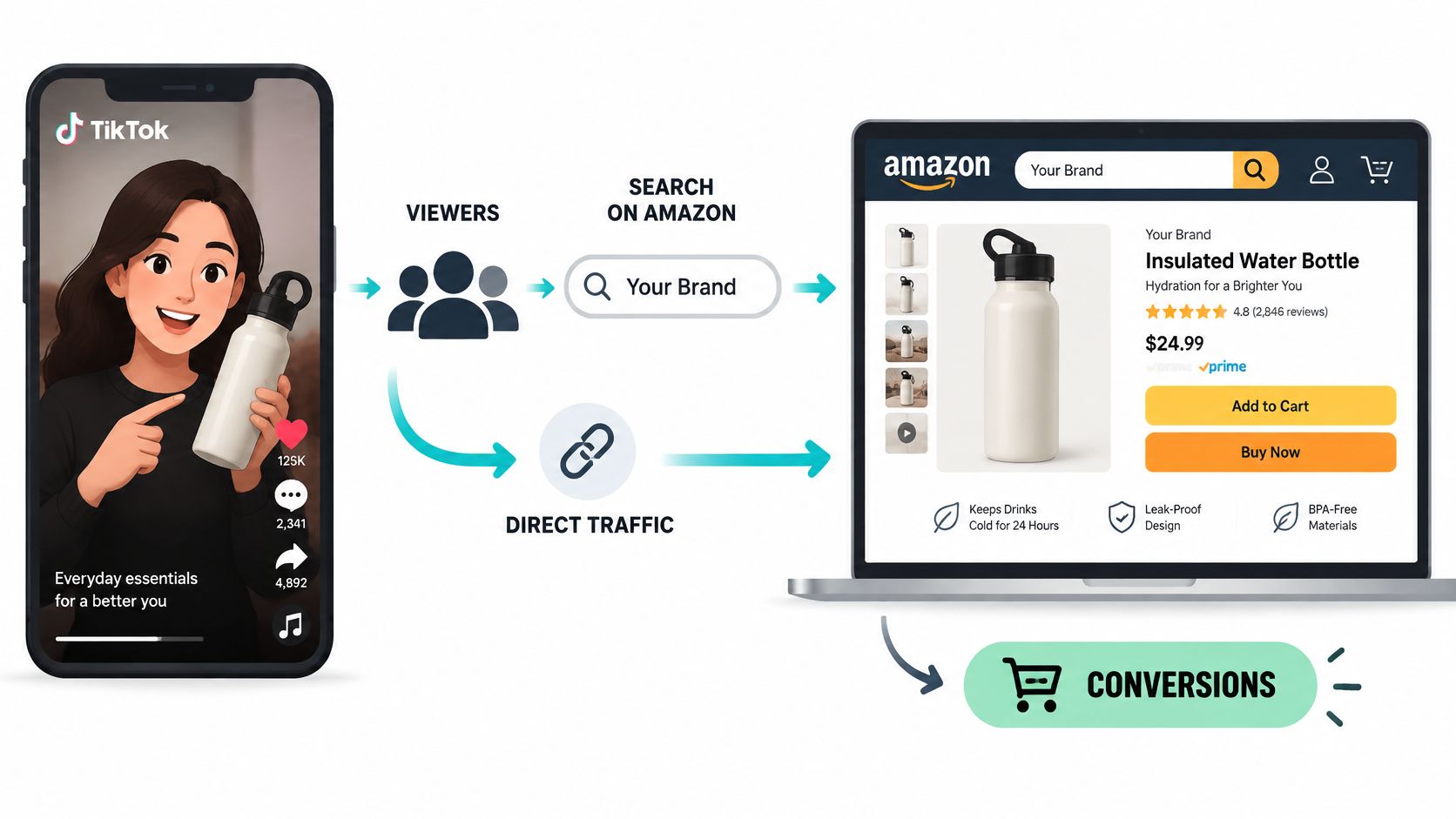
TikTok often creates demand that shows up later as branded search or direct traffic. Last-click reports miss that handoff entirely, so plan for it before you launch rather than explaining it afterward.
The funnel below shows that path from a TikTok view to an Amazon purchase. Every step in it is a place where demand leaks if you haven't prepared.
Make the Listing Ready to Convert
Point TikTok traffic at a listing that can close the sale. That means strong main images, a demonstration video, and reviews that answer the exact question your TikTok raised. If your video shows how fast the product sets up, a review confirming fast setup does more work than another feature bullet.
If you sell through a storefront, connect it properly so the path from profile to product has no dead ends. Our walkthrough on adding your Amazon storefront to TikTok covers the setup.
Capture the Demand TikTok Creates
Capture branded demand with Sponsored Products and Sponsored Brands. A shopper who searches your brand name after watching a video is high intent, and a competitor can take that click if you're not defending it. Here PPC stops being a cost and starts acting as a lever for organic growth, because paid velocity on the right queries supports ranking and visibility.
Track Amazon Brand Referral Analytics next to TikTok performance. Watch TACOS and organic rank as your signal of sustainable growth, since a falling TACOS with rising sales means paid spend is building organic position rather than renting it.
Oneisall shows the pattern at scale. In Amazon's Oneisall case study, the brand ran Sponsored Products, Sponsored Brands, and display with A/B tests on Sponsored Products creative, and its share of voice in its core keyword category increased by more than 50%, sales rose by more than 50% year over year, and ACOS fell by 22% year over year. Visibility, volume, and efficiency improved together.
Our own lifestyle brand case followed the same logic. Headline doubled the brand's market share and increased organic visibility by 156%, using PPC as an investment in organic visibility. Different brand, same principle. Judge the TikTok route by the total marketplace result, not by the clicks that reached the listing.
Launch Your First TikTok Test This Month
Four weeks is enough to get a clean first read. The calendar below assumes one product, one primary KPI, and one holdout.
The Four-Week Calendar
Week 1 is setup. Choose one product with a proven Amazon listing, strong main images, and a clear customer question a demonstration video can answer. Confirm its reviews already address that question. Set your primary KPI, CPA or ROAS, and your scale-or-stop rule. Install the TikTok Pixel and Events API, and create a unique link or code for each route.
Week 2 is launch. Run your creative grid, three hooks against one demonstration cut, with an organic post as the baseline. Reuse proven creatives and high-performing keywords rather than rebuilding campaign structure. If posting volume is your bottleneck, use a tool to schedule social media posts so the organic baseline goes out on time every day.
Week 3 is patience. Keep the holdout geography or audience running and let the test window finish before you read results. Don't reallocate budget mid-test because one variant looks hot. You'll contaminate the comparison and learn nothing reliable.
Week 4 is the decision. Review branded search, new-to-brand sales, and contribution margin together. Scale the winning route only if profit holds, then assign the remaining budget to the next test.
That discipline is what turns paid spend into organic position. In one case study, a lifestyle brand doubled its market share, with organic visibility up 156% and a 10% TACOS reduction. Those results came from treating every paid test as an investment decision, and your TikTok test deserves the same standard.
TikTok earns budget when it adds profitable sales to the Amazon funnel.
If you'd rather not build the tracking, holdout, and PPC capture structure yourself, Headline can set up the test and the Amazon campaign structure that captures the demand it creates. Bring us one product and one profit target, and we'll tell you whether TikTok is the right first test.
Ready to find out whether TikTok can add profitable Amazon sales instead of cheap views? Headline Marketing Agency builds the test, the tracking, and the PPC structure that turns TikTok demand into captured branded search, organic rank, and contribution margin. Visit us to start with one product, one KPI, and a scale-or-stop rule you can defend.
Get Your Free Amazon PPC Audit
Discover untapped growth opportunities and see how our data-driven approach can improve your ROAS.
Get Free Audit →Wollen Sie Ihre Amazon PPC-Performance aufs nächste Level bringen?
Lassen Sie Ihre Amazon PPC-Kampagnen professionell analysieren und entdecken Sie neue Wachstumsmöglichkeiten.