Landing Page Conversion Optimization That Drives Profit
Master landing page conversion optimization with proven frameworks, A/B testing and Amazon insights to turn more clicks into profitable growth.

A landing page can convert 19.3% of email traffic but 4.1% of display traffic, according to benchmark summaries based on Unbounce data (Backlinko's landing page statistics summary). That spread changes the entire CRO conversation. The page isn't operating in isolation, and a blended conversion rate can hide whether your offer is strong, your traffic is qualified, or your ad promise is attracting the wrong shoppers.
For Amazon brands, landing page conversion optimization should answer a harder question than “How do we get more orders?” It should answer, “Which traffic produces profitable customers, stronger retail signals, and sustainable organic growth?” The right page helps PPC traffic convert today while giving Amazon better evidence that your product deserves visibility tomorrow.
Why Landing Page Conversion Optimization Is a Profit Lever
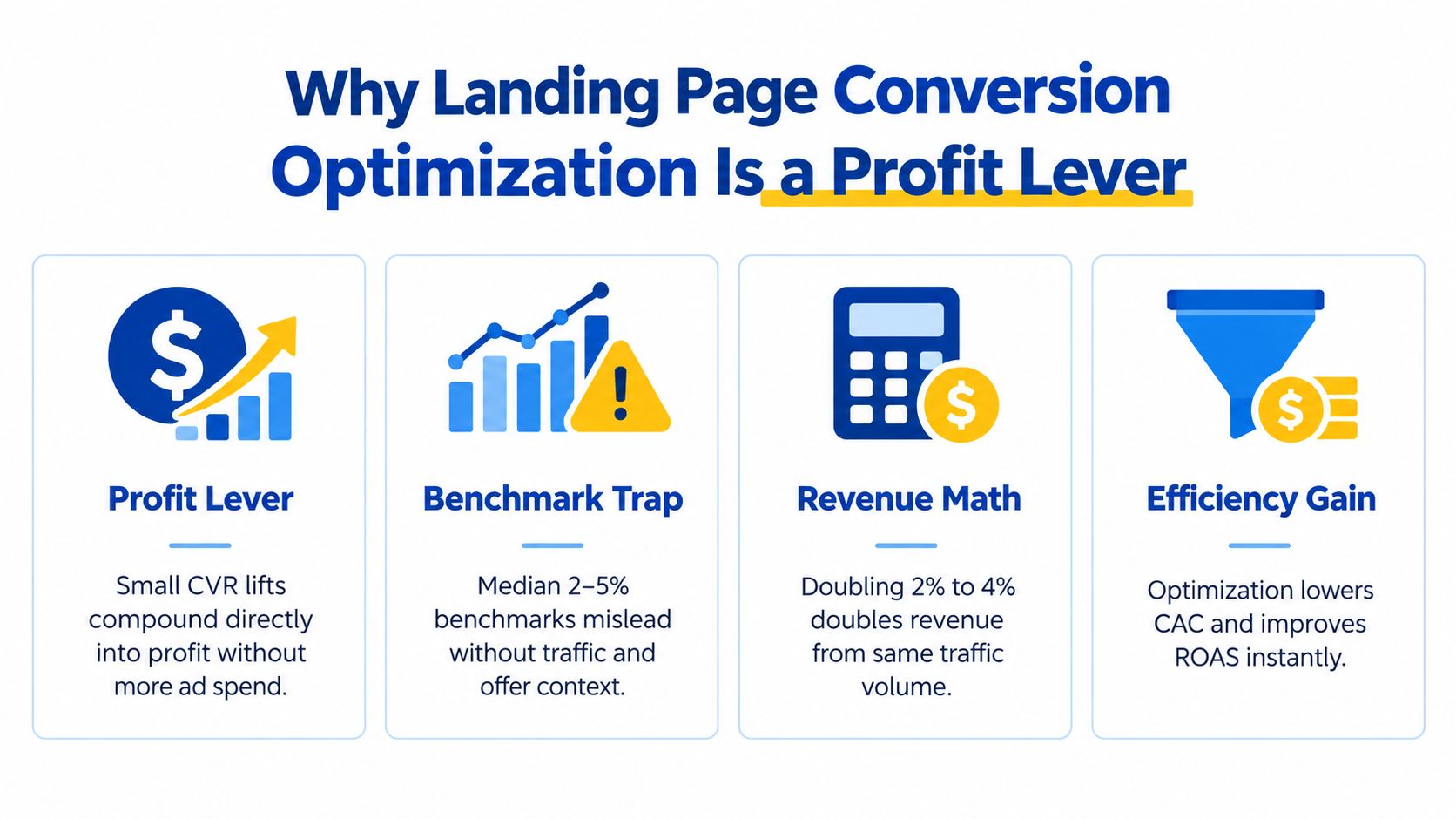
Unbounce's Q4 2024 benchmark reported a 6.6% median landing page conversion rate across industries, based on more than 41,000 landing pages, 464 million visitors or pageviews, and 57 million conversions (Unbounce's Conversion Benchmark Report). That's a useful reference point, not a universal target. A median tells you where the middle of a large dataset sits. It doesn't tell you whether your cold paid-social audience, branded Amazon audience, repeat buyer segment, or high-intent search cohort should convert at the same level.
Traffic quality is one reason. Benchmark summaries report average conversion rates of 19.3% for email, 10.9% for paid search, 12.0% for paid social, and 4.1% for display (Backlinko's landing page statistics summary). If you judge every campaign against one blended CVR, you'll either overreact to weak traffic or underinvest in a page that performs exceptionally well with qualified shoppers.
The math is simple, the strategy isn't
Conversion rate is a profit lever because it improves the economics of traffic you've already paid to acquire. More qualified visitors complete the desired action, so acquisition costs work harder and paid media can support more revenue without relying exclusively on additional reach.
The business case becomes clearer when you separate raw conversion volume from conversion quality. A page that captures every curious click may produce an impressive CVR while generating weak leads, low-value orders, poor repeat purchase behavior, or unprofitable Amazon sales. A more selective page can convert fewer visitors and still create better contribution margin.
For Amazon, PPC is also more than a direct-response channel. Sponsored Products, Sponsored Brands, Display, and Video can place qualified shoppers in front of a listing, Brand Store, or external landing experience. When those shoppers engage with the product and purchase, PPC can contribute to sales velocity, keyword relevance, and organic discoverability. That connection makes landing page work part of a broader marketplace growth system, not a cosmetic website exercise.
Practical rule: Optimize the page for the traffic cohort and the business outcome, not for a benchmark that ignores both.
Before changing layout or button color, compare your own performance by source, query intent, device, offer, and downstream value. Shopify landing page conversion insights can provide useful context for DTC teams, while Headline's conversion rate optimization best practices offer another reference for structuring page improvements. The decision should still come from your data.
Know Your Traffic Before You Touch the Page
Most failed redesigns begin with the wrong diagnosis. A team sees a low blended CVR, assumes the page is broken, and replaces the hero section, form, imagery, navigation, and CTA at once. That creates activity, not learning.
Start with an intent audit. Build a view of who arrives, what they expected, and how close they are to purchase. Amazon brands should connect paid campaign data with customer and search behavior instead of treating every click as interchangeable.
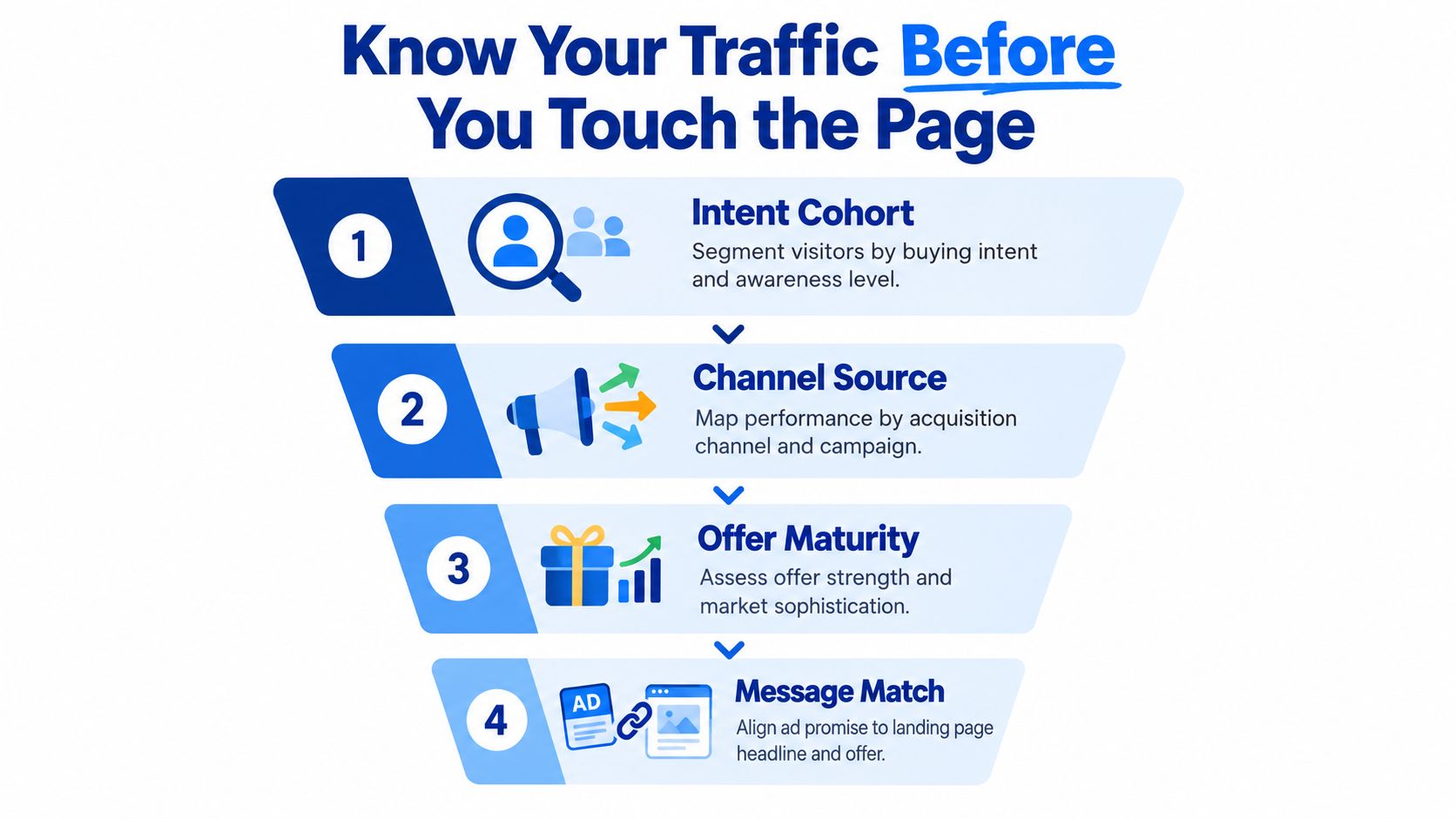
Segment intent before diagnosing friction
Use four practical lenses:
- Intent cohort: Separate branded searches, category searches, competitor searches, retargeting audiences, prospecting audiences, and existing customers. Branded traffic already understands your product. Category traffic needs education and differentiation. Competitor traffic needs a reason to switch.
- Channel source: Report CVR by Sponsored Products, Sponsored Brands, DSP, external PPC, email, organic, and social. Then break paid traffic down by campaign and query group. A weak aggregate can conceal one profitable segment and one expensive failure.
- Offer maturity: A new product needs proof, explanation, and reassurance. A mature offer may need sharper differentiation, stronger bundles, or a clearer reason to buy now. Don't apply launch-page messaging to a product with established awareness.
- Message match: Compare the ad keyword, creative, landing-page headline, product promise, price presentation, and CTA. If the ad promises a solution for sensitive skin and the page opens with a broad brand statement, shoppers must do unnecessary interpretation work.
Search Query Performance can help Amazon teams understand how shoppers move from query to product interaction and purchase. Amazon Marketing Cloud can add a fuller view of paths across eligible advertising touchpoints. Use those inputs to identify which searches and audiences produce meaningful product engagement, not just cheap clicks.
A short diagnostic checklist
Before touching the page, answer these questions:
- Which campaigns drive the highest-quality sessions and orders?
- Which queries indicate a specific problem, use case, or product requirement?
- Does the headline repeat the promise that earned the click?
- Does the page answer the primary objection for that cohort?
- Is the offer appropriate for the visitor's awareness level?
- Where does the user abandon, and does that pattern differ by device or source?
The point isn't to build a perfect taxonomy. The point is to stop making sitewide decisions from mixed traffic. If branded shoppers convert well but cold category traffic doesn't, redesigning the entire page may damage the audience that's already working. Build a cohort-specific hypothesis instead.
High Impact Fixes for Copy UX and Speed
Once diagnosis identifies the friction, fix the elements closest to the decision. Don't start with a full redesign. Start with the page's promise, proof, action, and path to completion.
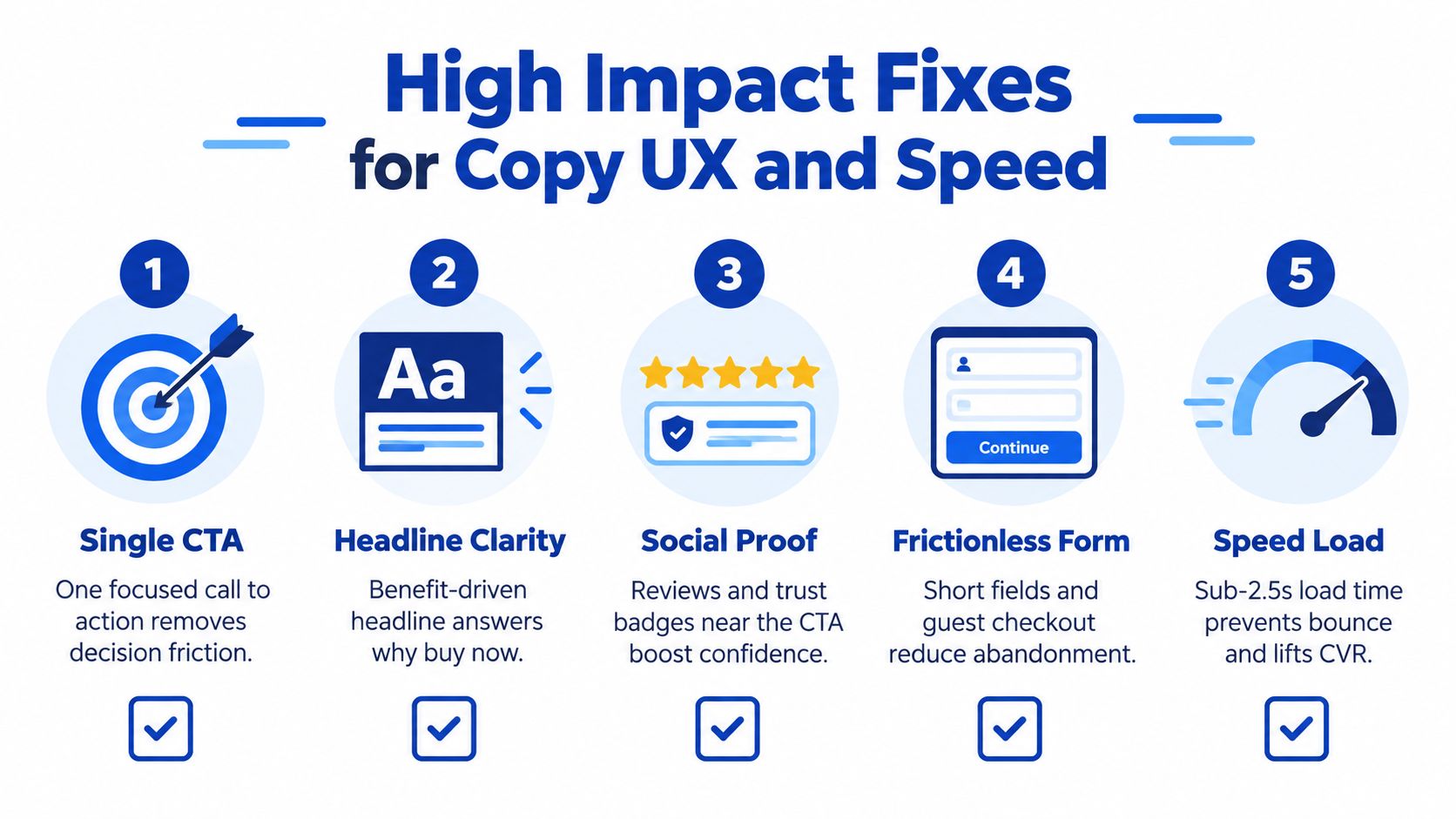
Make the decision obvious
A single primary CTA reduces competing decisions. Benchmark summaries cited by Backlinko report that pages with a single call to action average 13.5% conversion, reinforcing the value of a focused action path (Backlinko's landing page statistics summary). The CTA should describe the value of the next step. “Shop the solution” is more useful than a vague “Submit,” provided it accurately reflects what happens after the click.
Your headline should state the customer benefit before the brand story. For an Amazon supplement brand, “Daily hydration support for long travel days” gives a shopper a reason to continue. “Innovation for modern wellness” doesn't. Keep the brand context, but don't make shoppers decode the offer.
Place credible proof near the decision point. Use verified reviews, retailer ratings, product guarantees, expert credentials, or clear shipping information where relevant. Never manufacture urgency, endorsements, or performance claims. Trust improves when the page answers the shopper's risk question directly.
Remove friction that doesn't earn its place
Forms deserve ruthless editing. A benchmark cited by Colorlib says that cutting a form to three fields improved conversion by 50% (Colorlib's landing page statistics). Treat that as an example from a cited benchmark, not a guarantee for your page. Remove fields that sales, fulfillment, or qualification teams don't use.
For ecommerce, test guest checkout, autofill, clear error states, concise shipping information, and a mobile-friendly payment flow. For Amazon traffic, make sure any external experience hands shoppers into the correct product detail page or Store path without forcing them through an unnecessary lead form.
The page also has to load quickly and work on a narrow screen. Compress images, remove scripts that don't support the buying journey, prioritize the first viewport, and test the mobile experience. Speed matters, but don't turn it into a slogan. Diagnose whether slow rendering, layout shifts, or an obstructive pop-up is causing the abandonment.
Use this ecommerce conversion rate improvement guide when prioritizing changes across product pages, checkout, and campaign destinations. For teams that need to replace a complex form workflow, a practical resource on the best Formstack replacement for forms may help evaluate simpler options.
A focused page should make the next step feel easy, credible, and relevant. It doesn't need more copy. It needs less uncertainty.
Build an A/B Testing System That Actually Learns
A/B testing fails when teams treat it as a vote between designs. The purpose is causal learning. Change one meaningful variable, hold the rest steady, and record what happened by audience and source.
Industry summaries cite an average conversion lift of about 49% from A/B testing, but only about 1 in 8 landing-page tests reaches statistical significance (Colorlib's landing page statistics). Those figures should make you more disciplined, not more excited about declaring early winners. Many tests produce no reliable difference, and an inconclusive result is not permission to choose the version your team prefers.
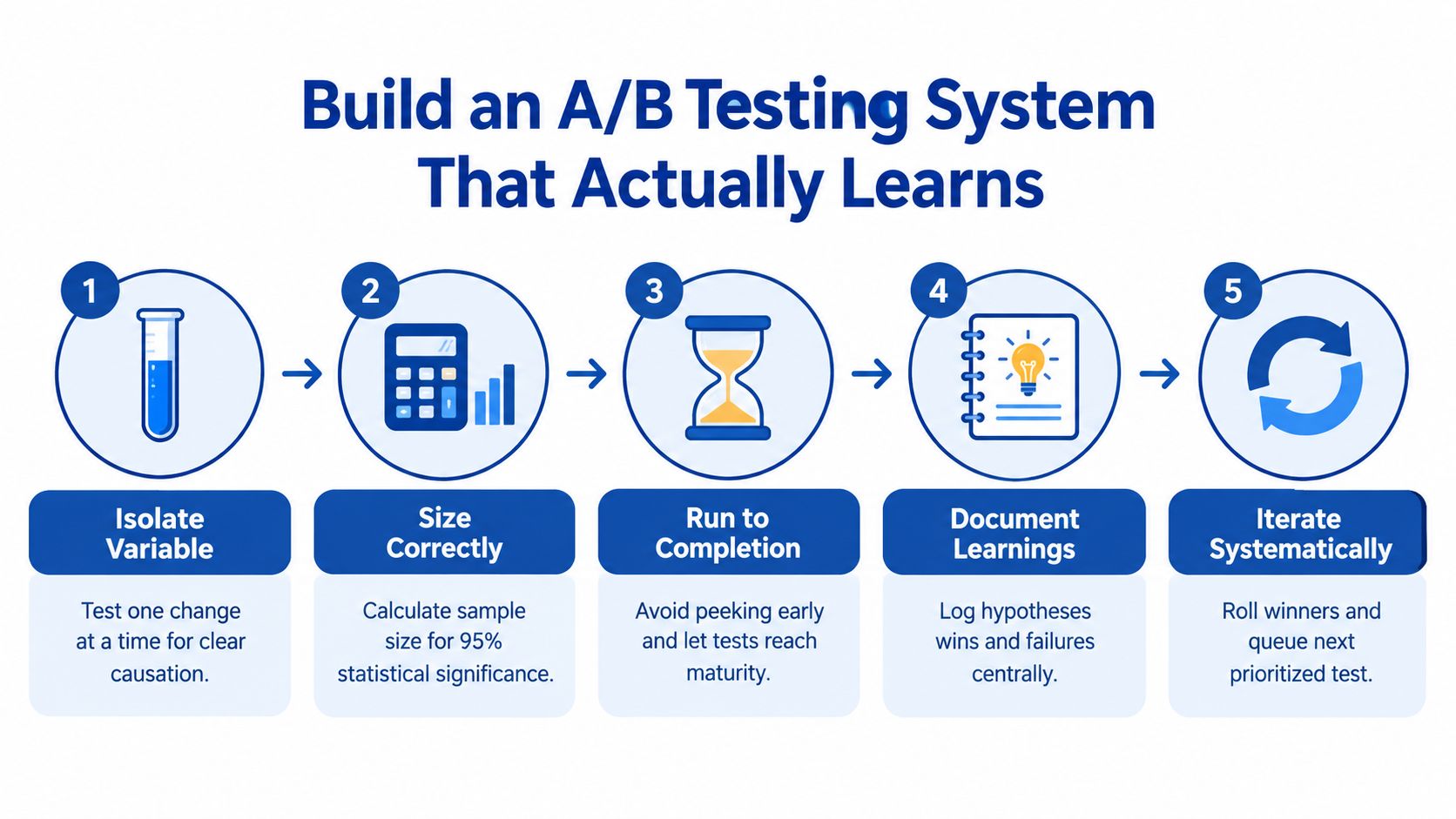
Test the highest-leverage uncertainty first
Prioritize tests using three questions:
- Impact: How many valuable sessions does the element affect, and how close is it to the conversion event?
- Evidence: What do query data, recordings, customer questions, or funnel reports suggest is wrong?
- Effort: Can the team implement and measure the change without introducing tracking risk?
A headline test often deserves attention when paid traffic and page copy don't match. A form test deserves attention when users start but don't complete the form. A proof test deserves attention when shoppers engage with the offer but hesitate near the CTA.
Don't change the headline, imagery, form, CTA, and page structure in one experiment. If the variant wins, you won't know why. If it loses, you won't know what to restore. Multivariate testing can have a role with sufficient traffic and a clear design, but most mid-market teams get more useful learning by isolating one variable.
Define maturity before you call a winner
Set the primary conversion event before launch. Establish the audience, allocation, decision threshold, and minimum runtime in advance. Don't stop when the dashboard shows an attractive result, and don't keep checking until random fluctuation produces the answer you want.
Document the hypothesis in plain language:
If we align the landing-page headline with the category query, qualified product visits will produce more completed purchases because shoppers won't need to reconcile the ad promise with the page.
Track the result by source, intent cohort, device, and downstream quality. A variant can win with cold traffic and lose with branded traffic. Those aren't contradictory results. They indicate that the page should serve different jobs for different audiences.
Use a central experiment log with the hypothesis, implementation date, audience, result, confidence, and follow-up action. A practical Polish approach to split testing can help teams organize the mechanics, while Headline's guide on how to conduct an A/B test provides additional process context.
Testing is a system, not a redesign event. Ship the credible winner, preserve the learning, and queue the next evidence-backed question.
Measure What Matters Beyond the Conversion Rate
Raw CVR is necessary, but it isn't sufficient. A landing page can produce more completions by making the action easier for everyone, including people who were never a good fit. For lead-generation pages, that can reduce sales efficiency. For ecommerce, it can attract low-margin orders, discount dependence, or poor repeat behavior.
Set one primary conversion event, then pair it with diagnostic and downstream measures. Bounce rate and scroll depth help explain behavior, but they don't prove profitability. Qualified lead rate, lead-to-sale efficiency, customer acquisition cost payback, pipeline value, contribution margin, and revenue per visitor tell you whether the page is improving the business.
For Amazon brands, add marketplace outcomes to the reporting view. Track the relationship between PPC traffic, product detail page engagement, orders, advertising efficiency, organic keyword movement, and retail readiness. The exact relationship depends on campaign structure and attribution, so avoid claiming that every conversion automatically creates organic rank. Treat PPC as a controlled input and measure marketplace effects over time.
Choose the metric that matches the page
| Page Type | Optimize For | Key KPI to Watch |
|---|---|---|
| Direct ecommerce product page | Profitable purchases | Contribution margin and revenue per visitor |
| Amazon campaign destination | Qualified product detail page visits and orders | Order quality by query and campaign |
| Lead-generation page | Sales-ready submissions | Qualified lead rate and pipeline value |
| Product launch page | High-intent demand capture | Qualified actions and downstream purchase behavior |
| Retargeting page | Efficient returning-customer conversion | Incremental revenue and repeat purchase quality |
A higher CVR is a win only when the value of the resulting action supports the cost of acquiring it. If a shorter form increases submissions but sales rejects most of them, restore a qualification question or change the offer. If a discount increases orders but destroys margin, test value communication, bundles, or proof before escalating the promotion.
Report every important result by channel and funnel stage. Paid search, email, display, Amazon Sponsored Brands, and DSP audiences carry different intent. A blended dashboard makes the wrong decision look obvious.
Measurement standard: Never promote a variant on CVR alone when the conversion creates a lead, discount claim, or low-commitment micro-action.
Headline Marketing Agency is one option for brands that want PPC management, DSP strategy, analytics, and content optimization connected to conversion testing. The operating principle is straightforward: judge page changes by qualified revenue and marketplace growth, not by an attractive dashboard metric.
Your Prioritized Plan for Sustainable Scale
Landing page conversion optimization works best as an operating sequence, not a collection of design tips. Start with traffic intent, then fix the friction that blocks the most valuable cohort. Test one material change, measure it against downstream quality, and feed the learning back into PPC creative, keyword selection, product content, and Amazon listing decisions.
Use this order:
- Diagnose the traffic: Segment by channel, campaign, query intent, device, audience awareness, and offer maturity.
- Confirm message match: Make sure the ad promise, headline, product benefit, proof, price, and CTA tell the same story.
- Fix decision friction: Remove unnecessary form fields, distractions, unclear copy, weak proof, and mobile usability problems.
- Test systematically: Isolate one variable, define the primary event, run the experiment to maturity, and document the result.
- Measure business quality: Review qualified actions, profitability, CAC payback, pipeline or order value, and Amazon marketplace outcomes.
- Scale the learning: Apply winning insights to PPC targeting, ad creative, Brand Store content, product detail pages, and organic growth initiatives.
The strongest Amazon teams don't treat PPC as a rented source of sales. They use it to learn which searches, messages, benefits, and audiences produce qualified demand. Those insights can improve organic content and ranking strategy, while better conversion efficiency gives the brand more room to scale profitably.
Audit one high-spend landing page this week. Choose the campaign with meaningful volume, export its query and audience signals, compare the ad promise with the page experience, and identify one friction hypothesis. Fix that issue, set the downstream KPI before testing, and don't approve the next redesign until you can explain which customer problem it solves.
Headline Marketing Agency connects Amazon PPC and DSP management with landing page optimization, experimentation, and profitability-focused reporting. If you want to turn paid traffic into qualified revenue and stronger organic growth, visit Headline Marketing Agency and discuss the landing page and campaign that deserve attention first.
Get Your Free Amazon PPC Audit
Discover untapped growth opportunities and see how our data-driven approach can improve your ROAS.
Get Free Audit →Wollen Sie Ihre Amazon PPC-Performance aufs nächste Level bringen?
Lassen Sie Ihre Amazon PPC-Kampagnen professionell analysieren und entdecken Sie neue Wachstumsmöglichkeiten.