How to Increase Amazon Sales: A Performance-First Playbook for eCommerce Leaders
Amazon success comes from consistent fundamentals. Our scaling Amazon sales playbook is behind 4.2x average ROAS for clients.

Tired of the generic tips? Let's cut through the noise. Increasing your Amazon sales isn't just about tactical tweaks; it's about building a self-sustaining growth engine. This playbook is for brand leaders who understand that the real goal isn't just selling more units—it's building a profitable, scalable asset on the world's largest marketplace. We'll show you how to use paid advertising as a strategic lever to ignite profitable, organic growth and dominate your category.
Your Performance-First Amazon Sales Playbook

Too many brands treat Amazon PPC as an expense line item, disconnected from the bigger picture. They throw budget at ads, chase a target ACOS, and wonder why they're not building market share. A performance-first approach re-frames this entirely. It views the marketplace as an ecosystem where every action—especially paid media—creates a powerful ripple effect.
The core principle is leveraging paid advertising to fuel your organic presence. This is the Amazon "flywheel effect" in action—a concept many talk about but few execute with discipline.
- Strategic PPC Spend drives highly qualified traffic to your listings.
- Increased sales velocity improves your Best Seller Rank (BSR).
- Strong BSR and conversion rates signal relevance to Amazon's A9 algorithm, boosting your organic keyword rankings.
- Higher organic rankings generate more "free" sales, improving total profitability and allowing you to strategically reinvest ad spend.
This isn't theory. We've guided brands to slash their Total Advertising Cost of Sale (TACOS) by over 50% in under six months by executing this model. The shift happens when you stop managing PPC and organic in silos and start using paid media as a catalyst for the entire flywheel.
Adopting the Flywheel Mindset
To execute this playbook, you must shift from chasing short-term sales to building a long-term, defensible asset. Every ad dollar is an investment in your product's organic visibility and market share. This requires a disciplined approach to every facet of your Amazon presence, from listing optimization to inventory management.
A critical component is mastering the strategies for Winning the Amazon Buy Box. It's a non-negotiable prerequisite. If you don't own the Buy Box, even the most brilliant ad campaign is just driving sales for a competitor.
Headline's Recommendation: Stop viewing ad spend as a cost center. Treat every PPC dollar as a strategic investment to kickstart a virtuous cycle of sales velocity, improved rankings, and ultimately, greater enterprise value. This mindset shift is the single biggest differentiator between brands that merely sell on Amazon and those that dominate their categories.
Turning Traffic into Revenue by Optimizing Product Listings
Before investing a single dollar in traffic, your product detail pages must be "retail ready." Your listing is your 24/7 digital sales associate. A poorly optimized page makes your ad spend inefficient, hemorrhaging budget on traffic that fails to convert.
The objective isn't keyword stuffing; it's architecting a high-conversion experience that satisfies both Amazon's A9 algorithm and your human customer.
Competition is fierce. With US Amazon sales projected to hit $491.65 billion in 2024—40.4% of the total eCommerce market—you have seconds to capture attention and earn trust. A poorly merchandised product page is a critical point of failure.
Engineering Titles and Bullets for High-Intent Shoppers
Your title is your most valuable piece of digital real estate. It must do more than describe the product; it must articulate the core benefit and align precisely with high-intent search queries. Getting this right directly impacts your click-through rate (CTR) from search.
For example, "12-Inch Non-Stick Frying Pan" is a description, not a title.
A performance-engineered title: "ProChef 12-Inch Ceramic Non-Stick Skillet - Toxin-Free, Oven Safe Pan for Easy-Clean Searing & Frying." This includes the brand, size, key feature, material, and high-value use cases—all signals for both the algorithm and the qualified buyer.
Your bullet points are your opportunity to overcome purchase objections before they arise. Each bullet should be a mini sales argument.
Lead with the benefit, support with the feature. Instead of "Made with 304 stainless steel," frame it as "Unmatched Durability, Zero Corrosion: Built with premium 304 stainless steel to deliver a lifetime of performance."
Answer the unasked questions. Is it dishwasher safe? What are the exact dimensions? Does it include a warranty? Proactively providing this information reduces friction and builds the confidence needed for a shopper to click "Add to Cart."
Address objections head-on. If your product is priced at a premium, justify it. "Features a fully-clad, triple-ply construction for superior heat distribution—a critical detail for professional results that entry-level pans lack."
Headline's Recommendation: Treat your title and bullets as a rapid-fire sales pitch. The title earns the click. The bullets close the deal by systematically answering questions and eliminating doubt. This is foundational to maximizing your return on ad spend.
Using Visuals and A+ Content to Drive Conversion
Humans are visual buyers. All the conversion-focused copy in the world won't save a listing with low-resolution, uninspired images. Your main image must be flawless: crisp, clear, and on a pure white background, compliant with Amazon's ToS.
Your secondary images are where you tell the story. Utilize lifestyle shots showing the product in use, infographics with text callouts highlighting key features, and scale images to manage customer expectations.
Video is no longer optional for serious brands; it's a critical conversion tool. A well-produced 30-60 second video can demonstrate product value in a way static images cannot, consistently leading to measurable lifts in conversion rates.
For registered brands, A+ Content is a game-changer. It transforms a standard product page into a branded merchandising experience.
- Articulate your brand narrative: Use modules to communicate your mission, values, and what differentiates you from the competition.
- Facilitate product discovery: Leverage comparison charts to cross-sell or upsell customers to other products in your catalog.
- Simplify complex information: Use a combination of rich imagery and text to explain technical specifications that would be cumbersome in the bullet points.
Optimizing these on-page elements is the bedrock of a successful growth strategy. A retail-ready listing ensures every ad dollar has the highest possible chance of converting, turning your PPC budget into a true growth investment. For a deeper dive, check out these proven strategies to boost your conversion rate on Amazon.
Using PPC as a Lever for Organic Dominance
This is where the performance-first mindset delivers exponential returns. Most brands treat Amazon PPC (Pay-Per-Click) as a simple sales channel. That’s a tactical error. Sophisticated operators understand its true strategic purpose: PPC is the lever you pull to directly influence and accelerate long-term organic rank.
The objective isn't just to buy sales; it's to architect a profitable, self-funding system where ad spend today secures higher organic ranking tomorrow. This transforms PPC from an operating expense into a capital investment in your brand's market share.
The scale of this opportunity is immense. With Amazon’s ad revenue projected to reach $56.2 billion in 2024 and third-party sellers generating $157.1 billion in sales, the marketplace is a battleground. A data-driven, aggressive advertising strategy is no longer a "nice to have"—it is the cost of entry for brands serious about growth.
Architecting a Profitable Campaign Structure
Effective PPC management is built on a methodical campaign structure. You must separate your keyword discovery initiatives from your proven performance campaigns. This allows you to allocate budget surgically, pouring fuel on demonstrated winners while efficiently mining for new opportunities.
A battle-tested framework is the two-tiered campaign structure:
Discovery Campaigns: These are your intelligence-gathering assets, typically Auto or Broad Match campaigns running on a controlled budget. Their sole purpose is to harvest new, relevant search terms that real customers are using. Profitability is secondary to data acquisition.
Performance Campaigns: This is where you drive scale and profitability. Once a search term from a Discovery campaign demonstrates conversion viability (e.g., 3-5 sales at or below your target ACOS), it is "graduated." That exact keyword is moved into a dedicated single-keyword ad campaign (SKAG) where you can bid aggressively to dominate top-of-search placement and maximize sales velocity.
This systematic process prevents you from wasting capital on unproven terms. You are letting customer data dictate strategy, methodically building a portfolio of high-converting keywords that fuel both paid and organic growth.
The Causal Link Between Ad Sales and Organic Rank
Herein lies the mechanics of the flywheel. Amazon’s A9 algorithm is fundamentally driven by sales velocity. It is one of the most heavily weighted ranking factors. When a customer searches a keyword, clicks your Sponsored Product ad, and completes a purchase, it sends a powerful relevance signal to the algorithm.
That ad-driven sale is credited to your product's "sales history" for that specific keyword. The greater the sales velocity attributed to a term—regardless of whether the click was paid or organic—the higher Amazon will rank your product for it organically over time.
Headline's Recommendation: Your Sponsored Products campaigns are a direct training mechanism for Amazon's algorithm. Every conversion teaches the algorithm what your product is most relevant for, systematically improving your organic positioning on your most valuable keywords.
This is about building algorithmic trust. When your product consistently converts for a given search query, it signals to Amazon that you provide a positive customer experience, which they reward with better organic placement.
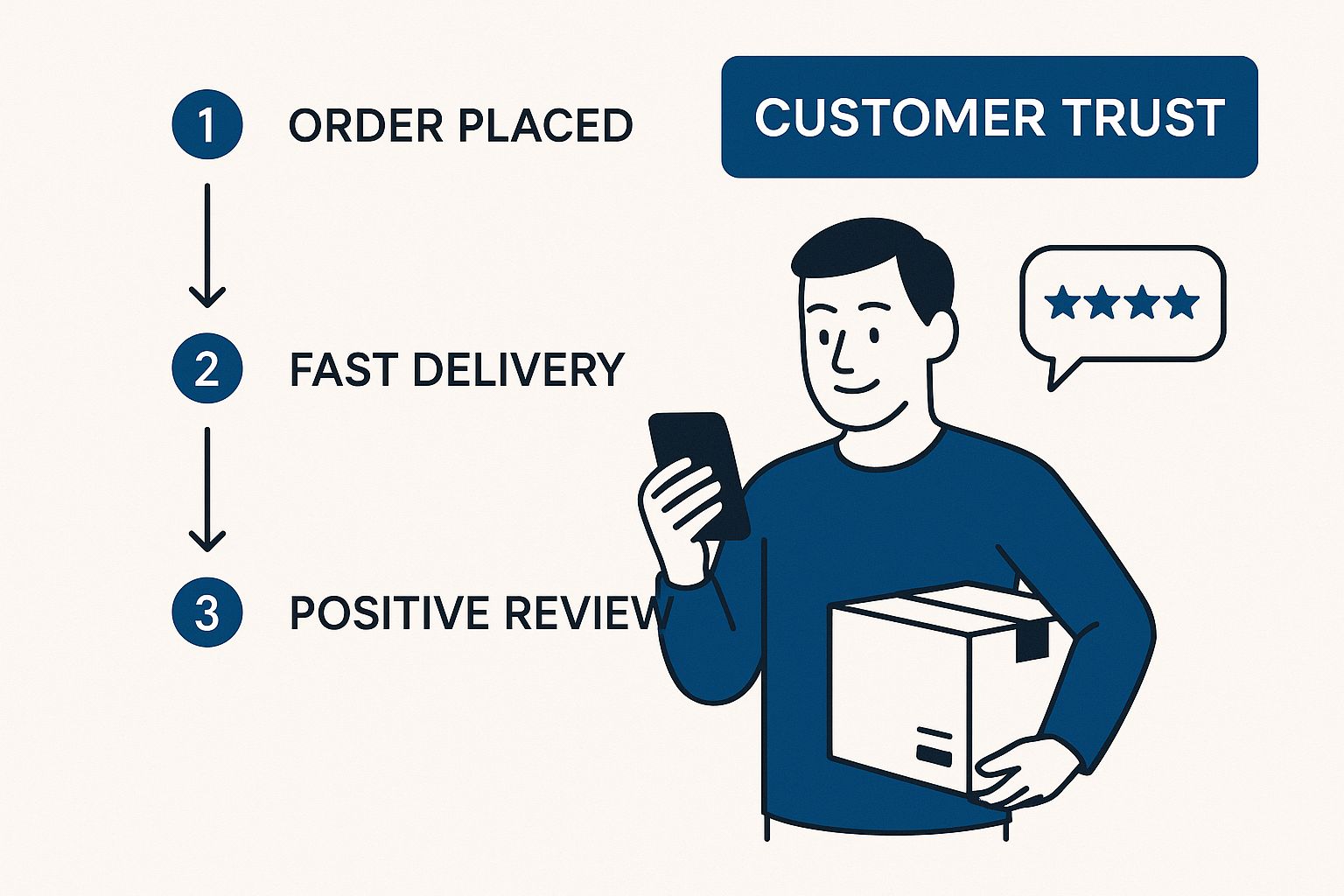
As this flywheel illustrates, the journey from discovery to conversion solidifies trust with both the customer and the algorithm, fueling a virtuous cycle of growth.
Moving Beyond ACOS to TACOS
Most sellers are myopically focused on ACOS (Advertising Cost of Sale). While it’s a crucial metric for campaign-level efficiency, it only tells part of the story. A low ACOS in isolation reveals nothing about the overall health and scalability of your Amazon business.
To understand the true impact of your advertising, you must obsess over Total Advertising Cost of Sale (TACOS).
TACOS is calculated as (Total Ad Spend ÷ Total Revenue) x 100. This formula provides a true north metric, showing the relationship between your advertising investment and your total business revenue (paid + organic).
A declining TACOS over time, even with a stable or increasing ACOS, is the ultimate indicator of a successful flywheel strategy. It is mathematical proof that your ad spend is effectively increasing your organic sales, making your entire Amazon business more profitable and less reliant on paid media. To go deeper on this, check out our guide on 10 advanced Amazon advertising strategies to fuel organic growth and profitability.
To make it crystal clear, let's break down how these two critical metrics differ and why you need both.
TACOS vs ACOS: A Strategic Comparison
This table breaks down the difference between ACOS and TACOS, helping leaders understand the true impact of their ad spend on overall business health.
| Metric | What It Measures | Strategic Focus | Ideal for Assessing |
|---|---|---|---|
| ACOS | Ad Spend ÷ Ad Revenue | Campaign Efficiency | How profitably an individual ad campaign is converting clicks into direct sales. |
| TACOS | Ad Spend ÷ Total Revenue | Business Health | The overall impact of your advertising on total sales, including organic uplift. |
By managing to both KPIs, you achieve a holistic view. ACOS guides your tactical, short-term campaign management, while TACOS directs your long-term strategy toward building a sustainable, scalable, and ultimately more valuable business on Amazon.
So, you’ve optimized your listings and your PPC flywheel is spinning. Your organic rank is climbing. What’s next?
Stopping here is a defensive posture—you're only capturing existing demand. To truly scale and build a defensible brand, you must go on offense. You need to create demand, not just fulfill it. That means reaching shoppers before they even begin their search on Amazon.
Go Beyond the Search Bar with Amazon DSP
This is where Amazon's Demand-Side Platform (DSP) becomes your strategic growth driver. It enables you to engage shoppers across the web, on Amazon-owned properties (like Twitch and IMDb), and on third-party sites and apps, all powered by Amazon's unparalleled first-party purchase and browsing data.
While PPC is exceptional at capturing bottom-of-funnel demand, DSP is designed to create it. It generates awareness and consideration, filling the top of your marketing funnel so that your PPC campaigns have more high-intent demand to harvest later. It’s the one-two punch that unlocks breakthrough growth.
Stop Thinking Keywords, Start Thinking Audiences
Executing on DSP requires a critical mindset shift from keywords to audiences. You are no longer bidding on what people type; you are targeting people based on who they are and what they do. This opens up powerful strategic capabilities.
You can engage shoppers based on their demonstrated behaviors, both on and off Amazon. For example, you can target:
- In-Market Audiences: Consumers who have recently browsed or purchased within your category.
- Lifestyle Audiences: Shoppers whose patterns indicate specific affinities, like "Eco-Friendly Shoppers" or "Luxury Travelers."
- Lookalike Audiences: New audiences that mirror the browsing and buying behaviors of your most valuable existing customers.
This is how you break through a performance plateau. You are shifting from a reactive, search-based strategy to a proactive, audience-based one, building brand equity that drives purchase decisions.
DSP Strategies You Can Use Right Now
Where DSP excels is in its retargeting capabilities. Leveraging Amazon's pixel and purchase data allows you to execute highly relevant, full-funnel remarketing campaigns.
Consider this scenario: a shopper visits your product detail page, adds your item to their cart, but gets distracted and abandons the purchase. An hour later, while browsing a news site, they are served a dynamic display ad featuring the exact product from their cart.
That is a recovered sale that Sponsored Products simply cannot influence.
Headline's Recommendation: DSP is the strategic bridge between a shopper's activity across the entire web and the point of purchase on Amazon. Use it to re-engage high-intent traffic, stay top-of-mind during the consideration phase, and drive incremental sales that would otherwise be lost.
Mini Case Study: Re-Engaging Past Buyers for a Higher LTV
A pet supplements brand we work with faced a common challenge: a respectable but stagnant repeat purchase rate. Customers would buy once but were not being systematically re-engaged for their next purchase cycle.
The Playbook: We leveraged Amazon DSP to create a specific audience segment: all customers who had purchased their top-selling joint supplement within the last 90 days. We then deployed a simple "replenishment" campaign targeting only this group. The creative was direct: a product shot with the copy, "Running low? Keep your best friend feeling their best."
The Win: The results were definitive. The brand saw a 22% lift in repeat purchases from this cohort in the following quarter. Because the targeting was so precise, the return on ad spend (ROAS) was exceptionally high.
This wasn't just a short-term sales lift. This tactical DSP execution directly increased customer lifetime value (LTV) and built a more loyal, predictable revenue base. This is the power of a mature DSP strategy: using Amazon's data to deliver the right message to the right person at the exact right time.
Making Smarter Decisions with Your Amazon Data
Guesswork is the enemy of scalable growth on Amazon. Sustainable performance is built on a foundation of data-driven decision-making. Too many brands focus on vanity metrics that feel good but provide no real insight into business health.
To truly increase sales, you must go deeper. The goal is to create a tight feedback loop where performance data directly informs your strategy—from ad creative and budget allocation to pricing and product development.
Your Amazon reports are not just a record of the past; they are a roadmap for the future. A data-first culture is the core of any modern, high-performance Amazon operation.
Uncovering Opportunities in Your Search Term Report
One of the most valuable—and often underutilized—tools at your disposal is the Search Term Report. This is a direct transcript of customer intent. Analyzing this report reveals precisely how shoppers find your products and, just as importantly, how they don't.
Identify search terms with strong conversion rates that are not yet isolated in manual, exact-match campaigns. These are proven winners. "Harvesting" these terms and moving them into dedicated campaigns allows you to control bids with precision, maximize impression share, and defend your position against competitors.
Conversely, the report uncovers budget waste. Identify terms that generate clicks but no sales and add them as negative exact match keywords. This is like plugging a leak in your budget, immediately improving your ACOS and reallocating capital to terms that actually drive revenue.
Headline's Recommendation: The Search Term Report is your direct line into the customer's mind. Use it relentlessly to double down on what works, eliminate what doesn't, and uncover pockets of growth that are invisible to your competitors.
Leveraging Brand Analytics for a Competitive Edge
For brand-registered sellers, Amazon Brand Analytics is a strategic force multiplier. It provides market-level intelligence that goes far beyond your own account data, offering a clear view of the competitive landscape and aggregate consumer behavior.
Use these reports to answer mission-critical business questions:
- Market Basket Analysis: What other products are frequently purchased alongside yours? This insight can unlock powerful opportunities for product bundling, cross-promotional advertising, and new product development. If you sell premium coffee beans and see a specific grinder in the report, a "Complete Barista Kit" bundle becomes an obvious strategic initiative.
- Demographics: Who is your actual customer? Understanding their age, income, and gender allows you to refine ad targeting and craft listing copy and A+ Content that resonates more deeply.
- Item Comparison: Which competing products are shoppers considering alongside yours? This report provides a data-validated list of your direct competitors. Analyze their listings, pricing strategies, and customer reviews to identify their weaknesses and your opportunities.
This level of intelligence is indispensable on a platform where competition is always intensifying. Amazon's relentless growth—revenue is up 10.87% year-over-year—creates immense opportunity for sellers who know how to wield data as a competitive weapon. You can see the full picture by checking out the latest financial trends on macrotrends.net.
When you integrate these data sources, you are no longer just running ad campaigns; you are operating a business intelligence engine that fuels your Amazon advertising strategy blueprint for profitable scale. Every decision becomes backed by data, not intuition.
Answering Your Top Amazon Growth Questions
As your brand scales on Amazon, you move beyond tactical questions and into complex strategic challenges. Below, I'll address the most common high-level questions we hear from eCommerce leaders who are committed to moving from simply participating on Amazon to truly leading their category.
How Should I Split My Budget Between Ad Types?
Allocating your ad budget should be a strategic exercise, not a guess. A sophisticated approach aligns budget with the specific objective of each ad type within the marketing funnel.
Sponsored Products (SP): This is your primary demand-capture tool. It targets bottom-funnel shoppers with high purchase intent. This is where the majority of your budget—typically 60-70%—should be focused. The core job of SP is to drive immediate sales velocity, defend branded search terms, and conquer high-value non-brand keywords.
Sponsored Brands (SB) & Sponsored Display (SD): These are your mid-funnel assets for brand building and competitive defense. Allocate 20-30% of your budget here. Use Sponsored Brands for top-of-search visibility on broad category terms and Sponsored Display for powerful on-platform retargeting to re-engage shoppers who viewed your products but did not purchase.
Amazon DSP: This is your demand creation engine. DSP reaches shoppers across the web, building top-of-funnel awareness before they even begin their search on Amazon. For brands poised for aggressive scale, an initial allocation of 10-15% is a strategic investment in future growth.
This is a dynamic model. As your brand matures and your TACOS improves, you should strategically shift more budget towards top-of-funnel initiatives like DSP to continuously feed the flywheel.
How Do I Break Through a Sales Plateau?
A sales plateau is rarely caused by a single factor. It's a signal that your current strategy has reached its ceiling of effectiveness. To reignite growth, you must layer in new strategies to expand your audience and increase your conversion rate.
Start with a data audit.
Is your impression share on top keywords declining? This may indicate increased competitive bidding pressure requiring a more aggressive bid strategy. Is your conversion rate trending down? This is a clear signal to begin A/B testing your main image, title, or A+ Content. A marginal gain in conversion rate can have a significant impact on total sales.
Once you've optimized existing assets, seek new territory. Are there adjacent, non-branded keyword categories you have yet to target? Amazon Brand Analytics is an invaluable tool for this discovery. However, the most reliable way to break a plateau is to move up the funnel. If your strategy has been 100% reliant on PPC, launching a DSP retargeting campaign is a proven method for capturing otherwise lost traffic and pushing past your previous sales peak.
Headline's Recommendation: A sales plateau is not a roadblock; it's a strategic inflection point. Stop trying to extract more from an exhausted strategy. Instead, use performance data to optimize your conversion funnel, then expand your reach with new audiences and ad formats.
Balancing Aggressive Growth with Long-Term Profitability
This is the central tension for every eCommerce leader. The choice between aggressive growth and margin preservation is a false one. You can and must achieve both. The key is focusing on the right metric at the right stage of the product lifecycle.
During a product launch or a market share offensive, a high ACOS is not only acceptable but often required. You are investing in data acquisition and sales velocity to initiate the flywheel.
The ultimate barometer of long-term, profitable health, however, is your TACOS (Total Advertising Cost of Sale). As long as your TACOS is stable or trending downward, your aggressive ad spend is working. It is definitive proof that your paid media investment is successfully lifting your organic sales baseline, making the entire business more profitable and valuable over time. Mastering this balance is the key to understanding how to increase sales on Amazon in a way that is both sustainable and scalable.
At Headline Marketing Agency, we transform these complex challenges into a clear, data-driven growth plan. We leverage proprietary technology and deep cross-channel expertise in both PPC and DSP to build advertising strategies that drive not just sales, but sustainable profitability and category leadership. Discover how our performance-first methodology can unlock your brand's potential at https://headlinema.com.
Get Your Free Amazon PPC Audit
Discover untapped growth opportunities and see how our data-driven approach can improve your ROAS.
Get Free Audit →Wollen Sie Ihre Amazon PPC-Performance aufs nächste Level bringen?
Lassen Sie Ihre Amazon PPC-Kampagnen professionell analysieren und entdecken Sie neue Wachstumsmöglichkeiten.