Amazon Seller How to Ship: FBA, FBM and SFP Compared
Learn Amazon seller how to ship: compare FBA, FBM and Seller Fulfilled Prime, then set handling times, tracking targets and fees.

“Use FBA so you can focus on growth” is incomplete advice. So is “ship orders yourself to save money.” Neither tells an Amazon seller how to ship profitably once storage, warehouse labor, delivery performance, returns, and advertising enter the calculation.
Shipping is a product-level profit decision, not just a carrier choice. Your fulfillment model determines how much contribution profit remains to fund PPC, how confidently you can promise delivery, and whether additional sales improve the business.
FBA, FBM and Seller Fulfilled Prime Side by Side
FBM only saves money when your fulfillment operation costs less than Amazon's. A lower postage quote does not account for warehouse labor, packing materials, carrier management, or customer-service work. Each model assigns those costs and responsibilities differently.
Amazon's FBA program covers storage, picking, packing, shipping, customer service, and returns, with per-unit fulfillment and monthly storage charges. Prime eligibility depends on product, inventory, and marketplace requirements.
Amazon's Fulfilled by Merchant program leaves the seller responsible for fulfillment. That gives you control over handling and shipping, but the advantage depends on reliable execution.
Fulfillment model comparison
| Factor | FBA | FBM | Seller Fulfilled Prime |
|---|---|---|---|
| Who stores and packs | Amazon | Seller | Seller |
| Who ships and handles delivery | Amazon | Seller through a carrier | Seller, under Prime delivery standards |
| Prime eligibility | Eligible, subject to product and inventory rules | Not included by default | Prime badge after a 28-day trial and meeting performance thresholds |
| Cost model | Per-unit fulfillment fee plus monthly storage | Postage, packaging, and labor | Postage, packaging, and labor |
| Who owns handling time | Amazon | Seller, set per SKU | Seller, with same-day or one-day handling for Prime promises |
| Best fit | Compact, steady, high-velocity items | Oversized or low-margin items, or sellers with strong warehouse control | Sellers with proven capacity and at least 100 seller-fulfilled packages in the last 90 days |
Seller Fulfilled Prime keeps the warehouse and carrier operation in your hands while requiring Prime-level execution. Treat the badge as an operating commitment, not a shortcut to more sales.
Practical rule: Set a default fulfillment model for each product line, then make exceptions where the economics justify them.
Compact products with steady demand are reasonable FBA candidates. Test FBM for bulky items, custom packing requirements, or products with margins that cannot absorb storage and fulfillment costs. Recheck the fit when costs or operating requirements change.
Choosing Each SKU's Model by Contribution Margin
A cheap postage quote can hide an expensive fulfillment operation. If your comparison excludes picking labor, packaging, failed handoffs, and returns processing, you're comparing a complete FBA service with an incomplete FBM cost.
Use contribution profit before advertising as the common denominator:
Selling revenue minus product COGS, referral fees, inbound freight allocation, fulfillment, storage, surcharges, packaging, labor, carrier charges, and expected return costs.
Amazon's FBA fee schedule lists the following 2026 U.S. low-price, non-peak examples, before the separately stated fuel and logistics surcharge. It also explains that monthly storage uses daily average inventory volume and that aged inventory can incur an additional surcharge.
2026 US FBA cost reference points
| Cost item | 2026 US reference | Applies to |
|---|---|---|
| Small-standard item, 2 oz or less | $2.43 non-peak fulfillment fee | Low-price FBA |
| Large-standard item, 4 oz or less | $2.91 non-peak fulfillment fee | Low-price FBA |
| Fuel and logistics surcharge | 3.5% from April 17, 2026 | FBA in US and Canada |
| Average 2026 FBA fee increase | $0.08 per unit, under 0.5% of average selling price | FBA in US |
| Monthly inventory storage | Charged on daily average inventory volume | FBA |
| Aged inventory surcharge | Extra fee on aged stock | FBA |
| Postage and packaging | Carrier rate for the parcel, plus packing materials | FBM |
Amazon's fee-change documentation states the 3.5% surcharge begins April 17, 2026, and reports an average 2026 U.S. FBA increase of $0.08 per unit, under 0.5% of an average item's selling price. These are reference points, not a substitute for your SKU's actual fee calculation.
Find the volume where the economics change
Calculate expected monthly contribution under both models. Include incremental fixed costs for FBM, such as additional warehouse staffing or equipment, rather than spreading existing overhead arbitrarily across orders.
Where FBM offers lower variable costs but requires extra fixed spending, calculate:
Break-even monthly orders = additional monthly fixed cost ÷ per-order variable-cost saving.
If there's no positive variable-cost saving, additional volume won't create that particular break-even point. Also test whether a different delivery promise changes conversion enough to offset the apparent fulfillment saving.
Use our guide to shipping rates on Amazon to organize the cost comparison. Keep fast sellers in FBA where the economics hold, test slow or bulky products in FBM, and evaluate heavily returned products against your actual returns-processing costs. Review assignments quarterly.
How to Set Up Seller-Fulfilled Shipping Step by Step
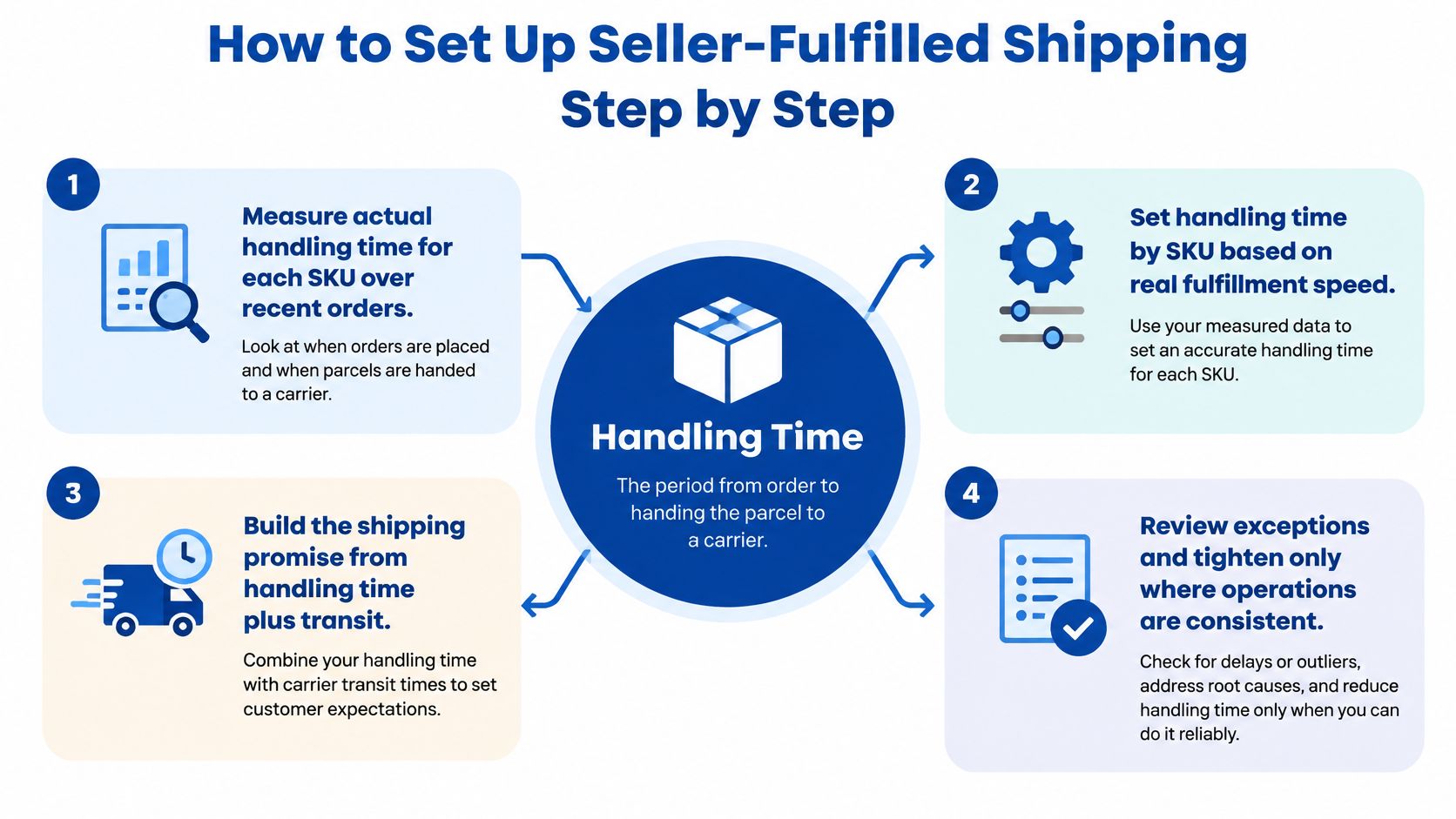
Handling time controls the part of the delivery promise your warehouse owns. Amazon's handling-time guidance defines it as the period from order placement to carrier handoff and states that, beginning June 29, 2026, seller-fulfilled SKUs must use accurate handling times that consistently match actual performance.
Use this process to connect the promise to physical execution.
Build the promise from warehouse evidence
Measure actual handling by SKU. Pull recent order-placement and carrier-acceptance timestamps from your warehouse records, separating normal operations from exceptions. Don't configure the whole catalog around your fastest packing day.
Set SKU-level handling times. Use the measured performance to distinguish ready-to-ship inventory from products requiring assembly, customization, or special packing. The common mistake is assigning the same aggressive setting to products with different workflows.
Match order cutoff to carrier acceptance. Amazon's Seller Fulfilled Prime handling rules require orders received before cutoff with same-day, one-day, or two-day delivery promises to ship that day, meaning zero-day handling. Don't accept orders against a pickup that's already departed.
Verify standard Prime and weekend coverage. The same rules specify one-day or same-day handling for standard shipping offered to Prime customers. Confirm staffing and carrier availability before enabling the promise, rather than assuming weekday capacity extends to weekends.
Control the physical handoff
Print labels when parcels are ready. Finish picking, packing, and address validation before releasing the label into the dispatch workflow. Printing labels hours before packing creates an internal appearance of progress without moving the parcel.
Validate tracking at creation and carrier acceptance. Check that the tracking identifier belongs to the selected service and order, then investigate parcels that don't receive an acceptance scan. A valid-looking identifier isn't evidence that the carrier collected the package.
Compare actual handoff with configured handling. Review exceptions by SKU, shift, and pickup route so warehouse leaders can distinguish capacity problems from carrier failures. Don't shorten the setting until the process can sustain the faster handoff.
Our Amazon Buy Shipping guide explains the label-purchasing workflow. Keep label processing subordinate to the operational sequence, not the other way around.
Extend or suppress promises the warehouse can't support. A faster displayed promise isn't useful if your team can't hand over the parcel on time.
Choosing Carriers, Packing and Routing for Parcels
Choose the lowest total-cost service that can meet the promise, not the lowest advertised rate. A carrier comparison built around a parcel you rarely ship tells you little about the lanes that drive your actual costs.
Buy against your real parcel profile
Request quotes using packed weight, external dimensions, destination mix, and expected pickup arrangements. Compare billed charges with your estimates after an initial shipment sample, including adjustments that weren't visible in the original quote.
For a concrete packaging comparison, Material Handling USA's guide lets you compare shipping costs for 12x12x12 boxes. Use that fixed-box example to understand the comparison method, then substitute your own parcel dimensions.
- Check acceptance timing. A service misses your dispatch requirement when collection or acceptance falls after your operational deadline. Transit speed can't repair a missed handoff.
- Reduce empty space. Select the smallest protective package, then weigh and measure the finished parcel. Don't use the product's bare dimensions as shipping dimensions.
- Confirm label compatibility. Test label format, printer settings, barcode readability, and service selection before warehouse rollout. Reprints and unreadable barcodes add avoidable handling work.
Route by lane, not habit
Use regional services for short-distance lanes where their delivery performance supports the promise. Consolidate longer-distance volume with a national carrier when its coverage and economics justify that choice.
Keep a qualified backup for each important region, including tested labels, pickup arrangements, and tracking integration. Switch an underperforming lane before its failures become an account-wide problem.
Don't force every parcel through the carrier with the best blended average. Your customers receive individual parcels on individual lanes, not an average service.
How to Send Inventory to FBA Without Reconciliation Errors
An FBA shipment isn't complete when someone creates the shipment plan. It's complete when the physical inventory, shipment records, and carrier information agree.
Amazon's Send to Amazon workflow separates product selection, packing, shipping confirmation, labels, pallet information, and tracking. Assign a named owner to each stage so unfinished work doesn't disappear between teams.
Use a dispatch checklist with accountable owners
- Inventory planner selects the products. Choose eligible FBA SKUs or upload them in bulk, then verify the ship-from address and destination marketplace. Confirm the shipment contains the intended product versions, not similar-looking units.
- Pack lead verifies quantities and packing type. Enter unit quantities, prepare products, and apply required labels. Check whether preparation and labeling belong to your team or Amazon before the warehouse begins work.
- Operations lead reviews the shipment plan. Confirm products, quantities, shipping method, and carrier details against the actual movement. Don't approve a plan solely because the software generated it successfully.
- Dispatch coordinator completes carton and pallet records. Print the correct box labels, add pallet details where applicable, and confirm tracking. Keep obsolete labels away from the packing line.
- Pack lead signs off before collection. Reconcile SKU quantities across the shipment plan, carton contents, and carrier handoff records. Resolve discrepancies before dispatch instead of leaving receiving teams to discover them.
Reconcile before the inventory leaves
Use a carton-level packing record that allows another employee to identify what each box contains. Save the final shipment documents and carrier handoff evidence together so discrepancies can be investigated without reconstructing the shipment from messages.
For an additional operational walkthrough, use Reddog Consulting Group's FBA shipping guide. For cross-border movements, our guide to Amazon FBA freight forwarders helps frame the inbound logistics decision.
Labeling, preparation, carton, and carrier requirements differ by marketplace and category. Check the destination's requirements before packing, and size the shipment against forecast demand through the next replenishment window. Sending everything available isn't an inventory strategy.
Shipping Metrics Amazon Checks and Their Thresholds
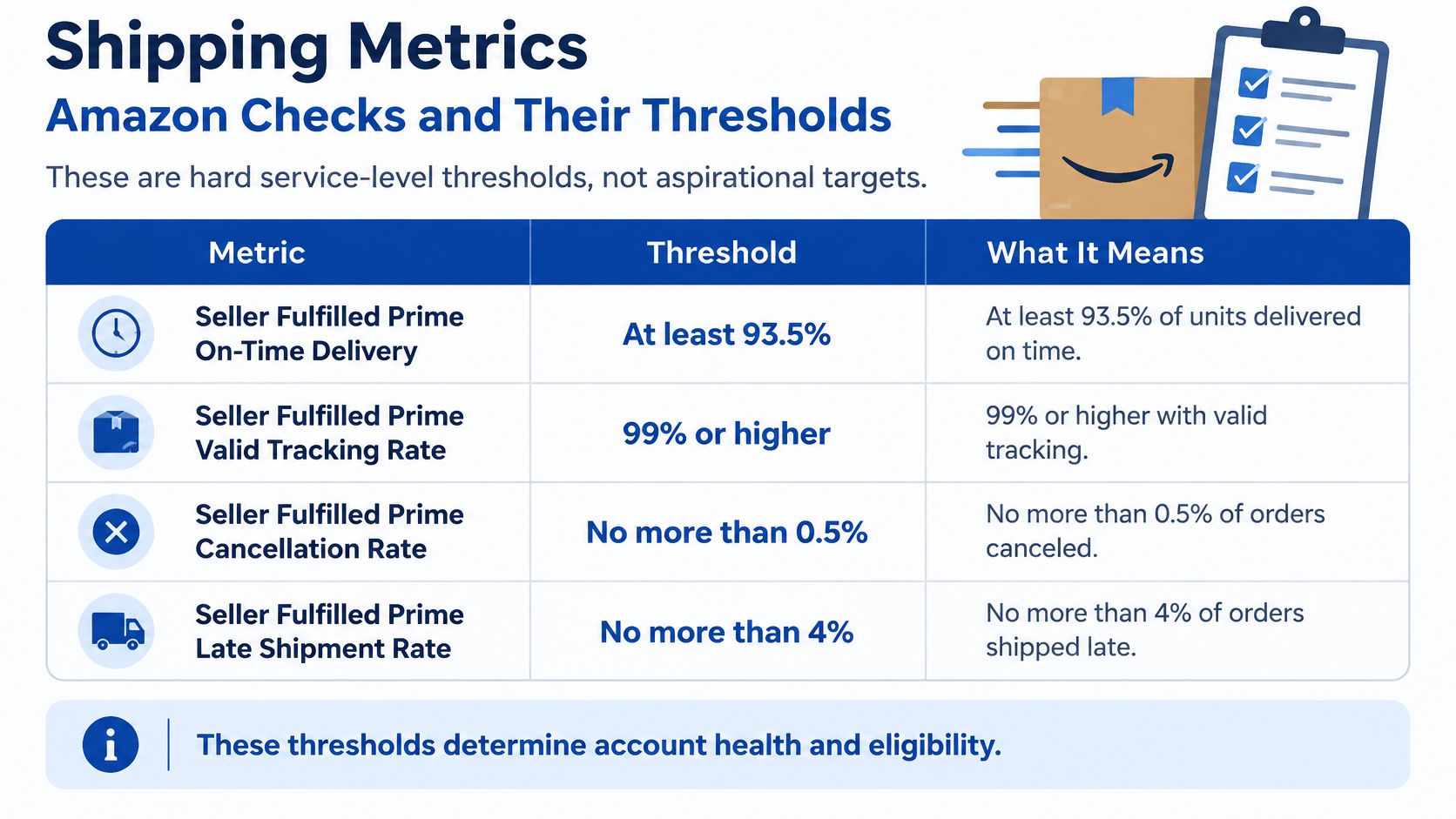
Seller Fulfilled Prime requires at least 93.5% on-time delivery, according to Amazon's program requirements, alongside at least 99% valid tracking, cancellations no higher than 0.5%, and at least 100 Prime packages per month. These are service-level thresholds, not stretch goals.
A failing destination lane can pull down the account-level result even while other regions perform well. Monitor the groups that produce the aggregate, not just the final dashboard percentage.
Seller Fulfilled Prime thresholds and checks
| Metric | Threshold | How it is measured |
|---|---|---|
| On-time delivery | At least 93.5% | Units delivered on or before the promised date divided by Prime units with a delivery scan |
| Valid tracking | At least 99% | Check at order creation and again at the first carrier scan |
| Cancellation rate | No more than 0.5% | Separate stockouts, address problems, and warehouse cutoff failures |
| Prime packages | At least 100 per month | Monthly count of Prime packages shipped |
| Trial entry | At least 100 seller-fulfilled packages in 90 days | Tracking rate above 95% before the 28-day trial starts |
Amazon's Seller Fulfilled Prime enrollment page specifies a Professional selling account, a domestic U.S. default shipping address, at least 100 seller-fulfilled packages during the preceding 90 days, and valid tracking above 95%. Its 28-day trial also requires at least 100 Prime-trial orders, consistent weekly shipping, and compliance with program performance requirements.
Use the visual as a monitoring reminder, but verify each program-specific requirement in Seller Central rather than applying a generic late-shipment figure to SFP.
Review causes before averages
Amazon's Fulfillment Insight documentation describes a trailing 30-day view for seller-fulfilled non-Prime orders, including actual handling, transit, delivery, and on-time metrics. Don't confuse that dashboard's scope with the Prime program's requirements.
Calculate internal metrics daily by SKU, carrier, destination region, and shipping template. Flag groups approaching a threshold, then adjust capacity, service selection, inventory availability, or promises.
Separate cancellations into stockouts, address problems, and cutoff failures because each needs a different owner and fix. In the weekly operations review, compare warehouse dispatch and carrier transit separately. Faster picking won't repair an unreliable transportation lane.
Pricing, Packaging and PPC After 2026 Fee Changes
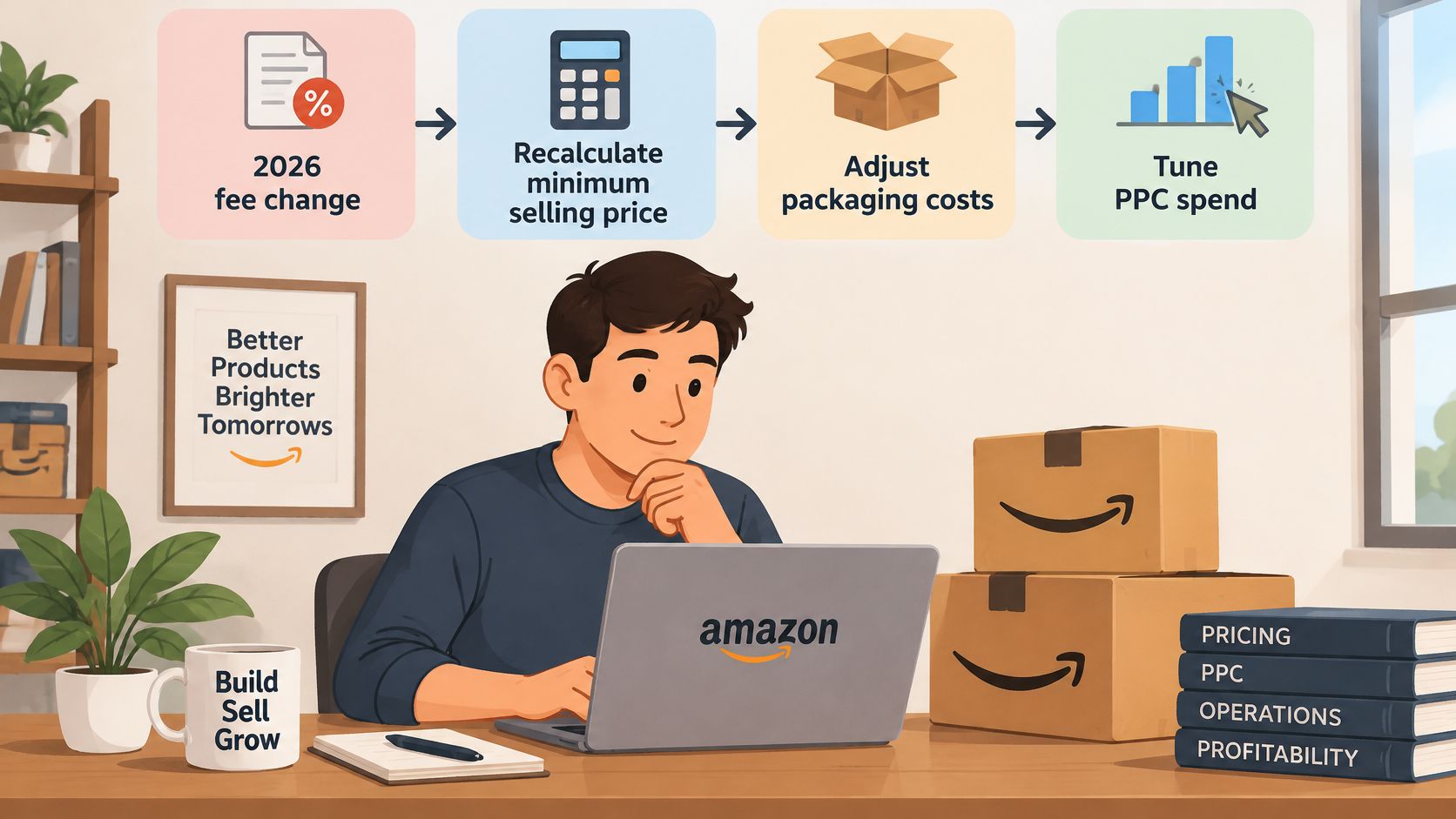
Fee changes should trigger a SKU profitability review before an advertising-budget cut. The published average increase isn't your product's increase, and the logistics surcharge must be reflected in the fulfillment cost you model.
Use the operating review to connect fulfillment changes with commercial decisions.
Adjust price, packaging, then bids
Start with price. Recalculate the minimum selling price that preserves your required contribution profit using the current fee preview, not a catalog-wide average. Prioritize products with larger actual fee changes and limited pricing flexibility.
Next, test packaging. Measure the final sellable package against the applicable size and weight rules, then test whether a smaller protective design changes the fee outcome. Include damage and return exposure, because saving on fulfillment while increasing breakage isn't progress.
Finally, reset PPC targets. Your break-even advertising cost of sales, or ACOS, follows contribution margin before advertising; a profitable target must also preserve the contribution you want to retain. Don't keep bidding against an old ACOS target after the underlying unit economics change.
The advertising discussion belongs inside that broader operating review.
Fund growth from profit, not revenue
Headline's position is straightforward: PPC should support profitable sales, organic visibility, and sustainable scale, not merely produce an attractive advertising dashboard. Paid search can support the sales velocity behind organic growth, but it doesn't guarantee ranking improvements or justify selling at an unacceptable loss.
Our Analytics Suite combines Amazon Seller Central, Amazon Advertising Console, third-party tools, and Amazon Marketing Cloud into a unified view; its P&L analysis integrates sales, advertising spend, product COGS, and Amazon fees to show actual Amazon profitability. We work within client-owned accounts, and clients retain ownership of their listings and advertising assets.
We serve Amazon marketplaces in the US, CA, MX, BR, UK, DE, FR, IT, ES, PL, SE, and AU. Apply local fulfillment economics in each market rather than exporting a U.S. margin assumption.
Scale advertising only on SKUs whose contribution profit holds after shipping and fee costs.
Headline Marketing Agency offers Amazon PPC, DSP, AMC, and Analytics & Insights to connect advertising decisions with product profitability. Visit Headline Marketing Agency to discuss a SKU-level review of fulfillment costs, contribution margins, and the advertising investment your products can sustain.
Get Your Free Amazon PPC Audit
Discover untapped growth opportunities and see how our data-driven approach can improve your ROAS.
Get Free Audit →Wollen Sie Ihre Amazon PPC-Performance aufs nächste Level bringen?
Lassen Sie Ihre Amazon PPC-Kampagnen professionell analysieren und entdecken Sie neue Wachstumsmöglichkeiten.