Amazon Seller Account Suspended? A Performance-First Recovery Guide
Account suspensions happen fast. Our reinstatement playbook for Amazon seller reinstatement has recovered dozens of accounts — here's the process.

The "Your Amazon selling privileges have been removed" email is a gut punch to any eCommerce leader. One minute you're optimizing ad spend and monitoring sales velocity; the next, your entire Amazon operation grinds to a halt. Cash flow freezes, your products disappear from the digital shelf, and the organic rank you fought for begins to erode.
In those first 24 hours, panic is the enemy. A calm, methodical, data-driven response is your only path back to profitability.
That Dreaded Suspension Email: What To Do First
That initial notification from Amazon feels vague, impersonal, and engineered to cause maximum confusion. Before you even consider drafting an appeal, your immediate priority is a forensic analysis of your account data.
Resist the powerful urge to fire off a quick, emotional email. This is a classic mistake that signals to Amazon you're an amateur, making reinstatement significantly more difficult. Take a breath. Your job is to gather the facts, not make rash decisions.
Pinpoint the Exact Policy Violation
Amazon’s notifications are notoriously indirect, but they contain critical clues. You must read between the lines to diagnose the precise policy failure. Was it a performance metric slip-up or a more severe product policy or IP complaint?
Look for key phrases that point you to the root cause:
- "Rights owner complaints" or "intellectual property" is an IP violation.
- "Order Defect Rate," "Late Shipment Rate," or "Valid Tracking Rate" signal a breakdown in your fulfillment operations.
- "Inauthentic" or "counterfeit" points directly to weaknesses in your supply chain documentation.
- "Used sold as new" is a red flag for product condition or packaging failures.
Understanding the why is everything. A suspension isn't just about lost sales; it's a catastrophic blow to your growth engine. All your Sponsored Products and Sponsored Brands campaigns are shut down instantly. Ad revenue drops to zero, killing the sales velocity your PPC efforts were built to support and, in turn, destroying your organic rank.
To help you get started, here's a quick reference table to translate Amazon's cryptic language into actionable intelligence.
Decoding Amazon's Suspension Triggers
| Suspension Category | Common Notification Language | What It Really Means | Immediate Action Required |
|---|---|---|---|
| Performance | "Your Order Defect Rate exceeds the 1% target." | You're getting too many A-to-z claims, negative feedback, or chargebacks. | Audit all recent negative feedback and A-to-z claims to find a pattern. |
| Product Policy | "We have removed listings that violate our Restricted Products policy." | You're selling something that's either banned or requires pre-approval. | Review the specific ASINs mentioned and check against the Restricted Products list. |
| IP Complaint | "We received a complaint from a rights owner..." | Another brand claims you've infringed on their trademark, patent, or copyright. | Identify the complainant and the specific ASIN. Find your invoices and LOA. |
| Authenticity | "Concerns about the authenticity of your items." | A customer reported your product as a fake, or Amazon can't verify your supplier. | Gather all supplier invoices and Letters of Authorization for the last 365 days. |
This table should be your first stop. Once you've identified the likely cause, you can begin the real work of collecting evidence for your appeal.
Headline Takeaway: Your initial reaction sets the tone for your entire reinstatement process. A calm, evidence-based approach is infinitely more effective than a panicked appeal. Your goal is to demonstrate to Amazon that you are a professional partner capable of identifying and permanently fixing a core business problem.
Grasp the Financial Urgency
The financial bleeding from a suspension is immediate and severe. If you need a reminder of how quickly things can go south, just look at this real-world account takedown scenario where a seller lost $50,000 in 3 days. This isn't just a pause; it's a direct assault on your revenue, making a swift, accurate diagnosis essential.
And don't think it can't happen to you. Back in 2020, 23% of German Amazon sellers had their accounts suspended, with a staggering 66% receiving no prior warning. More recently, "related" or "linked" accounts have become a massive issue, with Amazon's algorithms ruthlessly shutting down sellers who have any connection to a previously suspended account. This isn't a rare problem—it's a constant threat.
Getting to the Real Reason for Your Suspension
Let's be clear: Amazon doesn't care about apologies. They want to see that you’ve found a real, operational problem and fixed it for good. Sending a vague "we'll do better" appeal is the fastest way to get your account permanently shut down. A successful reinstatement starts with a deep, brutally honest look at what actually went wrong.
This isn't a time for guessing games. You need to conduct a forensic audit of your business—your operations, performance metrics, and especially your supply chain. Think of it like a detective's investigation; the suspension notice is just your first clue. The real evidence is buried deep inside your account data. This process is a lot like learning how to do legal research efficiently – you have to be methodical to get the right answer.
Start Your Investigation in the Account Health Dashboard
Your Account Health dashboard is the crime scene. Every single metric in there tells a piece of the story, pointing directly to the breakdowns that landed you in this mess. Don't just glance at the numbers; you need to analyze the trends over time and connect them back to your day-to-day business processes.
Here's exactly where you need to focus:
- Order Defect Rate (ODR): If your ODR is creeping over the 1% threshold, that’s a classic red flag. You need to dig into every single A-to-z claim and every piece of negative feedback. Look for patterns. Is a specific ASIN always arriving damaged? Are your product descriptions accidentally misleading customers?
- Late Shipment Rate (LSR) & Valid Tracking Rate (VTR): These two metrics are a direct reflection of your fulfillment process. A sudden spike in your LSR could mean your warehouse is understaffed or your 3PL partner is dropping the ball. A dip in VTR might be as simple as your team entering tracking information incorrectly.
- Policy Compliance: This is where the really serious violations show up. Pay extremely close attention to any Intellectual Property (IP) complaints or Product Authenticity issues. Download the performance notifications and get the specifics—which ASINs were involved, and who filed the complaint?
Uncover Your Supply Chain Weaknesses
For so many sellers, weak documentation is the silent killer. I've seen private label brands get suspended simply because their invoices from an Alibaba supplier didn't have the details Amazon demands, like a verifiable phone number for the supplier or a clear per-unit breakdown.
In fact, inauthenticity complaints remain the #1 reason for Amazon suspensions. As we head into 2025-2026, poor sourcing documentation is the primary culprit. One law firm even reported over 175 successful reinstatements in 2025 alone that were tied directly to this issue. Don't think you're safe just because you're doing retail arbitrage, either. Those receipts from Walmart or Target won't cut it; Amazon wants to see proper, detailed invoices. Their standards are incredibly high, and flimsy paperwork is a guaranteed way to get suspended. You can find more data about suspension causes on amazonsellerslawyer.com.
Headline Takeaway: Your investigation has to be ruthless. The goal isn't to shift blame—it's to find the single, undeniable root cause of the problem. That's the only way you can build a Plan of Action that proves you’ve put a permanent fix in place.
Connecting the Dots to Pinpoint the Root Cause
Once you've gathered all the data from your dashboard and audited your supply chain, it's time to put it all together. The final step is to boil down all your findings into a single, clear statement that identifies the root cause. This one sentence will be the foundation of your entire appeal.
Look at the difference between a vague cause and a specific one:
- Vague Cause: "We got customer complaints about product condition."
- Specific Root Cause: "Our packaging for ASIN B0XXXXXXX was not durable enough for FBA shipping, which led to a 15% damage rate in Q3. This caused a spike in 'Used Sold as New' complaints and pushed our ODR to 1.3%."
Here's another example:
- Vague Cause: "We had an IP complaint."
- Specific Root Cause: "Our marketing team used a copyrighted image in the A+ Content for ASIN B0YYYYYYY without getting a proper license, which resulted in a valid IP infringement complaint from the rights owner."
This level of detail shows Amazon you’ve actually done the work. You aren't just begging to get your account back; you're proving you understand the problem and are capable of fixing a fundamental flaw in your business. This is the only language Amazon's performance teams truly understand.
How To Write A Plan Of Action That Actually Works
Once you've dug in and figured out the real reason for your suspension, it’s time to build your case. Your Plan of Action (POA) isn't an apology letter. It's not the place to argue about whether the suspension was fair. Think of it as a formal, no-nonsense business document with a single goal: to convince Amazon’s investigators that you’ve found and permanently fixed a core problem in your operation.
Forget about those generic templates you find online. A POA that actually gets you reinstated is specific, backed by data, and shows you take full ownership of the problem. Remember, the people reviewing these appeals spend just a few minutes on each one. Your document has to be easy to scan, logical, and credible from the first sentence.
Before you start writing, it’s helpful to quickly map out the process you just went through to get here.
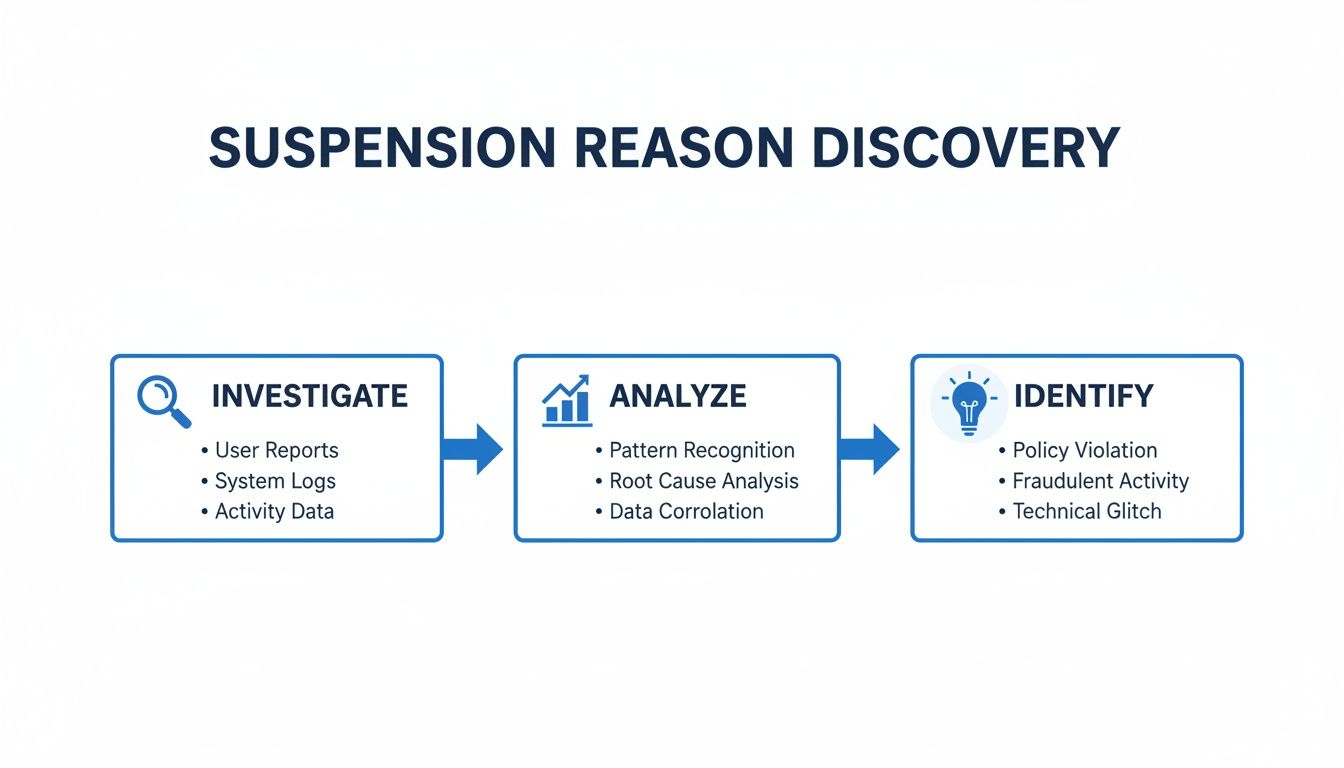
This simple flow—investigating the notice, analyzing your account data, and zeroing in on the specific root cause—is the bedrock of a persuasive POA. It's the groundwork you've already done.
The Three Pillars Of A Winning POA
Every successful Plan of Action is built on three essential pillars. You need to clearly label each section so the reviewer knows exactly what they're reading. This structure demonstrates you've addressed the past, present, and future of the issue.
- The Root Cause: Get straight to the point and explain what went wrong. Don't make excuses. Focus on the operational breakdown. Show Amazon you looked past the symptom (like a customer complaint) and found the underlying process that failed.
- Immediate Corrective Actions: This is where you detail the specific things you have already done to fix the immediate problem. This part is crucial—always use past-tense language ("we have implemented," "we have removed") to prove these actions are already complete.
- Long-Term Preventive Measures: Now, you'll outline the new systems, processes, or even staff you've put in place to guarantee this issue never happens again. This proves you’re thinking systematically and are serious about long-term compliance.
From Vague Promises To Concrete Actions
I can't stress this enough: the biggest mistake sellers make is being too general. Amazon investigators have seen thousands of these, and vague promises are a giant red flag. Your POA needs to be relentlessly specific. You have to turn fuzzy intentions into actions that can be measured and verified.
Just look at the difference here:
Vague POA Statement:
"We will improve our quality control to reduce customer complaints."
Specific, Actionable POA Statement:
"We have implemented a mandatory three-point inspection for ASIN B0XXXXXXX at our 3PL. A dedicated QA manager now signs off on each batch before shipment. We also updated our packaging with a 2-inch bubble wrap liner, which our internal tests show reduces in-transit damage by 45%."
See the difference? The second one works because it's packed with details, uses a real metric, assigns responsibility, and proves the solution is already live. That's the level of precision you need to aim for.
Headline Takeaway: Treat your POA like a legal document. Every claim must be provable. Be professional, stick to the facts, and leave emotion out. Never blame customers, competitors, or Amazon. The entire focus must be on your business and the tangible steps you’ve taken to get back in line with Amazon's policies.
Critical Dos and Don'ts For Your Appeal
Crafting a good POA is as much about what you leave out as what you put in. Sticking to these guidelines will keep your appeal focused, professional, and give you the best shot at getting a yes from the Seller Performance team.
What You MUST Do:
- Use Bullet Points: Nobody wants to read a wall of text. Structure each of your three sections with clear, scannable bullet points.
- Be Factual and Concise: Get right to it. State the root cause, explain the immediate fix, and outline the long-term prevention plan. No fluff.
- Take Full Responsibility: Kick off your root cause section with phrases like, "We acknowledge that..." or "The root cause was our failure to..."
- Provide Evidence: If you mention new invoices, updated training logs, or quality control checklists, attach them to your case as supporting documents.
What You MUST NOT Do:
- Do Not Get Emotional: Pleading about how much money you're losing or the impact on your family won't help. It's counterproductive.
- Do Not Blame Amazon or Customers: Pointing fingers is the fastest way to get your appeal denied. Own the problem completely.
- Do Not Submit a Second Appeal Too Quickly: If your first POA is rejected, don't just send the same one again. Read the feedback, dig deeper, and write a much-improved version.
- Do Not Open a New Account: This is the ultimate sin in Amazon's eyes. It’s a major violation and will almost certainly get you and any related accounts banned for life.
By building your POA around these core principles, you're no longer just a suspended seller—you're a professional partner showing a real commitment to fixing problems. That change in tone and substance is exactly what Amazon is looking for.
The Hidden Damage A Suspension Does To Your Ad Performance
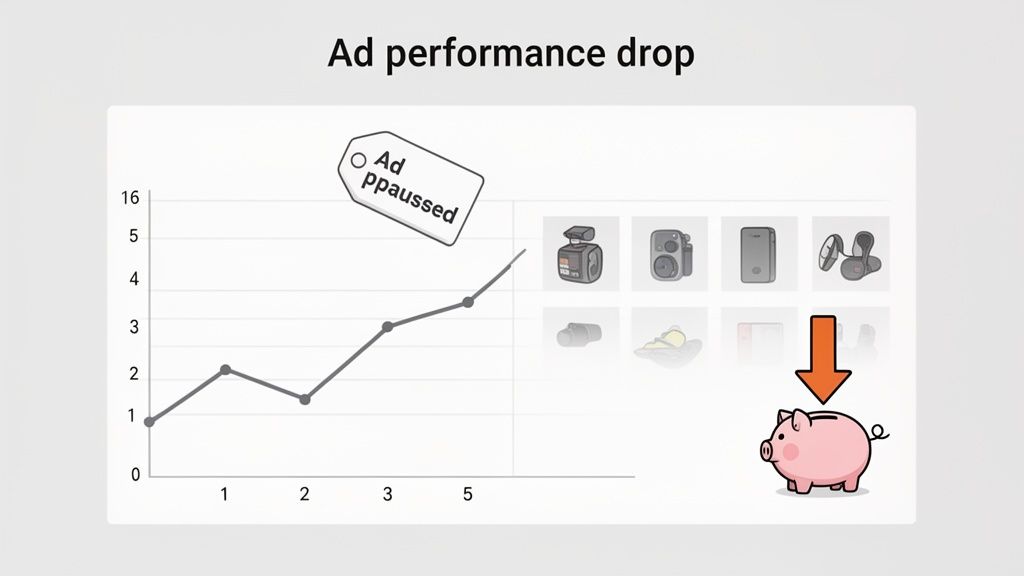
When your seller account gets suspended, the immediate stop in sales is a significant blow. But for performance-focused brands, the real silent killer is the catastrophic failure of your advertising engine—the primary lever for sustainable, profitable growth.
An amazon seller account suspended notice doesn't just halt your organic sales; it instantly shuts down every single Sponsored Products, Sponsored Brands, and Sponsored Display campaign you have running.
Your ad revenue flatlines overnight. All the work you've put into optimizing bids, finding the right keywords, and structuring your campaigns goes out the window. The momentum you fought so hard to build comes to a grinding halt, and that's just the start of your problems.
The Long-Term Erosion of Organic Rank
The lasting damage isn't just about the ads themselves—it’s about your organic visibility. Smart Amazon advertising isn't just about driving immediate sales; it’s a strategic lever to feed the A9 algorithm, prove product relevance, and boost organic rankings. Your PPC campaigns create the sales velocity for key search terms that tells Amazon your product is a top contender.
When your ads disappear, so does that velocity.
Your Best Seller Rank (BSR) starts to slip. The organic keyword positions your ads helped you secure begin to fade. Before you know it, your top-of-page-one product is buried on page five.
Consider this common scenario:
- A brand is hit with a two-week suspension over a minor paperwork issue.
- Before this, their hero product ranked in the top 5 organic spots for its primary keyword.
- Once they're reinstated, they log in to find that same product is now ranking at position 47.
To recover, they are forced to get incredibly aggressive with their ad spend—often doubling their bids just to reclaim the visibility they used to have organically. Their entire advertising profitability model is compromised.
The Cost of Rebuilding Momentum
Fighting your way back up the rankings after a suspension is a slow, expensive grind. Amazon's algorithm doesn't just welcome you back with open arms; you have to prove your relevance all over again. This means pumping serious money back into advertising, often at a much higher Advertising Cost of Sale (ACOS) than before.
This directly hammers your profitability. You’re not just spending to find new customers anymore—you’re paying a premium to reclaim the ground you already owned. Every dollar spent playing catch-up is a dollar you can't invest in launching new products or scaling your business.
If you're finding that your campaigns just aren't hitting their stride even after you're back online, it might be time to re-evaluate your whole strategy. We actually cover this in our guide on what to do when your Amazon advertising is not working.
Headline Takeaway: A healthy seller account is the bedrock of a profitable advertising program. Maintaining compliance isn't an operational chore; it's a strategic imperative to protect your ad investment, organic rank, and long-term brand equity on Amazon.
Ultimately, putting in the work to avoid an amazon seller account suspended notice is one of the smartest investments you can make. The cost of recovering—both in lost sales and the inflated ad spend required to fix the damage—is always far greater than the effort it takes to stay compliant in the first place.
Building A System To Prevent Future Suspensions
Let's be honest, the best way to deal with an Amazon seller account suspended notice is to never get one in the first place. Scrambling to write an appeal is a stressful, expensive nightmare. The real solution is building a proactive compliance system—it’s the ultimate insurance policy for your revenue and reputation.
For any serious brand, this isn't about crossing your fingers and hoping for the best. It's about building concrete operational habits that Amazon’s bots and human reviewers can easily recognize. This is how you protect your investment and make sure you're not building a seven-figure business on a foundation of sand.
Fortify Your Supply Chain Verification
A shocking number of suspensions come down to one simple, avoidable mistake: shoddy supply chain documentation. Amazon’s verification teams are relentless, and a flimsy invoice from a supplier is a time bomb just waiting to go off in your account.
This isn't a new problem, but it has gotten much worse. In 2024, suspensions skyrocketed, hitting over a third—that’s 35%—of all sellers. Mid-sized businesses were caught in the crossfire as Amazon cracked down hard on supply chain documents that sellers thought were perfectly valid. You can discover more insights about this Amazon suspension wave to see just how widespread the damage was.
To avoid this fate, your supplier vetting process needs to be ironclad.
- Define Your "Valid Invoice" Standard: Before you even think about placing a PO, confirm your supplier can provide invoices that meet Amazon's strict criteria. That means their full business name, address, and phone number; your business name and address; itemized quantities of the products; and a date within the last 365 days. No exceptions.
- Vet Suppliers Before You Buy: Don't wait for an account health warning to discover your supplier is unverifiable. Pick up the phone and call the number on a sample invoice. Look up their business registration. A few minutes of due diligence now can save you months of lost sales later.
- Create a Document Library: Keep a clean, organized digital folder for every single invoice and Letter of Authorization, sorted by ASIN. When Amazon comes knocking, you should be able to pull the correct files in minutes, not spend days digging through emails.
Implement Proactive Account Health Audits
Your Account Health dashboard is not a place you visit only when things go wrong. Think of it as your early warning system. The most successful brands I’ve worked with treat it like a mission-critical KPI dashboard and give someone clear ownership of it.
Make it a non-negotiable daily task. Someone on your team needs to check that dashboard every single morning. Their job is to log the key metrics in a shared spreadsheet and immediately escalate anything that’s trending in the wrong direction.
Don't just aim for Amazon's targets; set your own, stricter internal thresholds. For instance, if Amazon's Order Defect Rate (ODR) limit is 1%, your internal red flag should go up the second it hits 0.7%. That triggers an immediate investigation to find the root cause long before you're in Amazon's penalty box.
This proactive approach completely changes the game. You stop being a victim of the algorithm and start acting like an operator who’s always a step ahead. You’re no longer waiting for Amazon to tell you there’s a fire—you’re smelling the smoke and putting it out yourself.
Systematize IP and Customer Feedback Management
Intellectual Property (IP) complaints and a steady stream of negative customer feedback are two of the fastest ways to get your account shut down. You need clear, repeatable processes to manage both before they can do any real damage.
Preventing IP Complaints:
Having a solid system for IP compliance is non-negotiable. It’s about more than just a quick trademark search; it's about understanding how to operate cleanly without stepping on another brand's toes. For a deeper look at this, our full guide on how to navigate Amazon brand protection is a great resource.
- Audit All Creative: Before any new listing or piece of A+ Content is published, have a process to verify that every image is properly licensed and all marketing copy is 100% original.
- Vet Your Keywords: Make sure your backend search terms and PPC ad campaigns don't contain competitor brand names or trademarked terms. It's a common mistake that can easily trigger an infringement complaint.
Managing Customer Feedback:
Your ODR is a direct reflection of customer happiness. A systematic approach to handling their feedback is the key to keeping this metric safely in the green.
- Review Feedback Daily: Someone needs to be tasked with reading every new piece of seller feedback and every product review, every single day.
- Tag and Analyze: Don't just read the comments—categorize them. Tag negative feedback by the core issue (e.g., "damaged in transit," "product smaller than expected"). This turns random complaints into actionable data you can use to fix underlying problems, whether it's improving your packaging or updating a misleading product photo.
By weaving these practices into your daily operations, you build a powerful defense against suspensions. This isn't just about dodging trouble. It’s about creating a resilient, scalable brand on Amazon that can thrive through any policy change and keep its growth on track.
Common Questions About Amazon Suspensions
When that dreaded suspension notice hits your inbox, it's easy to feel panicked. Your mind starts racing with questions. Let's cut through the noise and get you some straight answers to the most common concerns we hear from sellers in this exact spot.
How Long Does Amazon Reinstatement Usually Take?
Honestly, there's no magic number. Anyone promising a specific timeline is just guessing. The real answer depends entirely on why you were suspended and how well you present your case in your Plan of Action (POA).
For something straightforward, like your Late Shipment Rate slipping for a week, a solid POA with clear evidence can sometimes get you back online in 24-48 hours. But for the heavy hitters—think intellectual property complaints or inauthenticity claims—you could be looking at weeks, or even months, of back-and-forth with Amazon's internal teams.
Your best shot at a quick resolution is nailing the POA on the first try. Don't rush it.
Can I Just Open a New Seller Account?
In a word: no. Trying to get around a suspension by opening a new account is one of the worst mistakes you can make. It’s a major policy violation, and Amazon's ability to connect accounts is scarily good.
They link accounts using a ton of data points:
- Bank accounts and credit card numbers
- Business and personal addresses
- IP addresses and even your computer’s device fingerprint
- Tax ID numbers (EIN/SSN)
If they catch you—and they almost always do—both accounts will be shut down for good. At that point, your chances of a successful appeal drop to nearly zero. The only way forward is to fix the original account.
What Happens to My FBA Inventory When I Am Suspended?
The moment your account is suspended, all your FBA inventory becomes stranded. It's stuck in Amazon's warehouses, you can't sell it, and you can't send in more. Worse, the storage fee clock keeps ticking on all that product you can't move.
If Amazon ultimately denies your appeal, they usually give you a 30-day window to create a removal order. You’ll have to pay per-item fees to have everything shipped back to you or disposed of. If you ignore the deadline, Amazon will likely destroy your inventory and bill you for it.
Should I Hire a Service to Write My Appeal?
It really depends. If the suspension is for a simple performance metric and you know exactly what went wrong, you can probably handle writing the POA yourself. Just be methodical and stick to the facts.
However, for more serious violations, bringing in an expert is a wise move. I'd strongly consider it for situations like:
- Intellectual Property (IP) or counterfeit claims.
- "Related account" suspensions, which are notoriously tricky to solve.
- Any case where your first appeal has already been rejected.
A seasoned consultant or an attorney who specializes in this stuff knows the specific language and documentation Amazon's investigators are trained to look for. They understand the nuances of things like Amazon brand guidelines and can frame your appeal for the best possible outcome. For complex cases, that expertise can be the difference between getting reinstated and losing your account forever.
An amazon seller account suspended notice can feel like a direct hit to your brand's bottom line. The best defense is always proactive compliance paired with a smart, data-driven strategy.
At Headline Marketing Agency, we focus on building resilient Amazon businesses that can scale without hitting these roadblocks. If you're ready to protect your brand and grow your presence on Amazon the right way, let's talk.
Get Your Free Amazon PPC Audit
Discover untapped growth opportunities and see how our data-driven approach can improve your ROAS.
Get Free Audit →Wollen Sie Ihre Amazon PPC-Performance aufs nächste Level bringen?
Lassen Sie Ihre Amazon PPC-Kampagnen professionell analysieren und entdecken Sie neue Wachstumsmöglichkeiten.