Amazon Save and Subscribe Deals: What You Really Pay
Amazon Save and Subscribe Deals explained: how seller and Amazon discounts stack, what you pay each delivery, and how brands protect margin.

The most common advice about Amazon Subscribe & Save is to chase the biggest discount and count the resulting subscriptions as a win. That's backwards. The headline percentage doesn't tell you what a customer will pay next time, what your brand funds, or whether repeat orders will cover the acquisition cost. Judge Amazon Save and Subscribe deals by the delivered price, contribution margin, and whether subscribers reorder.
For sellers, the right discount is the lowest one that meaningfully improves subscription adoption without damaging payback. For shoppers, the useful question isn't just “How much do I save today?” It's “Will this still be a good price when my next order is placed?”
How Much You Really Save at Each Funding Tier
| Seller base tier | Amazon tier for five or more same-day items | Total for that customer | Typical use |
|---|---|---|---|
| 0% | +5% | 5% | Basket consolidation only |
| 5% | +5% | 10% | Light incentive for trial orders |
| 10% | +5% | 15% | Matches the public “up to 15%” message |
| 15% | +5% | 20% | Higher adoption with more margin cost |
| 20% | +5% | Not published as a headline figure | Aggressive acquisition, test before scaling |
Amazon's seller documentation lists five base funding tiers: 0%, 5%, 10%, 15%, and 20%. Amazon funds an additional 5% when a customer has at least five enrolled products scheduled to arrive on the same day, so the total shown in the table applies to a qualifying basket, not automatically to every individual subscription. A seller using the 10% tier can therefore offer a customer up to 15% total savings when that same-day threshold is met, according to Amazon's Subscribe & Save seller guidance.
Start with the 0% row. The seller contributes nothing toward the discount, so the customer's 5% saving comes from Amazon's basket-consolidation tier. At 5%, the brand funds the base incentive, and Amazon can add its share for a qualifying basket. The same logic applies at 10% and 15%: the seller's cost rises along with the customer's potential saving. At 20%, the seller is already funding a substantial base discount. The added Amazon tier exists under the same qualifying-basket rule, but Amazon doesn't publish a combined total for that row as a headline figure. Don't turn an unpublished total into a promised customer saving. Test the configuration and confirm the actual offer.
That's why “up to 15%” can mislead. The public message matches a 10% seller-funded tier plus Amazon's additional 5% for a qualifying basket. A single item doesn't reach that total just because its detail page carries a Subscribe & Save offer.
For a simple example, a $30 item at a 10% seller tier costs the customer $27 before any Amazon-funded tier applies. The seller's discount is $3. A qualifying basket may get an additional Amazon-funded discount, but that doesn't change who pays the seller's portion.
If you're building a broader replenishment story around repeat-use products, Fillaree's story of sunflower fields offers a useful example of how a brand can connect a product with a recurring-use narrative.
Model savings twice: once for a single item and once for a five-item basket. Then choose the lowest tier that moves subscription adoption.
Eligibility, Markets and Rules for Merchants
Amazon's customer terms name these markets for Subscribe & Save shipments:
- Americas: United States, Canada, Mexico, Brazil
- Europe: United Kingdom, Germany, France, Italy, Spain, Netherlands
- Asia-Pacific and Middle East: India, Japan, Australia, United Arab Emirates
Those are 13 named markets, not a guarantee that every product or subscription configuration is available in each one. Amazon's customer terms describe the eligible product types and delivery availability; its seller guidance on eligibility and discount funding sets out how the discount depends on the item and subscription configuration.
Use these checks before enrolling products:
- Confirm the product suits replenishment. Subscribe & Save is designed for repeat-use consumables, including household goods, personal-care items, groceries, and pet supplies. A product customers use on a predictable cycle has a clearer reason to stay subscribed than a novelty or occasional purchase.
- Choose a base funding tier for each enrolled product. Sellers select a tier from 0% to 20%. Treat that selection as a margin decision, not just a merchandising setting: the seller-funded portion reduces what the brand keeps on each order.
- Check whether the customer can qualify for Amazon's added tier. Amazon's extra 5% applies when at least five enrolled products are scheduled to arrive on the same day. A product subscribed to by itself receives only its applicable base discount.
So, does one item save 15%? No. One item doesn't trigger Amazon's additional tier. The advertised 15% total requires five coordinated subscriptions and a configuration that supports the required combined saving. Don't build a promotion assuming an individual subscription automatically earns the maximum.
Amazon's Terms of Service and Advertising Policies govern how sellers promote the program. Headline operates in compliance with Amazon's Terms of Service, Advertising Policies, Data Protection Policy, and Acceptable Use Policy. For cross-market plans, verify enrollment and eligibility listing by listing in every target marketplace before scheduling campaigns or promotions. A product that's available in one marketplace shouldn't be assumed eligible in another.
How Your Price Changes Between Deliveries
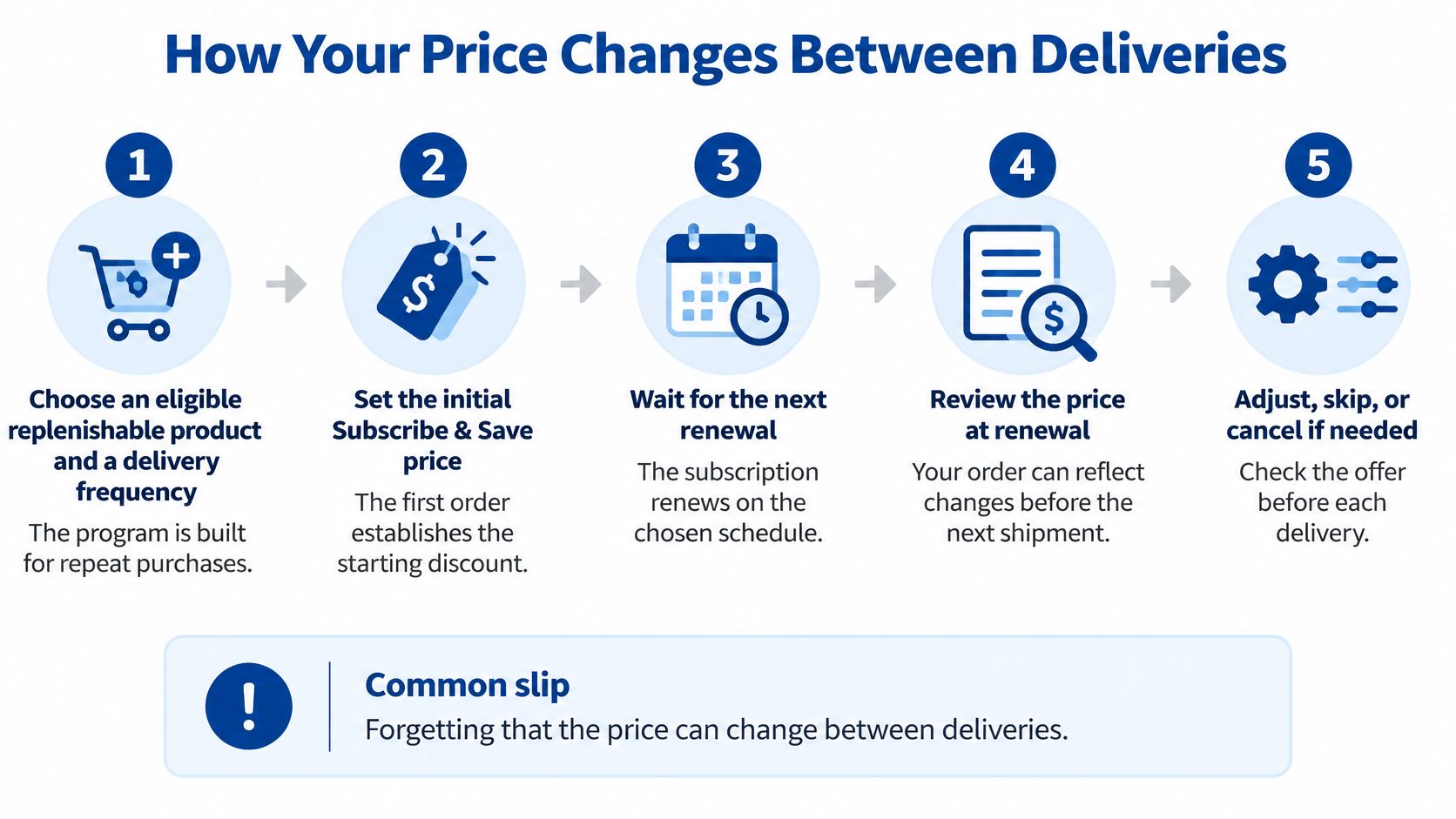
A subscription is a repeat-order arrangement, not a lifetime price guarantee. Amazon applies the discount to the item price when each order is placed, and both the item price and the discount may change before a future delivery. Amazon's customer terms say an order that has already shipped keeps the discount shown when it was processed, but that past price doesn't lock in the next one.
Follow the renewal, not just the signup
- Choose an eligible replenishable product and delivery frequency. The program is built for repeat purchases, so choose an interval that matches how quickly you use the product. The common slip is to sign up because the first price looks good without considering whether the delivery schedule makes sense.
- The first order starts the relationship, not a fixed-price contract. Amazon applies the discount to the product price at the time each order is placed. Don't assume the initial Subscribe & Save price remains in place for the life of the subscription.
- Check each upcoming order as its own price decision. Amazon can change the applicable price and discount between deliveries. The badge is a snapshot of the current offer, not a guarantee that the future order will use the same list price or percentage.
- Separate shipped orders from future ones. An order that has already shipped retains the discount used when it was processed. That's useful for understanding a completed purchase, but it doesn't predict the next bill.
- Adjust before the next order if the offer stops working. Shoppers can skip a delivery, change the frequency, or cancel. The slip is missing the chance to review the upcoming price and letting a renewal proceed without checking whether it still beats alternatives.
The operating habit is simple: compare the upcoming Subscribe & Save price with the item's recent one-time prices, set a reminder a few days before each shipment, and skip or cancel if the recurring price no longer offers good value. For essentials, supplements, and pet products, that quick check helps catch price drift before it turns a convenient reorder into an unnecessarily expensive one.
Brands should apply the same discipline to customer retention. A larger displayed discount might help win a first subscription, but unpredictable price changes can erode trust and encourage cancellations. Build pricing and renewal assumptions into product detail pages, promotional calendars, and profitability models. Don't treat the subscriber's first order as evidence that later orders will have the same effective price.
For teams monitoring Amazon's price movements, this guide to Amazon dynamic pricing provides relevant context for interpreting price changes rather than assuming the original offer will persist.
The shared monthly check is to ask, “What will I pay on the next delivery date?” Shoppers should inspect the upcoming order before it processes; brands should judge program performance using effective delivered price and reorder retention, not the badge percentage alone.
Brand Margin Math Behind Subscribe & Save
A Subscribe & Save order still carries ordinary selling and fulfillment costs. The table separates the discount funded by the brand from costs that continue under the usual fee structure.
| Cost component | Who funds it | How it is set | Effect on brand margin |
|---|---|---|---|
| Seller-funded discount | Brand | Tier of 0%, 5%, 10%, 15% or 20% | Direct cut to contribution on every order |
| Amazon tier discount | Amazon | 5% when five or more enrolled items arrive on the same day | No brand cost from this line |
| Standard selling fees | Brand | Category referral rate | Unchanged by enrollment |
| Fulfillment by Amazon costs | Brand | Standard FBA rates | Unchanged by enrollment |
| Subscribe & Save program fee | None | Not charged | No added cost to model |
| Advertising spend | Brand | Your PPC budget | Measure against cohort margin, not attributed sales |
Amazon says sellers pay standard selling fees and normal FBA costs, with no separate Subscribe & Save program fee, as described on Amazon's program page. That makes the economic question the discount and retention tradeoff, not whether a separate program charge is hidden in the fee stack.
Walk the calculation in order. Start with the item's list price, subtract the seller-funded discount, then subtract the referral fee and FBA fulfillment cost. Next subtract advertising cost per new subscriber and expected returns. Finally, add the expected value of repeat orders over the subscriber's first six months. The result is a more useful view of acquisition economics than subscription revenue alone.
For a $40 item at a 10% seller tier, the first subtraction is visible: $40 minus $4 equals $36 before fees. Subtract the item's actual referral fee and FBA cost, then the advertising cost required to acquire a subscriber and the expected return cost. The margin left depends on the product's fee structure and ad cost per subscriber, so don't present $36 as the brand's net proceeds.
A subscriber who reorders several times may justify a discount that looks expensive on the first order. That's the case to test, not assume: compare subscriber and one-time-buyer cohorts, and include repeat purchase behavior in the contribution calculation. Use a consistent method for the per-unit math with this guide to calculating profit per unit.
Build a cohort-level margin model that compares subscribers with one-time buyers. Don't approve a tier based on the first order alone.
Using PPC to Win Subscribers Without Overpaying
In 2024, 23% of U.S. Amazon customers had an active Subscribe & Save order, according to CIRP data cited by My Amazon Guy. That's a meaningful audience to test against, but scale should follow profitable repeat behavior, not reach alone.
| Offer or lever | Job it does | Control | Metric and decision rule |
|---|---|---|---|
| 5% seller-funded discount | Lifts subscription conversion | Same product at list price | Subscription conversion rate; scale only if the lift covers the discount cost |
| 20% first-time, then 10% standard | Closes the first order and builds repeat purchase | Single 10% offer | Payback from repeat orders; scale only if the first-order discount is recovered within one replenishment cycle |
| Sponsored Products plus first-time coupon | Captures high-intent shoppers | Sponsored Products alone | Cost per new subscriber; scale while contribution stays positive |
Amazon advertising guidance cites Envision Horizons research claiming that a 5% seller-funded discount can double subscription conversion rates. The same guidance says a 20% first-time subscriber discount followed by a standard 10% subscription discount has produced optimal results in many cases. These are directional findings, not universal benchmarks; category, price, replenishment frequency, and baseline conversion all affect the outcome. Amazon's advertising guidance also recommends Sponsored Products to reach high-intent shoppers and a Subscribe & Save first-time purchase coupon to help close the initial order.
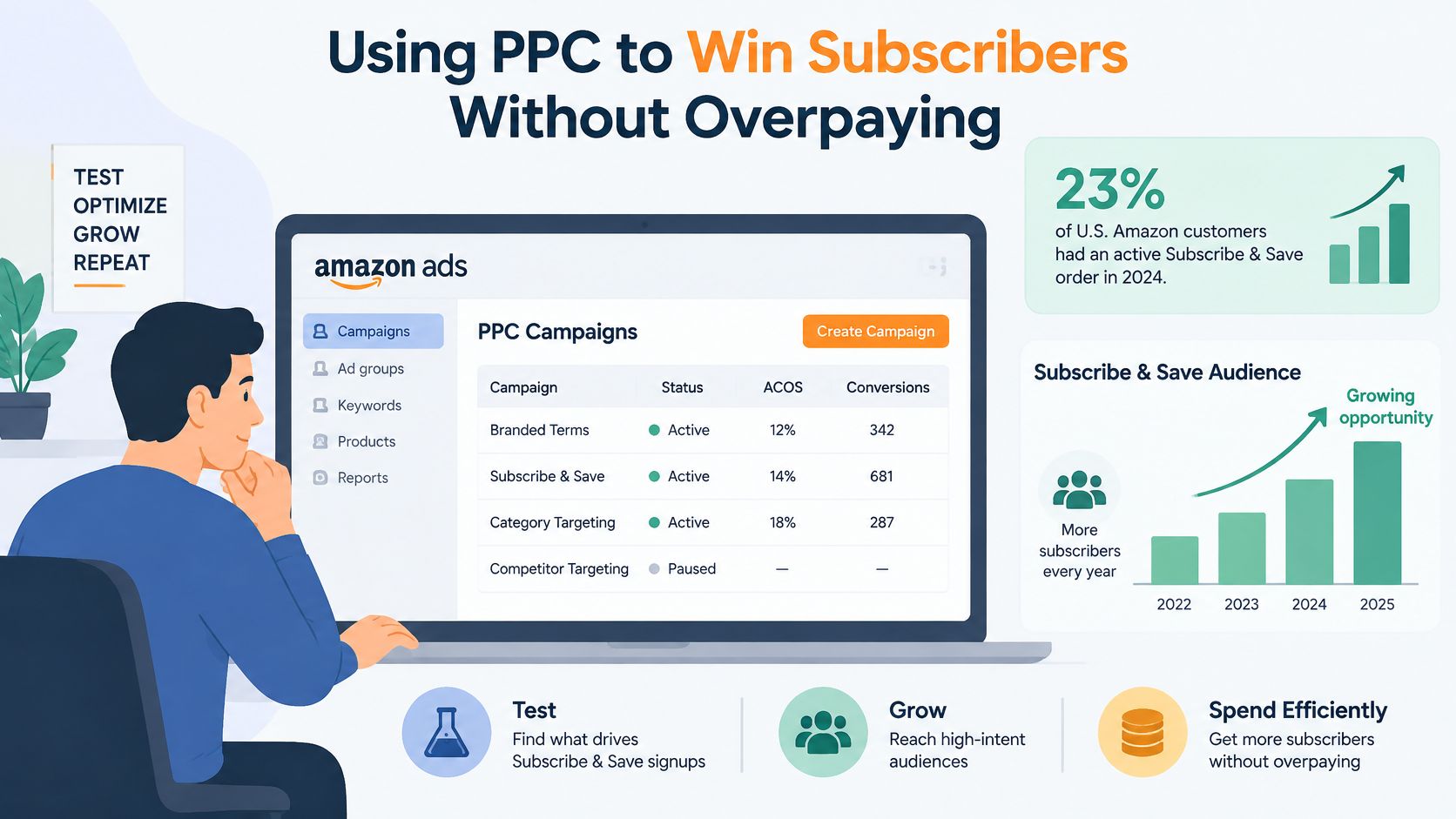
Read each decision rule against the control. A conversion lift isn't enough if the extra seller-funded discount eats the contribution it creates. A first-order promotion isn't a success if repeat orders don't recover the cost. And Sponsored Products shouldn't scale just because the coupon increases order volume.
Headline's approach to Amazon advertising focuses on contribution margin optimization and profit-based bidding. For a practical framework on how bids affect campaign economics, see this guide to Amazon bidding. Teams evaluating campaign automation can also explore AI-powered e-commerce campaign management, while keeping human review focused on margin and customer quality.
PPC can contribute to organic growth by bringing qualified shoppers to a product and supporting sustained sales velocity. Treat improved organic ranking as a hypothesis to test, not a guaranteed result. Track subscriber acquisition, contribution, repeat orders, and organic performance separately so you can see whether paid activity is creating durable value.
Run each test against its control for at least one full replenishment cycle before deciding. Scale only when incremental subscribers pay back through repeat orders at an acceptable contribution margin.
Confirm Your Subscribe & Save Tier Before You Launch
Use a decision sequence that connects the customer offer to the economics you can measure:
- Choose products with predictable replenishment cycles. Repeat-use products give the subscription a practical role in the customer's routine and make renewal behavior easier to assess.
- Model net contribution at each seller tier. Include the seller-funded discount, referral and fulfillment costs, advertising, returns, and the repeat-order assumptions that matter to your business.
- Test PPC against a control. Use the offer comparisons above and wait through at least one full replenishment cycle before calling a test.
- Pick the lowest tier that improves adoption without breaking payback. A larger discount should earn its place through profitable subscriber growth, not merely a higher conversion rate.
- Review delivered price and cancellations by cohort. Track whether the customer's renewal offer remains competitive and whether subscribers continue ordering.
The recommendation is direct: scale a tier only when contribution margin holds across cohorts, not when the headline discount looks strong. Headline Marketing Agency is a Certified Amazon advertising partner, and its listed services include Amazon PPC, Amazon DSP, Amazon AMC, and Analytics & Insights. The complimentary Amazon advertising audit, also called the Free Audit, is a practical next step for connecting campaign results with subscription economics.
Request the Free Audit with your current Subscribe & Save enrollment data and cohort margin figures.
Headline Marketing Agency helps consumer brands connect Amazon advertising performance to profitability, organic growth, and sustainable scale. Bring your Subscribe & Save enrollment data and cohort margins to Headline Marketing Agency to assess whether your PPC and discount strategy is building profitable repeat demand.
Get Your Free Amazon PPC Audit
Discover untapped growth opportunities and see how our data-driven approach can improve your ROAS.
Get Free Audit →Wollen Sie Ihre Amazon PPC-Performance aufs nächste Level bringen?
Lassen Sie Ihre Amazon PPC-Kampagnen professionell analysieren und entdecken Sie neue Wachstumsmöglichkeiten.