Amazon PPC Not Working? Diagnose and Fix It Fast
Amazon PPC not working? Learn a data-backed diagnostic flow to separate traffic failures from conversion failures, with prioritized fixes and metrics

“Amazon PPC isn't working” is usually the wrong diagnosis. The popular response is to lower bids, add negative keywords, and tighten match types. Those changes can reduce waste, but they won't rescue a product page that fails to convert, an offer that loses the comparison, or a campaign aimed at the wrong search intent.
The useful question is simpler: are you failing to generate qualified traffic, or are shoppers arriving and refusing to buy? That fork determines what to fix, what to pause, and what to measure next.
Why Your Amazon PPC Feels Broken When the Channel Isn't
Amazon Sponsored Products isn't showing signs of a channel-wide collapse. Tinuiti's 2025 to 2026 benchmark reporting shows Sponsored Products clicks rising 23% year over year in Q4 2025, while average CPC fell 1% year over year. The same report says pricing declined in four of the last five quarters.
That combination matters. More clicks and lower average CPCs suggest that the marketplace is still generating demand and auctions aren't uniformly becoming less efficient. If one account is spending without producing profitable sales, the more likely explanation sits inside the account, the offer, the product detail page, or the way performance is being interpreted.
Stop treating every problem as a bid problem
Bids control access to auctions. They don't create relevance, improve an image, clarify a product benefit, repair a broken variation, or make an uncompetitive price acceptable. A higher bid can buy more exposure to the same weak experience, which increases the speed of loss rather than fixing the underlying constraint.
The first audit should therefore separate traffic failure from conversion failure. Traffic failure means the campaign isn't earning enough relevant impressions or clicks. Conversion failure means shoppers click, inspect the detail page, and leave without purchasing. Some accounts have both, but many teams still try to solve both with the same bid adjustments.
Practical rule: Never increase spend until you know whether the account needs more qualified visits or a better reason to buy.
Amazon's own reporting defines CTR as clicks divided by impressions. That makes CTR a useful first signal, not a complete verdict. A weak CTR can indicate poor targeting, weak creative, an unclear value proposition, or placement beside more compelling alternatives. A strong CTR paired with weak sales points to a different bottleneck entirely.
Use the account as a diagnostic system
Query-level data is more useful than an account-wide ACOS average because it shows where the failure occurs. Review the actual customer search term, impressions, clicks, spend, attributed sales, and conversion behavior for each meaningful query. Then compare those queries with the product's price, reviews, images, title, variation structure, and inventory position.
The fix sequence should follow the constraint. Repair retail readiness before scaling traffic. Refine targeting when the product converts but the ads attract too little qualified demand. Test creative when the offer is sound but the ad fails to earn attention. Treat Amazon PPC as a lever for organic growth, profitability, and sustainable scale, not as an isolated media expense.
Traffic Failure or Conversion Failure
Start with the impression-to-sale path:
Impressions → clicks → detail-page visits → orders
Each transition has a different owner and a different remedy. Impressions depend on eligibility, relevance, bids, budget, and placement. Clicks depend on query alignment and ad resonance. Orders depend on the detail page, offer, price, trust, availability, and product-market fit.
One benchmark source reports a 2024 average Sponsored Products CTR of 0.42%, while another 2026 benchmark places Sponsored Products around 0.6% to 0.9% across marketplace verticals. A sub-1% CTR means small targeting or creative mistakes can drain spend quickly because most impressions never become clicks.
The traffic failure test
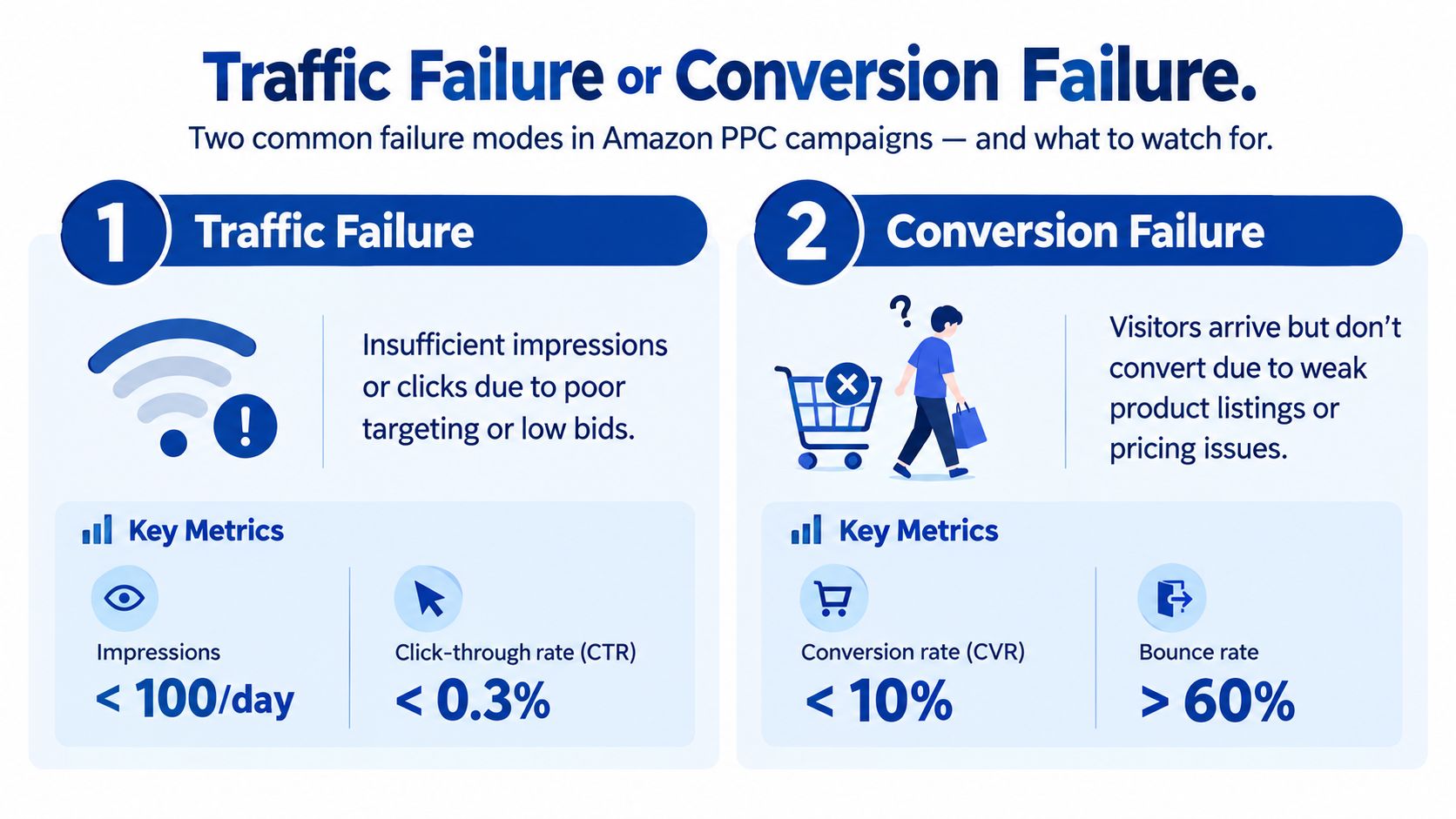
Traffic failure is likely when relevant queries receive limited impressions, clicks remain scarce, or CTR is consistently weak. Low impressions can come from conservative bids, insufficient budget, poor relevance, weak indexing, unsuitable products, or placement decisions that keep the campaign out of meaningful auctions.
A low CTR doesn't automatically mean the bid is too low. If the ad is visible but shoppers ignore it, bidding harder may buy more ignored impressions. Review the query itself, the product shown, the main image, price position, review context, and whether the ad promises something relevant to that search.
The conversion failure test
Conversion failure is likely when the campaign earns qualified clicks but sales remain weak. In that case, the campaign may be doing its job by delivering shoppers. The detail page isn't completing the job.
Look for mismatches between the search term and the landing experience. A query may promise a specific size, use case, ingredient, compatibility, or pack configuration while the listing leaves that information unclear. Price, shipping, coupons, stock status, review quality, and variation selection can also stop a shopper who was interested enough to click.
| Symptom | Failure Mode | First Fix |
|---|---|---|
| Few relevant impressions | Traffic failure | Check eligibility, indexing, bids, budgets, and product selection |
| Impressions but weak CTR | Traffic failure | Review query intent, main image, price position, and ad relevance |
| Clicks with little or no sales | Conversion failure | Audit the detail page, offer, reviews, availability, and query fit |
| Strong branded sales but weak non-branded sales | Mixed | Separate brand defense from discovery and review generic queries |
| Spend concentrated in irrelevant terms | Traffic failure | Add query-level negatives and restructure targeting |
| Sales occur only on a narrow group of queries | Mixed | Isolate converting queries and reduce exposure to weak intent |
Make the decision before changing settings
Export the search-term data and classify queries into three groups: relevant converters, relevant non-converters, and irrelevant traffic. The first group deserves controlled expansion. The second needs a product-page or offer investigation before more spend. The third needs isolation, negation, or removal.
This approach prevents a common mistake: treating every click as evidence that bids should change. Clicks prove interest, not purchase intent. Your next action should follow the stage where shoppers stop progressing.
Fix the Listing Before You Touch the Campaigns
A weak listing can make competent PPC look incompetent. Ads send shoppers to the detail page, but the page must answer the buying questions immediately: what is the product, who is it for, why is it different, what does the package include, and can the shopper trust the offer?
Audit the page in the order a shopper experiences it.
- Main image: Confirm that the product is clear at thumbnail size and that the visual communicates the category without forcing interpretation.
- Title and bullets: Match the language customers use, but prioritize clarity over awkward keyword repetition. State use cases, compatibility, size, quantity, and material where they affect the purchase decision.
- Image sequence: Use supporting images to explain dimensions, setup, ingredients, use cases, comparison points, and what arrives in the box.
- Offer clarity: Check price, coupon presentation, fulfillment, delivery promise, variations, and stock status together. A technically available product can still feel risky when the offer is confusing.
- Proof: Review ratings, review themes, questions, and recurring objections. Your copy should address the concerns shoppers repeatedly raise.
- Catalog health: Check variations, browse placement, product type, suppressed content, and retail-readiness warnings.
Let PPC amplify products with evidence behind them
Amazon's own product recommendations can help prioritize spend. Amazon's Sponsored Products guidance says suggested products are 321 times more likely to generate ad-attributed sales when advertised than products that aren't suggested. That doesn't mean every suggested product will be profitable, but it does signal that Amazon already sees some product-level readiness or relevance.
Use that signal alongside conversion data, not instead of it. If an item has weak detail-page engagement, an unclear offer, or poor availability, reduce exposure while the retail issue is repaired. Redirecting budget toward products that already convert protects cash flow and creates cleaner evidence about campaign quality.
A practical listing audit should end with a written decision:
- Scale: The page, offer, and product experience support more qualified traffic.
- Repair: Keep testing only where query intent is strong, but fix the page before adding budget.
- Pause or contain: The product cannot currently convert well enough to justify broad discovery spend.
For a deeper page-level review, use Headline's guide to optimizing Amazon listings alongside the campaign audit.
If the product page is ready, creative can still determine whether the campaign earns attention:
Campaign Fixes for Targeting, Bids, and Creative
Once the product can convert, campaign changes become more valuable. The priority isn't to rebuild every campaign at once. It's to make the account reveal which queries, placements, and creative assets deserve investment.
Start with search intent
Separate discovery from control. Auto and broad campaigns can uncover language and adjacent demand, but they need close query review. Exact campaigns should concentrate proven, commercially relevant searches. Product targeting should distinguish direct substitutes, complementary products, and placements where the price or positioning makes the offer credible.
A common waste pattern is one campaign combining auto targeting, broad discovery, exact terms, brand defense, and different profitability goals. That structure produces an average that hides the reason a term is receiving budget. Separate campaigns by objective so ranking, discovery, revenue efficiency, and brand protection don't compete for the same control settings.
Use the search-term report to decide what belongs where:
- Relevant converters: Move into controlled exact targeting when the query deserves dedicated budget.
- Relevant non-converters: Keep under observation only if the detail page and offer are credible for that intent.
- Irrelevant queries: Negate at the right level to prevent repeated waste.
- Brand terms: Isolate them so branded demand doesn't make discovery campaigns look healthier than they are.
- Product targets: Split close competitors from broad category placements because they carry different shopper expectations.
Adjust bids after the structure is clean
A bid should reflect the value of a click, not Amazon's suggestion alone. Consider contribution margin, conversion behavior, query intent, placement, and the campaign objective. A ranking campaign may tolerate a different efficiency profile from a mature harvest campaign, but those purposes should be visible in reporting.
Don't lower every bid after one poor day. Don't raise every bid because impressions are low. Change the specific control connected to the observed failure, then watch whether impressions, CTR, CPC, conversion, and sales move in the expected direction.
Test creative before buying more exposure
Creative is often the fastest overlooked lever. Amazon states that Sponsored Products campaigns using video delivered 67% higher CTR and 9% higher conversion rate than campaigns without video. The result doesn't guarantee the same outcome for every brand, but it supports testing video when the listing and targeting are sound yet attention or post-click performance remains weak.
Build video around the buying decision, not a generic brand montage. Show the product in use, demonstrate the problem it solves, make the primary benefit legible without sound, and connect the opening frame to the search intent. Test one meaningful change at a time so a stronger result has an identifiable cause.
For a campaign-side checklist, use these Amazon Sponsored Ads tips from Headline. The useful standard is not more settings. It's a cleaner relationship between query, product, offer, and objective.
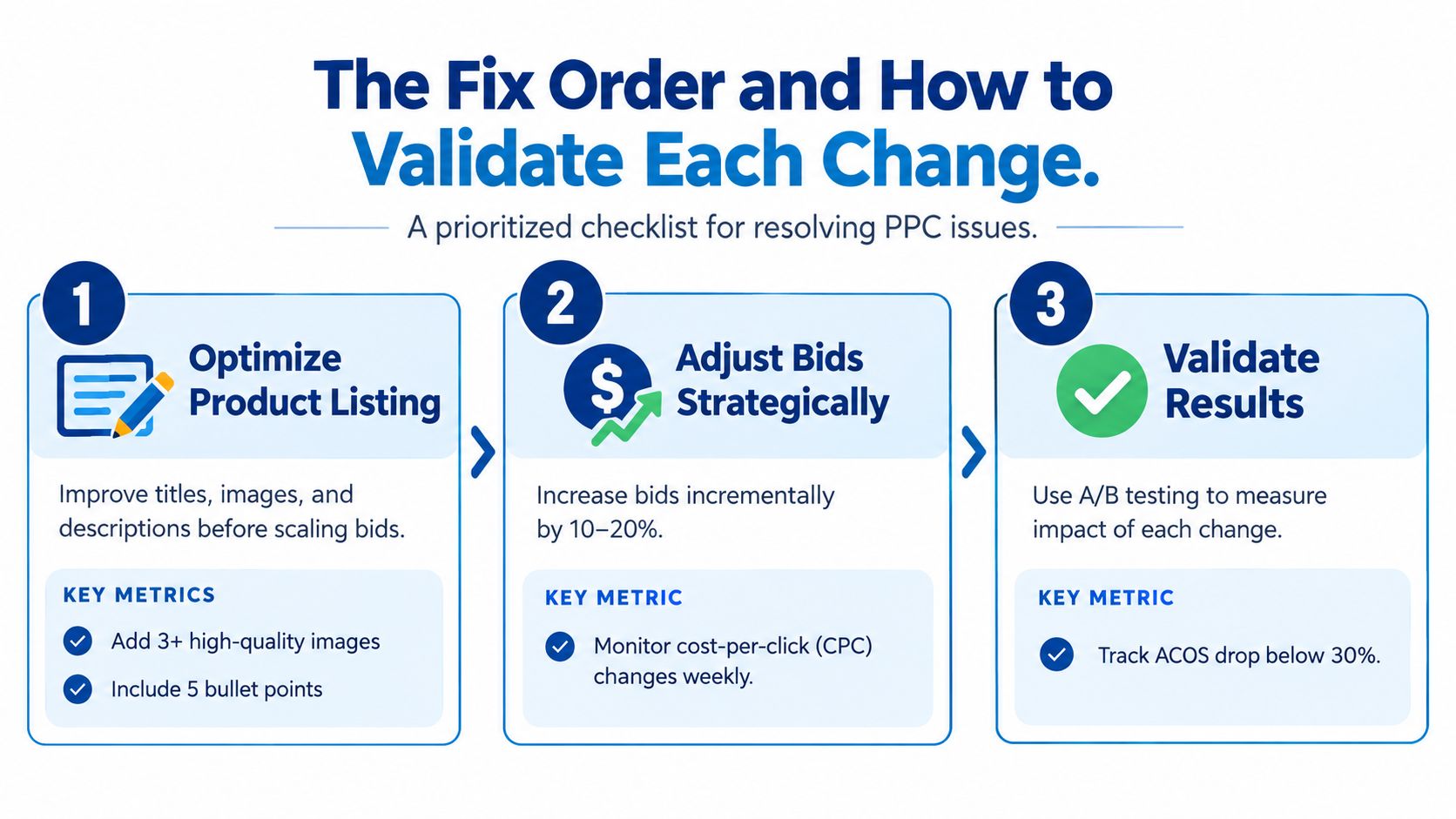
The Fix Order and How to Validate Each Change
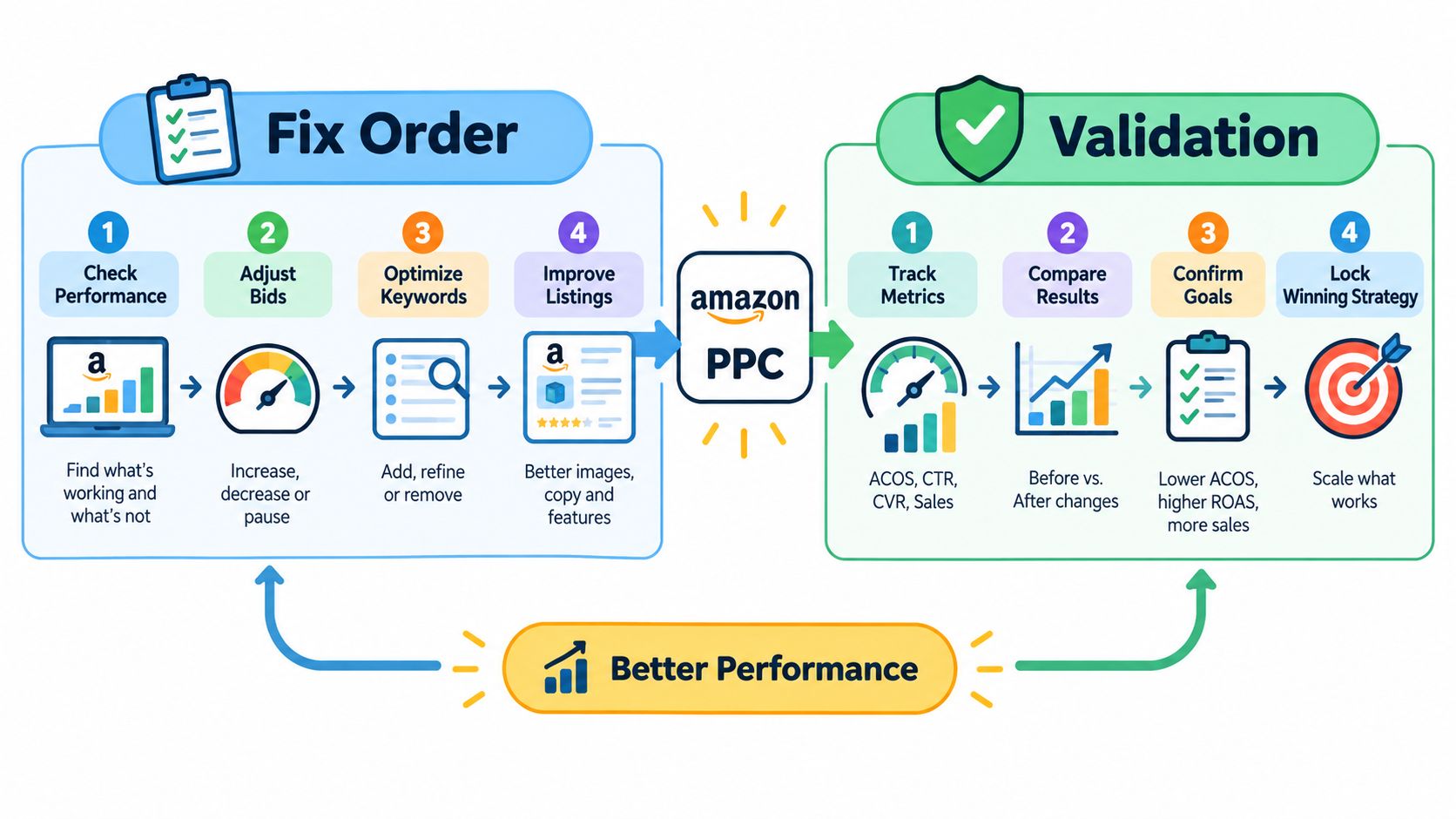
Fix order matters because every later decision depends on the earlier one. Scaling bids before repairing conversion creates expensive noise. Rebuilding targeting before confirming the product can win the click creates a cleaner route to the same poor outcome.
Use this sequence:
- Confirm retail readiness. Check inventory, buyability, variations, price, fulfillment, images, copy, and offer clarity. If the product experience is broken, contain spend while fixing it.
- Classify query behavior. Separate relevant converters, relevant non-converters, and irrelevant traffic. Record the decision for each important query.
- Align campaign objectives. Isolate discovery, exact control, brand defense, product targeting, and any deliberate ranking activity.
- Refine bids and budgets. Apply changes to the campaigns or targets that support the diagnosis. Preserve control over where incremental spend goes.
- Test creative. Use video or a stronger image-led message when CTR or conversion remains weak after relevance and retail readiness are addressed.
- Validate against the original failure. A traffic fix should improve qualified impressions or clicks. A conversion fix should improve orders from relevant traffic. Don't call a change successful because total spend increased.
Amazon's research illustrates why execution deserves scrutiny before the format gets blamed. In research covering 200,000 Sponsored Products campaigns, the best-performing China-based sellers had 4.6x higher ROAS, 3.7x higher CVR, and 3.2x higher CTR than the weakest group, according to Amazon's campaign research. The gap points to inputs and execution, including selection, structure, listing quality, and creative, rather than a single universal PPC outcome.
Build a test that can fail
Before changing a campaign, write down:
- The diagnosed constraint: For example, weak CTR on relevant non-branded searches.
- The exact intervention: A new video, tighter query segmentation, or a product-page revision.
- The expected signal: Higher qualified CTR, stronger conversion, fewer irrelevant clicks, or improved contribution.
- The guardrail: A spend limit, inventory condition, or profitability boundary.
- The review point: A defined period after enough relevant traffic has accumulated, not an emotional reaction to a single day.
Read results at query level and compare similar targets, placements, products, and periods. Keep a change log. If you alter bids, listing copy, price, budget, and creative together, you may improve performance, but you won't know which action worked or whether one change offset another.
The practical rhythm is straightforward. Diagnose first, make the smallest high-impact change, observe the relevant metric, then either expand, revise, or reverse it. Testing is not slower than random optimization. It is how you stop paying for assumptions.
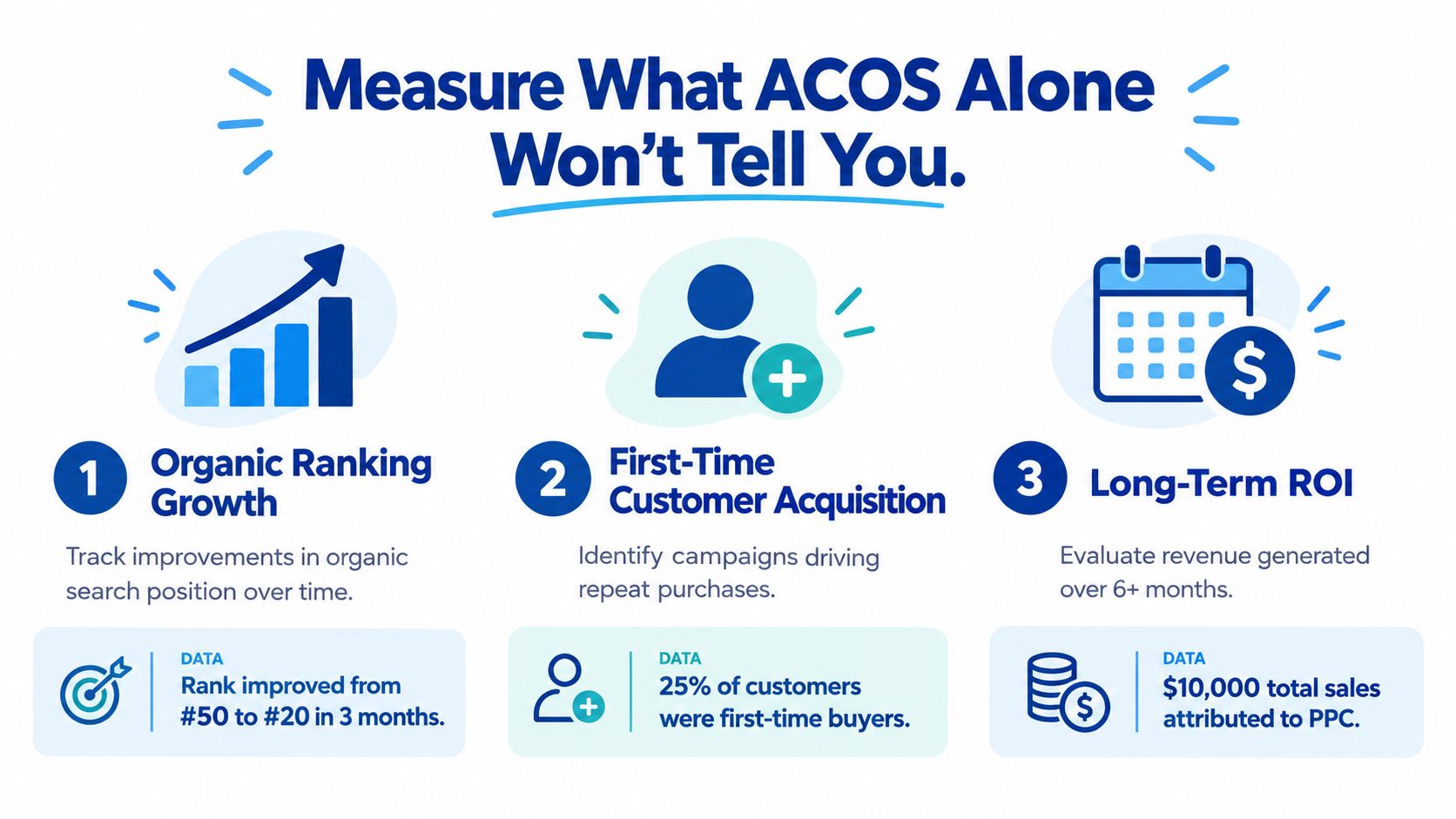
Measure What ACOS Alone Won't Tell You
ACOS is useful, but it answers a narrow question: how much ad-attributed revenue did spend generate? It doesn't tell you whether the campaign acquired a new customer, supported organic visibility, protected branded demand, influenced a later purchase, or produced acceptable contribution after product and fulfillment costs.
Senior teams should pair ACOS with a broader commercial view. Track contribution margin after advertising, total sales, organic sales movement, branded and non-branded mix, new-to-brand share, repeat behavior where available, and the query groups responsible for growth. The right metric depends on the campaign objective. A defense campaign, discovery campaign, ranking initiative, and acquisition campaign shouldn't all be judged by the same last-click target.
Treat acquisition as a business outcome
Sponsored Brands can contribute beyond immediate conversion. Amazon Ads reports that advertisers using all Sponsored Brands ad formats saw 79% of their sales from new-to-brand customers on average. That makes new-to-brand share a meaningful lens for evaluating acquisition, especially when a campaign is designed to introduce the brand to shoppers rather than harvest existing demand.
Read that metric with caution. New-to-brand sales don't automatically prove incremental profit, and they don't replace contribution analysis. They do reveal customer composition that a basic ACOS view can hide.
Connect paid activity to organic growth
PPC can support organic growth when it sends qualified demand to a relevant, compelling product and the resulting sales strengthen the product's ability to compete. That relationship isn't automatic. Poor targeting can generate clicks without useful commercial signals, while a weak listing can waste both paid traffic and the opportunity to convert organic shoppers.
Use query-level reporting to connect paid activity with organic movement. Look for changes in organic visibility for the terms you deliberately support, then compare that movement with total sales, contribution, and the quality of the acquired traffic. Headline's advertising performance metrics guide provides a useful framework for moving beyond a single efficiency ratio.
The central decision: Don't ask whether Amazon PPC works in general. Ask which search terms, products, offers, and campaign objectives create profitable incremental growth.
If your team can't separate traffic failure from conversion failure, start with an account and retail-readiness audit before changing bids. Brands that need deeper execution can use Headline Marketing Agency for Amazon PPC and DSP strategy, query-level analysis, campaign management, and listing-led performance testing.
Headline Marketing Agency helps consumer brands diagnose Amazon PPC problems, improve retail readiness, and connect advertising decisions to profitability and organic growth. Visit Headline Marketing Agency to request a focused assessment of your campaigns, listings, and measurement approach.
Get Your Free Amazon PPC Audit
Discover untapped growth opportunities and see how our data-driven approach can improve your ROAS.
Get Free Audit →Wollen Sie Ihre Amazon PPC-Performance aufs nächste Level bringen?
Lassen Sie Ihre Amazon PPC-Kampagnen professionell analysieren und entdecken Sie neue Wachstumsmöglichkeiten.